
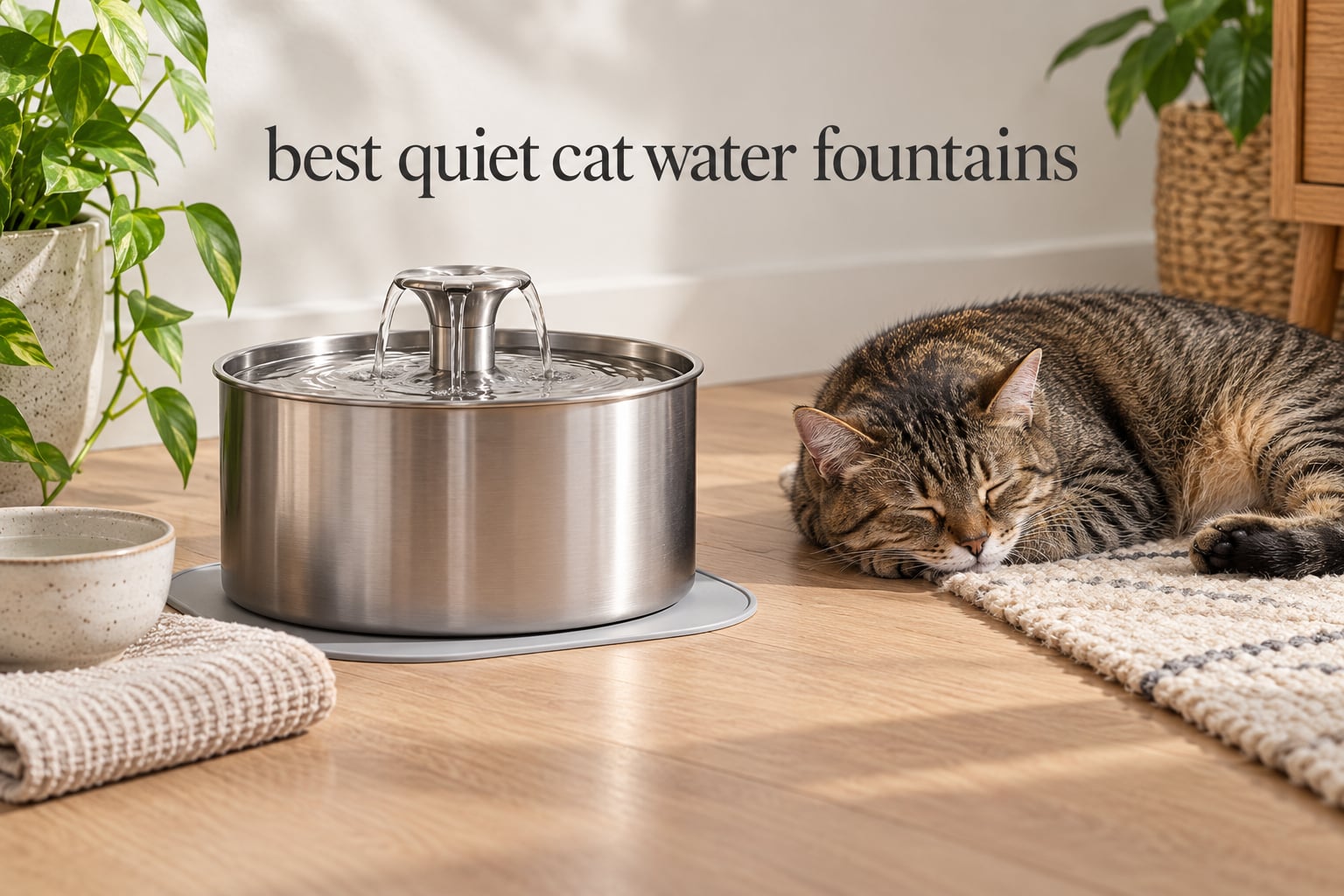
Most people buying the best quiet cat water fountains are not really shopping for a fountain at all. They are trying to solve a noise problem. A cat fountain that hums, gurgles or splashes hard enough to hear from the next room gets unplugged inside a month, and a fountain that sits unplugged in a closet does not help the cat drink more, support urinary health, or give the owner any peace at all.
So we treated noise as the first and last question for every fountain in this guide. Not the decibel number printed on the side of the box, but the three sounds that actually reach your ears in a real apartment: motor hum from the pump, splash from water hitting the drinking surface, and vibration conducted through the base into your floor. Two fountains can share the same printed figure and behave nothing alike in a living room, because the housing, the spout and the water level are doing as much work as the pump.
We ran all twelve fountains here through the same filter. Is the motor type known? Does water free-fall or slide back into the reservoir? Is the body dense metal or hollow plastic that rings like a drum? How do long-term owners describe the noise after three months, when scale and biofilm have had time to build? We also flag the units where owners report the noise getting worse over time, because a quiet day-one fountain that turns into a grinding pump by month four is not a quiet fountain.
If you are starting from scratch rather than replacing a loud unit, our broader pet water fountain roundup for cats covers capacity, filtration and cat appeal in more depth. This one is built around acoustics first, updated for 2026.
Table of Contents
What Actually Makes a Cat Water Fountain Loud
A cat water fountain makes sound from three separate sources, and most owners only ever diagnose the first one. The three sources are motor hum inside the housing, splash where water lands, and vibration conducted out through the base into whatever surface it sits on. Fixing the pump does nothing for splash, and putting a mat under the base does nothing for splash.
Motor hum comes from the pump itself and from the way the housing responds to it. A hollow plastic tank acts like an acoustic drum: the pump’s vibration sets the thin walls ringing, and the hum you hear is louder than the motor ever was on its own. Dense 304 stainless steel and glazed ceramic absorb that energy instead of amplifying it, which is why the metal and ceramic fountains in this guide tend to sound denser and lower at the same pump wattage. Put your palm flat on the side of a fountain while it runs. If the wall feels like it is buzzing, the housing is amplifying the pump, and no filter change will fix it.
Splash is the second source and the one people misattribute to the motor. An open-drop spout lets water fall through air before it hits the tray, and falling water is surprisingly loud. A ramped, bubbler-style or wall-hugger spout keeps water in contact with the surface, so it sheets back down instead of crashing. This is why two fountains with identical pumps can be separated by an obvious margin: the loud one has a lip, the quiet one has a ramp.
Floor vibration is the third source and the one that matters most in apartments and bedrooms. A pump bolted to a rigid base on hardwood or tile transmits every cycle into the joists below. Carpet, a silicone mat or a neoprene pad breaks that path. A wired pump adds a fourth, subtler path: the power cable itself can conduct vibration from the pump into the housing, which is one reason cordless pumps tend to be genuinely quieter rather than merely more convenient.
The last thing worth knowing is that printed decibel figures rarely transfer to a home. They are measured with the unit running in a controlled setup at a stated distance, often with a smooth surface underneath and no cat stirring the water. We quote them below as manufacturer claims, not as our own measurements, and we tell you in every review which of the three noise sources dominates. A 40 dB fountain with a ramped spout on a mat can beat a 25 dB fountain with an open-drop spout on bare tile.
How We Judged Quietness in These Fountains
We want to be straight about the method: we did not use a sound meter, so we are not publishing invented decibel figures. What we did do is rank every fountain on directional noise, meaning whether it is near-silent, quiet, moderate or audible in a normal room, and then explain which of the three noise sources is responsible.
Each verdict came from four things. First, the pump architecture stated in the listing, including power draw and whether the design separates the pump from the tank. Second, the spout geometry, because open-drop spouts add splash and ramped or bubbler spouts do not. Third, the housing material, since thin plastic rings and dense steel or ceramic does not. Fourth, long-term owner reports, which are the only honest source on month-six noise and we weighted them heavily.
Where a manufacturer publishes a decibel figure, we repeat it as a manufacturer claim and note what it does and does not tell you. For a fuller look at how measurement conditions skew these numbers, our take on ultra-quiet appliance claims covers the same trap in a different category.
Top 3 Quietest Cat Water Fountains

Wonder Creature 81oz Stainless
- Dishwasher-safe stainless lid
- Quiet pump under 40 dB
- 81 oz tank with three carbon filters

Neareal 74oz Stainless 304
- 5V ultra-silent pump
- 28 dB or below claimed
- 2.2 L tank for about a week

Veken 95oz 5-Stage
- Ultra-quiet low-energy pump
- Flower waterfall and fountain modes
- 5-stage filtration
Two of our top three are stainless steel models with the quietest spouts and densest housings we found, and the third is the value pick most owners end up with anyway. The full ranking below runs from the most consistently quiet to the models where splash, hum or floor vibration is most likely to reach you.
All 12 Quiet Cat Water Fountains at a Glance
| Product | Specifications | Action |
|---|---|---|
| Wonder Creature 81oz/2.4L Stainless Lid Fountain |
|
Check Latest Price |
| Veken 95oz/2.8L C1 Classic Fountain |
|
Check Latest Price |
 PETKIT Eversweet Solo SE 65oz Wireless Pump PETKIT Eversweet Solo SE 65oz Wireless Pump |
|
Check Latest Price |
| Neareal 74oz/2.2L 304 Stainless Fountain |
|
Check Latest Price |
 BEMOONY 108oz/3.2L Super Silent Fountain BEMOONY 108oz/3.2L Super Silent Fountain |
|
Check Latest Price |
 iPettie Tritone Ceramic 71oz Fountain iPettie Tritone Ceramic 71oz Fountain |
|
Check Latest Price |
 PetSafe Seaside Stainless 60oz Fountain PetSafe Seaside Stainless 60oz Fountain |
|
Check Latest Price |
 Kastty 2.2L Super Quiet LED Fountain Kastty 2.2L Super Quiet LED Fountain |
|
Check Latest Price |
 FEELNEEDY Cordless 3.2L 4000mAh Fountain FEELNEEDY Cordless 3.2L 4000mAh Fountain |
|
Check Latest Price |
 PETLIBRO Stainless Steel 101oz/3L Fountain PETLIBRO Stainless Steel 101oz/3L Fountain |
|
Check Latest Price |
 AONBOY Stainless Steel 108oz/3.2L Fountain AONBOY Stainless Steel 108oz/3.2L Fountain |
|
Check Latest Price |
 MISFANS All-Ceramic 71oz Copper Spout Fountain MISFANS All-Ceramic 71oz Copper Spout Fountain |
|
Check Latest Price |
1. Wonder Creature 81oz Stainless Lid Fountain: The Best Quiet Cat Water Fountain Overall
Wonder Creature Cat Water Fountain Stainless Steel Lid 81oz/2.4L-3 Filters
- Dishwasher-safe stainless top resists chin acne
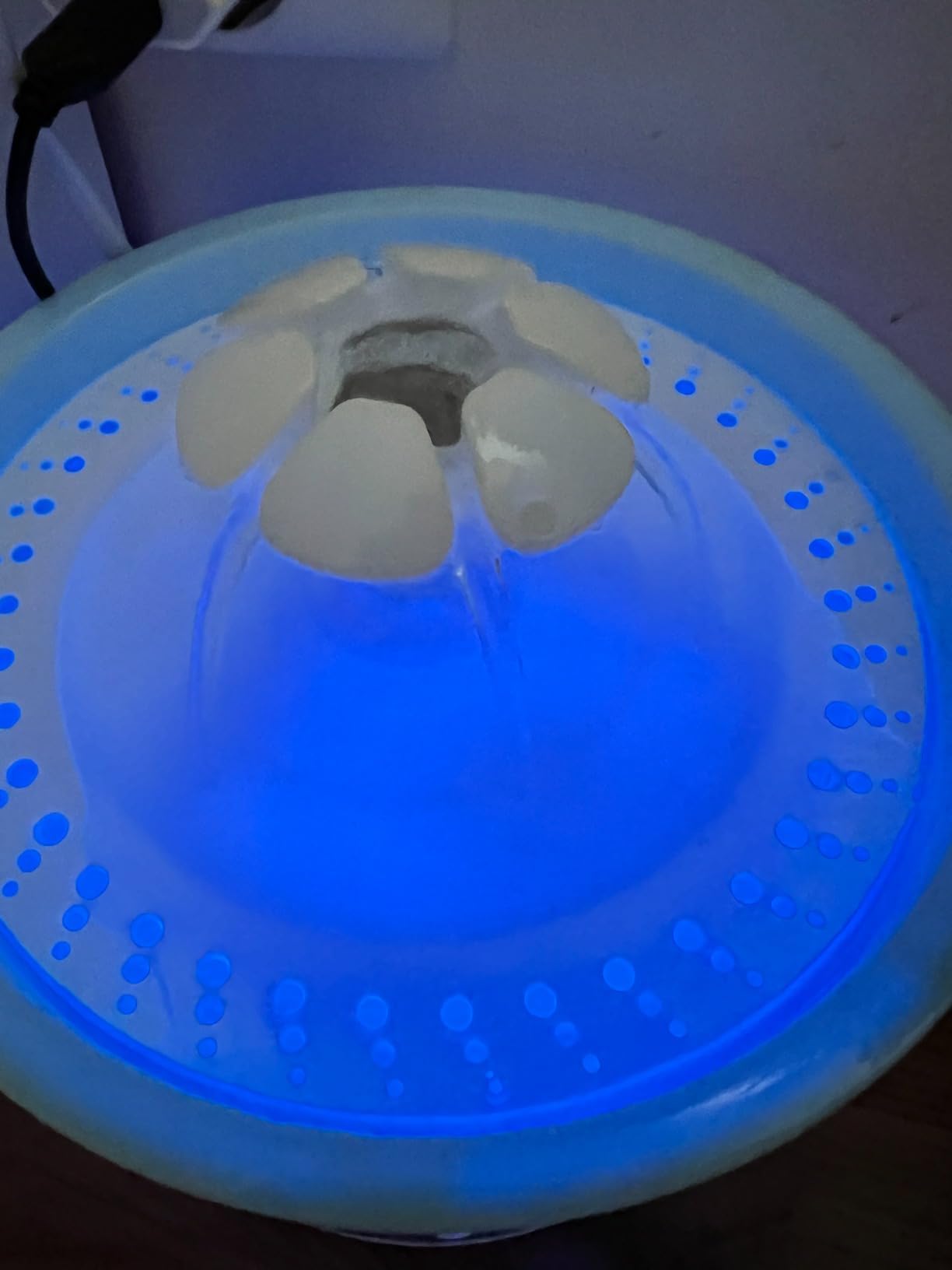
- Quiet low-voltage pump with LED
- Three carbon filters plus foam pre-filter included
- Three drinking modes with 360-degree streams
- Large review base for long-term noise reports
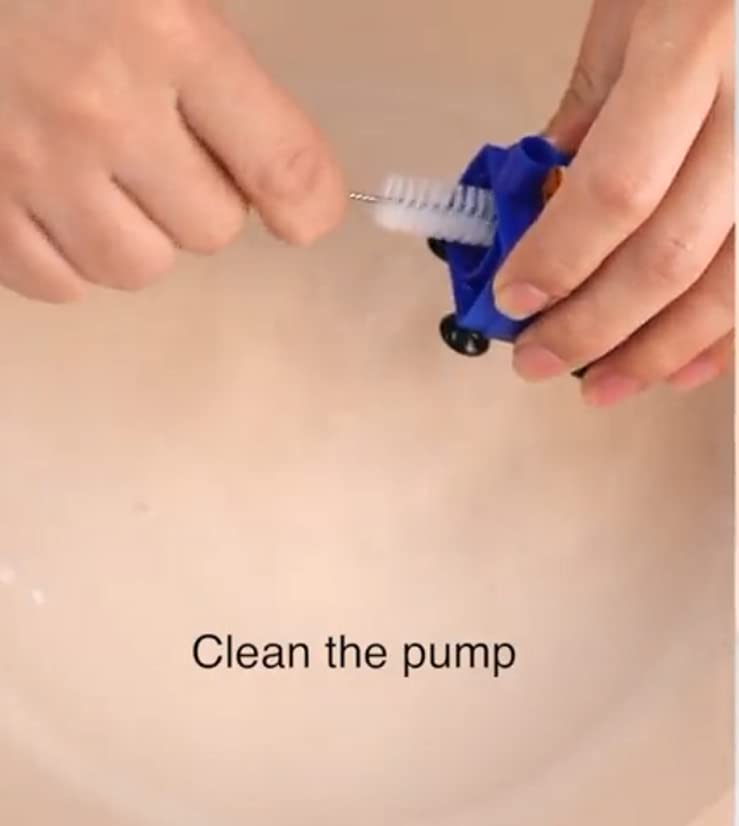
- Pump needs regular brush cleaning
- Stainless lid shows fingerprints
Noise verdict: quiet, and the splash is more controlled than its open-looking top suggests. The manufacturer rate for the pump is below 40 dB, which is the highest printed figure among our quietest picks, so what makes this one work in a real room is everything around the pump: a stainless steel lid instead of a thin plastic one, and a drinking surface that receives water rather than dropping it from height.
This is the unit we keep coming back to because it is the rare fountain where long-term owners still describe it as quiet after a year. Reviewers consistently mention a soft low-voltage hum and an LED that lights the water, not a rattle. The stainless lid is the part that matters acoustically, since it is the surface the pump vibration would otherwise set ringing.
Capacity is the other half of the appeal. At 81 oz or 2.4 L it covers a solo cat for several days without a refill, which matters because every top-up is a chance to lift a heavy unit and drop it badly. Three drinking modes with multi-directional streams also give a cat options, and owners report that cats who refused one flow mode often accept another.
The 2.4 L tank is not the largest we tested, but it is the sweet spot between refill frequency and the weight you have to carry to the sink. At 1.67 pounds this is one of the lighter units here, and the dishwasher-safe stainless lid and BPA-free body clean up without much disassembly.
Who this fountain suits
It suits owners who want quiet without paying a premium, and anyone whose cat has reacted badly to plastic. The stainless lid is the piece most likely to matter for chin acne, and reviewers note the surface stays clean better than plastic bowls.
It also suits nervous sleepers better than open-splash designs, because the water lands close to the surface instead of dropping into an empty basin. If your home runs on hardwood or tile, put a mat under it and the residual hum drops noticeably.
Where it falls short
The recurring maintenance note is pump upkeep. Owners who let the impeller go without cleaning report it getting noisier over time, which is exactly the month-six trajectory we were watching for. A weekly brush of the impeller keeps the original quiet profile intact.
It is also corded, so it needs to live near an outlet, and it is a poured stream design rather than a bubbler, so there is more water sound than a fountain built around a bubbling flow.
2. Neareal 74oz 304 Stainless Fountain: The Quietest Pump in the Lineup
Cat Water Fountain Stainless Steel: 74oz/2.2L Cat Fountain for Drinking
- Ultra-silent 5V pump
- 304 stainless steel takes high-temperature cleaning
- Quadruple filtration cuts odor
- Water level window avoids lifting the lid
- About seven days of water per fill
- Plastic body sections still present
- Some cats prefer a bubbler stream
Noise verdict: the quietest pump in this group, with splash held down by the top layout. The listing rate is 28 dB or below on a 5V pump, and unlike most printed figures on this list that number is at least plausible, because the pump is genuinely low-power and the 304 stainless body is not a resonance chamber.
What stands out is the combination of a stainless drinking surface and a very small pump. A 5V pump does not have the torque to make a loud splash, so the water arrives gently, and the stainless shell absorbs rather than amplifies whatever hum remains. Owners put it in the same category as the ceramic fountains for inaudibility in a quiet room.
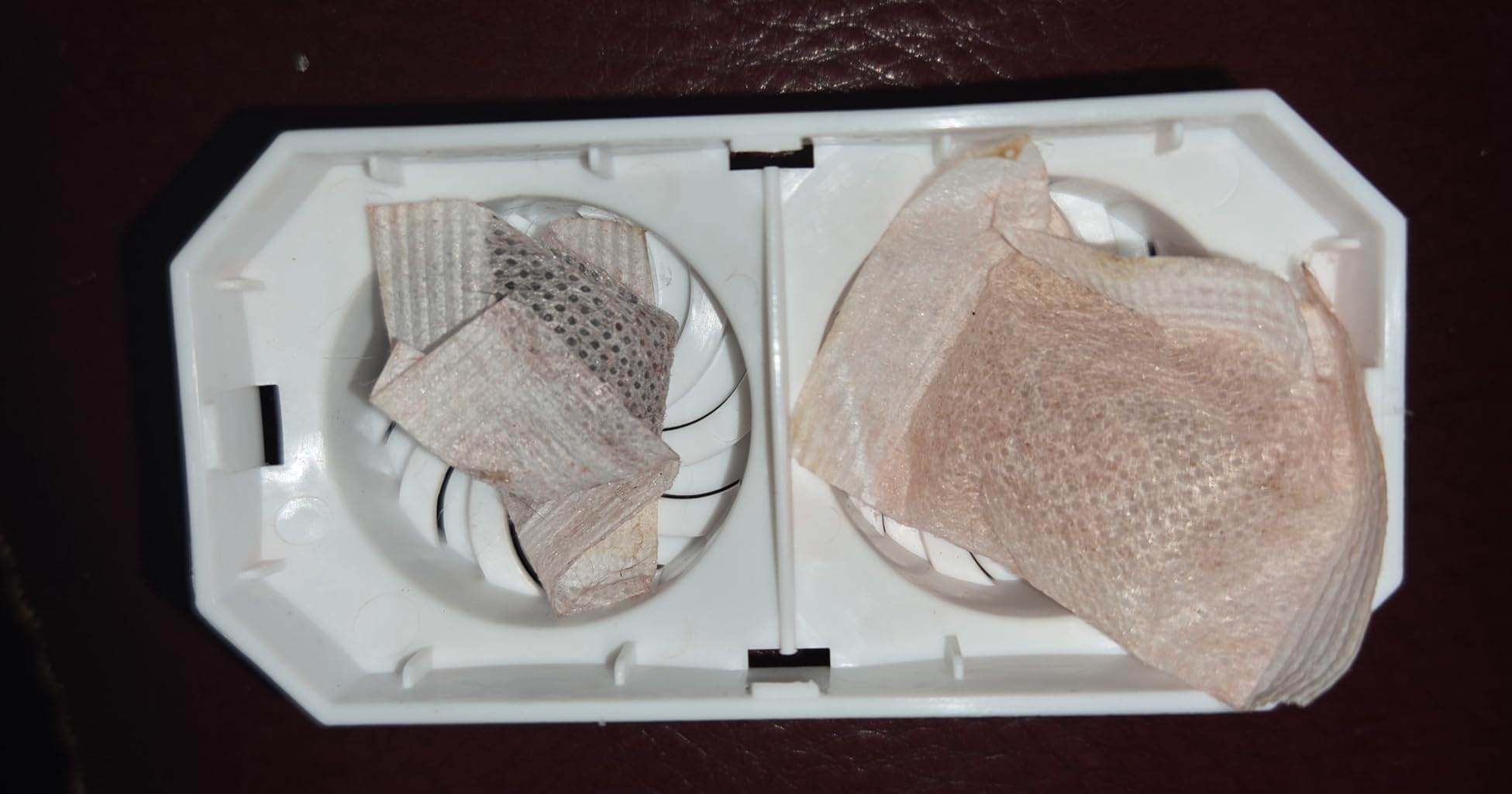
It is also one of the newer listings here and already sits high in the category, with 74% of reviews at five stars. Reviewers mention the water level window constantly as a practical detail, since checking the level without lifting the cover avoids the two-handed lift that spills water.
Quadruple filtration with activated carbon and cotton layers is the most thorough stage count we saw at this capacity. It is not the fountain for a cat that wants bubbles, though, since this is a stream design and some cats that prefer moving water will ignore a fountain without one.
Who this fountain suits
This is the pick if the pump sound is the specific thing keeping you up. A low-power pump in a stainless shell is the shortest path to a fountain you genuinely forget is running.
It also suits anyone who wants a week between refills in a one-or-two-cat home, and anyone who prefers to see water level at a glance rather than open the lid and judge by eye.
Where it falls short
The reservoir is not entirely metal, so owners focused on avoiding plastic contact should read the material description carefully. Cats with a history of chin acne may still react to the non-stainless sections.
And it is corded with a fixed flow. There is no bubbler mode, no battery option and no way to slow the stream down, which rules it out for cats that are startled by moving water.
3. Veken 95oz C1 Classic Fountain: Best Value for a Quiet Household
- Huge ownership base with consistent noise reports
- Five-stage filtration with scale inhibitor
- Water-level window plus blue LED
- Large capacity for multi-cat homes
- Low-energy pump rated for long-term use
- Open flower waterfall adds splash sound
- Filter upkeep every one to two weeks
Noise verdict: the pump is quiet, the water is not. Owners on r/CatAdvice repeatedly name this style of fountain as the reason they are still searching for something quieter, specifically because the flower waterfall mode lets water drop through air before it lands. If the flower mode is your cat’s preference, accept that the noise is splash rather than hum.
The gentle fountain mode is the quieter half of this unit. Switched away from the flower waterfall, the same low-energy pump produces a softer delivery with less free-fall, and that is the version most people end up running long-term.
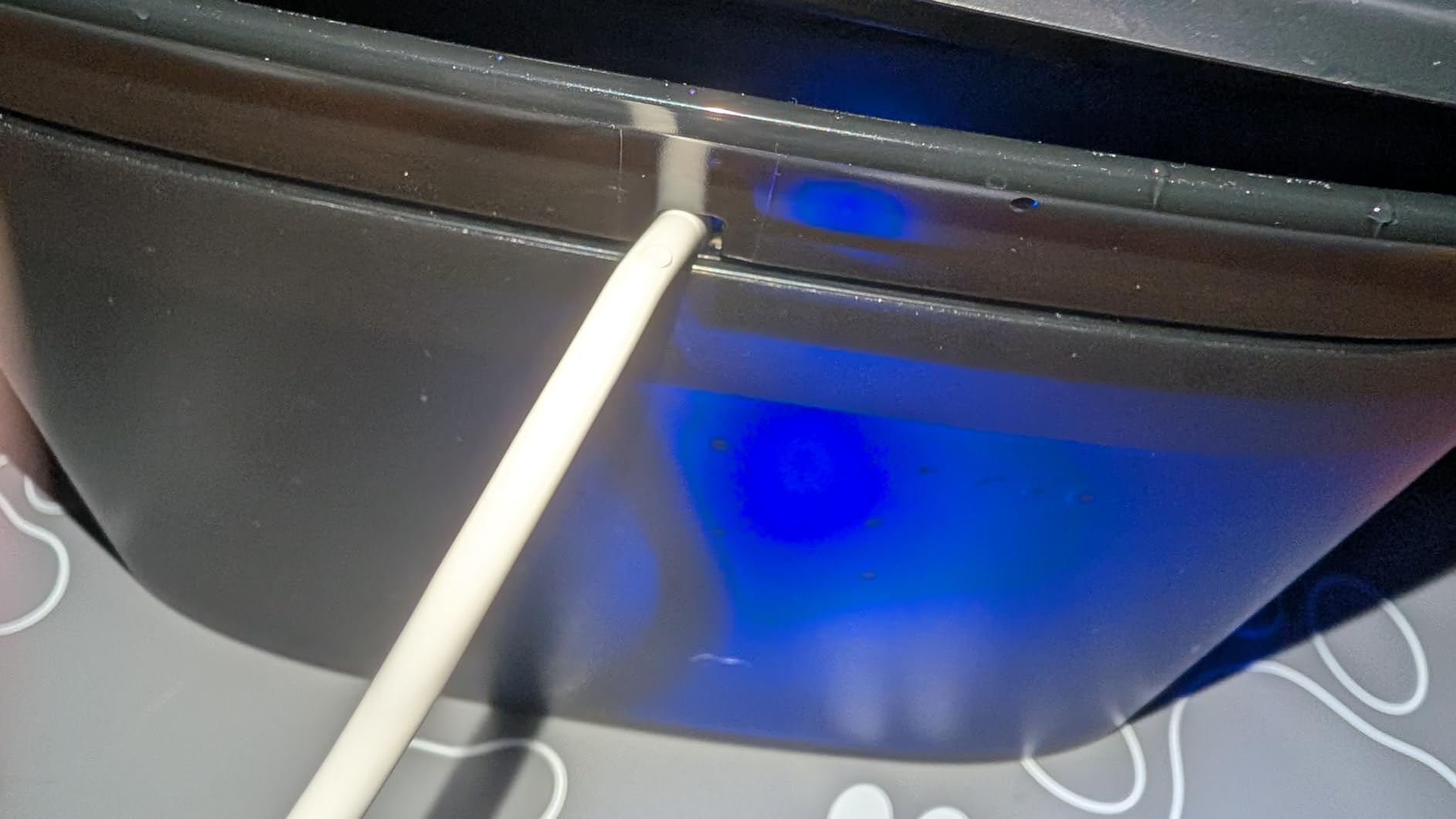
What you get for the money is unusual. Five-stage filtration with coconut shell activated carbon and a scale inhibitor is the deepest filtration in the lineup, and the 2.8 L tank covers two cats without a daily check. With more than 43,000 reviews there is a deep enough pool of long-term ownership reports to trust the noise verdict.
Those long-term reports are the honest catch. Owners describe the pump needing cleaning or filter changes every one to two weeks, and a scale-infested impeller is exactly what turns a quiet pump into a grinding one. Weekly impeller cleaning keeps this one in the quiet category.
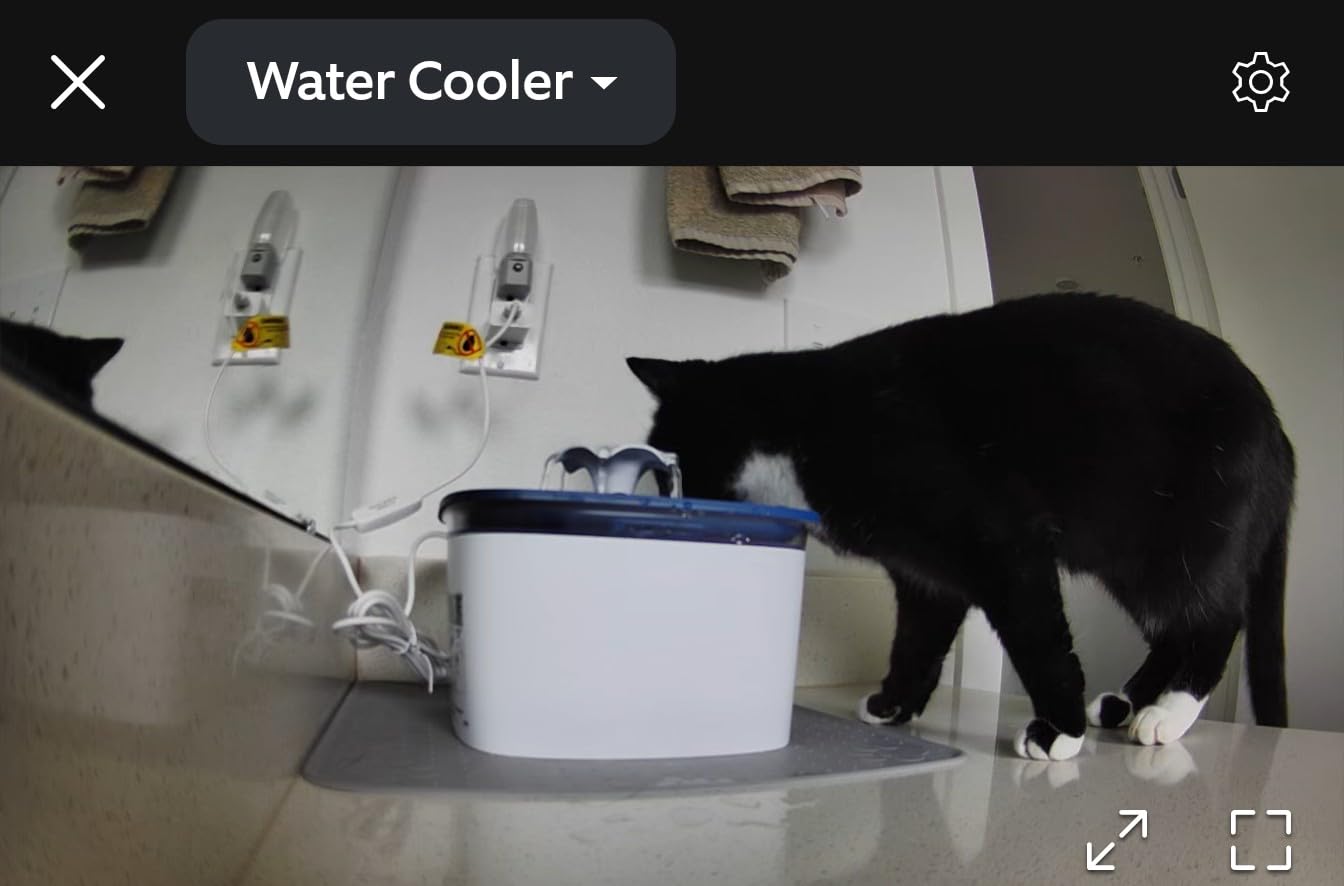
Who this fountain suits
It suits multi-cat households that need a lot of water and deep filtration on a budget. The 2.8 L reservoir and the water-level window handle more animals than any other plastic option here.
It also suits cats that are drawn to a flower waterfall. If your cat will only drink from moving water, forcing a bubbler design onto them usually ends with an ignored fountain and a dusty one.
Where it falls short
Splash. This is the honest limit of its quietness, and no amount of matting changes a water drop that lands in an empty basin. In a bedroom-adjacent room, test the gentle mode before committing.
The filter cadence is also frequent, and because the filter stage count is high, a neglected filter becomes a smell problem rather than just a noise one.
4. PETKIT Eversweet Solo SE 65oz: Best Budget Cordless-Pump Fountain
- Bubbler stream barely splashes
- Separable tank and base make filling safe
- Flat stacking parts wash easily
- Indicator flashes blue when water is low
- Dry-run protection stops the pump
- Base still needs to be plugged in
- No non-slip hold so it can be knocked over
- Filter and foam pads cost extra
Noise verdict: one of the quietest delivery styles here, because the bubbler stream removes free-fall almost entirely. The claimed figure is roughly 25 dB for the gushing bubbler flow, and unlike a printed open-drop number that one lines up with what owners report, since there is very little water actually falling.
The wireless pump moves the pump out of the tank, which also removes the direct vibration path through the housing. Separating the pump from the reservoir is the single biggest structural reason this design sounds as thin as it does.
Cleaning is the reason many owners stay with it. The tank lifts off the base so you can fill without an electrical unit next to water, and the mostly square flat parts stack inside a dishwasher rather than hiding in curved corners.
Be clear about one naming issue that shows up repeatedly in reviews. Despite the wireless pump in the name, the base has to be plugged in to run, so this is a wireless-pump fountain rather than a battery fountain. If you need the base nowhere near an outlet, look at the battery model further down.
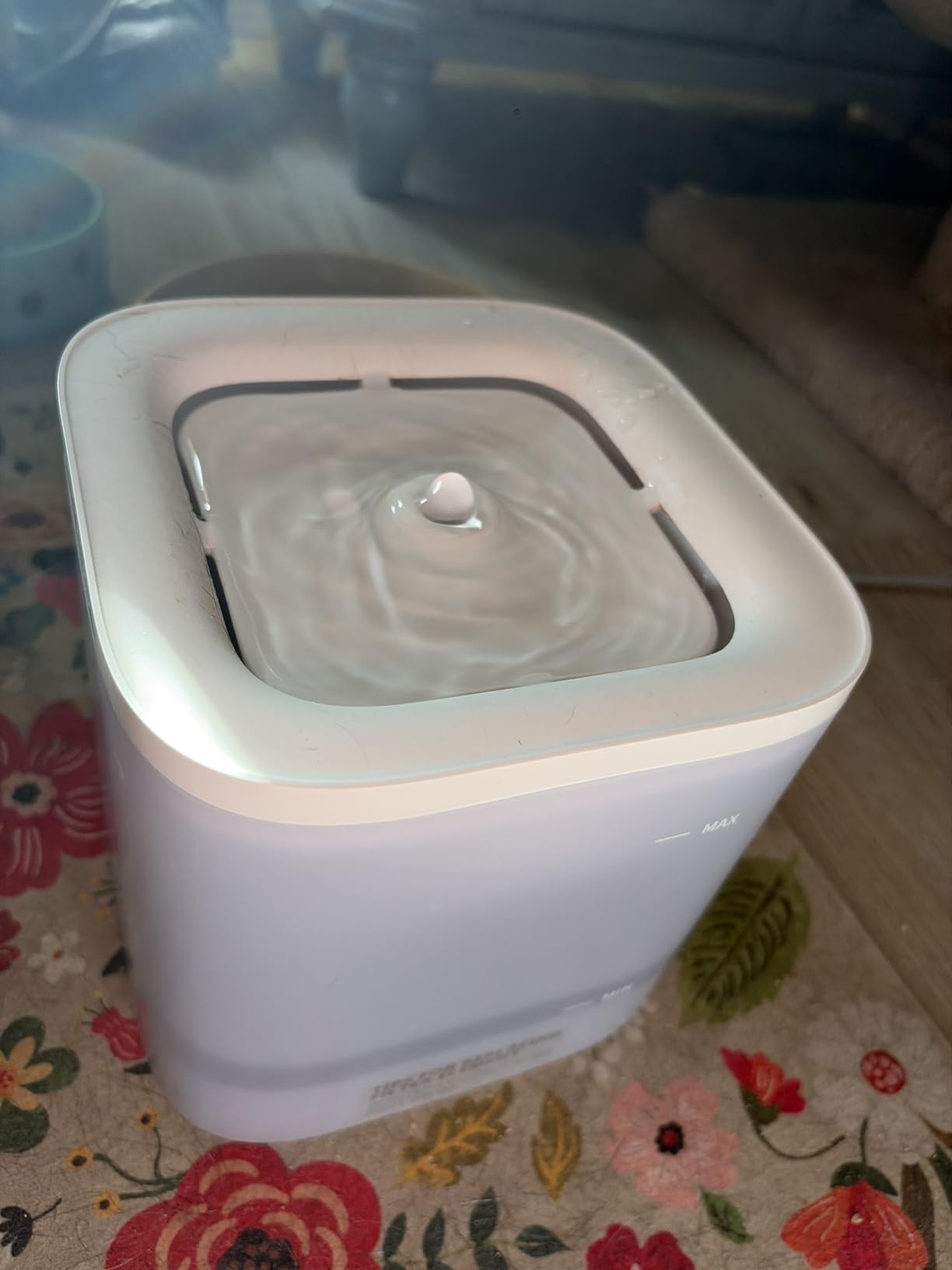
Who this fountain suits
It suits owners who want splash-free quiet on a budget, and anyone nervous about filling a reservoir with the pump installed. The separable design removes that whole risk.
It also suits cats that ignore still water but do not need a tall stream. Bubblers often attract cats that find fountains with falling water startling.
Where it falls short
The base has no non-slip hold, so a playful cat can knock it over and spill the tank. Owners report this more than any other complaint on this unit.
Replacement filters and foam pads are pricey, and a few owners report the pump stopping after a while, sometimes right after a filter change. That last pattern points at the impeller rather than the water, so clean the pump before you change the filter next time.
5. BEMOONY 108oz/3.2L Super Silent Fountain: Best for Multi-Cat Homes
- Largest tank here for multi-cat homes
- Faucet spout mimics a tap for hesitant cats
- Wide water table catches splash
- Translucent tank with level line and pump LED
- Disassembles with no dead-end corners
- Two-year assurance period
- Plastic reservoir rings more than metal bodies
- Faucet spout produces some drip noise
Noise verdict: moderate, and the sound is water rather than motor. The anti-dry-burn pump is quiet, but the faucet-style spout delivers water that strikes the wide surface below, and on a hard floor you will hear that landing more than you will hear the pump.
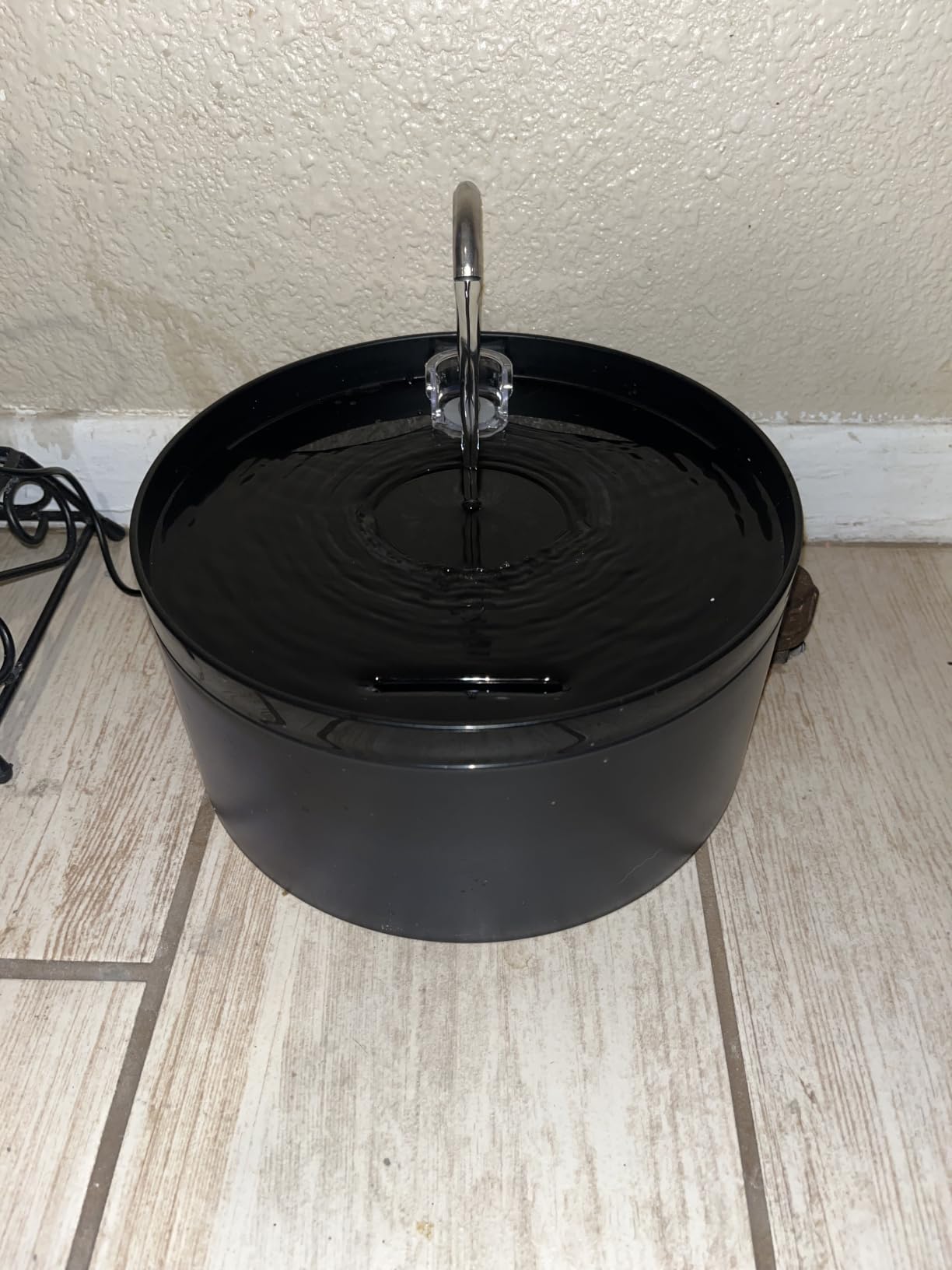
The 3.2 L tank is the reason this one earns its place. That is the largest reservoir in the lineup, rated at roughly eight days for one adult cat, and it means fewer top-ups and fewer reasons to lift and slop water across a floor at midnight.
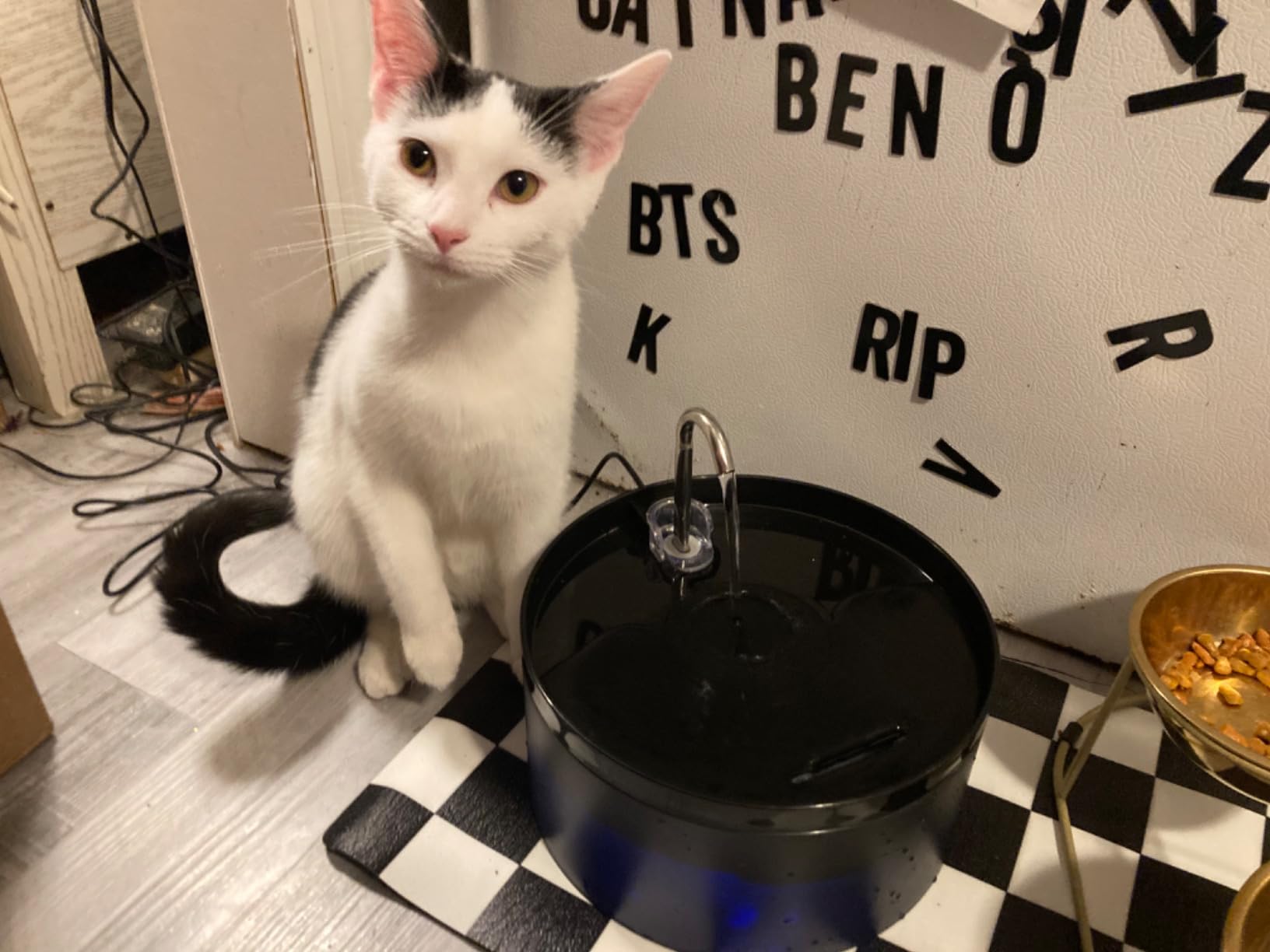
The faucet spout is a genuine appeal feature rather than decoration. Cats that have ignored tall fountains often drink from a tap, so the geometry is doing the recruitment work, and the wide water table below the spout catches what overshoots.
Construction is BPA-free plastic with a sealed cord, and the smooth curved body disassembles into parts with no dead ends. That is how you keep biofilm out of the corners, and biofilm at the water line is one of the main reasons a fountain starts sounding rough later on.
Who this fountain suits
It suits two, three or four cat households that want to stop babysitting a water level. Nothing else in this guide holds this much water, and it is also the sensible choice for a cattery or a home where someone travels at weekends.
It also suits cats that drink from a bathroom tap but ignore fountains, since the faucet spout is a direct translation of something they already use.
Where it falls short
It is a plastic reservoir, so it will ring a little more under the pump than a stainless or ceramic unit, and the faucet design puts more water in motion than a bubbler. If your problem is motor hum specifically, this is not the answer.
It is also the lightest unit here at a little over 10 ounces, which helps carrying but means less of an anti-tip deterrent for an active cat.
6. iPettie Tritone Ceramic 71oz Fountain: Best Ceramic for Noise and Chin Acne
iPettie Tritone Ceramic Cat Water Fountain, Heavy-Duty Waterer for Pets
- Ceramic body resists chin acne and is easy to clean
- Whisper-quiet CE-certified IP68 pump at 2W
- Dual foam and carbon filtration
- Over two weeks of water
- Three-year pump warranty with 24-hour support
- Heaviest unit here at 6.6 pounds
- Small lip where water lands
- Porous glaze if chipped
Noise verdict: near-silent, and the sound that remains is falling water rather than a pump. Owners describe it as whisper-quiet with noise coming only from the water itself, and at 2W this is one of the lowest-power pumps in the group, which leaves almost nothing to hum.
Ceramic is the densest drinking material available on a fountain, and it does two useful things at once. It does not ring like thin plastic, and it is the surface cats with chin acne tend to tolerate best, which is why this one keeps a 4.5 average across more than 4,000 reviews.
The 71 oz capacity is unusually long-running for a ceramic unit, at over two weeks of water for a single cat in the listing’s own estimate. Foam filtration handles hair and debris and the carbon layer handles odor and impurities, which is the standard two-stage pairing.
Three-year pump warranty is the longest coverage here, and with 24-hour customer care behind it. For a heavy ceramic unit you will not want to pass between floors, that support history matters more than it would for something you can lift with one hand.
Who this fountain suits
It suits cats with a history of chin acne and owners who want a material that will not hold odors as it ages. Ceramic is the cleanest drinking surface of anything in this guide.
It also suits anyone who wants to set a fountain down and stop thinking about it, since the pump is low-draw and covered for three years.
Where it falls short
It weighs 6.6 pounds. That is the point as much as the problem: a heavy ceramic fountain resists being knocked over, but it is a genuine two-hand carry to the sink every week, and that is the reason some owners go quiet on maintenance and then on noise.
It is also the most expensive unit here and runs corded, so it stays near an outlet.
7. PetSafe Seaside Stainless 60oz Fountain: Best for Easy Cleaning
PetSafe Seaside Stainless Cat & Dog Fountain, 60 oz, 2 Filters & Pump
- Very few parts and no crevices to scrub
- Quiet pump with only soft running water sound
- Stainless resists dents and pet acne
- Works as tower or bowl
- Fast replacement pump support
- Gravity-held top cone can be knocked off
- Very long cord
- Flow speed cannot be adjusted
Noise verdict: quiet, with the noise concentrated in the running water rather than the pump. Owners consistently describe a quiet pump and only a soft sound of water moving, which is the profile you want in a room where you can hear the television.
At 60 oz it is a modest reservoir, so it suits a one-cat home or a home with a second drinking station nearby. The stainless body is the acoustically important part: thin walls ring, and these are not thin.
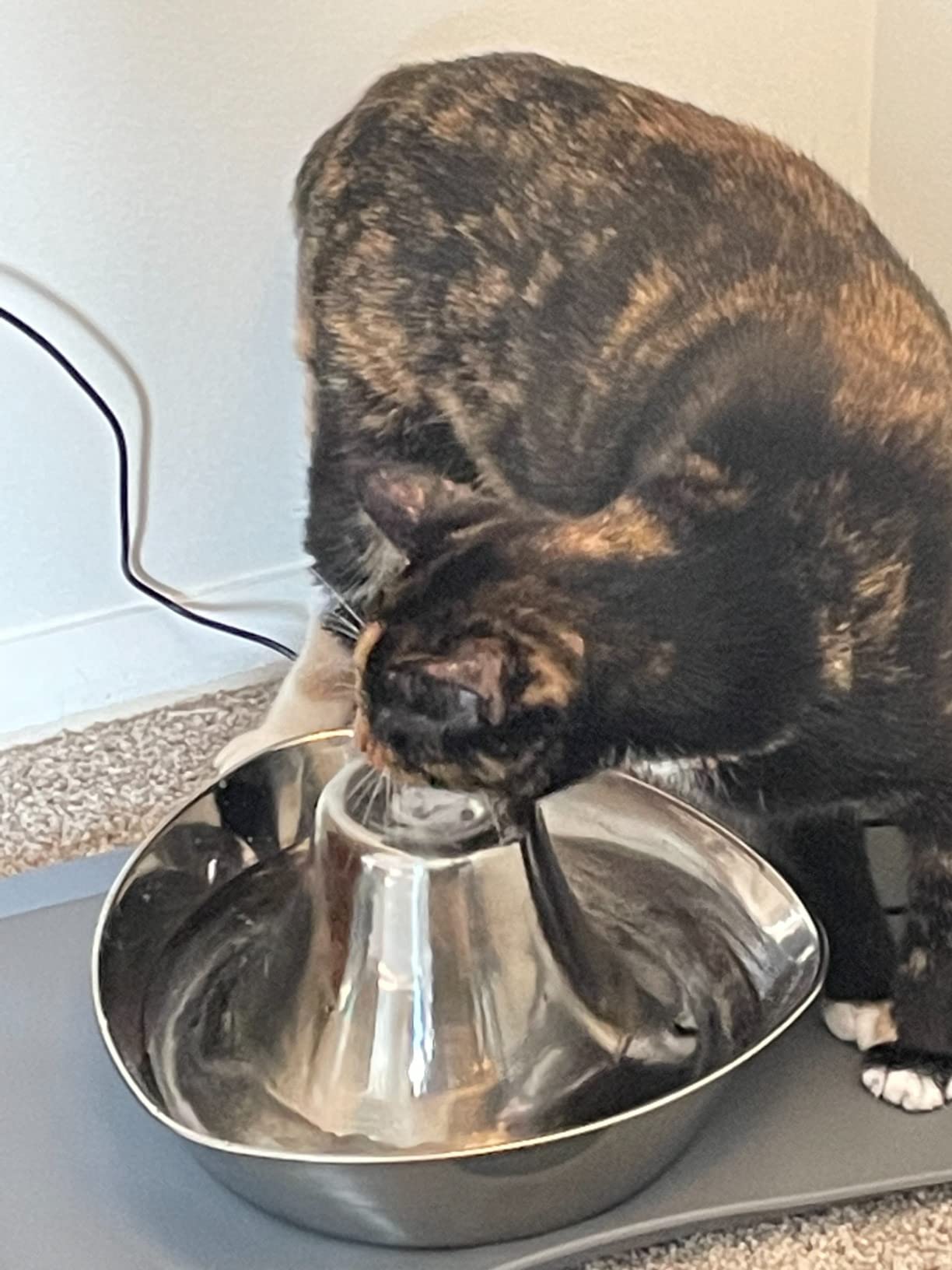
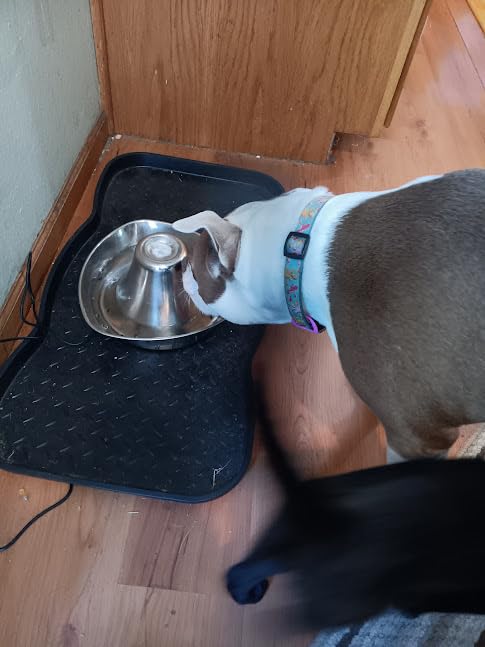
Cleaning is the strongest reason to buy this one. There are very few parts and no crevices, which is what actually determines whether you keep up a weekly rinse. A fountain with hard-to-reach internal corners is a fountain that develops biofilm, and biofilm is what makes a pump grind.
Triple filtration with additional activated carbon is on the deeper side, and the deep reservoir keeps water available during a power cut, which matters more than it sounds if you ever lose power in a heatwave.
Who this fountain suits
It suits owners who want a quiet fountain they will genuinely keep clean. Minimal parts and no crevices is the honest answer to why some fountains get quieter over time and others get louder.
It also suits cats that like to drink from a bowl as well as a tower, since the same unit serves both. And owners who have had bad luck with dead pumps value the fast replacement support.
Where it falls short
The top cone is held on by gravity alone, so rambunctious cats can knock it off and spill the reservoir. That is the main knock-on risk with an otherwise simple design.
The cord is very long, which dictates placement, and flow speed cannot be adjusted, so you cannot trade a little splash for a little quiet. A minority of owners also report slime and biofilm building quickly, which tracks with the fixed flow keeping water moving over one spot.
8. Kastty 2.2L LED Fountain: Best for Nighttime Placement
Kastty Cat Water Fountain, Pet Water Fountain for Cats Indoor, Cat Water Dispenser 2.2L/74oz, Super Quiet, Long Life Span Pump, Black+Colorful LED Light
- Very quiet pump and gentle water flow
- Colorful LED night light with on/off switch
- Low-water sensor shuts the pump down
- Red light reminder for low water
- Multi-stage carbon and pre-filter filtration
- ABS housing rings more than metal
- LED may be distracting in a dark room
Noise verdict: quiet, with owners singling out both the pump and the water flow as soft. Gentle flow means less water in motion than a full-rate fountain, and that is where most of the splash reduction comes from in this design.
The low-water sensor is the quiet-related feature most people overlook. When the level drops, the pump shuts down before it can cavitate, and a cavitating pump is the loudest thing in this entire article. Preventing that failure mode is worth more to a light sleeper than any decibel claim.
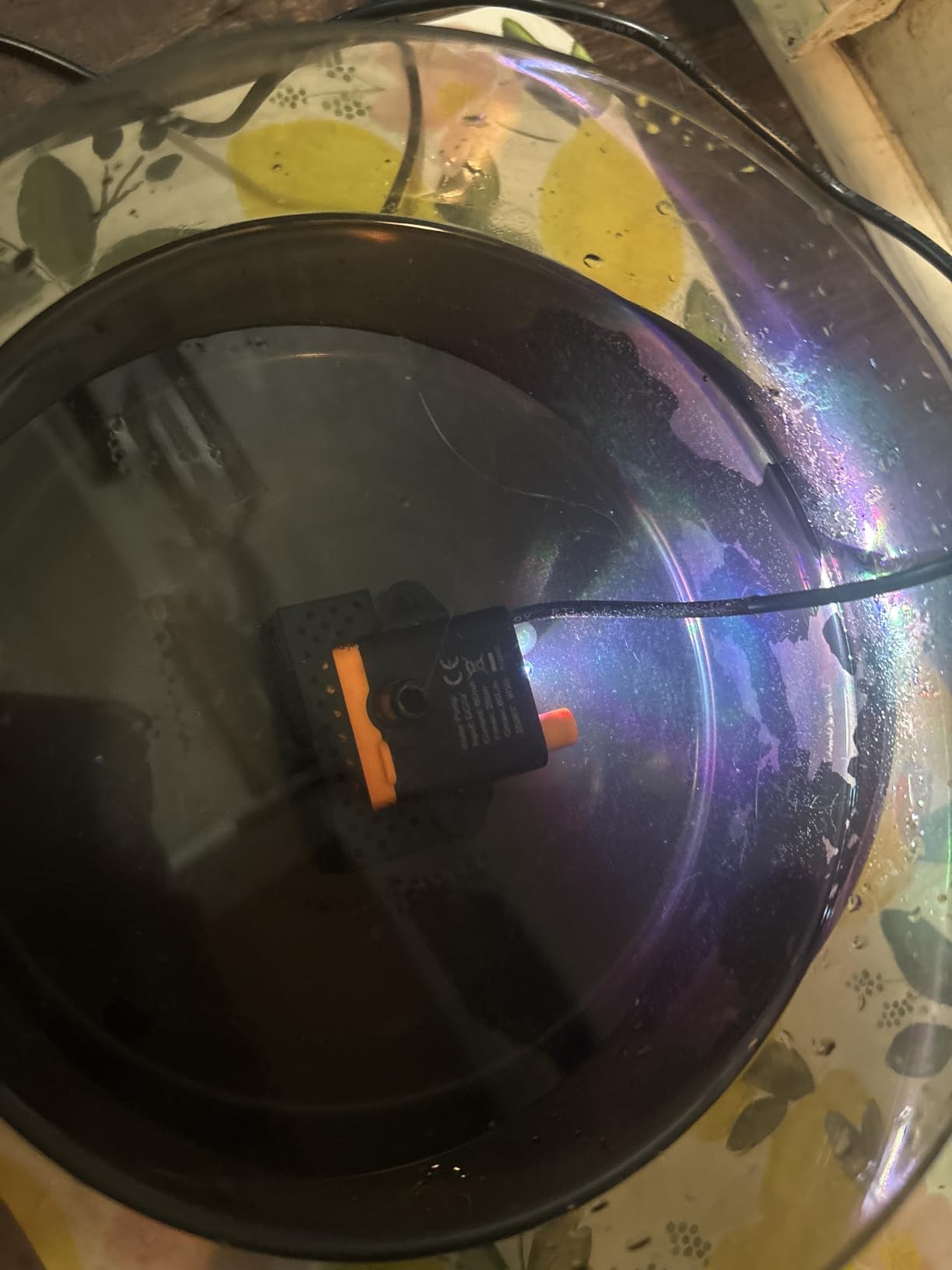
The LED night light has a genuine on/off switch, which is rare and matters for a bedroom. A light that cannot be turned off is a light that ends up unplugged with the pump, and an unplugged fountain is a plastic ornament.
Filtration is multi-stage with coconut shell activated carbon and a pump pre-filter, and replacement filter and pump parts are listed separately so you can order them without guessing. At 2.2 L it sits in the middle of the capacity range, good for one or two cats.
Who this fountain suits
It suits owners placing a fountain in or near a bedroom who want a visible, switchable light and a pump that will not cavitate at 2am. The red low-water reminder means you find out before the pump complains.
It also suits households where the cat is a night owl and a dark fountain at 2am is a hazard. Gentle flow and a lit water surface solve that together.
Where it falls short
It is ABS plastic, which is the most ring-prone material on this list. In a room with hard floors you will hear more of the pump than you would from a stainless or ceramic body.
The LED, while switchable, is a bright colored light. If your partner is sensitive to light while trying to sleep, test it in a dark room before settling in.
9. FEELNEEDY Cordless 3.2L Fountain: Best for Cord-Free Placement
- Cordless 4000mAh battery runs weeks between charges
- No cable to conduct vibration into the tank
- Visual filter window shows when to change it
- Three flow modes including sensor activation
- Keeps running during a power cut
- Shallow tray spills if a pet paws at it
- Pump can develop pink slime
- Small hard-to-read manual
Noise verdict: quiet, and this is the design where quiet and convenience are the same feature. There is no power cable at all, which removes the acoustic bridge that lets a wired pump transmit vibration into its own housing. That is a structural quiet gain, not a convenience one.
The thick 304 stainless tank is the second quiet contributor. Same reasoning as the other metal units here: dense walls absorb pump energy instead of ringing, and the tank resists the slime and rust that make plastic units loud and unpleasant later.
![Cordless Cat Water Fountain : [Visual Filter] & [Heavy-Duty Stainless Steel] 3.2L/108oz, FEELNEEDY- Premium, Durable Design, 4000mAh Battery Operated Pet Fountain with Sensor, FN-W17 for Cats and Dogs customer photo 1](https://www.wpa-pool.com/wp-content/uploads/2026/10/B0F9WQGMH7_customer_1.jpg)
Three modes give you real control over noise. Sensor mode runs briefly when a cat approaches, timed mode pulses every fifteen minutes, and continuous mode is the loudest of the three because the pump runs without pause. Most owners settle on timed or sensor after the novelty wears off.
The visual filter window is the feature we would single out for long-term noise. Being able to see filter condition without lifting the lid means you replace filters on condition rather than on memory, and a fresh filter keeps water moving cleanly through the impeller.
![Cordless Cat Water Fountain : [Visual Filter] & [Heavy-Duty Stainless Steel] 3.2L/108oz, FEELNEEDY- Premium, Durable Design, 4000mAh Battery Operated Pet Fountain with Sensor, FN-W17 for Cats and Dogs customer photo 2](https://www.wpa-pool.com/wp-content/uploads/2026/10/B0F9WQGMH7_customer_2.jpg)
Who this fountain suits
It suits anyone whose outlet is in the wrong room, and anyone whose previous fountain was unplugged to escape the cable noise. Sensor mode also suits households where you do not want a pump running all night for a cat that drinks twice a day.
It also suits people away for several days, since the 3.2 L tank covers roughly 10 to 13 days for one cat and keeps running during a power cut.
Where it falls short
The drinking tray is shallow, so water spills easily when a pet paws at it. On hardwood that means wet floor and, eventually, a squeak that competes with the fountain for your attention.
It is not suited to large dogs despite the capacity, and owners report the pump accumulating pink slime that needs regular cleaning. Treat that as a noise maintenance item, not just a hygiene one.
10. PETLIBRO Stainless Steel 101oz/3L Fountain: Best for Splash Control
- Runs below 30 dB with adjustable flow
- BPA-free 304 stainless resists rust and odor
- 3 L capacity suits multi-cat homes
- Filter and pre-filter sponge catch hair and debris
- Raised pump holder cuts splash and leaks
- Doubles as a small dog station
- Corded with a fixed tank position
- Less review history than the older picks
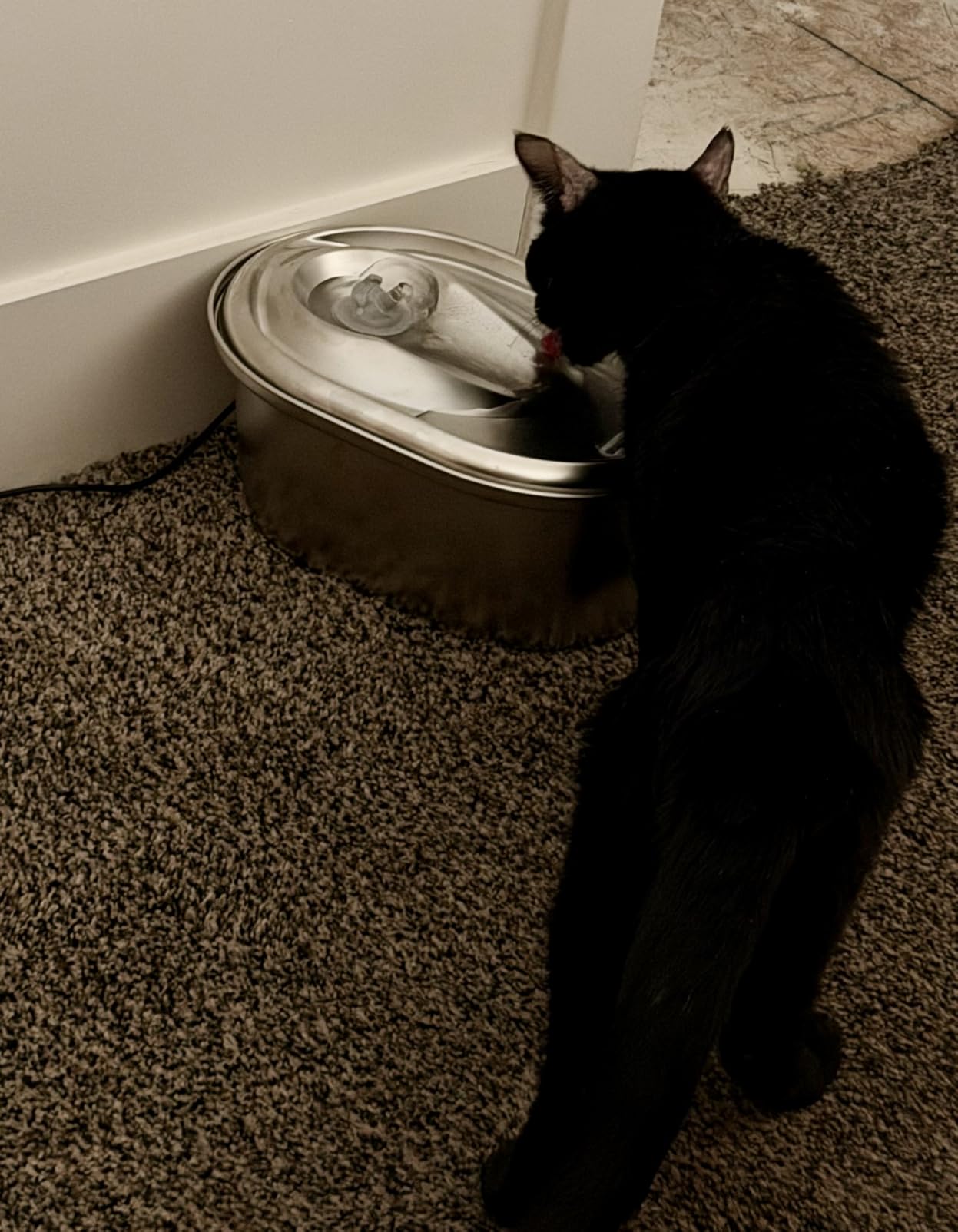
Noise verdict: quiet, and its distinguishing feature is that the raised pump holder and higher outlet cut splash at the source. The claimed figure is below 30 dB, and the splash reduction is the reason it earns that rather than just printing it.
Adjustable flow is the practical noise control most fountains here lack. Turning the output down lowers both the volume of water in motion and the agitation around the impeller, which is the difference between a fountain you tune and one you tolerate.
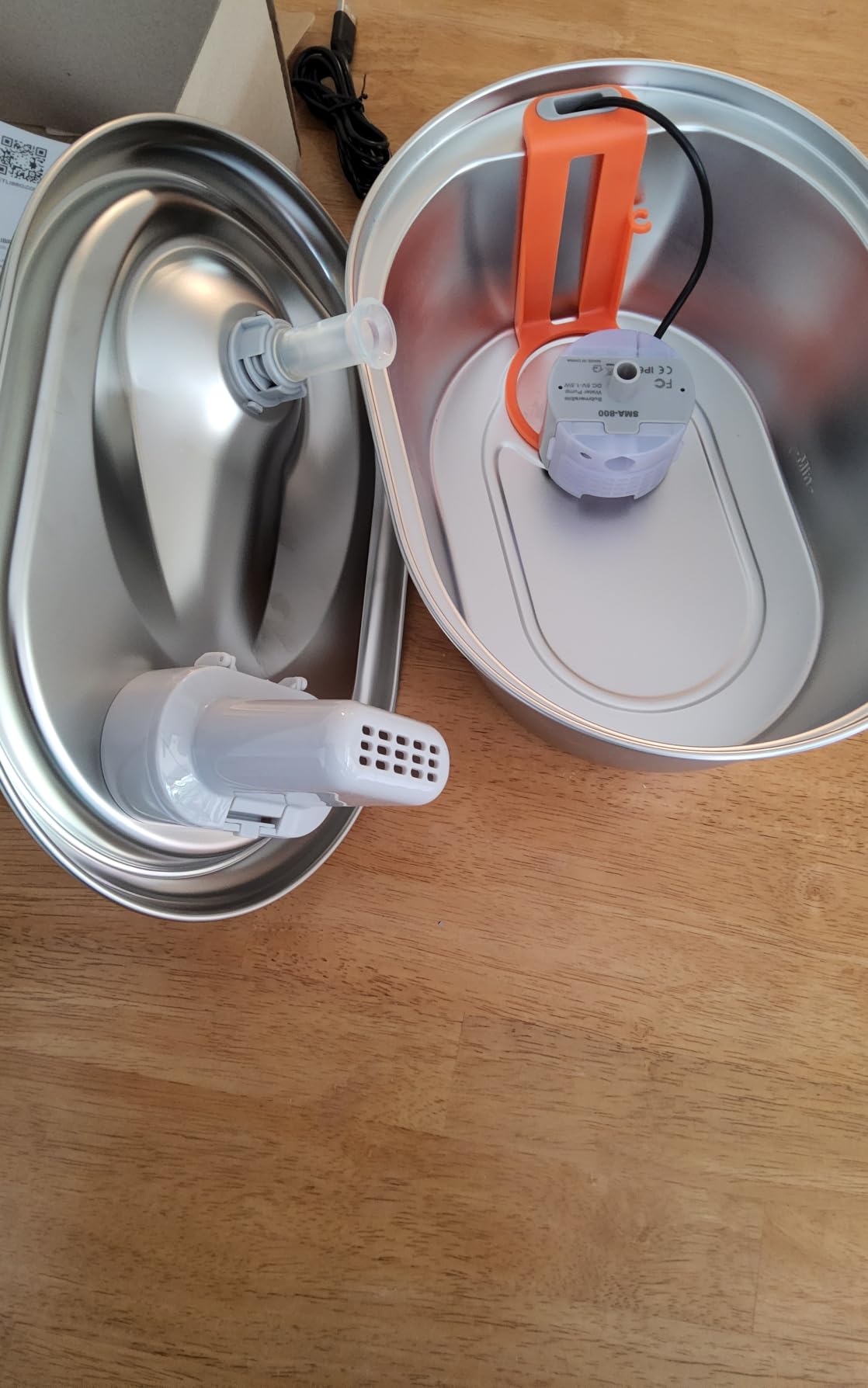
At 3 L or 101 oz this is one of the larger stainless tanks, which is what makes it work in a two-cat home without a daily level check. Stainless also resists the rust and odor complaints that push owners off plastic after a year.
It is a recent entry in the category and carries less long-term ownership history than the older picks on this list, so treat month-six noise reports as thinner here. What owners do report consistently is quiet operation and reduced splashing.
Who this fountain suits
It suits households where splash and wet floors, rather than motor hum, are the complaint. The raised holder and outlet address the landing zone that other stainless fountains leave open.
It also suits multi-cat homes wanting a big stainless reservoir, and homes with a small dog that shares the station, since it is rated for both.
Where it falls short
It is corded, so placement is dictated by the outlet, and the tank sits in a fixed position rather than lifting fully away for cleaning like a separable design does.
Because it is newer, there is less evidence about long-term pump behaviour than on the older picks. If you are risk-averse about durability, weigh that against the splash control you actually need.
11. AONBOY 108oz Stainless Steel Fountain: Best for Weekends Away
- About eight days of water for one adult cat
- Spherical housing is designed to reduce noise
- Front window avoids lifting the lid
- Four-stage filtration with ion exchange resin
- Dishwasher-safe bowl
- Two-year pump warranty
- Filters can add a taste cats dislike
- Window and spout holder are plastic
- Blue LED may be distracting at night
Noise verdict: quiet, with the pump noise reduced by the spherical body shape rather than by a special pump. The manufacturer pairs a silent low-noise pump with a spherical structure specifically to cut noise, and owners report it as nearly inaudible in a quiet room.
The spherical form also explains the large capacity in a compact footprint. A 3.2 L reservoir rated at about eight days for one adult cat means you can leave it alone over a long weekend, which is where the noise question stops mattering anyway.
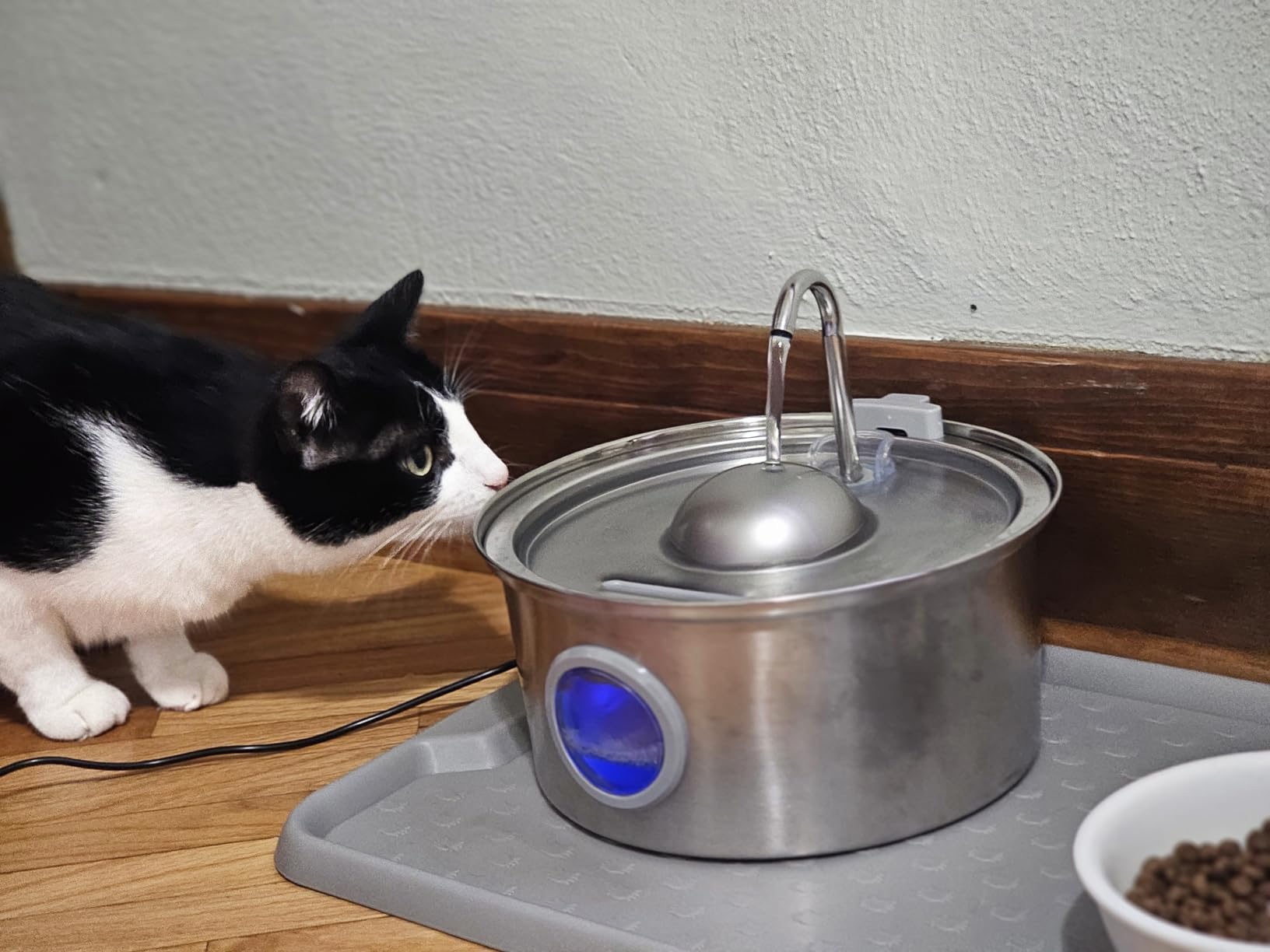
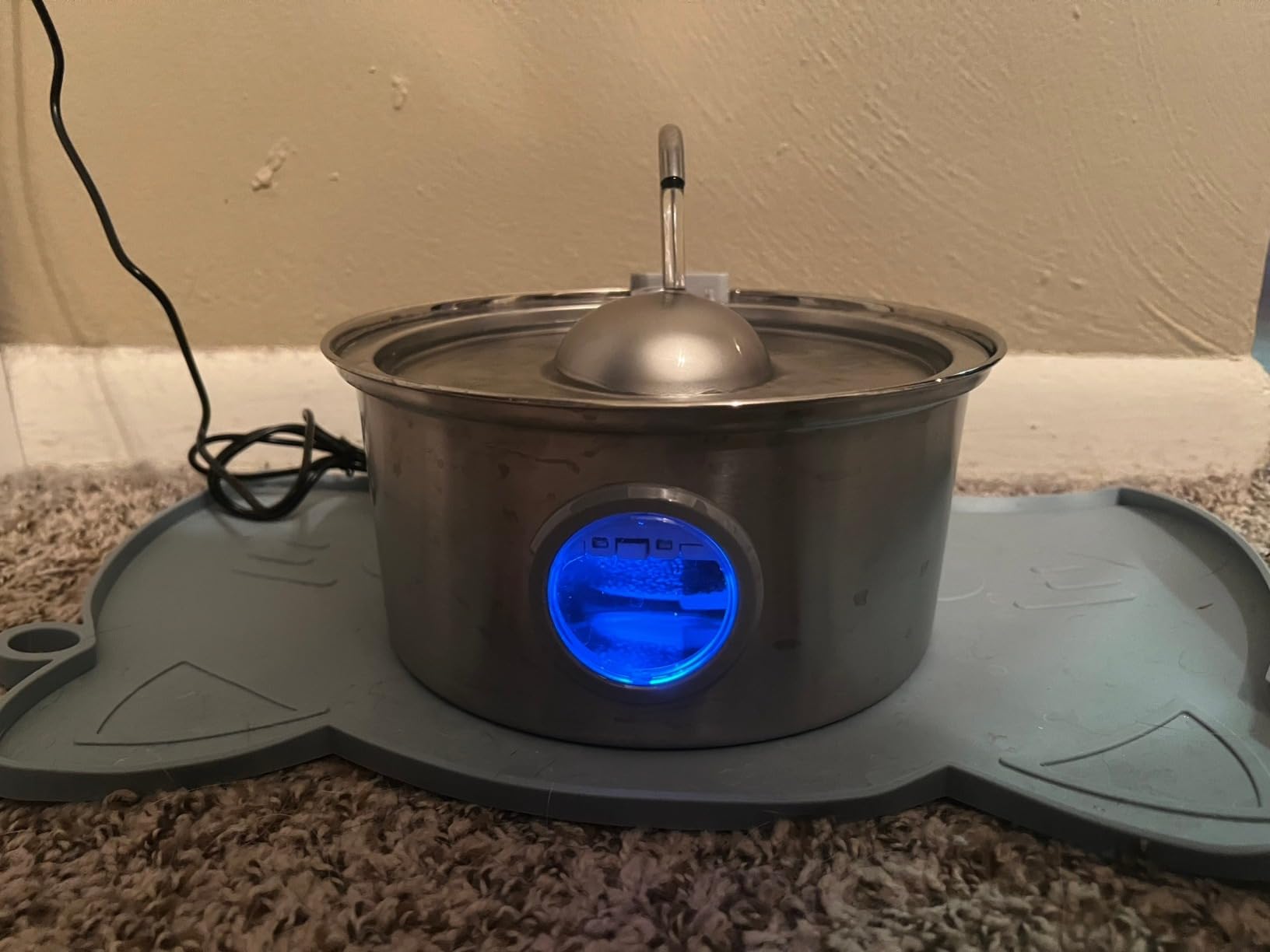
The front water-level window is the detail owners mention most, because checking the level without lifting the lid removes the two-handed lift that spills water and wakes the cat. Three drinking options cover the tray, the dome fall and the spout, so different cats can choose.
Filtration is the deepest stack here: filter cotton, coconut shell activated carbon, an ion exchange resin cartridge and a pump pre-filter sponge. Multi-cat households report visible changes in how much their cats drink after moving off plastic.
Who this fountain suits
It suits people who travel regularly or work long shifts, and anyone who does not want to think about water for a week. Long-term owners report multi-year use without problems on several of them.
It also suits owners who want to avoid the chin acne problem without paying for ceramic. Stainless is the compromise most people land on, and the two-year pump warranty plus free replacement filters reduce the risk.
Where it falls short
The included replacement filters can add a taste some cats dislike, and cats that dislike it will simply stop drinking. That is the single most reported complaint on this unit, and it is a rejection problem disguised as a water problem.
The window and spout holder are plastic, so it is not fully stainless, and the blue LED near the water may be distracting in a bedroom. A minority also report leaks at the window seal and pump failures after about a year.
12. MISFANS All-Ceramic 71oz Fountain: Best Plastic-Free Design
MISFANS Ceramic Cat Water Fountain, All-Ceramic Body, Pure Copper Spout
- No plastic top
- so no porous plastic holding odors
- Pure copper spout resists corrosion and plastic flavor
- Dishwasher-safe ceramic bowl and lid
- Quiet two-mode pump for stream or bubbles
- Three filters plus a sponge included
- Heavy at nearly 6 pounds in the package
- Smaller tank than stainless models
- Copper spout must be hand-washed
- Pump stops if water runs low
Noise verdict: the quietest by design on this list, and the manufacturer figure is below 20 dB across two modes. Treat that as a claim rather than a measurement, but the two-mode pump gives you a bubbling fountain option that removes free-fall entirely, which is where real quiet comes from.
This is the only unit here with no plastic in the drinking structure at all. Ceramic bowl, ceramic lid and a pure copper spout means there is no porous plastic surface to hold odor or to pick up the biofilm that eventually makes a pump rough.
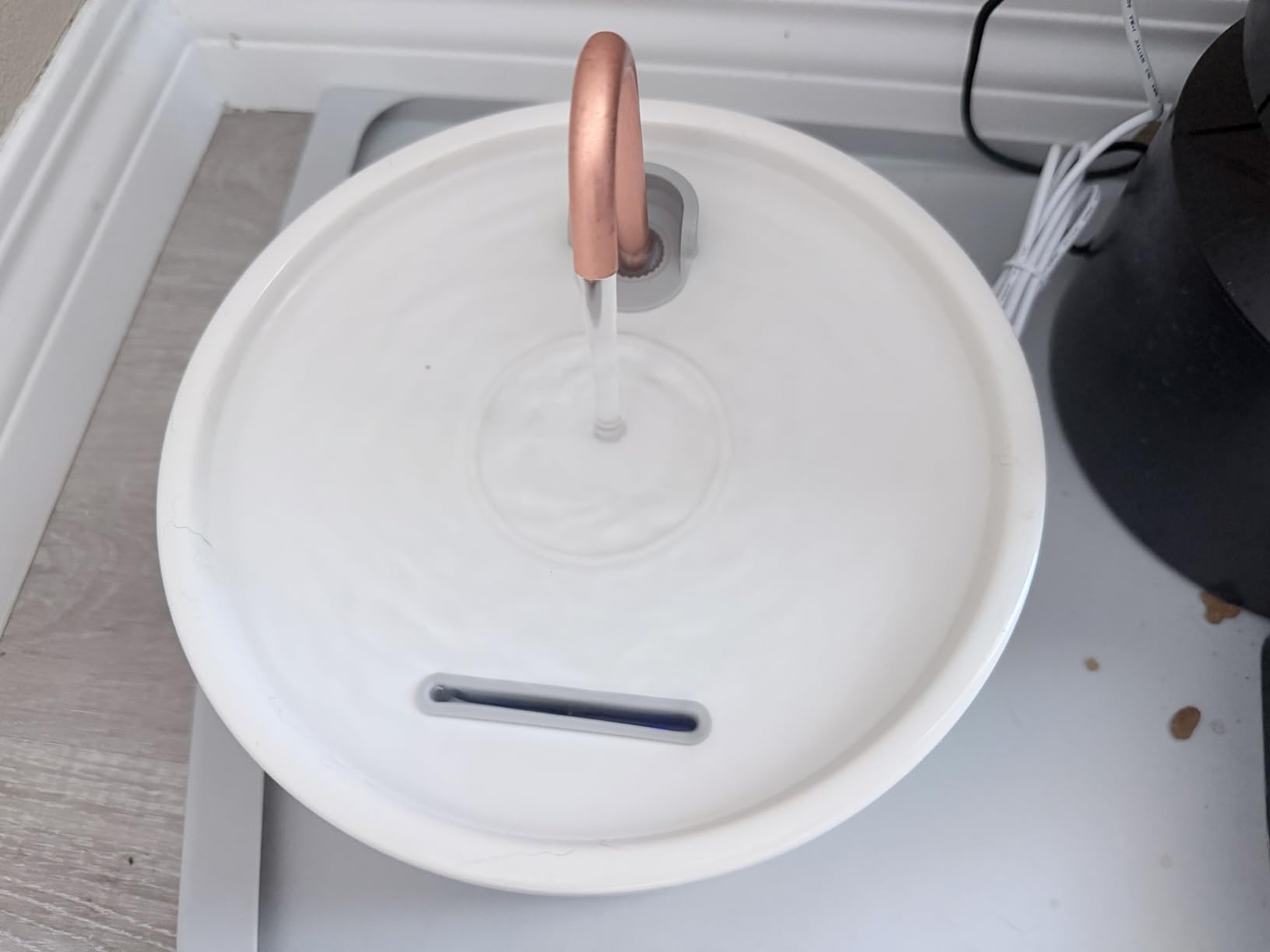
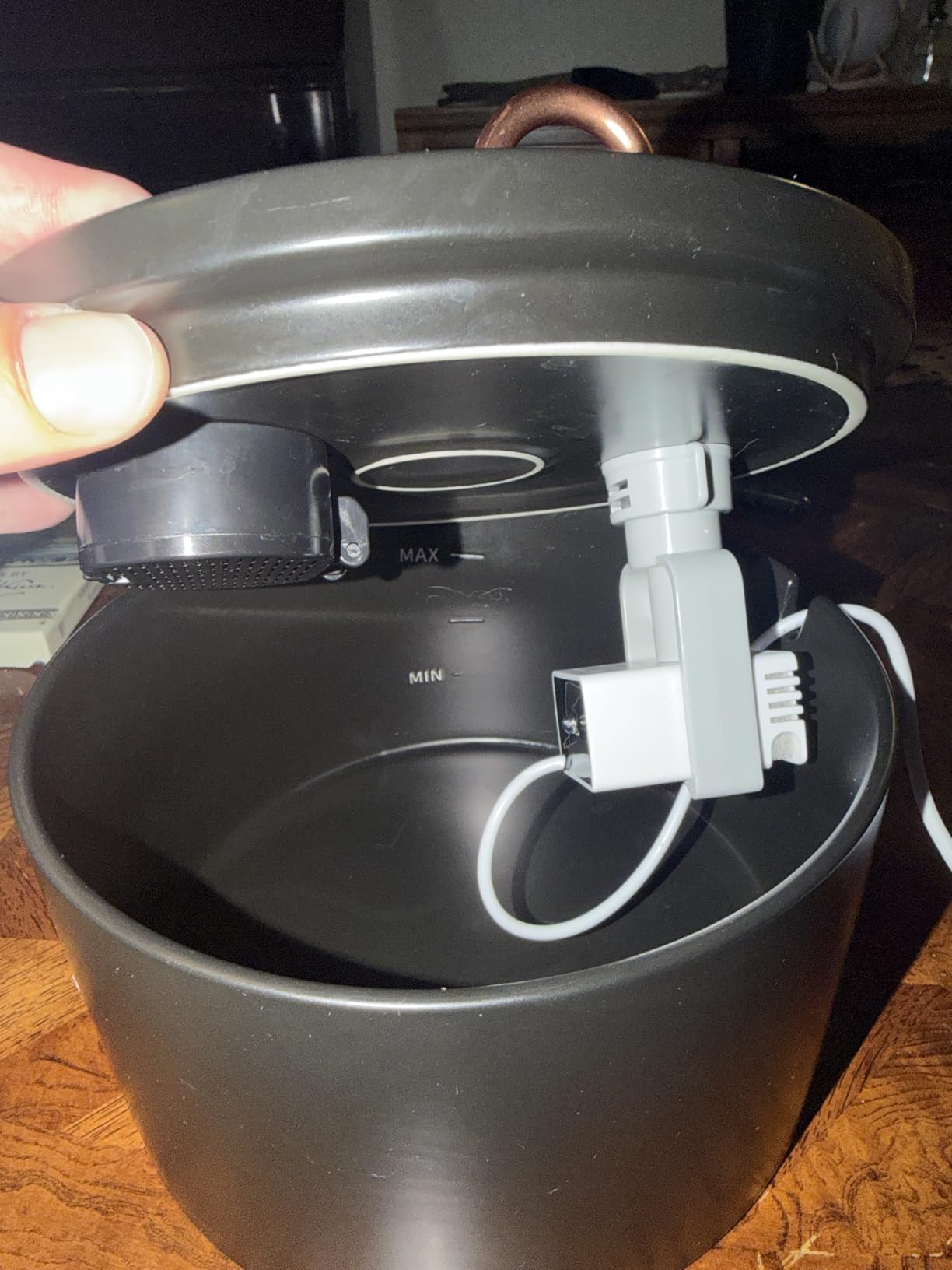
Maintenance is straightforward by design. Everything detaches, and the ceramic bowl and lid go in the dishwasher once the electrical and filtration parts are removed. Three filters and a sponge are included, which covers the first several replacements before you are buying your own.
Foam handles hair and debris and the activated carbon layer handles odors and impurities, which is the right pairing for hard water. At 2.1 L it runs a little shorter than the big stainless tanks, roughly a week rather than closer to two.
Who this fountain suits
It suits cats with chin acne, and owners who have decided plastic contact is not worth negotiating. Removing it entirely is cleaner than choosing the least-bad plastic model.
It also suits anyone who wants a fountain that stays odour-free over years. Non-porous ceramic and copper do not hold smells the way plastic does, and that also helps the water stay sweet longer between changes.
Where it falls short
It is heavy, at nearly 6 pounds in the package. Carrying that to a sink weekly is a real chore, and heavy fountains get cleaned less often, which hurts noise more than any spec on the page.
The copper spout has to be hand-washed and cannot go in the dishwasher, the 2.1 L capacity is small next to the 3 L stainless units, and the pump stops if the water runs low, so it will not coast through a forgotten refill.
How to Choose a Quiet Cat Water Fountain
Start with the sound you actually hate. If it is the motor, prioritise a low-power pump, a dense metal or ceramic body, and a cordless or wireless-pump design. If it is the water, prioritise a bubbler, ramped or wall-hugger spout over any open-drop or flower waterfall. If it is the floor, matting solves most of it for free. Diagnose first and the rest of the decision is easy.
Material is an acoustics decision before it is a hygiene decision. Thin plastic rings like a drum when the pump runs, while 304 stainless steel and glazed ceramic absorb the same vibration. This is why the metal and ceramic units on this list tend to sound lower and denser at similar pump power. If your cat has chin acne, the same ranking applies for a different reason, since plastic contact is linked to breakouts. Our cat condo roundup covers the other half of a multi-cat setup if you are planning stations as a pair.
Pump type beats marketing wording. A low-wattage brushless pump is the quiet architecture you want. Watch for the pump being separated from the reservoir, since a remote pump shortens the vibration path through the tank. And check the low-water behaviour: a pump with dry-run protection cannot cavitate at 3am, and cavitation is the loudest failure mode there is.
Spout design decides splash, and splash is usually the real culprit. Water that slides down a ramp or bubbles up through a grate makes far less noise than water dropping through air. Packaging rarely tells you which you have, so look at the product photos: a visible gap between spout and surface means free-fall.
Corded or cordless is an acoustic question too. A power cable can conduct vibration from the pump into the housing, and removing it entirely removes that path. Cordless also solves the placement problem where the only outlet is in another room, which is why bedroom placement usually goes battery-first. Our approach to noise in compact-apartment equipment applies here: treat cable-borne vibration and floor transmission as separate problems from the motor.
Capacity should match the number of cats and the length of your absences. A single cat needs roughly 60 to 80 oz for a comfortable week. Two cats, or a household where someone travels at weekends, needs 3 L or more. Bigger tanks are heavier, and heavy tanks are quieter but harder to clean, which is the trade-off nobody lists.
Anti-tip matters more than most specs for multi-cat homes. Weight is the best anti-tip mechanism there is, which is why the ceramic units double as knock-over-resistant fountains. If a cat plays with the water, a wide base and a rubber foot matter as much as the mass. If the base lifts off for filling, check whether it locks, because a cat can push an unlocked tank off a counter.
Filters are the hidden long-term cost and the hidden noise cost. Proprietary cartridges mean brand lock-in and a rising bill, and a neglected filter changes both smell and sound. A foam prefilter catches hair before it reaches the impeller, and an impeller wrapped in hair grinds instead of pumping. That is the mechanism behind the most common long-term complaint in this category: fountains that got louder after a few months.
Hydration is the reason the fountain exists. Many cats drink more from moving water, and higher water intake supports urinary tract health, which is why vets often suggest fountains to owners of dry-fed cats with a history of crystal or stone issues. But a fountain that gets unplugged defeats the purpose, which is the entire argument for buying the quiet one first.
How to Quiet the Fountain You Already Own
Before you replace anything, work through these four steps. In our experience most fountains people call loud are fixable in about ten minutes and a mat.
Put something soft underneath it. A silicone mat, neoprene pad or even a folded towel decouples the base from the floor. This kills floor vibration, which is the sound most people describe as coming through the wall at night.
Soak the impeller in a 50/50 vinegar and warm water solution. Ten minutes dissolves the hard-water scale that turns a smooth impeller into a rough one. This is the single biggest fix for a fountain that has got louder over time.
Top the water up to the correct level. Running a pump with too little water causes cavitation, which sounds like a loud irregular gurgle and can damage the pump. Most units have a marked level line on the tank.
Reseat the pump properly in its cradle. A pump sitting loose or cocked in its housing vibrates against the tank walls instead of being damped by them, and that turns a quiet unit into a rattling one overnight.
After those four steps, match what is left to its source:
A steady electrical hum means the pump or the housing. Look for scale first, then check whether the body is thin plastic. Matting will not help, because the sound is airborne, not structural.
A grinding or rasping sound means the impeller. Scale, hair or a foreign object wrapped around the shaft, and this is the noise that reliably gets worse over months.
An irregular gurgle means cavitation from low water. Fill the tank to its line and check that the pump is fully submerged.
Continuous splashing means the spout. Raise the water level, switch to a bubbler mode, or place a shallow plate under the lip so water sheets down rather than free-falling. That last trick is an owner discovery and it works.
Noise that appears when you touch the fountain means floor or housing vibration. Add a mat, and if the wall buzzes under your palm, the housing is amplifying the pump and no amount of cleaning will change that.
Filter Costs and the Weekly Cleaning Routine
Noise maintenance and filter maintenance are the same job. A hair-fouled impeller grinds, a scaled impeller rattles, and both sound like a failing pump when they are really just dirty.
A workable routine is simple. Top up daily, since low water causes cavitation. Rinse the tank and bowl two or three times a week. Fully disassemble and clean weekly, including the impeller, which is the part everyone skips. Replace the filter on its stated interval rather than when the water starts to smell, because an overdue filter changes the pump’s behaviour before it changes anything you notice.
Watch for proprietary cartridges. They are the main long-term cost in this category and the most common discontinuation risk, so check that replacement filters for your fountain exist and are sold separately before you buy it. If a unit only ships with a month of filter supply, budget for a multi-pack rather than discovering it one filter at a time.
For slimy buildup specifically, an overnight soak in a 50/50 vinegar and warm water solution lifts biofilm off ceramic and stainless without scratching either surface. Avoid soaking the pump itself beyond the impeller if the manufacturer does not allow it.
Frequently Asked Questions
How to make a cat water fountain quieter?
Four steps fix most fountains: put a silicone or neoprene mat under the base to break floor vibration, soak the impeller in 50/50 vinegar and warm water to remove scale, refill to the marked level line to stop cavitation, and reseat the pump fully in its cradle so it does not vibrate against the tank. If a steady hum remains, the housing is amplifying the pump and only a denser body or a different model will fix it.
Which cat water fountain is the quietest?
Among the twelve we ranked, the quietest designs pair a low-power pump with a dense stainless steel or ceramic body and a bubbler or ramped spout that removes free-fall. The Wonder Creature 81oz stainless model is our overall pick for quiet-plus-ease-of-cleaning, the Neareal 74oz uses a very low-draw pump in a 304 stainless body, and the MISFANS all-ceramic unit has no plastic anywhere in the drinking path. Printed decibel figures differ by test conditions, so treat them as manufacturer claims.
What type of water fountain makes the most noise?
Open-drop and flower waterfall designs make the most noise because water falls through air before landing, and thin hollow plastic bodies amplify pump hum by ringing like an acoustic drum. Dense stainless steel or ceramic bodies, low-wattage pumps, wireless or separated pump designs and bubbler or ramped spouts are all quieter. Hard floors and bare tile add vibration transfer on top of the airborne noise.
Why is my cat’s water fountain making a loud noise?
Work out the source first. A steady hum is the pump or housing resonance. Grinding or rasping is scale or hair wrapped around the impeller, which is the most common cause of noise that worsens over months. An irregular gurgle is cavitation caused by too little water. Continuous splashing is the spout design, and noise that only appears on contact is floor or housing vibration. Each has a different fix.
Why does my water fountain pump make noise?
Pumps get louder over time for three main reasons: hard-water scale roughens the impeller, hair wraps around the shaft and unbalances it, and a low water level causes cavitation as air is drawn through the impeller. Filters are not the cause, despite common belief, since a dirty filter changes taste and smell rather than motor noise. Weekly impeller cleaning restores most of the original quietness.
Are ceramic water fountains better for cats?
For cats with chin acne, ceramic is generally better because it is non-porous and does not trap biofilm the way scratched plastic does. For noise, ceramic is also a good choice since its density absorbs pump vibration instead of amplifying it, and the heavy body resists being knocked over. The trade-offs are weight, usually around six pounds, and hand-washing for any non-ceramic spout. Stainless steel is the lighter alternative with similar acoustic behaviour.
What cat fountains do vets recommend?
Vets generally recommend fountains as a hydration tool rather than as a specific brand, particularly for cats on dry food or with a history of urinary crystal or stone problems, since many cats drink more from moving water. They also stress that the fountain must actually get used, so choosing one the cat accepts and that is quiet enough to keep running matters more than any model name. Vets also flag cleaning as the real health concern, not the pump.
How often should I change cat fountain filters?
Follow the stated interval for your filter, which is typically every two to four weeks, and replace earlier if the water starts to smell or the flow drops. Many filters combine a foam prefilter that catches hair with an activated carbon layer for odor, and both lose effectiveness as they clog. Deep filtration stacks need more frequent changes than single-stage setups. Replacing on condition rather than on memory is what keeps the pump running quietly.
Which Quiet Cat Water Fountain Should You Buy
Pick by the sound you want gone. Hating the motor means a low-wattage pump in a dense metal or ceramic body, and the Wonder Creature 81oz stainless fountain is the choice we would make first: quiet, dishwasher-safe, and light enough to clean weekly without thinking about it. That is our Editor’s Choice for 2026.
Hating the water means avoiding open-drop and flower waterfall designs entirely, and choosing a bubbler or ramped spout instead. The PETKIT Eversweet Solo SE does that well at a budget level, and the Neareal 74oz gets there with a stainless body and a very low-draw pump. Hating noise through the floor means matting first, then any stainless or ceramic unit, which is also naturally knock-over resistant in a multi-cat home.
The one thing worth repeating: almost every loud fountain we read about became loud slowly. Weekly impeller cleaning, filling to the level line, and a mat underneath will keep any of these quiet for years, and that maintenance matters more than the decibel figure on the box ever did.