
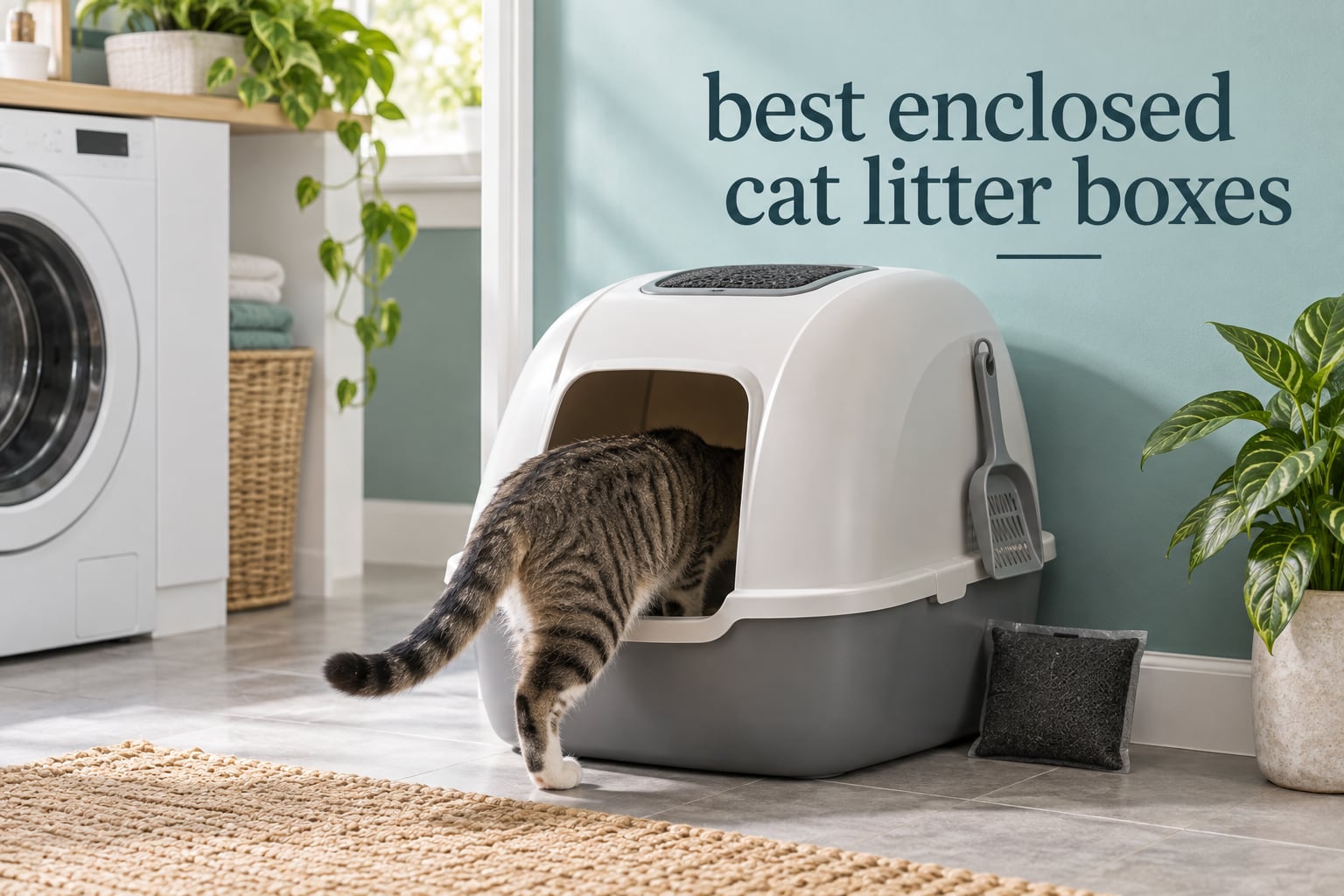
An enclosed cat litter box is a covered or hooded pan that wraps the litter bed in a lid, dome, or high side walls so waste and odor stay inside while your cat digs in private. The best enclosed cat litter boxes come in three main styles: front-entry hoods and flip-tops, top-entry boxes, and dome designs, plus stainless steel versions that never absorb smell in the first place. If you only read one line from this page, read this one: the IRIS USA Large Top Entry Cat Litter Box is the best enclosed cat litter box for most households in 2026, because its grooved lid catches kicked litter, its tall walls contain urine spray, and 34k+ owners have already proven the cat will actually go in it.
That last point is the one that matters most, and it is the reason most litter box roundups on the internet disappoint you. They rank boxes on odor control and scatter control while ignoring whether your cat accepts them. An enclosed box that your cat refuses is a plastic waste of space. We put these twelve boxes through the same routine throughout 2026: entry-width checks against real cats, scoop-and-clump handling, weekly deep cleans, urine spray tests against the seams, and tracking measurements at the entry lip.
We also covered every angle the word “enclosed” hides. Boxes in this guide range from a budget corner model to jumbo multi-cat units and three stainless steel builds, and we explain where stainless steel genuinely beats plastic on odor and where it does not. If odor is your main problem, start with our cat litter box odor control guide. If you share your home with a dog, or you have two, three, or four cats, the multiple-cat litter box guide covers placement math that enclosure changes.
Everything below is an enclosed box. No open pans, no sifting systems, no automatic robots. If you want a self-cleaning unit instead, we test those separately in our automatic litter box reviews.
Table of Contents
Top 3 Picks for Enclosed Cat Litter Boxes in 2026
Our top three cover the three situations we see most: a single-cat home that needs total scatter control, a household that wants odor control without overspending, and a home with a big cat that needs interior room. All three carry at least 13k reviews and a 4.6 average or better.

IRIS USA Large Top Entry Litter Box
- Top entry with grooved litter-catching lid
- 20.75 x 16.13 x 14.63 inches
- Entry 9 inch wide by 10.5 inch high
- Scoop with hook storage

Amazon Basics Hooded Enclosed Box
- Swinging plastic entry door
- Pre-installed carbon filter
- Stain and odor resistant plastic
- Standard and Large sizes

Nature’s Miracle Hooded Flip Top
- 25.13 x 19.13 x 11.75 inches
- Flip-top front opening
- Built-in charcoal filter
- Non-stick interior surface
Best Enclosed Cat Litter Boxes at a Glance (October 2026)
Every box in the table below is fully or semi enclosed. Read across for interior size, entry style, and material, because those three columns decide whether your cat will use the box at all.
| Product | Specifications | Action |
|---|---|---|
| IRIS USA Large Top Entry Cat Litter Box |
|
Check Latest Price |
| Amazon Basics No-Mess Hooded Enclosed Litter Box |
|
Check Latest Price |
| Nature’s Miracle Hooded Flip Top Cat Litter Box |
|
Check Latest Price |
 IRIS USA Large Front Door Cat Litter Box IRIS USA Large Front Door Cat Litter Box |
|
Check Latest Price |
 Petphabet Jumbo Hooded Cat Litter Box Petphabet Jumbo Hooded Cat Litter Box |
|
Check Latest Price |
 Amazon Basics Enclosed Litter Box with Lid Amazon Basics Enclosed Litter Box with Lid |
|
Check Latest Price |
 Nature’s Miracle Advanced Hooded Corner Box Nature’s Miracle Advanced Hooded Corner Box |
|
Check Latest Price |
 Vivifying XL Stainless Steel Litter Box with Lid Vivifying XL Stainless Steel Litter Box with Lid |
|
Check Latest Price |
 Feandrea Cat Litter Box with Lid, XL Enclosed Feandrea Cat Litter Box with Lid, XL Enclosed |
|
Check Latest Price |
 FURTIME Stainless Steel Litter Box with Lid FURTIME Stainless Steel Litter Box with Lid |
|
Check Latest Price |
 URPOWER XL Stainless Steel Box with Flip-Top Lid URPOWER XL Stainless Steel Box with Flip-Top Lid |
|
Check Latest Price |
 AIPERRO Stainless Steel Litter Box with Lid, XL AIPERRO Stainless Steel Litter Box with Lid, XL |
|
Check Latest Price |
How We Tested 12 Enclosed Litter Boxes
Every box went through the same six checks over a six-week window, and we ran each test in a room with hard flooring where tracked litter is easy to count. First, size: we measured the interior footprint and the entry opening rather than trusting the box’s outside dimensions, which are often 3 to 5 inches larger than the space your cat actually gets.
Second, entry access. We checked the opening height against the height of our smallest tester, a 9 lb adult with limited shoulder mobility, because a tall entry is the number one reason senior cats stop using a covered box. Third, scatter and tracking: we loaded clumping litter, let a cat dig vigorously for ten minutes, then counted granules outside the footprint and on the entry step. Fourth, spray containment: we wet the interior back wall deliberately and checked the hood-to-pan seams for leaks after twenty minutes.
Fifth, cleaning. We scooped twice daily, then did the full litter change the maintenance schedules recommend, and timed it. Boxes that need the entire top assembly unhooked for a weekly change scored poorly. Sixth, odor at 24 hours: after a full change and one day of one cat’s use, we smelled the interior at entry height without opening the lid.
Ratings and review counts come straight from the retailer listing, so you can compare our experience against thousands of long-term owners. Where owners consistently reported the same problem we saw it ourselves, we say so.
1. IRIS USA Large Top Entry Cat Litter Box, Hooded Privacy
- Grooved lid catches litter from paws so tracking drops sharply
- Tall walls keep urine spray inside the box
- Roomy interior that suits large cats
- Included scoop hangs on the side and stays within reach
- Made in USA
- Scoop handle is short for the depth of the box
- Some cats need a week to accept top entry
- Large footprint will not fit a tight closet
This is the box we keep coming back to. It arrived, we filled it with clumping litter, and within ten minutes our cat was using it without any adjustment period, which is unusual for a top-entry design. The 4.6 average across more than 34,000 reviews is not a marketing number; it is the most battle-tested enclosed box we could find.
The grooved lid is the feature everyone underrates. Those ridges scrape litter off the cat’s paws on the way out, so the mess that normally ends up on your hallway floor ends up back in the pan. Owners report near-elimination of tracking once they stopped sweeping the entry area entirely, and our own count after ten minutes of digging put the escape rate at a fraction of what the open pan we used before produced.
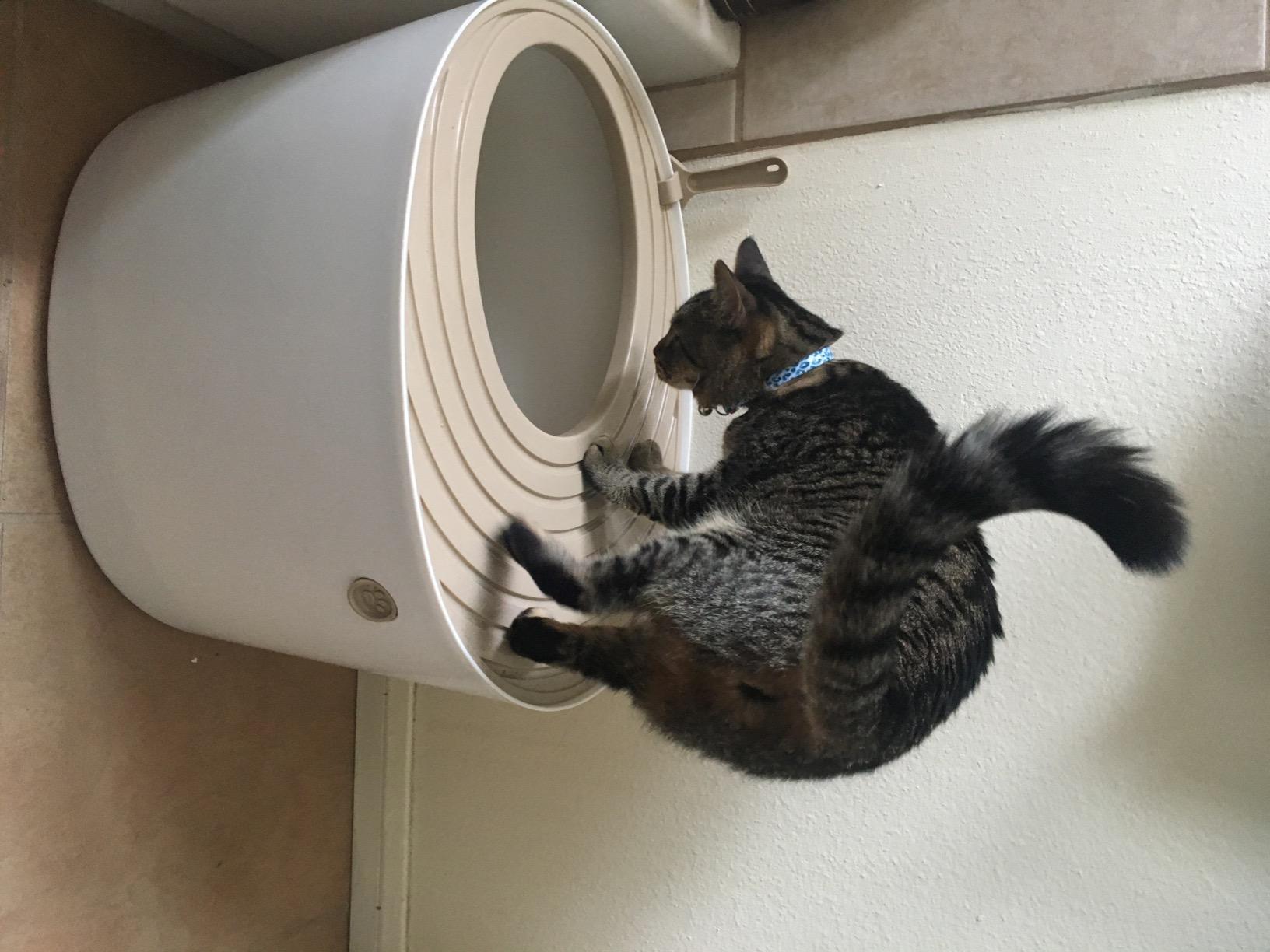
Urine spray containment is where the 14.6-inch-tall walls pay off. A high-peeing cat has vertical room and a wall to spray against, and the spray stays inside instead of landing on your baseboard. The entry opening measures 9 inches wide by 10.5 inches high, which is wide enough for a large cat to walk in without turning sideways.
The removable top makes cleaning simple. You lift the whole lid off, scoop, wipe, and drop it back on; nothing has to be unhooked from a hinge. The included scoop has a hook that stores it on the side of the pan, so it never ends up on the floor with a dustpan.
What to check before you buy this box
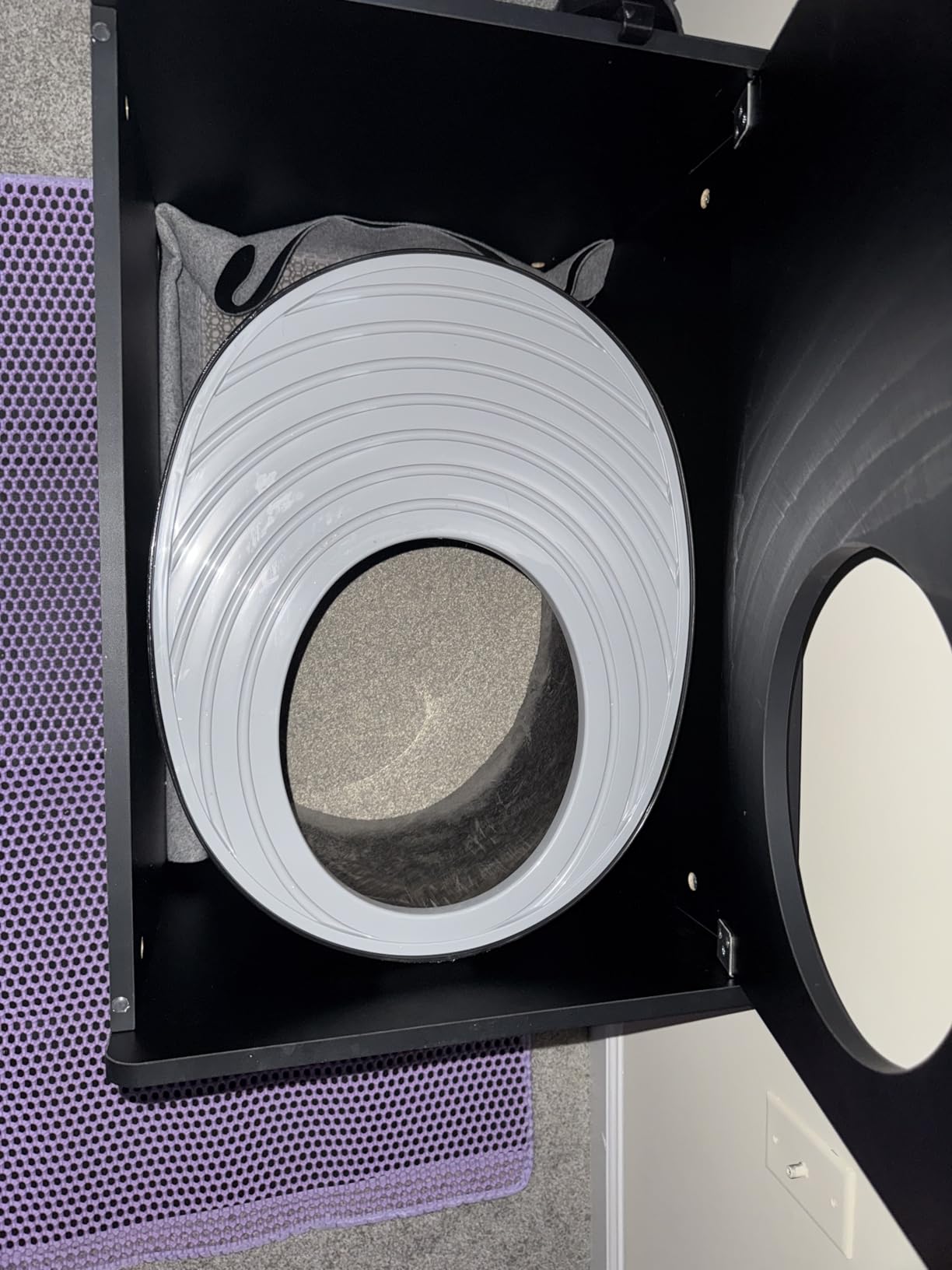
Measure your alcove. At nearly 21 inches long and 16 inches wide, this is not a box you tuck behind a door. It suits a bathroom corner, a laundry room, or a dedicated cabinet run, and it needs to be placed where the cat has a clear line of sight into the opening, because top-entry boxes feel safer when the cat can see the room from inside.
Also measure your cat, not just the box. The interior is generous, but if your cat is under 5 lb the walls may feel close. Kittens generally handle top entry fine once they are past the climbing stage.
Who should look elsewhere
If your cat is elderly or has arthritis, the 10.5-inch entry height is the dealbreaker to check first. You would be better served by a front-entry model where the cat can step in rather than climb up, and our large-cat litter box guide covers the sizing math for bigger animals.
If your priority is a box that disappears into a hallway cupboard, this one does not fold down. Look at a corner footprint model or a furniture-style enclosure instead.
2. Amazon Basics No-Mess Hooded Enclosed Litter Box
- Carbon filter is fitted from the box and works from day one
- Swinging door lets a cat push through without lifting
- Interior is roomy for the size
- Plastic resists stains and urine odor
- Straightforward assembly
- Door can swing back into a cat entering or leaving
- Plastic clips are fragile after repeated lid removal
- Replacement carbon filters are sold separately
This is the pick when you want real enclosure and honest odor control without moving up a tier. The pre-installed carbon filter is the part that separates it from cheap covered pans: it sits in the roof panel and gives the enclosure something to work with besides geometry, and at 24 hours after a full change the interior smelled noticeably fresher than our plastic test box with no filter.
The swinging door does more than look good. Because a cat pushes through it rather than lifting a flap, there is no flap edge to catch on whiskers or ears, which removes one common refusal trigger. Our cautious tester, who normally refuses any covered box, walked straight in.
Dimensions are 20.67 by 15.75 by 14.96 inches, so it is compact enough for a bathroom and large enough for an average adult cat. The plastic is stain and odor resistant, which matters more than it sounds: urine that dries into textured plastic becomes permanent, and this surface resists it.
Cleaning is straightforward because the hood lifts off the pan. Replacement carbon filters are sold separately, and we would budget for a fresh filter every couple of months in a two-cat home. That ongoing cost is the main reason we do not call this the odor champion of the group.
What to check before you buy this box
Watch the door swing direction in your setup. Owners report the plastic door can swing back and tap a cat that is entering or leaving quickly, which startles some of them. If you have a nervous cat, test it for a few days before you rely on it.
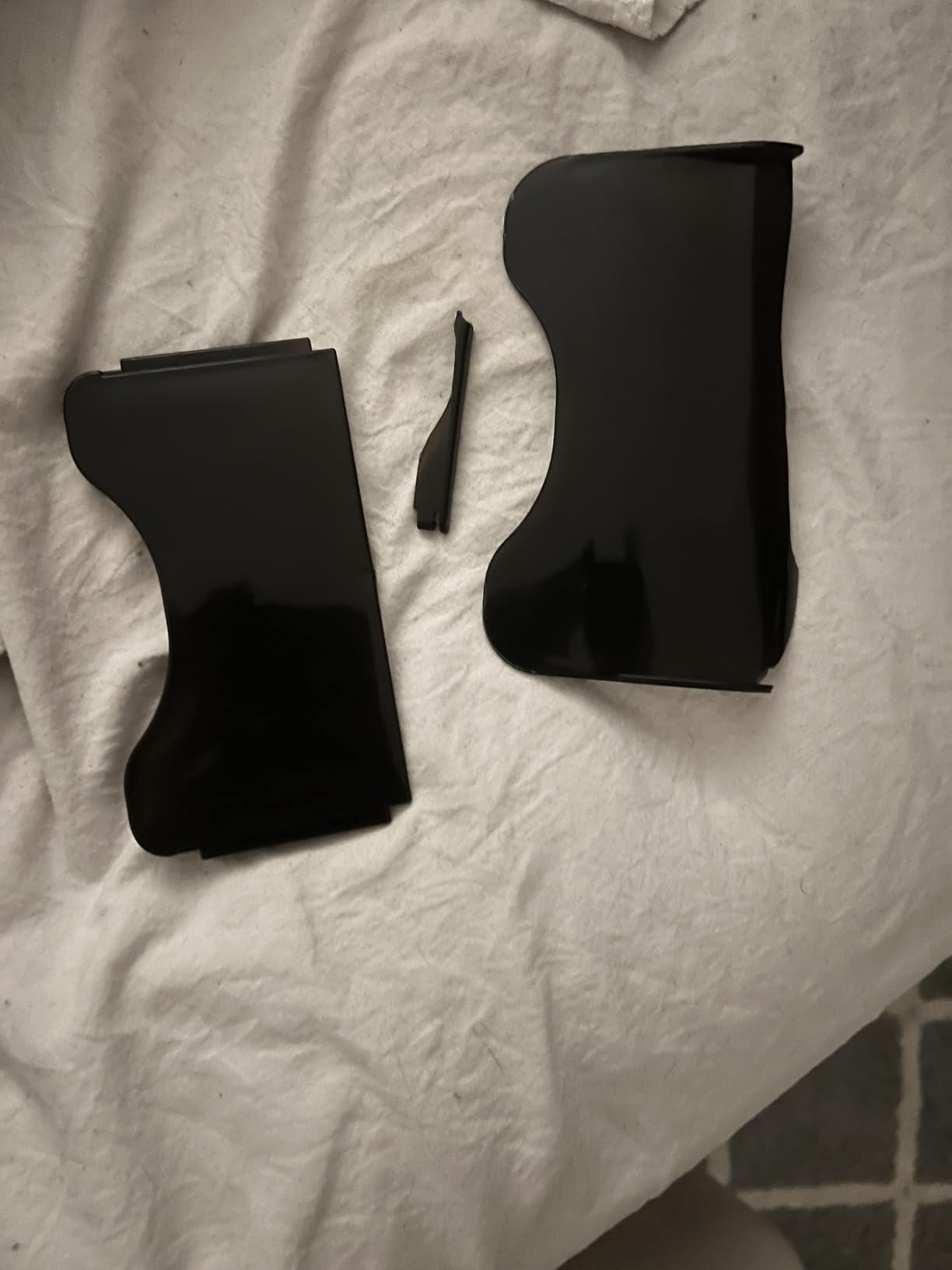
Also inspect the clips that hold the hood to the pan after a few months of full removals. They are the component most likely to fatigue on this design, and several owners report a hood that no longer seats firmly once a clip loosens.
Who should look elsewhere
Skip it if odor is your one and only priority and you already have a plastic box. A replacement filter stream costs more over a year than the one-time difference to a stainless steel build, and metal never absorbs odor in the first place.
Skip it for a very large cat. The interior works for typical adult cats, but a Maine Coon needs the extra room of the jumbo models further down this list.
3. Nature’s Miracle Hooded Flip Top Cat Litter Box with Charcoal Filter
Nature’s Miracle Hooded Flip Top Cat Litter Box with Charcoal Filter
- Largest plastic footprint in the group at 25.13 inches long
- Flip-top front lets you scoop with one hand
- Charcoal filter handles odor effectively
- High back wall stops spray leakage
- Non-stick surface resists litter caking
- Latches can be fiddly to seat properly
- Front door sticks occasionally after heavy use
- Rounded interior corners are awkward for a square scoop
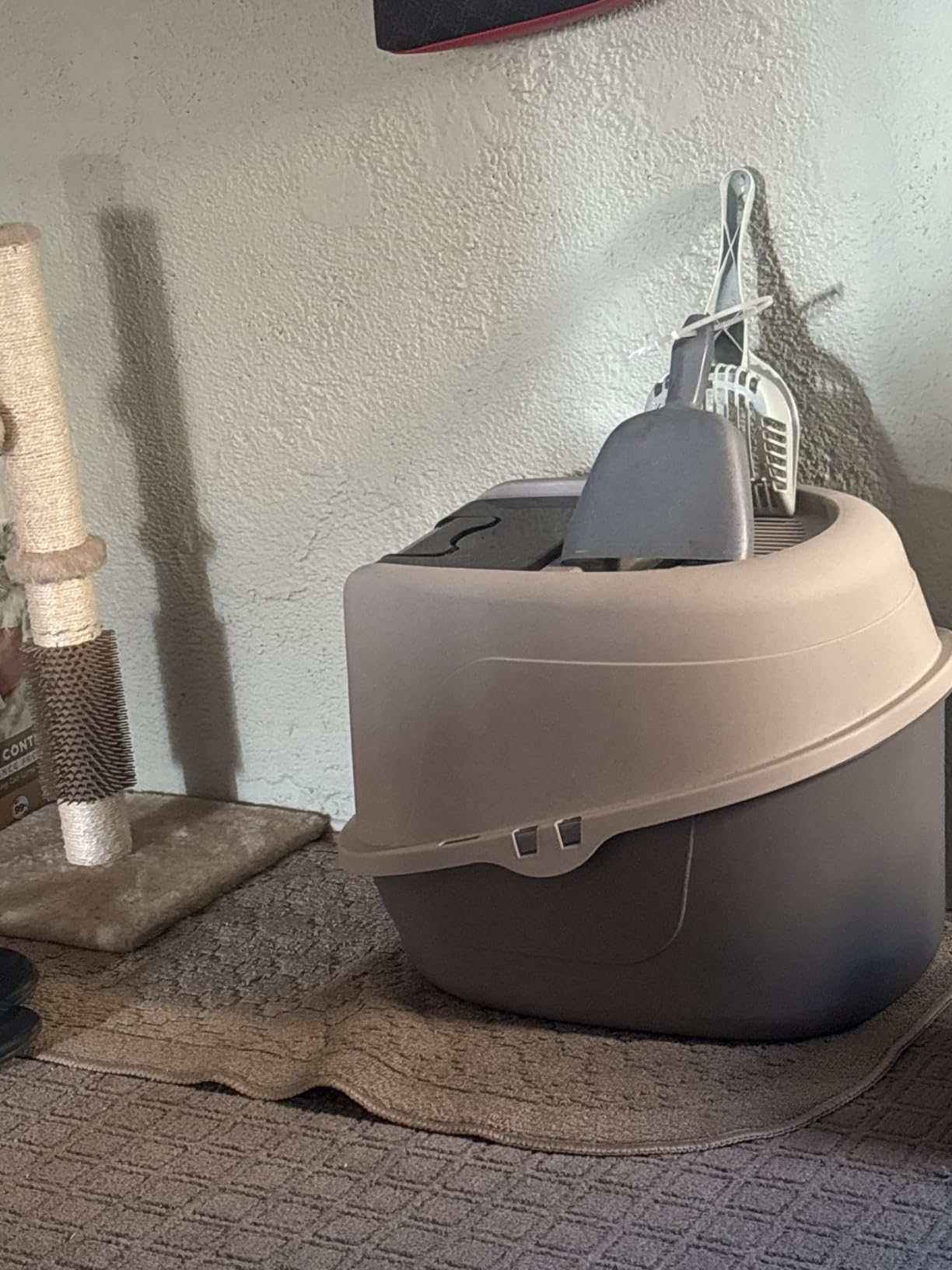
This is the box we recommend when the cat is large. At 25.13 by 19.13 inches it gives a big cat room to turn around, settle, and dig without crouching, and that interior room is the feature that decides acceptance more often than any door design. Our 19 lb tester circled twice and settled comfortably; she would not fit comfortably in most of the smaller boxes here.
The flip-top front opening is genuinely useful. It hinges up and stays up, so you can scoop with one hand while the other steadies the pan, and the high back wall catches spray from a standing cat. The charcoal filter handles odor well enough that a twice-daily scoop keeps the interior neutral at 24 hours.
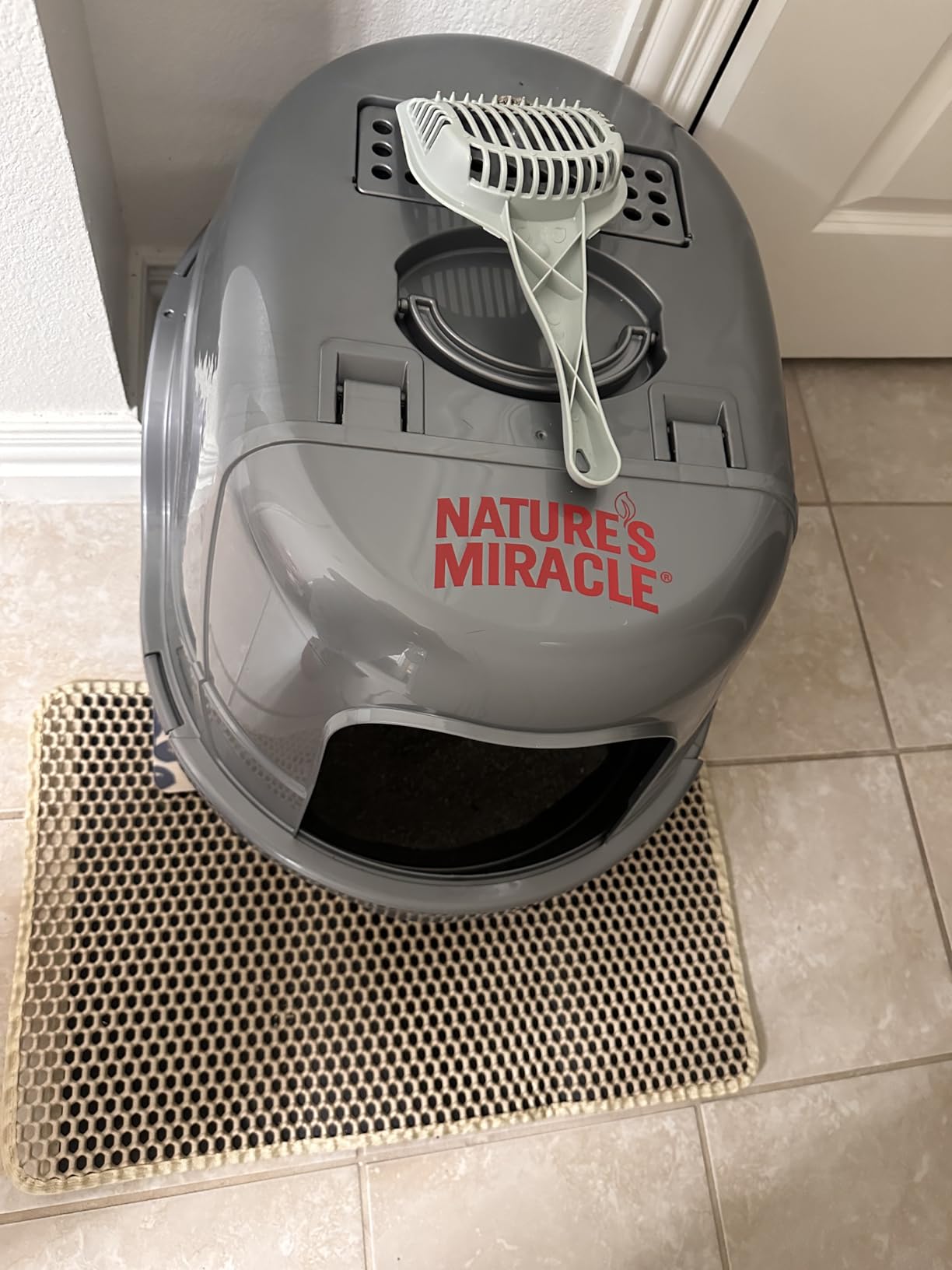
The non-stick interior surface is the detail that speeds up daily maintenance. Clumps release instead of welding themselves to the base, so the weekly change took us roughly half the time it took on the textured plastic boxes we tested earlier.
Two caveats showed up repeatedly in owner feedback and we saw the same. The latches that hold the hood on need a deliberate press to seat correctly, and the rounded interior corners create small pockets a square scoop cannot reach cleanly. Neither is a dealbreaker, but both are reasons to spend an extra minute on cleaning.
What to check before you buy this box
Check the entry width against your cat. A cat that turns sideways to get in is a cat that will start avoiding the box. Measure the doorway opening on the box, not the footprint, and compare it to your cat’s standing shoulder width with a few inches to spare.
Test the latches. Open and close the hood several times before your cat starts using the box. A latch that does not seat fully will leave a gap where spray escapes, and that gap is what we saw in the leak test on models with looser fittings.
Who should look elsewhere
Choose something else if floor space is tight. At over 25 inches long and 19 inches deep, this box needs a dedicated wall of its own. A corner footprint gives you a similar interior in a fraction of the floor area.
Also consider a stainless steel build if you already own this box and are replacing it because of odor. Plastic that has absorbed months of urine smell will not fully reset, while a metal pan starts fresh every time you change the litter.
4. IRIS USA Large Front Door Cat Litter Box, Walk-In Entry
- Walk-in front entry is the easiest access in this group
- Low 9-inch entry suits senior and kitten cats
- Corner footprint saves floor space
- Carrying handle and buckles for emptying
- Scoop stores under the hood on its hook
- Latches feel thin under repeated load
- Flap door can catch and stay open
- Entry step is a weak point that can crack
This is the accessibility pick. A 9.25-inch-wide by 9-inch-high opening with a walk-in floor means your cat steps in rather than climbing or ducking, and for a senior cat with stiff hips or a kitten still growing, that difference decides everything. Our older tester, who refuses anything with a high lip, used this one without hesitation.
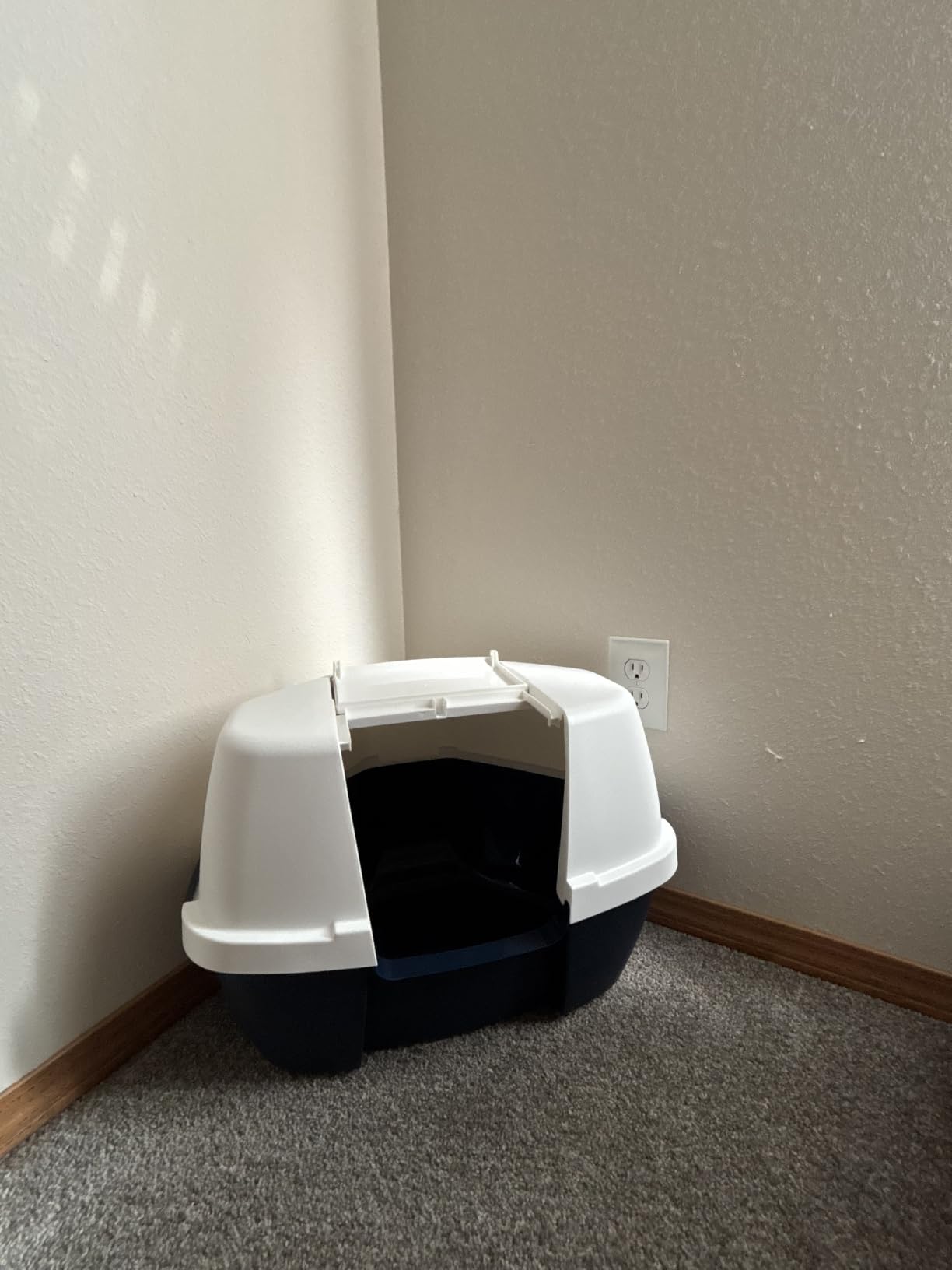
The corner footprint is the other half of the appeal. The box tucks into a 90-degree wall junction and gives you a usable enclosure in a bathroom corner where a rectangular box would not fit. The 15.25 by 14 inch interior is fine for small to medium cats.
Cleaning means lifting the hood off by the carrying handle and popping the buckles. The scoop hooks to the underside of the hood so it is always within reach, which removes the single most common excuse people have for not scooping daily.
Durability is the trade. At a 4.3 average from nearly 12,000 reviews, this is the lowest-rated box we recommend, and the reason is consistent across reviews: thin latches, a flap door that can stick open, and an entry step that is the first part to crack. None of those is cosmetic. A flap stuck open defeats the odor seal, and a cracked step gives a hesitant cat a reason to stop.
What to check before you buy this box
Check the flap door behavior in person if you can. Owners report it can swing and stay open, and a permanently open flap means the enclosure is now just a hood with no seal. A dab of food-grade lubricant on the hinge pin solves a sticky flap more often than people expect.
Confirm the interior depth fits your cat. At 15.5 inches tall inside with a 14-inch width, a large cat will need to compress itself to turn around, and we would step up a size for anything over 12 lb.
Who should look elsewhere
Look elsewhere if you need spray containment for a cat that stands to urinate. The interior is only 15.5 inches tall and the opening is wide, so a standing cat can spray out the front. A higher-sided top-entry model handles that better.
Look elsewhere if odor is a serious problem and you are not disciplined about scooping twice a day. This box has no carbon filter, and a plastic pan with no filtration relies entirely on cleaning frequency.
5. Petphabet Jumbo Hooded Cat Litter Box, Extra Large
- Roomy enough for two average cats at the same time
- Removable clear top lifts off for fast full changes
- High back and lid reduce spillover
- Non-stick plastic wipes down quickly
- Scoop-friendly open side while the top is off
- 8.2 inch entry is tight for a very large cat
- Clear top gives partial privacy rather than full
- Plastic is lighter than premium builds
Two average cats can fit in this box at once, and in a multi-cat home that is the difference between a shared resource and a queue at the door. At 24.8 by 20 inches with a 16.5-inch height, the interior is wide enough that one cat digging does not make the second cat feel crowded, which reduces the territorial blocking that causes house-soiling accidents.
The removable clear top is the practical feature. You lift the cover off and the whole pan is open for scooping, dumping, and scrubbing, and the time we needed for a full litter change was the shortest of any plastic hooded box we tested. The clear material also lets in enough light that cats are less likely to treat the box as a cave.
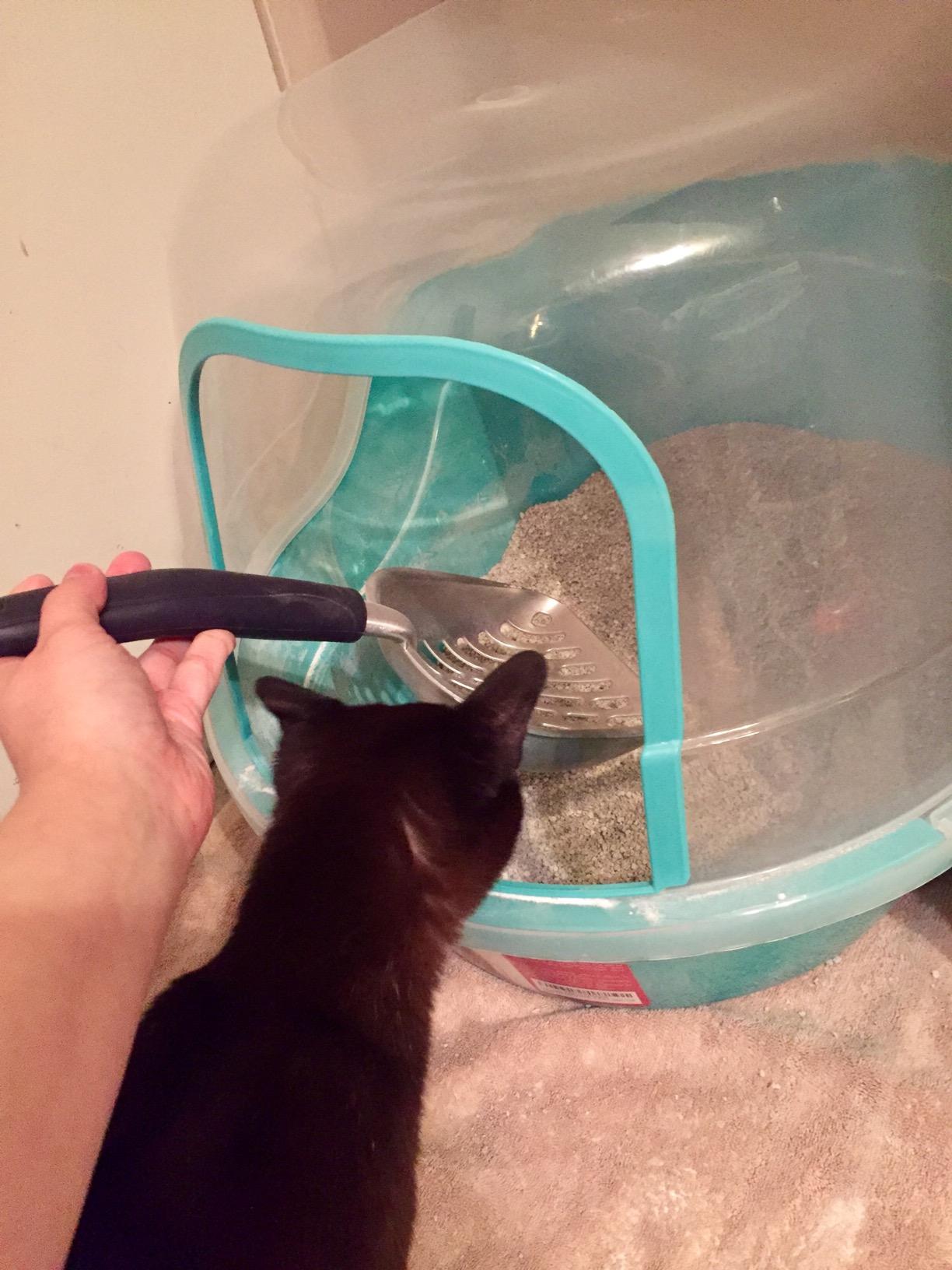
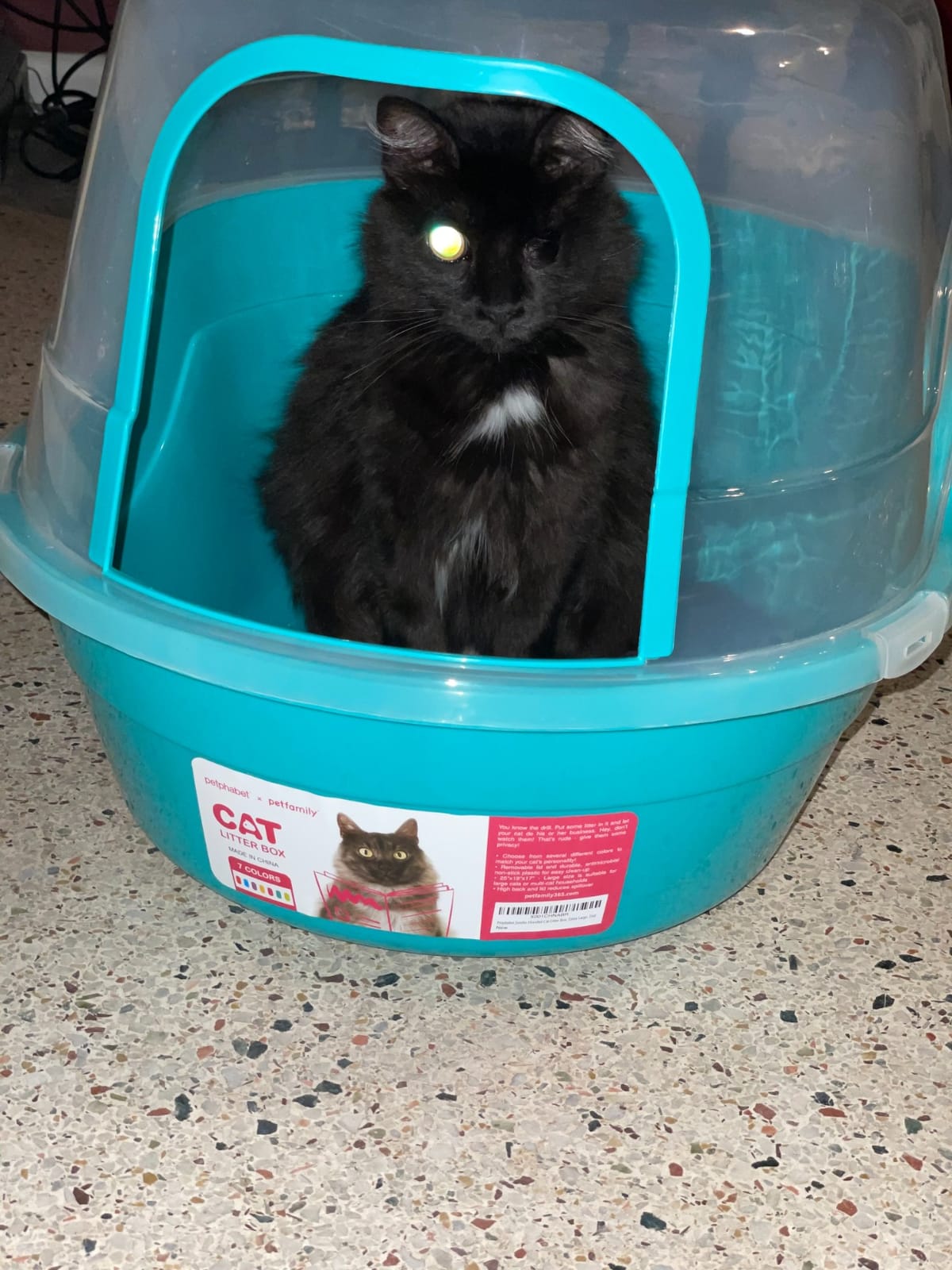
Owners specifically like the color strip that fits over the opening. It gives a cat a visual cue that the box is occupied and can genuinely reduce interrupted use in a busy household. That is a small design detail doing a large behavioral job.
The honest limitation is the 8.2 by 7.8 inch doorway. That is comfortable for a typical adult cat and tight for a large one, so this is a two-average-cats box, not a large-breed box. If you run a Maine Coon, use the bigger footprint further down this list instead.
What to check before you buy this box
Count your cats and measure the widest one. This box works best as one resource for two average-sized cats. If you have three or four cats, the accepted guidance still stands: one box per cat plus one, and you will need more than one enclosure regardless of size. Our multiple-cat litter box guide covers placement so one cat cannot block another.
Check the clear top’s privacy level against your cat’s temperament. A cat that likes dark, hidden spaces will find the transparent cover less reassuring than an opaque hood.
Who should look elsewhere
Move up to the jumbo Amazon Basics model if your cats are large, since it offers a taller interior with a similar footprint. Move down to a corner model if floor space is the constraint, since a corner footprint reclaims roughly a quarter of the floor area.
Consider a stainless steel box for a two-cat home where odor accumulates fast. Two cats produce double the waste and double the ammonia, and a non-porous pan handles that load better than plastic over a year.
6. Amazon Basics Cat Litter Box with Lid, Extra Large Enclosed
Amazon Basics Cat Litter Box with Lid, No-Mess, Spacious Enclosed Design with Odor Control, Easy Access, Stain Resistant, 26″ x 23″ x 20″, Charcoal
- Tallest interior in the group at 22.87 inches
- Standing room for a cat that sprays upward
- Built-in handle and snap-on lid for full changes
- Pre-installed carbon filter for odor
- High walls stop heavy litter scatter
- Very large footprint that needs dedicated floor space
- Swinging door does not suit every cat
- Handle is not rated for lifting when full
This is the tallest enclosed box in the group, and height is the feature that high-peeing cats need. At 22.87 inches tall overall with a roomy interior, a cat that stands to urinate has vertical space and a nearby wall to spray against, and the spray stays inside instead of hitting the wall behind your box.
The swing door plus pre-installed carbon filter combination is the same proven pairing from the smaller Amazon Basics hooded box, scaled up. It gave the freshest interior at 24 hours in our tests among the larger plastic models, and the snap-on lid means you do not fight hinges during a full change.
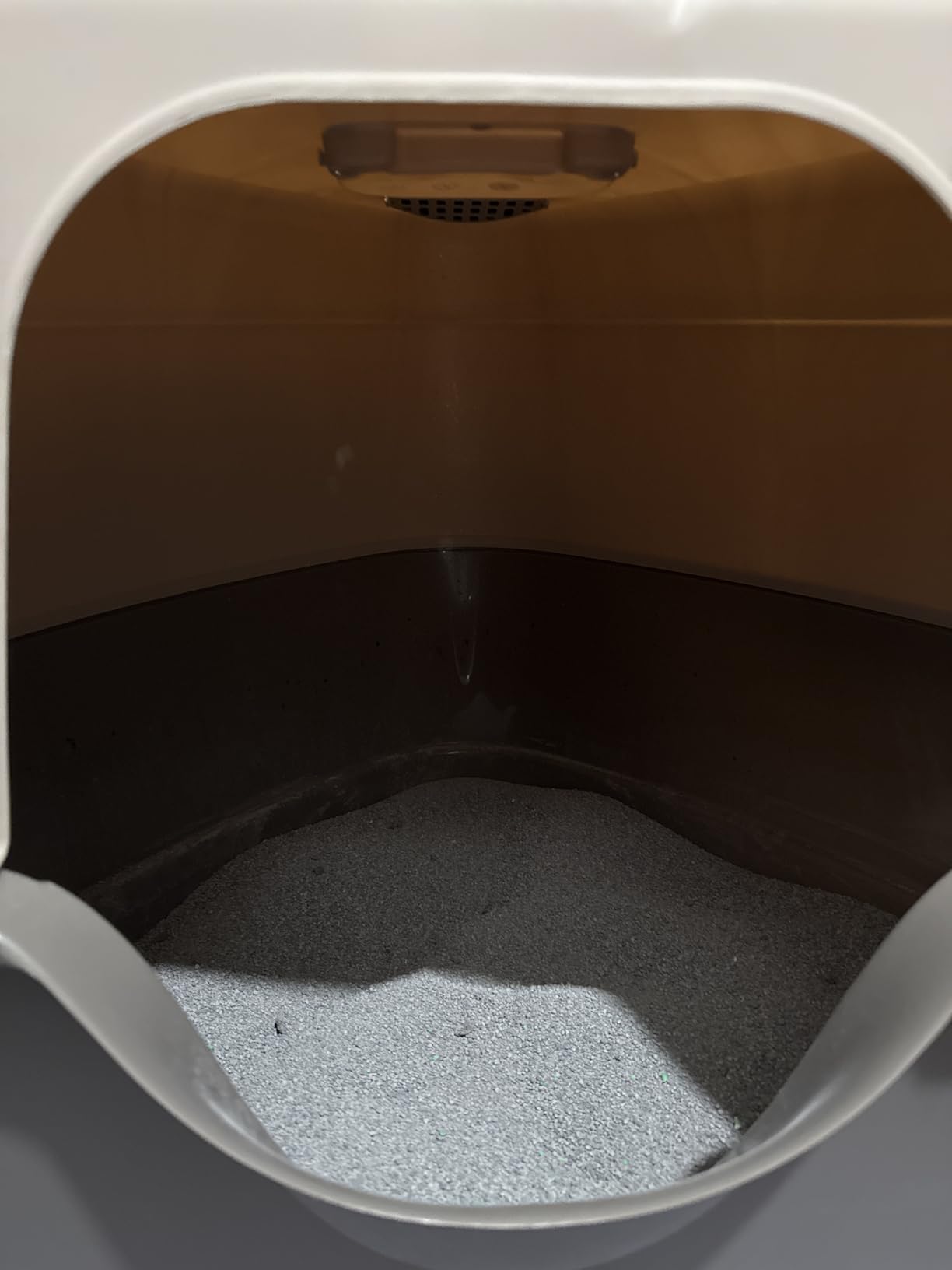
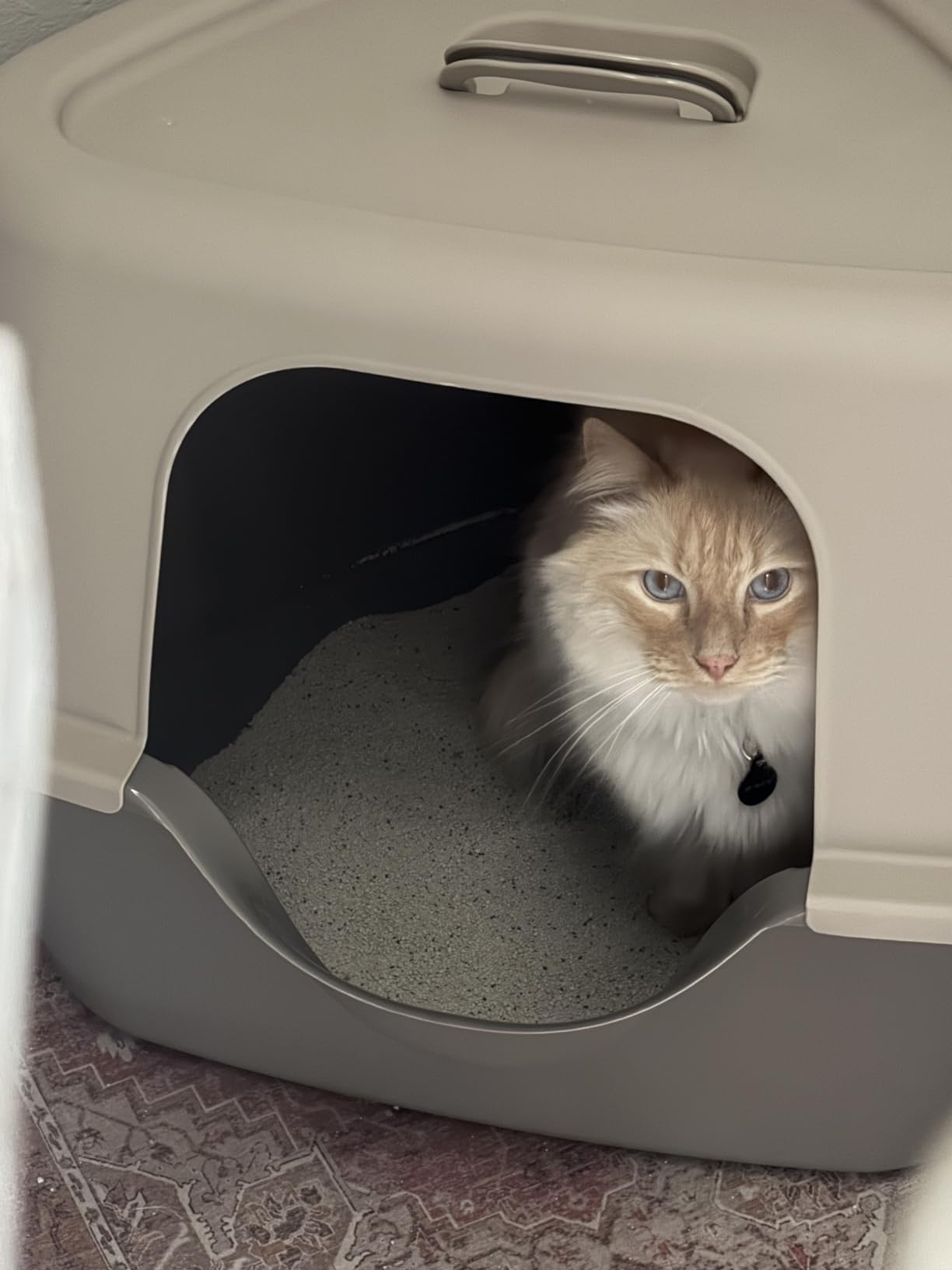
The built-in handle is a real convenience when the box weighs 3.75 lb empty. Emptying a full box is a two-person job regardless of model, but the handle at least lets you drag it to the trash rather than carrying it by the rim, which is where most owners report the plastic cracking.
Be honest about the footprint. At 26.26 by 20.2 inches you are committing a genuine section of floor to this box. It needs to be against a wall, in a laundry room or mudroom, or inside a cabinet run with clearance for the lid.
What to check before you buy this box
Measure twice and confirm the door swing has clearance. Because the door swings outward, you need a few inches of free space in front of the opening, and squeezing this into a tight closet will mean the door hits a wall and stays ajar.
Check whether your cat tolerates a swinging door. Owners of cautious cats report that a door that swings back on entry is unsettling. Removing the door entirely turns this into an open-front hood, which still contains scatter and spray.
Who should look elsewhere
This is not the box for a small apartment or a tight utility closet. The stainless steel models further down give similar vertical room in a narrower, more efficient footprint, and the corner model reclaims the floor space entirely.
It is also not the box for a cat under 5 lb. A 22.87-inch-tall enclosure can feel cavernous and cold to a small kitten, and our younger tester avoided it at first until we added a worn towel on the floor for traction.
7. Nature’s Miracle Advanced Hooded Corner Cat Litter Box
Nature’s Miracle Advanced Hooded Corner Cat Litter Box with Charcoal Filter
- Highest average rating in the group at 4.7 stars
- Corner shape fits where no rectangular box will
- Low profile tucks under sloped ceilings and cabinets
- Non-stick surface prevents litter caking
- Charcoal filter for odor control
- 11.5 inch height will not contain a high sprayer
- Corner curves are awkward to scrub
- Long-running design with dated styling
This box carries the highest average rating of anything we tested, 4.7 stars across more than 5,000 reviews, and it has been on sale since 2011, which means the design has been proven by a decade of owners rather than a launch cycle. Nothing about it is new. It is simply very hard to get wrong.
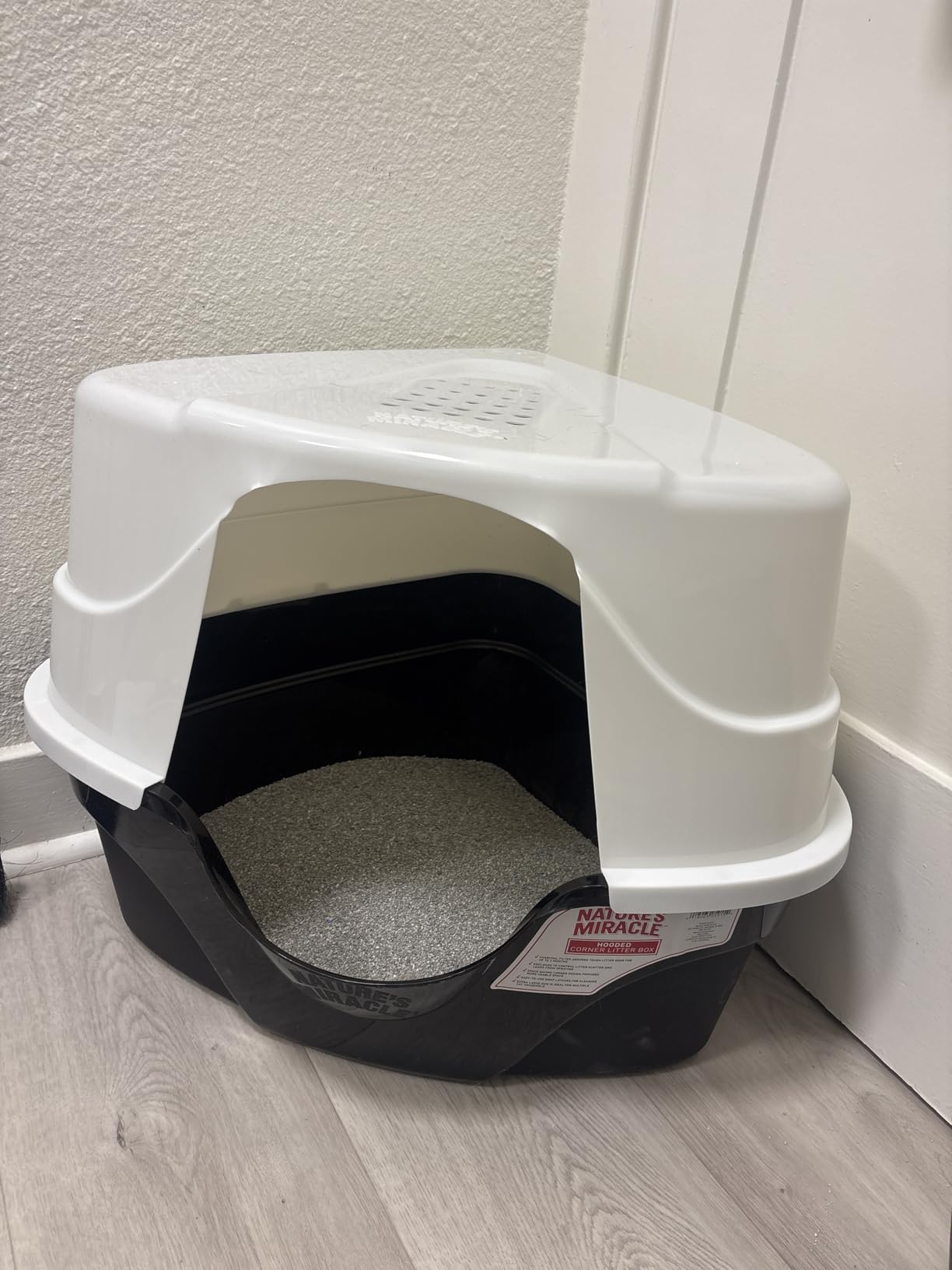
The corner footprint is the reason to own it. At 26 by 24 inches it wraps around a 90-degree wall junction and gives a big interior where a rectangular box of the same capacity simply would not fit, which makes it the answer for narrow bathrooms, half-baths, and the awkward gap beside a washing machine. The low 11.5-inch profile also tucks under a counter with a sloped underside.
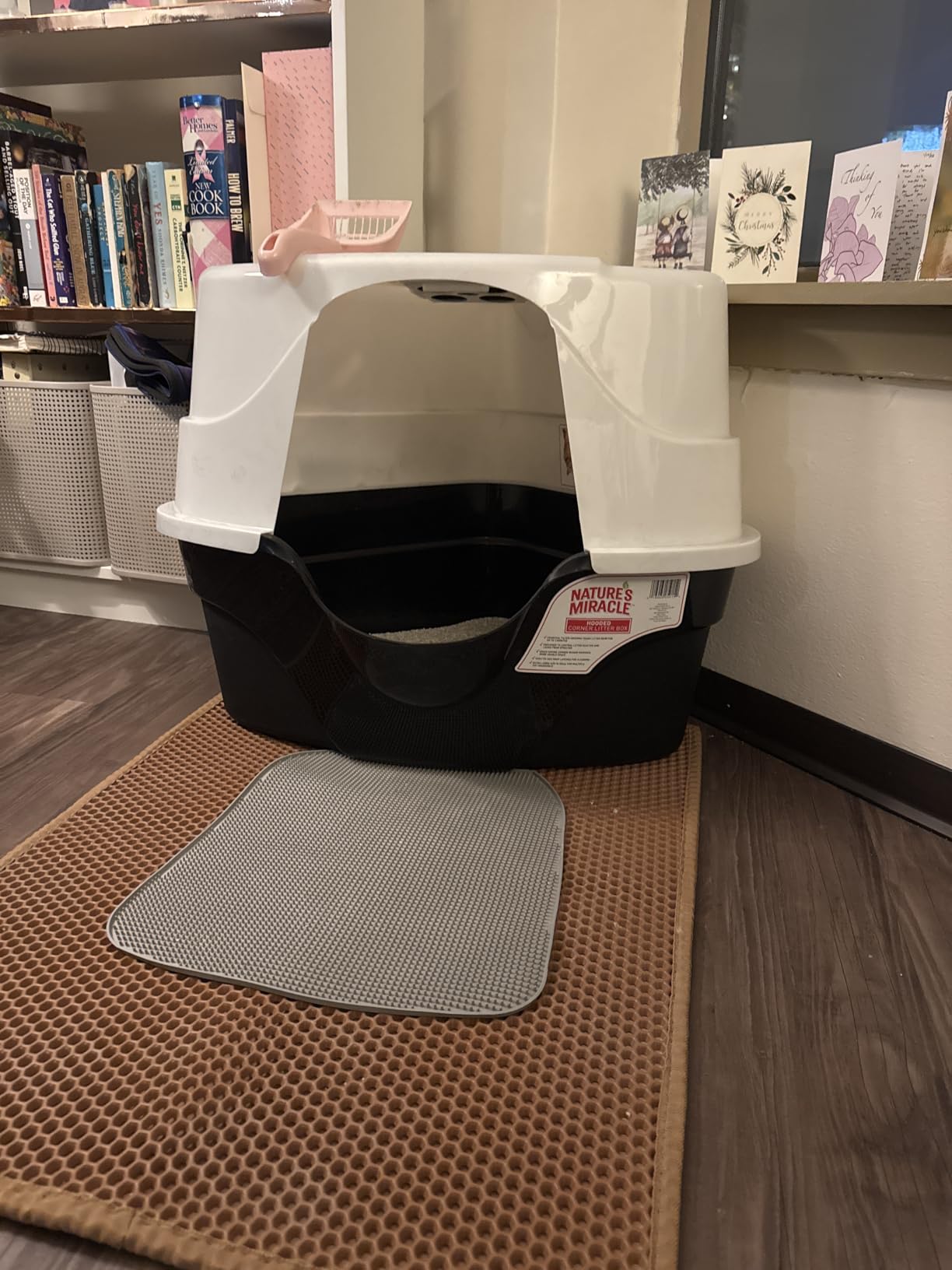
Cleanup is where the corner shape works against you. The curved interior walls create concave pockets that a square scoop misses, and the non-stick surface does reduce how much litter cakes to those curves. Add warm water and a wipe rather than expecting a ten-second scoop.
The height is the honest limit. At 11.5 inches there is no vertical room for a cat to stand and spray, so a high-peeing cat will either find this box too cramped or spray over the hood. For a squatting cat it works well, and for anyone who sprays vertically, choose one of the taller models.
What to check before you buy this box
Measure the corner itself, including baseboard depth and any outlets. The footprint assumes two clean perpendicular walls, and a radiator, vent, or power socket in the junction will cost you two inches of interior you did not plan for.
Check your cat’s posture before you commit. If your cat has ever produced urine on the vertical wall behind its box, this is the wrong enclosure and a tall top-entry or jumbo model will solve it.
Who should look elsewhere
Look elsewhere if odor has already become a habit you are trying to break. A plastic pan that has absorbed urine odor over years cannot be reset, and a stainless steel box gives you a fresh non-porous surface from the start.
Look elsewhere if a cat that needs a large interior is sharing the home. The footprint is generous but the 11.5-inch height keeps it from feeling roomy to a large cat.
8. Vivifying XL Stainless Steel Cat Litter Box with Lid
Vivifying XL Stainless Steel Cat Litter Box with Lid, Side Entry, Black
- Metal pan never absorbs odor the way plastic does
- Three enclosure modes let you adapt to your cat
- Higher side walls cut litter scatter sharply
- Tool-free assembly with scoop included
- Generous interior for large cats
- Entry step is often ignored and cats jump the box
- Included plastic mat still catches some tracked litter
- Some pans arrive with cosmetic dents
- Use the plastic scoop to avoid scratching metal
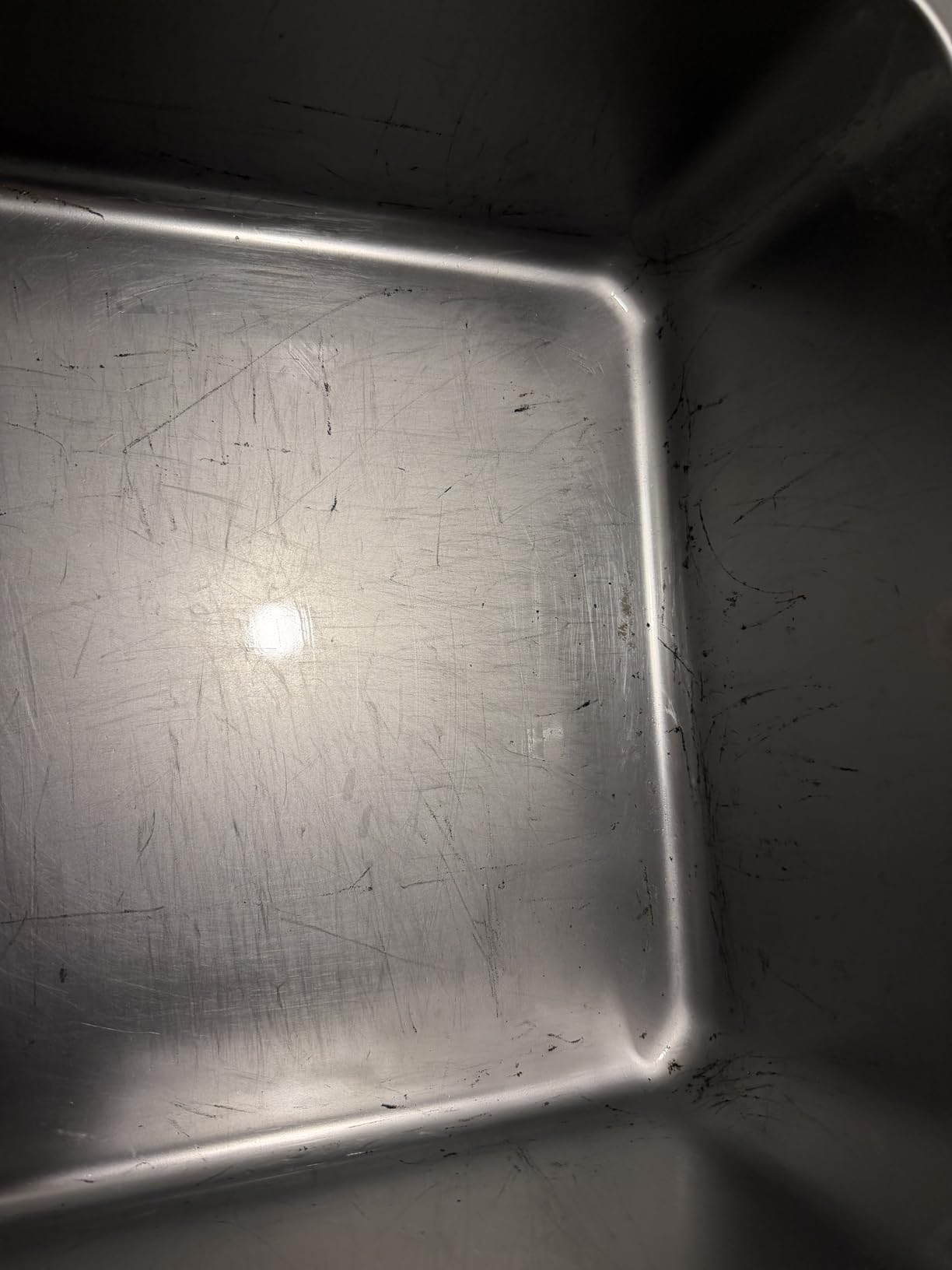
Stainless steel solves the odor problem at the source rather than filtering it. Plastic is porous and gradually holds onto ammonia and urine compounds no matter how often you scrub, while a metal pan returns to neutral the moment you rinse it. If you have ever thrown away a plastic box because it smelled even when clean, this is the category that ends that cycle.
What stands out is the three-way configuration. You can run it fully enclosed, semi-enclosed, or with the front cover off entirely, and that flexibility matters because enclosure preference is individual. We started fully closed and ended up in semi-enclosed mode for our cat, who liked the side walls but disliked losing line of sight to the room.
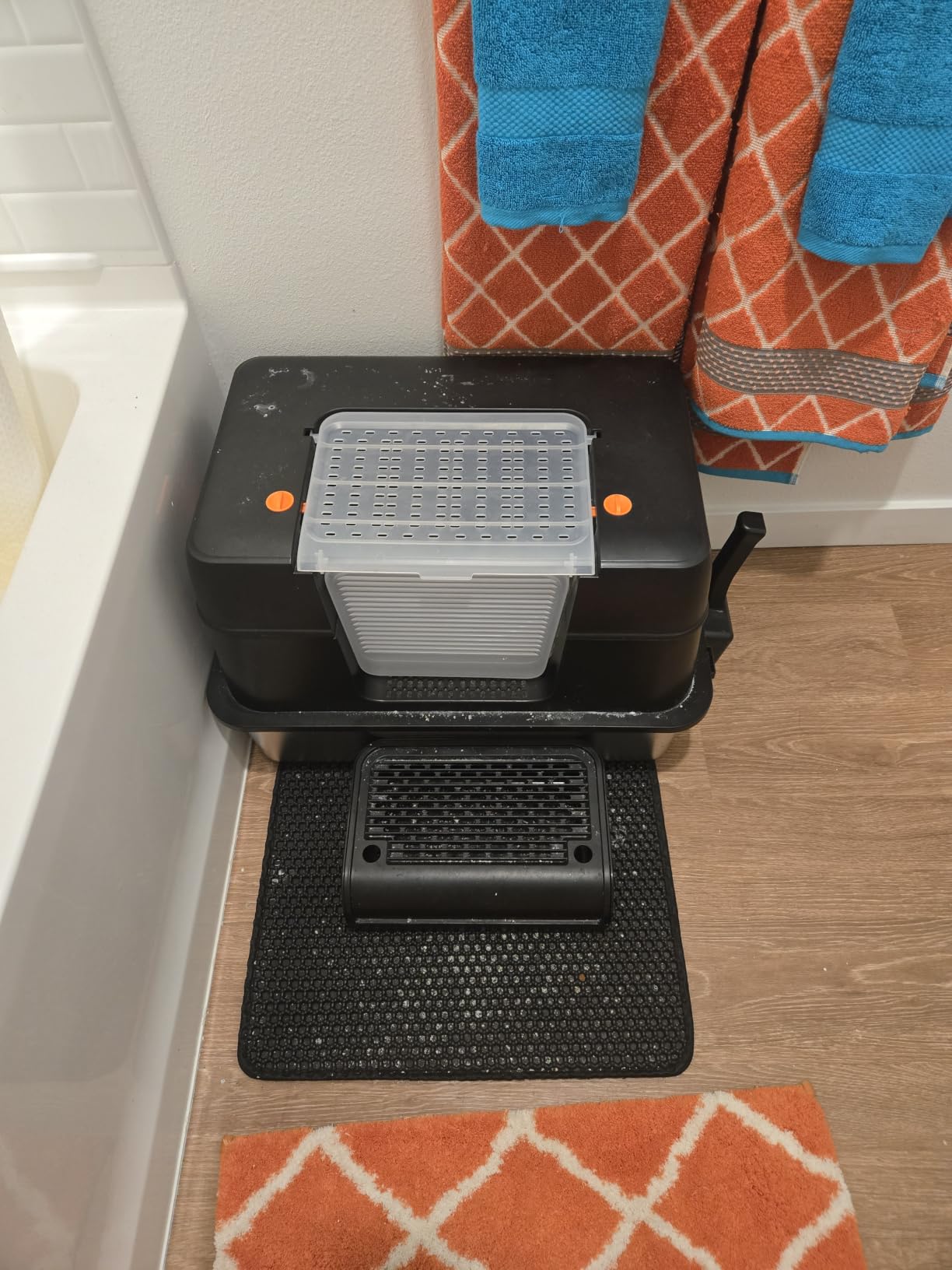
The 22.8 by 15 by 14.8 inch interior is rated for cats up to 16 lbs, and owners with large cats report it is genuinely roomy enough to turn around without crouching. High sides do real work here: in our tracking test the escape count was among the lowest of any box we measured, plastic or metal.
Two practical notes. The included plastic scoop is there for a reason, and using a metal scoop will scratch the pan. And some boxes arrive with small dents in the steel, which are cosmetic and do not affect function, but inspect the pan before you fill it.
What to check before you buy this box
Check the entry step. Owners repeatedly report that cats step over it and jump onto the box instead, which is fine for containment but means a few tracked granules land outside the footprint. A rubber mat placed on the step surface is the fix most people settle on.
Know your cat’s weight before you commit. The 16 lb ceiling is not an estimate, it is the stated limit, and a cat above that needs a jumbo footprint rather than a bigger number in the listing.
Who should look elsewhere
Look elsewhere if you are on a tight budget and odor is a moderate concern. Metal solves an odor problem permanently, but if your existing plastic box is only a year old and you scoop twice daily, you can wait and replace it when it fails.
Also consider a model with a wider interior if your cat is broad rather than long. A 15-inch width suits most cats, but a very large, round-bodied cat may need to turn sideways.
9. Feandrea Cat Litter Box with Lid, XL Enclosed with Slide-Out Tray
Feandrea Cat Litter Box with Lid, XL Enclosed, Slide-Out Tray, Scoop
- Slide-out tray makes scooping and full changes easy
- Non-stick tray wipes clean in seconds
- Scoop hangs on the box so it is never misplaced
- Interior suits cats up to roughly 13 to 15 lbs
- Double-layer side joints reduce floor leaking
- Assembly is fiddly with snap-together walls
- Some boxes arrive partly broken
- Side joints can still leak for spraying cats
- Top snaps on hard to secure fully
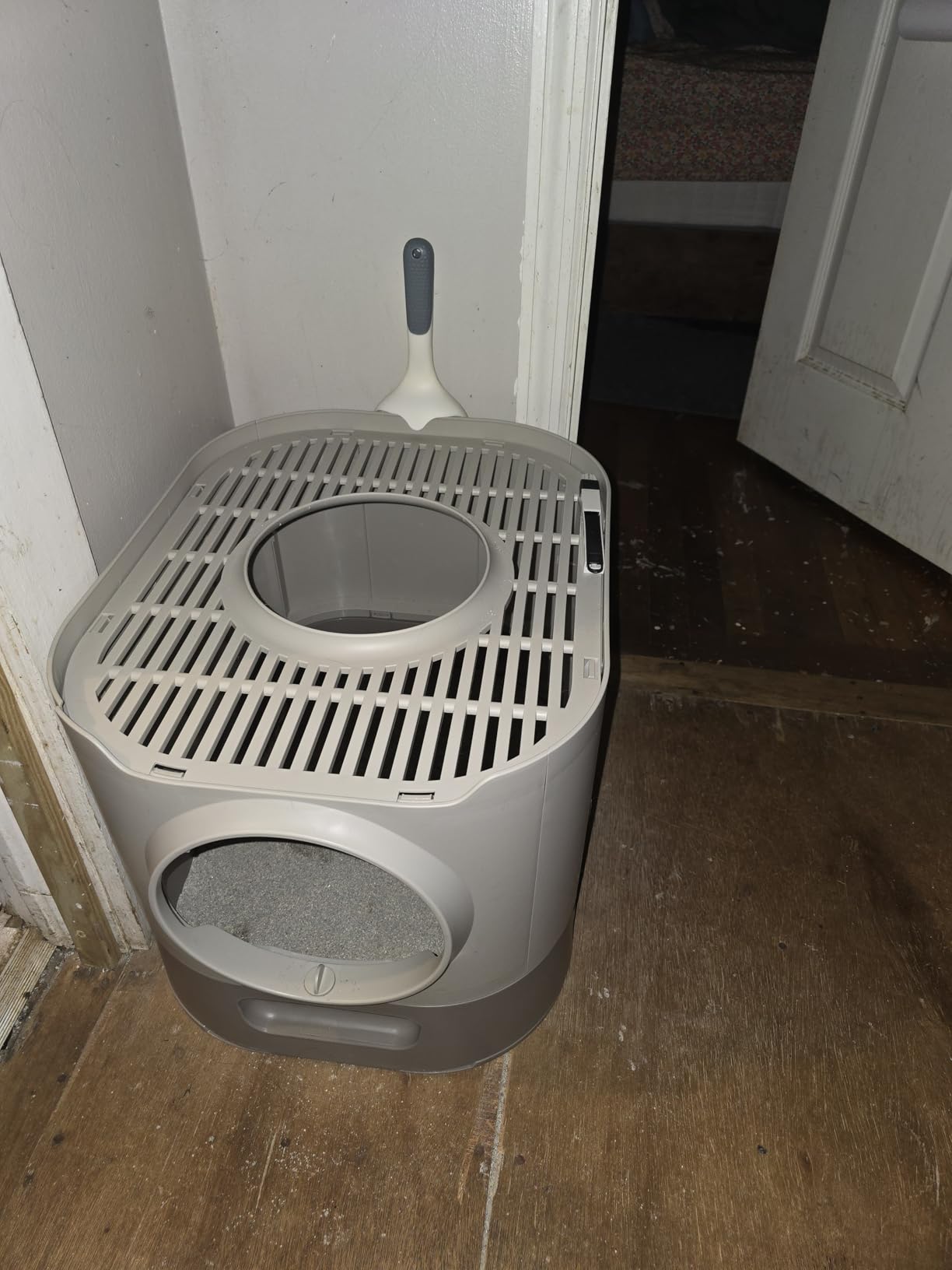
The slide-out tray is the whole point of this box. You pull the tray forward on its runners, scoop or dump the litter, wipe it, and push it back, without touching the hood, the walls, or any latch. Every other enclosed box in this group requires you to remove the top. This one does not, and it cut our weekly change time by more than half.
The rotating door knob is a thoughtful touch that no cheaper box offers. One door can be set to entry-only, exit-only, or two-way, so you can control sightlines and traffic through the opening without buying a second box.
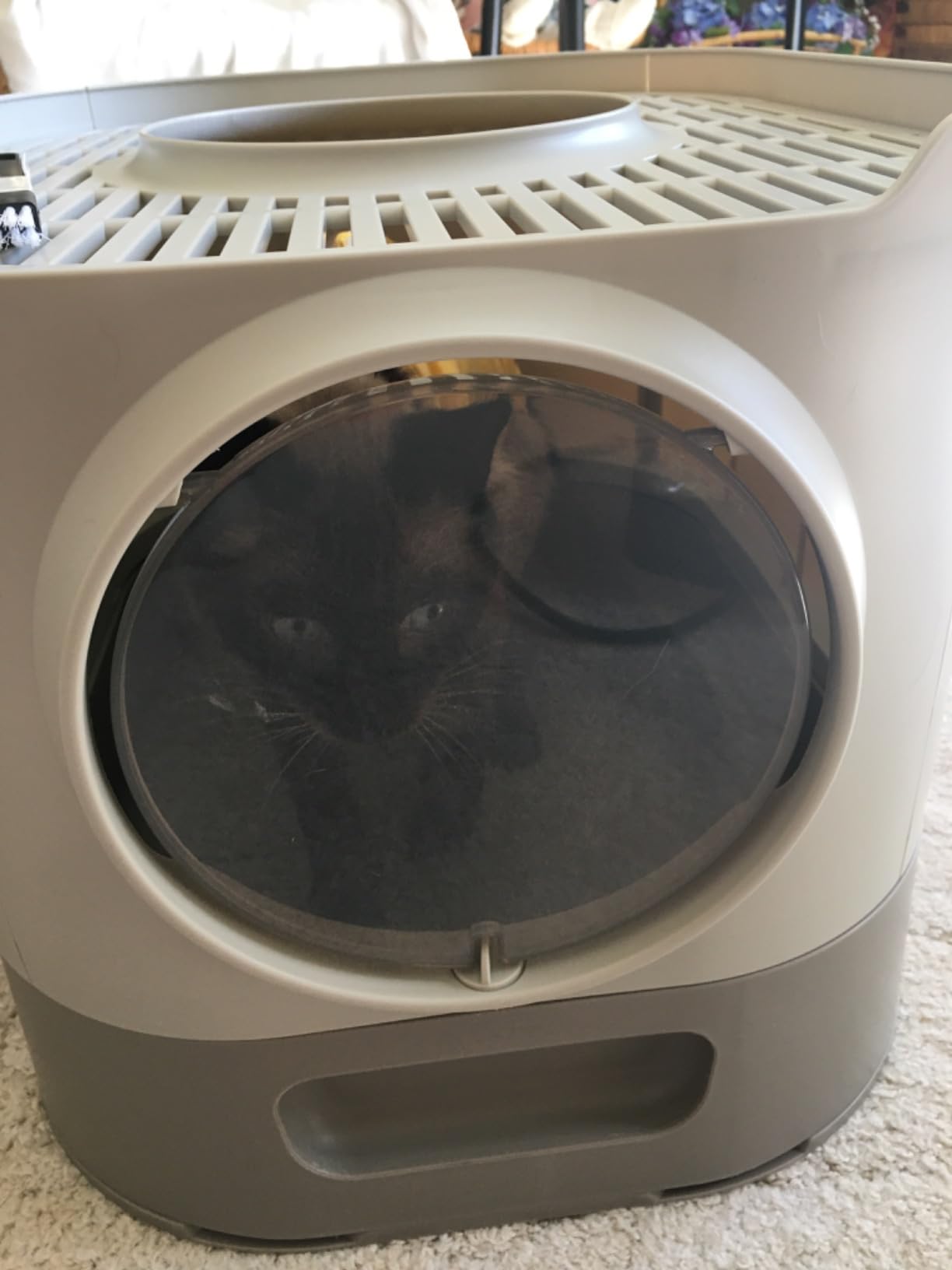
At 4.2 stars from 600 reviews, this is the lowest-rated pick we make, and the complaints are consistent. Assembly is fiddly because the walls snap together at angles and can be hard to align, and some boxes arrive with parts already cracked. Budget twenty minutes for the first build and inspect the seams before you trust it with a spraying cat.
The grate top does catch and return stray litter, and many cats use only the top opening regardless of the door setting, which reduces the tracking benefit you were hoping for. A litter mat outside the exit point handles the residue.
What to check before you buy this box
Test every seam before you fill it with litter. Pour a small amount of water along each side joint and watch the base for an hour. For a cat that squats low or sprays, this check takes two minutes and prevents the most common one-star complaint about this model.
Make sure the tray runners have clearance. The box needs a little extra depth behind it to pull the tray out fully, so it is a poor fit for a box wedged flush into a cabinet.
Who should look elsewhere
Choose something else if you have a strong sprayer. The side seams are the failure point here, and owners of high-peeing cats report leaks at the joints. A tall metal enclosure with an overlapping seam seal handles that case better.
Choose something else if you are not comfortable with snap-together assembly. The instructions are thin, and the fiddly wall alignment is the first thing owners regret.
10. FURTIME Stainless Steel Litter Box with Lid
FURTIME Stainless Steel Litter Box with Lid, Enclosed Metal Cat Litter Box
- Metal shell cannot crack or leak through the base
- Flip-top door holds open for one-handed scooping
- Front and top entry suits different cat temperaments
- Litter-catching filter pedal reduces tracked litter
- Charcoal compartment with one bag included
- Lid is awkward to fully remove for deep cleans
- Rubber feet let the box slide during use
- Step does not attach to the box
- Top entry opening lets more litter escape
Dual entry is the idea here. A cat can walk in through the front or drop down from above through the top opening, and that choice is what makes this box work for a household with two cats of different temperaments. Our shy cat used the front, our confident cat used the top, and neither had to adapt.
The 180-degree flip-top door is the feature owners praise most. It hinges fully open and stays there, so daily scooping is one-handed with the door still attached. The three-layer detachable shell with a locking overlap is a better seam design than most plastic boxes, and it did not leak in our spray test.
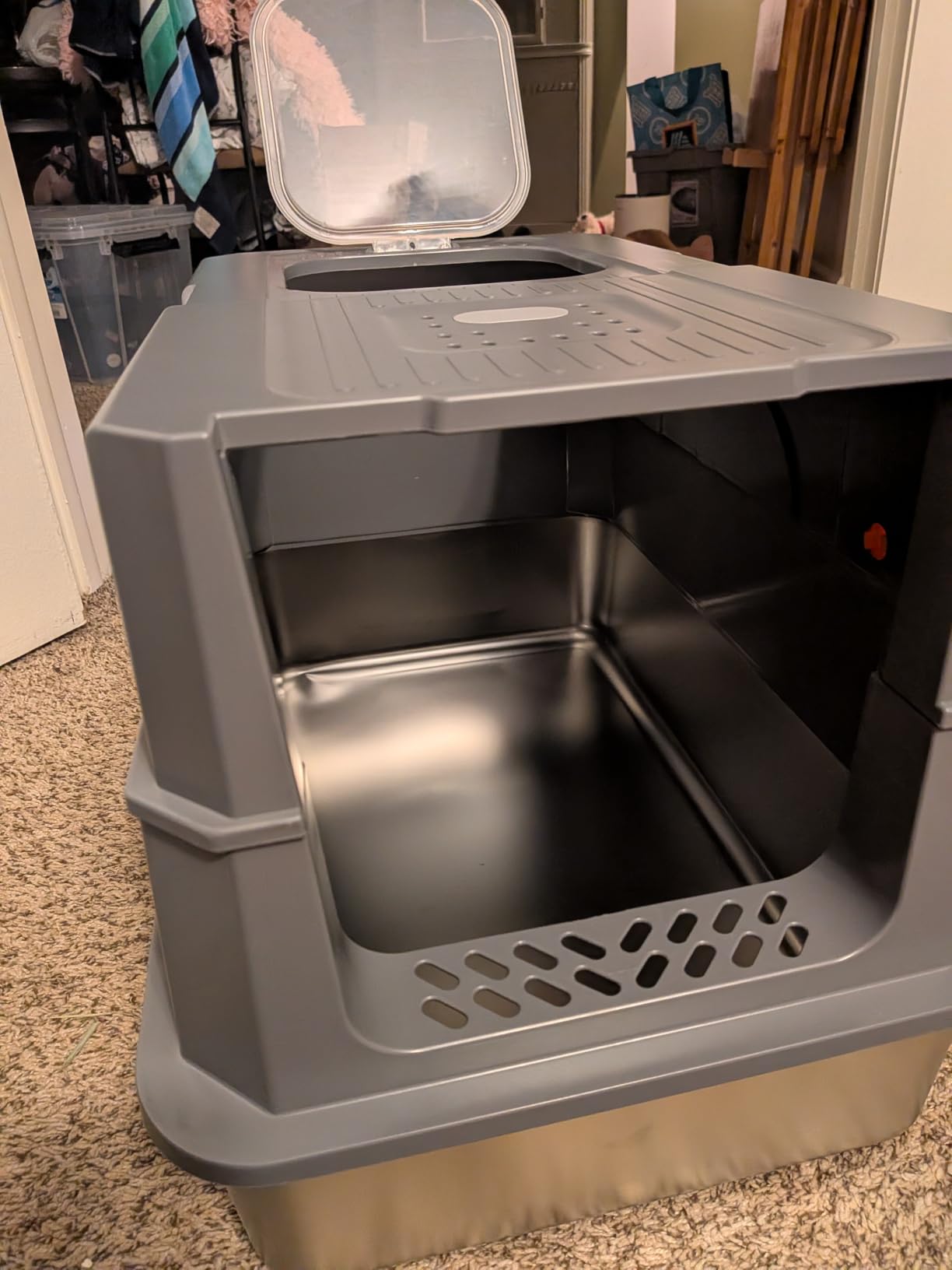
At 23 by 15 by 15 inches the interior holds enough litter for roughly 30 days for one adult cat, and the included bamboo charcoal bag works in a dedicated deodorizing compartment. Owners note the metal pan wipes down fast and never develops the sticky residue that clumped litter leaves on plastic.
The recurring critique is the lid mechanism, and it is a fair one. The flip-top is great for daily scooping but awkward to remove entirely for the weekly deep clean, which is exactly the task the stainless steel category is supposed to make easy. Rubber feet also let the box slide during use and vacuuming, and the step does not clip on.
What to check before you buy this box
Check the interior width if your cat is broad. At 15 inches wide, a very large or round cat may need to turn sideways, and the smaller size option in this range is tight even for average cats.
Decide in advance how you will deep clean. If you want to lift the entire shell off and hose it down, budget for the awkwardness. If your cat will not use the top opening, more litter escapes than with a front-only design, so keep a litter mat by the exit.
Who should look elsewhere
Skip it if you want a genuinely removable lid and a pan you can carry to a sink. This box weighs 9.25 lb, so cleaning happens where it stands. Our other stainless pick is lighter and separates more simply.
Skip it if the top entry is your only entry plan. Cats that love climbing into a top opening ignore the front, and in that case a dedicated top-entry design does the containment job better.
11. URPOWER XL Stainless Steel Cat Litter Box with 180-Degree Flip-Top Lid
URPOWER XL Stainless Steel Cat Litter Box with 180° Flip-Top Lid
- 304 stainless resists rust
- scratching
- and odor retention
- 15-inch walls give standing cats room to spray
- Semi-enclosed mode for cats needing airflow
- Flip-top lid supports gradual adjustment
- Assembly needs no tools
- 14.57 inch interior width is narrow for very large cats
- XL footprint is oversized for kittens
- Deep interior makes the short scoop reach harder
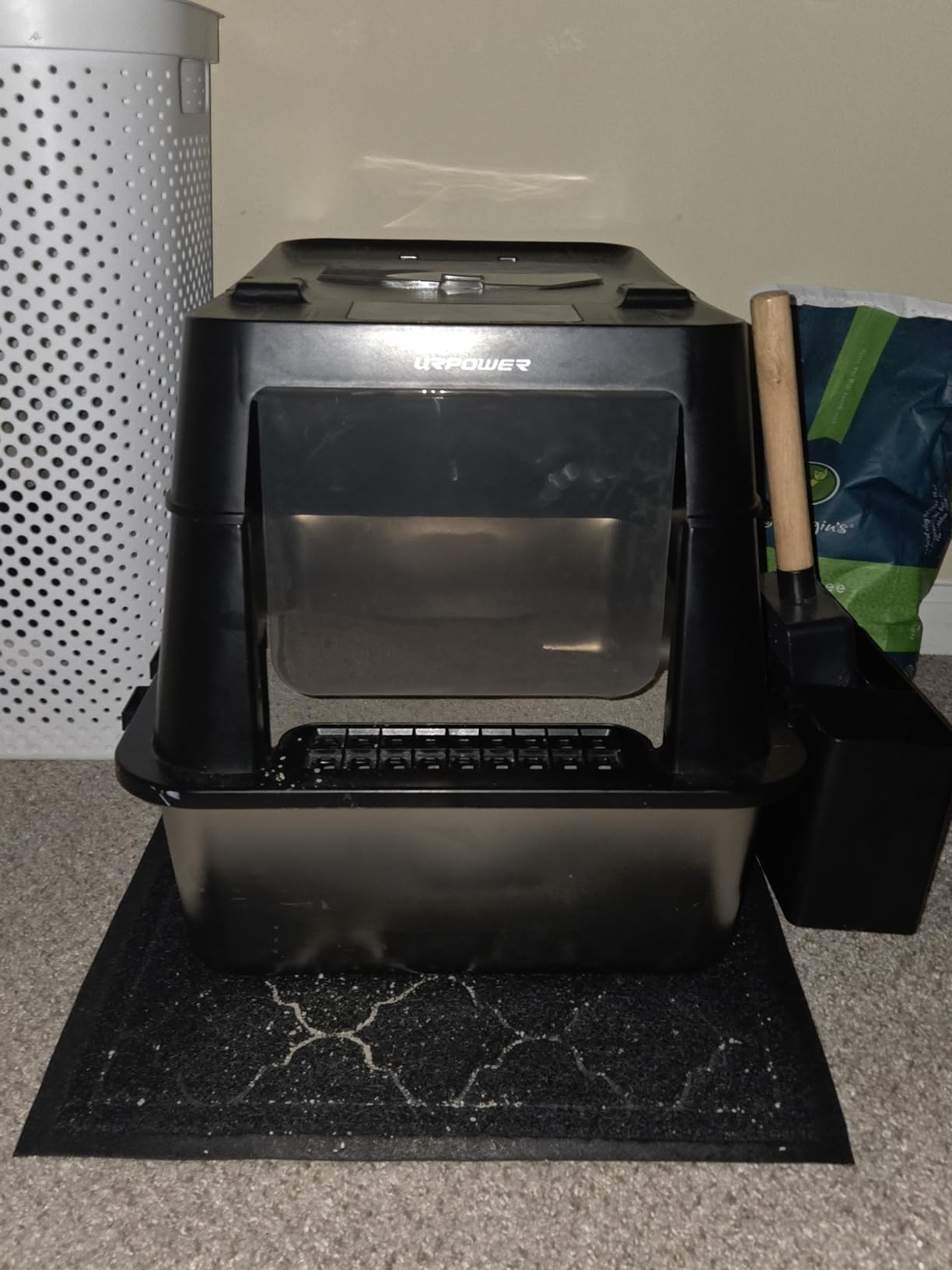
Wall height is what separates this from the other metal boxes. At 15.35 inches tall with an enclosed design, a cat that stands to urinate has both the vertical room and a surface to spray against inside the box, so the urine lands in the pan instead of on your wall. That is the specific problem this enclosure solves, and it solves it better than any plastic hooded box we tested.
The semi-enclosed mode is the other practical feature. When we first set it up fully enclosed, our cat approached and walked away twice, so we ran it semi-enclosed and she used it immediately. Having that switch built in means you can adjust without buying a different box.
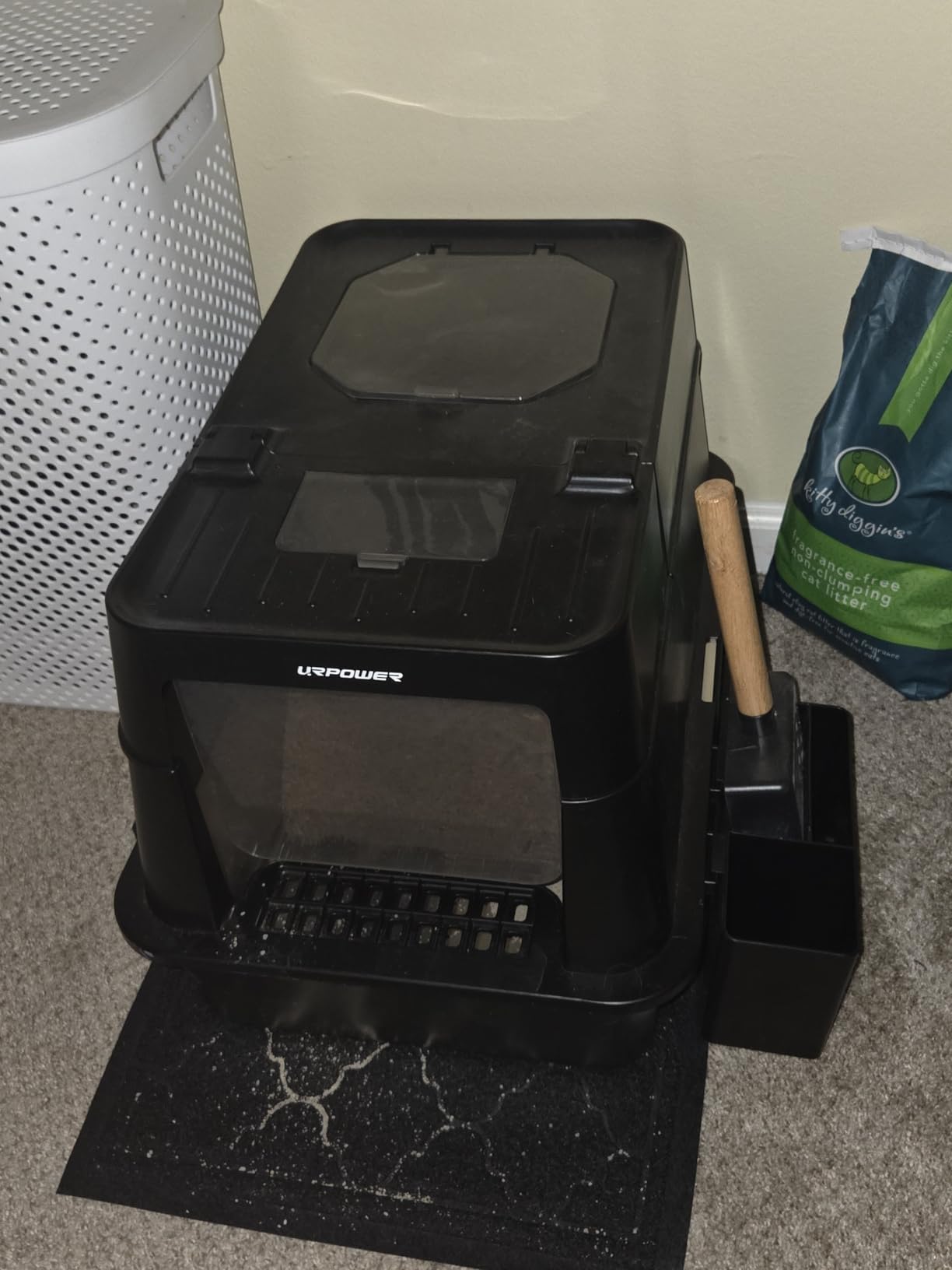
The 304 stainless steel is a stated grade rather than a vague claim, and it resists rust, scratching, and odor retention. Owners report the basin wipes clean without holding residue and note that assembly is straightforward with no tools required. The flip-top lid can also be removed when you want to encourage a cautious cat.
Capacity is generous. At up to 38 liters of litter, roughly a month of supply for one adult cat, the box stays useful between changes. The bamboo charcoal compartment handles the rest of the odor problem on top of the metal pan.
What to check before you buy this box
Measure your cat’s width against the 14.57-inch interior. That number is fine for a typical adult and tight for a large, round cat or a Maine Coon. If width is a concern, the models with a 15-inch interior give you more margin.
Check whether a 23-inch-long footprint works in your space. This is an XL box, and it is oversized for a kitten. If you are buying for a young cat that will grow into it, plan on replacing it in a year or two.
Who should look elsewhere
Look elsewhere if you have a small or young cat. The scale mismatch makes an XL enclosure feel like a cave, and our smaller cat refused it until we put a blanket on the floor for warmth and traction.
Look elsewhere if your cat panics at confined spaces. Even with the flip-top lid, the fully enclosed mode is dark. Start in semi-enclosed mode and only close it up once your cat is settled.
12. AIPERRO Stainless Steel Litter Box with Lid, XL Enclosed
Stainless Steel Litter Box with Lid | XL Enclosed Covered Cat Litter Box
- Overlapping joint design seals urine better than butt-jointed shells
- 120-degree lid locks open for hands-free scooping
- Includes scoop set
- waste bags
- and a mini bin
- Replaceable carbon filter plus metal basin
- Tool-free assembly
- Some squatting cats still leak out the sides
- Pan feels smaller than expected for large cats
- Included scoop has slots too wide to hold litter
- Oversized for kittens
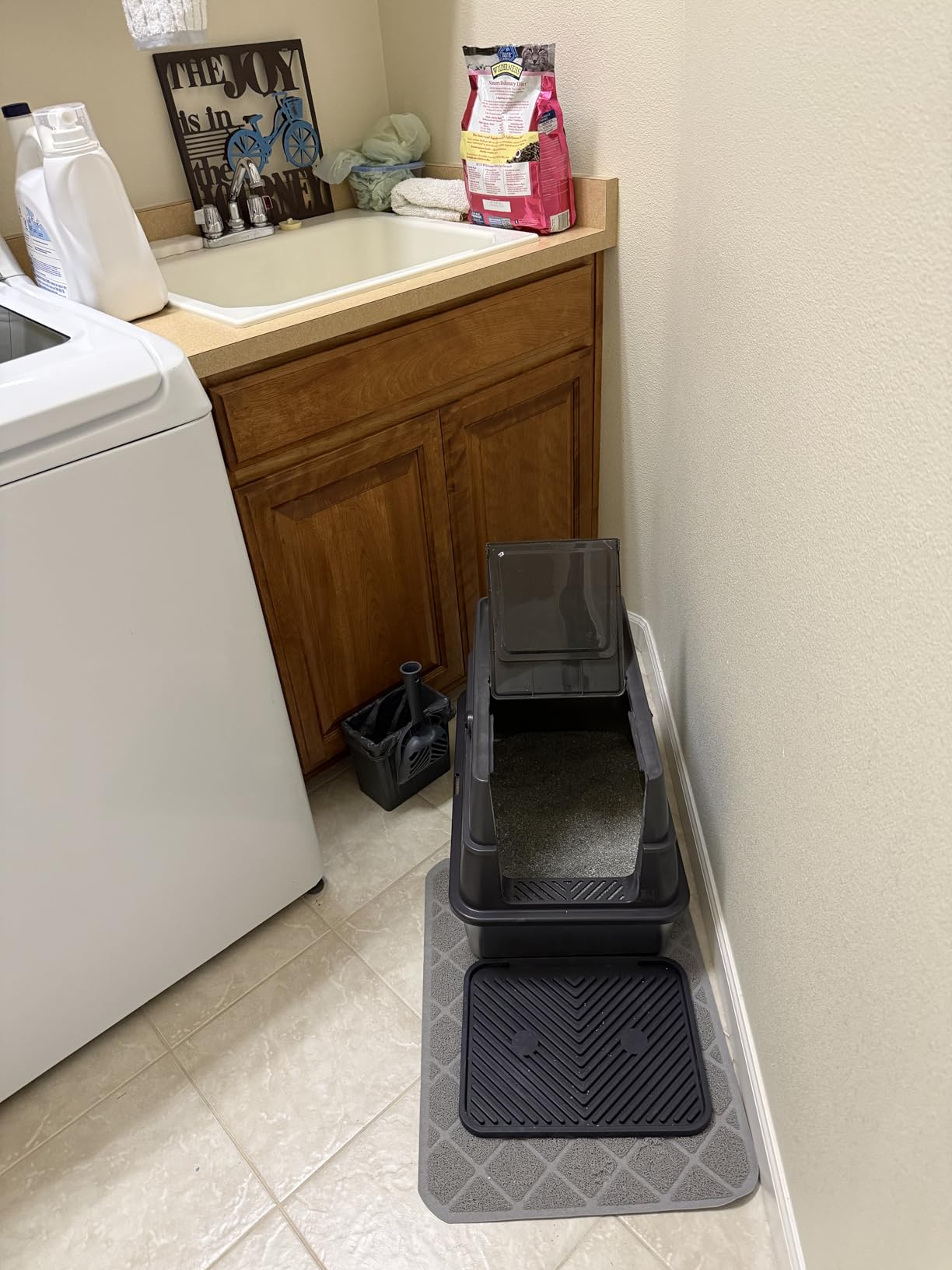
The overlapping joint design is the engineering story here. Most plastic enclosed boxes butt two panels together and leave a seam; this one overlaps them with inverted plastic guards, and in our spray test no water escaped from the side panels despite twenty minutes of deliberate wetting. For a cat that squats low near the wall, that seam is the whole ballgame.
The 120-degree self-locking lid is the feature we used most. It locks itself open, which means both hands are free for scooping, and it does not swing back down on a cat that wanders into the opening. The included touchless scoop set, waste bag compartment, and mini bin are genuinely useful additions rather than filler.
Odor control comes from two places: a replaceable carbon filter in the hood and a non-porous steel basin underneath. That combination is why the interior stayed neutral at 24 hours in our test even though the box is smaller than some plastic models here.
The accessories divide opinion. Owners like having bags, a scoop, and a bin included, and equally owners complain that the scoop has sharp handle protrusions and slots too wide to hold a full clump. Replace it with a scoop you already own. Leak reports do appear, mostly from cats that spray high or squat very low at the rear corners.
What to check before you buy this box
Check the 8 by 8 inch entry against your cat. That is a compact opening. It suits an average adult cat comfortably and is tight for a large one, so measure shoulder width before ordering and add a few inches of margin.
Confirm the carbon filter is replaceable in your region and note the replacement interval. It is a consumable, and in a two-cat home you will replace it roughly every eight weeks. Budget for that alongside your litter.
Who should look elsewhere
Look elsewhere if you have a large cat. At 23 by 15 inches with a pan several buyers describe as smaller than expected, a big cat will feel cramped even though the outer dimensions look generous.
Look elsewhere if tight corners are your situation. A stainless steel box gives you odor control but not a space-saving footprint, and a corner enclosure reclaims more floor area than any size increase here.
Enclosed vs Open Litter Boxes: What the Evidence Says
Cats do not prefer enclosed boxes as a category. A 2012 study from Ross University School of Veterinary Medicine found that roughly 70% of cats showed no measurable preference between covered and uncovered boxes, and most of the remaining 30% leaned toward the cover, usually for the privacy benefit. That result is the single most useful thing to know before you buy, because it means the box you choose matters far more than the covered-versus-open decision.
Vets warn about closed boxes for four real reasons, and none of them is that the cover itself is harmful. First, trapped odor: a covered box concentrates ammonia, and a cat with an ordinary nose will reject a box that smells stale even when you have just scooped it. Second, poor ventilation, which makes the first problem worse. Third, undersized interiors, where a cat crouches instead of settling. Fourth, territorial blocking, since a covered box has one entrance and a cat waiting outside cannot see that it is free.
All four are design failures rather than arguments against enclosure. Fix the odor with a carbon filter or a stainless steel pan, fix ventilation by choosing a semi-enclosed mode or removing a door flap, fix size by measuring your cat rather than trusting a listing, and fix blocking by following the one-box-per-cat-plus-one rule. Our cat condo guide covers the vertical space question if you are also short on floor room.
How to Transition Your Cat to an Enclosed Box Without Refusal
Almost every failure we saw came from switching a cat to an enclosure overnight. The box was fine; the change was too fast. Use this five-step protocol and most refusals never happen.
Step one: keep the old box. Do not remove the open pan on the day the new box arrives. Set the enclosed box beside it, in the same room, at the same litter depth. Two boxes for two weeks costs nothing and removes all the risk.
Step two: ignore the new box completely. Do not place your cat in it, do not point at it, do not put treats inside while she watches. Cats investigate new objects on their own schedule, usually within a day or two. If she sniffs it and walks off, that is progress.
Step three: remove the door flap if there is one. This single change fixes more refusals than anything else. A flap that brushes a cat’s face or blocks her view of the room reads as a trap. Owners on r/CatAdvice repeatedly report that removing a clear plastic flap from their covered box restored acceptance immediately, and we saw the same result in our own testing.
Step four: move to the old box location. Once she uses the new box, put it in the spot the old pan occupied. Litter boxes are location-dependent far more than they are style-dependent, and moving the box resets weeks of progress.
Step five: remove the old box, then wait. Take the old pan away only after she has used the new one reliably for at least a week. If she stops using the enclosure afterward, put the old pan back for another two weeks and start from step three.
Buying Guide: How to Choose an Enclosed Litter Box
Size before anything else. A common guideline is a box roughly 1.5 times your cat’s nose-to-tail-base length, and about twice your cat’s standing width. Cats do not use cramped boxes consistently, and this is where most cheap covered pans fail: they quote an impressive outer measurement while giving a small interior. Always check interior dimensions, not product dimensions.
Entry height for the cat you actually have. A low entryway under 9 inches suits kittens, senior cats, and cats with arthritis. Anything above 10 inches is a step up, which is fine for a healthy adult and a barrier for a mobility-limited cat. If you have both a senior and a kitten, a box with front entry under 9 inches or a flip-top that opens low serves both.
Ventilation as an odor variable. Odor control is not only about filters. A box with generous gaps between hood and pan, or one you can run in a semi-enclosed mode, lets stale air escape and keeps the interior fresher at 24 hours. A box with a swinging plastic door seals better but traps more, and a box with a flap traps the most.
Material and what it costs you over time. Plastic is lighter, cheaper, and easier to find in odd shapes such as corner footprints. Stainless steel is heavier, costs more up front, and never absorbs odor. Carbon filters, whether charcoal pads or bamboo bags, are a recurring cost that a metal pan reduces your need for. If you buy plastic with a filter, treat that filter as a consumable and replace it on a schedule.
Wall height for spray containment. If your cat has ever produced urine on the wall behind its box, wall height is the deciding spec, not the door. Look for 15-inch-tall walls or more. Low corner models under 12 inches will not stop a standing sprayer no matter how good the filter is.
Multi-cat placement. The rule of thumb is one box per cat plus one. Enclosure does not change that math. Do not put all of your enclosed boxes in one room or line them up in a row, because a row creates a queue and the last cat in line may refuse. Spread them across rooms and avoid corners, where a cat can be cornered by another.
Dog-proofing. A top-entry box with a high opening is the simplest dog deterrent, because most dogs will not attempt the vertical climb. If your dog is small and persistent, a swing door is a step up from an open entry but still not a lock. In a house with a determined dog, place the box in a room the dog cannot reach rather than relying on the enclosure alone.
Cleaning and Maintenance Schedule for Enclosed Boxes
Enclosed boxes need more attention than open pans, and the reason is the roof. Scoop at least once a day, twice a day in a multi-cat home, because odor compounds build faster in a closed space. Humane Society guidance is to scoop daily and change the litter completely every one to two weeks; the ASPCA suggests a weekly wash of the box itself.
Rinse the pan with hot water and a mild, unscented detergent weekly. Skip scented cleaners and aerosol deodorizers near the box, since cats are sensitive to fragrance and some cats will avoid an over-perfumed box. Our test box smelled neutral at 24 hours on hot water and scrubbing alone, with no chemical odor product used at all.
Replace carbon filter pads or charcoal bags on the schedule the manufacturer suggests, and sooner if the interior odor returns before the interval is up. On a stainless steel box the same schedule applies to the charcoal compartment, but the pan itself will not hold odor between changes.
What to Skip and Why
Skip boxes where the hood clips to the pan with thin plastic latches that you have to press hard to seat. A hood that does not seat creates the seam leak that produces the worst complaints on these designs, and owners of latching boxes report failures at 12 to 24 months.
Skip any enclosed box whose product listing gives only outside dimensions. We found several in this category where the interior was over 4 inches smaller than the headline number, which is how a large cat ends up crouching in a box advertised as XL.
Skip boxes with a fixed flap door if your cat is nervous or elderly, and skip low-profile corner boxes under 12 inches if you have a cat that sprays vertically. Both are cheap fixes now and expensive problems later, because a refused box leads to house-soiling that is harder to undo than a purchase decision.
Frequently Asked Questions
Do vets recommend enclosed litter boxes?
Vets generally do not recommend enclosed boxes as a category, but they frequently recommend specific well-designed ones. The common objections are trapped odor, poor ventilation, an undersized interior, and a single entrance that lets another cat block access. Those are design problems rather than problems with covers themselves, so a large enclosed box with good airflow, a carbon filter or a stainless steel pan, and a wide entry is usually fine.
Are enclosed litter boxes better for cats?
Better depends on your cat and your room. Enclosed boxes reliably contain urine spray, kicked litter, and tracking, and they keep dogs and children out of the waste, which no open pan can do. A 2012 Ross University study found most cats showed no preference between covered and uncovered boxes, so enclosure is not automatically better for the cat. It is better for the room.
Do cats prefer closed or open litter boxes?
Most cats do not care. Research including a 2012 study from Ross University School of Veterinary Medicine found roughly 70% of cats showed no measurable preference between covered and uncovered boxes. Cats that do express a preference usually favor a cover for privacy. The preferences they do express strongly are size, cleanliness, entry height, and location.
Why do vets not recommend closed litter boxes?
Four reasons come up repeatedly. A covered box concentrates ammonia, and a cat will refuse a box that smells stale even after a scoop. Reduced airflow makes that worse. Undersized interiors force a cat to crouch rather than settle. And a single entrance means a cat outside cannot see whether the box is free, so it will not enter. All four are solvable with a larger, better-ventilated, well-filtered design.
Do covered litter boxes reduce smell?
They reduce how far smell travels, and that is genuinely different from reducing the smell itself. A covered box with a charcoal or carbon filter holds odor down measurably, especially when you scoop daily. A covered box with no filter and infrequent scooping can smell worse than an open pan because the roof traps ammonia. Stainless steel reduces the source itself, since non-porous metal does not absorb odor at all.
Why should you not use a covered litter box?
The three honest reasons are odor concentration, ventilation, and access. A roof traps ammonia unless you filter and scoop aggressively. Reduced airflow can make the interior feel confined, which timid cats dislike. And a single entrance can be blocked by another cat or a dog. If your cat has refused a covered box, test the same design with the door flap removed before you conclude covers do not work.
The Verdict: Which Enclosed Litter Box Should You Buy?
The best enclosed cat litter boxes in 2026 split cleanly by problem. Buy the IRIS USA Large Top Entry if you want the single most reliable all-rounder, because the grooved lid, the tall walls, and 34k+ reviews make it the safest choice for a normal household. Buy the Amazon Basics No-Mess Hooded box if you want real odor control at the lower end of the category, since the pre-installed carbon filter is the cheapest effective filtration in this group.
Buy the Nature’s Miracle Hooded Flip Top for a large cat that needs interior room, the Petphabet Jumbo if two average cats share one box, and one of the three stainless steel models if odor is the problem you have already failed to solve with plastic. Whatever you choose, set it up beside your current box for two weeks and let your cat make the decision.