
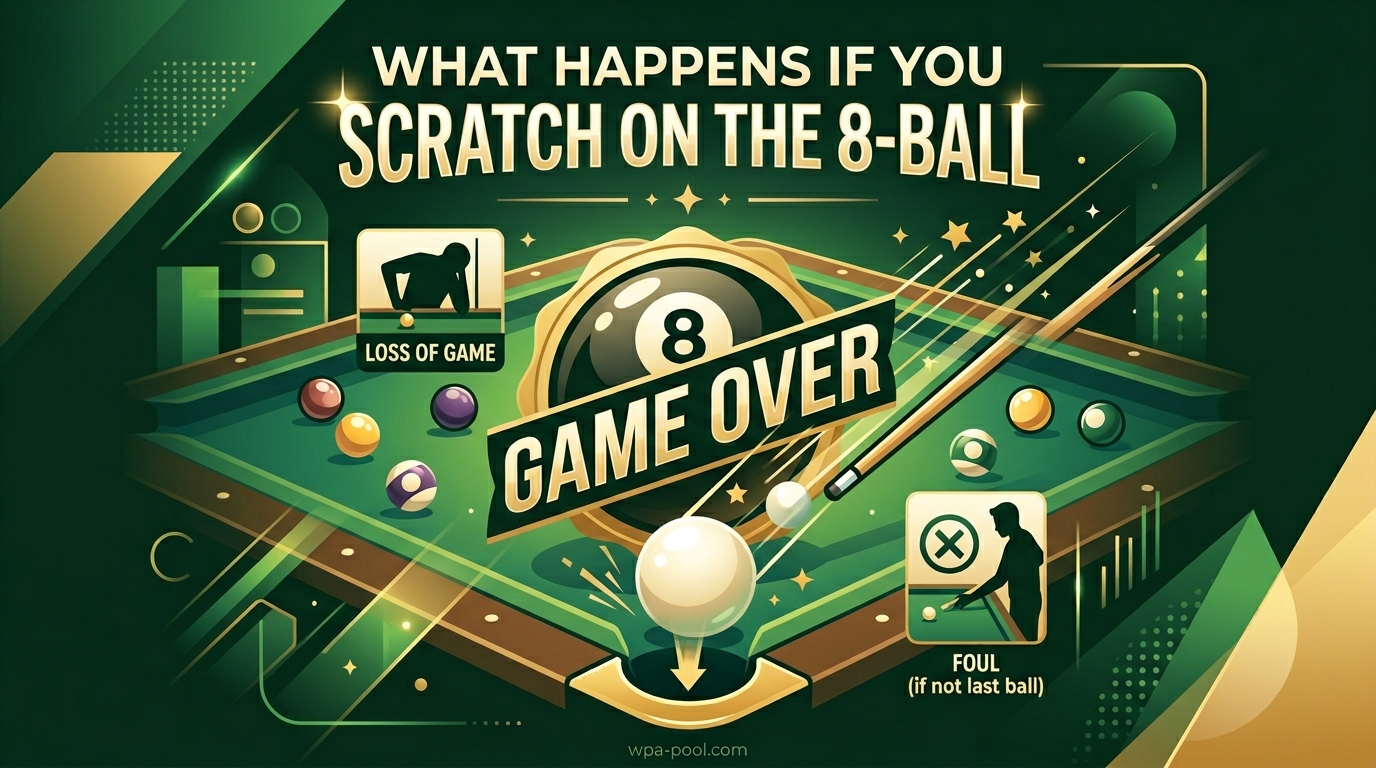
Scratching on the 8-ball is one of the most debated situations in pool. What happens depends entirely on which rule set you are playing under. Here is the direct answer you need:
- WPA/BCA Rules: Scratching without pocketing the 8-ball gives your opponent ball-in-hand. You only lose if both the cue ball and 8-ball drop.
- APA Rules: Any scratch while shooting for the 8-ball is an automatic loss of game.
- Bar/House Rules: Most bars treat any scratch on the 8-ball as a loss, but rules vary by region and venue.
Understanding these differences matters whether you are playing casually at a local bar, competing in a league match, or participating in a tournament. I have seen countless arguments break out over this exact situation, usually because players assume everyone plays by the same rules. Our team has played under all three major rule sets, and the confusion is real. Let me break down exactly what happens under each system so you never face an unfair call again.
Before we dive into the specific rule variations, it helps to understand how official WPA pool table standards influence the rules used in competitive play.
Table of Contents
WPA and BCA Official Rules for Scratching on the 8-Ball
The World Pool-Billiard Association (WPA) and Billiards Congress of America (BCA) follow the same standardized rules for 8-ball. These are the rules used in professional tournaments and most serious competitive play.
Under WPA/BCA rules, scratching on the 8-ball is NOT automatically a loss. The outcome depends on whether the 8-ball was pocketed on that same shot.
If You Scratch Without Pocketing the 8-Ball
This is the most common scenario. You are shooting for the 8-ball, miss it completely, but the cue ball drops into a pocket. Under WPA/BCA rules, this is a standard foul. Your opponent receives ball-in-hand. They can place the cue ball anywhere on the table. The game continues.
I have been in this exact situation dozens of times. It stings to scratch when you are on the 8-ball, but at least you have not lost the game. Your opponent now has an advantage with ball-in-hand, but you are still alive.
If You Scratch While Pocketing the 8-Ball
This is the loss condition. If both the cue ball and the 8-ball enter pockets on the same shot, you lose the game immediately. It does not matter if you called the pocket correctly. The scratch takes priority, and the game ends with your opponent winning.
This rule makes sense when you think about it. Pocketing the 8-ball wins the game, but fouling on that same shot creates a conflict. WPA/BCA rules resolve this by penalizing the foul over the win. The logic is that you failed to execute a legal shot to win.
Ball-in-Hand After a Scratch
When you scratch without pocketing the 8-ball, your opponent gets ball-in-hand. This means they can place the cue ball anywhere on the playing surface. They are not restricted to behind the head string like on a break scratch.
Ball-in-hand is a significant advantage. Your opponent can position the cue ball for an easy run-out. This is why scratching on the 8-ball, even without losing immediately, often leads to losing the game on the next turn.
APA League Rules: Stricter Penalties for 8-Ball Scratches
The American Poolplayers Association (APA) takes a stricter approach to 8-ball scratches. If you play in APA league matches, you need to understand these differences. The rules are designed to simplify calls and reduce disputes.
Under APA rules, any scratch while shooting for the 8-ball results in a loss of game. It does not matter whether the 8-ball was pocketed or not. If the cue ball drops in a pocket while you are on the 8-ball, you lose.
Why APA Rules Are Stricter
APA leagues operate across thousands of bars and pool halls. The organization simplified the rules to make league play consistent everywhere. By making any 8-ball scratch a loss, they eliminate judgment calls and arguments.
From the APA perspective, scratching on the 8-ball shows poor cue ball control when it matters most. They treat it as a critical error that should cost you the game. This creates a higher-stakes moment when you reach the 8-ball.
APA League Play Implications
If you play APA 8-ball, you must approach the 8-ball shot with extreme caution. Many APA players will play a safety rather than risk a scratch on a difficult cut shot. The penalty is too severe to gamble with poor position.
Our team has seen APA matches decided by this rule alone. A player with an easy 8-ball shot gets careless with cue ball speed and scratches. Game over. The opponent never even had to shoot at the 8-ball.
Bar Rules and House Rules: The Wild West of 8-Ball
Bar rules are where the most confusion happens. Every bar seems to have its own variation. What is standard in one city might be completely wrong in another. If you are playing for money or drinks, clarify the rules before starting.
Common Bar Rule Variations
Most bars follow a simplified version of the rules. The most common bar rule is that any scratch on the 8-ball is a loss. This is simpler than WPA/BCA rules and easier for casual players to remember. Many bar players do not even know that WPA rules allow ball-in-hand after a scratch.
Some bars play with “call everything” rules. You must call every shot, including kisses and banks. Under these rules, scratching on the 8-ball is definitely a loss. Other bars are more relaxed about shot calling but still enforce the automatic loss for 8-ball scratches.
Regional Differences We Found
Through forum research and player reports, we have identified clear regional patterns. In the Dallas area, most bars enforce automatic loss for any 8-ball scratch. On the East Coast, some bars follow closer to WPA rules with ball-in-hand. Midwest bars tend to be stricter, treating every scratch as a loss.
The key is always to ask before playing. A simple “What are we playing? WPA or bar rules?” can prevent arguments later. I have learned this the hard way after losing games I thought I had won.
Scratch on the 8-Ball: All Scenarios Explained
Let me walk you through every possible scenario when shooting for the 8-ball. Understanding these situations will help you make better decisions and avoid costly mistakes.
Scenario 1: You Scratch but Miss the 8-Ball
This is the standard foul situation. You shoot for the 8-ball, miss it entirely, and the cue ball scratches into a pocket. Under WPA/BCA rules, your opponent gets ball-in-hand anywhere on the table. Under APA rules, you lose immediately. Under most bar rules, you lose immediately.
Scenario 2: You Pocket the 8-Ball and Scratch
This is the worst outcome. Both the 8-ball and cue ball drop on the same shot. Under WPA/BCA rules, you lose. Under APA rules, you lose. Under bar rules, you lose. This is the one scenario where all rule sets agree. You cannot win by scratching, even if the 8-ball goes in.
Scenario 3: You Pocket the 8-Ball Cleanly
The cue ball stays on the table after pocketing the 8-ball. You win the game. This is true under every rule set. The key is cue ball control. You must pocket the 8-ball without sending the cue ball into a pocket.
Scenario 4: Scratch on the Break
Breaking and scratching is treated differently than scratching on the 8-ball. Under WPA/BCA rules, if you scratch on the break, your opponent gets ball-in-hand behind the head string. The 8-ball is respotted if it was pocketed. The game continues.
Under APA rules, scratching on the break gives your opponent ball-in-hand anywhere on the table. This is more forgiving than the break scratch rules in some bar variations.
What Is Ball-in-Hand After a Scratch?
Ball-in-hand is one of the most important concepts in pool. When your opponent scratches without pocketing the 8-ball under WPA/BCA rules, they give you this advantage. Understanding how to use it can win you games.
Ball-in-hand means you can pick up the cue ball and place it anywhere on the playing surface. You are not limited to behind the head string. You can position the cue ball for the easiest possible shot on your next ball.
Strategic Placement
Smart players use ball-in-hand to break up clusters and create a clear path to run out. You are not required to shoot at your remaining balls immediately. You can play a safety or improve the table layout first.
I always take my time with ball-in-hand. Look at the entire table. Consider not just your next shot, but the sequence that follows. Can you get perfect shape on the 8-ball? That should be your goal when receiving ball-in-hand after an opponent’s scratch.
Common Myths About Scratching on the 8-Ball
Through our research and forum discussions, we found several persistent myths about 8-ball scratches. Let me debunk the most common ones.
Myth 1: Any Scratch on the 8-Ball Is a Loss
This is false under WPA/BCA rules. Many casual players believe this because bar rules often enforce it. However, in official tournament play, scratching without pocketing the 8-ball only gives your opponent ball-in-hand. The game continues.
Myth 2: Bar Rules Are Universal
Bar rules vary dramatically by region and even by individual establishment. What is standard in Chicago might be completely different in Los Angeles. Never assume bar rules are the same everywhere.
Myth 3: Calling the Pocket Prevents Loss
Calling your pocket is required in many games, but it does not change the scratch rules. If you scratch while pocketing the 8-ball, you still lose, even if you called the correct pocket. The scratch supersedes the called shot.
Myth 4: Good Players Concede on Scratches
Some players think that if you scratch on the 8-ball, you should just concede the game. This is not true under WPA/BCA rules. If you scratch without pocketing the 8-ball, you should absolutely keep playing. Your opponent might miss with ball-in-hand. Never concede until the game is actually over.
How to Avoid Scratching on the 8-Ball
Now that you understand the rules, let me share some practical tips to avoid this situation entirely. Prevention is always better than dealing with the consequences.
Position Play Is Everything
The best way to avoid scratching on the 8-ball is to have good position before you shoot it. You should be able to pocket the 8-ball with natural cue ball movement. Avoid thin cut shots where you must use extreme spin to pocket the ball.
Our team spends more time thinking about position on the ball before the 8-ball than almost any other shot. If you can leave yourself a straight-in shot on the 8-ball with the cue ball stopping naturally, your scratch risk drops dramatically.
Use a Safety When Needed
If you do not have a safe shot on the 8-ball, play a safety. Leave your opponent a difficult shot or hidden behind a blocking ball. This is especially important in APA rules where any scratch is a loss.
Practice Cue Ball Control
Spend practice time specifically on cue ball control. Set up shots where you must pocket a ball while keeping the cue ball away from pockets. This is a skill that pays off constantly in real games.
Frequently Asked Questions
Do you lose if you scratch on the 8-ball?
It depends on which rules you are playing. Under WPA/BCA rules, you only lose if you pocket the 8-ball on the same shot as the scratch. Under APA rules and most bar rules, any scratch on the 8-ball is a loss.
What happens if you scratch but the 8-ball doesn’t go in?
Under WPA/BCA rules, your opponent gets ball-in-hand and the game continues. Under APA rules, you lose immediately. Under most bar rules, you also lose immediately.
What is ball-in-hand after a scratch?
Ball-in-hand means your opponent can pick up the cue ball and place it anywhere on the table. They get to shoot from their preferred position, which gives them a significant advantage.
Do you lose if you scratch on the break?
No, scratching on the break is not a loss of game. Under WPA/BCA rules, your opponent gets ball-in-hand behind the head string. Under APA rules, they get ball-in-hand anywhere on the table. The game continues normally.
Why do bar rules differ from WPA rules?
Bar rules are simplified for casual play and faster games. Most bars treat any scratch on the 8-ball as a loss to avoid arguments and keep games moving. WPA rules are designed for competitive play where ball-in-hand creates strategic depth.
Conclusion
Scratching on the 8-ball is a situation every pool player faces eventually. What happens next depends entirely on which rule set governs your game. Under WPA/BCA rules, a scratch without pocketing the 8-ball gives your opponent ball-in-hand. Under APA rules and most bar rules, any scratch on the 8-ball ends the game with your loss.
The key is knowing which rules apply before you start playing. Ask your opponent, clarify the situation, and play accordingly. If you are unsure, assume the stricter rule applies and play cautiously. Good position play and cue ball control will help you avoid this situation entirely. Remember, the best way to handle a scratch on the 8-ball is to never have one in the first place.