
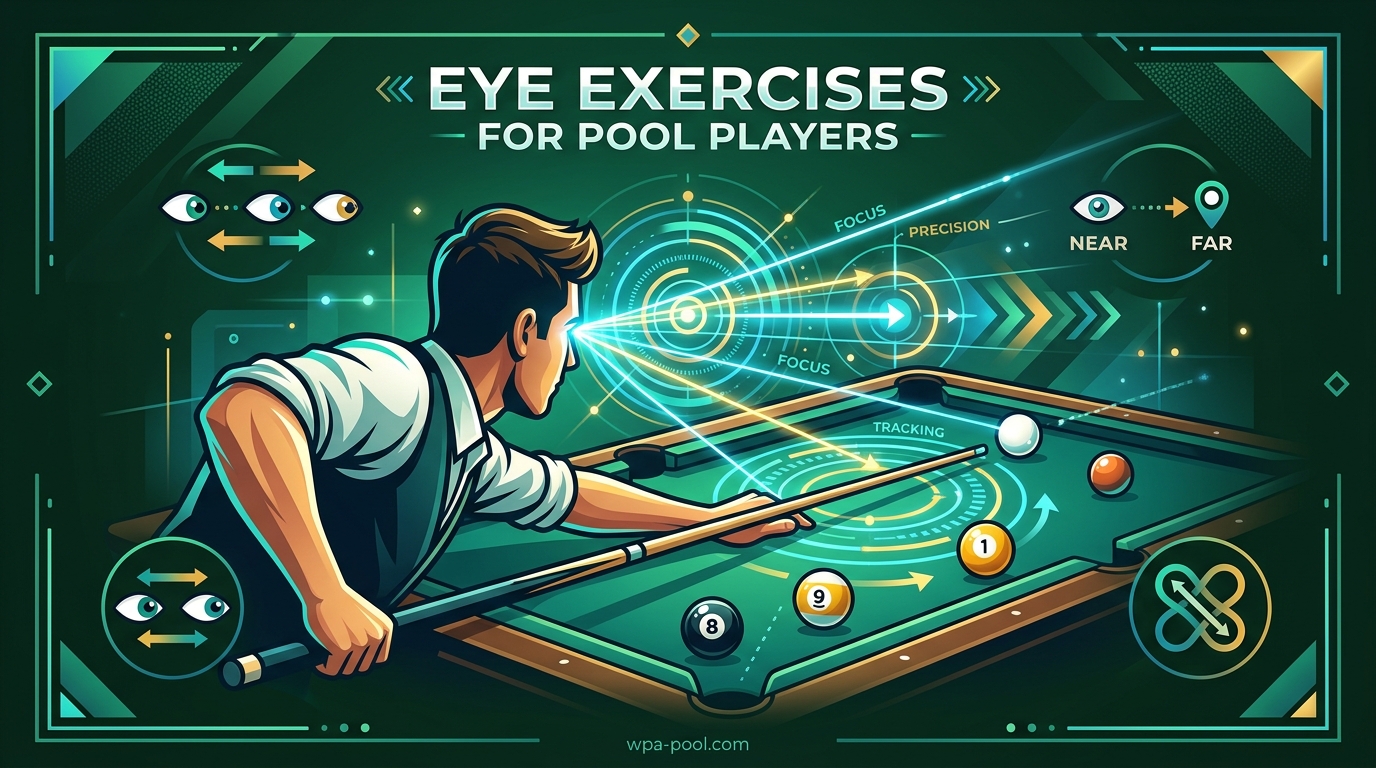
Most pool players obsess over their stroke mechanics, cue action, and stance. They buy expensive cues, practice for hours, and study advanced techniques. Yet many ignore the one element that directly controls where the cue ball goes: their eyes.
Eye exercises for pool players address a critical gap in traditional training. After working with players at all levels for over a decade, I have seen vision training transform struggling beginners into consistent shot-makers. The difference often comes down to how they use their eyes before and during each stroke.
In this guide, I will show you the quiet eye technique, how to find your dominant eye, and specific exercises you can practice at home or at the table. These drills require no special equipment and take just minutes each day. By the end, you will have a complete vision training system to add to your practice routine.
Table of Contents
What is the Quiet Eye Technique in Pool
The quiet eye technique refers to a steady, fixed gaze on your target that lasts for approximately one to two seconds before you begin your stroke. Research from sports science studies shows that elite performers in target sports maintain this fixation longer than amateurs, and their accuracy improves significantly as a result.
In pool, the quiet eye means keeping your eyes locked on the exact point where you want the cue ball to hit the object ball. You do not glance at the cue ball. You do not check your grip. Your visual attention stays glued to that target spot until your stroke begins.
Dr. Joan Vickers, a pioneer in sports vision research, found that athletes who use quiet eye have better motor control and make fewer errors under pressure. For pool players, this translates to straighter shots, better position play, and the ability to perform consistently when it matters most.
Why Quiet Eye Improves Your Accuracy
Your brain needs stable visual input to coordinate your muscles effectively. When your eyes dart around during a shot, your brain receives conflicting information about where the cue ball needs to go. This creates micro-adjustments in your stroke that you cannot consciously control.
A steady quiet eye gives your brain a clear, uninterrupted signal. It knows exactly where to send the cue ball. Your body responds with a smoother, more predictable stroke. Players who adopt this technique often report that their shots feel more natural and require less conscious effort.
The Science Behind Quiet Eye Duration
Studies of elite athletes in golf, archery, and shooting have identified the optimal quiet eye duration as between 1.5 and 2 seconds. This is long enough to stabilize your visual focus but short enough to avoid overthinking. In pool, this means picking your target, settling your gaze, and beginning your stroke within that window.
Beginners typically average less than one second of quiet eye time. Their eyes move frequently between the cue ball and object ball, creating visual noise that disrupts their stroke. Training yourself to extend that fixation time is one of the fastest ways to improve your consistency.
How to Find Your Dominant Eye for Pool
Eye dominance matters in pool because it determines how you should align your body with the cue. Most people have one eye that provides the dominant input to their brain. When you align your cue under your dominant eye, you get a more accurate view of the shot line.
Many players struggle with aim simply because they have never tested which eye is dominant. They align their cue under their non-dominant eye, creating a parallax error that makes straight shots look angled. Finding your dominant eye takes 30 seconds and can instantly improve your aim.
The Point Test Method
Stand about 10 feet from a wall and pick a small target, such as a light switch or picture corner. Extend both arms straight out and bring your hands together to form a small triangle with your thumbs and index fingers. Center this triangle around your target so you can see it clearly through the opening.
Close your left eye while keeping the right eye open. If the target stays centered in your triangle, your right eye is dominant. If the target jumps out of view, your left eye is dominant. Repeat the test closing your right eye to confirm the result.
The Open Hands Alternative
Some players find the point test awkward. An easier method involves holding your hands at arm’s length with a small gap between them. Look through this gap at a distant object, then slowly bring your hands back toward your face. Your hands will naturally move toward your dominant eye.
Do this test three times to ensure consistent results. Eye dominance can sometimes shift slightly based on fatigue or lighting, so multiple tests give you a reliable baseline.
Stance Adjustment for Eye Dominance
Once you know your dominant eye, adjust your stance so the cue passes directly underneath it. For right-handed players with right-eye dominance, this usually means keeping your head relatively centered over the cue. For right-handed players with left-eye dominance, you may need to shift your head slightly to the right so your left eye sits above the cue shaft.
Left-eye dominant players often struggle because standard instruction assumes right-eye dominance. If you are left-eye dominant, experiment with a slightly more open stance or position your chin more to the right side of the cue. Small adjustments here make a dramatic difference in how well you see the shot line.
Eye Pattern Fundamentals for Pool
Eye pattern refers to the sequence of where you look during your pre-shot routine and stroke. A consistent eye pattern builds muscle memory and reduces the variables you need to think about. Most professionals follow a similar pattern, though individual variations exist based on playing style.
The key principle is to look at the cue ball only when necessary and spend most of your visual attention on your target. Many beginners reverse this, staring at the cue ball while barely glancing at where they want it to go. This creates a disconnect between aim and execution.
The Six-Step Eye Pattern Process
Professional players generally follow these six steps in their eye pattern: First, stand behind the shot line and look at the object ball to identify the target. Second, glance at the cue ball to plan your approach angle. Third, walk into your stance while keeping your eyes on the target area.
Fourth, once in position, look at the cue ball briefly to confirm tip placement. Fifth, shift your gaze back to the target and hold it there for your quiet eye period. Sixth, execute the stroke without looking back at the cue ball. Your eyes stay on the target or follow the object ball naturally after contact.
Object Ball Focus vs Cue Ball Focus
A long-standing debate exists about whether to focus on the object ball or cue ball last. Research and observation of top players strongly favors object ball focus. When you look at the cue ball last, your brain processes the cue ball as the target, which can lead to striking it poorly or misjudging the angle.
By keeping your final focus on the object ball, your brain maintains the correct target image. Your stroke becomes a delivery mechanism to send the cue ball to that spot, rather than an action focused on hitting the cue ball itself. This subtle mental shift improves both accuracy and power control.
What is the 30 Rule in Pool
The 30 rule refers to a visual technique where you spend roughly 30 percent of your pre-shot visual attention on the cue ball and 70 percent on the object ball or target. This ratio ensures you give enough attention to cue ball placement without losing sight of your ultimate goal.
Apply this rule by limiting your cue ball glances to brief confirmations. Check your tip position, then immediately return to the target. Do not study the cue ball, analyze its spin, or second-guess your approach. The cue ball is the tool; the object ball pocket is the destination.
Eye Exercises for Pool Players
These exercises target the specific visual skills you need at the pool table. Practice them at home or during warm-up sessions. Each drill builds on the previous one, creating a complete vision training program.
Chalk Line Alignment Drill
Draw a straight line across your practice table using a chalk line or masking tape. Place the cue ball on one end and an object ball on the other, both centered on the line. Your goal is to pocket the object ball while keeping the cue ball rolling along the line.
Before each shot, practice your quiet eye by staring at the contact point on the object ball for two full seconds. Do not look at the cue ball during this time. Notice how your stroke feels different when you maintain this fixed gaze. Start with slow, deliberate strokes and gradually increase to your normal speed as the technique becomes comfortable.
Laser Pointer Accuracy Drill
Hold a laser pointer in your bridge hand as you would hold a cue. Practice aiming at various targets on a wall from different distances. Keep the laser dot steady on each target for two seconds before moving to the next. This trains the same fixation muscles you use during quiet eye.
Advanced version: Have a partner call out targets randomly. You must find and stabilize the laser on each target within three seconds. This adds the pressure of time constraints and simulates the quick target acquisition needed during matches.
Mirror Stance Check
Set up a full-length mirror beside your practice table. Get into your shooting stance and check that your dominant eye aligns vertically above the cue shaft. Look for a straight line from your eye down through your bridge hand to the cue ball.
Practice your eye pattern in the mirror without hitting balls. Go through the full six-step sequence while watching your head position. Ensure your head remains still during the stroke and your eyes stay level. The mirror provides instant feedback that is impossible to get while actually shooting.
Focus Flexibility Exercise
Hold your index finger at arm’s length and focus on it clearly. Then quickly shift focus to an object across the room. Alternate between near and far focus five times, trying to achieve clear vision at each distance within one second.
This exercise strengthens the muscles that control your lens shape, improving how quickly you can shift from looking at the cue ball to the object ball. Better focus flexibility means less time adjusting between distances and more stable visual attention during your routine.
Peripheral Awareness Training
Fix your gaze on a spot straight ahead. While keeping your eyes still, become aware of what you can see in your peripheral vision. Notice objects to your left and right without moving your eyes from the central point. Hold this awareness for 30 seconds.
At the pool table, this skill helps you sense the cue ball position without looking directly at it. You can maintain your target focus while still being aware of where your tip contacts the cue ball. This is an advanced skill used by professionals to maintain quiet eye while executing precise shots.
Depth Perception Drill
Place three object balls at different distances from the cue ball: one at two feet, one at four feet, and one at six feet. Practice pocketing each ball while focusing on judging the correct speed for the distance. Stare at each target for your quiet eye period before shooting.
This drill trains your brain to associate visual distance with stroke power. Over time, you develop an intuitive sense of how hard to hit shots at various distances. The quiet eye period gives your brain the stable reference it needs to make these depth judgments accurately.
Integrating Eye Training into Your Pre-Shot Routine
The best eye exercises in the world will not help if you do not use them consistently. Your pre-shot routine is where vision training becomes game performance. Every shot you face in competition deserves the same visual attention you give practice shots.
Build your routine around the six-step eye pattern. Make the quiet eye period non-negotiable. Even on simple shots, take your full two seconds of fixed gaze. This builds the habit so it happens automatically under pressure.
Building Consistency Through Repetition
Practice your complete eye pattern on every shot during practice sessions. Do not skip steps just because a shot seems easy. Muscle memory develops through repetition, not intensity. A hundred shots with perfect eye pattern teach your body more than a thousand shots with inconsistent focus.
Set a specific goal for each practice session. One day, focus entirely on quiet eye duration. Another day, work on the transition between cue ball glance and object ball fixation. Isolate each element until it feels natural, then combine them into your full routine.
Pressure Situations and Maintaining Focus
Pressure destroys eye patterns. When a match hangs on a single shot, players often rush their visual routine or skip it entirely. They look at the cue ball last, take a quick glance, and fire. The results are predictable.
Train for pressure by simulating it in practice. Place yourself in must-make situations where missing has consequences. Force yourself to complete your full eye pattern even when your heart is racing. The more you practice under simulated pressure, the more likely you are to maintain your routine when real pressure arrives.
Troubleshooting Common Eye Pattern Problems
Even with proper training, eye pattern issues can creep into your game. Recognizing and correcting these problems quickly prevents them from becoming permanent habits.
Eyes Moving During the Stroke
If you catch your eyes looking at the cue ball as you stroke, you are losing your quiet eye too early. The fix is simple but requires discipline: keep your eyes on the target until you hear the balls collide. Do not watch the cue ball travel. Trust your stroke and let your peripheral vision track the result.
Head Lifting Too Early
Many players lift their head to follow the cue ball immediately after contact. This movement throws off their stroke before the cue ball even leaves the tip. Practice keeping your head down and your eyes level through the entire stroke and follow-through. Count to one after the shot before allowing yourself to look up.
Inconsistent Aim Despite Good Stroke
If your stroke feels smooth but your aim wanders, check your dominant eye alignment. Use the mirror drill to verify that your cue sits under your dominant eye. Small head position errors create large aiming errors over distance. Fix the alignment and your consistency will improve immediately.
Difficulty with Long Shots
Long shots require more precise quiet eye technique because small errors become large misses. Extend your quiet eye period to a full three seconds on shots over six feet. The extra fixation time stabilizes your visual input and compensates for the increased distance demands.
Frequently Asked Questions
What is the quiet eye method?
The quiet eye method is a vision technique where you maintain a steady, fixed gaze on your target for 1.5 to 2 seconds before executing your stroke. In pool, this means staring at the exact contact point on the object ball without looking at the cue ball. Research shows this steady fixation improves motor control and accuracy by giving your brain stable visual input during the critical pre-shot period.
How do I train my quiet eye?
Train your quiet eye by practicing the chalk line drill, where you hold your gaze on the target for a full two seconds before each shot. Use a laser pointer to practice stabilizing your focus on wall targets. Start with slow, deliberate practice strokes and gradually increase speed as the technique becomes comfortable. Consistency matters more than intensity; practice your quiet eye on every shot during training sessions.
Should you close one eye playing pool?
No, you should not close one eye when playing pool. Closing an eye eliminates depth perception and reduces your ability to judge distances accurately. Both eyes provide important visual information, even if one is dominant. Instead of closing an eye, align your cue under your dominant eye while keeping both eyes open for full binocular vision.
What is the 30 rule in pool?
The 30 rule in pool suggests spending approximately 30 percent of your visual attention on the cue ball and 70 percent on the object ball or target. This means brief glances at the cue ball to confirm position, but sustained focus on where you want the cue ball to go. The ratio ensures proper cue ball placement without losing sight of your ultimate target.
Do eye exercises actually work?
Yes, eye exercises work for pool players when practiced consistently. Research in sports vision training shows that exercises targeting focus flexibility, peripheral awareness, and quiet eye duration improve accuracy in target sports. Players who dedicate 10 to 15 minutes daily to vision drills typically see measurable improvement in their shot consistency within two to four weeks.
Conclusion
Eye exercises for pool players offer one of the highest returns on investment in your training time. Unlike expensive equipment or complex techniques, vision training requires only your attention and consistency. The quiet eye technique, proper eye pattern, and the drills outlined in this guide give you a complete system for improving your visual performance at the table.
Start with the dominant eye test to ensure proper alignment. Practice the six-step eye pattern until it becomes automatic. Add the specific drills to your warm-up routine. Within a few weeks, you should notice your shots feeling more natural and your misses becoming less frequent.
Remember that vision is a skill, not a fixed trait. The players who dominate in 2026 are not necessarily those with the best natural eyesight, but those who train their visual system with the same discipline they apply to their stroke. Make eye training part of your regular practice, and your game will thank you when the pressure is on.