
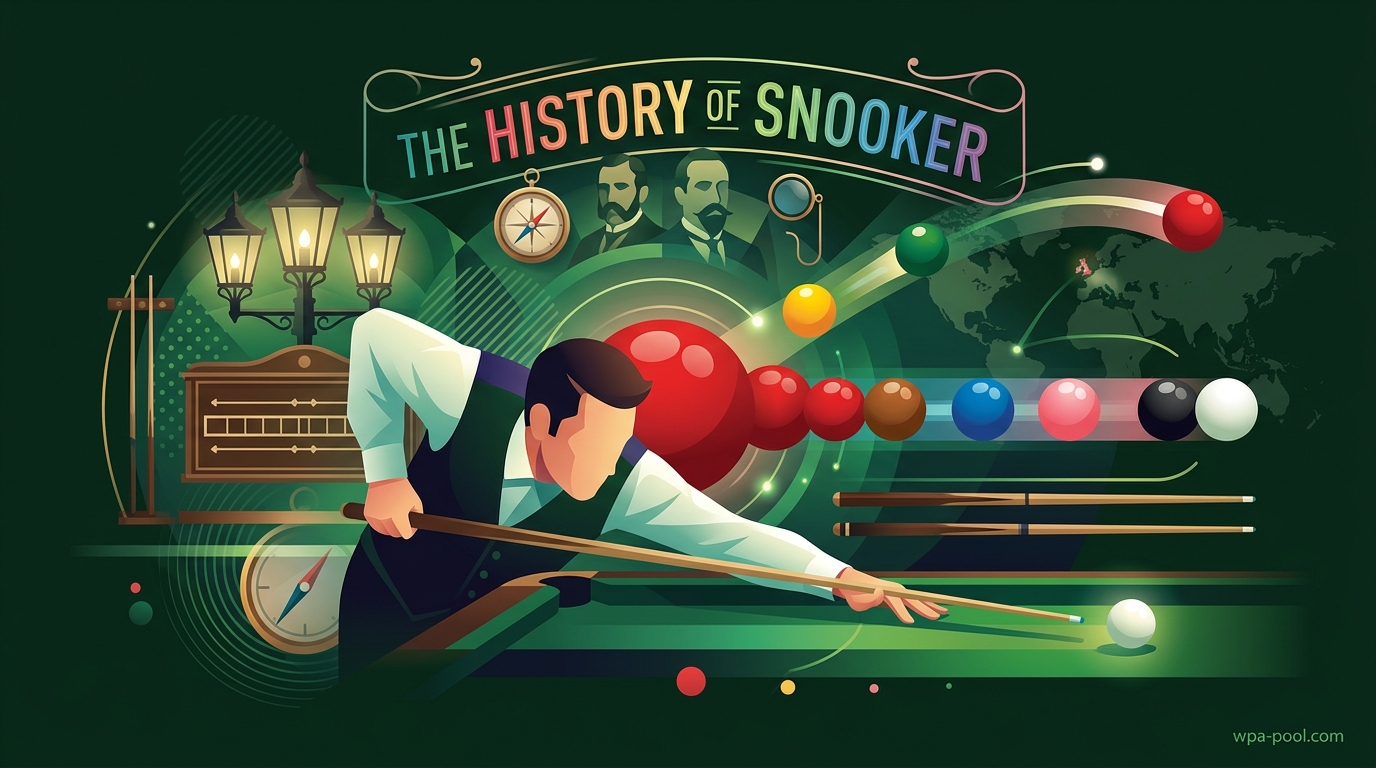
Snooker stands apart from other cue sports with its unique blend of strategy, precision, and colorful spectacle. What started as a casual diversion for bored British Army officers in India has evolved into one of the most watched indoor sports in the world. If you are a pool player curious about your sporting cousin, or simply fascinated by how games develop over time, this journey through the history of snooker will reveal exactly how this distinctive game came to be.
Understanding snooker’s origins helps explain why it shares so much DNA with pool and billiards, yet remains distinctly different. The larger table, the complex scoring system, and the ritual of the colored balls all trace back to those early days in British India. I have spent years following both pool and snooker, and the connections between these games run deeper than most players realize.
In this comprehensive guide, we will trace snooker’s path from Lieutenant Neville Chamberlain’s mess room in 1875 through its television golden age in the 1980s, right up to its 2026 status as a global phenomenon with millions of fans across Asia and Europe.
Table of Contents
The Origins and Invention: How Snooker Was Born in British India (1875)
The story of snooker begins not in Britain, but in the heat of colonial India. In 1875, a young British Army officer named Neville Francis Fitzgerald Chamberlain found himself stationed at Jubbulpore (now Jabalpur) with time on his hands. Bored with the existing cue games available, he began experimenting with variations that would eventually create something entirely new.
Chamberlain belonged to the Devonshire Regiment, and like many officers of his era, he was an enthusiastic player of billiards and pool. The British Army had brought these games to India decades earlier, establishing them as staples of officers’ mess recreation. However, Chamberlain wanted something more complex and challenging than the standard fifteen-ball pool or English billiards that dominated mess room tables.
Who Invented Snooker? The Chamberlain Story and the Debate
For over a century, Neville Chamberlain has been credited as snooker’s inventor. The story goes that he combined elements of “black pool” (a variant using colored balls) with the pyramid structure of fifteen red balls from traditional pool games. This hybrid creation immediately captured the interest of his fellow officers, who found the added complexity addictive.
However, recent scholarship from snooker historians has introduced some debate around this claim. The Snooker Heritage website has uncovered earlier references to games called “snooker” that may predate Chamberlain’s 1875 creation. Some researchers suggest the term existed as slang before it became a formal game name.
Despite these academic discussions, Chamberlain remains the widely accepted father of snooker. His role in formalizing the rules and spreading the game beyond India is undisputed. Whether he truly invented it from scratch or formalized an existing informal game, his contribution to cue sports history is monumental.
Where Did Snooker Originate? The Ooty Club Connection
While Chamberlain conceived the game in Jubbulpore, snooker truly flourished at the Ooty Club in Ootacamund (now Udhagamandalam). This hill station in the Nilgiri Mountains became the sport’s spiritual home during the British Raj. The cool climate made it a favorite retreat for British officers, and the Ooty Club’s billiard room witnessed countless early snooker matches.
The club still stands today, and visitors can see historical displays celebrating its connection to snooker’s birth. The original table where Chamberlain and his fellow officers refined the game may be long gone, but the atmosphere of colonial-era cue sports remains palpable. For any serious student of snooker history, the Ooty Club represents essential pilgrimage territory.
Why Is It Called Snooker? The Slang Connection
The word “snooker” originated as military slang for a first-year cadet or inexperienced soldier. Chamberlain reportedly used the term to describe an opponent who failed to pot a ball, shouting “you’re a snooker” across the table. The insult stuck, and eventually became the game’s permanent name.
This etymology reveals much about the social context of snooker’s creation. British Army mess rooms were masculine, competitive spaces where verbal sparring accompanied physical games. The playful insult that became a global sport’s name reflects the casual, irreverent atmosphere where snooker was born.
Some alternative theories suggest the word derives from “snook,” a type of fish, or from Indian language roots. However, the military slang explanation remains the most widely accepted and documented origin story.
Snooker vs Pool vs Billiards: The Early Relationship
Understanding snooker’s relationship to pool and billiards illuminates its early development. Chamberlain did not create snooker in a vacuum—he was actively combining existing games that British officers already knew and played.
Billiards, the oldest of the three, had been played in England since the 16th century. It features just three balls (white, spot white, and red) and emphasizes cannons and winning hazards. Pool emerged from billiards, with the fifteen-ball pyramid formation becoming standardized in the 19th century. Black pool, a variation using colored balls alongside the reds, provided the template for snooker’s ball set.
Snooker essentially combined the fifteen red balls from pool with the colored ball concept from black pool, then added its own scoring complexity. This fusion explains why accomplished pool players can often transition to snooker relatively quickly—the fundamental mechanics of cueing and potting transfer between games, even if the strategy differs dramatically.
For pool players reading this, think of snooker as your game’s more patient, strategic cousin. Where pool emphasizes position play and breaking clusters, snooker demands safety battles and long-term tactical planning over a much larger playing surface.
The Early Years: From Mess Room to Mainstream (1880-1919)
After its invention, snooker remained largely confined to British India for several decades. The game spread organically through the social networks of colonial officers, moving from mess room to mess room as regiments rotated through different stations. By the 1880s, most British Army posts in India featured snooker alongside traditional billiards tables.
The game’s structure continued evolving during this period. Early versions had not yet standardized the exact placement of colored balls or the precise dimensions of the playing area. Different regiments developed slight variations, leading to the kind of rule diversity common in young sports.
Return to Britain and Growing Popularity
British officers returning home from India brought snooker with them, introducing the game to London clubs and provincial billiard halls. The first recorded snooker match in England took place in the late 1880s, though exact dates remain uncertain. Initially, snooker struggled to compete with established billiards, which dominated the competitive scene.
The game’s complexity actually hindered early adoption. Where billiards offered straightforward scoring and quick games, snooker demanded patience and strategic thinking that did not immediately appeal to all players. Club owners, concerned about table time, sometimes discouraged snooker because games lasted longer than billiards matches.
Despite these obstacles, snooker gradually built a dedicated following. By the early 1900s, several London clubs had installed snooker tables, and informal competitions began emerging. The game’s reputation for rewarding skill over luck attracted serious players who appreciated its depth.
Life Pool and Black Pool: The Ancestral Games
Snooker’s development cannot be understood without examining its parent games. Life pool, popular in 19th-century Britain, involved each player having a specific colored ball as their “life,” with the goal being to pot all opponents’ lives while protecting your own. Black pool added the black ball as a final target after clearing other colors.
These games taught British officers the mechanics that Chamberlain would combine into snooker. The concept of colored balls with different point values came from these pool variants. The pyramid of reds, meanwhile, descended from traditional English pool, which itself evolved from billiards.
This lineage matters because it shows snooker as part of a continuous evolution in cue sports. No game appears fully formed from nothing—they all build upon previous innovations. For modern players, understanding this history deepens appreciation of how sophisticated modern cue sports have become through centuries of incremental refinement.
Rules Standardization and the Professional Era (1919-1946)
Snooker’s transition from casual pastime to organized sport required formal rules. In 1919, the Billiards Association and Control Club (later the Billiards Association and Control Council) standardized snooker’s regulations, finally establishing consistent gameplay across different venues. This milestone marked snooker’s emergence as a serious competitive activity.
The standardization addressed numerous ambiguities. Ball sizes and weights became fixed. The exact positions for colored spots were measured and mandated. Scoring procedures were clarified to eliminate disputes. These changes made competitive snooker feasible for the first time.
The First World Championship (1927)
The inaugural World Snooker Championship took place in 1927, establishing competitive snooker’s premier event. Organized by the sport’s leading players, this tournament drew entries from Britain’s best cue sports competitors. The final was held at Camkin’s Hall in Birmingham, a venue that would host several early championships.
Joe Davis won that first championship, beginning a dominance that would shape snooker’s early professional era. The tournament format established precedents still followed today, including multiple-session matches and a knockout structure. Though prize money was modest compared to modern standards, the championship provided legitimacy that helped snooker grow.
Joe Davis: The First Snooker Superstar
No discussion of early snooker is complete without Joe Davis. Between 1927 and 1946, he won fifteen consecutive world championships, a record of sustained dominance unmatched in any major sport. His technical precision and tactical brilliance established standards that influenced every subsequent generation.
Davis was more than just a champion—he was snooker’s first true ambassador. He promoted the game through exhibitions, wrote instructional books, and worked tirelessly to expand its popularity. His brother Fred also became a top player, creating a family dynasty that helped legitimize snooker as a career path.
The Davis era saw snooker gradually displace billiards as Britain’s premier indoor sport. By the late 1930s, most major billiards halls featured snooker tables, and the game’s audience had expanded far beyond its colonial origins. World War II interrupted competitive play, but snooker emerged from the conflict positioned for its golden age.
Television and the 1980s Golden Age (1969-1990)
Snooker’s relationship with television transformed the sport from a niche activity to mass entertainment. The breakthrough came in 1969 with the BBC’s “Pot Black,” a series that brought snooker into British living rooms during an era when color television was still novel and exciting.
“Pot Black” was perfectly timed. Color TV had launched in Britain in 1967, and broadcasters desperately needed programming that showed off the new technology’s capabilities. Snooker’s vividly colored balls against the green baize provided exactly the visual spectacle color television needed to demonstrate its superiority over black-and-white broadcasting.
Pot Black and the Television Revolution (1969)
The original “Pot Black” format featured single-frame matches between top players, compressed into thirty-minute programs ideal for BBC Two’s scheduling. Viewers who had never seen snooker before were captivated by the tension, the tactical battles, and the charismatic personalities of the players.
Television exposure created household names from previously obscure professionals. Suddenly, players who had labored in relative anonymity became recognized faces at pubs and workplaces across Britain. The 1970s saw snooker’s popularity surge, with club memberships increasing and new venues opening to meet demand.
By the end of the 1970s, snooker had become Britain’s most-watched indoor sport. The 1978 World Championship final drew record audiences, setting the stage for the explosive growth of the following decade.
The 1980s Boom: Steve Davis and Alex Higgins
The 1980s represented snooker’s commercial and cultural peak in Britain. Two contrasting superstars defined the era: Steve Davis, the methodical, machine-like champion who dominated tournaments through relentless precision, and Alex “Hurricane” Higgins, the flamboyant, emotional genius whose unpredictable brilliance thrilled crowds.
Davis won six world championships during the 1980s, establishing records that stood for decades. His approach to the game—calculating percentages, minimizing risk, wearing down opponents through safety exchanges—represented snooker as chess-like mental warfare. Young players studied his methods, and his influence persists in modern professional tactics.
Higgins provided the perfect counterpoint. His attacking style, lightning-fast play, and emotional volatility made every match unpredictable theater. When Higgins won the 1982 World Championship, dedicating the victory to his infant daughter, the moment became one of British television’s most emotional sporting scenes. His rivalry with Davis captivated the nation and drew millions of viewers who had never previously cared about cue sports.
The 1985 Black Final: Snooker’s Defining Moment
Snooker’s place in British cultural history was cemented by the 1985 World Championship final between Dennis Taylor and Steve Davis. Played over two days at Sheffield’s Crucible Theatre, the match came down to the final black ball in the deciding frame—hence the “Black Final” nickname.
Taylor, wearing his distinctive upside-down glasses, potted the final black at 12:23 AM after midnight, having trailed Davis 8-0 and 8-2 earlier in the match. The 18.5 million viewers who watched the conclusion set a British television record for post-midnight broadcasting that still stands today.
I remember watching a recording of that final black years later, and the tension remains palpable even in archival footage. The crowd’s roar, Taylor’s triumphant finger-pointing to the heavens, and Davis’s dignified concession created a sporting moment that transcended snooker itself. For many British viewers, that match was their introduction to the sport’s drama.
Global Expansion and the Modern Era (1990-2026)
The decades following the 1980s boom saw snooker consolidate its position while expanding internationally. The sport’s heartland remained Britain, but significant growth occurred across Europe, Asia, and beyond. By the 2026, snooker boasts professional tournaments on multiple continents and a global television audience measured in hundreds of millions.
The Hendry Era and New Standards (1990-1999)
Stephen Hendry emerged as the dominant force of 1990s snooker, winning seven world championships and setting records that challenged even the legendary Joe Davis. Hendry’s aggressive, break-building approach revolutionized professional play, proving that attacking snooker could succeed at the highest level.
His rivalry with Jimmy “The Whirlwind” White, who reached six world finals without winning, provided the decade’s most compelling narrative. White’s heartbreaking near-misses and eventual honorary world title (awarded in 2020) embodied both the cruelty and romance of sport.
Hendry’s seven titles, achieved by age 30, established a benchmark that seemed unassailable. His century break records and maximum 147 achievements pushed the sport’s technical limits, inspiring younger players to develop similarly aggressive styles.
The Rocket: Ronnie O’Sullivan’s Dominance
Ronnie O’Sullivan, known as “The Rocket” for his explosive speed of play, has dominated snooker since the late 1990s and remains competitive into the 2020s. His seven world championships (matching Hendry’s record), combined with his artistic approach to the game, have made him arguably snooker’s greatest ever player.
O’Sullivan’s influence extends beyond his titles. His ambidextrous play, his philosophical interviews, and his willingness to discuss mental health challenges have expanded snooker’s cultural relevance. Young players worldwide cite him as their primary inspiration, and his matches continue drawing record television audiences.
In 2026, O’Sullivan remains a formidable competitor while also serving as the sport’s most prominent ambassador. His longevity—competing at the highest level across three decades—demonstrates snooker’s unique capacity to reward experience alongside physical skill.
Snooker in China: A New Superpower
No development has shaped modern snooker more than its explosive growth in China. What began with Ding Junhui’s emergence as a teenage prodigy in the early 2000s has blossomed into a full-scale sporting phenomenon. China now hosts multiple ranking tournaments and boasts the world’s largest amateur snooker participation base.
Ding’s success—winning three UK Championships and reaching the 2016 World Championship final—inspired millions of Chinese youths to take up the game. By the 2020s, Chinese players regularly appear in tournament finals, and the country’s professional tour membership has grown exponentially.
The Chinese government’s support for snooker, recognizing its popularity and potential international prestige, has funded training academies and tournament infrastructure. Shanghai, Beijing, and other major cities now host events that rival the traditional British tournaments in prize money and prestige.
Women in Snooker: Breaking Barriers
Snooker’s history has not always been inclusive of women. For decades, the professional tour was male-only, with women restricted to separate competitions with smaller prizes. However, the 21st century has seen gradual progress toward gender equality.
Allison Fisher dominated women’s snooker in the 1980s and 1990s before transitioning to American pool, where she became equally legendary. Reanne Evans has won twelve women’s world championships and qualified for the professional men’s tour, competing against male opponents in ranking events.
The women’s game gained significant visibility in 2021 when Mink Nutcharut became the first woman to win a World Championship qualifying match. While full parity remains a goal rather than reality, the trajectory toward inclusive professional snooker appears established.
Snooker Today and Its Future
Snooker enters the mid-2020s in robust health. The professional tour features tournaments across Europe, Asia, and the Middle East, with total prize money exceeding twenty million pounds annually. Television coverage reaches over 100 countries, and streaming platforms have expanded access to matches that previously required expensive satellite subscriptions.
The sport has also embraced technology. Shot-tracking systems, high-definition cameras, and virtual reality training tools have enhanced both professional play and amateur practice. Online platforms connect players globally, enabling competitive matches without geographic proximity.
Environmental concerns have prompted innovations in equipment. Sustainable snooker balls (moving away from ivory substitutes), eco-friendly table materials, and energy-efficient venue lighting represent the sport’s adaptation to contemporary challenges. These changes maintain traditional gameplay while reducing ecological impact.
For pool players considering exploring snooker, the entry barriers have never been lower. Many cities feature snooker halls alongside pool rooms, and instructional content abounds online. The skills developed on a pool table—cue ball control, potting technique, safety play—transfer directly to snooker, though the larger table demands adjustments.
Frequently Asked Questions About Snooker History
Who invented the game of snooker?
Snooker was invented in 1875 by British Army officer Neville Francis Fitzgerald Chamberlain while stationed in Jubbulpore, India. While some academic debate exists about earlier references to games called snooker, Chamberlain is widely credited as the father of modern snooker for formalizing the rules and spreading the game. He combined elements of pool and billiards to create snooker’s distinctive format with fifteen red balls and six colored balls.
Which is older, billiards or snooker?
Billiards is significantly older than snooker. Billiards dates back to at least the 15th century in England and France, evolving from outdoor lawn games. Snooker was invented in 1875, making it roughly 400 years younger than billiards. Snooker actually developed from billiards and pool games, with inventor Neville Chamberlain combining existing elements rather than creating an entirely original game.
How did the game of snooker start?
Snooker started when British Army officer Neville Chamberlain created the game in 1875 to relieve boredom in the officers’ mess at Jubbulpore, India. He combined pyramid pool (using fifteen red balls) with colored balls from black pool. The game spread through British military networks in India before returning to Britain in the 1880s. It gained formal rules in 1919 and held its first World Championship in 1927, transitioning from a casual pastime to an organized sport.
Where did snooker start from?
Snooker started in British India, specifically in the city of Jubbulpore (now Jabalpur) in 1875. It was invented by a British Army officer named Neville Chamberlain. The game then spread to other British military posts across India, particularly flourishing at the Ooty Club in the Nilgiri Mountains. From India, returning British officers brought snooker back to England in the 1880s, where it gradually developed into the professional sport known today.
What is the difference between snooker and pool?
Snooker and pool differ in table size, ball count, and gameplay. Snooker uses a larger table (12 feet by 6 feet) with 22 balls (15 reds, 6 colors, and a white cue ball), while pool typically uses a smaller table with 16 balls (including the cue ball). Snooker scoring is more complex, with each colored ball worth different points. Pool games generally focus on pocketing balls in sequence or groups, while snooker emphasizes tactical safety play and building high breaks. The larger snooker table makes potting more challenging and rewards precise cue ball control.
Conclusion: The Enduring Legacy of Snooker
The history of snooker reveals a sport that evolved from humble origins to global phenomenon. From Neville Chamberlain’s mess room experiments in 1875 to the multimillion-pound professional circuit of 2026, snooker has maintained its unique character while adapting to changing times. The game rewards patience, strategy, and precision—qualities that transcend cultural boundaries and explain its worldwide appeal.
For pool players, understanding snooker’s history illuminates the deep connections between these related cue sports. The skills developed at the pool table transfer directly to snooker’s larger baize canvas, and many players find enjoyment in both games. The history of snooker is ultimately part of the broader history of cue sports, a continuous evolution of games played with sticks, balls, and tables that stretches back centuries.
Whether you are inspired to try snooker yourself after reading this history, or simply appreciate the game’s remarkable journey from colonial India to international television audiences, the story of snooker offers lessons about how sports develop, spread, and capture human imagination. The next chapter of that story is being written right now in tournaments across the world, as new players pick up cues and add their names to a history that began nearly 150 years ago in a British Army mess room.