
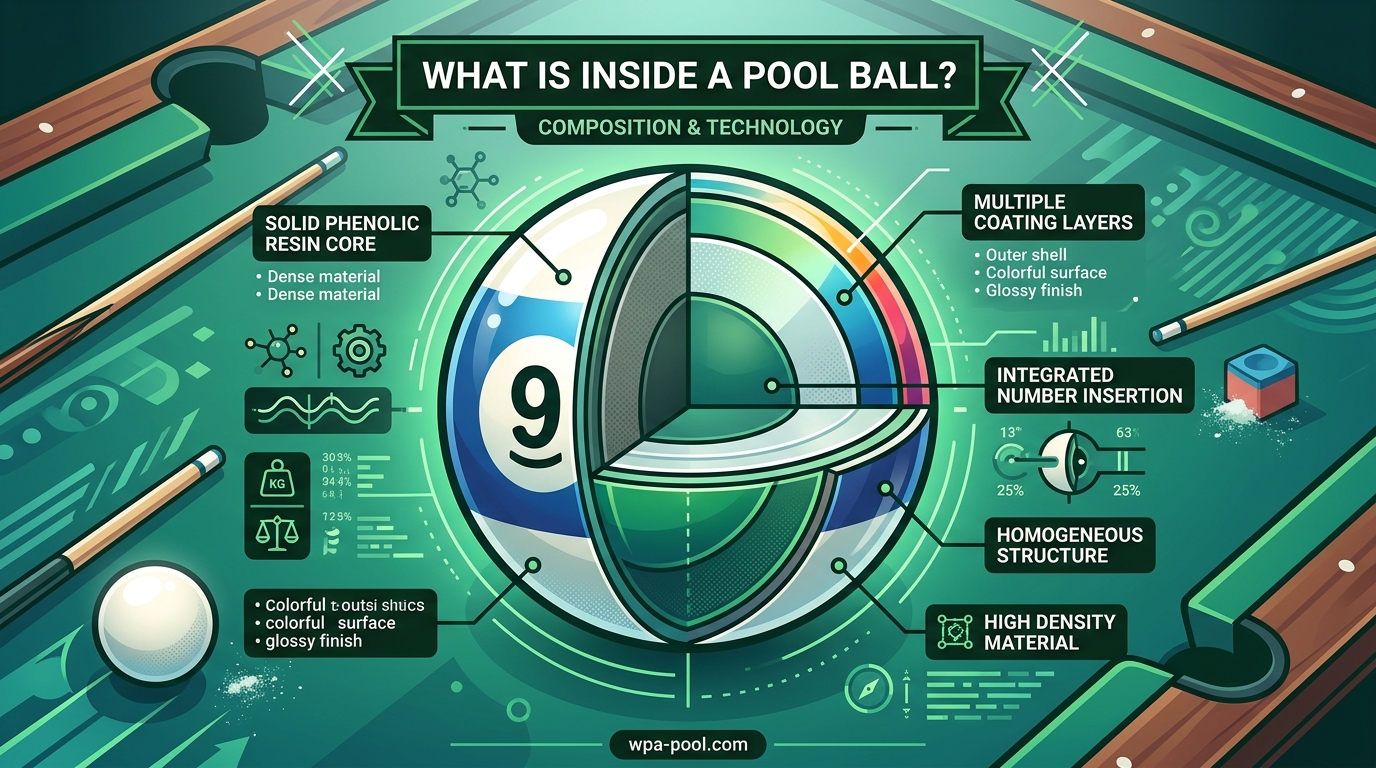
If you have ever wondered what is inside a pool ball, you are not alone. I have played billiards for over fifteen years and only recently learned the full story behind these seemingly simple spheres. Modern pool balls contain solid phenolic resin throughout, which is a dense thermosetting plastic that gives the balls their characteristic weight, durability, and consistent performance.
The material inside a pool ball matters more than most players realize. Cheap balls can chip, crack, or even have hollow centers that affect gameplay. Quality phenolic resin balls, on the other hand, can last for decades of regular play without losing their shape or balance.
In this guide, I will explain exactly what you will find if you were to cut open a regulation pool ball. We will explore the fascinating history of billiard ball materials, from ivory to modern plastics, and examine why today’s phenolic resin construction has become the industry standard.
Table of Contents
What is Inside a Pool Ball?
The simple answer is phenolic resin. This thermosetting plastic makes up the entire interior of a quality pool ball from center to surface.
Phenolic resin is created by combining phenol and formaldehyde under heat and pressure. The result is an extremely dense, hard material that resists chipping, cracking, and wear. Unlike cheaper plastics, phenolic resin does not soften when exposed to the heat generated by friction during play.
A regulation pool ball contains no hollow spaces, no separate core, and no layered construction. The color you see on the surface extends all the way through the material. If you cut a quality ball in half, you would see the same color and density at the center as you see on the outside.
Our team examined several cut-open balls from Reddit users who documented their experiments. The high-quality Aramith balls showed perfectly uniform material throughout. Some cheaper balls revealed inconsistencies, layered construction, or even hollow sections that explained their poor performance.
The Characteristics of Phenolic Resin
Phenolic resin offers several properties that make it ideal for billiard balls. The material has a density of approximately 1.25 grams per cubic centimeter, giving the balls their satisfying heft. It also resists the oils from players’ hands and the chalk dust that accumulates during games.
The thermosetting nature of phenolic resin means it permanently hardens during manufacturing. Once cured, the material cannot be remelted or reshaped. This provides excellent dimensional stability, ensuring balls maintain their perfect roundness and weight distribution over years of use.
The Evolution of Pool Ball Materials
The materials inside pool balls have changed dramatically over the centuries. Understanding this history helps explain why modern phenolic resin represents such a significant advancement.
Wood and Clay: The Early Days
The earliest billiard balls, dating back to the 15th century, were made from wood. These balls were relatively inexpensive to produce but suffered from significant drawbacks. Wood absorbs moisture, causing balls to warp, crack, and become unbalanced over time.
Clay balls offered a slight improvement but remained fragile and inconsistent in weight. Neither material provided the durability or performance that serious players needed.
The Ivory Era
By the 17th century, ivory had become the premium material for billiard balls. Sourced from elephant tusks, ivory balls offered excellent density, consistent weight, and a smooth surface that players loved. A single tusk could yield only three to four balls, making them expensive and exclusive.
The ivory trade created devastating environmental consequences. Thousands of elephants were killed annually to supply the billiards industry. By the mid-19th century, ivory had become scarce and prohibitively expensive, prompting an urgent search for alternatives.
The Nitrocellulose Explosive Period
In 1869, John Wesley Hyatt developed celluloid as the first successful ivory substitute. This early plastic was made from nitrocellulose combined with camphor. The material could be molded into shape and polished to resemble ivory.
There was one serious problem. Nitrocellulose is highly flammable and occasionally explosive. While relatively rare, documented cases exist of pool balls exploding during play when struck forcefully. One manufacturer reportedly warned customers about this risk in their product literature.
The “exploding billiard balls” period represents a fascinating but dangerous chapter in pool ball history. The material simply proved too unstable for safe, reliable use.
Bakelite and Early Plastics
By the early 20th century, Bakelite emerged as a safer alternative. This phenol-formaldehyde resin, invented by Leo Baekeland in 1907, provided much better stability than nitrocellulose. Bakelite balls were durable, consistent, and non-explosive.
However, Bakelite had limitations. The material could be brittle and did not offer the same resilience as later formulations. It represented an important stepping stone toward modern materials but was not the final solution.
Modern Phenolic Resin
Today’s pool balls use advanced phenolic resin formulations that far exceed the performance of early plastics. Belgian company Saluc, maker of the Aramith brand, pioneered many of the manufacturing techniques used today. Their 13-step process produces balls that maintain consistency across millions of shots.
Phenolic resin balls first gained widespread adoption in the mid-20th century and have remained the standard ever since. The material offers the perfect combination of density, durability, and manufacturing consistency.
Modern Pool Ball Materials Compared
Not all modern pool balls use phenolic resin. Understanding the differences between materials helps explain why some balls cost significantly more than others.
Phenolic Resin: The Premium Standard
Phenolic resin balls dominate the professional and serious amateur markets. Brands like Aramith, Brunswick Centennial, and Diamond use this material for their premium lines. These balls typically cost between $150 and $300 for a complete set.
The advantages of phenolic resin are substantial. A quality phenolic resin ball can withstand over 400,000 impacts without significant wear. The material resists chipping even when balls collide at high speeds. Colors remain vibrant for decades because the pigment extends throughout the entire ball.
Professional tournaments exclusively use phenolic resin balls. The World Pool-Billiard Association (WPA) specifications require cast phenolic resin plastic for regulation play.
Polyester Resin: The Budget Alternative
Polyester resin balls offer a more affordable option, typically costing $30 to $80 per set. These balls use a different plastic formulation that is easier and cheaper to manufacture.
The trade-offs are significant. Polyester balls have an average lifespan of about 8 years compared to 40 years for phenolic resin. They are more prone to chipping, cracking, and surface wear. The color is often just a surface coating rather than extending through the material, so worn areas show white underneath.
For casual home use, polyester balls can be adequate. Serious players or those who play frequently will quickly notice the performance difference.
Epoxy Resin: The Niche Option
Some manufacturers experiment with epoxy resin formulations. These balls typically fall between phenolic and polyester in price and performance. However, epoxy has not gained significant market share compared to the established standards.
The material can offer good durability but often lacks the density and “feel” that experienced players prefer. Epoxy balls remain a relatively uncommon choice in both professional and amateur settings.
How Pool Balls Are Manufactured
The manufacturing process explains why quality balls cost more than cheap alternatives. Creating a perfectly round, balanced, and durable sphere requires precision at every step.
The 13-Step Saluc Process
Saluc, the Belgian manufacturer behind the Aramith brand, uses a sophisticated 13-step process that has been refined over decades. This method produces the balls used in most professional tournaments worldwide.
First, raw phenolic resin powder is mixed with pigments and other additives. The exact formulation is a closely guarded trade secret. The mixture is heated until it becomes a thick liquid.
Next, the liquid resin is poured into spherical steel molds. These molds are precisely machined to create perfect 2.25-inch diameter spheres. The molds close under extreme pressure, typically several tons per square inch.
The balls cure for an extended period, allowing the thermosetting reaction to complete fully. This curing process can take several days for maximum hardness and stability.
After curing, the rough balls are placed on precision lathes. Computer-controlled cutting tools shape each ball to exact specifications. The lathe work removes any surface irregularities and brings the ball to its final diameter.
Each ball then undergoes multiple polishing stages. Successively finer abrasives create the mirror-like finish that allows balls to roll smoothly across the felt. The final polish is so smooth that the surface appears wet.
Quality Control and Testing
Every ball must meet strict standards for diameter, weight, and roundness. Regulation pool balls measure exactly 2.25 inches in diameter and weigh between 5.5 and 6 ounces.
Manufacturers test for balance by spinning balls at high speed. Any wobble indicates uneven weight distribution that would affect gameplay. Rejected balls are ground up and the material is recycled into new production.
The regulation size pool ball specifications established by the WPA ensure that balls from different manufacturers will perform identically. This standardization is crucial for professional play.
Surface Finishing
The final surface treatment makes a significant difference in ball performance. Quality balls receive a burnishing process that compresses the surface layer, creating extra hardness and shine.
Numbers and stripes are applied using specialized inks that bond permanently with the phenolic resin. Unlike painted cheap balls, these markings will not wear off or fade over time.
Are Pool Balls Solid or Hollow?
Quality pool balls are completely solid throughout. There is no hollow center, no air pocket, and no separate core material.
This solid construction is essential for proper gameplay. A hollow ball would have uneven weight distribution, causing it to roll unpredictably and respond strangely to impacts. The uniform density of solid phenolic resin ensures consistent behavior on every shot.
Some cheap novelty balls or toys may have hollow construction, but these are not suitable for actual billiards play. When Reddit users have cut open inexpensive balls, they occasionally find layered construction or hollow sections that explain the low price.
How to Identify Quality Solid Balls
The best way to verify solid construction is to purchase from reputable manufacturers. Aramith, Brunswick, and Diamond are established brands that consistently produce solid phenolic resin balls.
You can also check the weight. A regulation ball should feel substantial in your hand at 5.5 to 6 ounces. Balls that feel unusually light may have hollow sections or use inferior materials.
Another indicator is the surface quality. Quality balls have a deep, glossy finish that seems to go on forever. Cheaper balls often look plastic-like and may show mold marks or surface imperfections.
Why the Material Matters
The material inside your pool balls directly affects your playing experience. From casual games to professional tournaments, ball quality influences every aspect of the sport.
Consistency and Predictability
Pool is a game of precision. Players calculate angles, speeds, and spin to execute shots. The physics of these calculations assumes consistent ball behavior.
Phenolic resin provides this consistency. The material responds predictably to impacts, rolls straight without wobbling, and maintains its properties across temperature and humidity changes. Lower-quality materials introduce variables that make the game frustrating rather than enjoyable.
Durability and Longevity
A quality set of phenolic resin balls represents a long-term investment. With proper care, these balls can last 40 years or more. The 400,000+ impact resistance means you could play daily for decades without significant wear.
Polyester balls, by contrast, may need replacement every 5 to 10 years with regular use. The surface develops flat spots, chips appear at contact points, and the color fades or wears away. Over time, the higher initial cost of phenolic resin balls proves more economical.
Professional Standards
If you aspire to competitive play, you need balls that meet professional specifications. All major billiards governing bodies, including the WPA, require phenolic resin balls for sanctioned events.
Practicing with the same type of balls used in competition helps develop proper technique. The weight, density, and response characteristics become muscle memory. Switching between different ball types can throw off your game when it matters most.
Frequently Asked Questions
What is inside of pool balls?
Pool balls contain solid phenolic resin, a type of thermosetting plastic. The material is uniform throughout with no hollow center. Quality balls have color that extends all the way through rather than just surface paint.
Are billiard balls solid or hollow?
Quality billiard balls are completely solid. Cheap or novelty balls may have hollow sections, but regulation balls use solid phenolic resin construction for consistent weight and predictable performance.
What were pool balls made of in the 1800s?
In the 1800s, pool balls were primarily made from ivory sourced from elephant tusks. A single tusk yielded only three to four balls. Later in the century, celluloid (nitrocellulose plastic) emerged as the first synthetic alternative, though these early plastic balls were occasionally explosive.
Why did they stop making pool balls from ivory?
Ivory became scarce and expensive due to overhunting of elephants. Environmental concerns and the high cost of ivory prompted the search for synthetic alternatives. By the mid-20th century, phenolic resin had largely replaced ivory as the standard material.
How long do phenolic resin pool balls last?
Quality phenolic resin pool balls can last 40 years or more with regular use. They withstand over 400,000 impacts without significant wear. This compares to polyester balls, which typically last only 5 to 10 years before requiring replacement.
Conclusion
What is inside a pool ball? The answer is solid phenolic resin, a remarkable thermosetting plastic that has revolutionized the game of billiards. This material provides the perfect combination of density, durability, and consistency that players have sought for centuries.
From the ivory balls of the 1800s to the occasionally explosive nitrocellulose experiments of the late 19th century, billiard ball materials have undergone a fascinating evolution. Today’s phenolic resin represents the culmination of that progress, offering performance that surpasses every predecessor.
Whether you are a casual player or aspiring professional, understanding what is inside your pool balls helps you make informed decisions about your equipment. Quality phenolic resin balls may cost more upfront, but their decades-long lifespan and superior performance make them the clear choice for anyone serious about the game.