
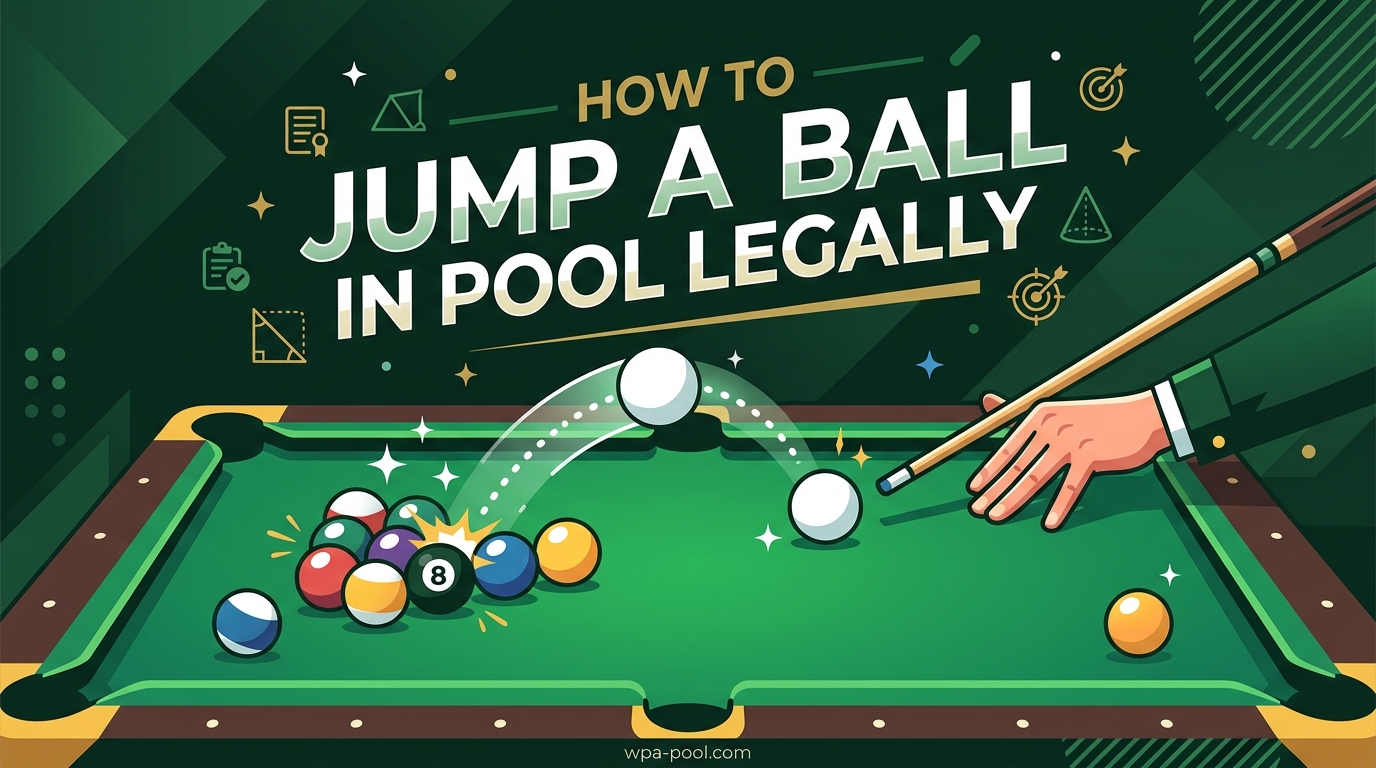
Learning how to jump a ball in pool legally opens up a powerful strategic tool for your game. I spent months confused about whether jump shots were allowed until I discovered the key distinction: in American pool, jump shots are completely legal when executed correctly with a downward stroke.
The technique differs dramatically from scooping, which is illegal in all forms of pool. A legal jump shot requires striking the cue ball above its equator at a 45-degree angle, causing the ball to bounce off the table surface and clear obstacle balls.
In this guide, I will walk you through everything you need to know about legal jump shots. We will cover the rules by game type, the exact technique you need to master, common mistakes to avoid, and practice drills to build your confidence.
Table of Contents
What Makes a Jump Shot Legal
A legal jump shot relies on physics. When you strike the cue ball above its center with a downward motion, the ball compresses against the slate beneath the cloth and rebounds upward. This bounce allows the ball to hop over obstacle balls in its path.
The critical requirement is the downward stroke. You must hit the cue ball from above, driving it toward the table surface. The cue ball literally jumps because it bounces off the slate, not because you lifted it with your cue.
This distinguishes legal jumps from illegal scooping. Scooping occurs when you hit below the cue ball’s equator, sliding under the ball and lifting it upward like a shovel. Scooping is always a foul because you are not playing a proper stroke.
The Equator Rule
Many beginners fail because they do not understand the equator rule. The cue ball’s equator is the horizontal center line that divides the top half from the bottom half. For a legal jump, your cue tip must contact the ball above this line.
I learned this the hard way after repeatedly scooping and being called for fouls in my local league. Once I focused on hitting above the equator, my jump shots became legal and far more consistent.
Angle of Approach
The cue angle determines how high the ball jumps. Most experts recommend a 40 to 50 degree angle for standard jump shots. Too flat and the ball will not clear obstacles. Too steep and you risk jumping the ball off the table.
With practice, you will develop a feel for how different angles produce different jump heights. Start at 45 degrees and adjust based on the height of the obstacle you need to clear.
Jump Shot Rules by Game Type
Not all pool games treat jump shots the same way. The rules vary significantly between American pool, English pool, and snooker. Understanding these differences will save you from costly fouls in competitive play.
American Pool: Legal with Proper Technique
In American pool, which includes games like 8-ball and 9-ball, jump shots are completely legal when executed properly. The WPA (World Pool-Billiard Association) rules explicitly permit jump shots as long as you use a downward stroke.
Major leagues like the BCA (Billiard Congress of America) follow WPA rules, so jump shots are legal in most American tournaments and leagues. However, some bar leagues and house rules may prohibit them, so always check before playing.
English Pool: Always Illegal
English pool follows different traditions. Jump shots are illegal in all forms of English pool, including Blackball rules governed by the EPA (English Pool Association). If you attempt a jump shot in English pool, it is an automatic foul.
This prohibition exists partly because English pool tables have different pocket sizes and cloth types that make jump shots less practical. The focus in English pool is on positional play rather than escape shots.
Snooker: Always Illegal
Snooker also prohibits jump shots completely. The rules require all balls to remain on the table surface during play. Any shot where the cue ball leaves the bed of the table constitutes a foul.
Snooker players must rely on other techniques like swerve shots or kick shots to escape difficult positions where a jump would be useful in American pool.
Rules Comparison Table
| Game Type | Jump Shot Status | Key Rule |
|---|---|---|
| American Pool (8-ball, 9-ball) | Legal | Downward stroke required, hit above equator |
| English Pool | Illegal | Always considered a foul |
| Snooker | Illegal | Cue ball must remain on table surface |
How to Jump a Ball in Pool Legally: Step-by-Step Technique
Now let us walk through the exact technique for executing a legal jump shot. Follow these steps carefully, and remember that proper jump shots require practice to master.
Step 1: Position Your Stance
Stand slightly closer to the cue ball than you would for a normal shot. Your bridge hand needs to be elevated to create the necessary cue angle. Some players use a side-arm stance where they hold the cue horizontally, while others prefer a more traditional elevated bridge.
I found that starting with an elevated bridge worked better for me. The side-arm technique, popularized by professionals like Fedor Gorst, requires excellent timing and can feel awkward for beginners.
Step 2: Elevate Your Cue
Raise your cue to a 40 to 50 degree angle. The exact angle depends on how high you need the cue ball to jump. Higher obstacles require steeper angles, but going too steep risks losing control.
Your bridge hand must support this elevated position. Place your fingers firmly on the table surface to create a stable platform for the cue to slide through.
Step 3: Aim Above the Equator
Position your cue tip to strike the cue ball above its horizontal center line. This is the most critical step for ensuring a legal jump. Hitting below the equator produces an illegal scoop.
Visualize the top half of the cue ball and aim for a spot about one-third of the way down from the top. This contact point will drive the ball downward into the slate.
Step 4: Execute a Quick Downward Stroke
Use a short, controlled stroke with firm acceleration. The stroke should be quicker than a normal shot because you need to generate enough force to compress the ball against the slate.
Think of punching through the cue ball rather than pushing it. The quick acceleration transfers energy efficiently into the ball.
Step 5: Follow Through Naturally
Allow your cue to follow through in the direction of the shot. Do not stop abruptly after contact. The follow-through ensures clean contact and prevents unintentional scooping from a jerky motion.
Your cue will naturally angle downward through the ball due to the elevated bridge position. This downward motion is exactly what makes the shot legal.
Step 6: Control the Landing
After the cue ball clears the obstacle, it will land and continue rolling. Plan your shot so the landing position sets up your next play. The cue ball retains significant forward momentum after landing.
Practice controlling where the ball lands by adjusting your stroke power and aiming point. This control separates good jump shots from random lucky hops.
Equipment Requirements
While you can legally jump balls with a standard playing cue, specialized equipment makes the technique significantly easier. Understanding your options helps you decide what works best for your game.
Jump Cues vs Standard Cues
Jump cues are specifically designed for jump shots. They are shorter than standard cues, typically measuring 40 to 48 inches compared to the standard 58 inches. This shorter length provides better control at steep angles.
Jump cues also feature harder tips and lighter weight, which helps generate the quick acceleration needed for jumping. The reduced mass allows for faster stroke speed.
However, you do not need a jump cue to execute legal jump shots. Many players successfully jump with their standard playing cue, especially for smaller obstacles. The technique matters more than the equipment.
Cue Tip Considerations
Harder tips work better for jump shots because they transfer energy more efficiently into the cue ball. Soft tips absorb some of the impact, reducing the jump height.
If you plan to jump frequently with your standard cue, consider a medium-hard tip. This provides a good compromise between control for regular shots and performance for jumps.
Table Conditions
Cloth condition affects jump shot performance. New, fast cloth makes jumping easier because the cue ball slides and compresses better against the slate. Slow, worn cloth absorbs more energy and requires more stroke power.
Also consider the table height and lighting. Low-hanging lights can interfere with your elevated cue position. Check our pool table dimensions guide for information about standard table heights and lighting clearances.
Chalk Importance
Always chalk thoroughly before attempting a jump shot. The elevated angle and firm stroke increase the risk of miscuing. A well-chalked tip grips the cue ball properly and prevents embarrassing miscues in front of your opponent.
Common Mistakes and How to Avoid Them
Most players struggle with jump shots because they repeat the same mistakes. Here are the most common errors and how to fix them.
Mistake 1: Scooping Instead of Jumping
The most common error is hitting below the cue ball’s equator, resulting in an illegal scoop. This happens when the cue angle is too flat or the player tries to lift the ball rather than drive it down.
Fix this by ensuring your cue angle is at least 40 degrees and focusing on hitting above the center of the ball. Practice the motion without hitting the ball first to develop the correct feel.
Mistake 2: Incorrect Cue Angle
Too flat and the ball will not jump. Too steep and you lose control or jump the ball off the table. The 40 to 50 degree range works best for most situations.
Fix this by practicing with different angles and observing the results. Start at 45 degrees and adjust based on how the ball responds.
Mistake 3: Insufficient Stroke Speed
Tentative strokes produce weak jumps that fail to clear obstacles. You need committed, firm acceleration to compress the ball against the slate.
Fix this by practicing with more confidence. The ball will not jump unless you hit it with authority. Start with easier obstacles and build up your stroke power gradually.
Mistake 4: Poor Follow-Through
Stopping the cue immediately after contact produces inconsistent results and can cause unintentional scooping. The cue needs to continue through the ball.
Fix this by focusing on following through toward your target. Let the cue keep moving after contact rather than jerking it back.
Mistake 5: Fear of Miscuing
Fear causes tentative strokes and poor technique. Players afraid of miscuing often hit too softly or change their form at the last moment.
Fix this by chalking properly and practicing until you trust your technique. Confidence transforms jump shots from scary gambles into reliable tools.
Practice Drills for Beginners
Jump shots require repetition to master. These progressive drills will build your skills systematically.
Drill 1: The Equator Practice
Place the cue ball on the table and practice your bridge position without hitting the ball. Focus on elevating the cue to 45 degrees and positioning the tip above the ball’s equator. Do this 20 times to develop muscle memory.
Once comfortable, gently tap the ball to confirm you are hitting above center. The ball should hop slightly forward, not lift vertically.
Drill 2: Distance Progression
Start with an obstacle ball placed 8 to 12 inches from the cue ball. This is the easiest distance for learning. Practice jumping over the obstacle until you succeed 8 out of 10 times.
Then move the obstacle to 18 inches and repeat. Continue increasing distance as your consistency improves. Most players can reliably jump 24 to 36 inches with practice.
Drill 3: Landing Control
Set up a jump shot where you must clear an obstacle and then pocket a target ball. This drill teaches you to control where the cue ball lands after jumping.
Focus on stroke power and follow-through to influence the landing position. The cue ball retains momentum after landing, so you can predict where it will travel.
Drill 4: Game Simulation
Practice jump shots during casual games with friends. Real-game pressure teaches you when jumps are appropriate and builds confidence for competitive situations.
Start with low-stakes situations where missing does not cost you the match. As your success rate improves, use jumps in more critical moments.
When to Use Jump Shots
Jump shots are powerful tools, but they are not always the right choice. Understanding when to jump and when to choose alternatives separates smart players from show-offs.
Appropriate Situations
Jump shots work best when you have a clear path to the target ball after clearing the obstacle. They are ideal for escaping snookers where the obstacle blocks a direct path but leaves room for a jump trajectory.
Use jump shots when you have no reasonable kick shot available. Kicking off rails is often safer because it keeps the cue ball on the table, but sometimes the geometry makes kicking impossible.
When to Avoid Jumps
Do not attempt jump shots when the obstacle is too close to the cue ball. Jump shots require at least 6 to 8 inches of distance to work properly. Closer obstacles make scooping more likely and jumping nearly impossible.
Avoid jumps when missing would leave your opponent an easy shot. The risk of a miscue or failed jump may outweigh the benefit of attempting the shot.
Alternative Shots
Consider kick shots, where you bank the cue ball off a rail to reach your target. Kicks are safer because they do not require the precision of a jump shot.
Safety play is another option. Rather than attempting a difficult jump, play a defensive shot that leaves your opponent no easy opportunity. Sometimes the smart play is avoiding the hero shot entirely.
Frequently Asked Questions
Can you legally jump a ball in pool?
Yes, you can legally jump a ball in American pool games like 8-ball and 9-ball. The jump shot must use a downward stroke hitting above the cue ball’s equator. However, jump shots are illegal in English pool and snooker. Always check your specific league rules, as some bar leagues prohibit jump shots even in American pool.
How to legally jump shot in pool?
To execute a legal jump shot, elevate your cue to a 40-50 degree angle, strike the cue ball above its equator with a quick downward stroke, and follow through naturally. The cue ball should compress against the table slate and rebound upward, clearing any obstacle balls. Avoid hitting below the center line, which would constitute an illegal scoop.
Is jump ball a violation?
A jump ball is only a violation if executed incorrectly or in games that prohibit jump shots. In American pool, a jump shot is legal when performed with a downward stroke hitting above the cue ball’s equator. However, scooping the ball by hitting below center is always a foul. Jump shots are violations in English pool and snooker regardless of technique.
Can any cue be used for jumping?
Yes, you can legally jump balls with a standard playing cue, though specialized jump cues make the technique easier. Jump cues are shorter (40-48 inches), lighter, and have harder tips than standard cues. Many professionals use dedicated jump cues for difficult jumps but use their regular cue for simpler obstacles.
Conclusion
Mastering how to jump a ball in pool legally adds a valuable weapon to your game. The key is understanding the difference between a proper downward stroke and an illegal scoop. By hitting above the cue ball’s equator at a 45-degree angle, you can clear obstacle balls and escape difficult positions that would otherwise cost you the game.
Remember that jump shot rules vary by game type. They are legal in American pool but prohibited in English pool and snooker. Always confirm your local league rules before attempting jump shots in competition.
Start with the practice drills outlined in this guide, beginning with 8 to 12 inch obstacles and progressing as your confidence builds. With consistent practice, you will develop the timing and technique to execute legal jump shots under pressure.
The jump shot is not about showing off. It is a strategic tool for situations where no other shot exists. Use it wisely, and it will save you countless games.