
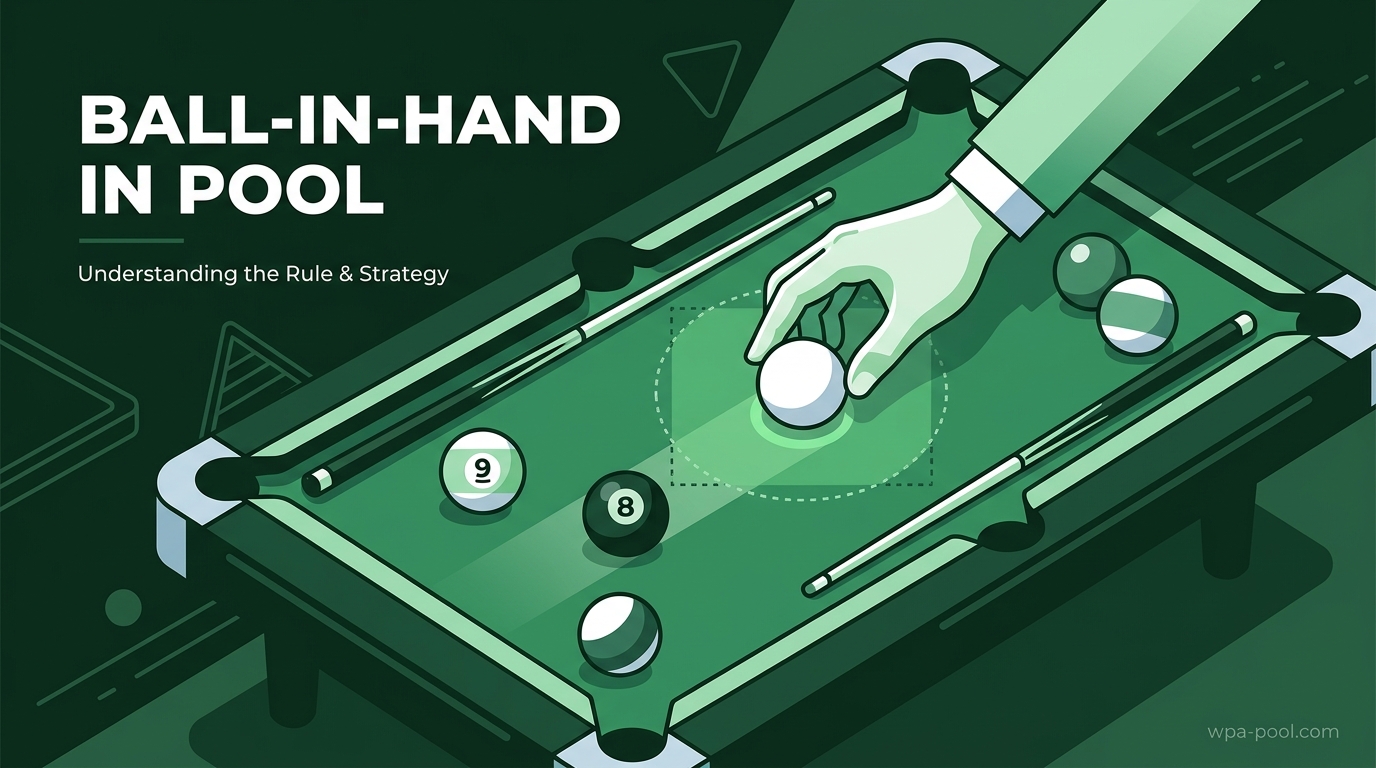
Ball-in-hand is one of the most powerful advantages you can gain during a pool game. It gives you complete control over where to place the cue ball before your next shot. Understanding this rule completely will dramatically improve your game, whether you play casually at home or compete in league matches.
Our team has analyzed hundreds of forum discussions from players at all skill levels. We have identified the most common points of confusion and the strategic opportunities most beginners miss. This guide covers everything from the basic definition to advanced techniques that separate good players from great ones.
For anyone serious about understanding the game, it helps to know the regulation pool table dimensions as well. The size of the playing surface affects how ball-in-hand strategies work in practice.
Table of Contents
What is Ball-in-Hand in Pool?
Ball-in-hand is a rule that gives a player the freedom to place the cue ball anywhere on the table before taking their shot. This advantage occurs when your opponent commits a foul, giving you full control over your next position.
The term “in hand” means the cue ball is literally in your control. You can pick it up and place it wherever you want on the playing surface. This differs from “behind the line” or “in the kitchen,” where placement is restricted to behind the head string.
Under standard WPA (World Pool-Billiard Association) rules, ball-in-hand is truly unrestricted placement. You can place the cue ball on any spot, including touching another ball if desired. The only limitation is that you must play a legal shot according to the game rules after placement.
When is Ball-in-Hand Awarded?
Several fouls result in your opponent receiving ball-in-hand. Understanding these situations helps you avoid giving away this powerful advantage.
Here are the most common fouls that award ball-in-hand to your opponent:
- Scratching the cue ball: When the cue ball pockets after a shot, your opponent gets ball-in-hand anywhere on the table.
- Missing all object balls: If the cue ball fails to touch any object ball during a shot, this is a foul.
- No ball hits a rail: After making contact with an object ball, either the cue ball or any object ball must hit a rail. Failure to do so is a foul.
- Double-hitting the cue ball: If your cue tip touches the cue ball twice during a single stroke, this is a foul.
- Pushing the cue ball: A push shot where the cue tip remains in contact with the cue ball through the stroke is illegal.
- Moving balls accidentally: Touching or moving any ball with your hand, clothing, or equipment is a foul.
- Playing out of turn: Shooting when it is not your turn results in ball-in-hand for your opponent.
In 9-ball specifically, failing to hit the lowest-numbered ball first is a foul that awards ball-in-hand. In 8-ball, hitting your opponent’s balls first (before contacting your own group) is also a foul.
Some fouls are more common than others in casual play. Scratching happens to everyone, but the “no rail” foul catches many intermediate players who think they made a legal shot.
How to Properly Place the Cue Ball
Once awarded ball-in-hand, you have specific procedures to follow. Doing this correctly prevents disputes and ensures you maintain your advantage.
Step 1: Pick up the cue ball with your hand. You can place it anywhere on the playing surface, including touching another ball.
Step 2: Position the ball exactly where you want it. Take your time here. Many players rush this step and waste their advantage.
Step 3: Remove your hand completely from the cue ball. The ball is now considered “in play” or “live.”
Step 4: Shoot your next shot. Once the cue ball is live, any accidental contact becomes a foul.
Important: While placing the cue ball, it is considered “dead” or not in play. This means you can touch other balls with your hand or cue stick during placement without penalty. The cue ball only becomes live once you remove your hand from it.
One common mistake is accidentally touching the cue ball after positioning it. Once your hand leaves the ball, any further contact is a foul. Be deliberate about removing your hand cleanly.
8-Ball Specific Rules
Eight-ball has a special exception that confuses many players. This rule applies specifically to the opening break shot.
When a player scratches on the break in 8-ball, the incoming player does NOT get full ball-in-hand. Instead, they get “behind the line” placement. This means they must place the cue ball anywhere behind the head string (the imaginary line connecting the second diamonds on the long rails).
The head string area is also called “the kitchen.” When placing behind the line, you cannot shoot at balls that are also behind the head string. You must either break up the cluster or play a safety that sends the cue ball across the line to hit a ball in the playing area.
This exception exists to prevent the breaking player from gaining an overwhelming advantage by scratching on the break. It adds strategic complexity to the opening shot.
After the break, all other scratches and fouls result in full ball-in-hand. The behind-the-line restriction only applies to break scratches.
Some house rules or bar rules may differ from official WPA rules. Always clarify which rules you are playing before starting a match. In APA league play, break scratches also result in behind-the-line placement rather than full ball-in-hand.
Strategic Tips for Using Ball-in-Hand
Having ball-in-hand is only valuable if you use it wisely. Based on discussions from experienced players in billiards forums, here are the strategies that work.
Evaluate the entire table first. Before touching the cue ball, walk around the table and look at every ball. Identify problem balls that are clustered, blocked, or near rails. Plan how to address these issues with your current shot.
Break up clusters when possible. Ball-in-hand gives you the perfect opportunity to separate balls that are grouped together. Use a gentle tap to spread balls into better positions for future shots.
Think three to four shots ahead. Do not just plan your current shot. Consider where the cue ball will end up and what shot you will have next. Good players use ball-in-hand to create a sequence of easy shots rather than just one difficult cut.
Set up insurance balls. Position the cue ball so you have multiple options for your next shot. If one path is blocked, you want an alternative route to continue your turn.
Use English and spin strategically. Since you can place the cue ball anywhere, you can use spin to control the cue ball’s path after contact. This helps you get position on difficult balls that would otherwise require perfect speed control.
One advanced technique is using ball-in-hand to play a safety rather than attempting a difficult shot. If the table layout is unfavorable, place the cue ball behind a blocking ball and leave your opponent with no easy shot.
Common Misconceptions About Ball-in-Hand
Forum discussions reveal several persistent myths about ball-in-hand rules. Let us clear these up to prevent arguments at the table.
Myth: You cannot touch other balls when placing the cue ball. This is false. While the cue ball is dead (during placement), you can touch other balls with your hand or cue without penalty. The balls only become a concern once you have removed your hand from the cue ball.
Myth: Ball-in-hand is always full table placement. This is not true for break scratches in 8-ball. After scratching on the break, you must place the cue ball behind the head string, not anywhere on the table.
Myth: You must declare ball-in-hand when awarded it. No declaration is necessary. You simply pick up the cue ball and place it. However, good etiquette suggests announcing it clearly so your opponent understands the situation.
Myth: APA rules and WPA rules are identical for ball-in-hand. While similar, there are subtle differences. APA league play often has specific exceptions and modifications. When playing in a league, always confirm which rule set applies.
Many casual players confuse “ball-in-hand” with “behind the line.” These are different advantages with different placement rules. Understanding the distinction prevents arguments and ensures fair play.
APA vs Official WPA Rules
Different organizations have slightly different interpretations of ball-in-hand rules. Understanding these differences matters for competitive play.
The WPA represents the international standard for pool rules. Their rulebook defines ball-in-hand as unrestricted placement anywhere on the table. This is the official standard used in most professional tournaments.
APA (American Poolplayers Association) league play uses modified rules designed for amateur competition. While the ball-in-hand definition is similar, the APA has specific exceptions. The most notable is the break scratch rule in 8-ball, which restricts placement to behind the head string.
In casual bar play, house rules may vary significantly. Some establishments play “kitchen only” rules where any scratch results in behind-the-line placement. Others use “ball-in-hand everywhere” for all fouls.
When playing a match, always confirm which rule set governs the game. This prevents mid-game disputes and ensures both players understand their rights and restrictions.
The official WPA specifications cover both equipment standards and playing rules. Familiarizing yourself with these documents helps you play correctly in any competitive environment.
Frequently Asked Questions
What is the rule for ball in hand in pool?
Ball-in-hand means a player can pick up and place the cue ball anywhere on the table after their opponent commits a foul. The player has complete freedom to position the cue ball optimally for their next shot. This advantage applies to most fouls including scratching, missing object balls, and illegal ball contacts.
What does in hand mean in pool?
In hand means the cue ball is under the player’s control and can be placed anywhere on the playing surface. The term distinguishes this advantage from behind-the-line placement, where the cue ball must be positioned behind the head string. When a ball is in hand, it is considered dead and not in play until the player removes their hand from it.
What type of scratch is a ball in the hand?
Not all scratches result in full ball-in-hand. In standard 8-ball rules, scratching on the break shot results in behind-the-line placement only, not full ball-in-hand. All other scratches during 8-ball play award full ball-in-hand. In 9-ball and most other games, any scratch typically awards ball-in-hand anywhere on the table.
What is the 8-ball ball in hand rule?
In 8-ball, ball-in-hand works like other games except for one important exception. When a player scratches on the opening break, the incoming player gets behind-the-line placement only, not full ball-in-hand. After the break, all other scratches and fouls award full ball-in-hand anywhere on the table. APA league rules follow this same exception for break scratches.
Can you move other balls when you have ball in hand?
Yes, you can touch and move other balls while placing the cue ball. While the cue ball is in your hand during placement, it is considered dead and not in play. You can use your hand or cue stick to move other balls out of the way during this phase. Once you remove your hand from the cue ball, it becomes live and any further contact with balls is a foul.
Is ball in hand the same as behind the line?
No, these are different advantages. Ball-in-hand allows placement anywhere on the table. Behind-the-line (or in the kitchen) restricts placement to behind the head string only. In 8-ball, break scratches result in behind-the-line placement, while other fouls result in ball-in-hand. Understanding this distinction is crucial for proper gameplay.
Conclusion
Ball-in-hand is a fundamental rule that every pool player must understand completely. It represents one of the biggest advantages you can gain during a game, giving you complete control over your next shot.
Remember the key points: full ball-in-hand allows placement anywhere on the table, except for break scratches in 8-ball. Use this advantage strategically to break up clusters, set up insurance balls, and plan multiple shots ahead.
Understanding ball in hand pool rules will improve your game immediately. Practice proper placement techniques and develop strategic thinking to make the most of every opportunity your opponents give you.