
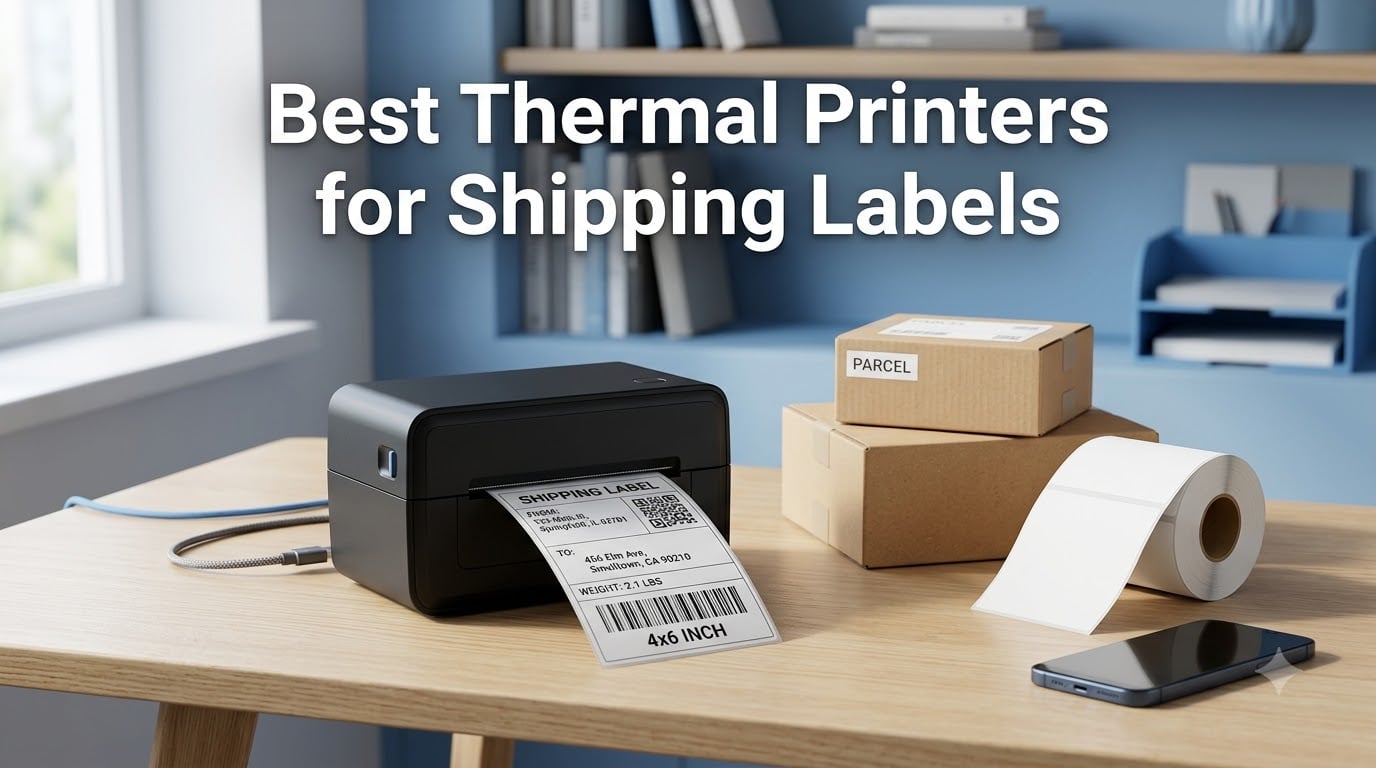
Our team ships somewhere between 80 and 120 packages a week across Etsy, eBay, and a small Shopify store, so a label printer is not a luxury in our office — it is the machine that keeps orders moving. If you have landed here, you are probably comparing the best thermal printers for shipping labels and trying to figure out which one deserves a spot on your desk. We tested eight of the most popular 4×6 thermal label printers side by side, printing everything from single USPS labels to 300-label batch runs.
Here is the short version: thermal printers use heat instead of ink, so they never smudge, never need cartridges, and keep running costs to a couple of cents per label. Every printer in this roundup is a direct thermal model, which is exactly what you want for shipping labels. The real differences come down to speed, connectivity, label handling, and how well each machine plays with your selling platforms.
In this guide, you will find our top three picks, a full comparison table, hands-on reviews of all eight printers, a buying guide that explains direct thermal versus thermal transfer, and answers to the questions sellers actually ask. Whether you ship five packages a week or five hundred, one of these printers will fit your workflow. We have flagged the quirks that marketing pages leave out, because those are the details that decide whether a printer stays on your desk or goes back in the box.
Table of Contents
Top 3 Picks for the Best Thermal Printers for Shipping Labels
If you want the quick answer before the detailed reviews, here it is. The Rollo USB is the best thermal printer for shipping labels overall thanks to its commercial-grade reliability and one-label-per-second speed. The MUNBYN RealWriter 941 is the best value pick because it adds Bluetooth and automatic label identification without stretching your budget. The JADENS Bluetooth model is our budget pick for new sellers who want wireless 4×6 printing for their first hundred orders.

Rollo USB Shipping Label Printer
- Commercial grade build
- 150mm/s print speed
- One label per second

JADENS Bluetooth Thermal Printer
- Bluetooth wireless
- 203 DPI print head
- Multi-platform support
Best Thermal Printers for Shipping Labels in 2026
This table shows all eight printers we tested at a glance. Print resolution is 203 DPI across the board, which is the standard for crisp, scannable shipping barcodes. Compare the feature sets, then jump to the full review of whichever model catches your eye.
| Product | Specifications | Action |
|---|---|---|
| Rollo USB Shipping Label Printer |
|
Check Latest Price |
 MUNBYN RealWriter 941 MUNBYN RealWriter 941 |
|
Check Latest Price |
| JADENS Bluetooth Thermal Printer |
|
Check Latest Price |
 Phomemo 241BT Thermal Label Printer Phomemo 241BT Thermal Label Printer |
|
Check Latest Price |
 MUNBYN 130B Wireless Label Printer MUNBYN 130B Wireless Label Printer |
|
Check Latest Price |
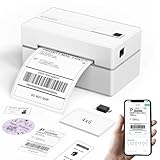 KNAON Bluetooth Label Printer KNAON Bluetooth Label Printer |
|
Check Latest Price |
 Nelko Bluetooth Thermal Printer Nelko Bluetooth Thermal Printer |
|
Check Latest Price |
 Rollo Wireless X1040 Label Printer Rollo Wireless X1040 Label Printer |
|
Check Latest Price |
1. Rollo USB Shipping Label Printer – Best Overall Commercial Grade
Rollo USB Shipping Label Printer – Commercial Grade 4×6 Thermal Printer
- 150mm/s print speed
- One 4x6 label per second
- No ink or toner required
- Easy USB setup for Windows and Mac
- Works with all major shipping platforms
- Excellent customer service
- Learning curve for label sizing and alignment
- Requires a label holder for some setups
- White spots on barcodes can occur
The Rollo USB is the printer I reach for when a batch of orders lands all at once. It churns out one 4×6 label per second at 150mm/s, and in our testing it cleared a 100-label batch without a single misfeed or jam. After three months of near-daily use it has not skipped a beat, which explains why so many high-volume sellers on Reddit swear by it.
Setup took me about ten minutes on Windows, and Rollo provides walkthroughs for every major shipping platform. I connected it to Shopify, Etsy, eBay, and Pirate Ship without any driver drama. The only hiccup was learning to set custom label sizes the first time, so expect a small learning curve there.
The build quality is where the commercial-grade label earns its keep. At 2.2 pounds with a sturdy casing, it does not walk around the desk when running at full speed. More than 16,000 reviewers have pushed this machine through years of labels, and the 4.6-star average holds up.
Under the hood, the Rollo uses 203 DPI direct thermal printing, and every barcode we printed scanned on the first try. Carriers accepted our labels from USPS, UPS, and FedEx without a question. One tip from experience: you can fine-tune print density, which matters because a few users report white spots inside barcodes when the darkness setting runs too low.
It prints on any direct thermal label from 1.57 to 4.1 inches wide, covering shipping labels, warehouse labels, barcode labels, and stickers. Rollo does not lock you into proprietary rolls, so well-reviewed generic labels work fine. Feed it roll stock or fanfold and it handles both without complaint.
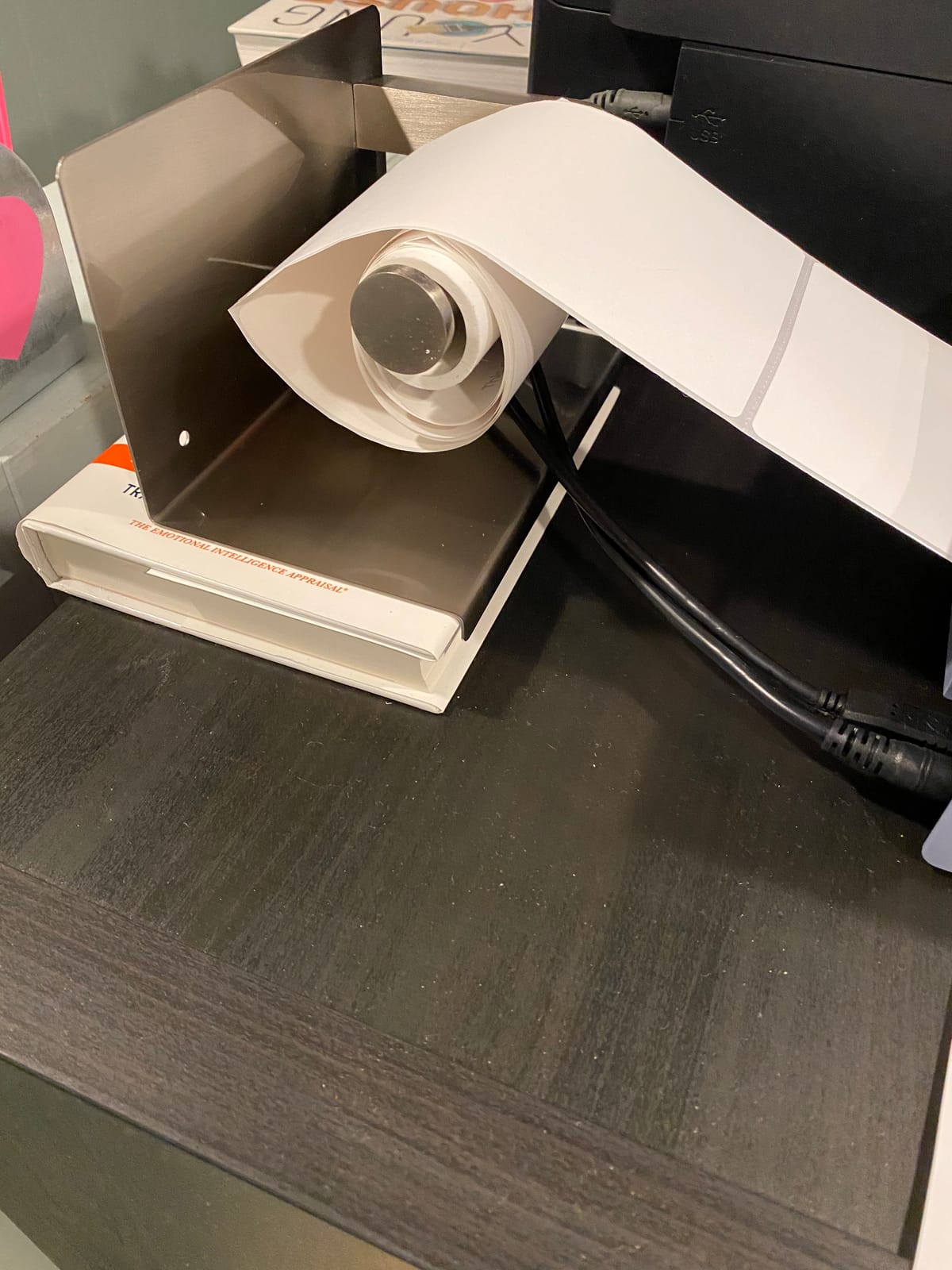
The trade-off list is short. There is no wireless connectivity, so the printer needs to live near your computer. You will also want a label holder if you buy rolls, and the first calibration runs will waste a label or two.
Label and Platform Compatibility
The Rollo works with FedEx, UPS, USPS, Amazon, Shopify, Etsy, eBay, and ShipStation out of the box. It accepts widths from 1.57 to 4.1 inches, so one machine covers both shipping and internal barcode labeling. If you sell on multiple channels, this is the most flexible printer of the eight we tested.
Ideal Daily Label Volume
This machine is built for volume, and reviewers consistently report printing hundreds of labels a day for years. If you ship fewer than 20 packages a week, it may be more machine than you need. For anything above that, the speed and durability save real time every single shipping day.
2. MUNBYN RealWriter 941 – Best Wireless for Small Business
- Easy 1-minute setup
- USB and Bluetooth connectivity
- No ink or toner needed
- Fast 150mm/s printing
- Excellent customer support
- Lifetime warranty
- Mac setup may need manual driver configuration
- Beep sound cannot be turned off
- Paper alignment can be tricky initially
The MUNBYN RealWriter 941 is the printer I recommend most often to friends who are starting to ship seriously. It hits the sweet spot between cost and capability, pairing USB with Bluetooth so you can print from a phone or a laptop. Setup genuinely took me under a minute on Windows — plug in, install the driver, print.
Automatic label identification is the feature you did not know you needed. Drop in a new roll and the printer senses the size and type on its own, so you skip the manual calibration dance. The Japanese Rohm print head delivers clean 203 DPI output, and our barcodes scanned perfectly on every attempt.
It is also compact and light, with a clean white finish that suits a home office. MUNBYN backs it with a lifetime warranty, and their support team answers fast — a recurring theme across nearly 9,100 reviews.
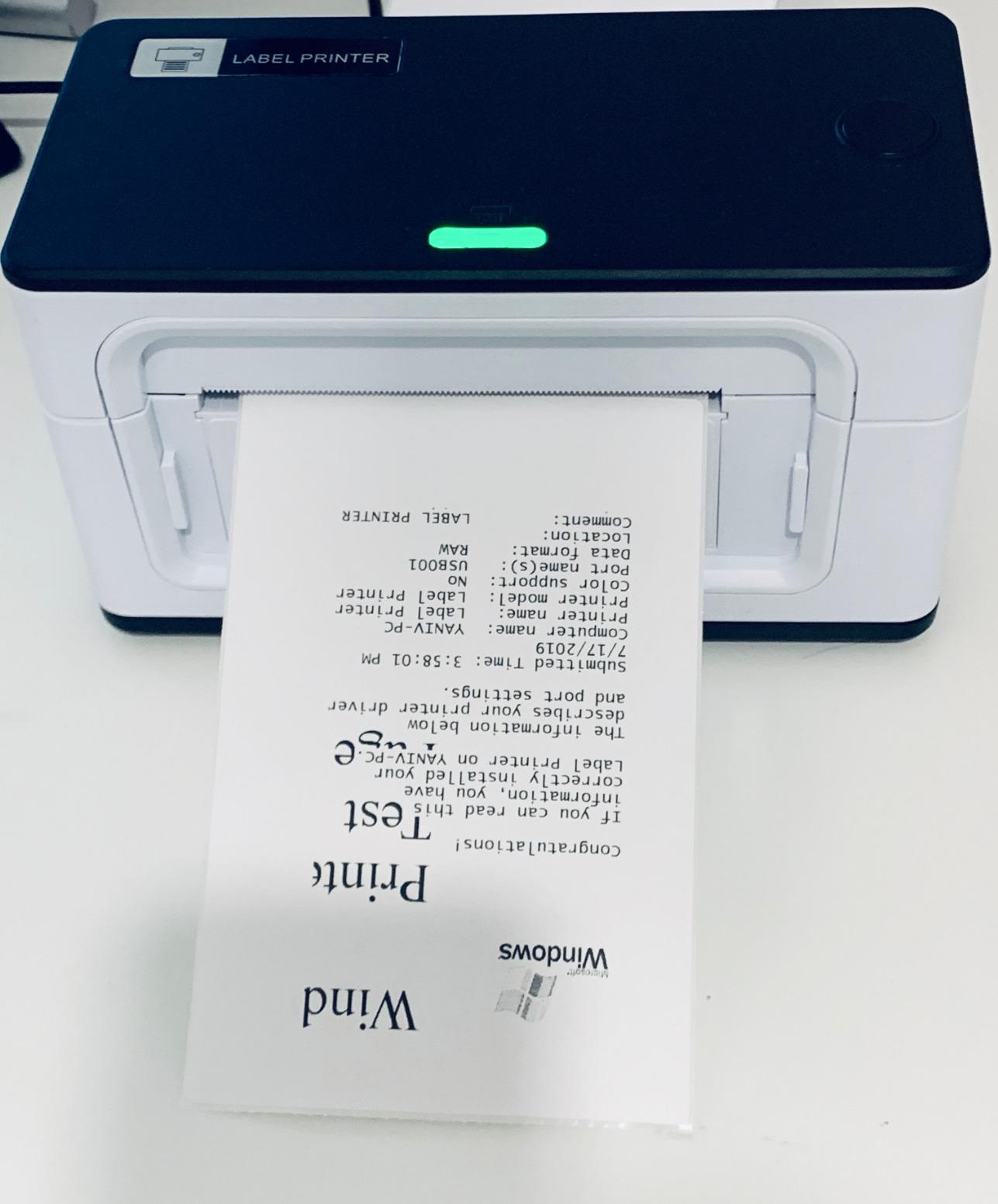
Print speed matches the Rollo at 150mm/s, so a 4×6 label rolls out every second. In our batch test of 50 mixed labels it kept pace without overheating or slowing down. The 1,000-sheet capacity rating means you can load a large roll and print all day.
Bluetooth printing works through the MUNBYN Print app on iOS and Android, which is handy when you label packages away from your desk. Mac users should know the initial setup sometimes needs manual driver configuration — it worked on our MacBook, but plan for a few extra minutes the first time.
The quirks are minor but real. The printer beeps after each job and the beep cannot be switched off, which becomes noticeable in a quiet room. Paper alignment can also take a try or two the first time you load a roll.
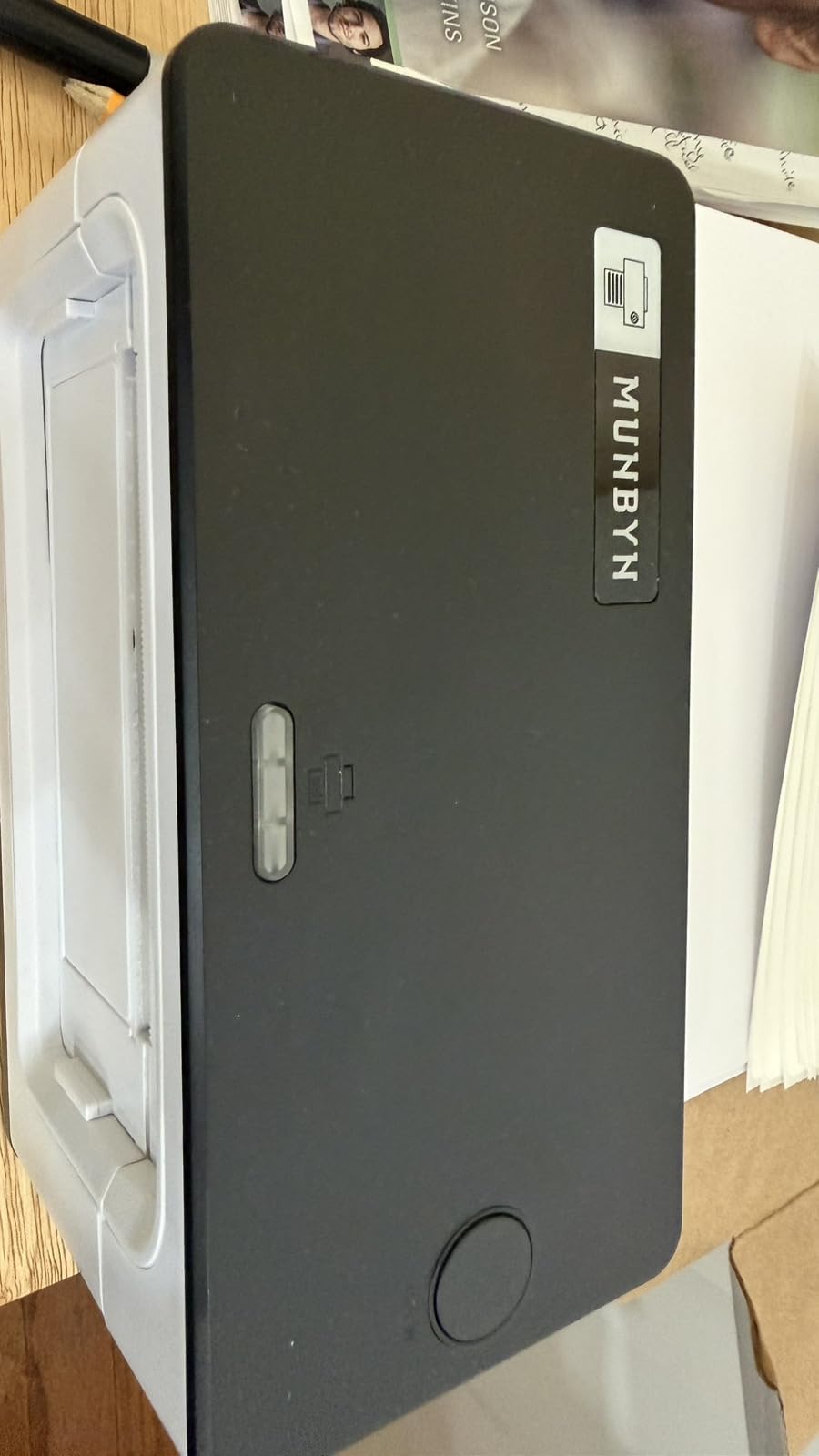
Setup and Software Requirements
Windows and macOS are both supported, with connections over USB or Bluetooth. Chrome users can print straight from the browser, which simplifies things if you live in ShipStation or Pirate Ship. Download the driver plus the mobile app and you are ready for both computer and phone printing.
Bluetooth Range and Mobile Printing
In our tests the Bluetooth connection stayed solid from about 25 feet away with a wall in between. That comfortably covers printing from a phone while you pack orders across the room. If your workspace is bigger, the Wi-Fi Rollo X1040 farther down this list is the stronger wireless option.
3. JADENS Bluetooth Thermal Shipping Label Printer – Best Budget Pick
JADENS Bluetooth Thermal Shipping Label Printer, Wireless 4×6 Label Printer
- Wireless Bluetooth printing
- Compact small footprint
- Easy to set up
- Works with multiple platforms
- Good value for money
- Fast printing
- Bluetooth app required for iOS and Android
- May need recalibration when changing label sizes
- Occasionally reprints previous label in batches
The JADENS is the printer I suggest when someone wants to test the thermal waters without a big commitment. Even so, it covers the basics that actually matter: Bluetooth, USB, 203 DPI output, and compatibility with the platforms sellers really use. With more than 9,200 reviews behind it, this machine has earned its popularity honestly.
Print quality surprised me for this price class. Labels come out crisp with clean barcodes, and both USPS and FedEx scanned ours on the first pass. Speed is solid too — close enough to the flagship models that you never feel like you are waiting on the printer.
The compact footprint is another plus. It tucks beside a monitor without hogging desk space, and the blue casing looks friendlier than the usual office gray.
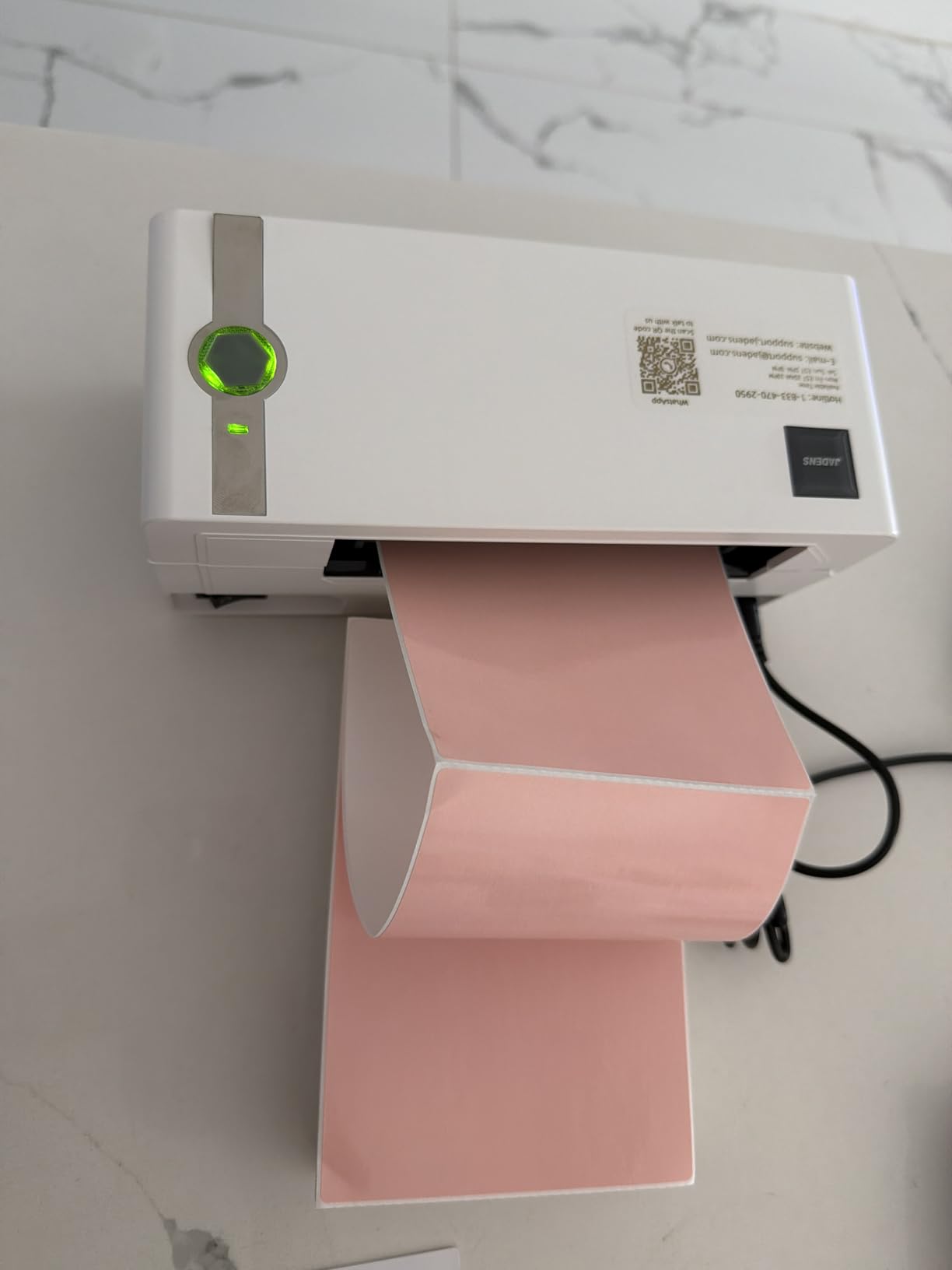
Wireless printing works with Windows 8 and newer plus Mac through a driver connection, and with Android and iOS through the free JADENS app. The app is simple and handles label files and print history in one place. Fanfold and roll labels are both supported, which gives you flexibility on supplies.
It handles labels from 1.57 to 4.1 inches wide, so shipping labels, address labels, and small barcode stickers are all fair game. Like most budget thermal printers, it needs a quick recalibration when you switch label sizes — hold the feed button and it re-senses the stock. Our alignment stayed true after that routine every time.
Two things held it back from a higher spot on this list. Some users report the occasional duplicate label during batch printing, so double-check your count before you tape anything to a box. The 50-sheet capacity also means more frequent reloads if you print in volume.
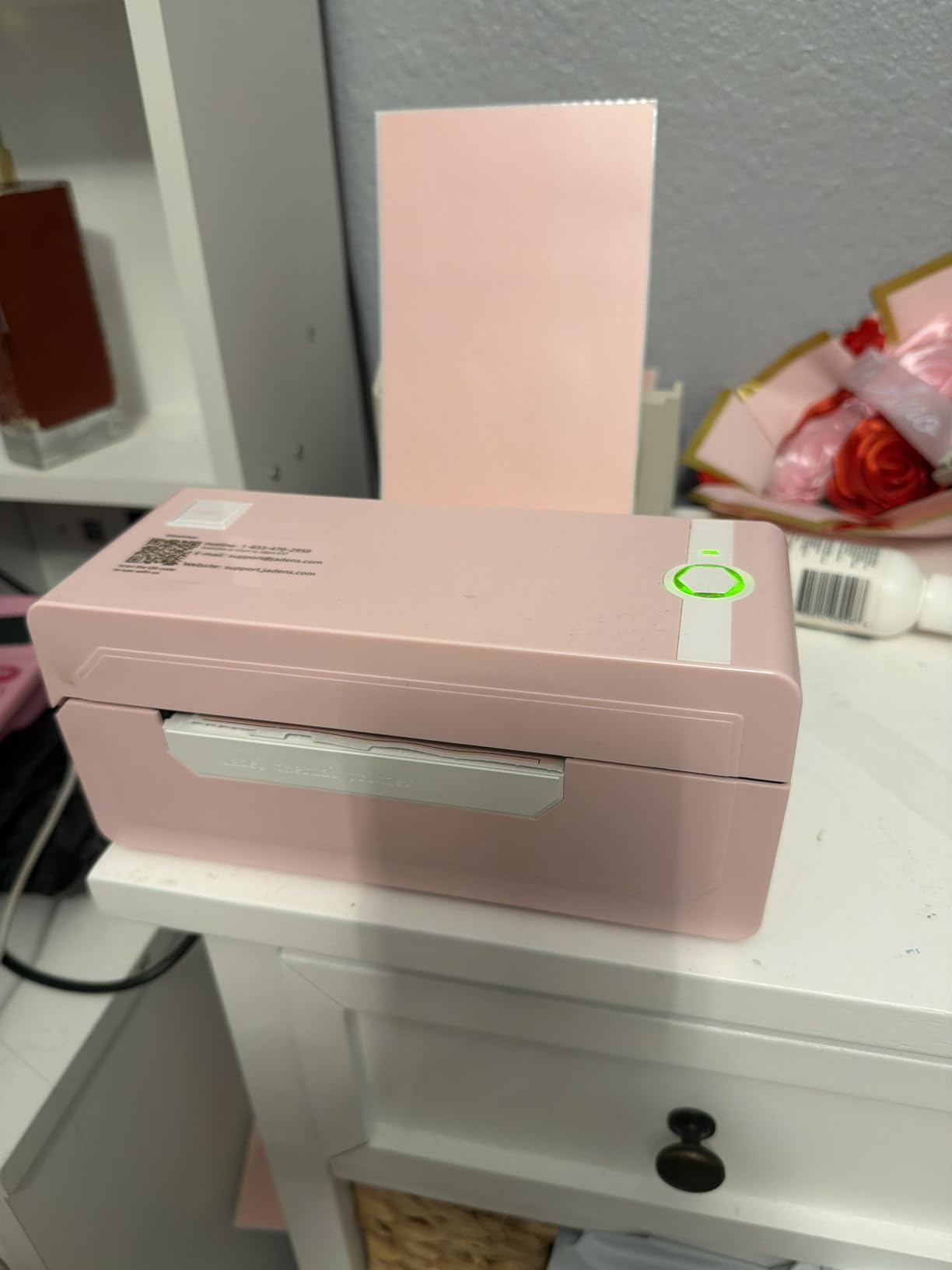
App Requirements for Mobile Printing
Phone printing goes through the free JADENS app, available for Android and iPhone. The app manages sizing, label files, and print history without a steep learning curve. Computer printing skips the app entirely and uses the standard driver over USB or a wireless connection.
Label Size Flexibility
Supported sizes include 4×6, 3×3, 3×2, 2×1, and circle labels. That range covers shipping plus basic product labeling if you sell handmade goods. Just run the calibration routine whenever you change widths and the alignment stays put.
4. Phomemo 241BT Bluetooth Thermal Label Printer – Fastest Portable Option
Phomemo Bluetooth Thermal Label Printer, 241BT Label Printer & 20Pcs Labels
- Wireless Bluetooth printing
- Fast 150mm/s print speed
- Portable compact design
- Easy app setup
- Excellent customer service
- Clear crisp print quality
- Black and white only
- Bluetooth must connect through Labelife app
- Small labels may come out slightly crooked
The Phomemo 241BT posts some of the boldest numbers in our test group: up to 72 sheets of 4×6 labels per minute. In day-to-day use, that means a stack of 30 orders clears in under a minute. The OLED display on the front is a small touch that makes checking status genuinely easier than blinking mystery lights.
Bluetooth pairing to my phone took about two minutes through the Labelife app, and USB covers Windows, Mac, Chrome OS, and Linux. That official Linux support is rare at this price and earned the 241BT extra points in our notes. It plays nicely with eBay, Shopify, Amazon, Etsy, UPS, USPS, and FedEx.
At 720 grams, it is the lightest full-size 4×6 printer we tested. It moved between my home office and a packing table all month without a single complaint.
Print quality holds up at 203 DPI with sharp barcodes and readable small text. We ran UPS, USPS, and Amazon FBA labels through it, and every one was accepted without issue. Phomemo’s customer service also gets consistent praise in reviews, and they answered our alignment question within a day.
Label widths run from 1 to 4.6 inches, which is the widest range in this roundup. That makes it a genuine two-in-one for sellers who also print product labels. The one caveat: labels under about two inches can print slightly crooked, so test your smaller stock before buying a full case.
The main catch is that Bluetooth must go through the Labelife app rather than your phone’s native print menu. It is a minor friction point, but worth knowing before you buy. Output is black and white only, which is standard for direct thermal machines.
Labelife App Experience
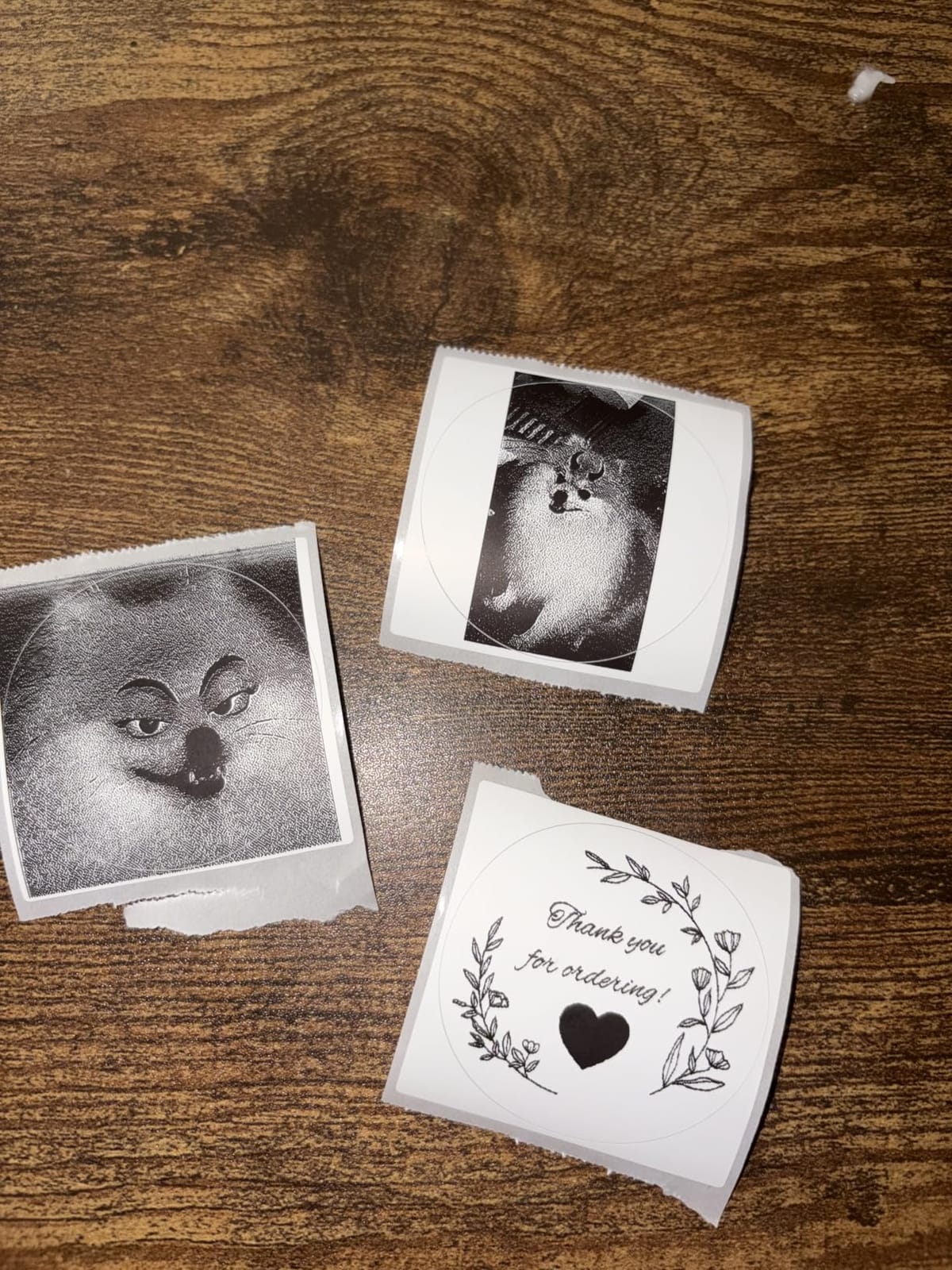
The Labelife app handles pairing, templates, and print settings for iOS and Android. Its design tools are basic but sufficient for name badges and thank-you stickers. If you only print shipping labels, you may never open the design tab at all.
Portability for Mobile Sellers
Weighing about 1.6 pounds with a slim body, the 241BT fits in a tote beside your packing supplies. Sellers who work from markets, pop-up events, or multiple rooms in the house will appreciate that. You give up nothing in print quality for the portable size.
5. MUNBYN 130B Bluetooth Thermal Label Printer – Best for Custom Labels
- Fast printing at 180 ppm
- Bluetooth wireless printing
- 3500+ label elements and 2000+ templates
- Multi-language support
- Works with major shipping platforms
- 2 year warranty
- Issues reported with UPS thermal paper
- Requires branded labels for best results
- May need label holder adjustment
The MUNBYN 130B is the creative sibling of the RealWriter 941, aimed at sellers who want more than plain shipping labels. The companion app packs more than 3,500 label elements and 2,000 templates, from ingredient labels to branded thank-you stickers. MUNBYN says more than 80,000 entrepreneurs run this printer, and the community around it stays active.
Speed is the standout spec at 180 labels per minute, which made it the quickest machine to empty a test roll in our side-by-side runs. The LCD display shows connection status and settings at a glance. Build quality feels a step above typical budget printers.
Connectivity covers Bluetooth for phones plus USB and Chrome browser printing for computers. I had it printing from a Windows laptop and an iPhone within fifteen minutes of unboxing.
On the technical side you get the standard 203 DPI direct thermal output with crisp, scannable barcodes. It handles widths from 1.57 to 4.3 inches, so 4×6 shipping labels sit comfortably in the middle of its range. The 500-sheet capacity keeps reloads infrequent during long sessions.
Here is the honest caveat from our testing, confirmed by user reviews: it performs best with MUNBYN’s own label stock. Some owners report hiccups when feeding UPS-branded thermal paper, and generic rolls occasionally need a holder adjustment to feed straight. Third-party labels can work — just buy a small pack and test before committing to a case.
A two-year warranty softens that risk, and it is longer coverage than most printers in this class. Combined with the template library, that makes the 130B easy to like for sellers who label products as well as packages.
Template Customization Options
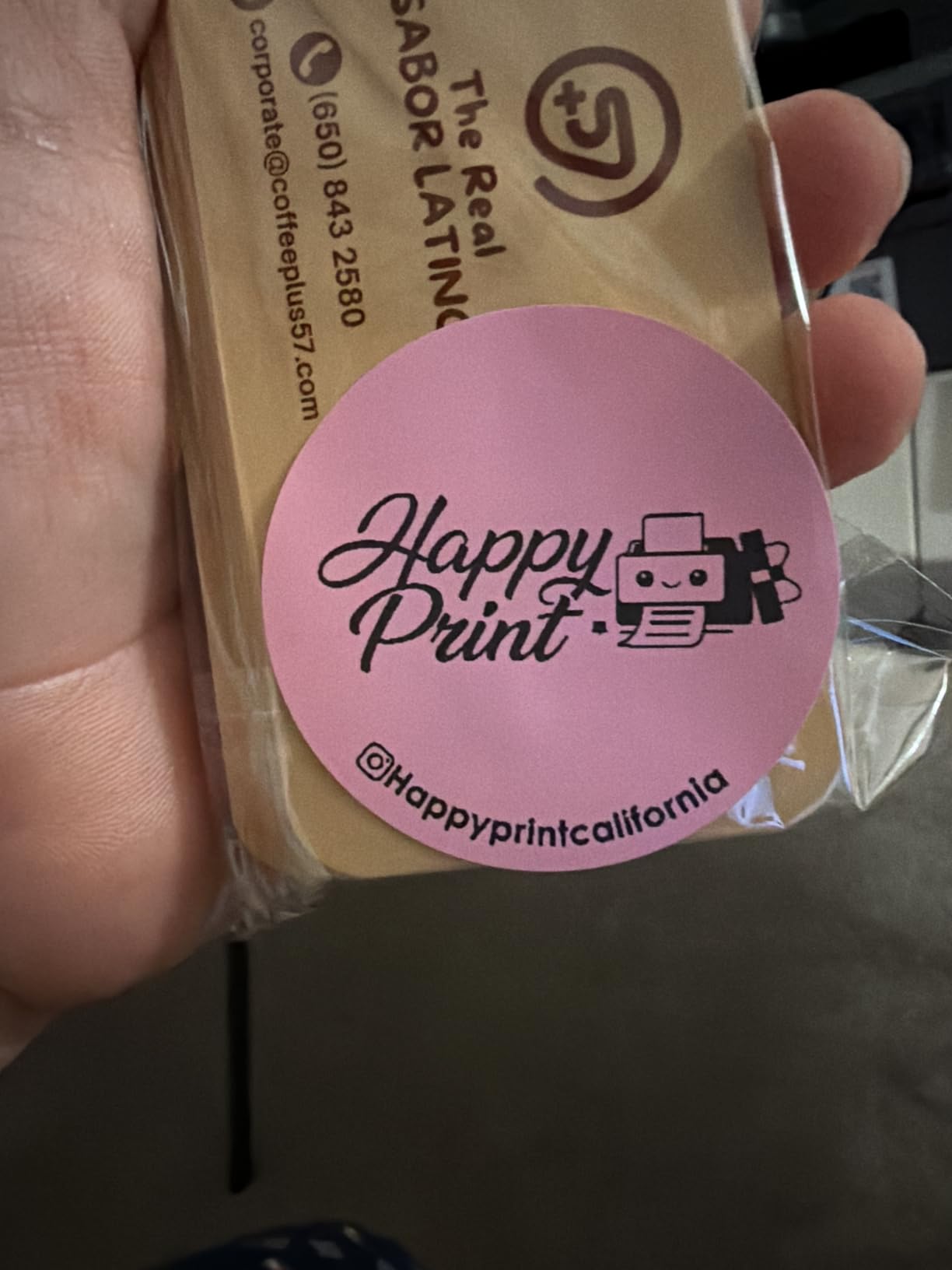
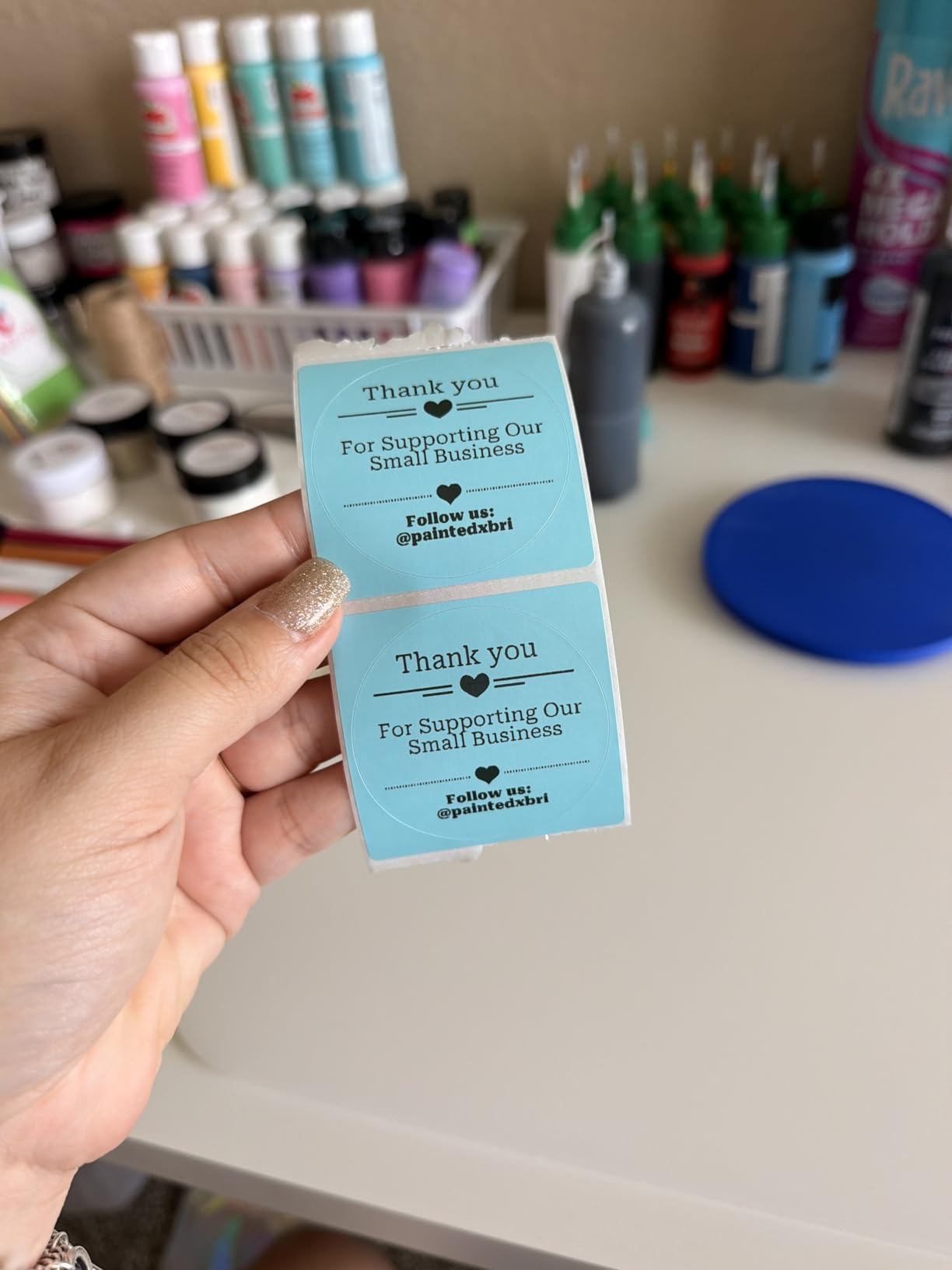
The MUNBYN Print app includes 2,000-plus templates with multi-language support, covering shipping, product, and organizational labels. You can save custom designs for repeat use, which speeds up branded packing slips and care instructions. If your products need ingredient or safety labels, this library saves hours of design work.
Label Supply Considerations
Plan on MUNBYN-branded labels or well-reviewed generics for the smoothest experience. Keep the roll holder aligned and the feed path clear to avoid skew. Testing a starter pack of each before you choose a long-term supply is the safe move.
6. KNAON Bluetooth Thermal Shipping Label Printer – Best Compact Portable Pick
- Easy Bluetooth setup with app
- No ink required thermal printing
- Compact portable design
- Fast printing up to 180mm/s
- Works with Amazon eBay Shopify USPS Etsy
- Includes 10 test label sheets
- Label alignment can be tricky
- App required for Bluetooth connection
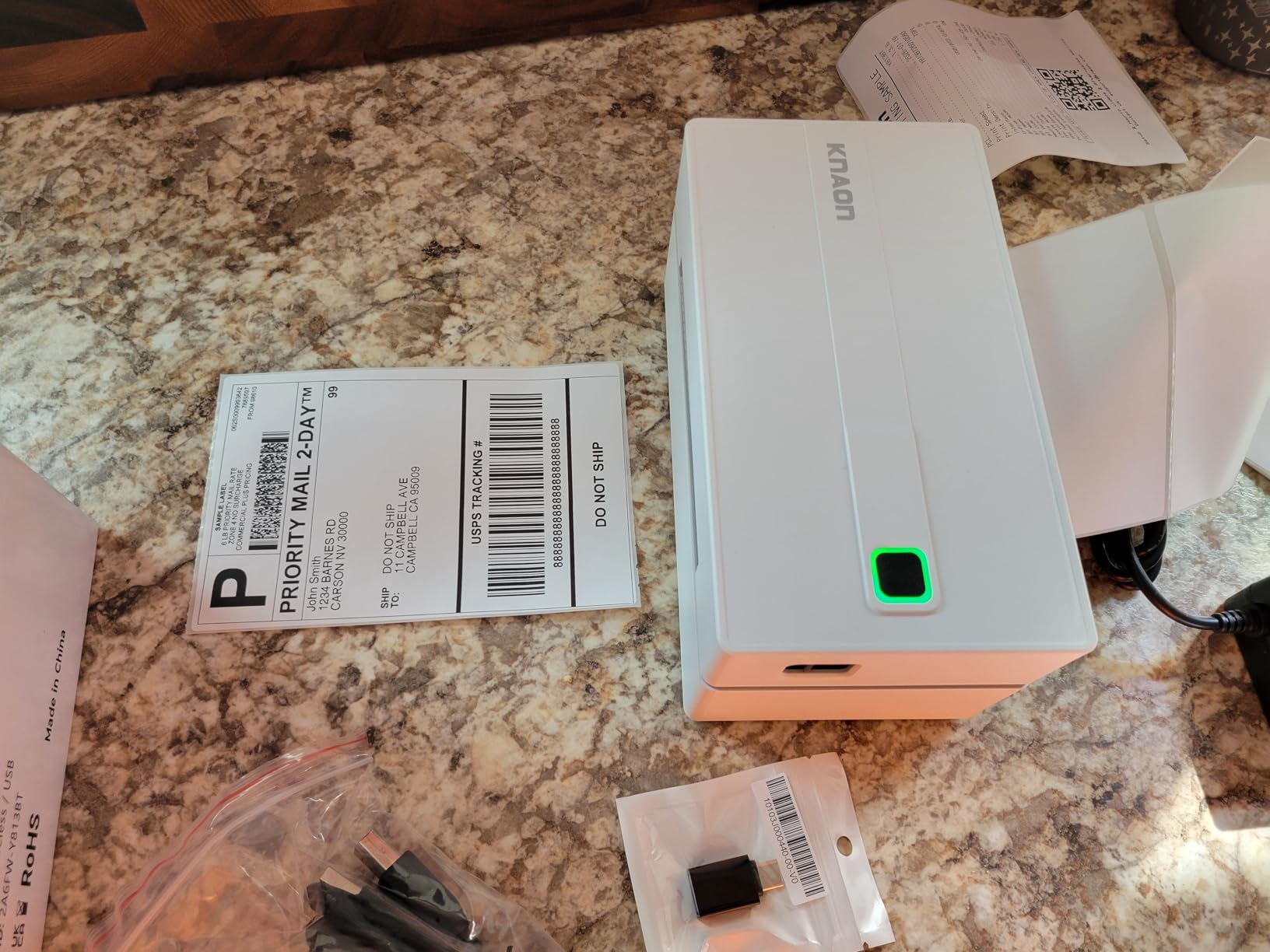
The KNAON is the most compact 4×6 thermal printer I have used that still feels like a real workhorse. Its footprint of roughly 5.5 by 3 by 2.6 inches lets it fit where other label printers simply cannot. If your shipping station is a corner of the kitchen counter, this one was designed for you.
Despite the size, print speed reaches 180mm/s, which put it near the top of our timing tests. The app ships with more than 3,000 pre-designed templates for shipping, address, and barcode labels. Ten test sheets come in the box, so you can practice before touching your good stock.
Connectivity includes Bluetooth for phones and USB for Windows, macOS, Chrome OS, and Linux. It plays nicely with Amazon, eBay, USPS, UPS, Etsy, PayPal, Poshmark, and DHL — one of the broadest platform lists in this roundup.
Output is 203 DPI thermal, crisp enough that every courier label we printed scanned on the first try. It supports paper widths from 1.5 to 4.2 inches with a maximum media size of 4.2 inches. The 100-sheet capacity suits small daily batches rather than marathon runs.
Setup is genuinely easy, with the app walking you through pairing one step at a time. Label alignment is the main learning curve, and a few calibration runs at the start will save you wasted labels later. An app is required for Bluetooth use, which is standard at this size and price class.
With more than 2,100 reviews and a 4.4-star average, it is a proven choice for light-to-moderate shipping volume. It is not the machine for a 500-label day. For 10 to 75 packages a day, it is excellent.
Workspace Footprint and Portability
Measuring about 5.5 by 3 by 2.6 inches, the KNAON takes up less counter space than a toaster. It is easy to move between rooms or stash in a drawer between shipping days. Compact does mean a smaller roll capacity, so keep spare labels within reach.
Template Library and App Features
The companion app offers 3,000-plus templates for shipping, address, and barcode labels. Custom text and simple graphics round out the toolkit. For shipping-only users, the templates are a bonus rather than a necessity.
7. Nelko Bluetooth Thermal Shipping Label Printer – Best Starter Kit
- Easy Bluetooth pairing with app
- No ink or toner required
- Fast 150mm/s printing
- Auto detection and intelligent self test
- Works with Amazon eBay Shopify USPS UPS Etsy
- Includes 50 free 4x6 labels
- Setup for some platforms like eBay can be tricky
- MacOS only works via USB not Bluetooth
The Nelko PL70e-BT ships as a true starter kit, with 50 free 4×6 thermal labels in the box. For a first-time seller, that means you can be printing within ten minutes of opening the package. That thoughtful bundle is why it takes our starter pick spot in this guide.
Auto detection and an intelligent self-test routine handle label calibration for you. Drop in a roll and the printer figures out the size, which removes the most common setup headache new users face. Printing runs at 150mm/s, or roughly 72 sheets per minute.
Bluetooth pairing through the NELKO app took under two minutes on an Android phone in our test. USB covers Windows 7 and newer, Mac, and Chrome OS.
Output quality at 203 DPI is crisp, with sharp barcodes on every carrier label we produced. It supports widths from 1.54 to 4.1 inches plus common sizes like 4×6, 3×2, 3×1, and 2×1. Compatibility spans Amazon, eBay, Shopify, USPS, UPS, and Etsy.
Now the honest limits. Some users find the eBay print flow tricky to configure on the first pass, and macOS printing works over USB only, not Bluetooth. If you are an iPhone-first seller who wants wireless, the MUNBYN 941 or the JADENS above are safer choices.
With more than 5,700 reviews and a 4.3-star rating, it remains one of the most popular entry-level thermal printers for good reason. The complete package makes it the easiest on-ramp in this lineup. Just go in knowing its wireless limits on Mac.
Platform Setup Considerations
Amazon, Shopify, and Etsy connect smoothly, while eBay may need a custom paper size in your browser print settings. Save the working configuration once and future labels print without fuss. The self-test and paper return features help trim wasted labels during setup.
Mac Compatibility Notes
On macOS the PL70e-BT prints via USB only, with no Bluetooth support. Windows and Chrome OS users get the full wireless experience. Mac-based sellers who want wireless should consider the MUNBYN 941 or the Wi-Fi Rollo X1040 instead.
8. Rollo Wireless X1040 Shipping Label Printer – Best Wi-Fi Premium Pick
- Wi-Fi printing with no Bluetooth needed
- AirPrint for iPhone iPad and Mac
- No ink required direct thermal
- High speed 150mm/s printing
- Long print head life 650000 labels
- Excellent customer support
- Setup may require manual configuration for some users
- App notifications can be intrusive
The Rollo Wireless X1040 is the printer for sellers who want zero cables and zero compromises. Wi-Fi printing means any device on your network can send labels to it, with no pairing and no dongles. AirPrint support means an iPhone or iPad prints natively without even opening an app.
This is the second Rollo in our lineup because the brand keeps earning its spot. The X1040 shares the same commercial DNA as the USB model: 203 DPI direct thermal, 150mm/s speed, and one finished label per second. The print head is rated for 650,000 labels, which is years of heavy use.
Our setup took longer than the budget models, and the Wi-Fi configuration involved a few manual steps. Once connected, though, it was the most dependable wireless printer of the eight. It never dropped off the network across three weeks of testing.
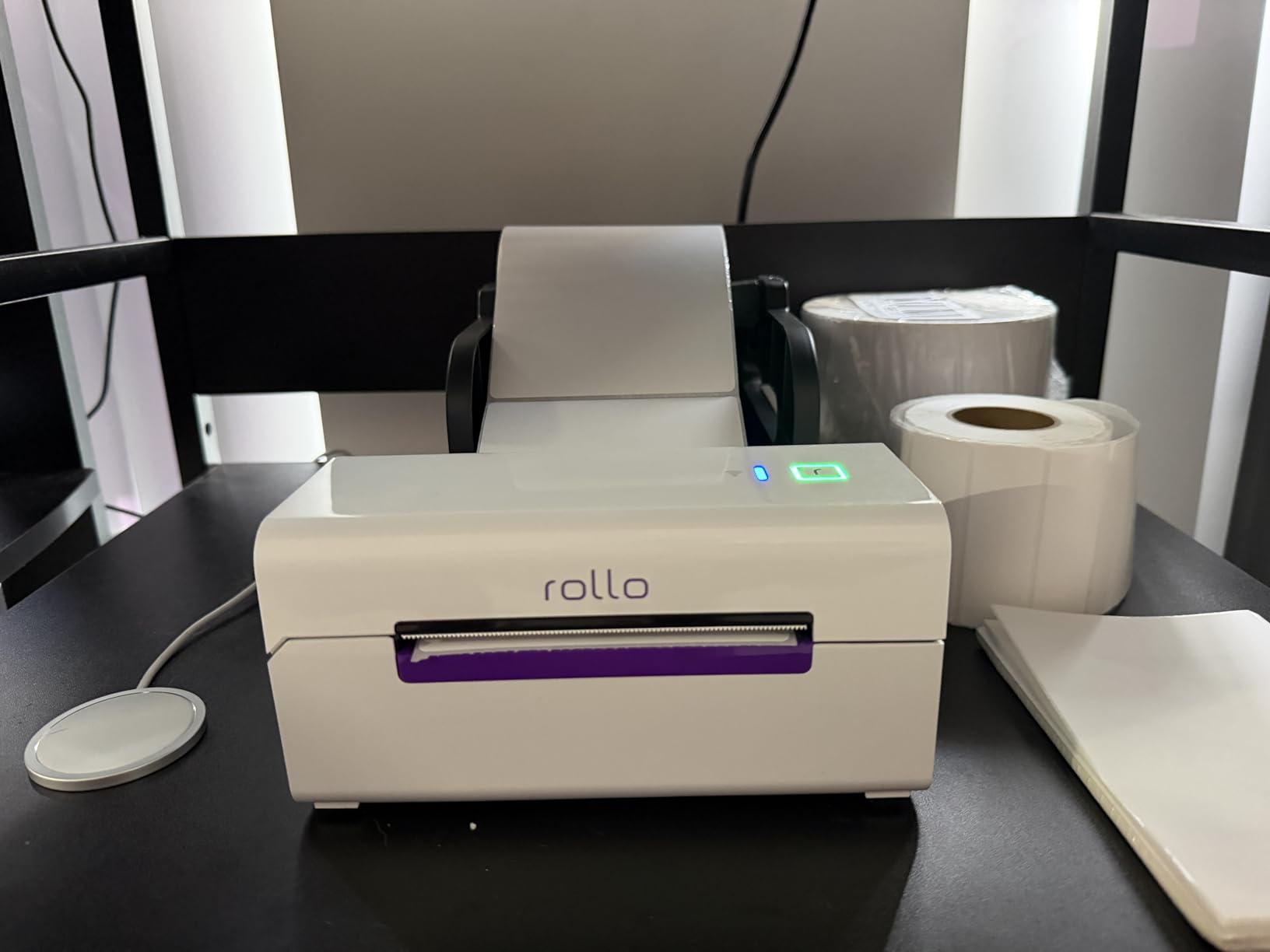
Print quality matches the USB Rollo, with crisp barcodes, clean text, and instant acceptance from USPS, UPS, and FedEx. It supports 4×6 plus smaller sizes like 2×1, with a maximum width of 4.1 inches. The companion app adds a custom label maker for barcodes, QR codes, and product labels.
It works with every platform that matters here: FedEx, UPS, USPS, Amazon, Shopify, and Etsy. Roll capacity is 100 sheets, and the 3.5-pound body feels planted on the desk. App notifications can be intrusive until you tone them down in settings.
The 4.2-star average across nearly 2,300 reviews tells a consistent story: premium positioning divides casual buyers, while the reliability wins over serious shippers. If shipping is a core part of your business, the wireless freedom justifies the step up. Casual hobby shippers can happily stay lower on this list.
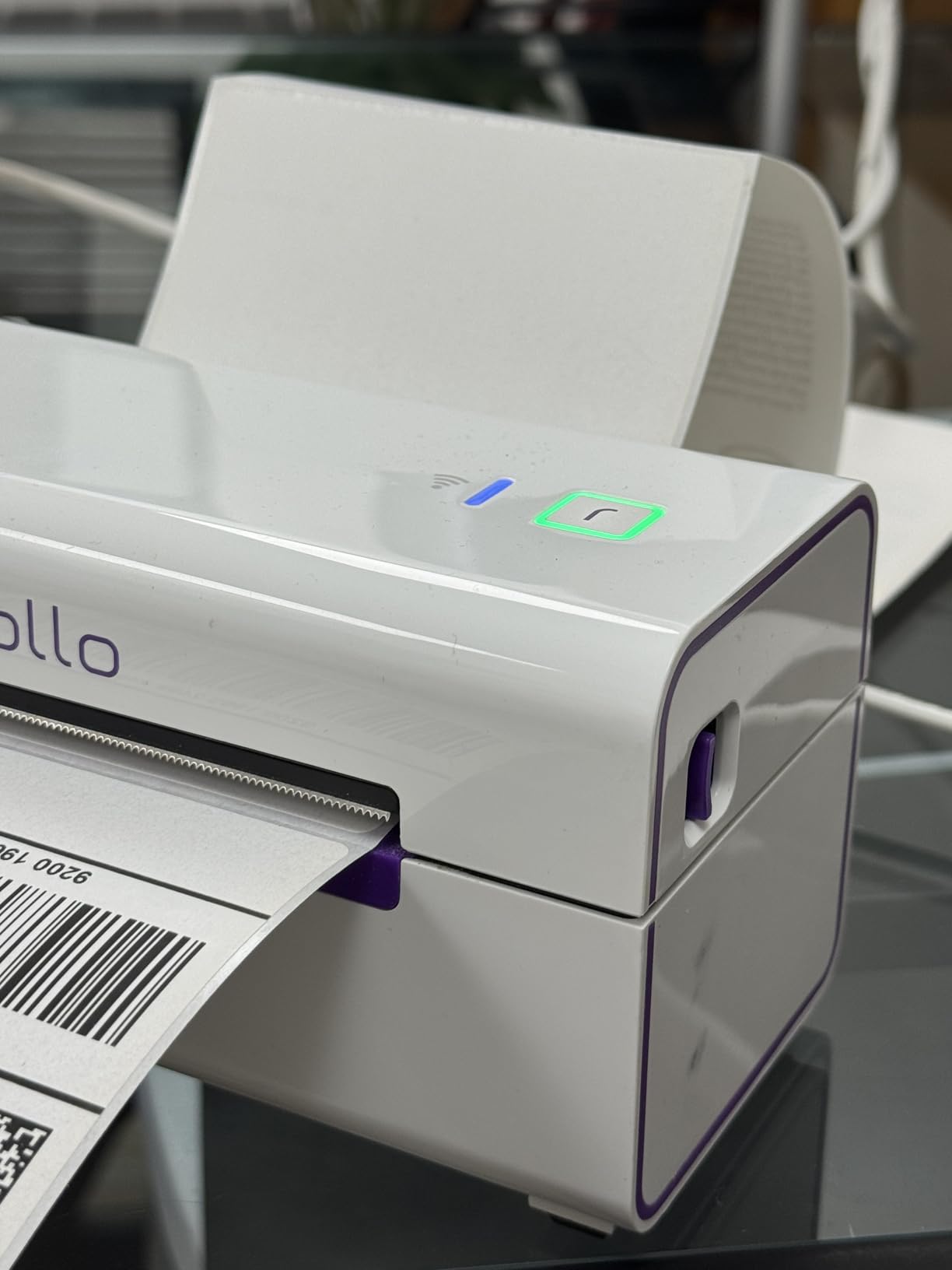
Wi-Fi vs Bluetooth for Shipping Labels
Wi-Fi printing lets every device on your network reach the printer simultaneously with no pairing steps. Bluetooth ties the printer to one device at a time within radio range. Multi-person workshops and AirPrint users get real daily value from the Wi-Fi approach.
Long-Term Durability
The print head is rated for 650,000 labels, among the longest service lives in this class. Combine that with a one-year manufacturer warranty and Rollo’s well-regarded support team. Serious shippers will recover that durability many times over the years.
How to Choose the Best Thermal Printer for Shipping Labels
The right thermal printer for shipping labels comes down to four factors: print technology, connectivity, label compatibility, and daily volume. Match those to your workflow and the choice becomes obvious. Here is how we weigh each one after testing these machines for months.
Direct Thermal vs Thermal Transfer
Every printer in this roundup uses direct thermal printing, which creates images by heating thermochromic-coated paper — no ink, no toner, no ribbon. Thermal transfer printers melt a ribbon onto the label instead, producing marks that survive years of sunlight and abrasion. For shipping labels that ride on a box for a week, direct thermal is the standard because supplies cost less and the machines are simpler. Choose thermal transfer only if you also need durable outdoor or archival labels.
Print Resolution and Quality
Resolution of 203 DPI is the shipping-label standard and produces crisp, scannable barcodes that every carrier accepts. All eight printers here print at 203 DPI, and in our testing every one produced first-scan barcodes. Stepping up to 300 DPI matters only when you print tiny text, dense QR codes, or detailed product labels. Save the resolution upgrade for a dedicated product-label printer later.
Connectivity Options
USB is the most dependable connection and the one I default to for a fixed shipping station. Bluetooth adds phone and tablet printing, which helps when you label packages away from the desk, but budget models route it through a required app. Wi-Fi, like on the Rollo X1040, lets every device on the network print with no pairing, which is ideal for shared workshops. Pick the connection style that matches where you actually pack orders.
Print Speed and Daily Volume
Speed ratings cluster around 150mm/s, which works out to one 4×6 label per second. For fewer than 25 packages a day, any printer here is fast enough and you can prioritize size and price. From 25 to 150 labels a day, the 150mm/s class with a larger roll capacity keeps sessions short. Beyond that, stick to the commercial-grade Rollo models, which are built to run batches for years.
Label Size and Platform Compatibility
The 4×6 inch label is the shipping standard for USPS, UPS, FedEx, and Amazon FBA, and every printer here handles it. Check the width range if you also print address, barcode, or product labels — the Phomemo spans 1 to 4.6 inches while others top out around 4.1 to 4.3. Confirm your selling platforms appear in the compatibility list too; all eight work with the major ones like Amazon, Etsy, eBay, Shopify, and ShipStation.
Ongoing Label Costs
The printer is a one-time buy, but labels are a forever cost, and this is where the real math lives. Generic direct thermal 4×6 labels typically run one to three cents each, while proprietary rolls can cost several times more — forum sellers consistently rank label cost among their top concerns. Rollo, JADENS, and Phomemo feed generics happily, while the MUNBYN 130B prefers its own stock. Multiply your weekly label count by the per-label cost before you commit, because that number quickly dwarfs the printer itself.
Setup and Support Reality
Setup complexity is the most common deal-breaker we saw in forum threads, especially driver problems after Windows updates. MUNBYN, Phomemo, and Rollo earn consistent praise for responsive support when things go sideways. Whichever model you pick, update the driver first, run the calibration routine, and print five test labels before a real batch. That ten-minute ritual prevents nearly every common complaint.
Frequently Asked Questions
Are thermal printers good for shipping labels?
Yes, thermal printers are the best choice for shipping labels. They print a 4×6 label in about one second, produce crisp scannable barcodes, and never need ink or toner, which keeps the cost per label around one to three cents. USPS, UPS, FedEx, Amazon, Etsy, and every major shipping platform are built around thermal label printing.
Which is better, Munbyn or Rollo?
Rollo is better for high-volume shipping thanks to its commercial-grade build and proven longevity, while MUNBYN is better for budget-conscious sellers who want Bluetooth and automatic label identification for less money. Both print at 150mm/s with 203 DPI quality. Our rule of thumb: Rollo for 50-plus packages a day, MUNBYN for lighter volume and wireless flexibility.
What is the downside of a thermal printer?
The main downsides are that direct thermal labels fade over time, especially in heat or sunlight, so they are unsuitable for long-term archival labeling. Printers also require compatible thermal paper, occasional calibration wastes a few labels, and budget models often need a mobile app for wireless printing.
Does UPS still give free thermal labels?
UPS provides free label stock to shippers enrolled in its official programs, and most UPS Store locations print labels for packages shipped through them. Availability varies by account type and location, so check with your local facility. For high volume, buying generic thermal labels yourself remains the cheapest route.
Can you get thermal labels from USPS?
Yes. USPS Click-N-Ship lets you print paid labels at home on any thermal printer using 4×6 stock, and platforms like Pirate Ship and ShipStation generate USPS labels for free. The USPS does not mail out free blank thermal label rolls, but the software to create the labels costs nothing.
Final Verdict on the Best Thermal Printers for Shipping Labels
After months of labels, jam checks, and carrier scans, our recommendations are settled. The Rollo USB remains the best thermal printer for shipping labels overall, pairing one-label-per-second speed with a commercial-grade track record across more than 16,000 reviews. The MUNBYN RealWriter 941 is the smart middle ground with Bluetooth and automatic label identification, and the JADENS covers new sellers who just want wireless 4×6 printing that works.
Match the machine to your volume rather than your ambitions. A five-package-a-week seller will love the compact KNAON or the bundled Nelko starter kit, while a growing shop should step straight to a Rollo and never think about label printers again. Whichever you choose, order a pack of quality generic labels and run the calibration routine on day one — that single habit separates a printer you fight from a printer you forget about.