

Most ferret cages sold for a single animal are simply too small for two. For two or more ferrets, the short answer is a multi-level enclosure with a footprint of roughly 36 x 25 inches, bar spacing of 1 inch (2.5 cm) or less, solid plastic floors rather than bare wire, ramps with covers, and a latch a ferret cannot pop open. Whatever cage you choose, plan on at least 4 hours of out-of-cage time every single day.
We keep ferrets, we have lived with pairs and small groups through several cage changes, and we spent the last few months working through the large multi-level cages, the plastic playpen systems and the rolling double units that owners actually keep two ferrets in. What follows is our short list of the best ferret cages for multiple ferrets, with the size math, the construction traps and the honest complaints attached to each one.
One thing worth saying up front: manufacturer capacity numbers run optimistic. Owners on ferret forums repeatedly report that a cage advertised for 2 to 4 ferrets is genuinely comfortable for 2 or 3, and a cage advertised for 3 is closer to a one-and-a-half. We have rated capacity ourselves on every pick below, using usable floor area rather than the printed label.
Table of Contents
Top 3 Best Ferret Cages for Multiple Ferrets

Prevue 485 Feisty Ferret Home
- 31 x 20 in base with stand
- 7/8 inch wire spacing
- Two large hinged doors
- Ramps plus shelves and hammock

Critter Nation Double Unit
- 36 x 24 x 63 in
- Two full levels
- 1/2 inch wire spacing
- Two removable base pans

Yaheetech 52 inch 6-Level Cage
- Six usable tiers
- Three front doors
- Slide-out litter tray
- Four caster wheels
Quick Comparison of Every Ferret Cage for Multiple Ferrets in 2026
| Product | Specifications | Action |
|---|---|---|
| Prevue 485 Feisty Ferret Home |
|
Check Latest Price |
 SONGMICS Pet Playpen with Floor SONGMICS Pet Playpen with Floor |
|
Check Latest Price |
| Yaheetech 52 inch 6-Level Cage |
|
Check Latest Price |
| Critter Nation Double Unit |
|
Check Latest Price |
 MidWest Ferret Nation Exercise Pen MidWest Ferret Nation Exercise Pen |
|
Check Latest Price |
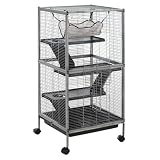 PawHut 4-Tier Rolling Cage PawHut 4-Tier Rolling Cage |
|
Check Latest Price |
 Amakunft Pop-Up Playpen Amakunft Pop-Up Playpen |
|
Check Latest Price |
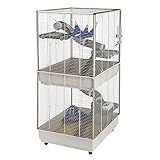 Ferplast Two-Story Tower Ferplast Two-Story Tower |
|
Check Latest Price |
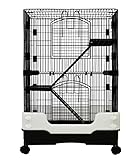 Homey Pet Rat Cage Homey Pet Rat Cage |
|
Check Latest Price |
 Mcage Deluxe Double Unit Mcage Deluxe Double Unit |
|
Check Latest Price |
1. Prevue Pet Products 485 Feisty Ferret Home with Stand
Prevue Pet Products 485 Feisty Ferret Home with Stand, Black Hammertone Small
- Widest reviewed cage in this roundup with 7199 ratings
- Two large doors can split the cage into separate spaces
- Ramps plus shelves and hammock included
- Removable platforms and tray make cleaning straightforward
- Storage shelf stand keeps supplies off the floor
- Wire spacing is 7/8 inch and needs checking against kit ferrets
- Large footprint eats floor space
- Nearly 24 pounds is awkward to reposition without the stand
The Feisty Ferret Home is the one we end up recommending first for a bonded pair, and the reason is not glamorous: it is the most widely reviewed large cage we found, with 7199 ratings averaging 4.5 stars. That volume of long-term owner feedback matters more here than any spec sheet, because the recurring theme is consistency rather than excitement.
The cage itself measures 31 x 20 inches at the base and stands 41.5 inches tall, rising to 54 inches on the included stand. Two large hinged doors run nearly the full width of the front, which is the feature owners praise most, because you can pull the door closed behind a ferret without shutting that ferret into the other half.
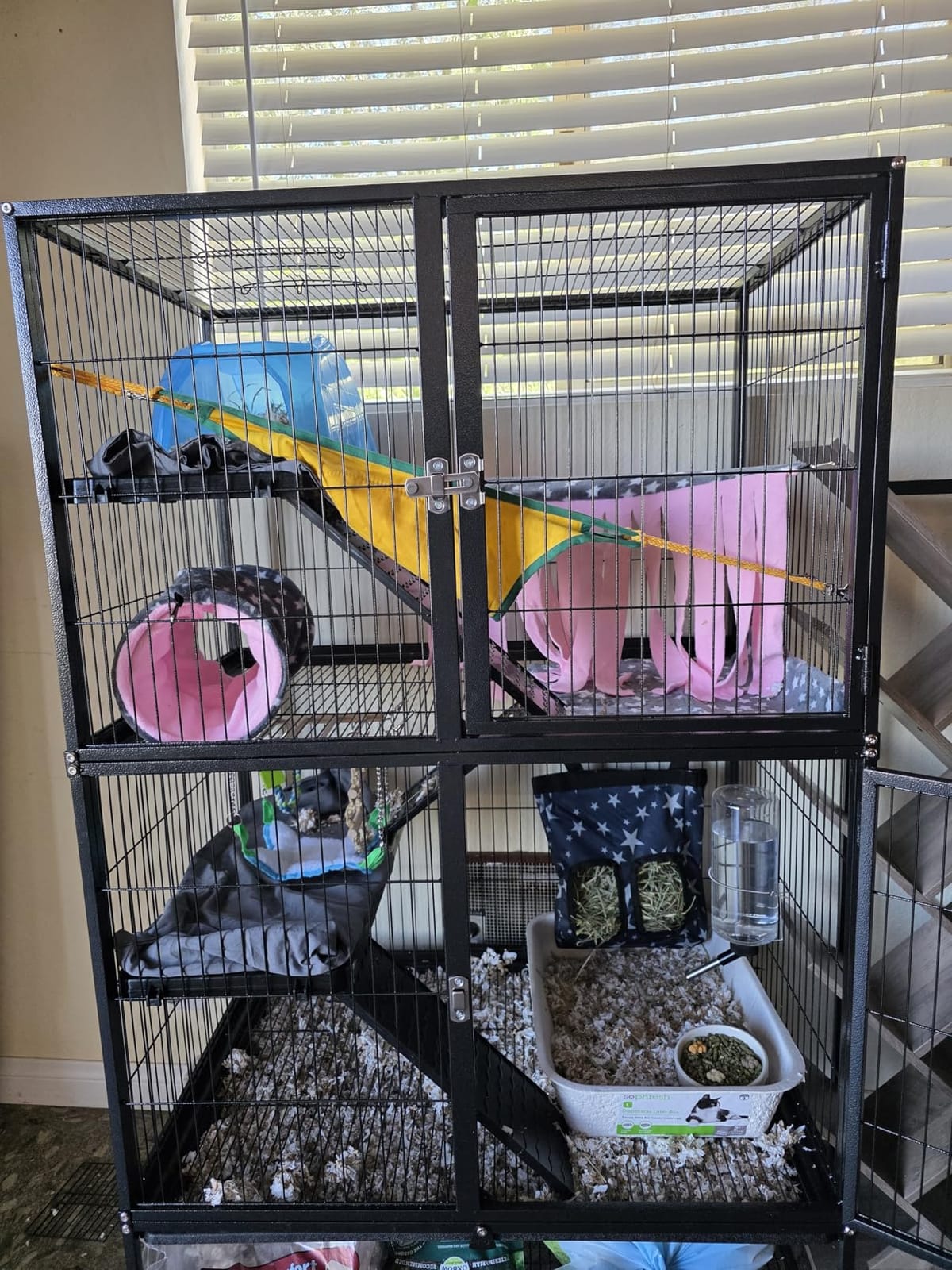
Two doors also means you can use the cage as two separate spaces, closing off one half when you need temporary separation or when you are introducing a new ferret. That is a genuinely useful function in a multi-ferret home, and very few cages of this size give you it.
Ramps, shelves and a hammock ship with the cage. The removable platforms, grille and bottom tray all lift out, so a deep clean on a two-ferret cage takes minutes rather than an evening. With two animals the litter volume roughly doubles, and pull-out trays are the difference between a chore and a problem.
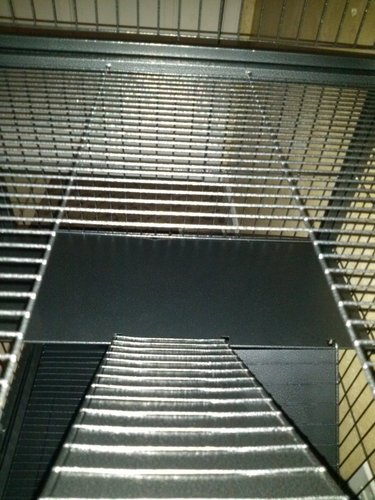
Who the Feisty Ferret Home suits
This is the pick for a pair living in an apartment or a smaller room where a 36 x 24 inch double unit would not fit. It gives you three usable surfaces, wide door access and the ability to split the cage, in a footprint most people can actually find space for.
It also works as a second cage. Multi-ferret households need somewhere to put one ferret during introductions, deep cleans or the occasional vet trip, and this one rolls on casters to a spare room or a bathroom corner easily.
Who the Feisty Ferret Home does not suit
Wire spacing is 7/8 inch. That is fine for adult ferrets and it sits under the 1 inch safety ceiling, but kit ferrets are smaller and you would want to watch early. If your group includes very young animals, one of the tighter-barred cages later in this list is the safer bet.
It weighs 23.6 pounds and the base is large. If you plan to move it daily between rooms, plan for the stand and the casters rather than lifting it.
2. SONGMICS Pet Playpen with Floor
- Tool-free assembly with included connectors and rubber mallet
- Lightweight modular design that moves between rooms easily
- Integrated floor keeps bedding and spills contained
- Panels can form an L-shape or a two-story layout
- Translucent panels wipe clean in seconds
- At 18.1 inches tall it is a play pen rather than a cage
- Plastic panels can be chewed or bent
- Panel gaps need checking before use with small animals
This is not a permanent cage and we want to be clear about that. It is the play system that sits around or next to a cage, and in a multi-ferret home it is often the piece of kit that does the most for daily quality of life.
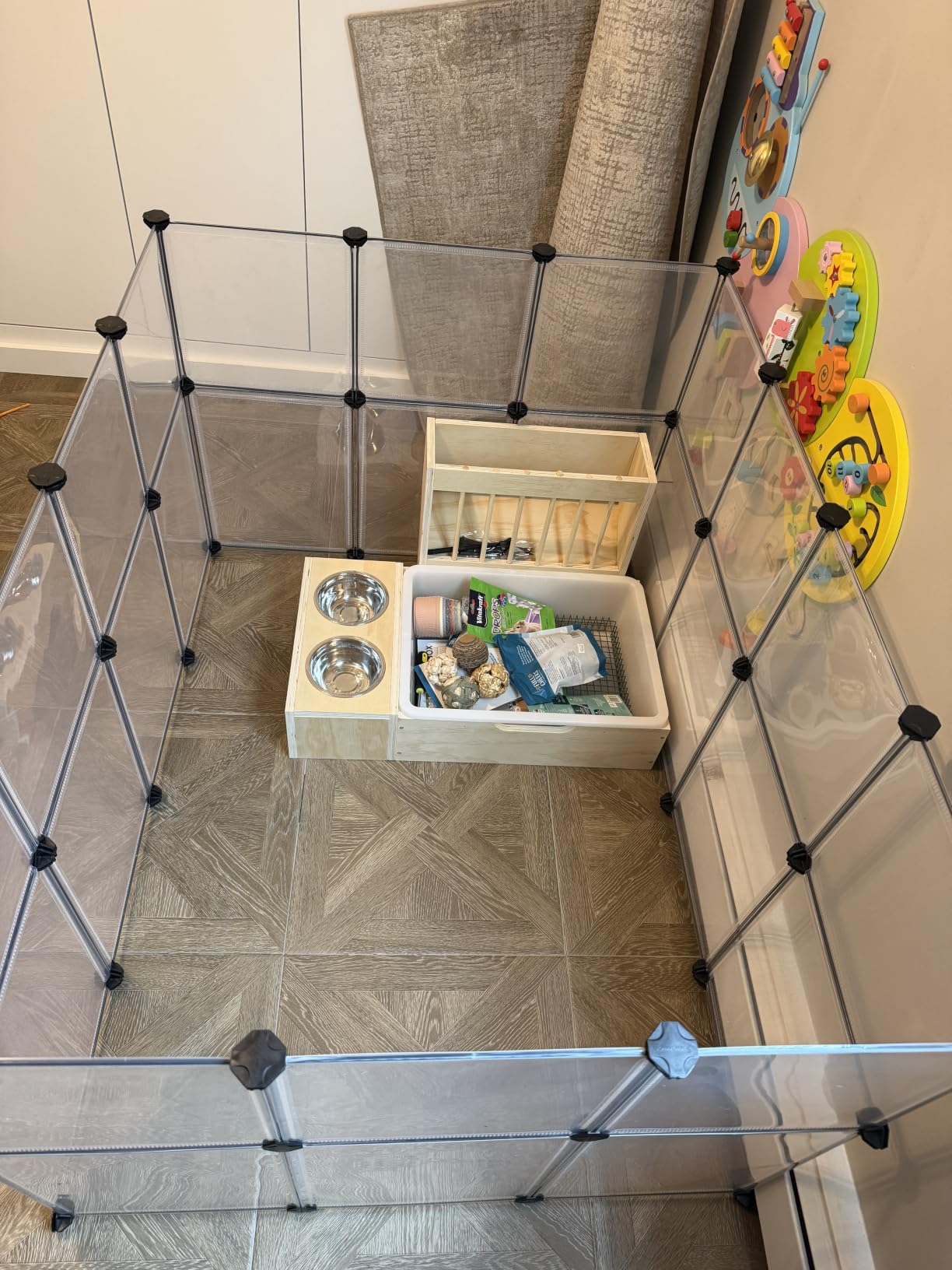
Twenty modular plastic panels assemble with multi-angle connectors and an included rubber mallet, with no tools. The integrated floor mat keeps bedding, litter and water inside the pen rather than across your floor, which matters enormously when two ferrets are zooming around at the same time.
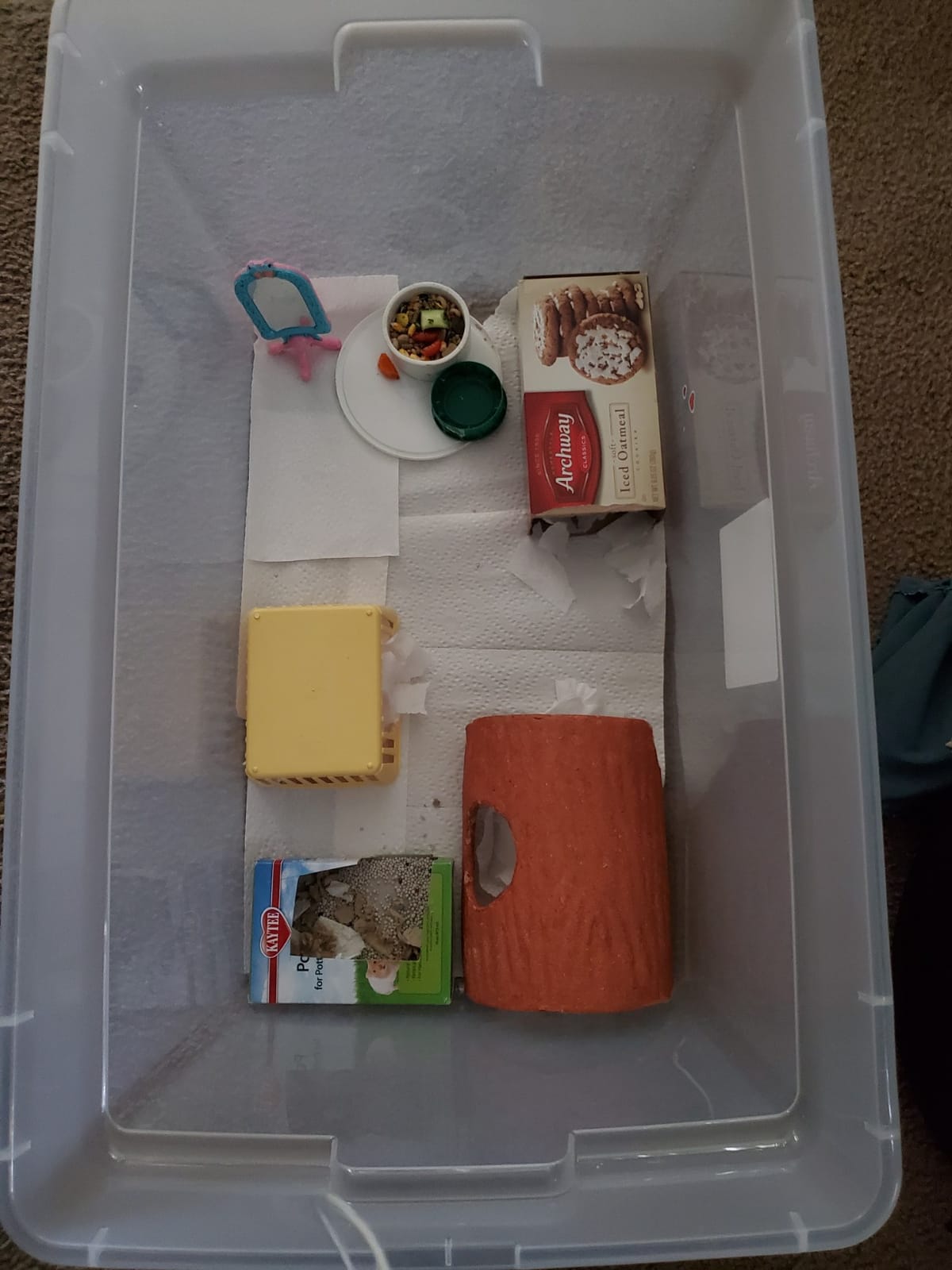
At 56.3 x 28.7 inches the usable floor area is larger than the main deck of most single-level cages on this list. Owners rearrange the panels into an L-shape to run along a wall, or stack them into a two-story pen when they want more usable surface without a bigger footprint.
Weighing 9 pounds, it moves between rooms without help. When the cage needs a proper deep clean, the whole pen lifts out and the cage itself becomes accessible. That is the daily-use argument for owning one, and it is why owners with two or three ferrets tend to end up with a pen even after they have bought the big cage.
Who the SONGMICS pen suits
It suits anyone whose ferrets get their 4 hours of daily free time in a contained play area rather than loose in a room. For a pair, that pen area is often the difference between exhausted, overstimulated animals and calm ones.
It also suits small spaces, since it packs flat against a wall and stores in a closet when the ferrets are asleep.
Who the SONGMICS pen does not suit
At 18.1 inches it is too low to be housing. Ferrets are accomplished climbers, and a determined one working at a panel seam can widen it over weeks. Treat the connectors as the weak point and check them regularly.
Plastic panels can be chewed or bent by determined animals, and the panel gaps need checking before you put young ferrets inside.
3. Yaheetech 52-Inch Six-Level Metal Ferret Cage
- Six tiers give the most vertical surfaces in this roundup
- Three front doors give access at every level
- Powder-coated steel resists chewing and water
- Slide-out litter tray under a metal grate
- Four 360-degree casters roll it anywhere
- Narrow 25 x 17 inch footprint limits running room
- Ramps and shelves may need securing once animals are active
- 52 inch frame is awkward through a doorway
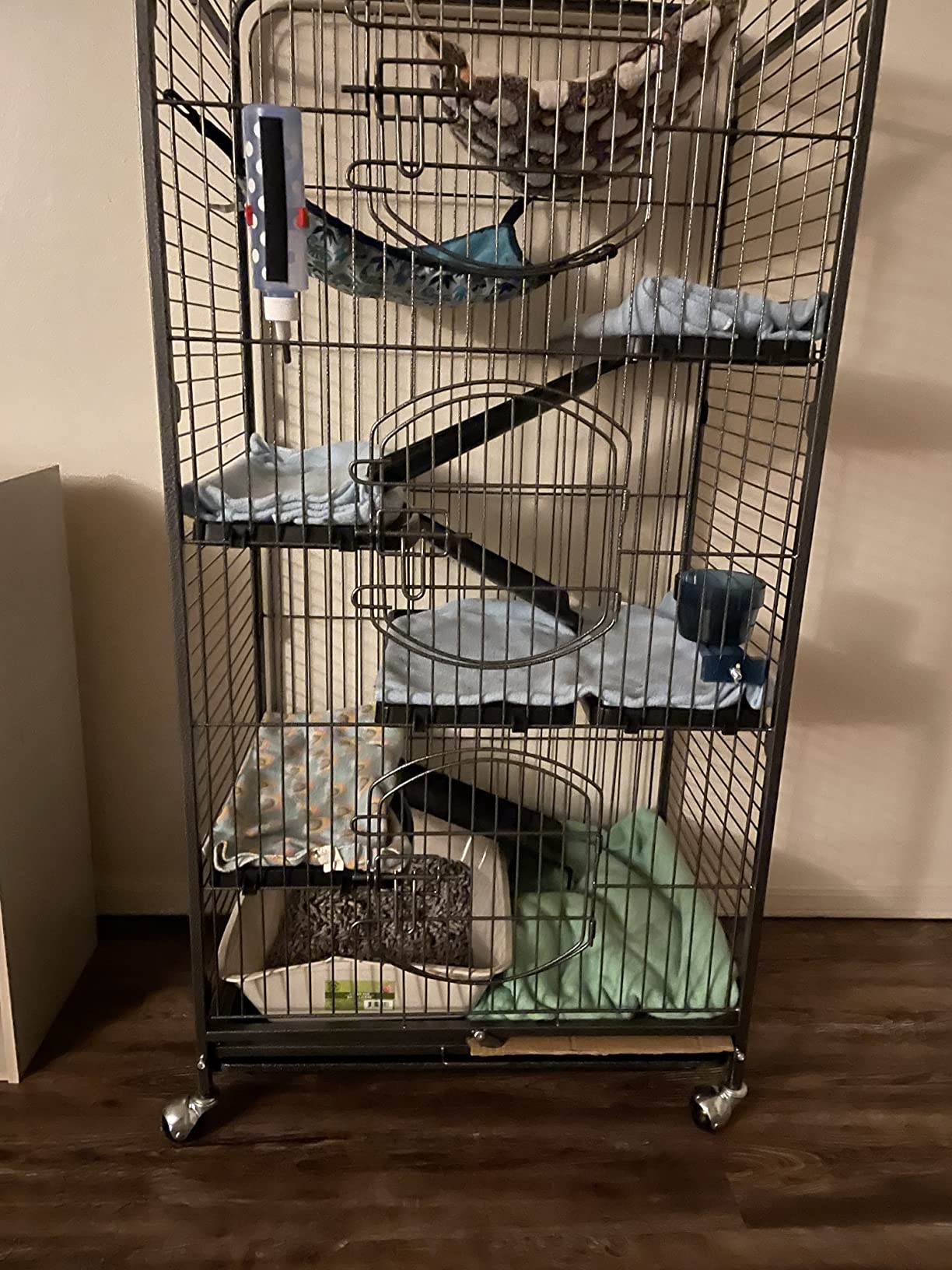
Six usable levels is the headline number here, and it is the reason this cage keeps coming up as the low-cost way to give a pair vertical room. Owners with 5221 ratings averaging 4.3 stars consistently talk about climbing rather than floor space, which is the correct instinct for ferrets.
The 25 x 17 inch base is narrow, and that is the trade-off. A pair can climb, stretch and nap in separate corners, but neither can do a full run along the bottom floor. Ferrets sleep 16 to 18 hours a day, so nap and climb room matters more than sprinting room, but it is still a real limitation.
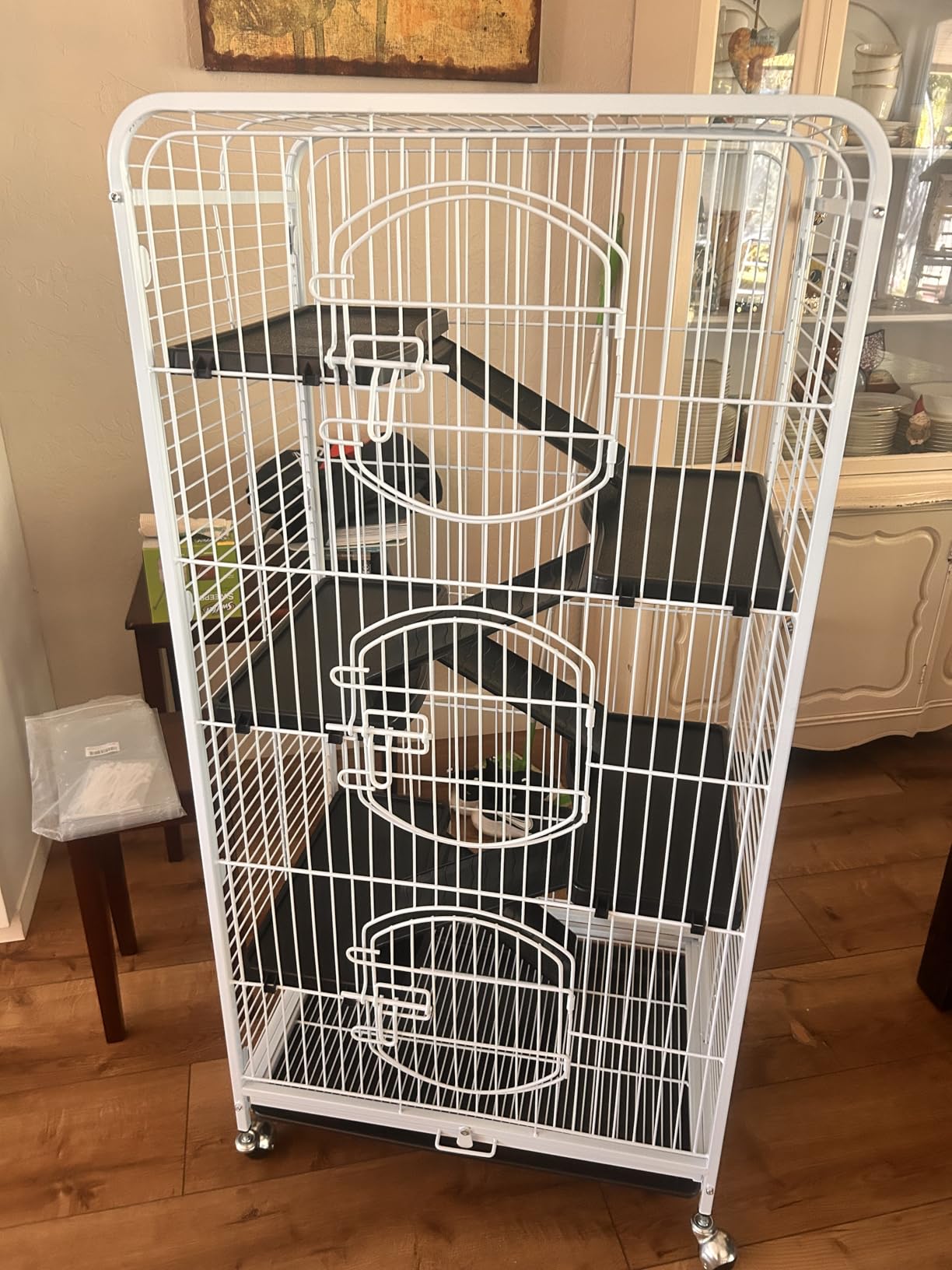
Three front doors with latches mean you can reach any tier without dismantling anything, which matters when the top level holds the sleeping ferret and the bottom holds the litter. The slide-out tray sits under a metal grate so the animals stay out of their own waste, and it pulls straight out for cleaning.
Powder-coated steel is the finish used throughout, and it is the right choice for chewing animals. Four 360-degree casters let you roll the cage away from a sunny window or into position for cleaning, which is a safety feature as much as a convenience one.
Who the Yaheetech cage suits
It suits anyone who wants many levels without a large floor footprint, and anyone whose ferrets climb more than they run. Six tiers let you split a sleeping level above a food-and-litter level, which is exactly the separation we look for in a two-ferret setup.
It also suits households working with a tight budget, since this is an affordable way to reach multiple solid levels in our list.
Who the Yaheetech cage does not suit
Ferrets need horizontal room as well as vertical room, and a 25 x 17 inch base is tight for two of them. If your pair are young, active and clumsy, expect more collisions in the lower levels than you would in a wider cage.
Owners report that ramps and shelves sometimes need securing once the animals are settled and active, and a 52 inch frame will not turn corners easily on the way through a door.
4. Critter Nation by MidWest Double Unit
- Highest-rated cage in this roundup with 6189 ratings
- 36 x 24 inch footprint is the benchmark for a pair
- 1/2 inch wire spacing contains even small ferrets
- Three ramps with covers plus two full-width shelves
- Full-width double doors with a swing-up locking ramp
- Assembly is time-consuming and usually needs two people
- Occasional reports of bent panels or door hardware
- Trays are awkward to remove and corner debris falls through
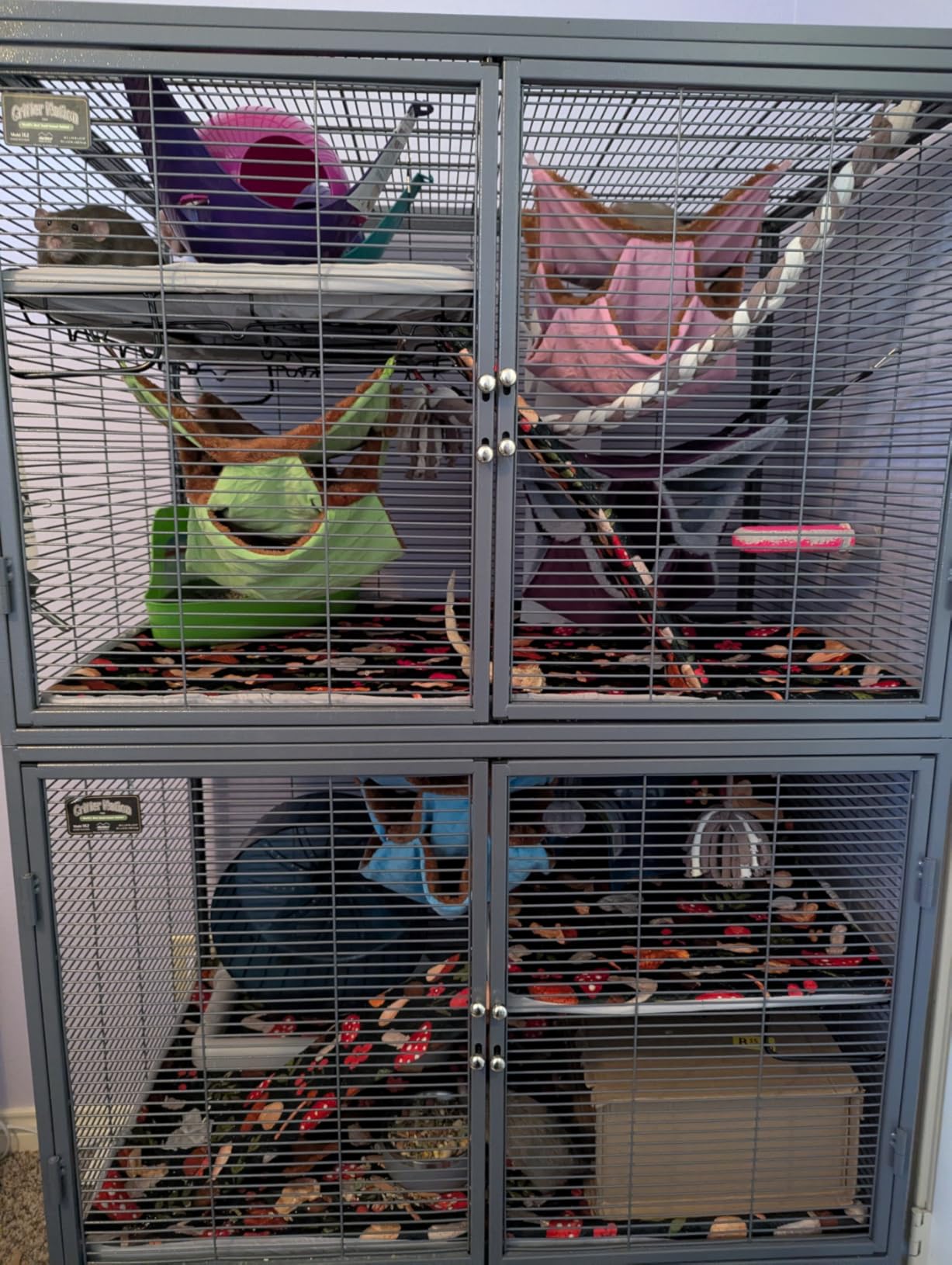
Two full levels measuring 36 x 24 inches, with 1/2 inch wire spacing, is the setup most experienced owners point to when someone asks what to house two ferrets in. This is the highest-rated cage in our roundup at 4.6 stars across 6189 ratings, and it is the one we would buy first if we were starting from nothing.
Bar spacing is the reason ferret veterans recommend this model over generic small-animal cages. A ferret has a flexible skeleton, so if the head fits through a gap, the body follows. Half-inch spacing removes that question entirely, including with kit ferrets.
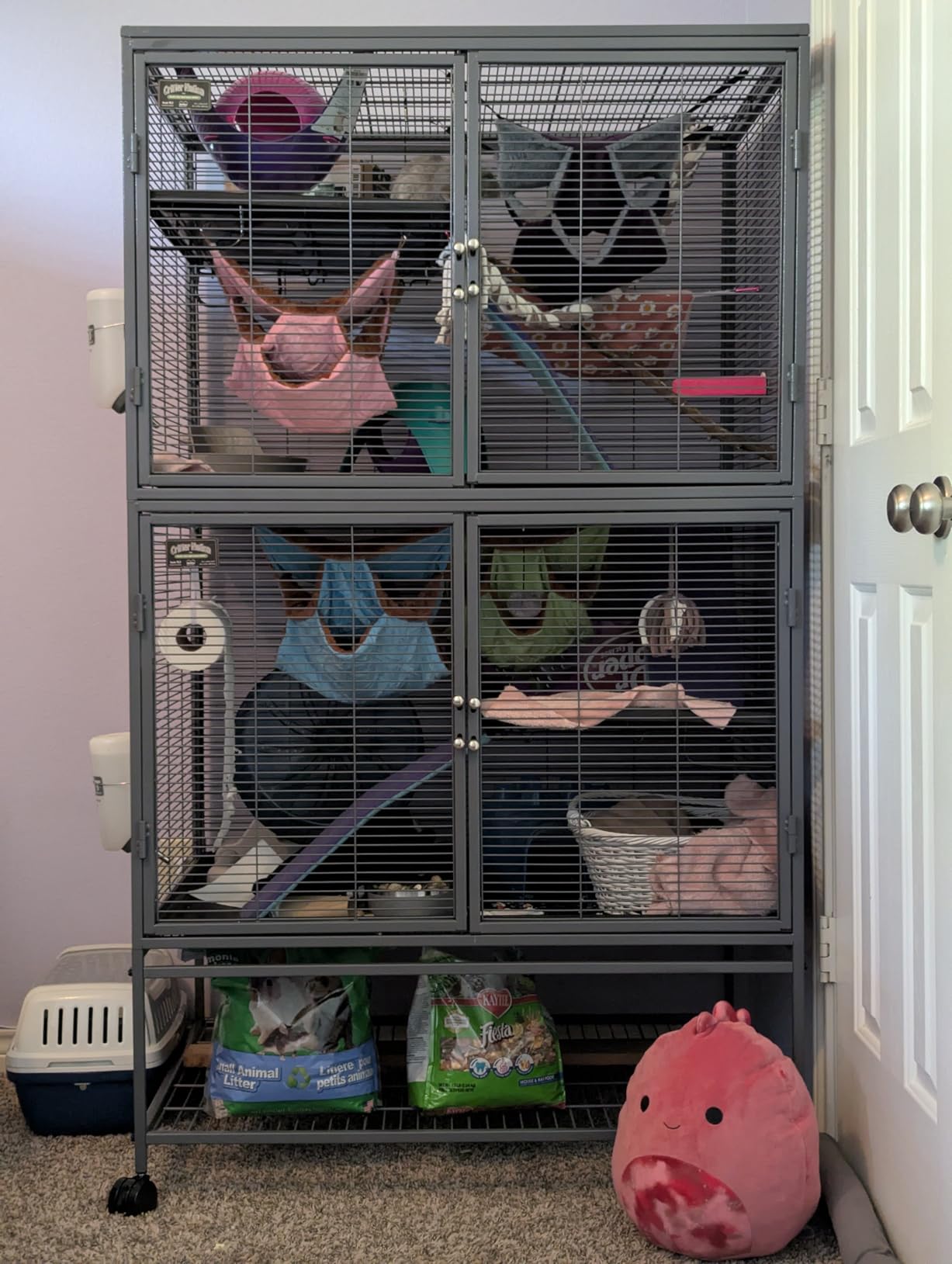
The width is what makes it work for a pair. At 36 x 24 inches, two ferrets can pass each other on the bottom floor without a confrontation, occupy separate ends, and each have a corner for a litter tray. That is the double the single-ferret floor space rule doing its job, spread across two levels so neither animal is forced into the other.
Three textured ramps come with covers already fitted, plus two full-width resting shelves. Ramp covers are not a luxury. Bare wire ramps are the single most common construction complaint we found from owners, and they are a direct route to sore, cracked footpads.
Who the Critter Nation Double Unit suits
It suits a bonded pair or a group of three who want the most reliable construction on this list, and it suits anyone with kit ferrets who needs bar spacing under an inch. Long-term owners describe it as the cage they would still own in ten years, and the review history backs that up.
The full-width double doors and the swing-up locking ramp let you separate the two levels, so this doubles as the holding cage when one ferret needs a vet visit or a clean-out.
Who the Critter Nation Double Unit does not suit
It weighs 44 pounds and it is genuinely fiddly to build. Owners regularly report getting it wrong on the first attempt, and we would budget for two people and a rubber mallet rather than trying it alone on an evening.
The trays are awkward to lift out, and owners note that anything sitting in the corner can fall through to the level below, which is untidy when you have two litter trays to keep clean. Expect to line the pans rather than pour bedding straight in.
5. MidWest Homes for Pets 100-29 Ferret Nation Exercise Pen
MidWest Homes for Pets 100-29 Ferret Nation Small Animal Exercise Pen
- Vertical bar layout reliably defeats climbing escape attempts
- Collapses flat and one person can carry it
- Tool-free thumb-snap assembly
- Panels link together for a larger enclosure
- Ground anchors included for outdoor use
- Panel area is smaller than the advertised square footage on some variants
- Not suitable as permanent housing
- Occasional units arrive with bent parts
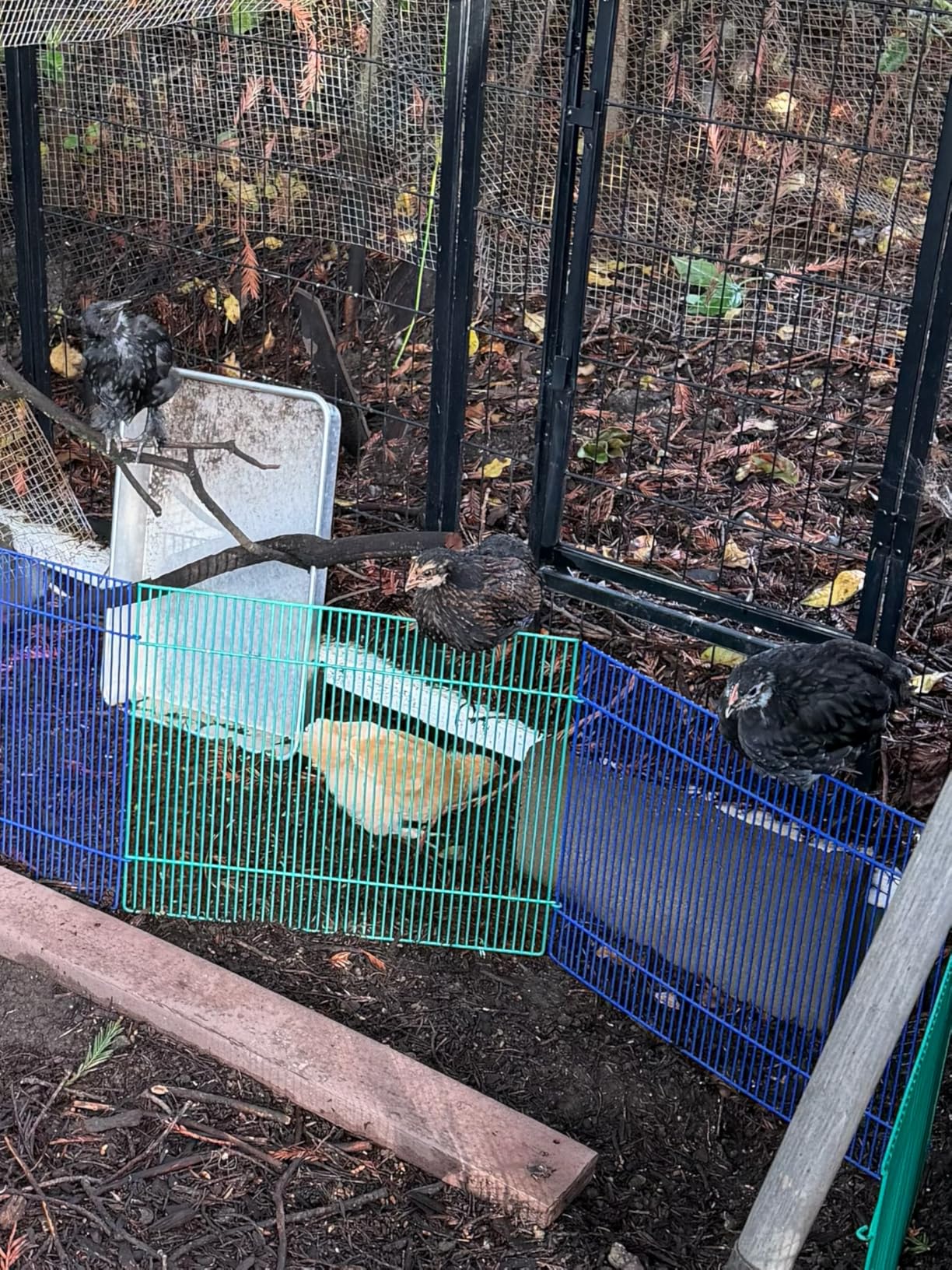
Eight panels with 0.86 inch wire spacing, and the reason ferret owners single it out is the vertical orientation of those bars. Horizontal-bar pens give a determined ferret a ladder. These do not, and owners with 2484 ratings averaging 4.5 stars consistently report that the layout defeats climbing escape artists.
At 29.75 inches tall the panels are high enough to stop a jump but low enough to step over, which means you can reach in without a step ladder. That sounds minor until you have cleaned a 60 inch cage and then cleaned this one.
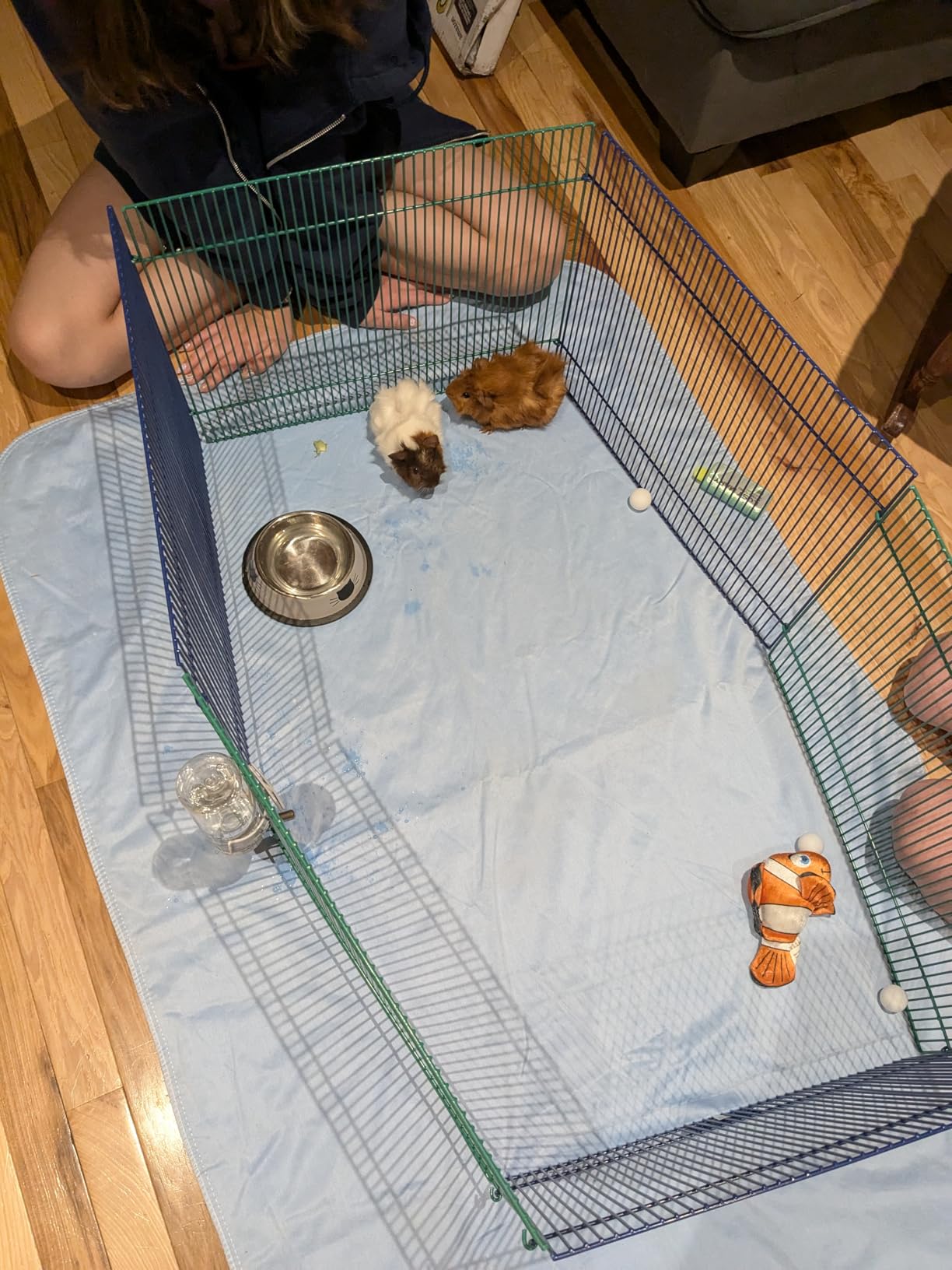
The panels assemble with thumb-snaps and no tools, then fold flat. Owners use them as a play area, as a travel pen for a sitter or a vet visit, and as a way to contain the ferrets while the main cage is being deep cleaned, which in a two-ferret home happens far more often than it does with one.
Panels link together, so two pens can be joined into a larger run for playtime. Some buyers report that a single pen does not deliver the square footage they expected, and that connecting two is where the useful size starts.
Who the exercise pen suits
It suits anyone who needs flexible, temporary containment: playtime, cage cleaning, travel, or a second area while you assemble something larger. For a pair, a pen plus one large cage covers most of what actually happens day to day.
It also suits owners with a ferret-proofed room, where the pen becomes a corner setup rather than the whole exercise space.
Who the exercise pen does not suit
It is not permanent housing. At 22 pounds assembled it is heavy to move around constantly, and there is no solid ramp or sheltered level, so it fails as a living space for more than a couple of hours at a stretch.
Check the panels on arrival. Owners report the occasional unit arriving with bent parts or a damaged carton.
6. PawHut Metal Small Animal Cage, 4-Tier Rolling
PawHut Metal Small Animal Cage, 4-Tiers Rolling Big Ferret Cage, Gray
- Four tiers of climbing space with a hanging hammock
- Four casters let you chase the daylight or clean underneath
- Pull-out tray and two doors make cleaning quick
- Steel wire gives a well-ventilated view
- Square footprint suits tighter rooms
- Bar spacing is wider than dedicated ferret cages
- Bare metal platforms can be hard on feet without covers
- Assembly needs close attention to the manual
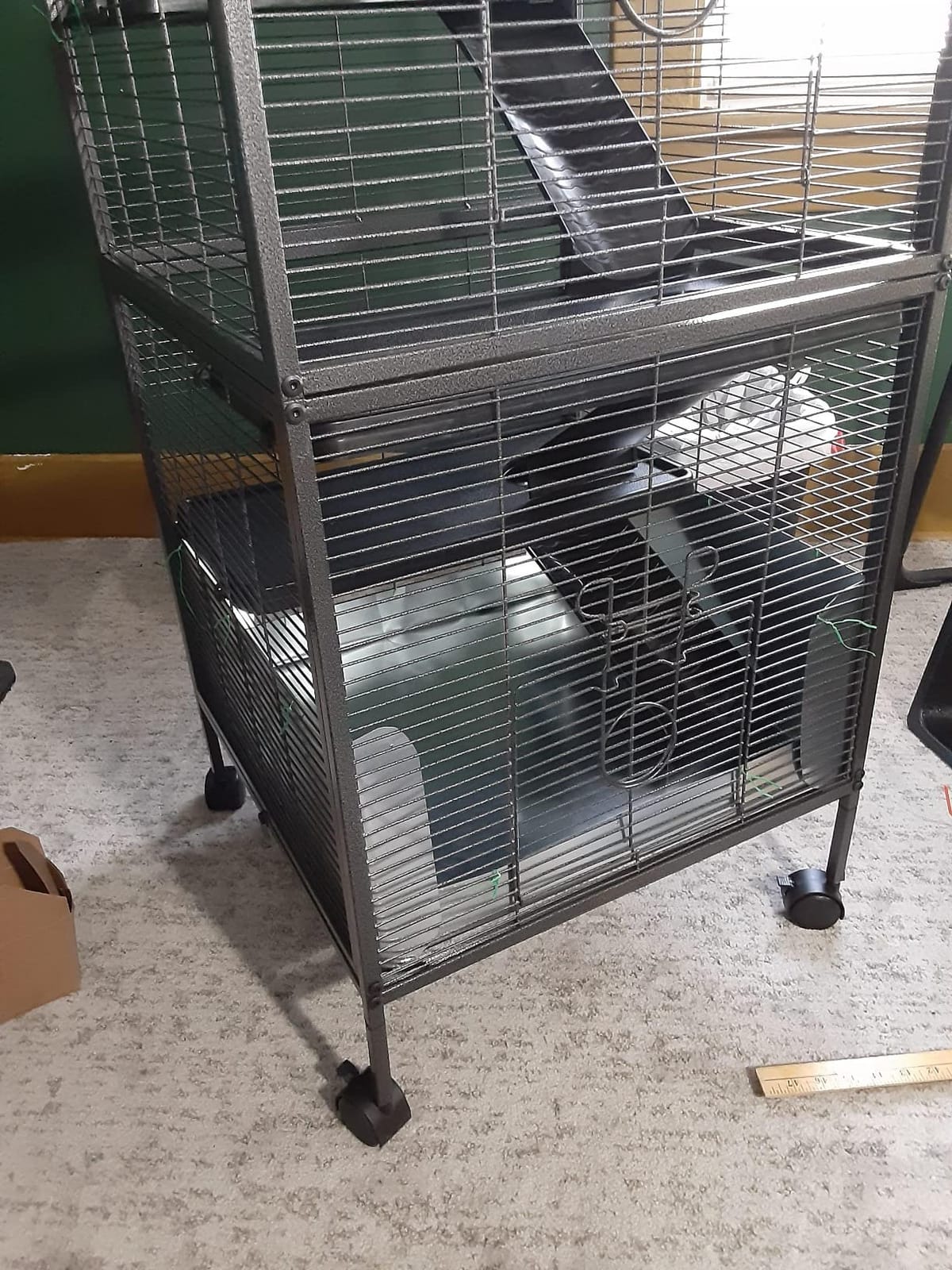
At 20.5 x 20.5 inches, this is one of the smaller footprints in our roundup, and that is the point. If you have measured your available floor space and the 36 x 24 inch doubles will not physically fit, a square tower is a better answer than buying something too small horizontally.
Four tiers give climbing room that a flat cage of the same width cannot, and a hanging hammock is included for the level where your ferrets will spend most of their 16 to 18 hours of daily sleep. Four casters mean it follows the sun around the room, which matters because you do not want a cage sitting in a warm window.
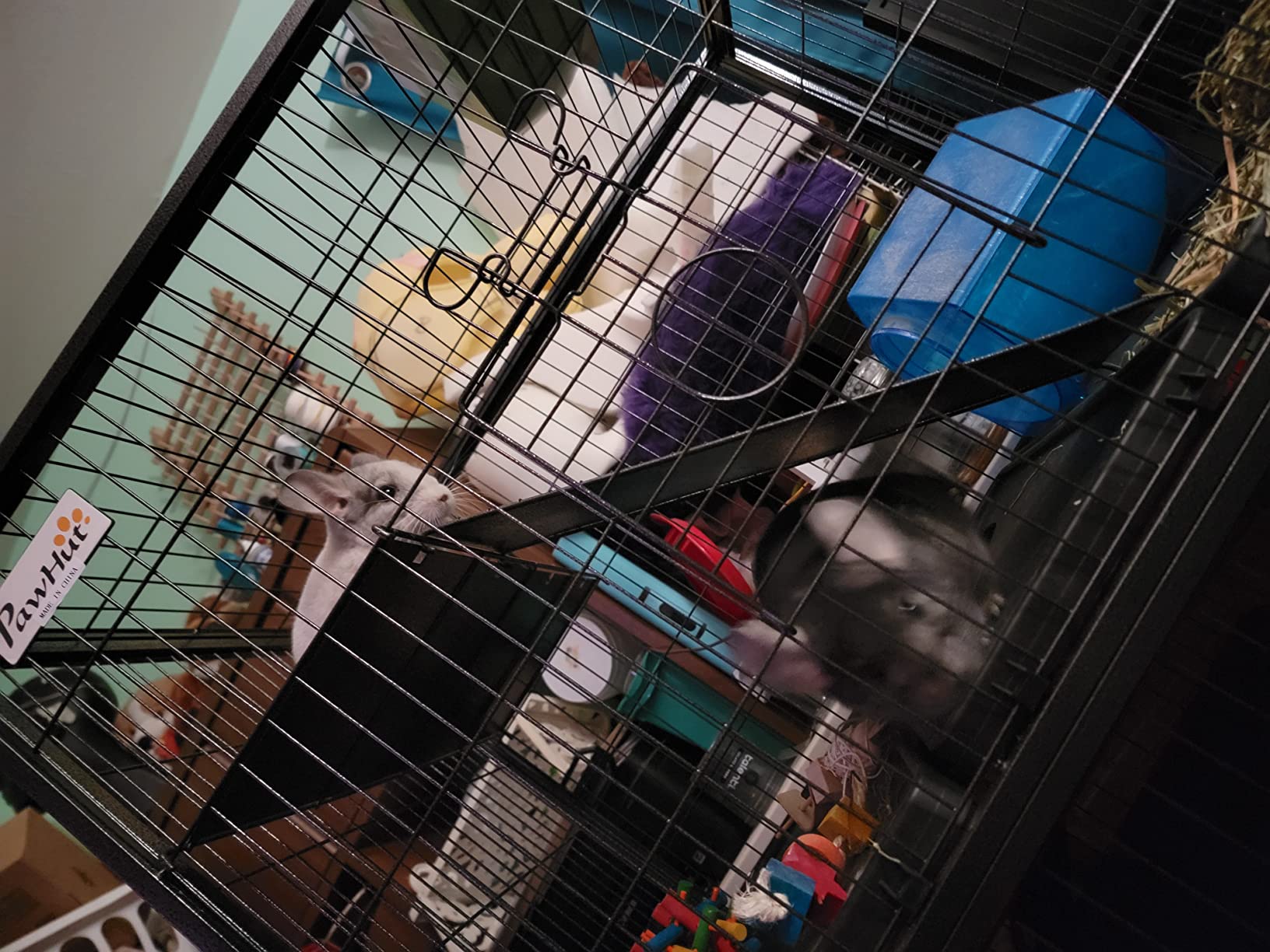
The pull-out bottom tray and two doors make routine cleaning straightforward. With two ferrets the mess volume doubles, so a tray that slides straight out rather than one you have to reach into is worth a lot over a year of daily use.
Owners also like being able to see through the cage. Steel wire gives a clear view of every level, so you can check on a pair without opening anything, and a ferret that has gone quiet in a covered hammock is still visible to you.
Who the PawHut cage suits
It suits small rooms and first-time multi-ferret owners who want more levels than a flat cage offers. A pair will use four levels happily as long as you supply two sleep spots, two litter trays and two food stations rather than one of each.
It also suits anyone whose ferrets are climbers rather than runners, since vertical space is the feature here.
Who the PawHut cage does not suit
Bar spacing is wider than on purpose-built ferret housing, so it is not the right choice for kit ferrets. Owners with younger animals should check the measurement before committing.
The platforms are bare metal, and bare metal is uncomfortable underfoot over long stretches. Add covers, and follow the manual during assembly rather than guessing at the fittings.
7. Amakunft Small Animal Pop-Up Playpen with Mesh Cover
- Pops open in about five seconds with no assembly
- Light enough to carry outside or between rooms
- Waterproof base contains urine and wipes clean
- Expanded mesh top helps prevent escapes
- Carries a carry bag for storage
- Zippers and seams fail first with repeated use
- Fabric sides can be chewed through
- 15 inches tall makes it a playpen not a cage
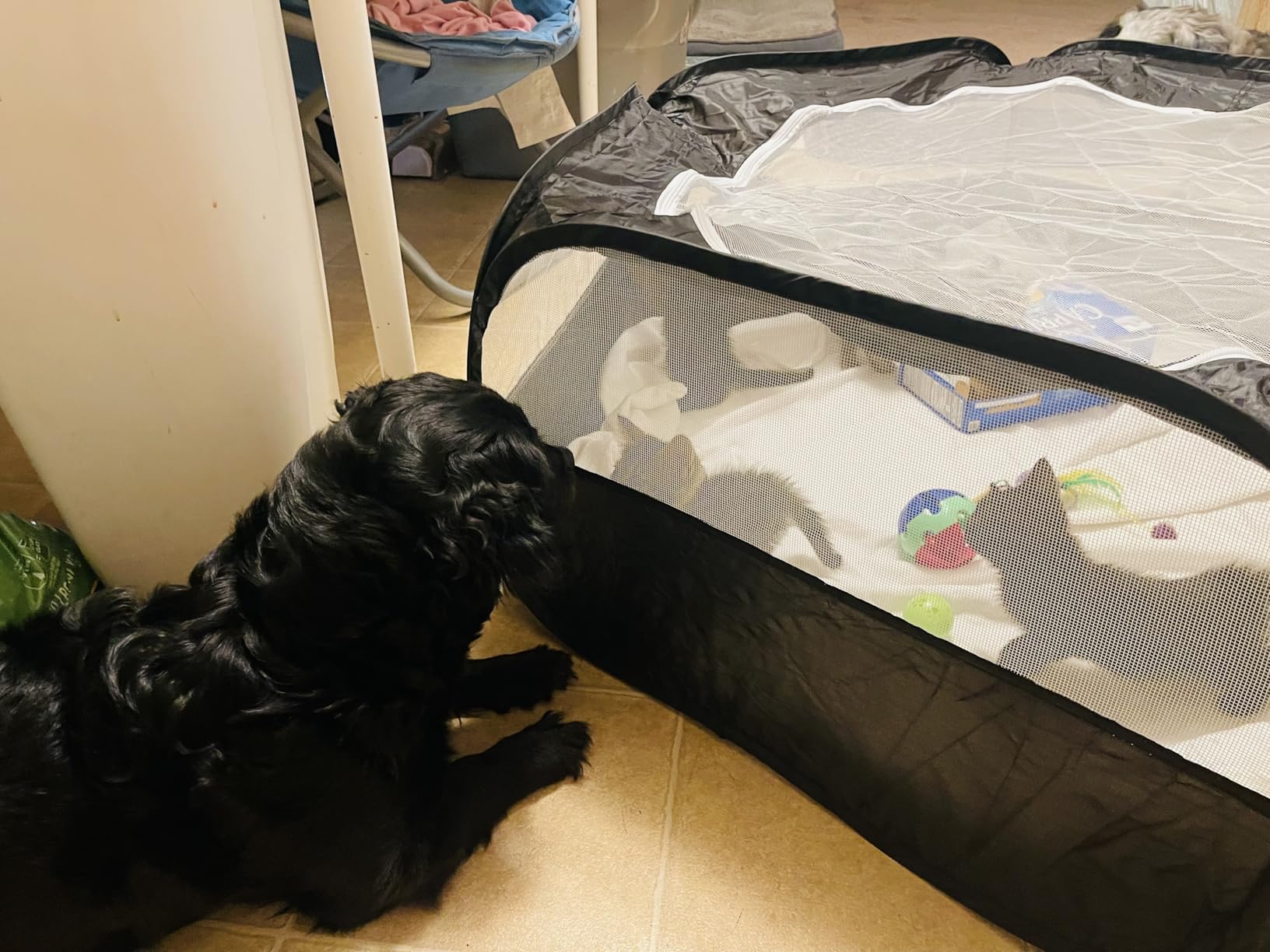
This is the quickest temporary solution in the list, and in a multi-ferret household it answers a question the big cages do not: where does one ferret go for an hour while you clean the main cage? It opens in roughly five seconds and weighs ten ounces.
The waterproof coated base is the feature that makes it useful with ferrets. It contains urine and wipes down, so you can set a small pet, bedding and a water dish inside without thinking about the floor underneath.

Half the side panels are mesh and half are textile, with 150 percent expanded mesh across the top. That top cover is what stops an ambitious ferret from launching itself out of a 15 inch wall, which is the whole reason this pen works and a low plastic tray does not.
Owners use it for supervised floor play, for travel and as a temporary pen during introductions. It collapses flat and folds into the included carry bag, so it lives in a closet until the moment you need it.
Who the Amakunft pop-up suits
It suits anyone who needs a fast, cheap holding pen for a short period: introductions, cage changes, a vet trip, or a supervised play session away from the cage. For a pair, one of these plus a proper cage covers most of the awkward gaps in a day.
It also suits renters and anyone who does not want to bolt anything or modify a room.
Who the Amakunft pop-up does not suit
Zippers and seams are the first thing to fail under repeated use, and fabric sides can be chewed through. Both are fine for a few hours; neither is fine as an overnight solution.
At 14.96 inches tall it is a playpen and nothing more, and it can stay slightly warped after folding.
8. Ferplast Ferret Tower Two-Story Ferret Cage XXL
Ferplast Ferret Tower Two-Story Ferret Cage | XXL| Ferret Cage Measures 29.5L x 31.5W x 63.4H – Inches
- Tall two-story tower with a door on each level plus a roof-top door
- 0.5 inch bar spacing contains ferrets safely
- Includes water bottle and litter pan plus dish and play tubes
- Quick-latch system takes it apart for cleaning
- Four casters included for mobility
- Weighs 52 pounds without the casters
- 31.5 inch width needs a dedicated corner
- Metal mesh ramps and floors may need covers
The Ferplast Tower measures 29.5 x 31.5 x 63.4 inches and uses 0.5 inch bar spacing, so it contains ferrets as reliably as the Critter Nation. For two animals, the 31.5 inch width gives each one a proper side of the cage rather than sharing a narrow strip.
It is the best-supplied cage in this roundup by a distance. The box includes a water bottle, litter pan, dish, two play tubes, two ramps, three platforms and a hammock, which for a first-time owner removes a long list of separate purchases.
There is a door on each level plus a roof-top access door, so you can reach any tier without shifting the whole cage. The quick-latching system lets you take it apart for cleaning and put it back together without tools, which matters more in a two-ferret home because you will be doing that weekly.
Two 6 inch deep litter pans are included, and there is enough deck area to fit one in each corner, one level apart, so the animals are not competing for the same box.
Who the Ferplast Tower suits
It suits owners who want tight bar spacing and a full accessory kit in one purchase, and it suits anyone whose ferrets climb and use vertical space well. The roof-top door and per-level doors make it genuinely easy to use every level rather than treating the top as storage.
It is also the option to look at if you are outside the US, since Ferplast builds across Europe as well as here.
Who the Ferplast Tower does not suit
It weighs 52 pounds, and without the casters moving it is a two-person job. The four included casters are not optional in practice, so install them before the ferrets arrive.
At 31.5 inches wide it needs a dedicated corner rather than a nook. The ramps and floors are metal mesh, so add fleece sleeves before you put a pair in for longer than a few hours.
9. Homey Pet Rat Cage, Three-Tier
Homey Pet Rat Cage, Small Animal Cage for Ferret, Chinchilla, Guinea Pig
- Longest floor run in this roundup at 38 inches
- Three levels with space for hanging toys and shelves
- Anti-spill guard keeps bedding and debris inside
- Four lockable 360-degree wheels
- Thickened rust-resistant wire
- Side clips can be fiddly to seat flush
- Debris collects along the urine guard seam and needs partial disassembly to clean
- Wire spacing is wider than purpose-built ferret cages
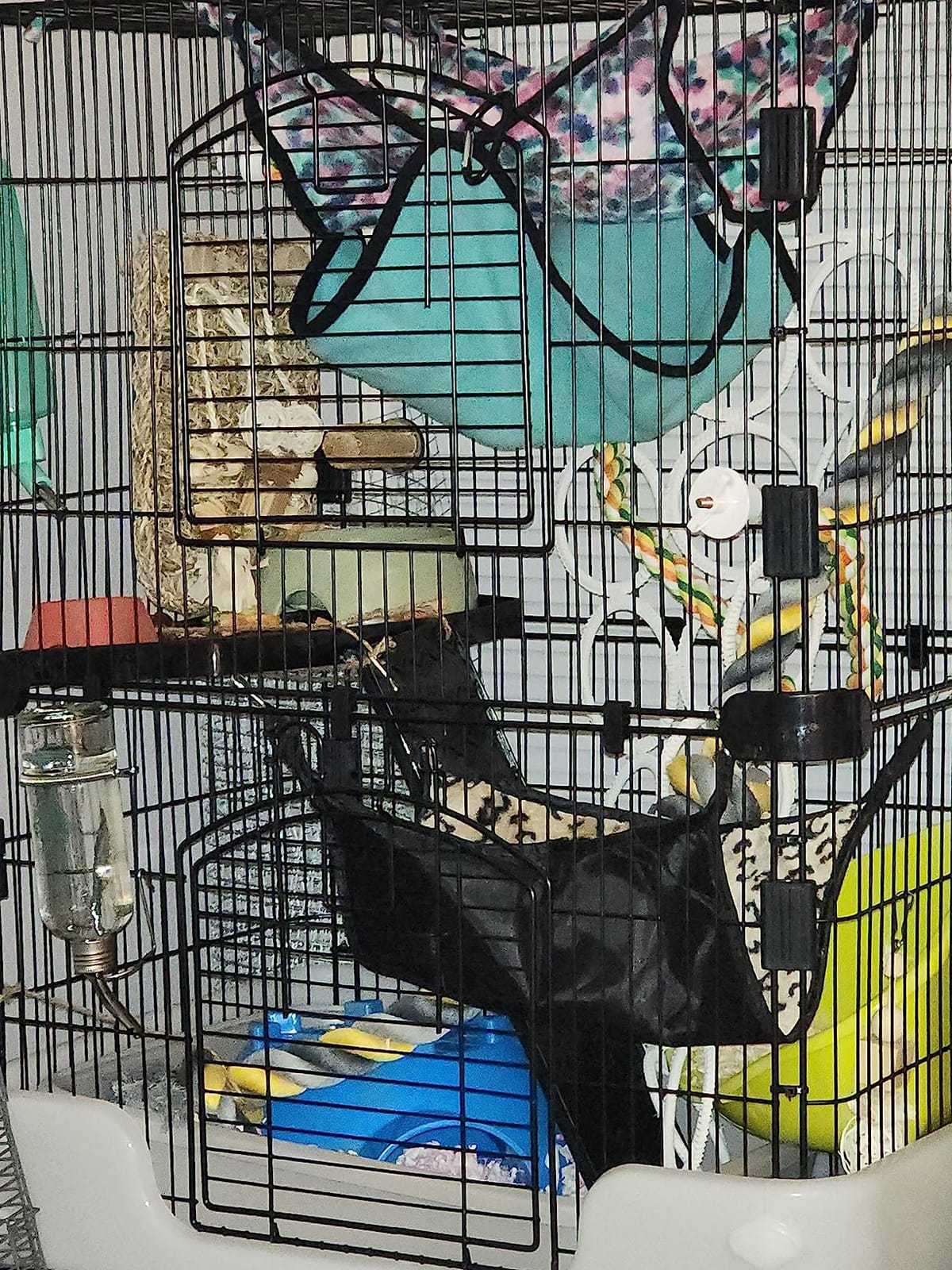
The 38 inch length is unusual in this category, and it is why this cage shows up for anyone who wants their ferrets to be able to run rather than only climb. Three tiers sit above it, with 0.65 inch wire spacing throughout and a detachable paw-friendly plastic floor grate on each level.
Detachable plastic grates are worth more attention than they get. A ferret standing on bare wire for hours is how you get sore, cracked footpads, and plastic grate floors are a middle ground between solid trays and open wire.
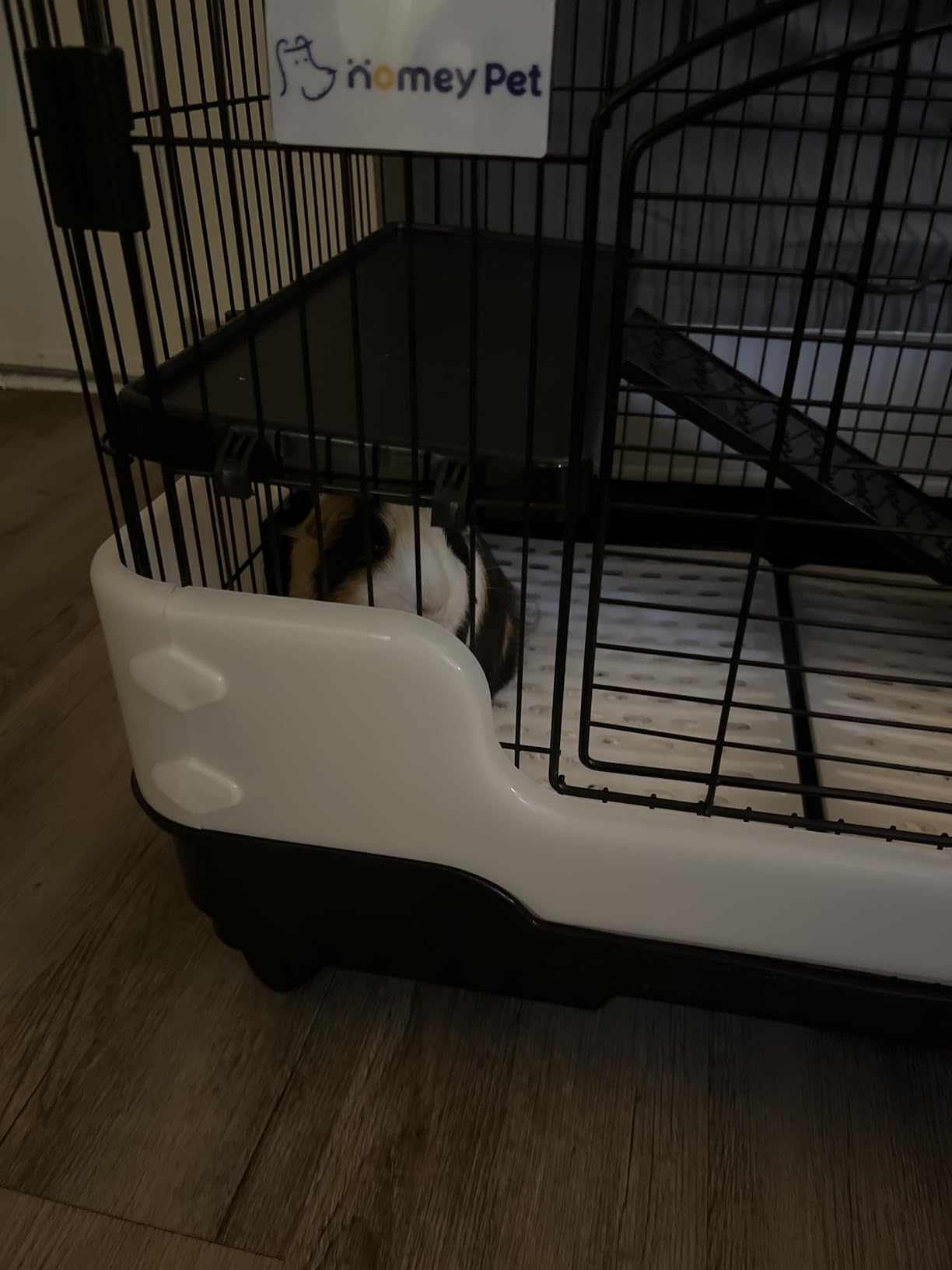
The anti-spill guard at the base is a sensible piece of design with two ferrets, because bedding and debris tend to migrate. The four 360-degree lockable wheels let you move the cage and keep it where you put it, which is important when a ferret decides to nose at the frame.
The front door uses a two-finger lock rather than a simple swivel catch. Swivel catches get popped open by determined ferrets, so a lock with a positive catch is one of the cheapest safety upgrades a cage can offer.
Who the Homey Pet cage suits
It suits owners whose ferrets run and stretch along a floor rather than climb constantly, and it suits anyone who wants a long cage on a shallow base for a room where vertical height is awkward. The open middle tiers give good air movement and visibility.
For a pair, the 38 inch length makes it easier to give each one an end, which reduces the corner conflicts that show up when two animals share a short base.
Who the Homey Pet cage does not suit
At 0.65 inch spacing it is wider than a dedicated ferret cage, so it is not the right home for very young ferrets. If your group includes kits, choose a cage under 1 inch spacing without exception.
The most-reported complaint is debris collecting along the seam where the cage meets the urine guard, and cleaning that means partially taking the cage apart. The side clips can also be fiddly to seat flush during assembly.
10. Mcage Deluxe Double Unit Two Full Story Rolling Cage
Deluxe Double Unit Two Full Story Small Animal Critter Home Rolling Cage
- Two stories with a full middle floor give real separation between animals
- 1/2 inch wire spacing and all-metal chew-free construction
- 21 x 15 inch front doors open wide for cleaning
- Ramps and platforms ship with paw-safe fabric covers
- Hammock
- water bottle
- food bowl
- storage shelf and casters included
- Bottom tray does not lock and can be pried open from inside
- Assembly instructions can be unclear and parts may not align
- Some units arrive with deformed bars or mismatched hardware
- One door per level in some variants
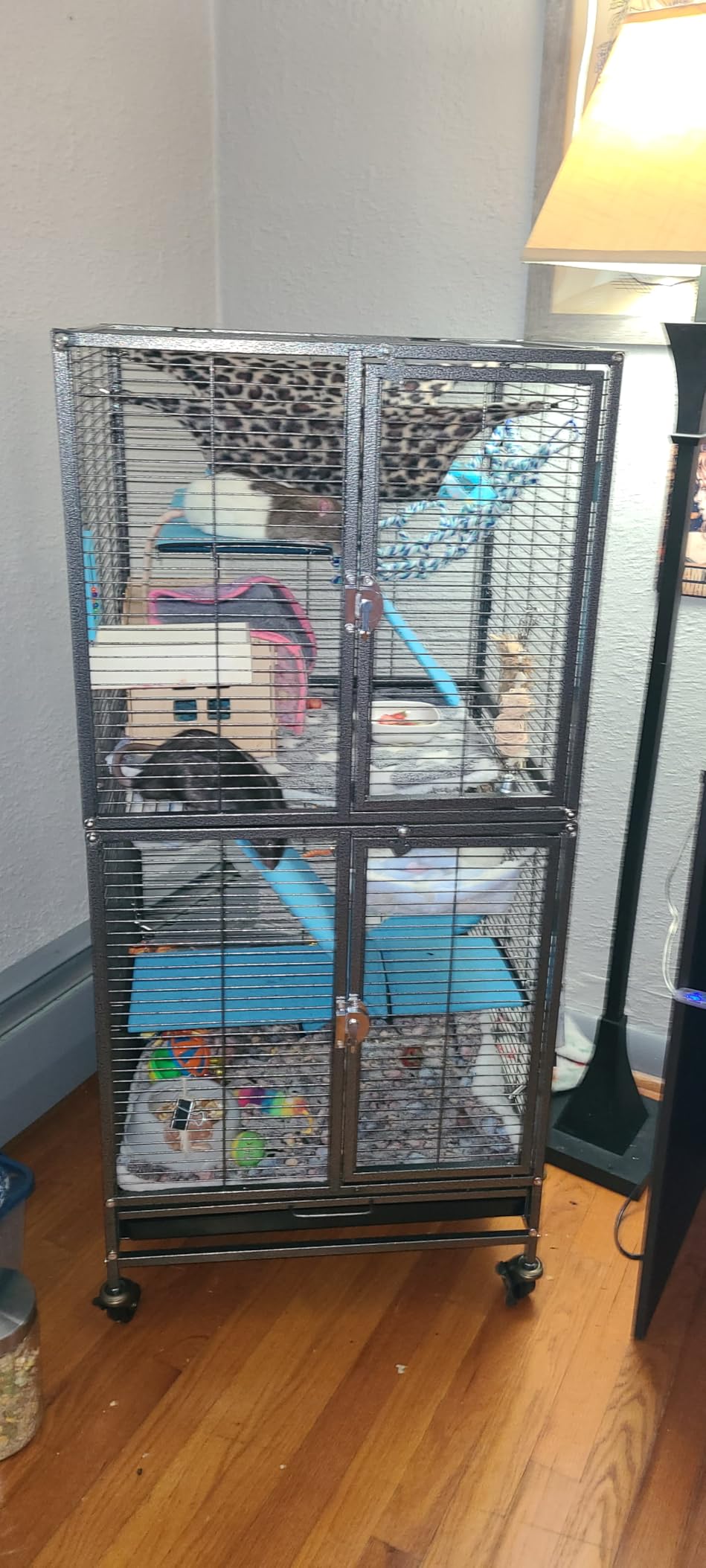
The Mcage Double Unit gives you two full stories with a complete middle floor at 31 x 20 x 55 inches, and the 21 x 15 inch front doors are wide enough to clean the corners properly. Those corners are where a two-ferret cage gets filthy, so door size is a genuine welfare feature here rather than a convenience.
Bar spacing is 1/2 inch, so it contains ferrets properly, and the ramps and platforms ship with paw-safe fabric covers already fitted. Owners rate that highly, since adding covers yourself is the step most people skip and most cages need.
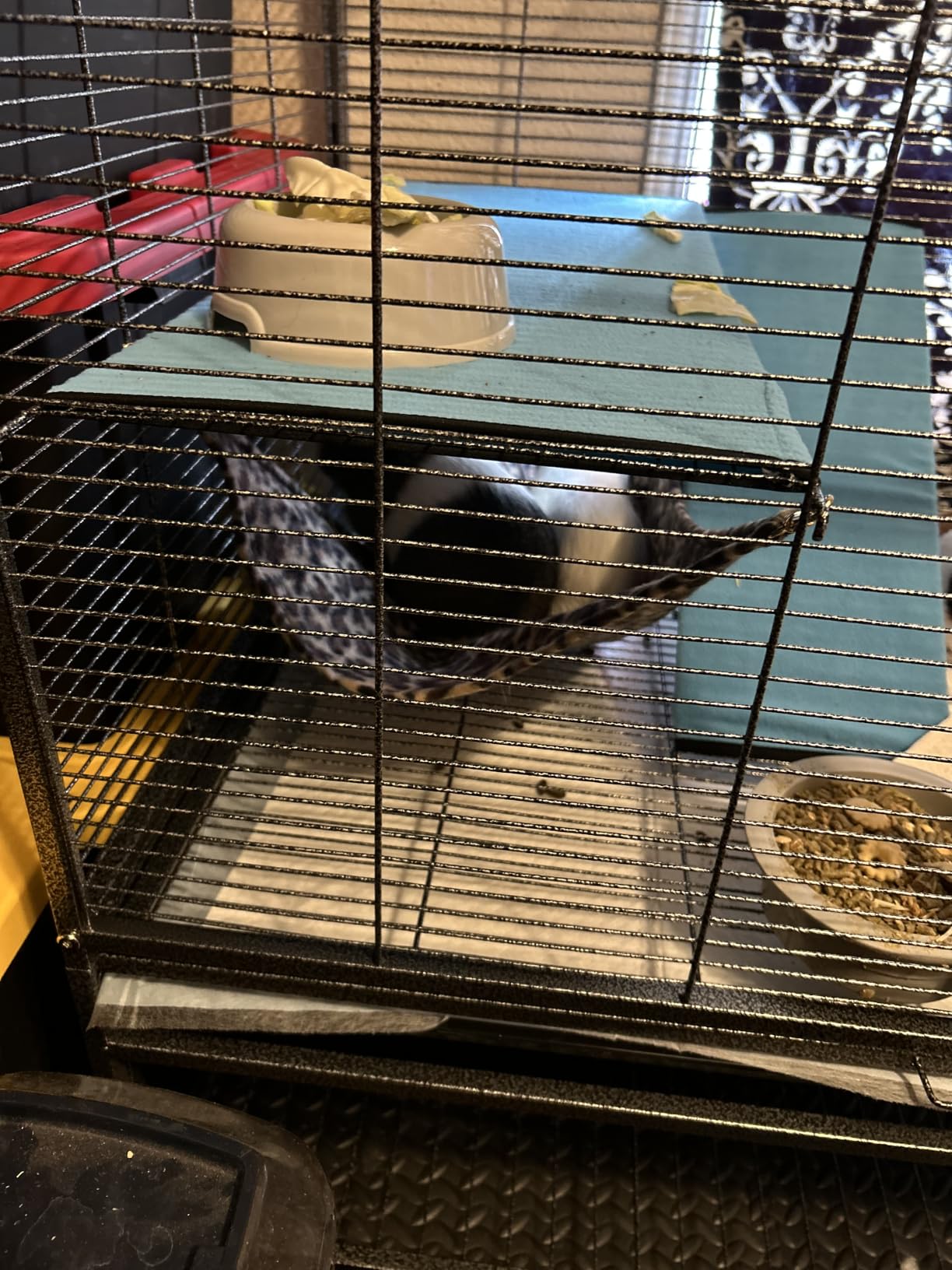
The hammock, water bottle, food bowl, bottom storage shelf and four casters all come as standard. Four rolling casters plus a storage shelf is a good combination in a multi-ferret home, because you can roll the cage back to reach the floor and the shelf holds the liners and bedding.
This is the pick for a second cage rather than a first. In a household with two or more ferrets you need somewhere to put one animal during an introduction or a deep clean, and a 31 x 20 inch two-story unit with tight bars does that job without becoming a second full enclosure competing for floor space.
Who the Mcage Double Unit suits
It suits a household that already has a large cage and needs a proper holding cage alongside it. It also suits anyone who wants a tight-barred two-level cage at a lower outlay than the flagship double units.
The wide doors suit owners who clean thoroughly, and the included covers suit anyone who wants paw protection without buying accessories separately.
Who the Mcage Double Unit does not suit
The bottom tray does not lock into place and can be pried open from inside. That is worth knowing about if the cage is ever used for an unsupervised young ferret, and it is the first thing we would check after assembly.
Owners report assembly instructions that are not always clear, plus the occasional unit arriving with deformed bars or mismatched hardware. Inspect the whole frame before you rely on it.
The Size Rule for Multiple Ferrets
For two ferrets, aim for roughly 36 x 25 inches of footprint spread over at least two levels with bar spacing of 1 inch or less. One ferret needs a 24 x 24 x 18 inch minimum, so a pair needs about double that floor space, plus a second litter tray, a second bed and a second food station.
That is the short version of the arithmetic that governs everything else on this page. The longer version is that you should count usable levels rather than total height, and here is how the numbers work out by ferret count.
How much space does each group of ferrets need?
One ferret: 24 x 24 inches of floor space minimum at 18 inches tall. Two ferrets: about 36 x 25 inches of footprint over two or three levels. Three or four ferrets: a double unit or a large multi-level cage at 36 x 24 inches or wider, with three or more solid-floored levels. Five or more: split the difference, because a single cage that big becomes an obstacle course rather than a habitat, and most experienced owners run two large cages side by side instead.
We have put our own capacity rating against each of these rather than repeating the number on the box. The gap is consistent across the category, and it is usually about one ferret.
Why floor area beats total height
A 24 x 24 inch four-tier tower has roughly the same raw volume as a 36 x 24 inch double unit, but the usable floor area is smaller and the levels are narrower. Two ferrets need to pass each other, each have a corner, and each be able to stretch out asleep without negotiating the same space. A wider base does that more easily than more tiers does.
Height still matters, because ferrets climb, nap off the ground and use vertical space through ramps and platforms. It just is not a substitute for width. When you are comparing two cages and the numbers look similar, measure the base and multiply by the number of solid-floored levels a ferret can actually occupy.
To keep a second piece of kit in mind while you read, the same multi-item logic shows up in our guides to hitch-mounted bike racks for multiple bikes and batting cages for larger groups.
Six Construction Rules Every Multi-Ferret Cage Must Pass
Bar spacing of 1 inch (2.5 cm) or less, solid floors rather than bare wire, ramps with covers, a latch a ferret cannot operate, doors wide enough to clean, and at least two usable levels. If a cage fails any of these six, it does not belong in a multi-ferret home regardless of its footprint.
1. Bar spacing of 1 inch or less
A ferret has a flexible skeleton, which means if the head fits through a gap the body follows. One inch is the ceiling and 1/2 inch is comfortable. Check the measurement rather than the label, because generic small-animal cages are often sold with wider spacing than the listing suggests.
2. Solid floors, not bare wire
Standing on wire for long periods causes sore, cracked and sometimes infected footpads, a condition known as pododermatitis or bumblefoot. Solid plastic trays, plastic grates, tray liners and ramp covers all count as protection. This is the number one construction complaint we found from owners across every price point.
3. Ramps with covers
Ramps are the most-used climbing surface in the cage and the most common place ferrets land awkwardly. Fleece sleeves or fabric covers on every ramp are a small cost that removes a whole category of paw and joint problems.
4. A latch a ferret cannot open
Skip the swivel catch. It pops open under pressure from a determined ferret. Look for a bolt, a clip or a positive sliding lock, and add clips on the doors if the cage ships with anything less. Two ferrets working a latch together is a more effective team than one.
5. Doors wide enough to clean
You will clean the corners, and small doors mean you cannot reach them. A door that lets you get both hands in, or at least a full cleaning hand, saves you from dismantling ramps every week.
6. At least two usable levels
Levels let you separate zones. Put sleep above food and litter, keep the sleeping level away from the tray level, and give each ferret a different end to occupy. One large level is a pen. Two levels is a home.
Two of Everything: Setting Up a Cage for a Pair
Two ferrets sharing one of everything will squabble over it. Give each ferret its own litter tray, sleep spot and food station, and add one more tray on top, which is why multi-ferret owners talk about the two-plus-one rule.
Litter trays
Two minimum, three better. Litter trays go low and in corners on different levels so one ferret is never cornered. The 6 inch deep pans on the Ferplast Tower and the two removable base pans on the Critter Nation both work well for this.
Sleep spots and separation
Two sleep sacks or hammocks on different levels, plus somewhere a ferret can hide completely when it wants to be alone. Two ferrets in one hammock is one of the most reliable squabble triggers we hear about from owners.
Food and water
Two food stations rather than one bowl, and a water bottle plus a bowl because ferrets have a habit of tipping bowls over. Placing stations on more than one level also stops one animal controlling access to everything.
The second cage every multi-ferret household needs
Owners with two or more ferrets keep a second, smaller cage for introductions, deep cleaning and the odd separation. Any of the mid-size three- or four-tier cages in this roundup works, and a pop-up pen or a panel pen covers short holding jobs without taking up floor space. Order the second cage at the same time as the main one; you will use it within the first week.
Cages to Avoid for Multiple Ferrets
Aquariums and glass tanks, wooden cages, tall narrow bird cages, starter cages and any enclosure with bare wire floors will not work for two or more ferrets. Each fails for a specific reason, and none of them is fixable with an accessory.
Aquariums and glass tanks
Ferrets overheat quickly, and a glass tank in a warm room has no ventilation to speak of. Ventilation, not visibility, is what a ferret needs. Glass also means no safe attachment points for ramps or hammocks, so the whole vertical structure has to go.
Wooden cages and wooden bases
Ferrets are diggers and urine is acidic. Wood absorbs, stains and eventually rots, and there is no way to disinfect it properly. Solid plastic or coated metal only.
Tall narrow bird cages
Height with a tiny base gives climbing room but almost no floor space, and bird cage bar spacing is usually far too wide. This is the single most common mistake in our view, because it looks like a tall cage and therefore seems generous.
Starter cages
A cage marketed for one small animal gives one ferret the minimum, not two ferrets a fair share. If you are housing two, the floor area has to roughly double.
Bare wire floor towers
Vertical space is not an excuse for wire floors. Any tower in this roundup can be made acceptable with ramp covers, liners and solid trays. One with no solid surface anywhere cannot.
Heat, Placement and Cleaning
Keep the enclosure below 80F (27C), ideally between 60 and 75F, and place it out of direct sun, away from radiators, and never in a conservatory or against a sunny window. Then clean it daily, not weekly.
Where to put the cage
Avoid direct sunlight, drafts, radiators, and busy or noisy corners. Leave a gap between the cage and the wall so a ferret cannot climb the bars and up over the top, and keep it somewhere you can check on the animals without waking them. The same multi-item thinking behind laundry sorters with multiple bins applies: the unit has to fit the space you actually have.
Recognising heat stress
Ferrets overheat fast. Excessive panting, lethargy, drooling, lying flat on a cool surface and a hot or dry nose are all warning signs. If you see them, move the cage to a cooler room immediately and cool the animal gradually. Heatstroke is one of the most common causes of death in ferrets, which is why a glass tank in a sunny room is a serious problem rather than a style choice.
The cleaning routine for two ferrets
Scoop litter daily, wipe pans daily, and do a full clean weekly with the trays and shelves removed. Line the pans with washable liners instead of pouring loose bedding in, which keeps debris out of the corners and off the level below. With two ferrets the litter volume roughly doubles, so a cage with pull-out trays and wide doors will save you real time every week.
How We Picked and What We Checked Before Buying a Secondhand Cage
We rated every cage on six things: footprint multiplied by usable solid-floored levels, verified bar spacing, whether the floors and ramps are covered, whether the latch resists a ferret, door size for cleaning, and the volume of long-term owner feedback. A cage that scores well on five and badly on bar spacing does not make the list, because an escape is not recoverable.
A used cage is a genuinely good buy in this category, because the main cages here are built to last decades. What you need is a checklist, because the wear that matters is not always visible in a photograph.
The secondhand cage inspection checklist
Check the bar spacing with a tape measure rather than trusting the listing, and look along every horizontal bar for dents or gaps where the coating has flaked. Push gently on each panel: any play in the frame means a ferret will find it. Inspect every ramp and its fixings, because a loose ramp is the most common failure on a used multi-level cage. Look for rust, particularly at the base where pans sit on wet litter, and check the door hardware closes fully with a positive catch rather than a spring-loaded swivel. Finally, count the parts against the manual. Missing casters, clips or shelves are the usual reason a used cage feels wrong once assembled.
Anything with rust at the frame joints, bent bars or missing hardware is a walking hazard and is rarely worth fixing. Missing trays, covers and clips are cheap to replace, and a fresh set of fleece ramp covers solves most of the comfort complaints owners report on older units.
What we do not count
Print capacity claims, glossy accessory bundles and overall height do not tell you whether a cage works for two ferrets. Usable floor area, bar spacing and paw-safe surfaces do. That is why our capacity ratings run about one ferret lower than the boxes do.
Frequently Asked Questions
What size cage for 2 ferrets?
For two ferrets, aim for roughly 36 x 25 inches of footprint spread over at least two or three levels. One ferret needs a 24 x 24 x 18 inch minimum, so a pair needs about double that floor space. Bar spacing must be 1 inch (2.5 cm) or less, floors should be solid rather than wire, and ramps should have covers.
How much space does a ferret need in a cage?
A single ferret needs a minimum of 24 x 24 x 18 inches (60 x 60 x 45 cm) of usable space, and that is a floor, not a suggestion. Count usable levels rather than raw height: multiply the base footprint by the number of solid-floored levels your ferret can actually occupy. Manufacturers typically advertise capacity about one ferret higher than the cage comfortably holds.
How many hours a day should a ferret be out of its cage?
At least 4 hours every single day, and more is better. Ferrets sleep 16 to 18 hours in a 24-hour period, so a cage is a secure base and sleeping area rather than a home. No cage size replaces out-time, which is why a playpen or a ferret-proofed room matters as much as the enclosure you buy.
What kind of cage does a ferret need?
A multi-level enclosure made of coated metal wire with solid plastic floors, bar spacing of 1 inch or less, ramps with covers, a ferret-proof latch, wide doors and at least two usable levels. Avoid glass tanks, wooden cages, bird cages and anything with bare wire floors. For two ferrets, add a second litter tray, bed and food station so they never have to share.
Can two ferrets live in the same cage?
Yes, and they generally should, because ferrets are social animals that benefit from a companion. Give each ferret its own litter tray, sleep spot and food station, and add one extra litter tray on top. Without that duplication, competition over a single hammock, tray or bowl is one of the most common causes of friction between a bonded pair.
Are ferrets better alone or in pairs?
Pairs are usually better, provided both animals are neutered and introduced properly. Ferrets are social and single housing for long periods leaves many without stimulation. The exceptions are animals that cannot be safely bonded and very young ferrets under about eight weeks, who should still be with their littermates. Keep a second small cage on hand for introductions and temporary separation.
Conclusion
The best ferret cages for multiple ferrets are the ones that give you a wide base, two or more usable levels, bar spacing under an inch, solid floors with covered ramps, and a latch that survives two determined animals. On that basis, the Prevue 485 Feisty Ferret Home is our first pick for most homes, the Critter Nation Double Unit is the one to buy when you have the floor space and want the tightest bars, and the Yaheetech six-tier is the cheapest route to real vertical room.
Whatever you choose, measure your floor space before you order, buy the second cage at the same time, and remember that 4 hours of daily out-time is part of the requirement, not a bonus. Use the 2026 buying guide above to check each cage against the six construction rules, and buy the largest one that genuinely fits your room.