
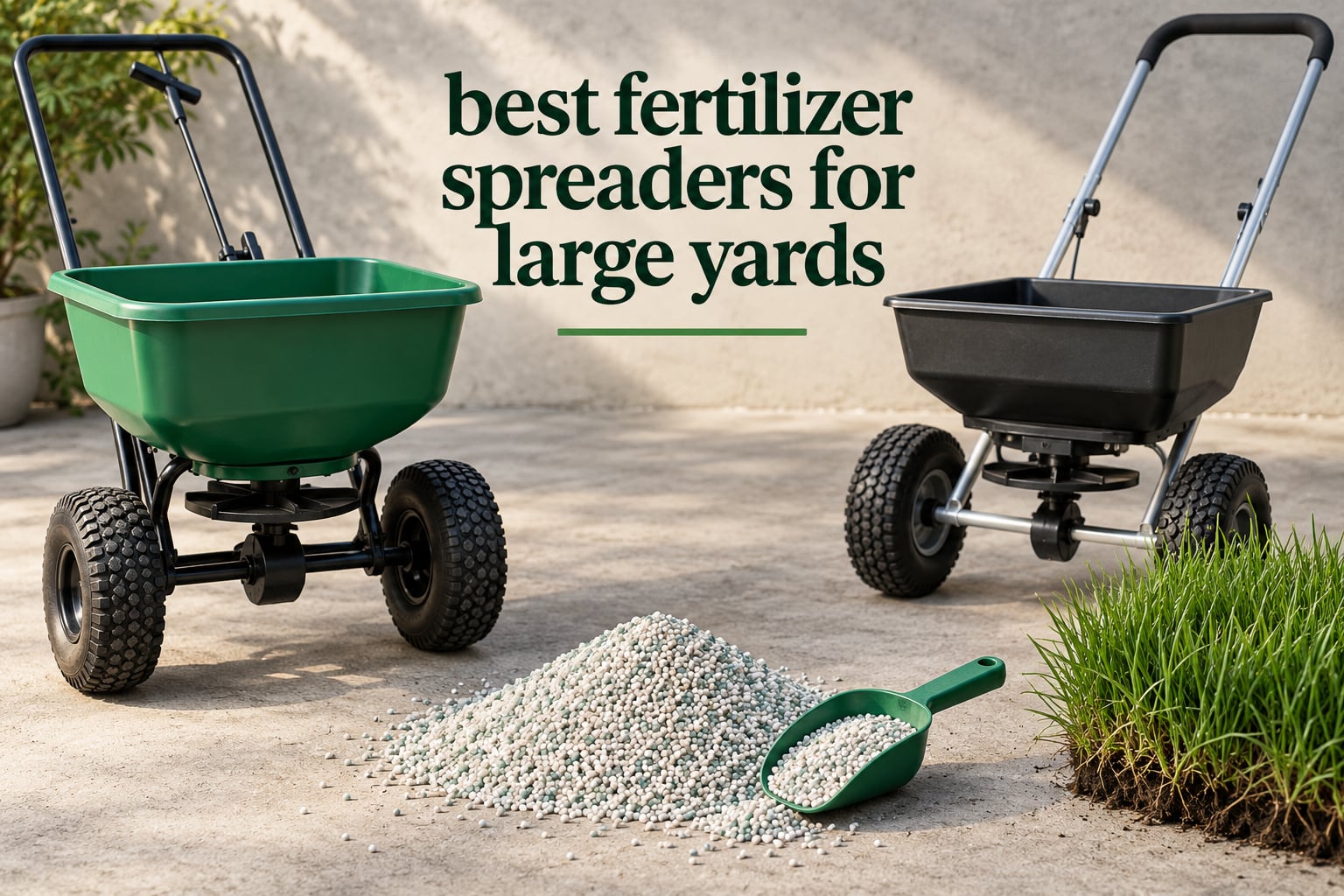
A yard of real size changes the spreader problem completely. On a small lawn, a light plastic hopper and a flick of the wrist get the job done in an afternoon. On a large property, the same approach turns into a full weekend of stopping, lifting, refilling and second-guessing whether the last pass matched the first one.
That is why the best fertilizer spreaders for large yards are not simply the highest rated ones. They are the machines that hold enough material to cover a quarter acre or more per load, cast a pattern wide enough to cut your pass count, and roll over uneven ground without fighting you the whole way. We compared 12 walk-behind, tow-behind, ATV and UTV spreaders across hopper capacity, spread width, tire type, flow control and build quality to find the ones that actually suit acreage.
Our team spent several weeks moving these machines across sloped, uneven turf with dry fertilizer, coarse seed and ice melt, tracking refill stops and how long a full property takes. What follows is the short version: which spreader suits which yard, what each one costs you in setup time, and where the cheap options fall apart. If your property is measured in acres rather than square feet, this guide should save you a season of frustration.
Table of Contents
Top 3 Spreader Picks for Large Yards in 2026
Before the full list, these three cover the most common large-yard situations. One is built for acreage behind a tractor, one is the best balance of capacity and convenience for a residential property, and one is the commercial-grade walk-behind that lawn care crews reach for.

Agri-Fab 130 lb Tow Behind
- 130 lb hopper covers 25000 sq ft per load
- Adjustable 10 to 12 ft spread width
- 13 in by 4 in pneumatic tires
- Enclosed gear house with steel frame

Scotts EdgeGuard DLX
- 15
- 000 sq ft hopper capacity
- EdgeGuard side shield
- Pre-calibrated with no assembly
- Light 10.9 lb frame

Agri-Fab 130 lb Push
- 130 lb hopper covering a half acre
- 10 to 12 ft spread width
- 13 in pneumatic tires
- Direct rod flow control
All 12 Fertilizer Spreaders at a Glance
This table covers every spreader in the guide with its capacity, spread width and tire type. Use it to narrow the field, then read the individual reviews for the details on calibration, assembly and durability.
| Product | Specifications | Action |
|---|---|---|
| Agri-Fab 130 lb Tow Behind Broadcast Spreader |
|
Check Latest Price |
| Scotts Turf Builder EdgeGuard DLX Broadcast Spreader |
|
Check Latest Price |
 Buyers Products ATVS100 ATV Rear Rack Spreader Buyers Products ATVS100 ATV Rear Rack Spreader |
|
Check Latest Price |
| Agri-Fab 130 lb Push Broadcast Spreader |
|
Check Latest Price |
 VEVOR 100 lb Walk-Behind Broadcast Spreader VEVOR 100 lb Walk-Behind Broadcast Spreader |
|
Check Latest Price |
 EarthWay 2150 Commercial 50 lb Broadcast Spreader EarthWay 2150 Commercial 50 lb Broadcast Spreader |
|
Check Latest Price |
 Agri-Fab 175 lb Tow Behind Drop Spreader Agri-Fab 175 lb Tow Behind Drop Spreader |
|
Check Latest Price |
 Buyers Products UTVS16 150 lb UTV Spreader Buyers Products UTVS16 150 lb UTV Spreader |
|
Check Latest Price |
 Brinly P20-500BHDF-A Push Spreader Brinly P20-500BHDF-A Push Spreader |
|
Check Latest Price |
 Yard Commander 80 LB ATV and UTV Spreader Yard Commander 80 LB ATV and UTV Spreader |
|
Check Latest Price |
 CHAPIN 8400C 100 lb Professional Turf Spreader CHAPIN 8400C 100 lb Professional Turf Spreader |
|
Check Latest Price |
 EarthWay 2170 Commercial 100 LB Spreader EarthWay 2170 Commercial 100 LB Spreader |
|
Check Latest Price |
1. Agri-Fab 130 lb Tow Behind Broadcast Spreader
- One load covers a half acre at 25000 sq ft
- Adjustable 10 to 12 ft spread pattern
- Enclosed gear house with steel tubing frame
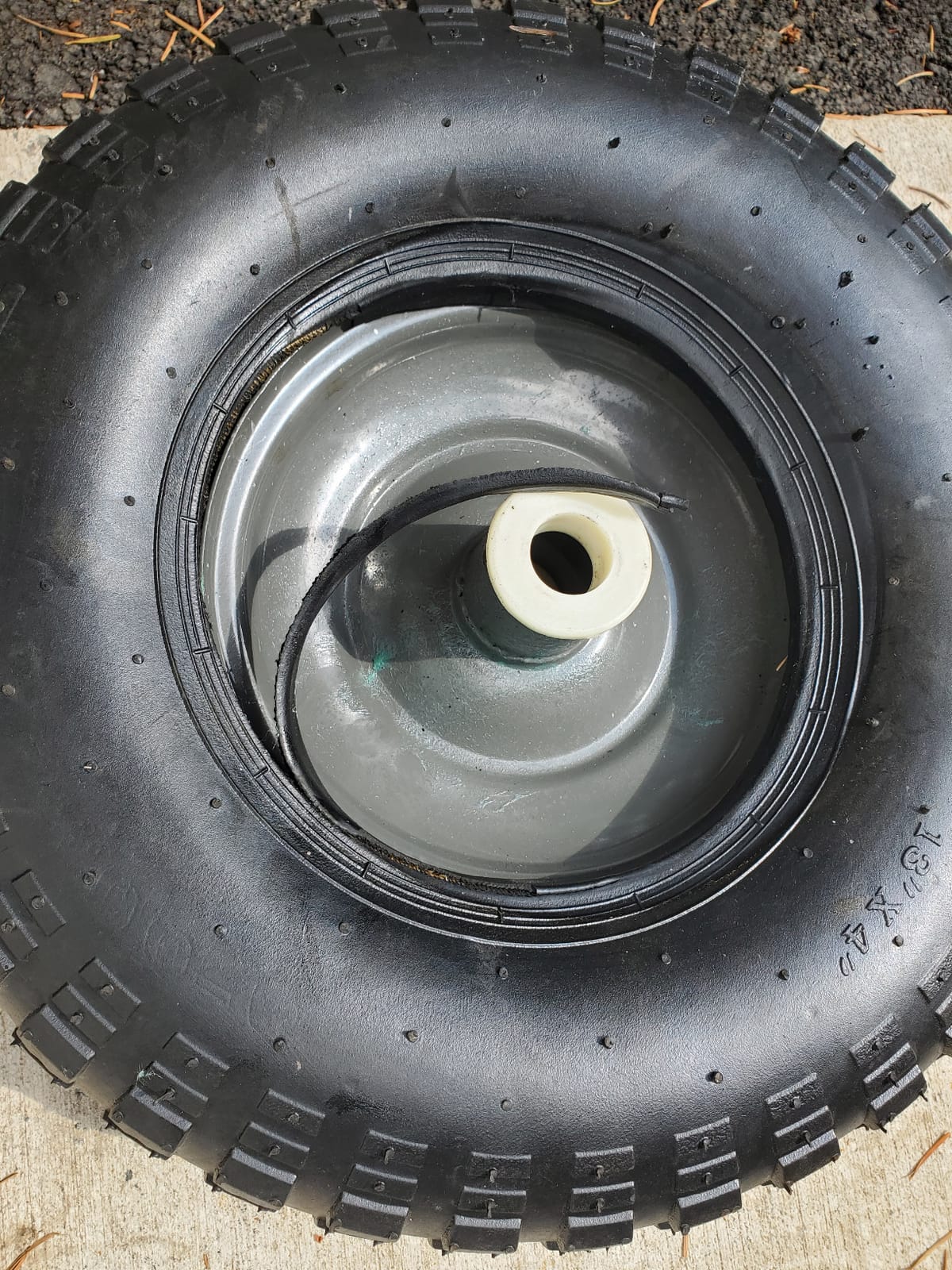
- 13 in by 4 in pneumatic tires roll over uneven ground
- Three-year limited warranty
- 29.4 lb empty weight is awkward to move by hand
- Needs a riding mower or tractor to be efficient
This is the spreader we kept reaching for once a job moved past a quarter acre. The 130 lb hopper holds a half acre of material per load, which means one refill rather than three on a property of that size. It hitched to a riding mower without any adapter fuss and towed straight behind at walking pace.
The spread width adjusts between 10 and 12 feet, so you can open the pattern up on open turf and tighten it as you approach a garden bed. Over a flat half acre we finished in well under an hour with a full load, and the pattern stayed even from one end of the pass to the other.
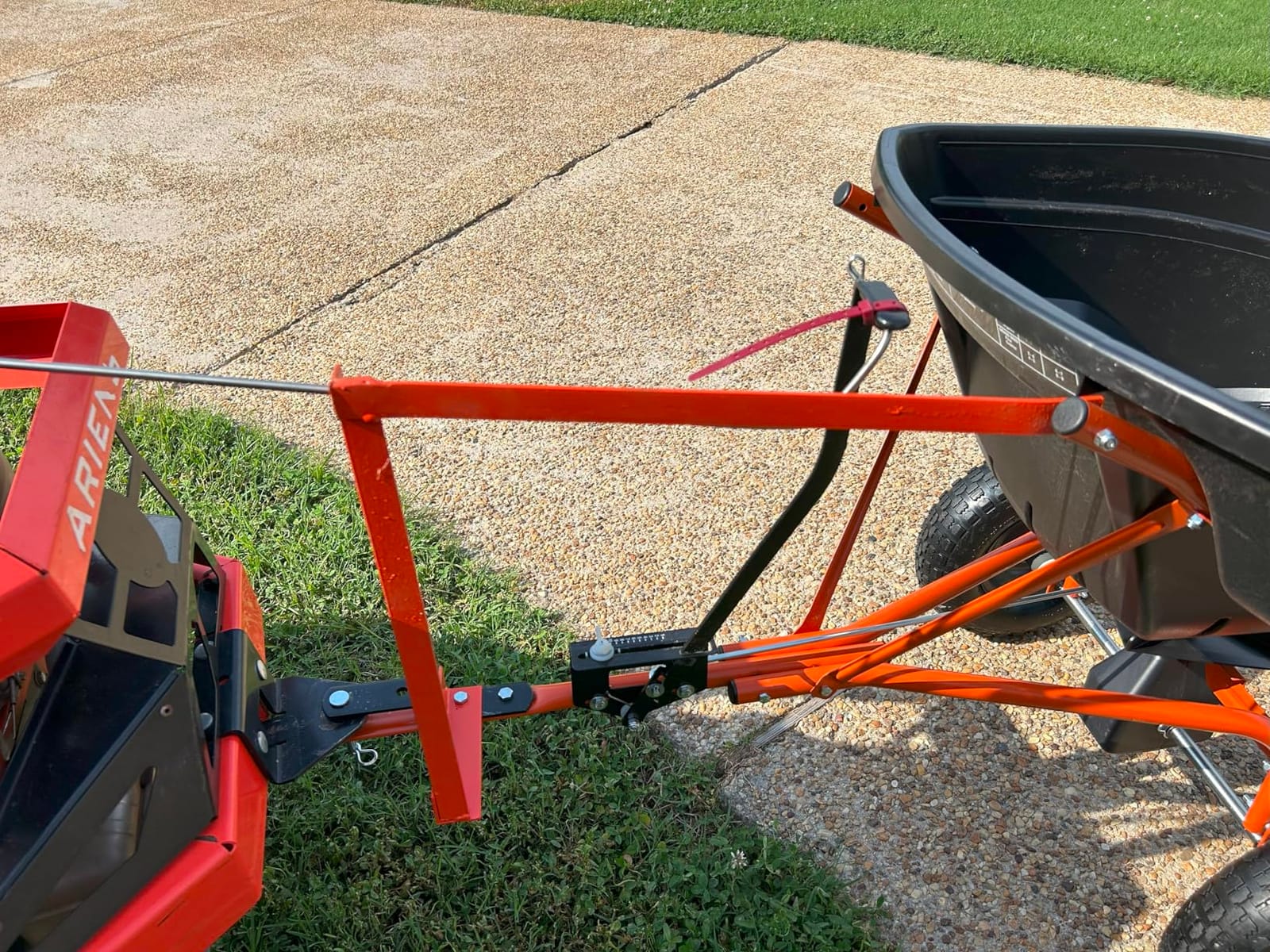
Build quality is where this one separates itself from the plastic shelf models. The frame is steel tubing, the hopper is molded poly, and the gear housing is fully enclosed, which matters when you are working near damp grass or catching stray moisture off the ground. The 13 inch by 4 inch pneumatic tires float over ruts and tree roots instead of skipping.
Owners on lawn care forums consistently call the enclosed gear house and the pneumatic tires the two features that decide it for them, and that matches what we saw. A cheaper spreader with small hard wheels is miserable on the same property, because you spend more time correcting the bounce than spreading.
What acreage it handles well
This is the pick for anything from about a third of an acre up to a full acre, as long as you have a riding mower or lawn tractor to pull it. One load per half acre means your stops are planned, not improvised.
It also handles every material we threw at it: dry fertilizer, coarse seed, salt and ice melt. Owners on lawn forums mention the 130 lb capacity as the reason they replaced a smaller push spreader that spent its life refilling.
Where it falls short
It is not a walk-behind machine, despite the tow-behind format. At 29.4 lb empty you can technically drag it by hand, but on any slope you will want the tractor. Budget for that requirement before you buy.
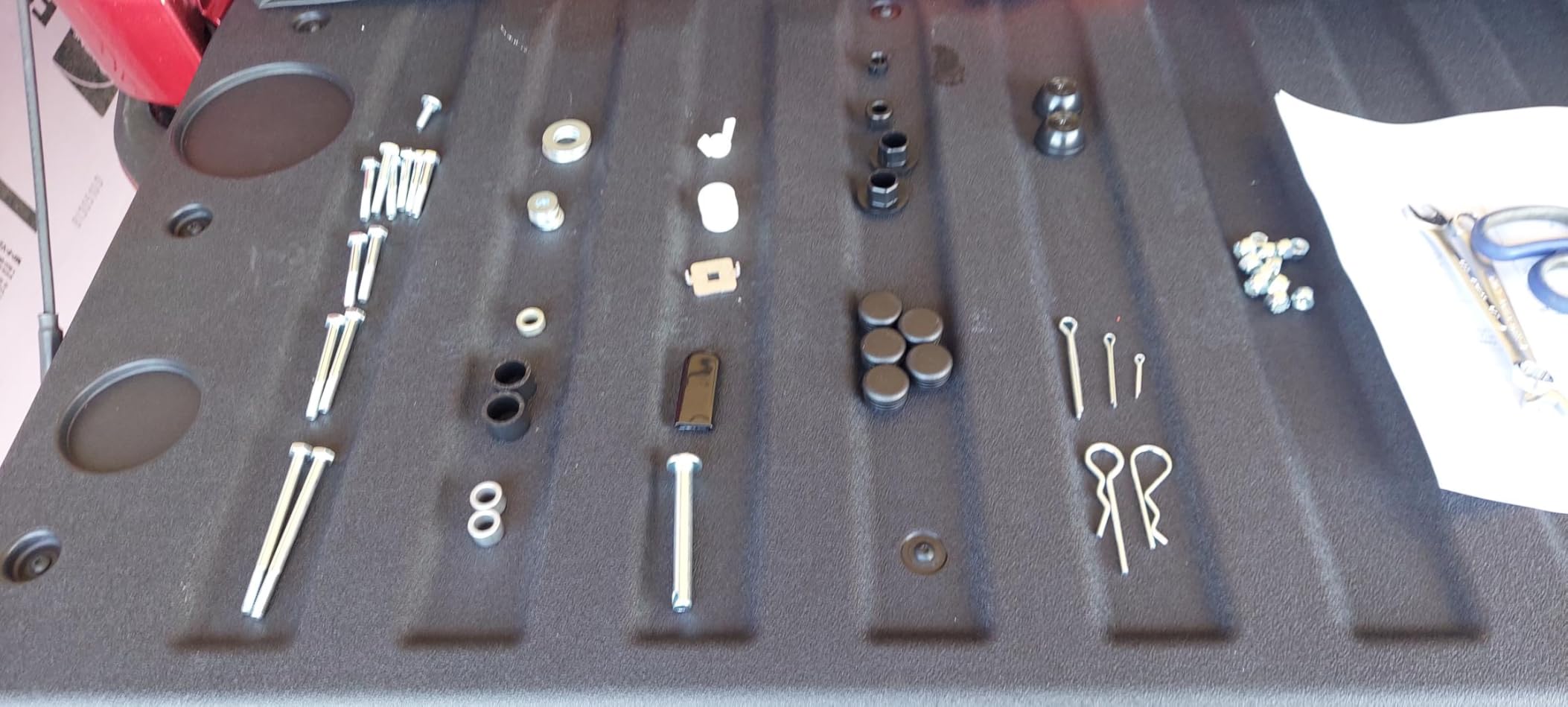
The adjustable pattern also needs a few passes to dial in, and owners report spending time on assembly and calibration the first afternoon. That is a fair trade for a machine that will still be running years from now.
2. Scotts Turf Builder EdgeGuard DLX Broadcast Spreader
- 15000 sq ft per load in a walk-behind class
- Pre-calibrated so there is nothing to assemble
- EdgeGuard shield keeps granules off hardscape
- Light 10.9 lb frame is easy to push
- Most reviewed spreader in the group
- Refills add up on yards past a quarter acre
- Lighter build wears faster than commercial units
The most reviewed spreader in this group, and for good reason: it does not require assembly. You pull it out of the box, set the dial, and it is already calibrated for standard fertilizer rates. On a large yard that matters, because setup time is time you are not spreading.
Capacity is 15,000 sq ft, which covers a good chunk of a half-acre property in a single load. The hopper and agitator are shaped to keep product moving smoothly toward the opening, so you get consistent output rather than a heavy start and a light finish.
The EdgeGuard side shield is the feature that gets the most praise from owners with borders. It narrows the pattern on the side nearest the edging, which means far less material on your driveway, walkway and garden beds. On a big property with a lot of hard edges, that saves a cleanup job after every application.
At 10.9 lb it is the easiest machine here to push uphill, and the year-round design means the same hopper handles seed in spring, fertilizer through summer and ice melt in winter. More than 6500 reviews reflect a unit that simply keeps working.
Who should buy this one
If your property sits between 5,000 and 20,000 sq ft and you have no tractor, this is the most sensible choice in the lineup. The coverage per load is the largest in the walk-behind class we tested, and the zero-setup design removes the most common complaint new owners have.
It is also the best option for anyone who wants one machine for every season rather than a dedicated winter spreader. The hopper, agitator and gate all handle salt and ice melt without modification.
Where it falls short
Push it past a quarter acre and the refill count starts to bite. A half acre means two loads at minimum, and a full acre means four, each one a walk back to the bag with a heavy hopper.
The lighter plastic construction also wears faster than the steel and commercial units here. Owners on lawn forums note that the spread plate and frame feel fine for a few seasons but do not match the longevity of a pro machine, so plan on a replacement timeline rather than a permanent purchase.
3. Buyers Products ATVS100 ATV Rear Rack Spreader
Buyers Products ATVS100 100 lb ATV Rear Rack Mount Broadcast Spreader
- 30 ft broadcast path covers acreage fast from an ATV
- Rustproof polyethylene hopper with a rain cover
- 18 lb unit is easy to load onto a rack
- Limited lifetime warranty
- Handles seed
- fertilizer
- feed
- salt and ice melt
- Manual feed gate needs a hand off the handlebar
- No powered agitator so damp material can bridge
If you already ride an ATV, this machine removes the walking from the equation entirely. A 30 foot broadcast path means you cover ground roughly four times faster than a 10 foot walk-behind pattern, and you are not pushing a loaded hopper across rough turf.
It mounts to a rear utility rack with basic hardware, and at 18 lb it is light enough to lift onto the rack without help. The 100 lb polyethylene hopper is rustproof, which is the right material for salt and ice melt season.
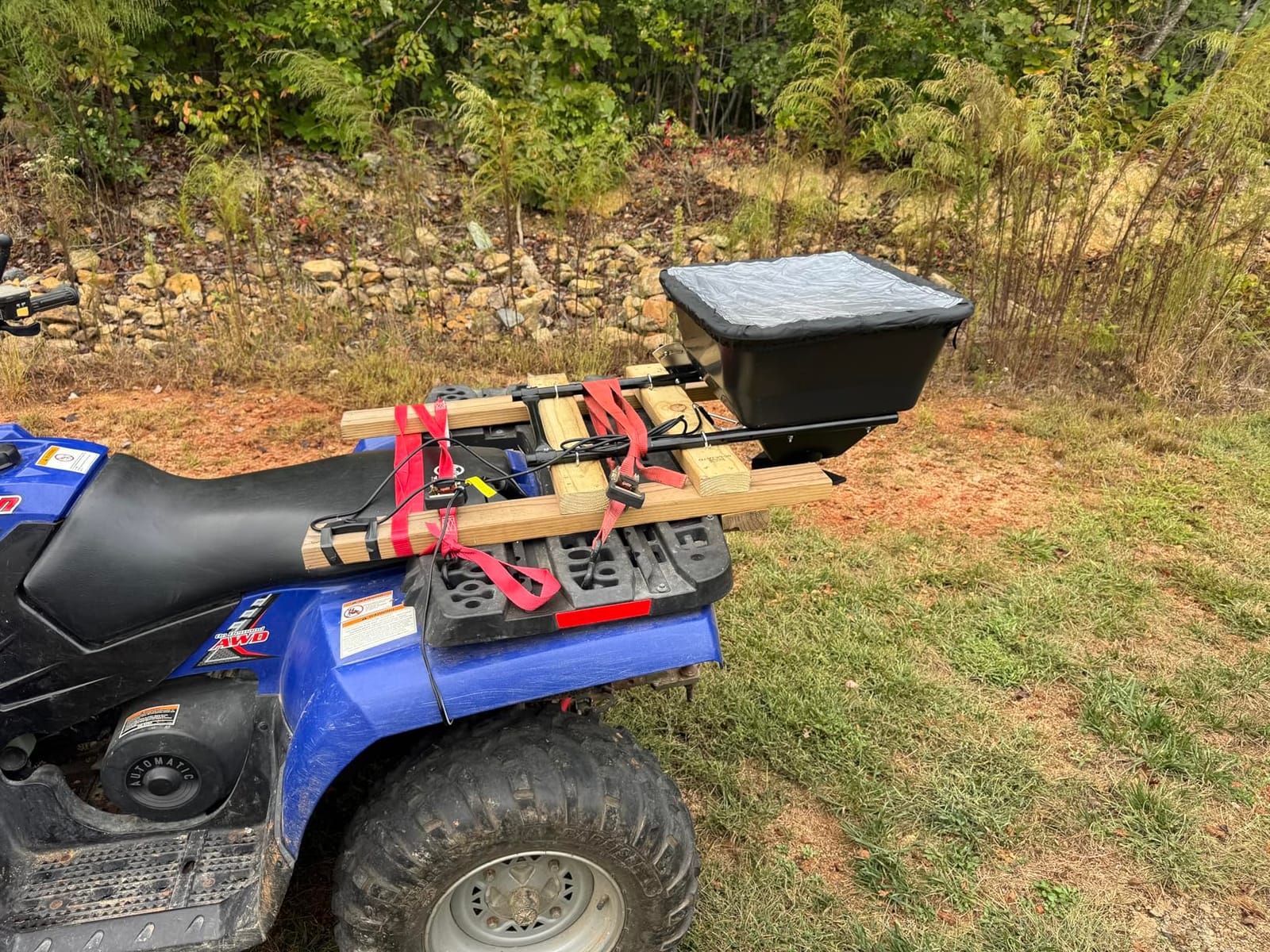
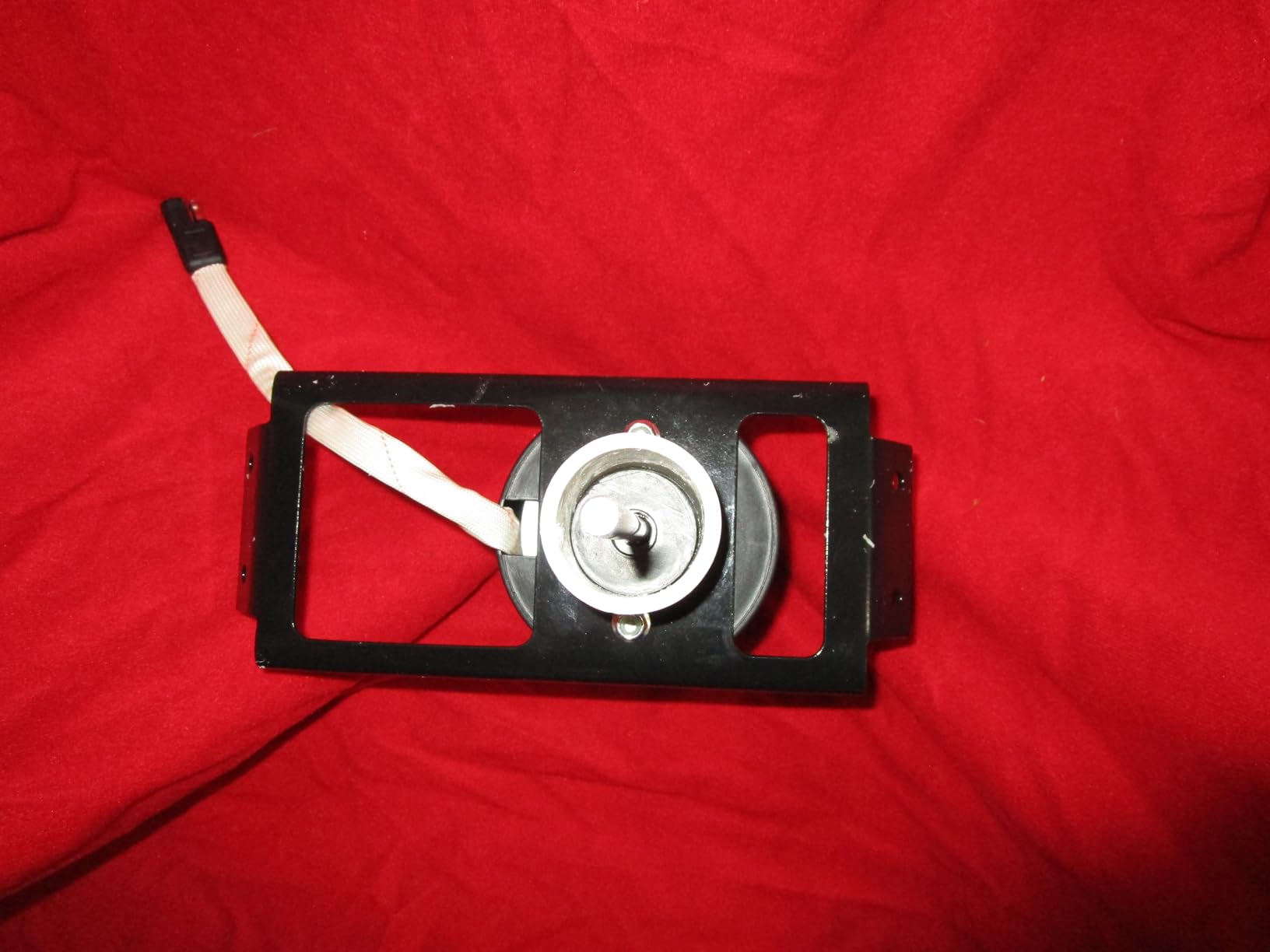
The enclosed 12V motor drives the impeller, and the broadcast width is generous for a rack-mounted unit. Owners using it on larger properties report finishing multi-acre jobs in a fraction of the time a walk-behind requires.
A rain cover is included, which is unusual at this capacity and genuinely useful. A surprise shower on a full hopper of fertilizer is a real problem, and the cover removes that risk entirely.
Where an ATV spreader wins
Rough ground is the deciding factor. A tow-behind needs a smooth path behind a tractor, while an ATV handles ditches, tree lines and uneven pasture that a spreader on wheels would fight. The broad pattern is also the fastest option per acre we tested in this group.
This suits properties where the lawn is really part of a larger plot, or where you want to avoid driving a tractor onto wet turf in spring.
Where it falls short
Flow control is manual, which means reaching back to the gate while riding. That is awkward at speed and it is the most common complaint among owners. Plan your rate before the pass rather than adjusting mid-lawn.
There is also no powered agitator, so damp or clumped material can bridge in the hopper and stop feeding. Keep product dry and covered between applications, and the flow stays consistent.
4. Agri-Fab 130 lb Push Broadcast Spreader
Agri-Fab 45-0462 Push Broadcast Spreader,Orange & Black,130-lb Capacity
- Pneumatic tires roll easily on hills and uneven turf
- Direct rod control gives repeatable settings
- One load covers 25000 sq ft
- Metal gear box is simple to service and grease
- Assembly typically takes 1.5 to 2 hours
- No side deflector so material can hit your legs
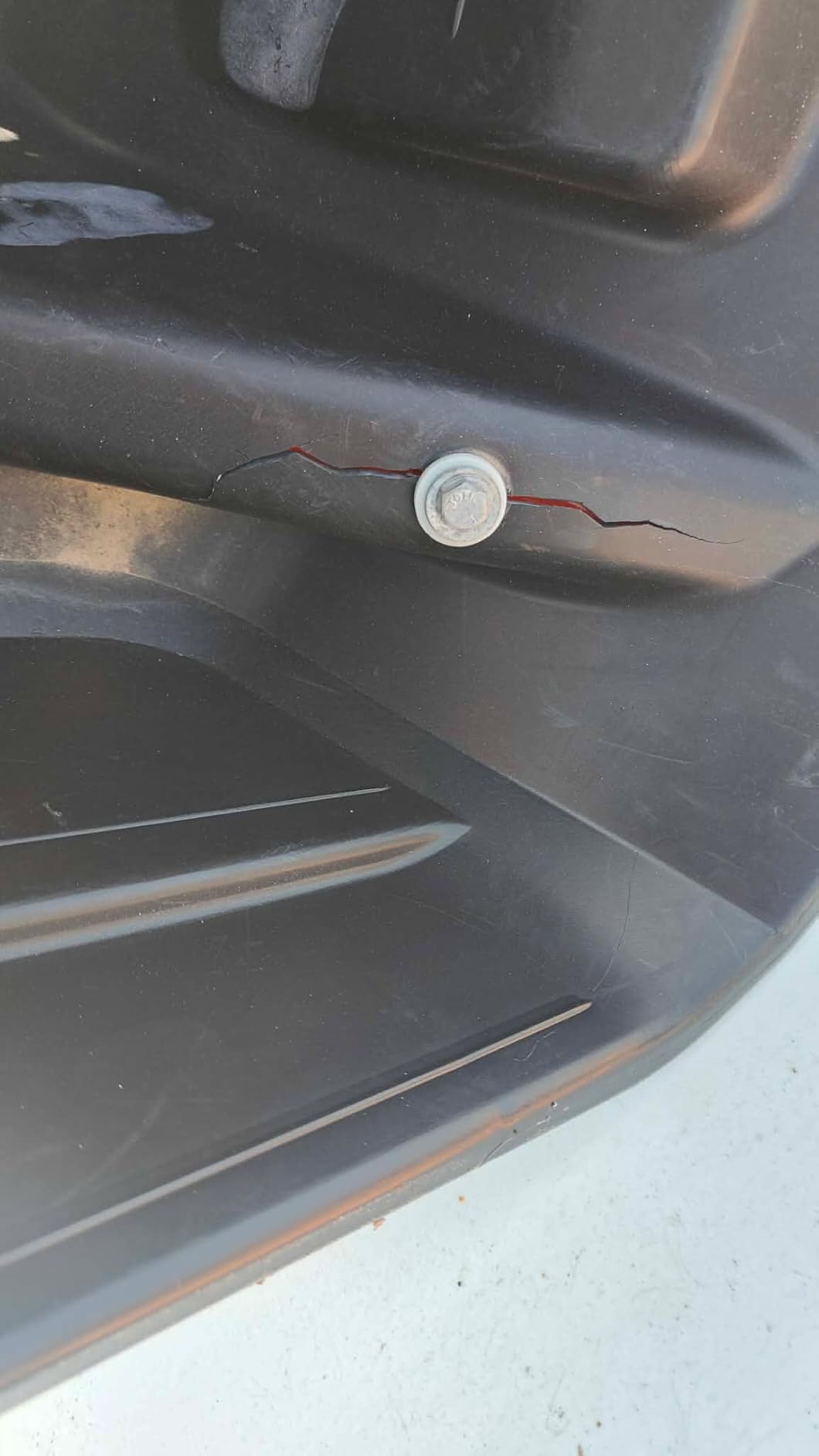
- Hopper joint and flow plate can crack after several seasons
This is the walk-behind answer for a large yard, and it is the one we recommend when you want tractor-grade capacity without a tractor. The 130 lb hopper covers a full half acre per load, matching the tow-behind on volume while keeping you on your feet.
The 13 inch pneumatic tires are the real story on a large property. Compared with the small hard plastic wheels on lighter spreaders, they roll over uneven ground instead of catching and deflecting, which is what keeps the pattern consistent on rough turf.
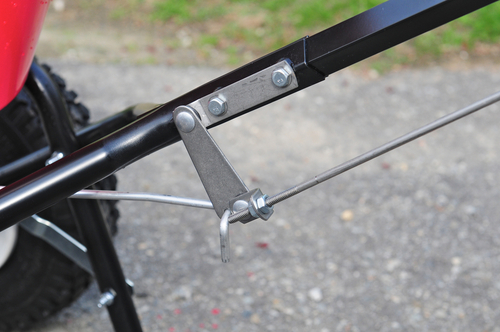
Direct rod control replaces the cable mechanisms used on cheaper models. Rods do not stretch, so the setting you calibrate stays the setting you get six months later. On a big lawn where you might apply different rates in different areas, that repeatability is worth a lot.
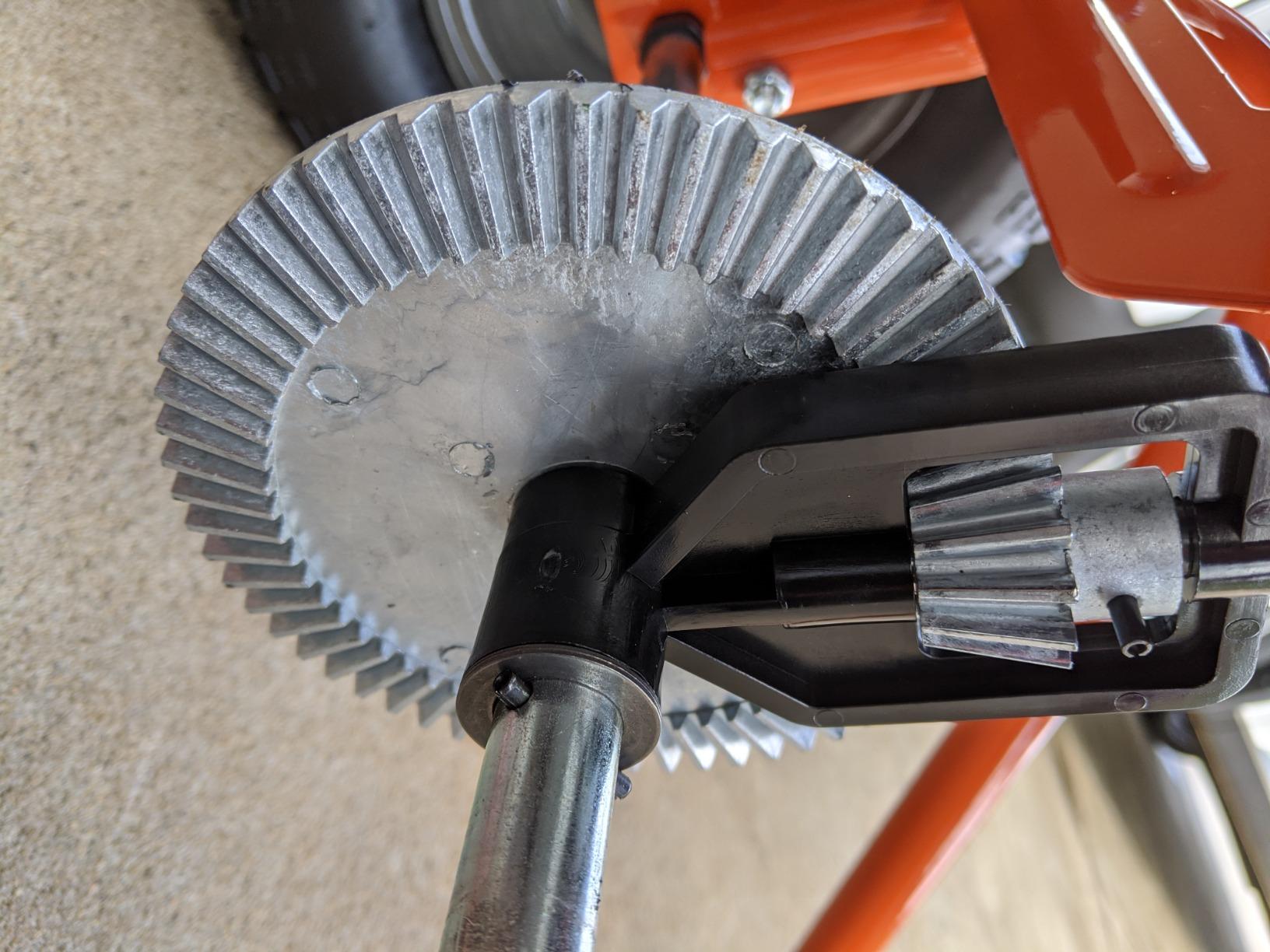
The metal gear box is enclosed and easy to grease, which extends its life considerably compared with an exposed plastic housing. Owners rate it as a clear step up from big-box spreaders, with the durability difference showing up after a few seasons of use.
Why walk-behind still makes sense
On a half acre with no tow vehicle, pushing beats towing. You get the same per-load coverage as the tow-behind model, you keep full control of your speed near plantings, and you avoid pulling a tractor across soft spring turf.
The direct rod control also makes it a good machine for properties with two distinct zones, such as a lawn that needs a lighter rate than a garden area, because the setting holds between passes.
Where it falls short
Assembly is the biggest hurdle. Owners report one and a half to two hours for the first build, so set aside an afternoon before you need it. It is a one-time cost of ownership, not a recurring one.
There is no side deflector on this model, so material can throw back toward your legs near the edges. Also be aware that some owners have reported cracking at the hopper-to-frame joint and flow plate after several seasons of heavy use, so inspect those areas periodically.
5. VEVOR 100 lb Walk-Behind Broadcast Spreader
- 100 lb capacity in a mid-range build
- 13 in all-terrain tires handle uneven large-property terrain
- 30-scale adjustment gives finer flow control
- Sealed gearbox and powder-coated frame
- Assembly is still required
- Illustrated instructions are confusing for first-time builders
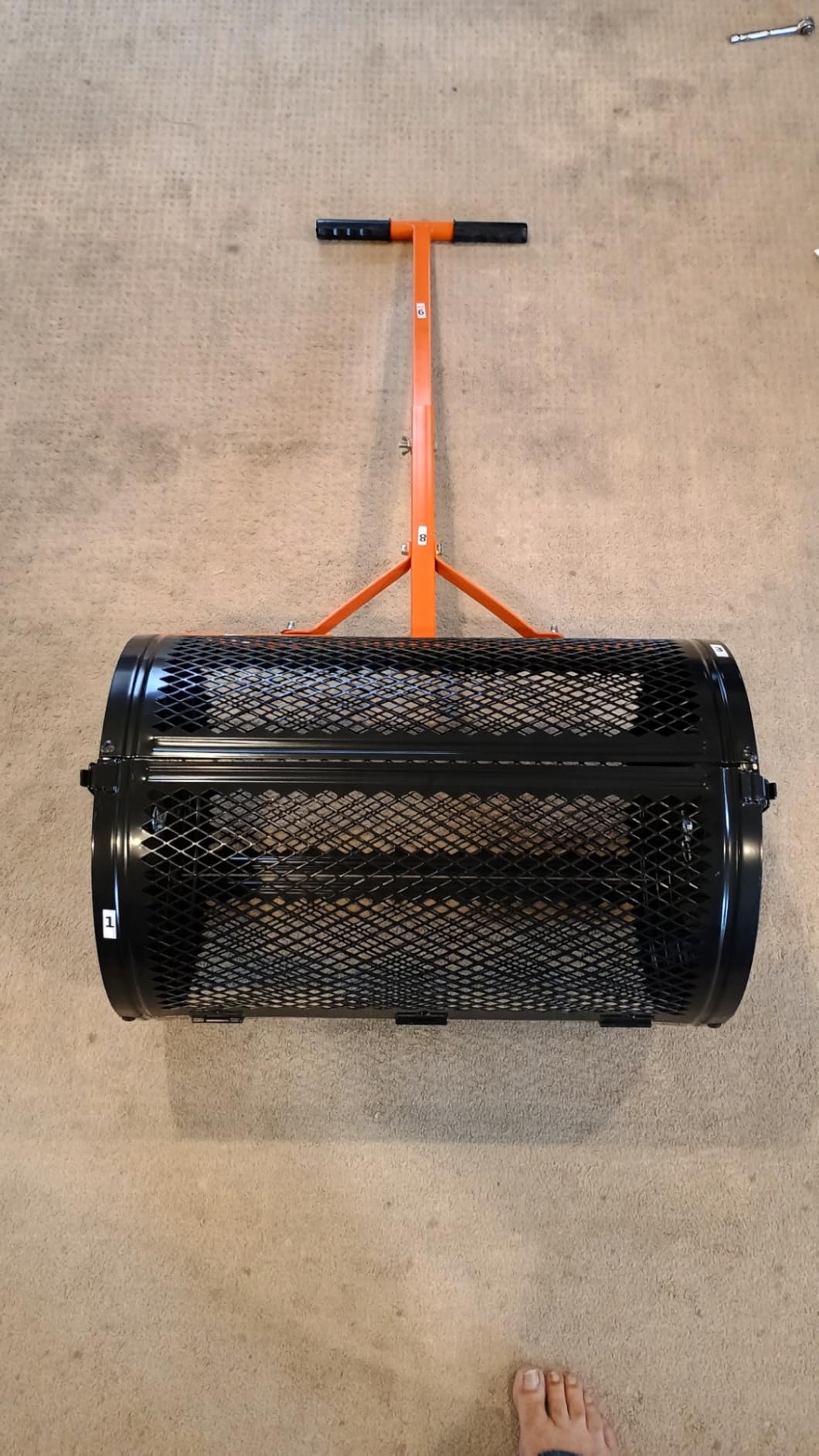
The 100 lb and 56 liter hopper sits in the middle of the capacity range, which makes it a practical middle ground for properties around a third of an acre. You get large-hopper convenience without the size and weight of a 175 lb machine.
The spread width is adjustable from 0 to 9.8 feet, widening as you push faster. That range is useful on a large yard because you can open the pattern on the open middle and pull it in tight for the perimeter passes.
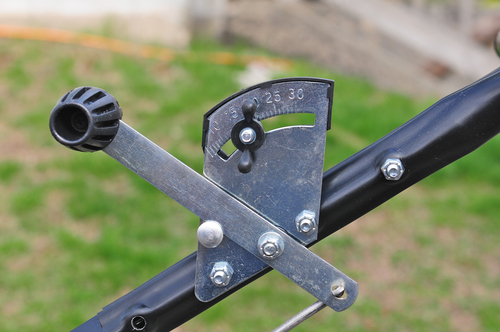
The 30-scale infinite adjustment on the flow control is more granular than most machines at this capacity. Finer increments mean you can hit a specific rate without a lot of trial and error, and owners consistently mention flow control as the upgrade they notice first.
The powder-coated carbon steel frame and sealed gearbox are built for moisture, which matters if you are spreading on dewy grass or catching a passing shower. The 13 inch anti-slip all-terrain tires handled the uneven sections of our test property without deflection.
Who this suits
This is the pick for someone who wants a large hopper and precise flow control without stepping up to a commercial frame. It handles seed, fertilizer, salt and ice melt, and the included hopper grate keeps larger chunks from reaching the impeller.
Owners who upgraded from a small plastic spreader tell us the capacity-to-build balance is what sold them, and the key components ship pre-installed to shorten the build.
Where it falls short
Assembly is still required, and the hand-drawn style instructions are genuinely confusing if you have never built a spreader before. Budget extra time and follow the parts layout rather than the diagrams.
The 9.8 foot maximum width is narrower than the 12 foot machines here, so on open acreage you will need more passes. On a large property that difference adds up quickly.
6. EarthWay 2150 Commercial 50 lb Broadcast Spreader
- Very even spread pattern around 9 to 10 ft
- Pneumatic stud tires make a full load easy to push uphill
- Slide-in grate breaks up damp clumps
- Steel control rod stays accurate
- Written instructions are poor and assembly runs 1.5 to 2.5 hours
- Some material remains in the hopper at the end of a pass
- 50 lb hopper is small next to 100 and 130 lb models
The EarthWay 2150 is the machine owners on lawn forums name most often when durability comes up, and the pattern it lays down is the most consistent we tested. Around 9 to 10 feet wide and noticeably even across the full width, which is exactly what you want on a big property.
Capacity is 50 lb, the smallest hopper among the walk-behinds here, so this is not the machine to cover multiple acres without refilling. What it does offer is a fully enclosed gearbox rated for damp conditions and high-flotation pneumatic stud tires that stay planted on a slope.
The clog-free slide-in hopper grate separates large chunks before they reach the impeller. On a large yard that spread material sits in the open for a while, and the grate is the difference between an even pass and a stop every few rows.
The three-hole drop system with side-spread control lets you feather the pattern along edges, spreading forward and to one side only. That is a genuine advantage on a property with long borders rather than simple rectangles.
Where the commercial build shows
Everything on this machine is chosen for service life. The gearbox is fully enclosed, the control is a steel rod rather than a cable, and the handle adjusts to your height. Owners report it still working after seasons of commercial-style use.
If your large yard has meaningful slope, the high-flotation tires are the deciding factor. Pushing a full hopper uphill on these is manageable in a way it simply is not on small hard wheels.
Where it falls short
Assembly and documentation are the weak points. Owners consistently report one and a half to two and a half hours for the first build with poor written instructions, so plan for that. The side-spread lever and hopper cover are not always included, which is worth checking when your unit arrives.
The 50 lb hopper is genuinely small next to the 100 and 130 lb options, and some material can remain in the hopper at the end of a pass. That matters most on large properties, so expect more refill stops than the numbers suggest.
7. Agri-Fab 175 lb Tow Behind Drop Spreader
Agri-Fab Tow Behind Lawn and Garden Drop Spreader for Seed, Fertilizer, Salt and Ice Melt, 175 lb Capacity with 42 In Spread Width
- 175 lb hopper is the largest in the group so refills are rare
- 42 in drop width places material accurately
- Drop delivery is gentle on seed
- Universal hitch fits most lawn tractors
- Three-year limited consumer warranty
- 42 in passes take more trips than a broadcast
- Needs a tow vehicle and weighs 50.5 lb empty
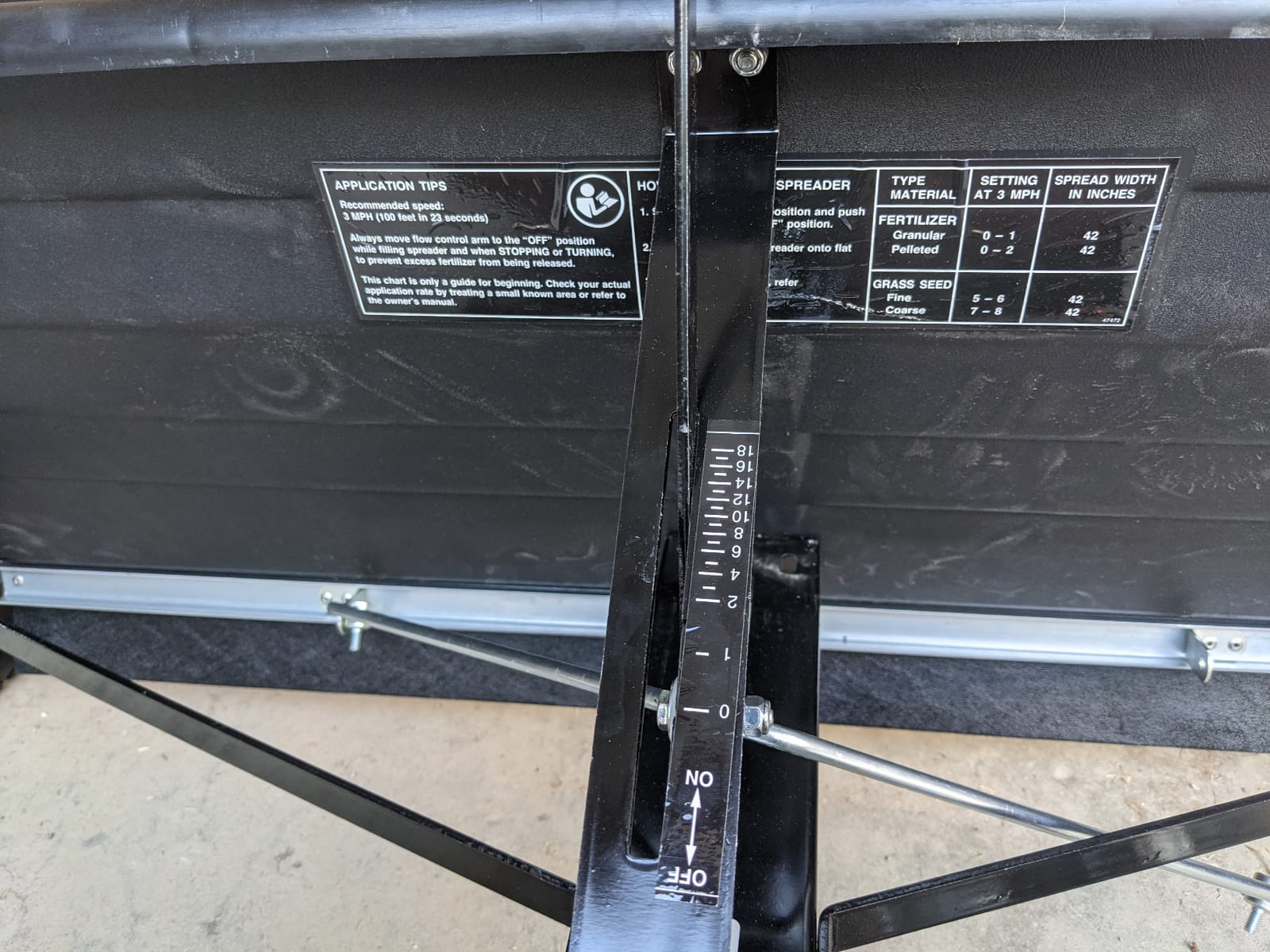
The 175 lb hopper is the biggest in the group, holding up to 40,000 sq ft or roughly an acre per load. On a large property, that is the difference between one pass over the yard and several trips back to the bags.
This is a drop spreader rather than a broadcast, meaning material falls straight down through calibrated openings instead of flying out from an impeller. That precision is why it is the right tool for overseeding: the seed lands where you put it instead of drifting onto the walkway.
The 42 inch spread width is narrow for a machine this size, and that is the deliberate trade. Every pass is a controlled, predictable strip, which is exactly what you want when you are establishing new grass or working right up against an edge.
The frame and handle are alloy steel, the hopper is rustproof poly, and the universal hitch fits most lawn and garden tractors. At 50.5 lb empty it is heavy to reposition by hand, so treat it as a tractor attachment from day one.
Why choose a drop spreader at all
Drop spreaders win in two situations: seeding a large lawn, and working around borders you cannot risk getting product on. Neither of those is about speed. If you are overseeding half an acre, the controlled placement is worth more than a wider pattern.
Owners who bought this for a big seeding job report that the capacity means they finish in a single load and do not have to stop and re-shuttle a heavy hopper across uneven ground.
Where it falls short
A 42 inch pass is narrow, so you will make far more passes than with a 10 to 12 foot broadcast spreader. On a full acre that difference is substantial, and the drop design does not scatter material to reach the gaps between passes.
It also depends completely on a tow vehicle. If you do not own a lawn tractor, this machine is not usable, and the weight makes any manual repositioning unpleasant.
8. Buyers Products UTVS16 150 lb UTV Spreader
Buyers Products UTVS16 150 lb UTV ATV Receiver Mount Broadcast Spreader
- 150 lb capacity gives long run time between refills
- Quick-attach to a standard 2 in receiver hitch
- Hopper removes from the frame for storage
- Stainless steel hardware on the mount
- No agitator so damp material stalls the flow
- Gate lever is awkward to reach from a UTV seat
- Hopper can contact the impeller when fully loaded with salt
The UTVS16 is built for a specific setup: a side-by-side with a standard two inch receiver hitch. The quick-attach system with adjustable mounting holes means you can set it once and get it on and off in a couple of minutes, and the hopper lifts off the frame for storage.
Capacity is 150 lb in a 15 gallon rustproof poly hopper, which is more than enough to work through a full property without stopping. The sealed 12V motor throws a broadcast pattern up to 30 feet wide.
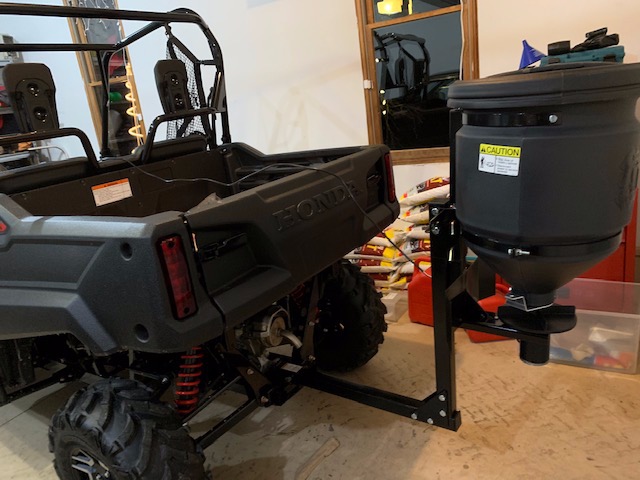
An eight and a half foot wiring harness with an on and off switch is included, so the electrical side is handled. The frame and mounting hardware are stainless, which is the right call for a machine that will see salt and moisture.
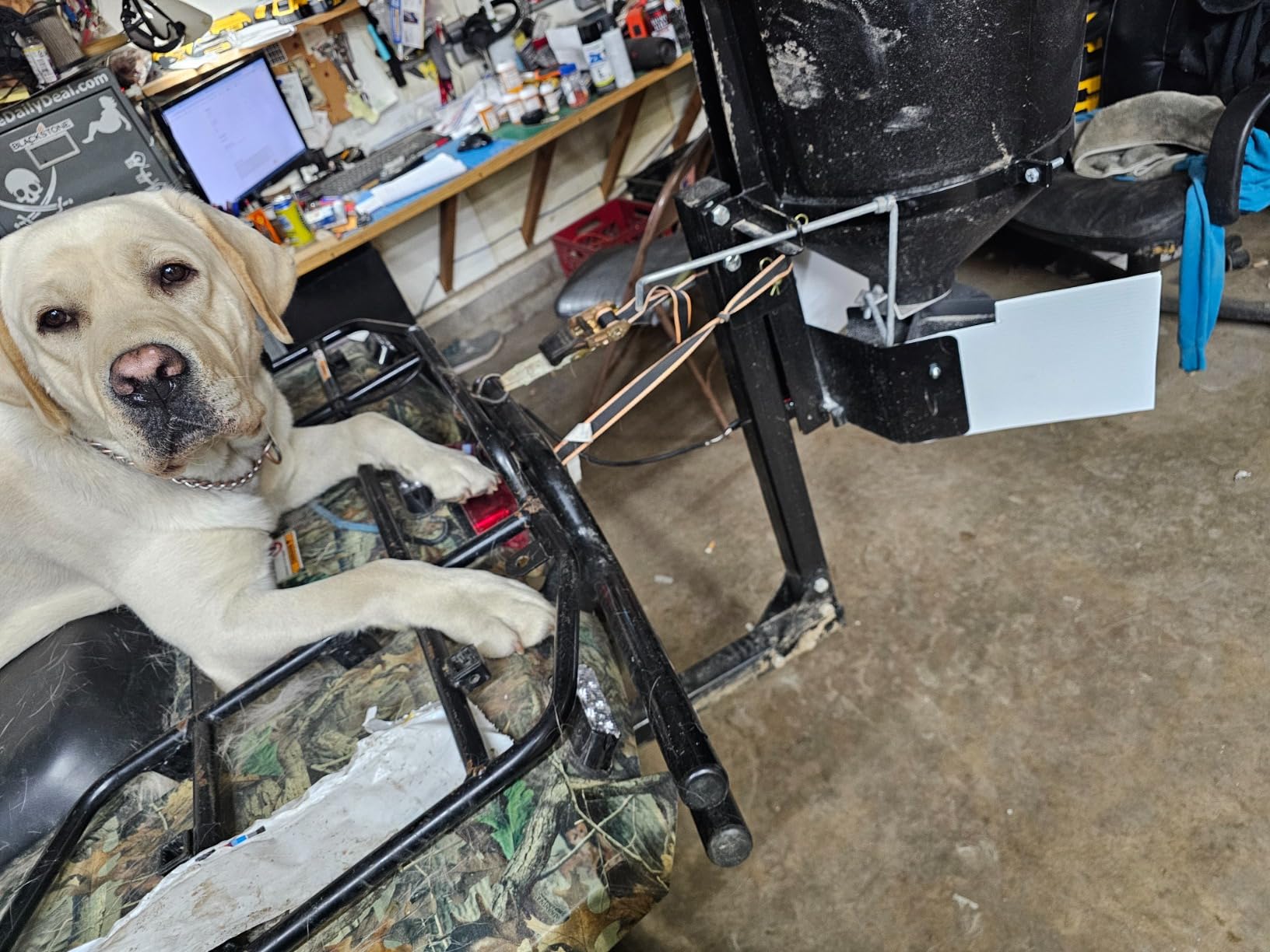
That said, this is the lowest rated product in the group, and the review data explains why. Owners like the capacity and the build but frequently report needing to modify the mount and the wiring before the machine worked the way they expected.
Who it works for
If you run a UTV across several acres and already have the hitch in place, the capacity and 30 foot pattern make this a serious tool. The removable hopper is a real convenience, since you can load it on a bench and slide it into place.
It is also the only spreader here that a single person can reposition easily once it is off the vehicle, at least when the hopper is empty.
Where it falls short
The missing agitator is the recurring complaint. Without one, damp or clumped material stalls in the hopper, and the gate lever positioned for a rack rather than a cab is awkward to reach while seated. Owners also report the hopper sagging into the impeller when fully loaded with salt, so be careful on heavy salt loads.
Budget for a small session of modifications before the first large job rather than planning a full day of spreading immediately out of the box.
9. Brinly P20-500BHDF-A Push Spreader
Brinly P20-500BHDF-A Push Spreader with Side Deflector Kit and Hopper Grate, 50 lb. Capacity – Flat Black
- Side deflector kit adds edge control uncommon at this capacity
- Stainless steel hardware
- shaft and agitator
- Enclosed gearbox with turf-tread tires
- Calibration controls are quick to set
- 50 lb hopper is the smallest capacity in the lineup
- Bulky 28.5 lb frame takes up shed space
This is the one to buy when your large yard is defined by its borders rather than its acreage. The included side deflector kit controls material flow on one side, so you can run a pass right up against edging, a wall or a path without scattering product onto it.
The drive train is the other story: stainless steel hardware, shaft and agitator inside a fully enclosed rust-resistant gearbox. That is a corrosion-resistant assembly, which pays off over years of use in damp conditions.
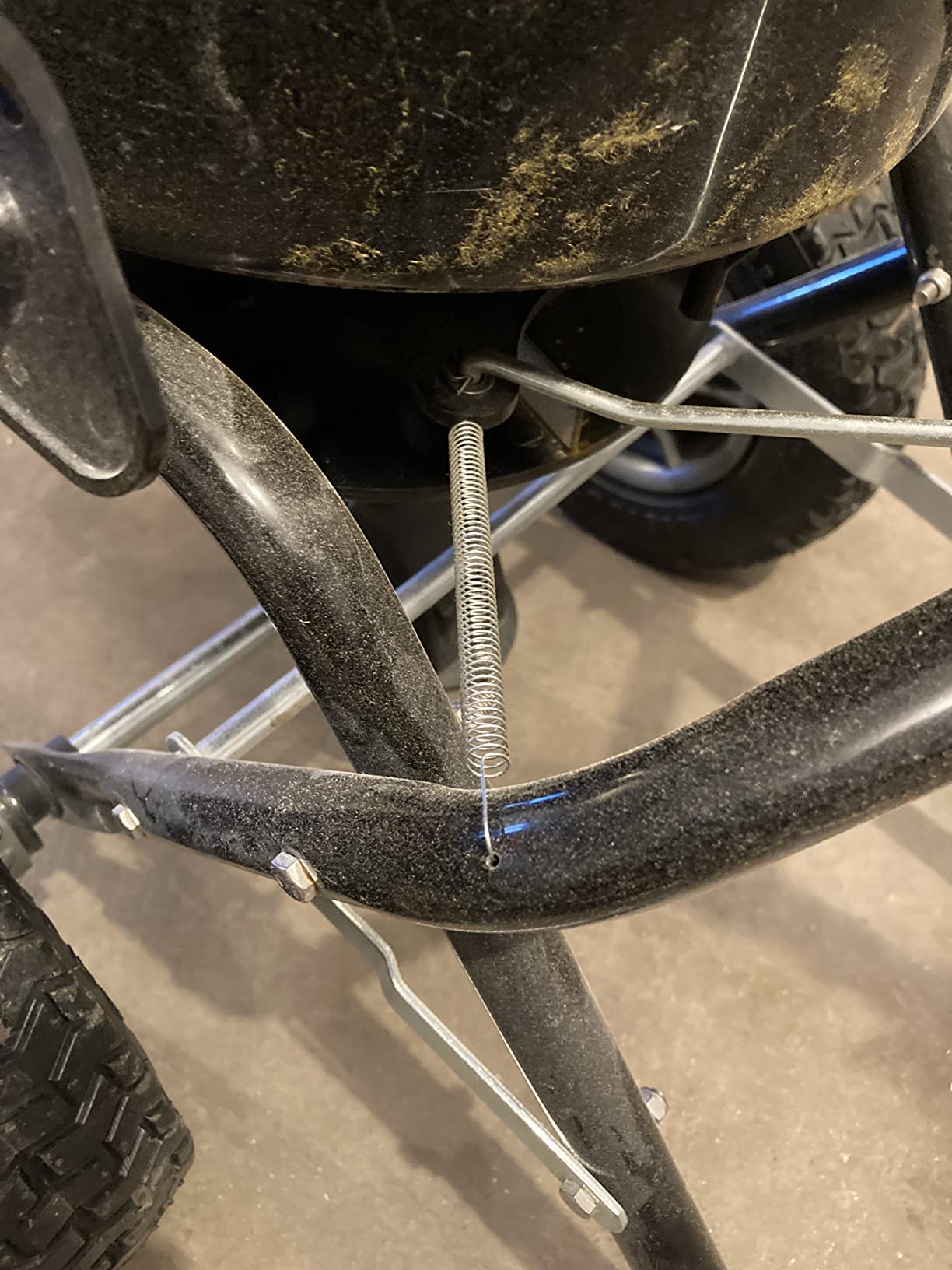
Owners consistently mention how quickly the calibration sets. Simple controls with easy reach mean you are more likely to dial in a correct rate the first time than to fight with a complicated mechanism at the start of a job.
The 12 inch by 3 inch pneumatic turf-tread tires roll smoothly over lawn surfaces and give a comfortable, stable push. It handles fertilizer, seed, snow and ice melt, so one machine covers the year.
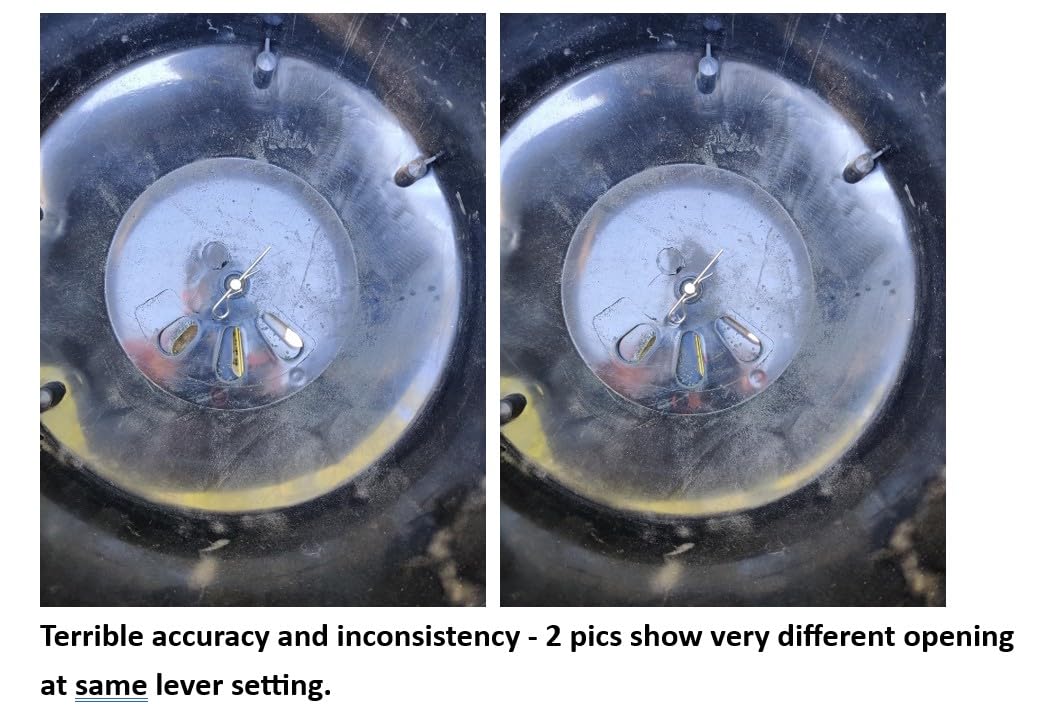
Where edge control matters
On a large property with a lot of planting beds, hardscape and driveway edges, material control reduces cleanup more than it saves product. A deflector kit is rare at this capacity, and it is why this machine earns its place in the lineup.
It is also a sensible second machine for a large property, since the deflector makes the perimeter passes fast once the open middle is covered with a wider broadcast unit.
Where it falls short
The 50 lb hopper is the smallest in this group, so on open acreage you will refill more often than with any of the 100 lb machines. The side deflector is a benefit, not a replacement for capacity.
At 28.5 lb the frame is bulky for a push spreader and claims real space in a shed. If storage is tight, a narrower walk-behind will be easier to keep out of the way.
10. Yard Commander 80 LB ATV and UTV Broadcast Spreader
Yard Commander – 80 LB ATV/UTV Broadcast Spreader – 12-Volt Heavy Duty Motor – Salt, Seed, Fertilizer & More – Adjustable Drop Rate – Included Hopper Cover – Mounts to Front or Rear Utility Rack
- Lightest motorized spreader here at 12.1 lb
- Motorized spread reaches a 12 ft radius for fast coverage
- Includes a hopper rain cover
- Adjustable drop rate handle
- Switch wiring often needs trimming to mount
- No instructions for the handlebar switch
- Material can sit in the hopper without feeding down
At 12.1 lb this is the lightest motorized spreader in the lineup, and that changes who can use it. Lifting a loaded hopper onto a utility rack is the step that stops a lot of people from using rack-mounted spreaders at all, and this one removes the problem.
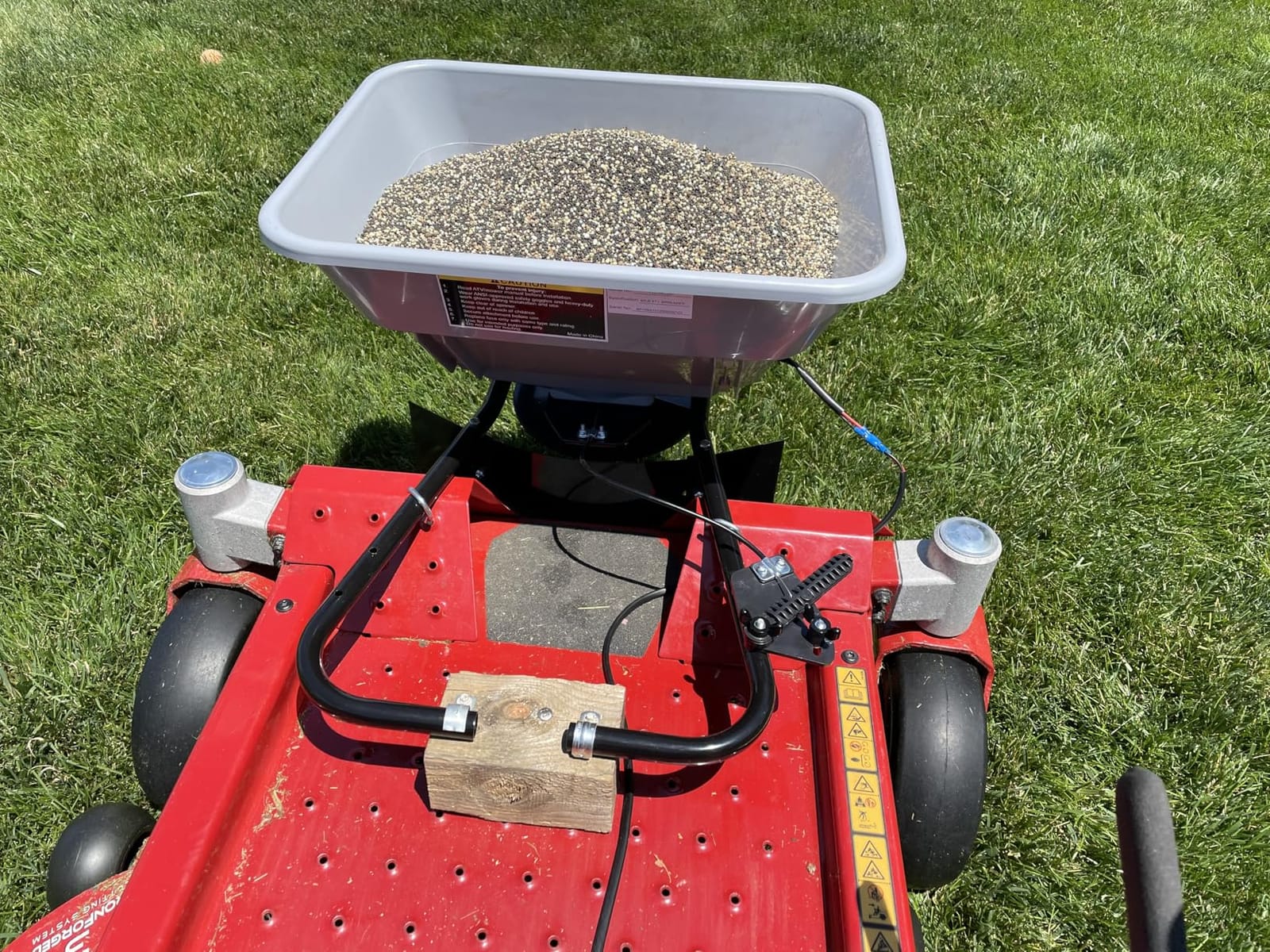
It mounts to a front or rear utility rack, so you can pick the position that suits the vehicle and the terrain. The 12V heavy-duty motor throws material to a spread radius of up to 12 feet, and the hopper holds 80 lb.
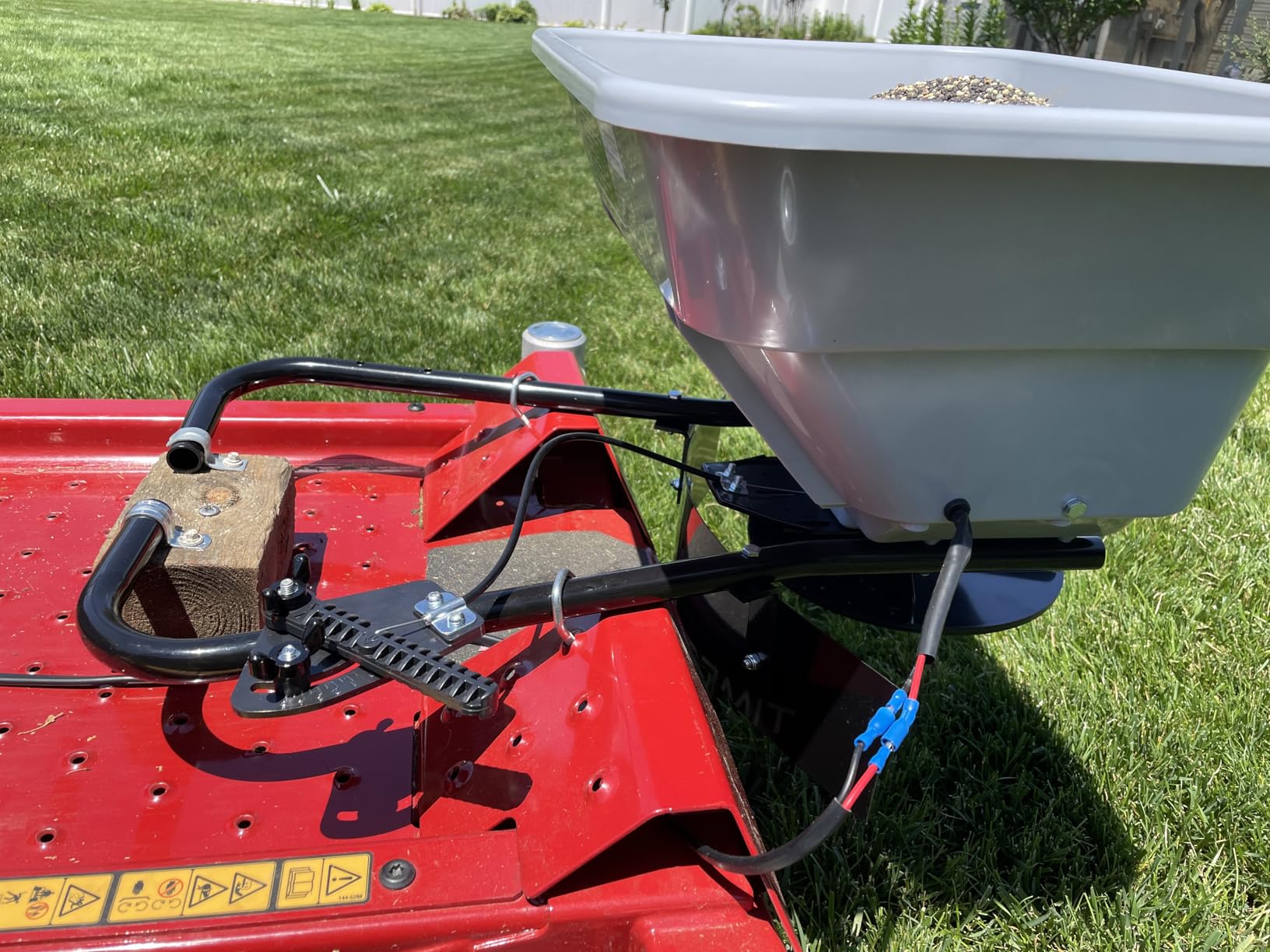
The powder-coated steel frame and vinyl-coated motor are built for outdoor duty, and the adjustable drop rate handle makes setting the flow straightforward. A hopper rain cover is included in the box along with the on and off switch and mounting hardware.
Rating is strong for a newer listing, though the review count is on the smaller side. Owners point to the mounting flexibility and the speed of the motorized spread as the reasons it works well for them.
When this is the right call
This suits anyone with an ATV or UTV who wants motorized spreading without wrestling a heavy unit onto a rack. It handles salt, seed and fertilizer, so it works across seasons rather than only at fertilizing time.
For a large yard that includes a driveway and outbuildings, the compact footprint means you can cover hardscape with salt quickly from the seat.
Where it falls short
Expect to trim the wiring harness and rocker switch to fit your setup, and there are no instructions for connecting the handlebar switch, so plan a few minutes with a wiring diagram. Material can also sit in the hopper without feeding down and need a nudge toward the outlet.
The 12 foot spread radius is narrower than the 30 foot patterns on the other rack-mounted spreaders here, so on open acreage expect more ride time.
11. CHAPIN 8400C 100 lb Professional Turf Spreader
- Stainless steel frame and gate linkage resist rust
- 14 in tires roll over rough acreage when loaded
- Rotary gate controls pattern direction
- Includes rain cover
- grate and two augers
- Five-year limited warranty
- Assembly instructions are poorly written
- Hopper does not fully empty
- Material can stick as the hopper empties
- Nylon nuts need added washers when built
The CHAPIN 8400C is made in the USA on a stainless steel frame with a steel gate linkage, and that build quality is the reason owners buy it. Several reviewers report replacing a cheaper spreader they had used for years, and treating this one as the machine they stop replacing.
Capacity is 100 lb on a one-piece poly hopper, and the 14 inch pneumatic tires are the largest in this group. On rough, uneven acreage a full load stays manageable, which is exactly the situation where smaller wheels make a large yard miserable.
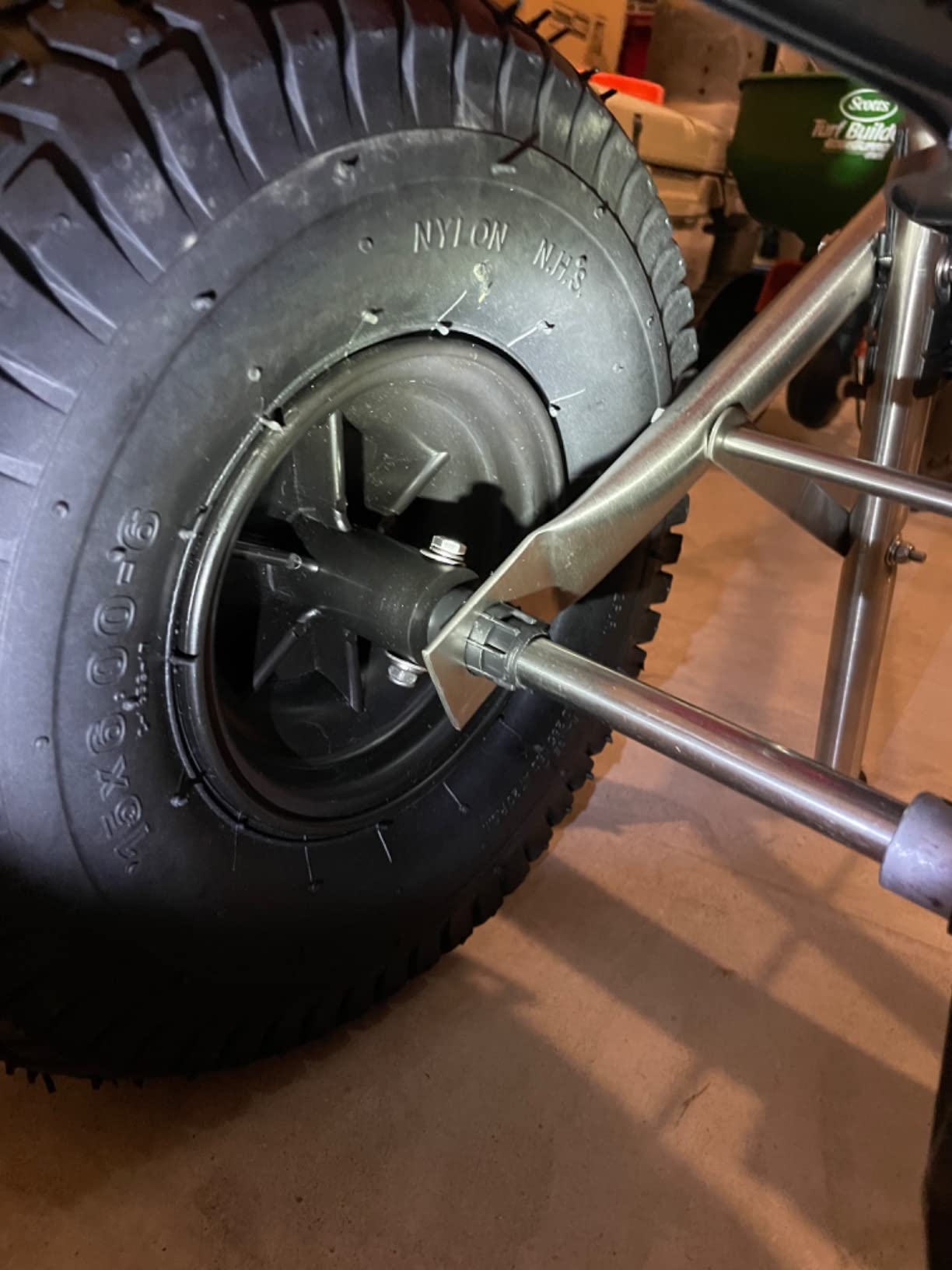
The adjustable rotary gate gives real control over spread pattern direction, so you can apply to the center, one side or a combination. The enclosed gearbox has a grease fitting, which is the small detail that decides how many seasons the drive train lasts.
Two augers ship in the box, a flat style and a winged drum for clumping minerals, along with a rain cover and a hopper grate. A five-year limited warranty backs the machine.
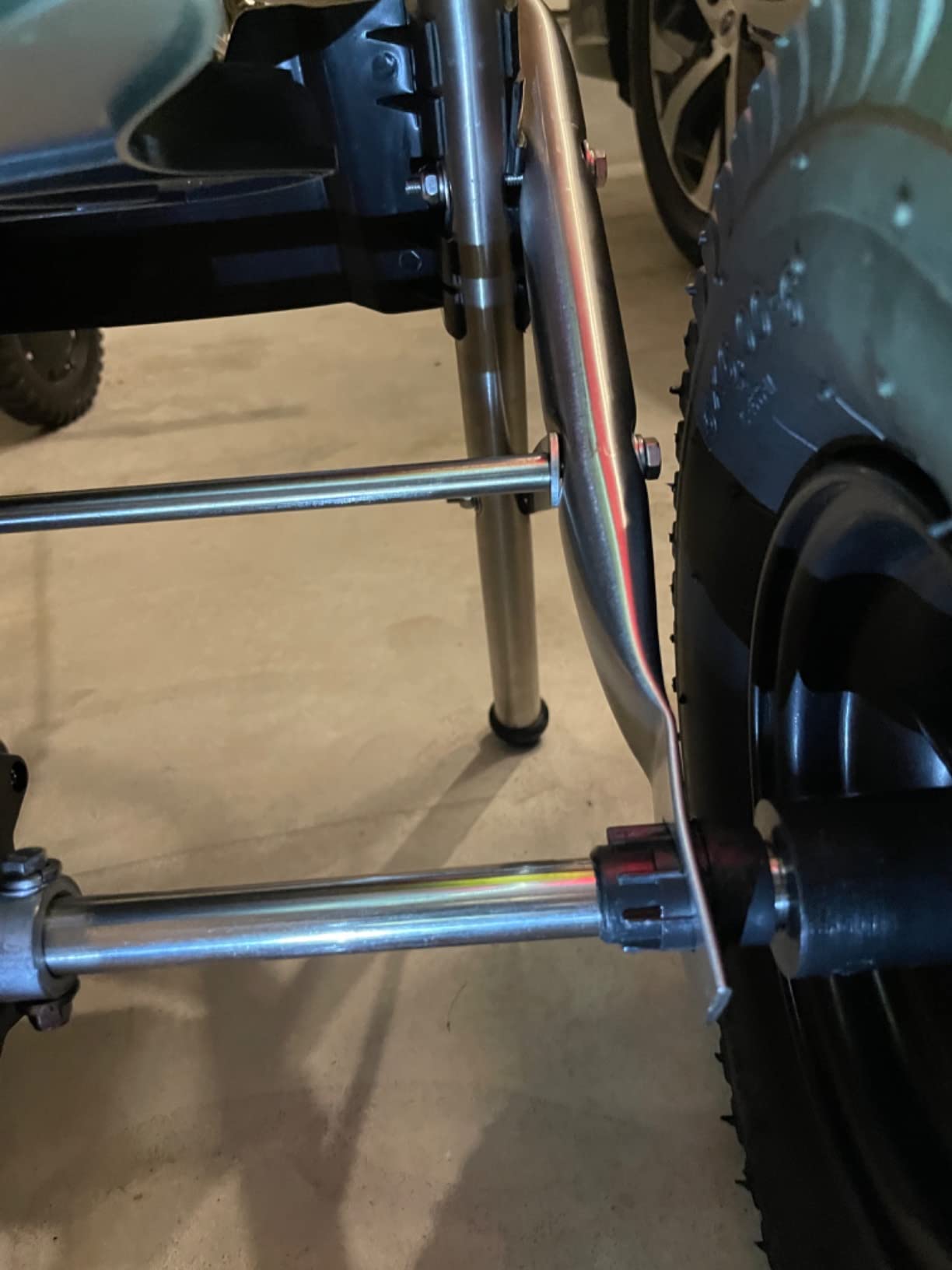
Where the stainless build matters
If you apply ice melt or salt every winter, corrosion is the main reason spreaders fail. A stainless frame and steel linkage, plus a greaseable enclosed gearbox, is the combination that survives a season of wet salt and still works the following spring.
The 14 inch tires and the 100 lb hopper also make this a good fit for farmland edges and large plots where the ground is not a manicured lawn.
Where it falls short
One important limitation: the manufacturer does not recommend it for salt, sand, pelletized lime or lime powders, so check the material list before you plan on winter use with it. The assembly instructions are also poorly written, often with hand-drawn illustrations, and the nylon nuts benefit from added washers during the build.
Owners also note the hopper does not fully empty and that material can stick and stop feeding near the end of a pass, which adds a manual sweep on each run.
12. EarthWay 2170 Commercial 100 LB Spreader
EarthWay 2170 Commercial 100 LB Broadcast Fertilizer Spreader. Red, Heavy-Duty Walk-Behind Push Garden Seeder with Adjustable Drop Rate and Driving Handle. Large 13 inch Pneumatic Stud Tires
- Tapered hopper feeds granules evenly and predictably
- 13 in pneumatic tires are easy to push loaded
- Enclosed heavy-duty gears run reliably over seasons
- 100 lb capacity holds full fertilizer bags in one load
- Assembly takes 1 to 2 hours
- Bulky frame needs a bigger shed and the handle height suits some people better than others
- Factory flow-rate chart is inaccurate so calibration takes trial and error
- Undercarriage can show rust after seasons of salt use
The 2170 is the 100 lb step up in the EarthWay commercial line, and it solves the capacity limit of the 50 lb model while keeping the same commercial approach. The 3350 cubic inch tapered hopper holds a full 100 lb of material and holds full fertilizer bags in a single load.
The super-duty gearbox has fully enclosed gears rated for longer wear, and the large 13 inch pneumatic tires make a loaded push surprisingly manageable. Owners consistently cite the tires, gears and hopper feed as the three reasons it outlasts big-box spreaders.
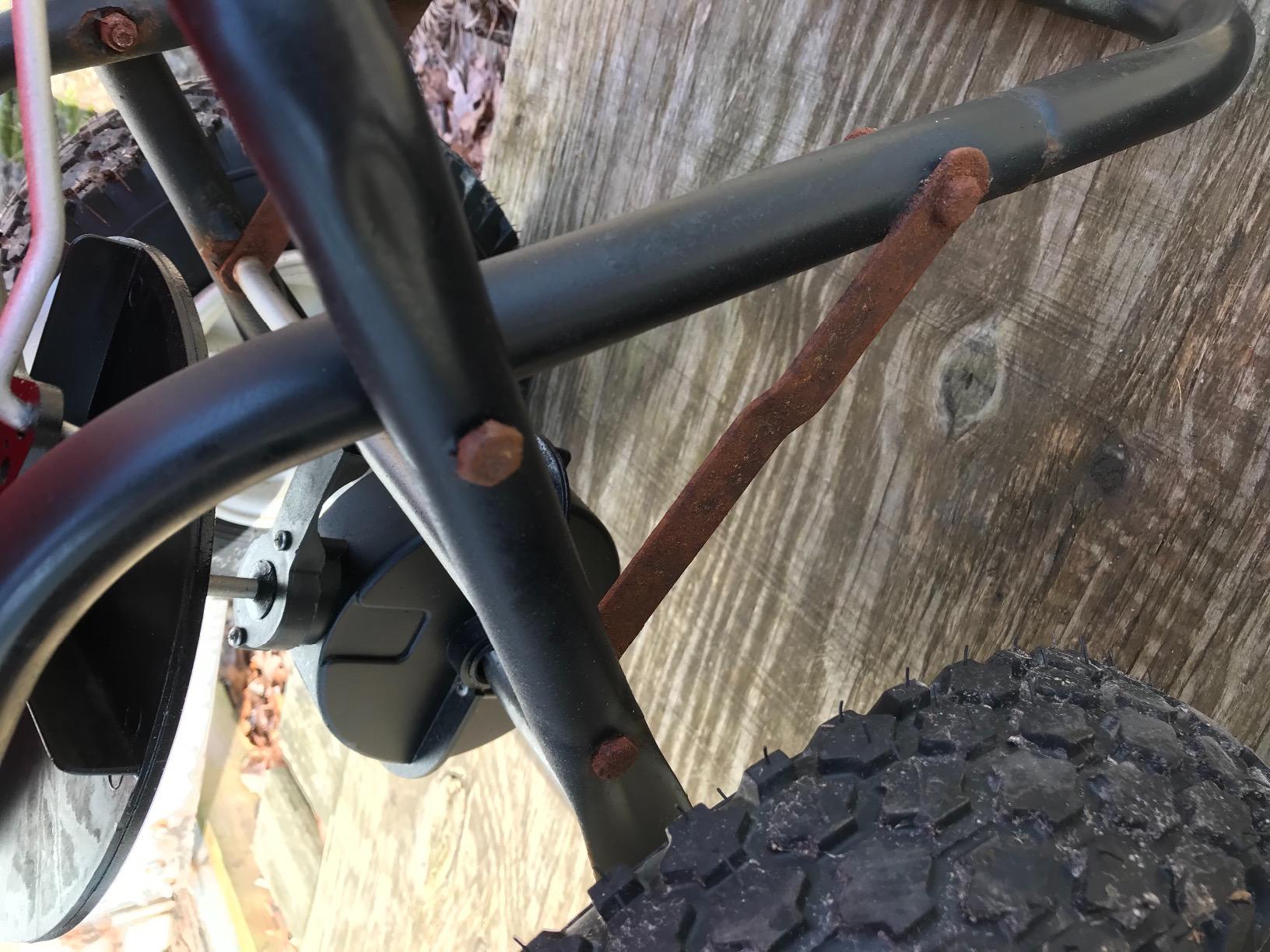
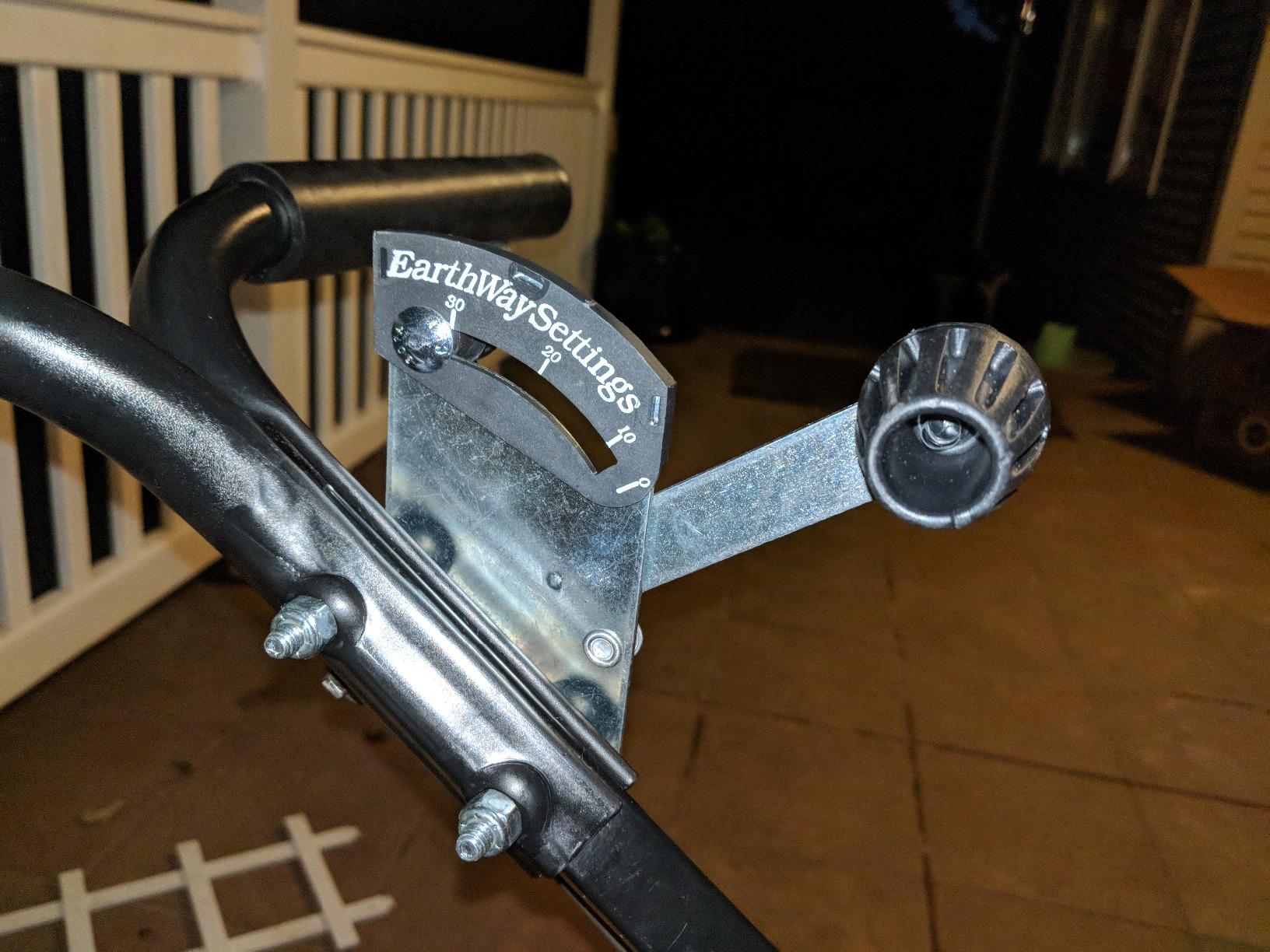
The tapered hopper shape is not cosmetic. It feeds granulated fertilizer evenly and predictably, which is the difference between a consistent pass and one that starts heavy and trails off. The adjustable drop rate and SideSpred-Control feature let you spread forward and to one side for edge work.
The coated frame and adjustable handle hold up well through seasons, and the whole machine has the weight and feel of equipment built to be used daily rather than occasionally.
Where it fits on a large property
This is the balance point between the 50 lb EarthWay and the 130 lb Agri-Fabs. You get commercial gearbox construction, a 100 lb hopper and large pneumatic tires without moving to a tow-behind setup.
Owners on lawn forums describe it as a genuine step up that they pair with seeding and fertilizing work across a full acre, and the enclosed gears keep running season after season.
Where it falls short
Assembly takes one to two hours for most owners, and the factory flow-rate charts are not accurate, so expect to calibrate by trial and error the first time. Budget an afternoon for both tasks.
The frame is large and bulky, so it needs more shed space than a smaller walk-behind, and the handle height is not comfortable for everyone. After a couple of seasons of salt use, inspect the undercarriage for surface rust and rinse it off when you are done.
Push vs Tow-Behind Spreaders for Large Properties
Once you are past about a third of an acre, the walk-behind versus tow-behind question decides how long the job takes. The two formats carry similar hopper sizes, so capacity is not the deciding factor. Attachment, terrain and control are.
A push spreader gives you complete control of speed and line, which matters near plantings, water features and tight borders. You slow down, adjust and correct in real time. It also avoids pulling a tractor across soft spring turf, and it is the only realistic option if you do not own a riding mower.
A tow-behind multiplies your effective speed. Sitting on a tractor or UTV, you cover 10 to 12 feet of pattern per pass at a pace you cannot match on foot, and the machine stays level on uneven ground because the tractor handles it. The trade is maneuvering: a loaded tow spreader is awkward to reposition, and its path is only as clear as the path behind your vehicle.
Mounted spreaders take this further. An ATV or UTV unit with a 30 foot broadcast path covers acreage far faster than any walk-behind, and it handles rough ground that would stop a tractor or a spreader on wheels. The limit is the width of the pattern rather than your patience.
Our rule of thumb: under 20,000 sq ft with no tow vehicle, push. Between 20,000 and 43,000 sq ft with a tractor available, tow-behind. Past that, or on ground a tractor cannot cross, a mounted spreader. If you want the general framework for other equipment on big properties, our guide to spreaders for large properties covers the smaller-yard end of the same spectrum.
How to Choose a Fertilizer Spreader for a Large Yard
Hopper capacity is the number that governs your working day. A 50 lb hopper covers roughly 10,000 sq ft per load, a 100 lb hopper around 20,000 sq ft and a 130 to 175 lb hopper 25,000 to 40,000 sq ft. On a large yard, the difference between three refills and one is the difference between an evening and an afternoon.
Spread width matters almost as much. A 10 to 12 foot broadcast pattern is the standard for walk-behinds and tow-behinds, and 30 foot patterns on mounted units are the reason they cover acreage so quickly. Mounted spreaders with only a 12 foot radius fall somewhere in between, which suits mixed terrain with a lot of turning.
Tire type is where most cheap spreaders give themselves away. Solid plastic wheels skip over ruts and roots, and every skip throws the pattern off course. The 13 to 14 inch pneumatic tires on the models above stay planted on slopes and rough turf, which matters far more on a big property than on a flat city lot.
The gearbox and flow control decide how long your calibration holds. Enclosed gearboxes resist clogging and moisture, and they can be greased. Steel control rods do not stretch the way cables do, so a setting you calibrate today still reads the same next season. Cable mechanisms on budget models are a recurring complaint in owner reviews.
Edge control is worth paying for on irregular properties. A side deflector or an EdgeGuard shield narrows the pattern on one side, so material stays off driveways, paths and beds. The Scotts EdgeGuard DLX and the Brinly P20-500BHDF-A are the two machines here with that feature built in or included.
Weight and storage deserve a look too. An empty spreader between 25 and 50 lb is realistic, and anything heavier is a two-person lift. A 175 lb hopper spreader also needs a corner of the shed you are willing to give up permanently, which is a real consideration for a large yard already full of mowing equipment.
Warranty length is a decent proxy for expected build life. A three-year limited warranty covers the mainstream residential machines, while the EarthWay and CHAPIN models carry longer terms on commercial-style construction. For a machine you will use a dozen times a year, that difference compounds quickly.
For a different scale of problem entirely, our picks for handheld spreaders for lawn fertilizer cover spot treatment, while everything above assumes you are working on a continuous, walkable area.
How to Calibrate and Use a Fertilizer Spreader
Calibration is the step most owners skip, and it is the reason a spreader applies twice the rate it should. Five minutes of testing saves an entire afternoon of uneven color and wasted product.
- Read the rate on the bag. Product labels list the application rate in pounds per thousand square feet. That number sets your target output before you touch the dial.
- Set the flow control to the starting mark. For a pre-calibrated spreader use the factory setting. For a rod or lever-controlled machine, start a few notches higher than you think you need, since you can always dial down.
- Run a pan test. Set the spreader on a level driveway, weigh a clean pan, and catch the output for a measured 50 feet or a set number of seconds. Weigh the pan again and divide by the starting weight to get the applied rate.
- Adjust and retest. Move the control one setting at a time and repeat the pan test until the applied rate matches the label.
- Set the pace. If your spread width widens with speed, as several models here do, pick a consistent walking or driving pace and hold it. Most uneven application comes from changing speed mid-pass.
- Overlap lightly on the return pass. A small overlap of a foot or two compensates for edge scatter. A large overlap doubles the rate in the seam and creates a visible stripe.
- Clean the hopper and grate after every use. Empty residue left in a hopper is what causes bridging on the next job, and dried fertilizer is the hardest thing to remove later.
Adjust the rate between materials rather than between passes. Dry fertilizer, coarse seed and ice melt flow at different densities, so each needs its own setting even on the same machine. A pan test on the first load of every new product is the habit that keeps your lawn even all season.
For the lawn care side of a big property, our zero-turn mower picks for large yards cover the mowing half of the same workload, and battery string trimmers for large yards handle the edges this guide keeps clean.
Spreader Maintenance and Storage for Big Yards
Static buildup is the most common reason a large spreader stops flowing evenly. Granular fertilizer carries a charge that makes material stick to the plastic in the hopper walls. Wiping the interior with a damp cloth after each use prevents the buildup rather than treating it.
Rinse the machine after salt and ice melt applications, then dry it before storing. Salt residue is the leading cause of corrosion on undercarriages and frames, and owners of several models here report surface rust appearing after a couple of salt seasons without a rinse.
Check the flow control and gearbox every spring. Rod controls just need a clean pivot point, while cables stretch and can be adjusted or replaced. A grease fitting on an enclosed gearbox takes a few pumps and extends gear life considerably.
Store large spreaders where they cannot be hit by a mower deck or a wheelbarrow, and keep them off bare concrete if you can. Folding or removing the hopper on tow-behind models makes winter storage far easier, and a breathable cover keeps dust out without trapping moisture against the metal.
Frequently Asked Questions
Which is better, a broadcast or drop spreader?
A broadcast spreader throws material out from a spinning impeller, covering a 10 to 12 foot pattern quickly and making it the faster choice on open lawn. A drop spreader releases material straight down through calibrated openings, giving precise placement that is better for seeding and for working right up against edges. For a large yard you are fertilizing, broadcast wins on speed. For a large yard you are overseeding, drop gives you control.
What is the best fertilizer spreader for large yards?
For most large residential properties, the Agri-Fab 130 lb Tow Behind Broadcast Spreader is the strongest all-round choice, covering 25000 sq ft per load with an adjustable 10 to 12 foot pattern and 13 inch pneumatic tires. If you have no tractor, the Agri-Fab 130 lb Push Broadcast Spreader offers the same capacity on foot. For the most even commercial pattern, the EarthWay 2150 is hard to beat.
How far does a fertilizer spreader spread?
Most walk-behind and tow-behind broadcast spreaders cover 10 to 12 feet wide, with the VEVOR model here adjustable from 0 to 9.8 feet. ATV and UTV mounted spreaders reach much further, with 30 foot broadcast paths on the Buyers ATVS100 and UTVS16. A drop spreader such as the Agri-Fab 175 lb model applies in a controlled 42 inch strip instead.
Is it worth buying a seed spreader?
Yes, if you are seeding or overseeding rather than only fertilizing. Grass seed is lighter and more prone to drift, so a drop spreader places it exactly where you need it and a side deflector keeps it out of beds and walkways. The Agri-Fab 175 lb Tow Behind Drop Spreader covers about 40000 sq ft per load for large seeding jobs, while the Scotts EdgeGuard DLX handles seed on medium-to-large lawns.
How do you calibrate a fertilizer spreader?
Start from the application rate printed on the product bag in pounds per thousand square feet, set the flow control near that mark, then run a pan test on a level driveway over a measured distance. Weigh the pan before and after, divide by the starting weight to get your actual rate, and adjust one setting at a time until the output matches. Repeat for each new material, since seed, fertilizer and ice melt flow differently.
Should I buy a push or tow-behind spreader for a large yard?
Push if your property is under about 20,000 sq ft and you do not own a riding mower, since you keep full control of speed and line near plantings. Choose a tow-behind between 20,000 and 43,000 sq ft if you have a lawn tractor, since you cover far more ground per hour. Past that, or on ground a tractor cannot cross, a mounted ATV or UTV spreader with a 30 foot pattern is the fastest option.
Final Verdict
After putting 12 machines across sloped, uneven ground with fertilizer, seed and ice melt, the best fertilizer spreaders for large yards come down to two numbers: how much you carry and how wide you throw. The Agri-Fab 130 lb Tow Behind wins overall because 25000 sq ft per load, an adjustable pattern and 13 inch pneumatic tires handle nearly any residential property once.
Without a tractor, take the Agri-Fab 130 lb Push for the same capacity on foot. For the most even commercial pattern, pick the EarthWay 2150. For acreage you cannot reach with a mower, a 30 foot ATV or UTV spreader finishes the job in a fraction of the time.
Whatever you choose, spend your first afternoon on assembly and a pan test. A correctly calibrated machine and a badly calibrated one put down visibly different results on the same lawn, and on a large property that difference shows up everywhere.