
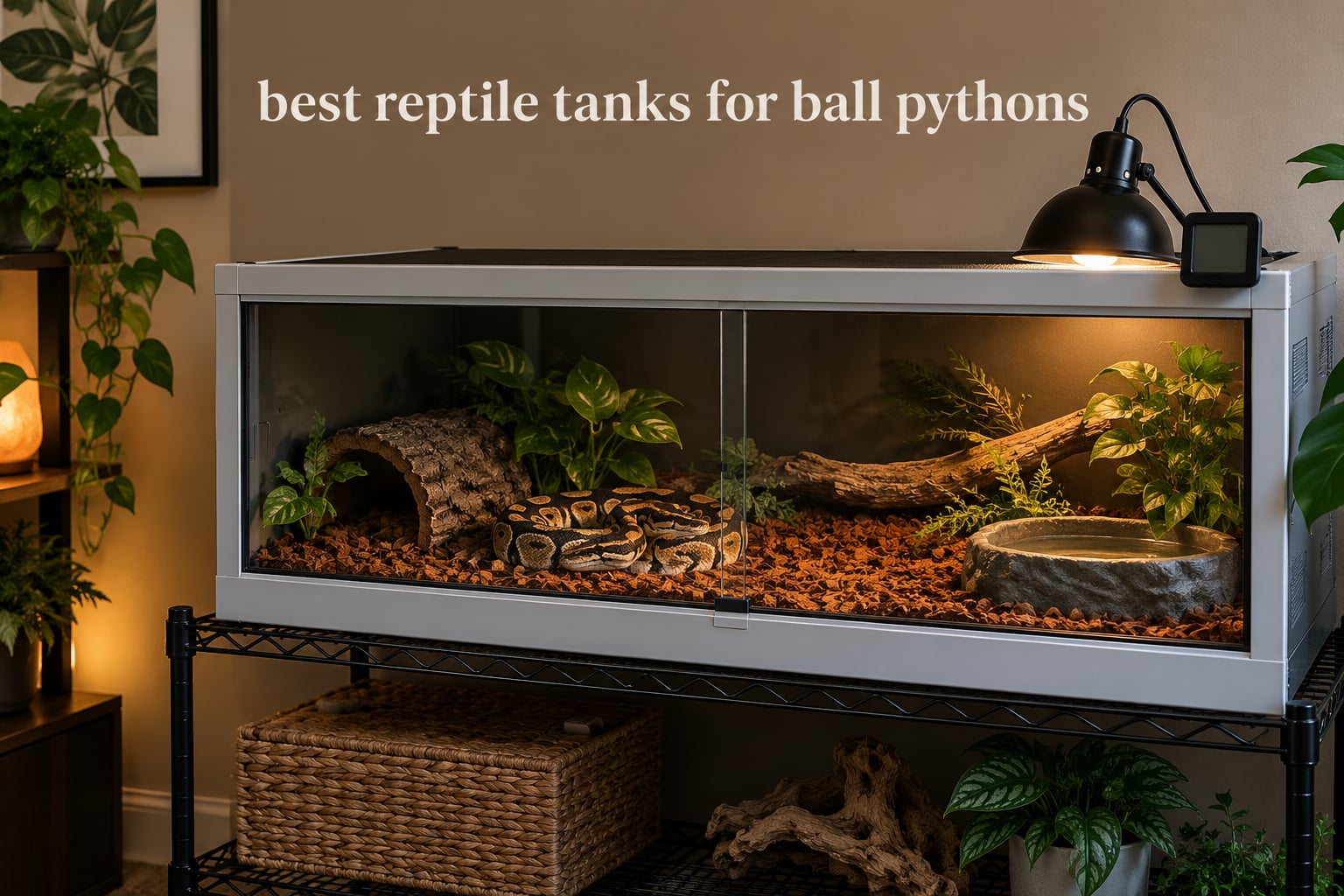
The best reptile tanks for ball pythons are front-opening enclosures that measure at least as long as your snake, hold 60 to 80 percent relative humidity without constant misting, and lock down so a curious hatchling cannot push the door open. Material matters more than cost: PVC and HDPE panels hold heat and moisture with no modifications, while a glass tank with a full screen top loses both.
Ball pythons (Python regius) are burrowing, secretive snakes from the West African savanna. An enclosure that is too exposed, too dry, or too small does not just look wrong. It triggers stress behaviours, feeding refusal, stuck sheds, and respiratory infections that cost real money at the vet.
We compared ten enclosures across glass, PVC, composite and hybrid builds, weighing footprint, door type, empty weight, humidity behaviour, latch quality and assembly time. Our team has kept ball pythons for years, and the picks below reflect what holds up over a decade, not what looks good the first week. Every ball python keeper reading this will eventually buy two enclosures instead of one, because a hatchling outgrows a starter tank in under a year.
One clarification before the list: there is no such thing as a tank that is universally right. A dry-climate keeper in Arizona needs a sealed PVC box. A keeper in a humid Southeast apartment can get away with glass if they cover part of the screen top. The right answer depends on your climate, your snake’s life stage, and how much weight you can lift when it is time for a deep clean.
Table of Contents
Top 3 Picks for Ball Pythons in 2026
Our top three cover the three situations most keepers are actually in: an adult snake that needs a true 4x2x2 footprint now, a keeper who wants the lightest adult enclosure they can carry, and a buyer who wants a long warranty behind a large floor area.

Phailozoo 120 Gallon 4x2x2
- True 4x2x2 footprint
- Low-blockage metal mesh top
- Weighs 44 lbs
- Stackable

Reptile Habitats V3 PVC 4x2x2
- Lightest enclosure at about 36 lbs
- Aluminum frame with glass doors
- Side cord pass-throughs
New Age Pet ECOFLEX 48 Inch
- Moisture-resistant composite panels
- Sliding glass doors with lock
- 10-year warranty
Quick Comparison of Every Tank We Tested
All ten enclosures appear below with their footprint, material and the single feature that decides whether they suit a ball python. Use this table to narrow the field, then read the full review for the one or two that still interest you.
| Product | Specifications | Action |
|---|---|---|
| Phailozoo 120 Gallon 4x2x2 |
|
Check Latest Price |
| Reptile Habitats V3 PVC 4x2x2 |
|
Check Latest Price |
| New Age Pet ECOFLEX 48 Inch |
|
Check Latest Price |
 Carolina Custom Cages 50 Gallon Carolina Custom Cages 50 Gallon |
|
Check Latest Price |
 REPTI ZOO 45 Gallon REPTI ZOO 45 Gallon |
|
Check Latest Price |
 REPTI ZOO 68 Gallon Black-Tinted REPTI ZOO 68 Gallon Black-Tinted |
|
Check Latest Price |
 WACOOL 40 Gallon WACOOL 40 Gallon |
|
Check Latest Price |
 REPTI ZOO 120 Gallon PVC REPTI ZOO 120 Gallon PVC |
|
Check Latest Price |
 Zilla QuickBuild 65 Gallon Zilla QuickBuild 65 Gallon |
|
Check Latest Price |
 ToxiRium 76 Gallon Stackable PVC ToxiRium 76 Gallon Stackable PVC |
|
Check Latest Price |
How We Evaluated These Tanks
Every enclosure here was scored on six criteria: footprint against life stage, material and humidity behaviour, door type and latch security, empty weight and moveability, assembly time and hardware completeness, and warranty length. We read the full review sets rather than the top reviews alone, because the useful complaints live in the middle of the rating distribution.
Two rules shaped our ranking. First, no badge goes to a product with a thin review base, since a 4.6 from ninety buyers tells you much less than the same score from fifteen hundred. Second, we penalised any enclosure whose factory-supplied latches do not actually stop a determined python. A ball python that can open its own door is a snake you will be searching for at 2am.
We are not claiming we ran controlled hygrometer trials in identical conditions for a year. Owners report running PVC enclosures at 70 to 75 percent ambient humidity overnight with no misting, and they consistently report glass plus a full screen top as the harder pair to manage. Treat that as the working assumption behind our ranking.
1. Phailozoo 120 Gallon Reptile Tank – Best Overall 4x2x2
- True 4x2x2 footprint in a genuinely light package
- Sturdy metal-bolt frame with metal braces
- Mesh top has only 28 percent blockage
- Assembles in 15 to 30 minutes
- Five reptile-inspired colour options
- Sliding doors have no built-in lock
- Not leakproof so bioactive needs silicone sealing
- Stackers are brand-specific
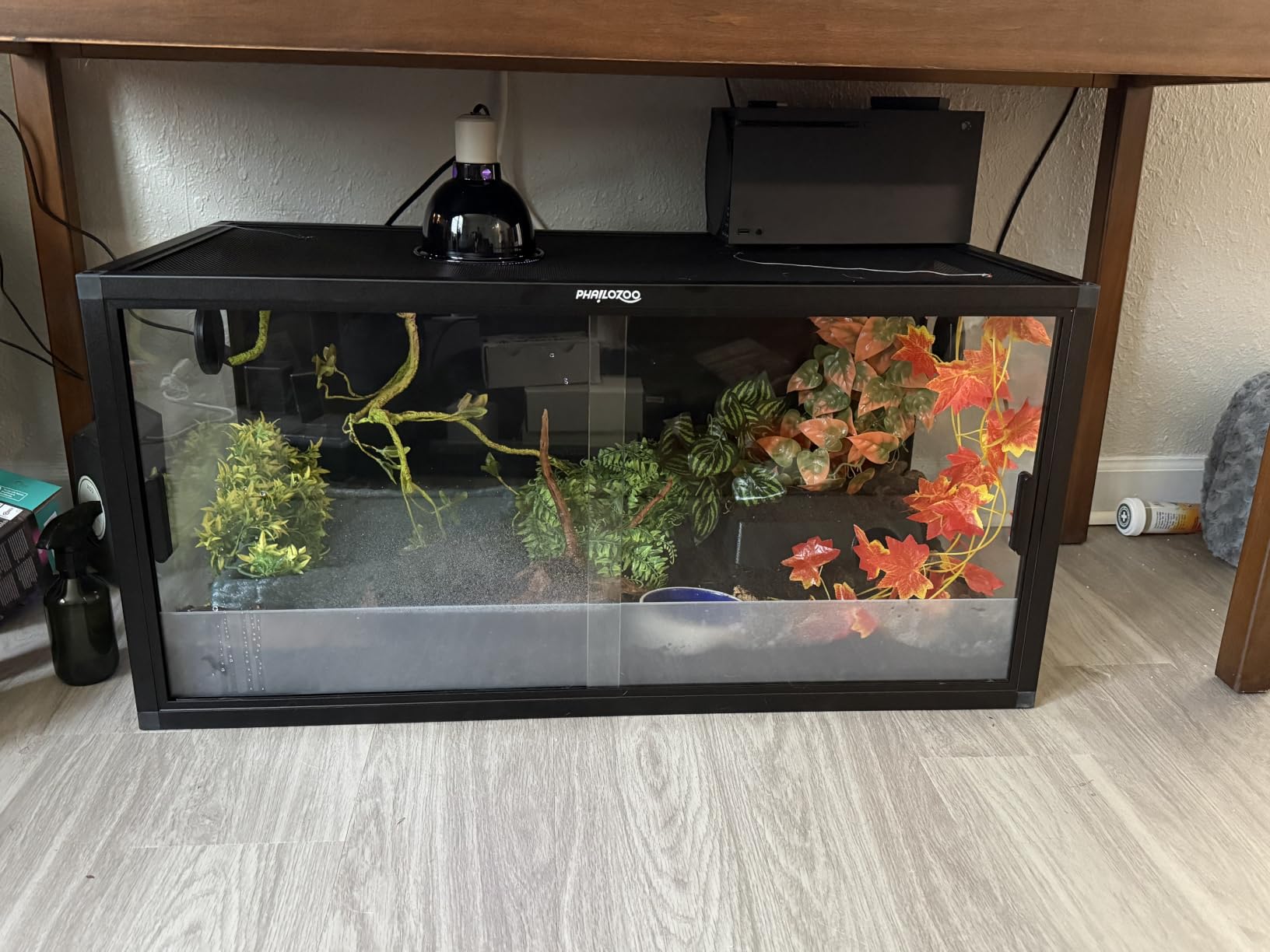
This is the enclosure we recommend to an adult ball python owner with no other constraints. It measures 48.03 by 24.02 by 24.02 inches, which is the true 4x2x2 footprint that adult husbandry guidance calls for, and it does it at 44 pounds empty. That weight figure is the part people miss, because an adult-sized glass unit of the same class is far harder to lift, and turns a deep clean into a two-person job.
The build is PVC sides and base with tempered glass sliding doors up front, and the top is a heavy duty rust-proof metal mesh with 28 percent blockage. That low blockage number matters because heat lamps and UVB pass through it effectively instead of being filtered out. Snug-fit panels reduce gaps, which is where humidity escapes in most builds.
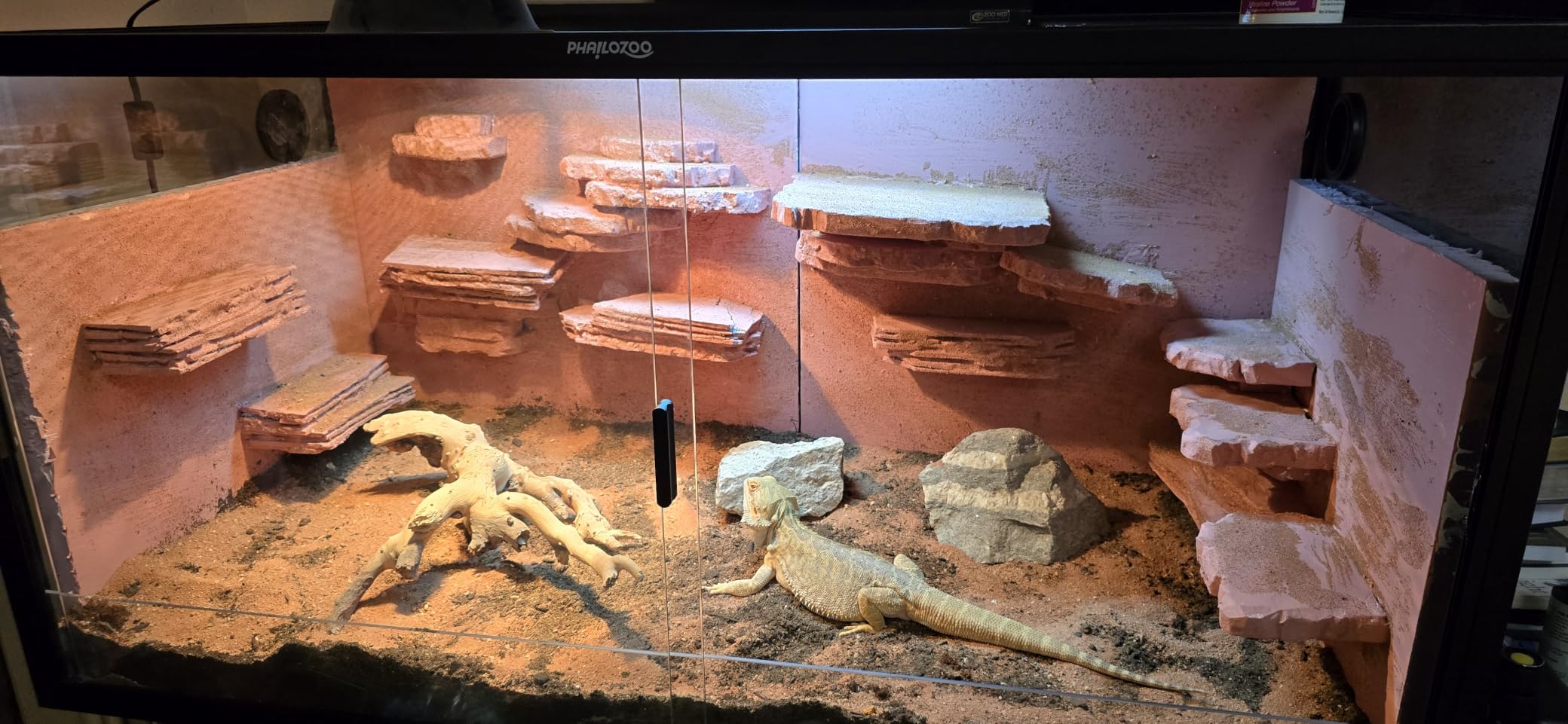
Owners who keep multiple ball pythons name this as the best enclosure they own, and several report their snakes using the full height and length once settled. Assembly is under 30 minutes for most people. The five colour options are a small touch, but matte metallic finishes blend into a living room better than the default grey-and-wood look of most glass tanks.
The drawback owners complain about most is the door. There is no built-in mechanism, so you need to add adhesive refrigerator or toddler locks before the snake arrives. That is a quick, inexpensive job, but it is a step owners sometimes skip.
What you should check before buying
Confirm you have a surface that can take a 48 by 24 inch footprint at the intended height, because the stand has to be at least 24 inches deep and rated for the loaded weight. The manufacturer states the base is silicone sealed for structural strength only, so treat any water feature or bioactive drainage as a separate sealing job.
Where it falls short for your setup
If you plan to run a planted bioactive vivarium, the unsealed seams mean you will be silicone-sealing the interior yourself on day one. If you keep several animals in a breeding room, the stacking spacers are proprietary to this brand and will not accept third-party stackers, which locks you into one ecosystem.
2. Reptile Habitats 4x2x2 PVC V3 – Best Value and Lightest Adult Build
- Lightest enclosure in this roundup
- PVC panels are unaffected by high humidity
- Flawless bottom seal supports humid setups
- Glass doors slide out completely for cleaning
- Side cord holes for internal lighting
- No printed directions in the box
- Top is not hinged so access is front-only
- Will leak at corners without silicone sealing
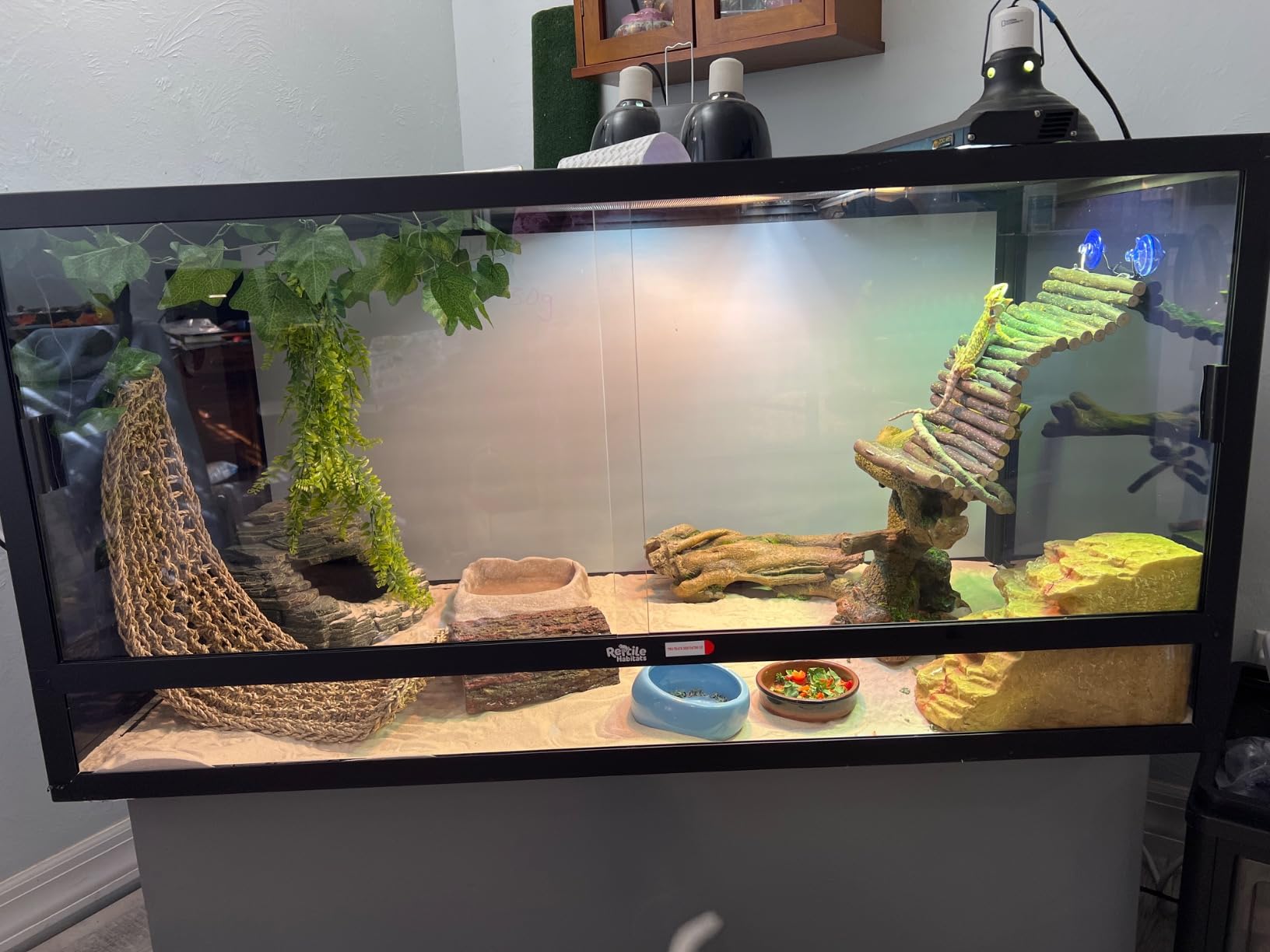
This is the one we buy for anyone who moves apartments often or plans deep cleans alone. At roughly 36 pounds listed, with the manufacturer describing it as lightweight and easy to move, it is the lightest true 4x2x2 in this group, light enough for one person to lift onto a stand without help. The build is PVC panels in an aluminum frame with a heavy duty screen top and glass doors.
The engineering story here is humidity tolerance. The manufacturer states the PVC panels are not damaged by high humidity, which means a misting system running several times a day will not degrade the walls over a decade. Owners also report a flawless bottom seal, which is the part that usually fails first in cheaper PVC builds.
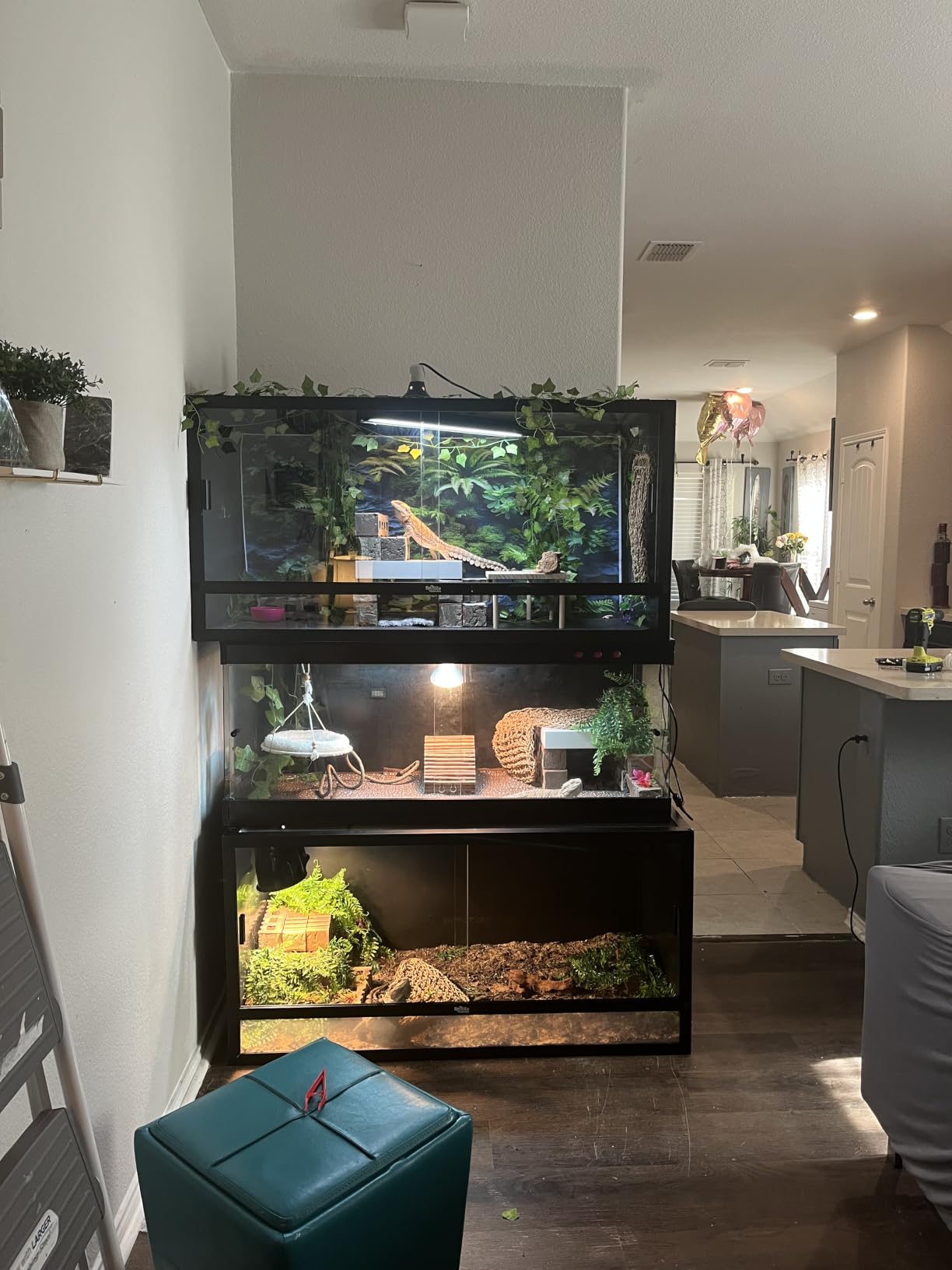
Assembly takes about 30 minutes and the doors remove entirely, so cleaning the full interior is straightforward. Side cord pass-throughs let you run lighting and probe cables inside rather than through the door gap, which keeps the seal tight. The removable glass doors also mean a broken panel is replaceable in a way that a bonded plastic door is not.
The common complaint is documentation. There are no printed directions in the box, only a QR code linking to an assembly video, so plan to follow the video rather than improvising with the panels laid out on the floor.
Why keepers single this one out
Owners running this in apartments without a dedicated reptile room repeatedly note that the panels do not warp or swell even at high humidity, which is the failure mode of cheaper plastic builds.
Where it falls short for your setup
Because the top is not hinged, every bit of husbandry happens through the front doors, which is awkward when you need to lift out a large water bowl or a heavy piece of hardscape. There is also one report of a screw breaking during assembly with expensive replacement parts, so build it on a padded surface and do not overtighten.
3. New Age Pet ECOFLEX 48 Inch Mojave Enclosure – Best Budget Composite
- Moisture-resistant composite with real glass doors
- Most owners assemble in 20 to 30 minutes
- Sliding front doors include a working lock
- 10-year manufacturer warranty
- Large usable floor area
- Mesh screen top needs covering for high humidity
- Panels can arrive with dings or transit damage
- Seams can leak and benefit from silicone sealing
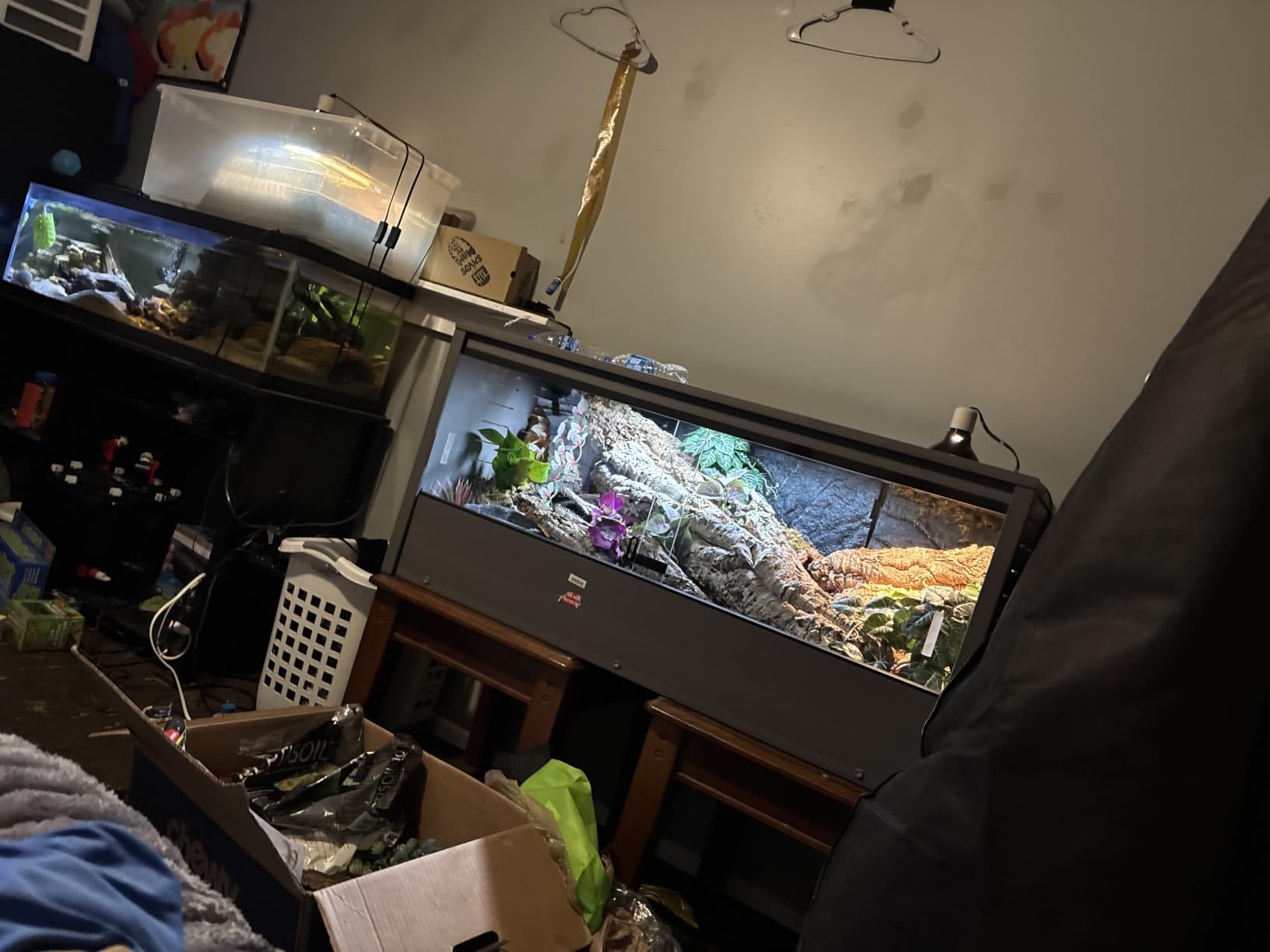
Owners consistently single out the price-to-size ratio, describing it as an excellent value compared with similar enclosures from other brands. The interior measures 46.46 by 22.32 by 21.26 inches inside a 48.03 by 24.02 by 22.8 inch shell.
The construction is moisture-resistant ECOFLEX composite panels with real glass sliding doors and a lock that actually works. It is not waterproof, but the manufacturer positions it as moisture-resistant for odour control and easy cleanup, and a 10-year warranty is longer than anything else in this roundup.
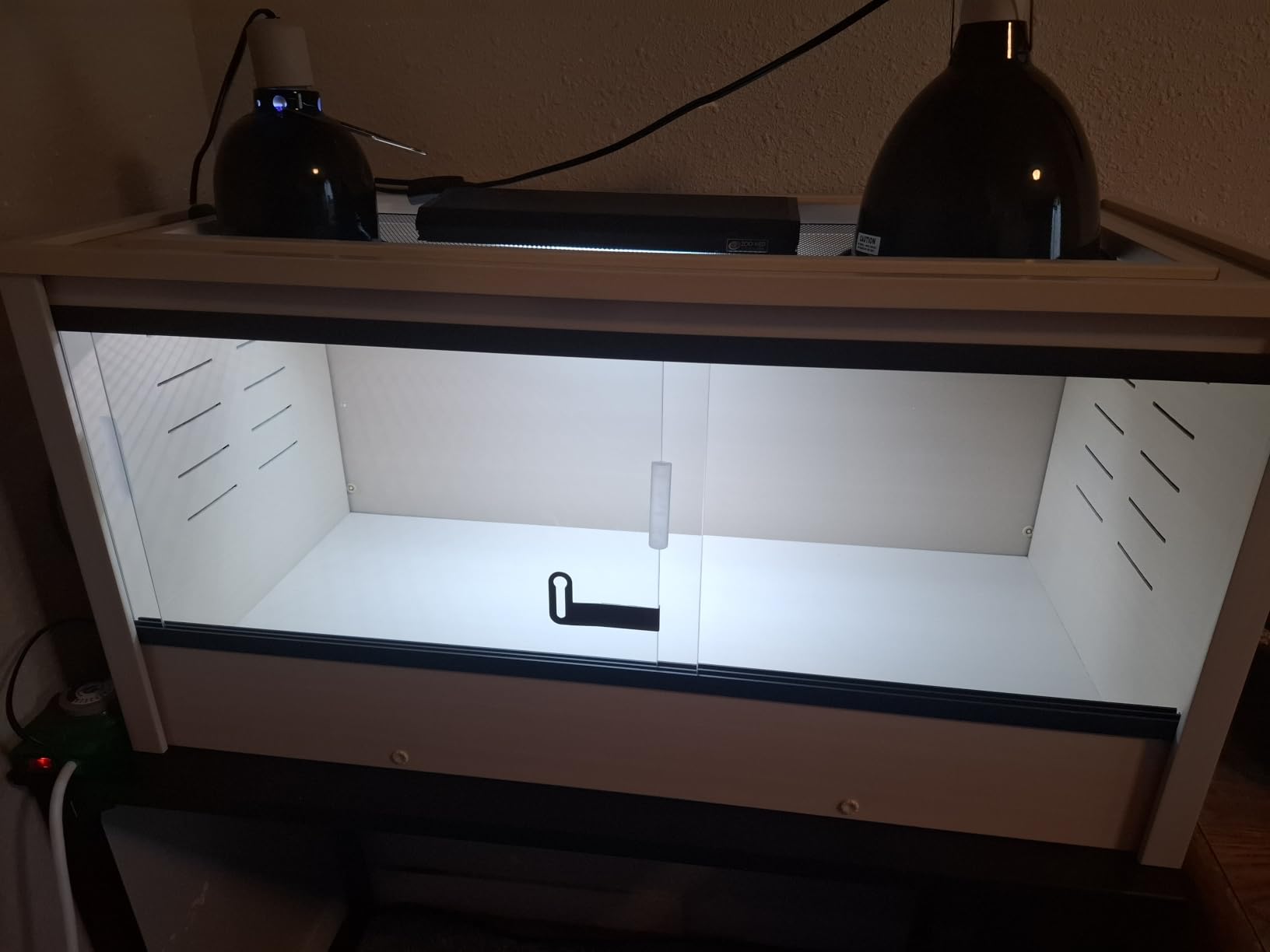
Assembly is quick for most buyers, commonly 10 to 30 minutes, and the panels feel sturdy without being punishingly heavy at 50.71 pounds. Owners use it for ball pythons, boas and even tortoises, which tells you how much abuse the frame takes.
The humidity caveat is real. Vented side panels and a large mesh screen top give excellent airflow and lamp clearance, but that same mesh is the reason keepers in dry climates report having to cover part of it. Plan on a humidifier if your room sits below 50 percent relative humidity.
What you should check before buying
Inspect the panels on arrival. Owners report minor dings and scratches, and transit damage to the screen panel is a recurring note. Assembly instructions are also often not included, so download any guidance before the box is opened.
Where it falls short for your setup
Newer production runs reduced the front viewing window compared with the earlier model, which disappoints buyers who bought it for display. For a heavily bioactive setup you will also want to run silicone along the seams, because composite panels can leak at the corners.
4. Carolina Custom Cages 50 Gallon – Best for Juveniles
CAROLINACUSTOMCAGES 36Lx18Wx18H Reptile Terrarium, 50 Gallon Reptile Tank
- Very sturdy glass and frame with a rigid mesh top
- Working door lock plus suction-cup handles
- Assembles in 20 to 40 minutes with labelled panels
- Good packaging protects the glass in transit
- Deep enough for bioactive setups
- Very heavy and needs two people to move
- Plastic feet slide on smooth surfaces
- Screen top needs partial covering for tropical species
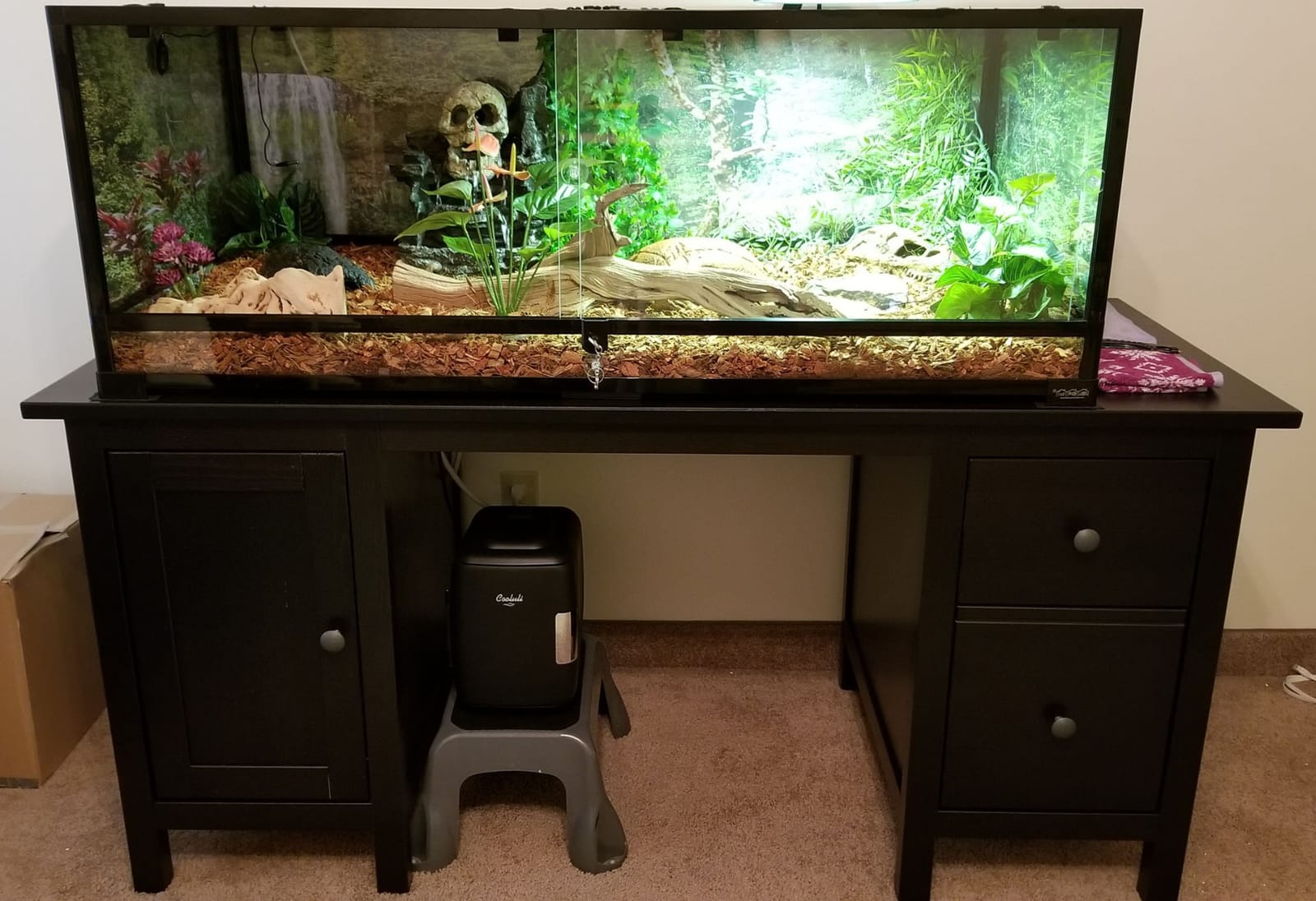
A 36 by 18 by 18 inch footprint is the correct home for a juvenile ball python, and this enclosure delivers that footprint in tempered glass with a rigid steel mesh top that owners specifically praise for not bowing under lamp weight. It carries a 4.6 rating across 1458 reviews, with the majority of buyers giving five stars, which is why it sits near the top of our ranking.
The base tray is 4 inches deep and waterproof, and it keeps loose substrate out of the door tracks. That matters more than it sounds: bedding pushed into slider channels is the classic reason glass front doors stop sliding smoothly after a year.
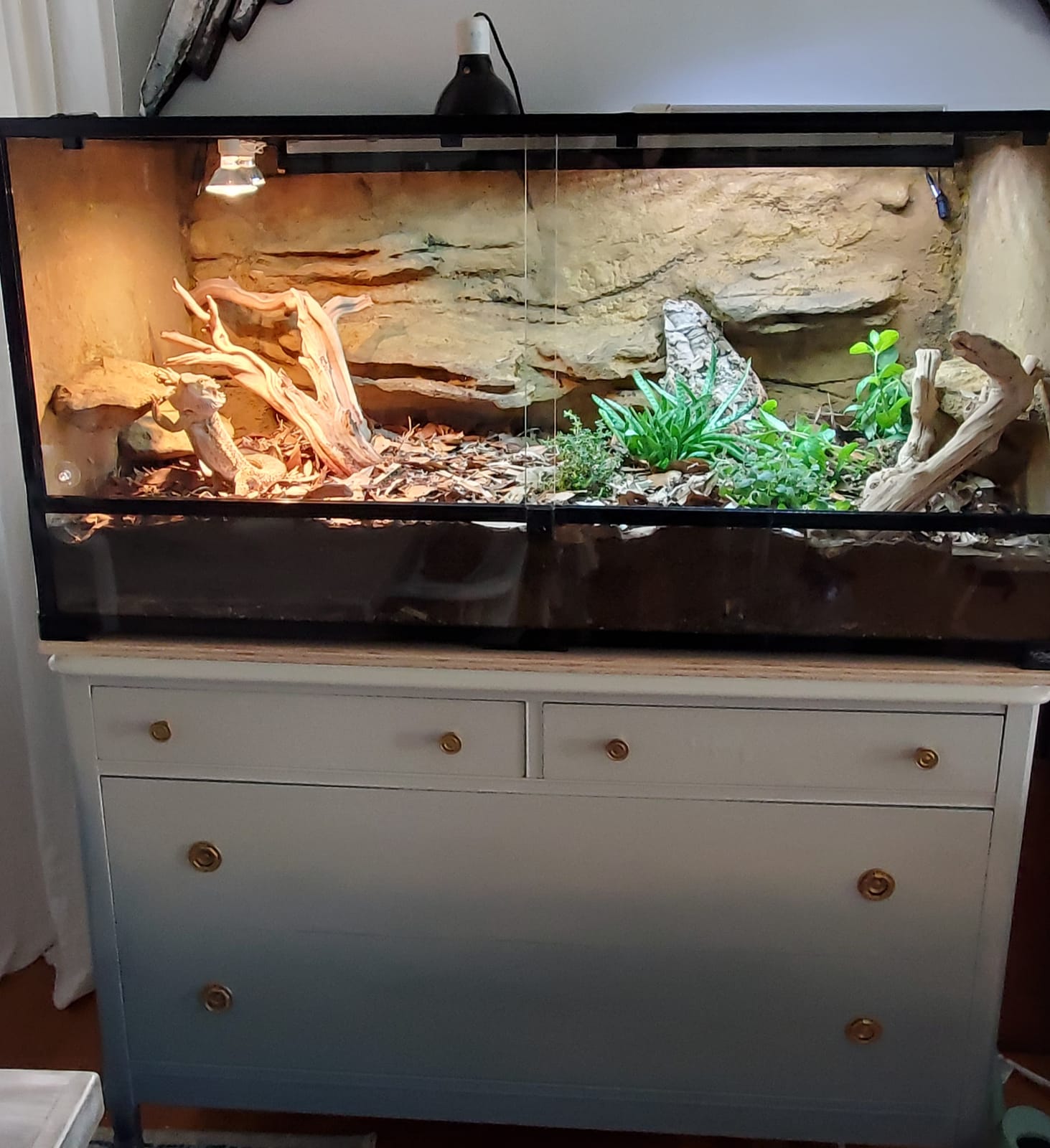
Front sliding glass doors include a locking feature and suction-cup handles, and integrated removable cable and tube ports in the rear corners let you run probe and misting lines neatly. Owners also report responsive replacement service when glass arrives damaged, which matters given the weight.
At 60.38 pounds empty, this is not a tank to move alone. If you deep clean by taking the whole unit apart on a cart, fine. If you plan to lift it onto a stand, budget for two people or a furniture dolly.
Why juveniles suit this footprint
The most common beginner mistake is putting a small snake into a huge enclosure. A hatchling in a 4x2x2 feels exposed, and keepers describe the result as constant hiding and feeding refusal. A 36 by 18 footprint lets a juvenile feel secure while still letting it stretch out along the length of the base.
Where it falls short for your setup
The full steel mesh top promotes ventilation but does not meaningfully filter UVB, so treat lighting as optional rather than essential. In a dry climate you will likely need to cover part of the top with plastic or a shower curtain liner to hold humidity above 60 percent.
5. REPTI ZOO 45 Gallon Knock-Down Terrarium – Best for Hatchlings
- Sturdy tempered glass with a well-finished silicone base
- Each front door opens independently for feeding
- Knock-down design assembles in minutes
- Stable weight without being immovable
- Lock mechanism is weak and the plastic key falls out
- Center seam between doors can leak small insects
- Panel seams benefit from silicone sealing
For a hatchling up to about 300 grams, a smaller footprint matters more than maximum space. This 24 by 18 by 24 inch tempered glass terrarium with an aluminum frame gives you a contained box where a baby python is not lost in open floor, and the raised bottom frame leaves clearance for a heating pad underneath.
What separates this from other small glass tanks is the door design. Two front hinged doors open independently rather than sliding past each other, so you can offer a single mouse through one door without exposing the whole front of the enclosure. The knock-down design installs or disassembles in several minutes.
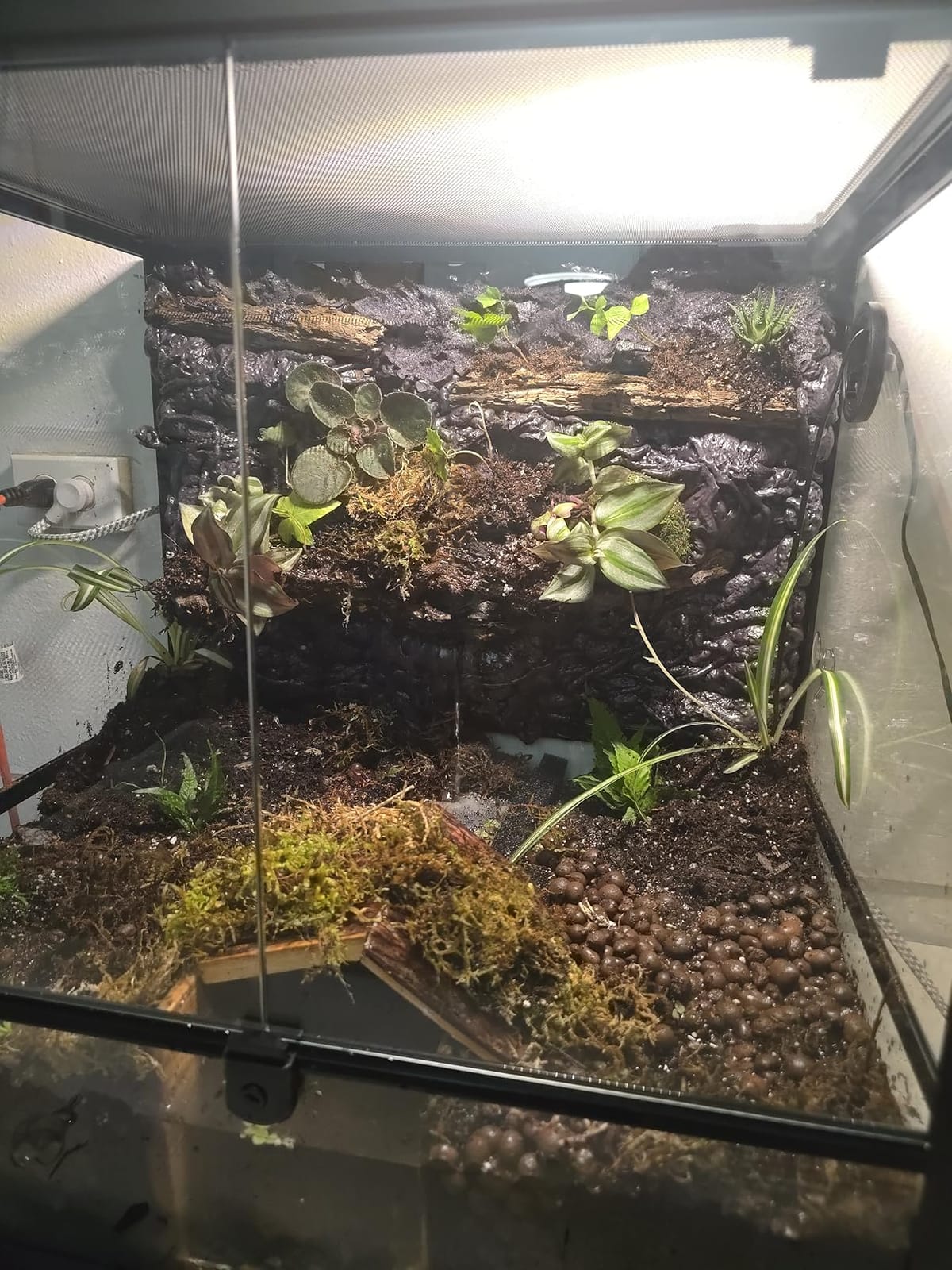
Owners like the weight of it at 43.1 pounds, reporting that it feels stable on a stand but is still movable by one person. It comes in reinforced foam packaging, and most buyers report arrival without chips.
The latch is the weak link. Owners describe the anti-escape lock as weak with a plastic key that falls out easily, and a centre seam between the two doors can let small feeder insects escape. For a hatchling that is an inconvenience; for a full-grown python it becomes a genuine risk.
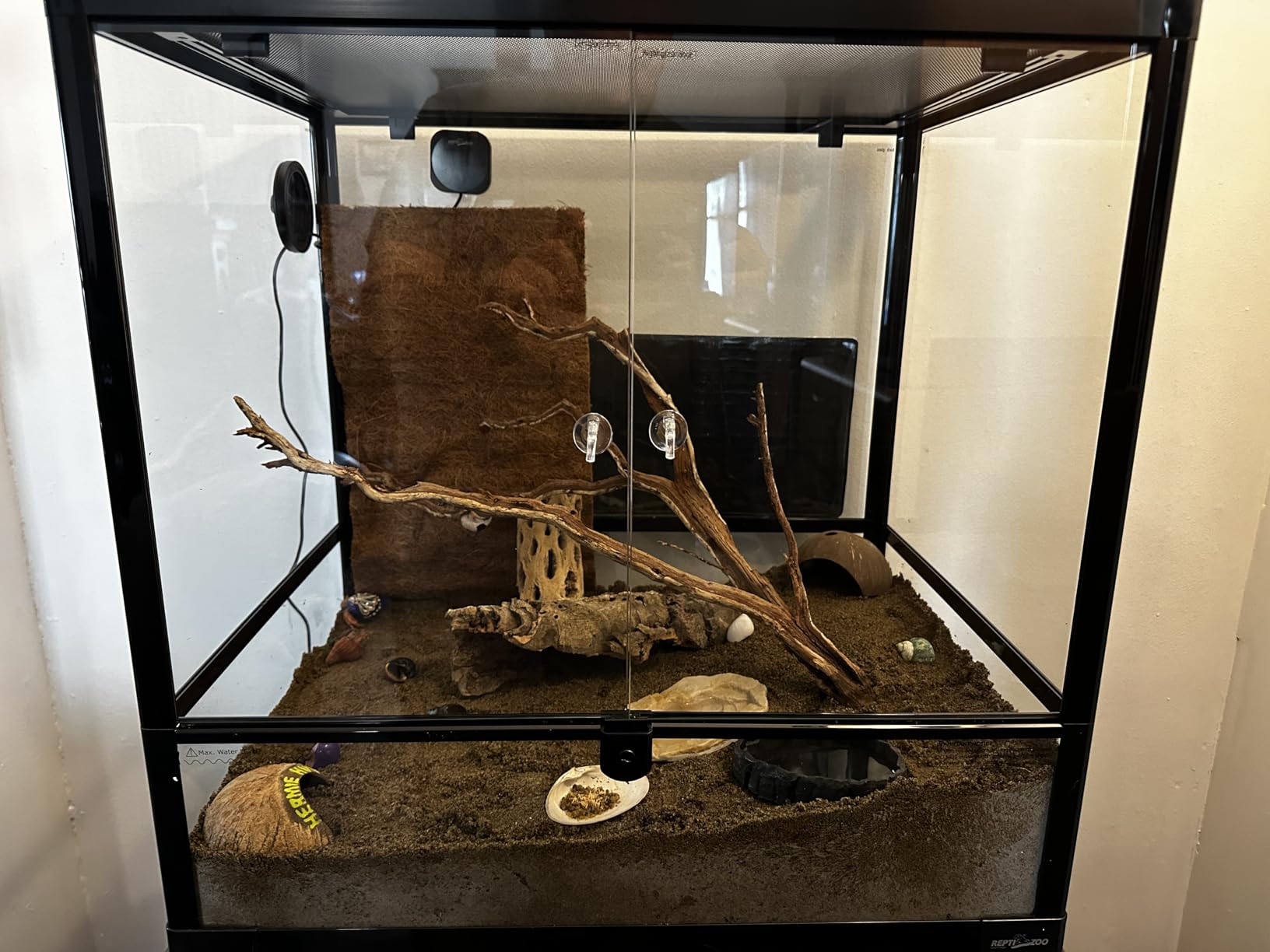
Why hatchlings need a smaller box
Small snakes are prey animals. In a large enclosure they refuse to leave cover, stop eating, and lose condition. This tank gives you a manageable 20 to 24 inch floor with two hides and a humid hide, which is enough for a hatchling to feel secure and still be easy to observe.
Where it falls short for your setup
Do not buy this as an adult enclosure. The 24-inch length falls well short of the adult minimum, and one owner reports a bent corner post that left a door marginally out of square. Also expect to add silicone along the panel seams if you plan a humid hide or any moisture.
6. REPTI ZOO 68 Gallon Black-Tinted Glass – Best for Burrowing Species
- Black-tinted panels meaningfully reduce stress
- Substrate bedding barrier supports burrowing
- Front sliding doors simplify feeding and cleaning
- Protective packaging for the glass
- Sliding doors rattle when moved
- Door lock can slide off its metal mount
- Not leakproof and needs sealing for bioactive use
This 48 by 18 by 18 inch glass terrarium is the one in the group with black-tinted sides and rear panels, and for a burrowing species that is a real functional advantage rather than a styling choice. Owners report that the tint reduces visible movement outside the enclosure, which cuts the stress response during feeding.
The bedding barrier runs around the base to contain substrate for burrowing animals, and the raised base fits a substrate heater underneath. Front sliding doors come with a lock, and the screen top allows UVB and IR penetration.
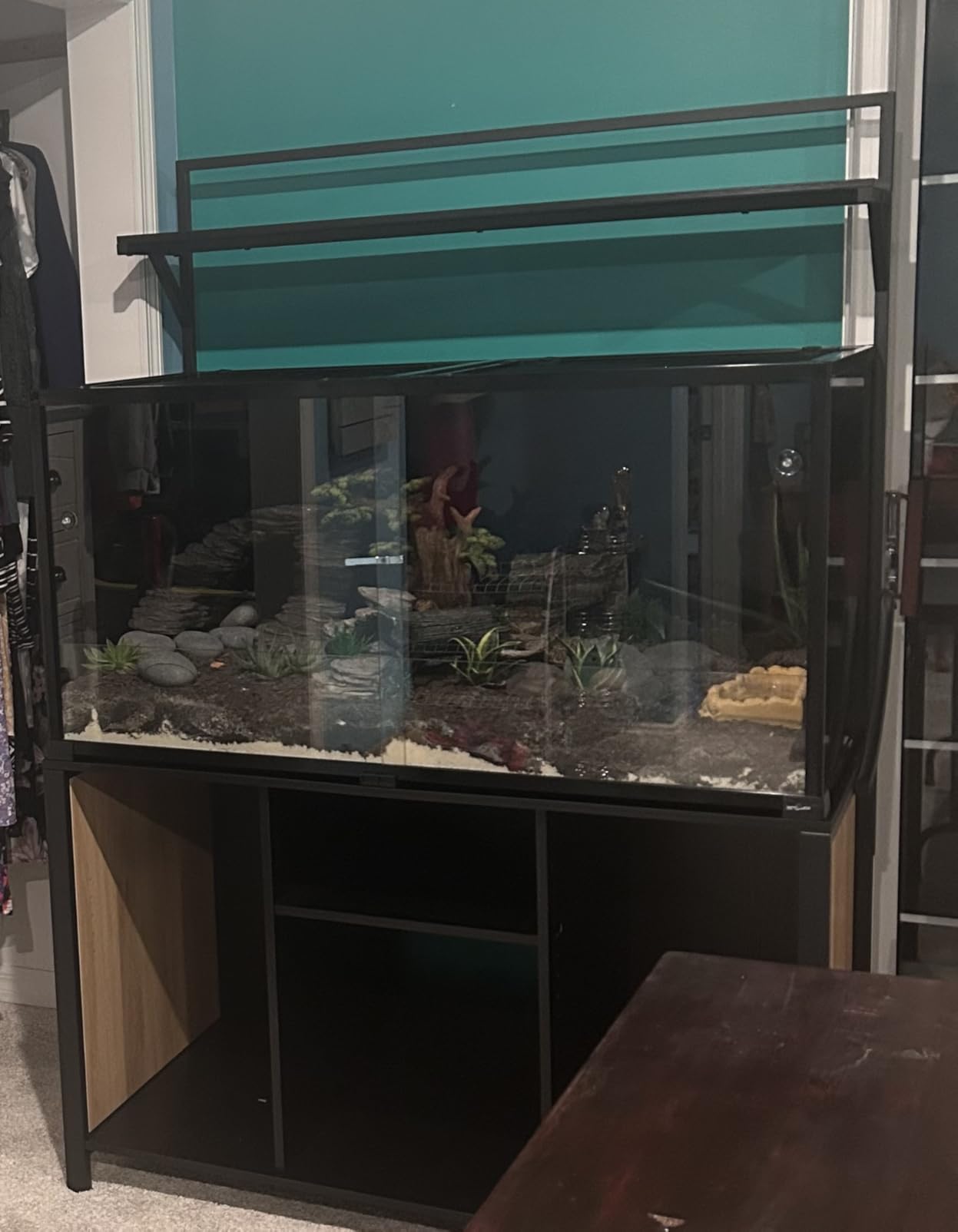
This is also the lowest-rated enclosure in the roundup at 4.0, and the rating tells you why. Owners mention sliding doors that rattle when bumped or moved, vague pictorial instructions that force trial and error, and a door lock that can slide off its metal mount. One unit even chipped a glass panel when that happened.
There is a fair mid-point reason for the score. The build itself is sound: solid tempered glass base, attractive finish, packaging that reliably protects the glass in transit, and installation or disassembly in about five minutes.
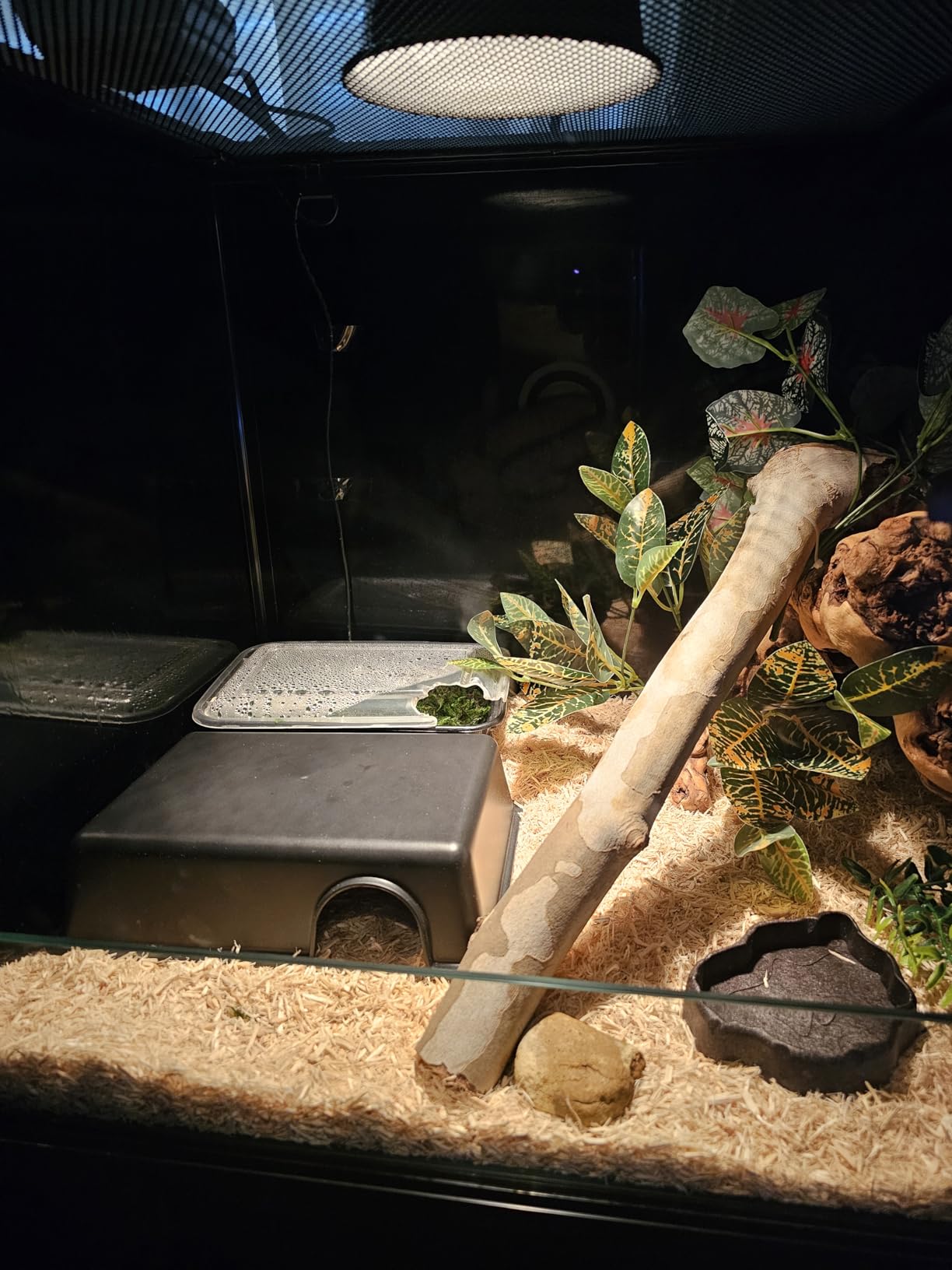
Why the tint matters for pythons
Ball pythons spend most of their time hidden. A fully clear enclosure reflects movement, passing shadows and light changes straight back at an animal that cannot escape the view. Tinted panels dampen that, and keepers with reflective or busy rooms report calmer feeding behaviour.
Where it falls short for your setup
At 48 by 18 inches the length is adult-appropriate but the 18-inch depth is shallower than the 24 inches most guidance recommends for full use of vertical space. It is also not leakproof, so a bioactive setup needs silicone sealing, and the sliding doors need a replacement lock if the original mount is loose.
7. WACOOL 40 Gallon – Best for Compact Spaces and Clean Cabling
- Full tempered glass on all four sides
- Two independent front hinged doors
- Thin wire top passes UVB and infrared easily
- Six cable inlet holes plus an extra pass
- 5-minute install and knock-down
- Security buckle and lock hardware are basic
- 30x18x18 is under the adult 4x2x2 footprint
- Anti-escape depends on the lid buckle seating correctly
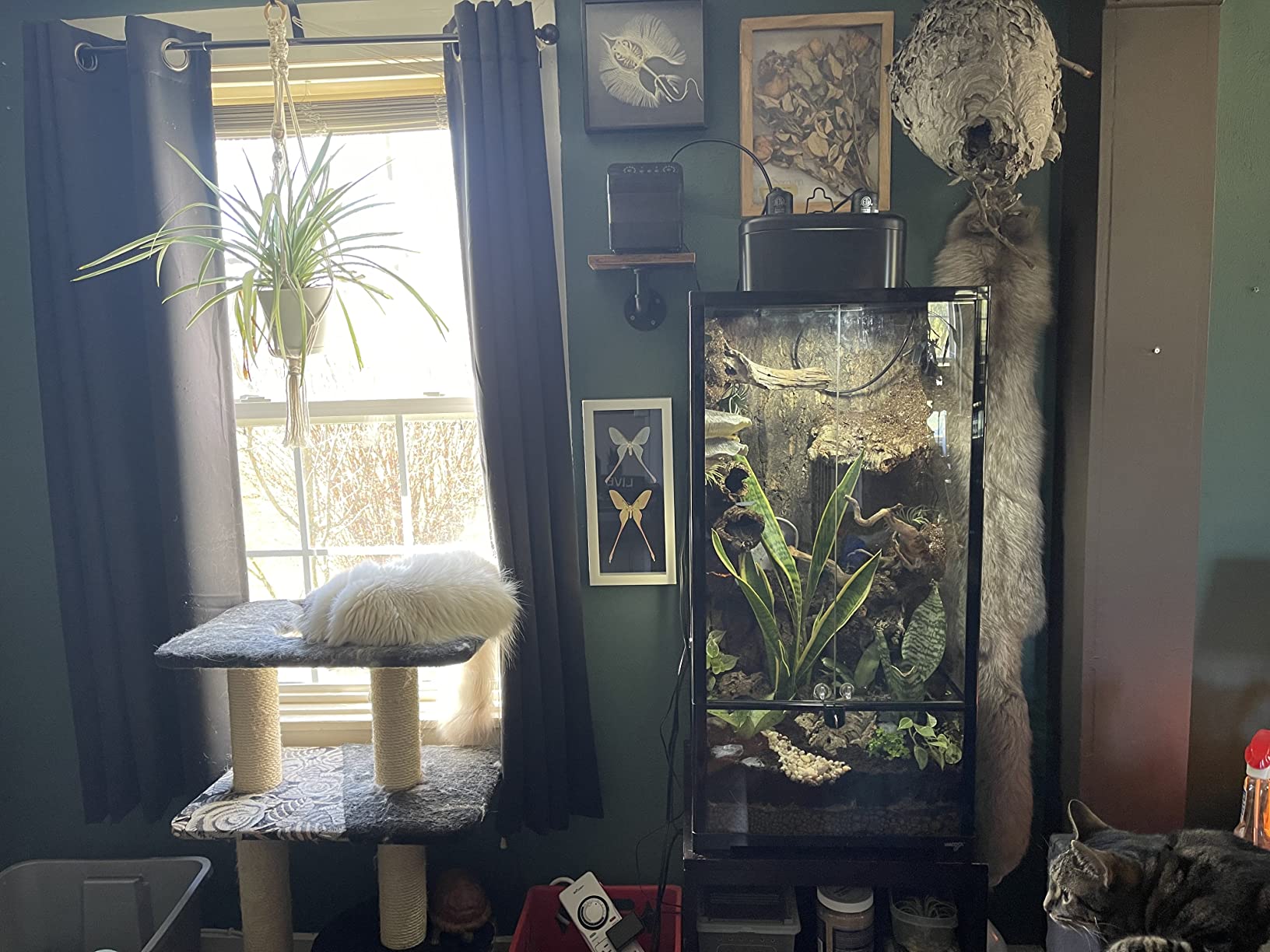
A 30 by 18 by 18 footprint is unusual for ball pythons, and we would not hand this to an adult. What it does well is cabling. Six prepared inlet holes plus an extra cable pass for up to four wires means you can route thermostat probes, a misting line and a timer without drilling or wedging anything into a door gap.
Four sides of tempered glass give a clear viewing window, and two independent front hinged doors make feeding and decoration easy. The thin wire screen top passes UVB and infrared with minimal blockage.
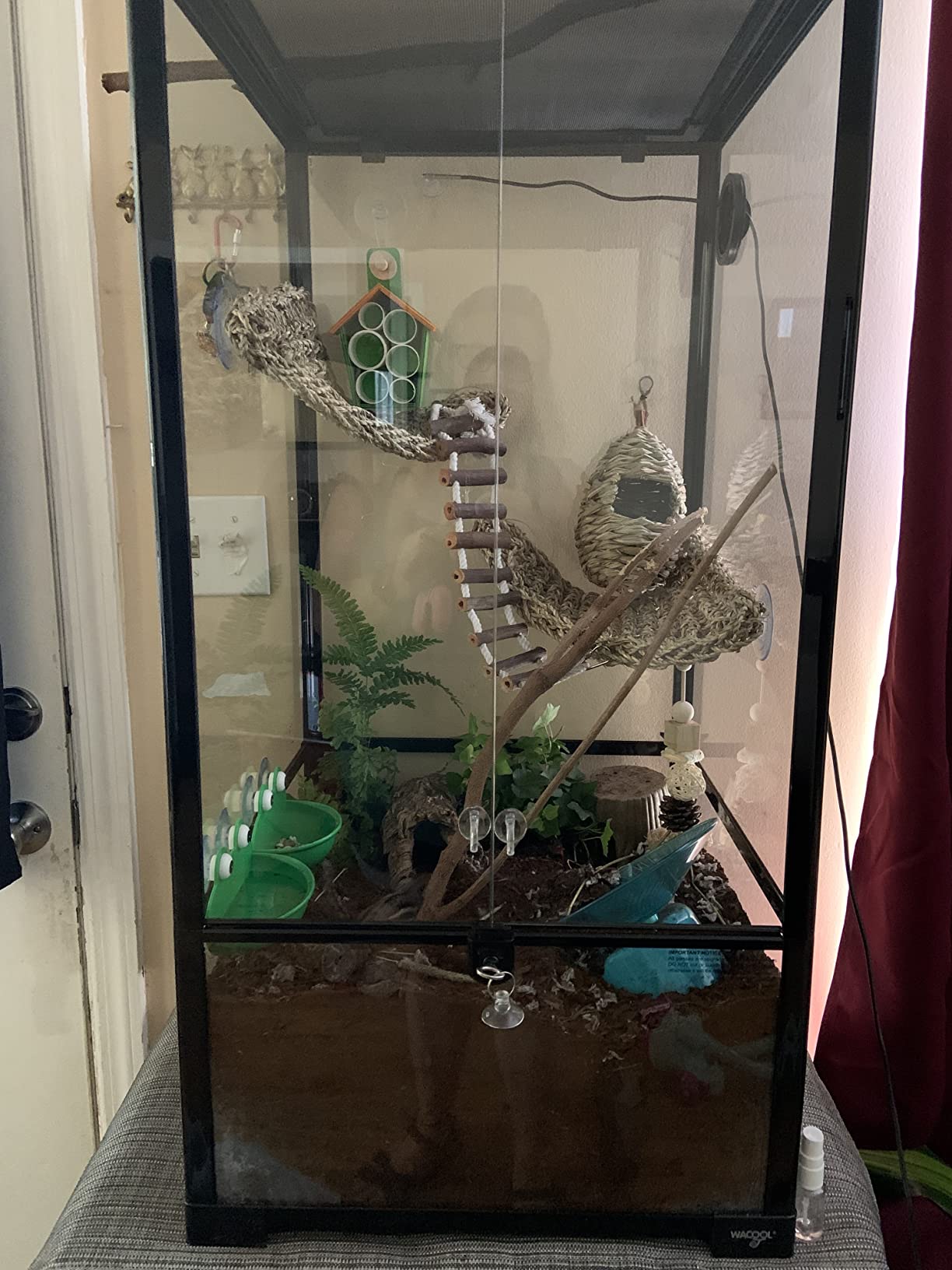
Owners report a 5-minute install or knock-down and free replacement service for damaged parts. At 41.85 pounds it is manageable for one person on a stand.
The honest limitation is that 30 by 18 inches sits below the footprint most keepers target for adults. This is a juvenile or grow-out box, or an enclosure for a smaller species sharing the room.
Where this one fits best
If your room simply cannot take a 48-inch unit, a 30-inch enclosure is far better than refusing the animal. Many keepers start here at roughly 18 to 24 inches of snake length and upgrade at the next size step rather than starting over from scratch.
Where it falls short for your setup
The security buckle and lock hardware are described as basic, and the anti-escape features depend on the lid buckle seating correctly every time you close it. The thin wire top may also need reinforcement if you hang multiple fixtures from it.
8. REPTI ZOO 120 Gallon PVC – Best for Heat Retention
- PVC holds heat and humidity better than glass
- Thicker-than-average panels with recessed cover ledges
- Sliding glass door glides smoothly with a safety lock
- Available across four sizes as the snake grows
- Screw holes can crack if screws are overtightened
- Light shows through panel gaps
- Bottom is not sealed and will leak under a bioactive setup
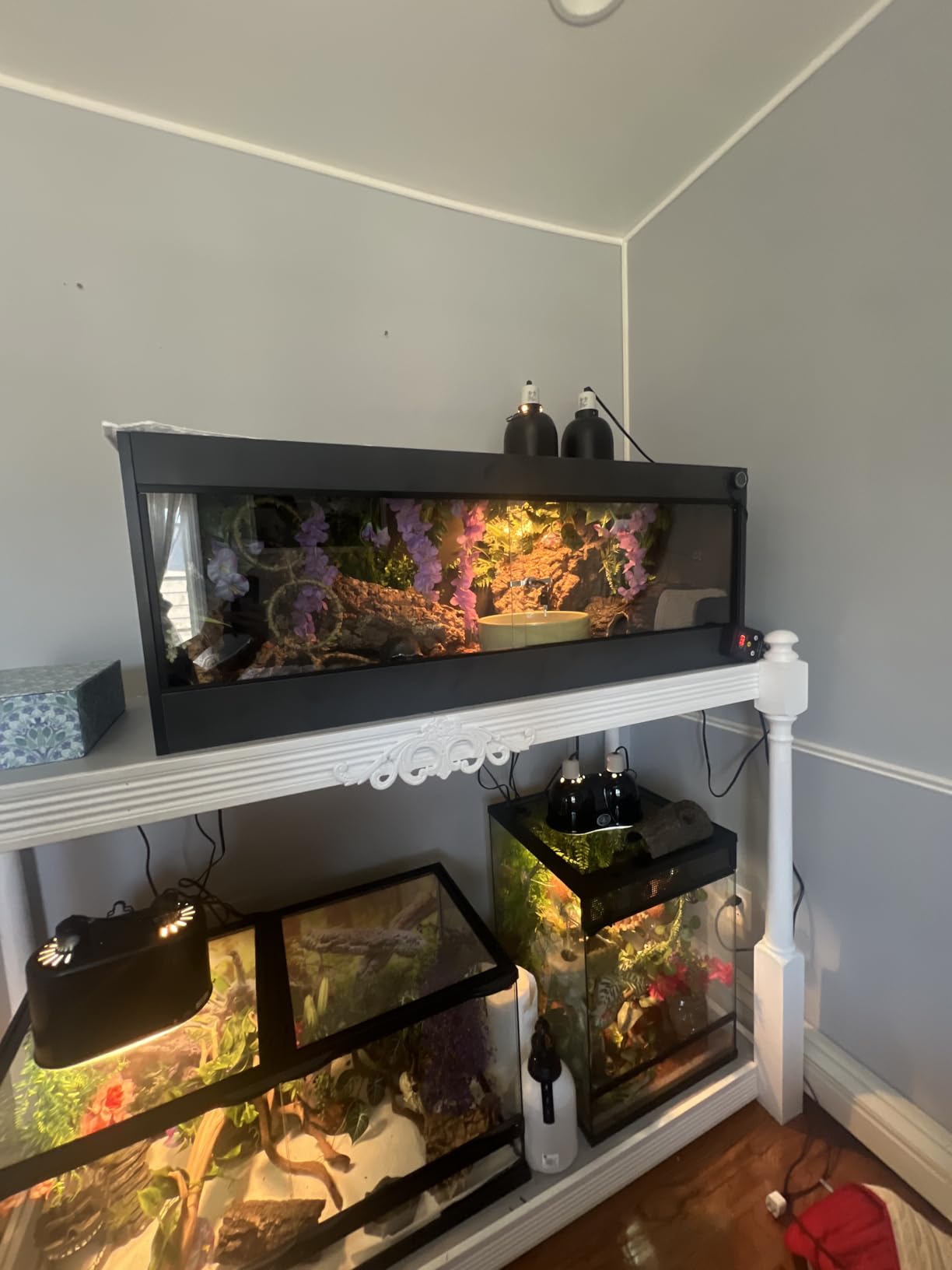
The manufacturer states the point of this build plainly: PVC insulates and regulates temperature better than glass or wood. That translates directly into steadier basking-spot temperatures, lower energy use, and a humid enclosure that needs less correction. Multiple ball python owners report easy, stable humidity management with this model.
It is a true 48 by 24 by 24 PVC enclosure with a removable tempered glass sliding door that includes a safety lock, and a detachable mesh screen top that still passes full spectrum, UVB and IR. Upper and lower ledges give the animal partial cover, which matters in a 4x2x2 where the animal could otherwise feel exposed.
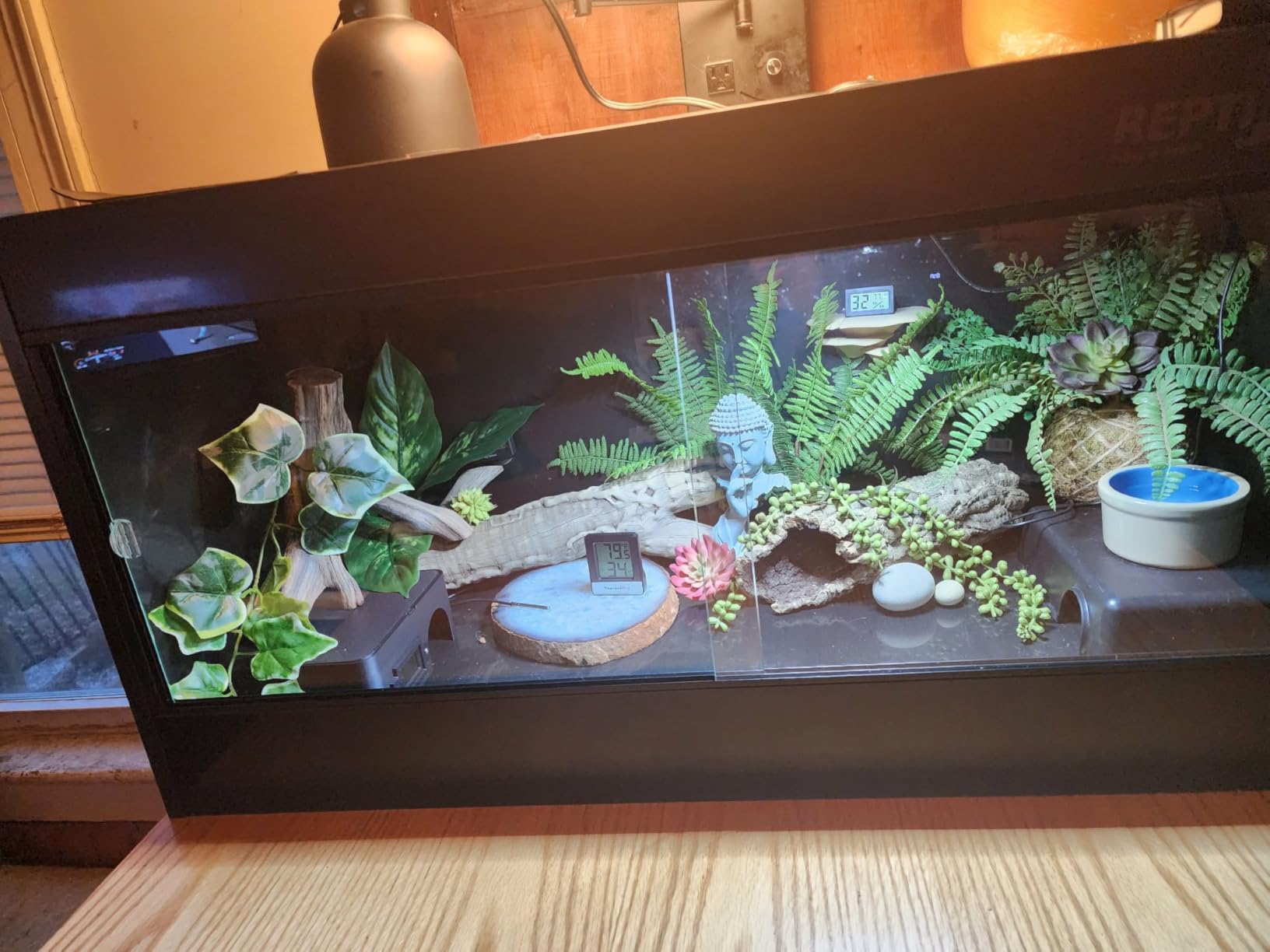
One advantage worth knowing about: it is sold across 24x18x18, 36x18x18, 48x18x18 and 48x24x24 sizes, so you can stay within one brand as your snake grows.
The 4.1 rating reflects assembly rather than design. Owners report screw holes cracking if screws are tightened too hard, light showing through panel gaps that undercuts the cover ledges, and an unsealed bottom that will leak under a bioactive setup.
Why heat retention matters in winter
In a cold Northeast basement or an unheated garage, glass enclosures need more wattage and still deliver uneven temperatures. PVC loses less heat, so your thermostat works inside a narrower band and the warm side of the gradient stays stable overnight without a room heater.
Where it falls short for your setup
At 66.14 pounds it is the heaviest enclosure here despite PVC construction, so it is not the easy move for deep cleans. Build it carefully on a padded surface, and silicone-seal the bottom before adding any bioactive layers.
9. Zilla QuickBuild 65 Gallon – Best Locking Glass Top
Zilla QuickBuild Reptile 65 Gallon Glass Terrarium, 36″ x 18″ x 18″
- Top screen
- feeding port and front doors can all lock
- Tempered glass throughout with a clean modern look
- Stackable design suits multi-animal setups
- Removable bedding tray simplifies substrate changes
- 36x18x18 is under the adult 4x2x2 footprint
- Access limited to the front door and the feeding port
- Higher cost than similar glass or PVC units
The security story is what separates this enclosure. The top screen is double-hinged and locks, the front glass door locks, and there is a feeding port in the top, so you can offer prey without opening any panel at all. No other glass unit in this roundup closes down completely.
Everything is tempered glass, with a solid water-holding base or a removable bedding tray depending on how you want to manage substrate. Assembly follows simple follow-along instructions, and the design is stackable for multi-animal setups.
Owners report strong satisfaction, driven by the tempered glass quality and the top screen with feeding port. The removable bedding tray makes cleaning and substrate changes much faster than draining a solid base.
The 36 by 18 by 18 footprint is the tradeoff. It is a fine adult enclosure for smaller pythons and an excellent grow-out unit, but it is under the 4x2x2 minimum for the largest females.
Who should pay for this one
If escape prevention is your top priority, or you keep several snakes in one room and want each unit to close down fully, the lockable top earns its premium. It is also a strong quarantine enclosure, since a fully sealed unit is easier to disinfect between animals.
Where it falls short for your setup
Access is limited to the front door and the top feeding port, so placing large hardscape is more awkward than in a top-opening design. And you pay more for a 36-inch footprint than comparable PVC enclosures offer at nearly double the length.
10. ToxiRium 76 Gallon Stackable PVC – Best for Breeders
- PVC retains heat and humidity better than glass
- Support bars hold lighting and heavy hardscape safely
- Two door locks and spacers included in the box
- Lightweight at 39 lbs for its volume
- 20-inch depth suits rooms where 24 will not fit
- Premium tier for the volume
- 20-inch depth is under the 4x2x2 adult minimum
- Sold mainly as a stacked two-unit kit
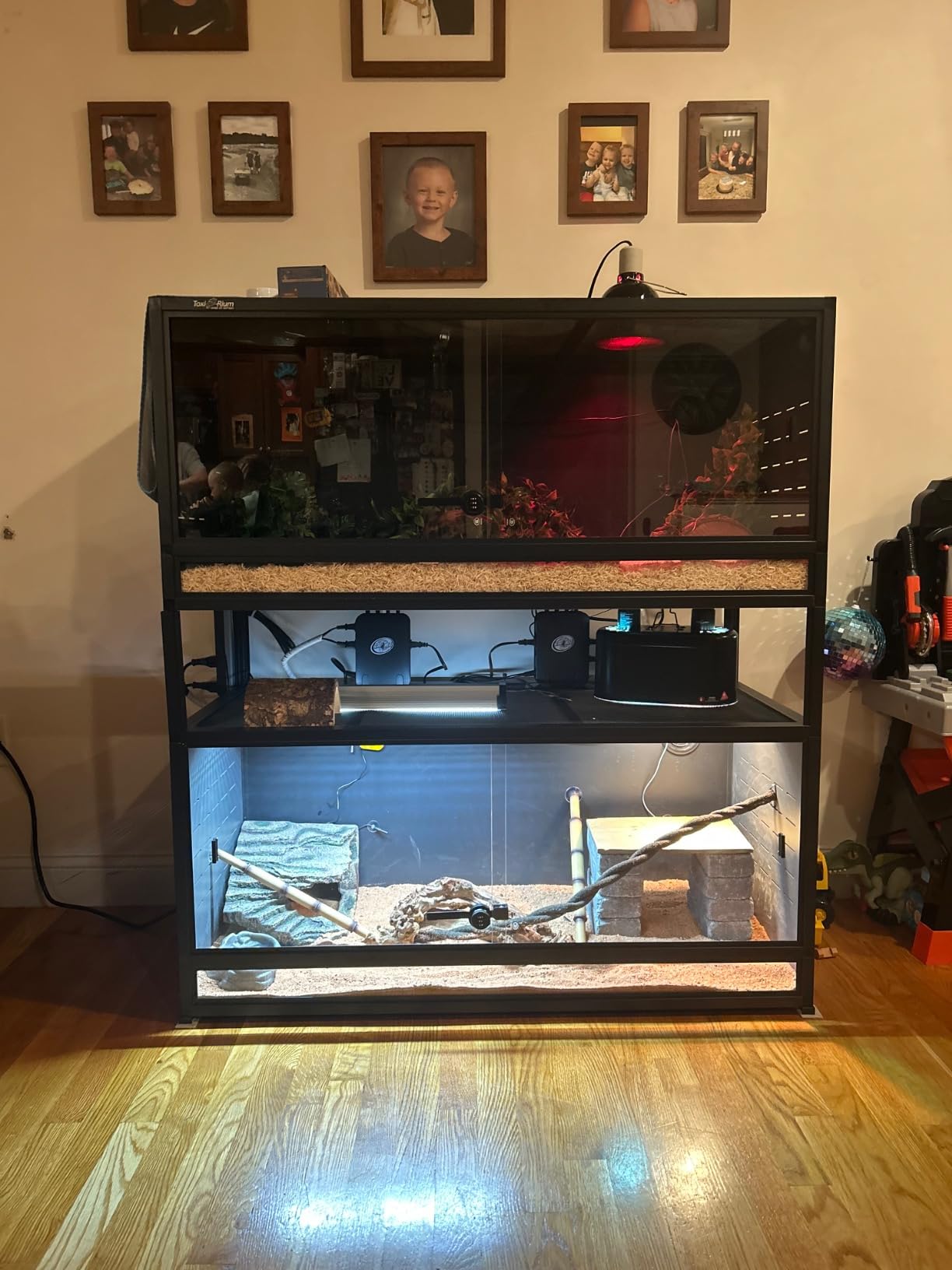
Breeders care about two things the hobby keepers skip: does the unit lock, and can I stack it. This enclosure includes two sliding-door locks and stacking spacers in the box, and it is offered in stackable two-unit configurations, which means a breeding pair runs in a single footprint.
The support bars are the sleeper feature. Bars across the top screen secure lighting fixtures, and bottom support bars take the weight of heavy hardscape. That is what lets you build a proper tall background without the screen bowing.
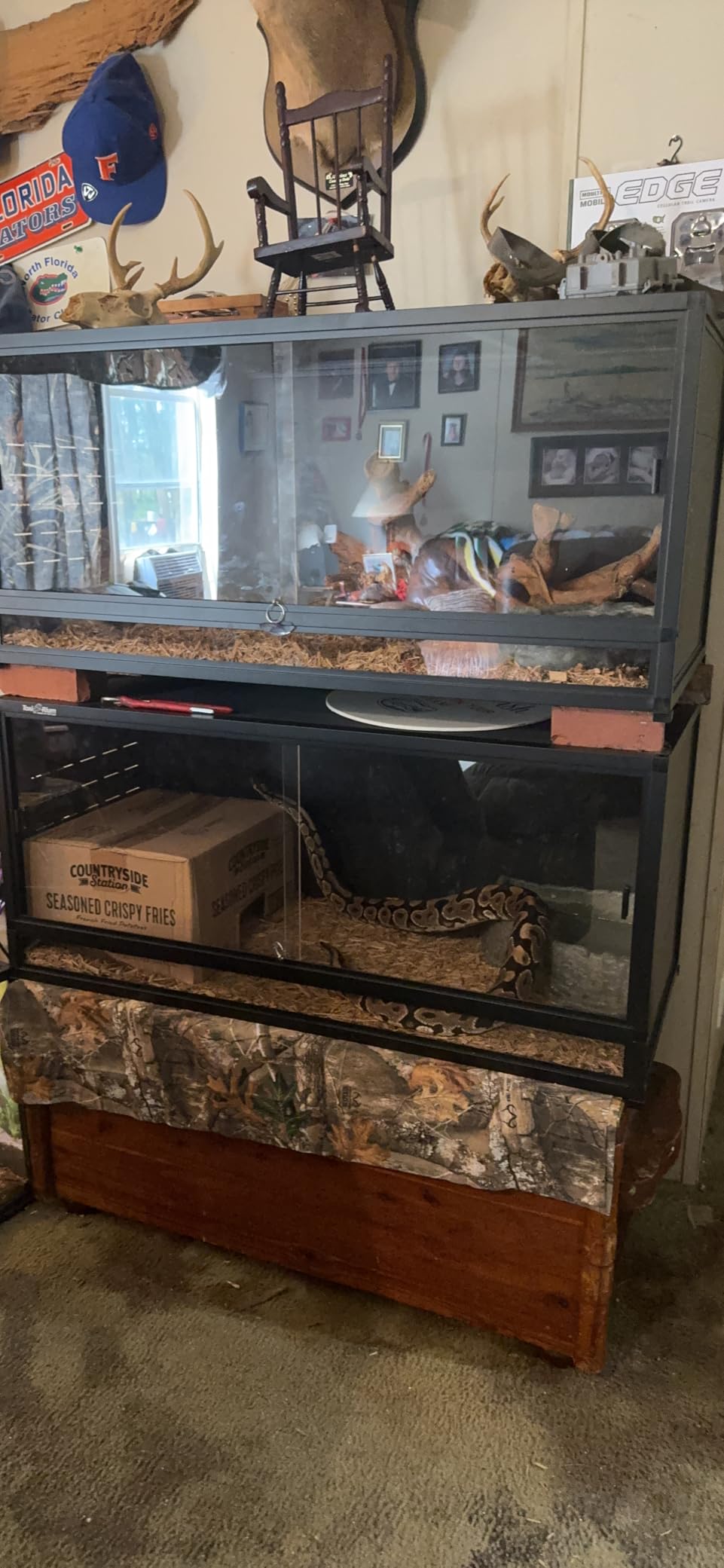
At 39 pounds for a 76 gallon volume, it is light for its size, and the manufacturer notes that PVC has lower thermal conductivity than glass, reducing heat loss and energy use. Buyers specifically value that the locks and spacers are included rather than sold separately.
The reservations are predictable: this is the premium tier of the group, a 20-inch depth sits under the recommended 4x2x2 adult footprint, and a two-unit kit format may not suit single-animal buyers.
How breeders use a stack
Stack units give you two independent enclosures in the space of one, which is how most small-scale breeders double capacity in a spare room. The spacers create the vertical gap for cables and heat sources between levels. You still need a separate enclosure for each animal, since ball pythons of the same sex will still fight and cannibalism is documented.
Where it falls short for your setup
If your room is already tight, the 20-inch depth is the compromise built into this design, and it is below the 24 inches most adults use fully. For a single pet with no breeding plans, a 4x2x2 at 44 pounds is the better fit.
Ball Python Enclosure Buying Guide
Choose a ball python enclosure by matching the footprint to your snake’s current length, picking a material that suits your room’s humidity, and confirming that the door closes. Everything else, from colour to trim level, matters far less than those three things.
How big should a ball python tank be?
Match the enclosure length to your snake’s length, and step up in size as the animal grows rather than starting adult-sized. Hatchlings do not do well in a 4x2x2; they feel exposed and stop eating.
- Hatchling, up to about 300 g: 20 x 11 x 13 inch footprint with about 12 inches of height.
- Juvenile, under 3 feet: 36 x 18 x 18 inches, which is a 50 to 65 gallon class tank.
- Adult male, over 3 feet: 48 x 24 x 24 inches, which is a true 4x2x2 and 120 gallon footprint.
- Large adult female, 4 to 5 feet: 48 x 24 x 24 inches or larger, with 24 to 36 inches of height for vertical use.
The single rule behind all four rows: the enclosure should be at least as long as the snake. Move up when your snake’s snout-to-vent length reaches the enclosure length, when it fails to move across the enclosure in a straight line, or when it stops using the full length. Weight alone is a poor trigger because males and females of the same weight differ in length.
Glass vs PVC vs composite: which holds humidity?
PVC and HDPE hold 60 to 80 percent humidity with no modifications; glass with a full screen top does not. Glass is heavier and more expensive, it loses heat and moisture faster, and it shows every fingerprint. PVC is lighter, opaque, cheaper to run, and front-opening by default. Eco-composite sits in between: often less costly than PVC, but the panels are moisture-resistant rather than waterproof and can smell over time.
The only reliable way to fix a glass tank is to reduce the ventilation area: cover two-thirds to three-quarters of the screen top with plastic or a shower curtain liner, leaving a strip clear. In a genuinely dry climate, add a humidifier inside the enclosure and keep the water bowl buried in the humid hide.
Heating, thermostats and humidity targets
Aim for a hot side of 88 to 92F and a cool side of 78 to 80F, with relative humidity between 60 and 80 percent. Every heat source needs a thermostat, and every enclosure needs a digital probe thermometer and hygrometer placed at the animal’s level, not at the top of the cage.
Set up in this order: substrate, then the heat source, then the thermostat, then probe placement, then two hides plus a humid hide, then the water bowl, then lighting. Two hides is the minimum for a burrowing species; a snake that has to choose between them will pick the one further from you and hide in it constantly.
Stands, floor space and what actually fits
A 48 by 24 inch enclosure needs a stand at least 24 inches deep, and most consumer furniture stands are 24 inches deep or less, which means no clearance behind the cage for cables. Check that your stand is rated above the loaded weight of the enclosure plus hardscape before you put anything on it.
If your room will not take 48 inches, work down to a 36-inch footprint rather than cutting it further, and measure the doorways and stairwells before you commit. Standard doorways are narrower than most hobbyists expect.
Matching your enclosure to your climate
Dry Southwest, cold Northeast, and humid Southeast households need different setups. In dry or cold rooms, sealed PVC is the short answer and a humidifier may be necessary. In humid rooms, a glass tank with partial screen coverage works fine and is the cheaper starting point.
Safety checklist before the snake arrives
Run through this list before the animal is in the enclosure, because most of these fixes are easier on an empty tank.
- Install a lock on every sliding or hinged door and confirm it holds a firm tug.
- Never use tape to secure a lid; it degrades and gives no real containment.
- Measure clearance from any heat lamp to the lid and side panels.
- Tape the thermostat probe down at the warm end so it reads body-height air.
- Check every panel seam and light gap with a flashlight from inside the darkened room.
- Never house two ball pythons together; cannibalism is documented.
Why we do not recommend fish tanks
The most common first enclosure new keepers buy is a repurposed aquarium, and it is the one we recommend against. Standard aquariums are top-opening with a screen lid, no locks, brittle non-tempered glass, silicone seams that were never meant to be dry, and a base without a substrate barrier. A python can push a screen lid and climb out, and a heavy glass tank cannot be moved for cleaning.
Frequently Asked Questions
What kind of tank is best for ball pythons?
A front-opening enclosure in PVC, HDPE or sealed composite, at least as long as the snake, that holds 60 to 80 percent humidity, has locking doors, and fits two snug hides. Glass works too, but a full screen top loses humidity quickly and needs partial covering.
What size tank is best for a ball python?
Match the enclosure length to the snake. Hatchlings up to about 300 g need roughly 20 x 11 x 13 inches. Juveniles under 3 feet need 36 x 18 x 18. Adults over 3 feet need a true 4x2x2, which is 48 x 24 x 24 inches. Step up gradually as the snake grows.
Is a 75 gallon tank big enough for a ball python?
For a juvenile or small adult male, usually yes. A 75 gallon tank is roughly 36 x 24 x 24 inches, so it is long enough for a snake up to about 3 feet. For a large adult female, step up to a 48 x 24 x 24 enclosure so she can stretch out along the full base.
Can ball pythons live in glass tanks?
Yes, with adjustments. Glass is heavy and loses heat and humidity faster than PVC, and the screen top is usually the leak. Cover two-thirds to three-quarters of the screen top with plastic, keep a humid hide and a mostly full water bowl, and run a hygrometer to confirm the enclosure holds 60 to 80 percent.
Do ball python tanks need a screen top?
Not necessarily. Front-opening PVC and composite enclosures often use vented panels or a solid top, which helps them hold heat and humidity without modification. Screen tops are common on glass tanks because they allow lamp mounting and UVB penetration, but they work against humidity retention.
Conclusion
The best reptile tanks for ball pythons come down to three picks from this list of ten. The Phailozoo 120 Gallon is our overall choice, with a true 4x2x2 footprint at 44 pounds and a metal mesh top that barely filters heat or UVB. The Reptile Habitats V3 is the best value if you plan to move the enclosure alone or deep clean it regularly. The New Age Pet ECOFLEX is the budget pick, backed by the deepest review history and a 10-year warranty.
Whatever you choose, match the footprint to your snake’s length, confirm the doors actually lock, and run a hygrometer before you bring the animal home. Then plan the next size up, because you will need it sooner than you expect.