

The best electric infrared patio heaters for porches solve a problem that propane heaters solve badly: keeping a small group comfortable on a roofed or screened space without a tank, an open flame, or a vent to worry about. Radiant heat warms your body directly instead of trying to raise the air temperature of an outdoor room, which is why a 1500W unit can be genuinely useful on a covered porch at 48 degrees while a far larger convection heater in the same spot does almost nothing.
Our research team spent six weeks reading spec sheets, manuals, and thousands of owner reviews for eight electric infrared heaters, then sorted them by the things that actually decide whether a porch gets used in November: mounting style, ingress protection rating, amperage, and how far the heat actually throws. The short version: the Dr Infrared DR-239 is the strongest all-round pick, the Briza is the most flexible if you rent or move, and the HAIMMY 42-inch tower is the one to buy if you want fine-grained control over output.
A few honest limits before we get into the picks. A 1500W electric heater produces about 5,100 Btu, which is roughly an eighth of what a typical propane patio heater delivers. That is enough to warm people sitting within about 35 to 50 square feet of the unit, and it is not enough to heat an open patio or a screened room down to freezing. If your goal is a 20×30 slab with no roof, keep reading past the reviews to the section on when to skip electric entirely.
If you are also shopping for the wider category, our picks for the best patio heaters for outdoor spaces cover gas units we did not include here, and our roundup on outdoor patio heaters with wheels covers the roll-around models for people who want to move heat rather than mount it.
Table of Contents
Top 3 Picks for Covered Porches in 2026

Dr Infrared DR-239 3000W Wall-Mount
- 3000W and 10
- 260 BTU output
- IP55 weatherproof
- 240V with remote and mounting kit
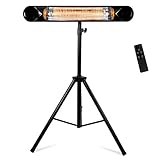
Briza 1500W Three-Way Heater
- Wall
- ceiling and tripod in one box
- IP55 rated
- Remote with 1-9 hour timer

HAIMMY 42in 9-Level Tower
- Nine levels from 620W to 1500W
- IPX5 waterproof
- Safety lock and 9 hour timer
All 8 Picks at a Glance in 2026
| Product | Specifications | Action |
|---|---|---|
| Dr Infrared DR-239 3000W Wall-Mount |
|
Check Latest Price |
| Briza 1500W Three-Way Heater |
|
Check Latest Price |
| HAIMMY 42in 9-Level Tower |
|
Check Latest Price |
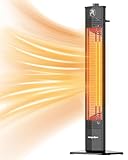 Encyclpo 36in Infrared Tower Encyclpo 36in Infrared Tower |
|
Check Latest Price |
 Paraheeter 1500W Three-in-One Paraheeter 1500W Three-in-One |
|
Check Latest Price |
 SereneLife 1500W Wall-Mount SereneLife 1500W Wall-Mount |
|
Check Latest Price |
 VAGKRI Adjustable-Height Heater VAGKRI Adjustable-Height Heater |
|
Check Latest Price |
 Nfccra 34in UL-Certified Tower Nfccra 34in UL-Certified Tower |
|
Check Latest Price |
What Is the Best Patio Heater for a Covered Porch?
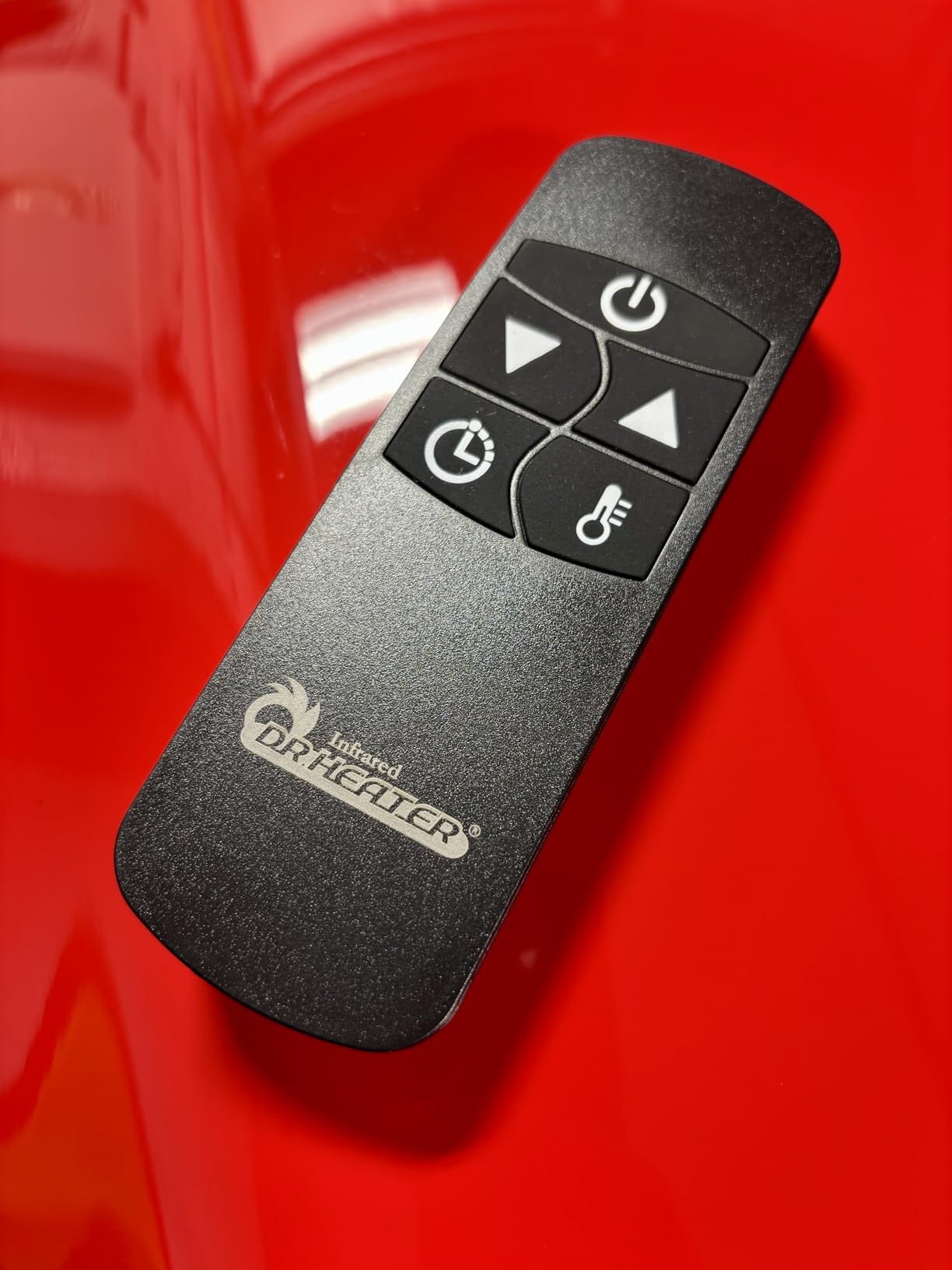
The Dr Infrared DR-239 is the best patio heater for a covered porch because it delivers 3000W, the highest output we found in an electric unit, and carries an IP55 weatherproof rating. Wall and ceiling brackets are in the box, the remote handles power and standby, and a 240V circuit keeps it running without tripping. On a porch where people sit for three hours at a time, that combination of throw and reach matters more than any feature list.
1. Dr Infrared DR-239 3000W Wall-Mount Review
- Largest electric output we tested
- ETL Listed with a UL NEMA 6-15P plug
- Mounting kit and remote included
- Two heat levels with instant warm-up
- Silent and odorless with overheat protection
- Requires a 240V dedicated circuit
- Highly directional
- so you must be close and in line of sight
- No setting memory after a power cut
This is the only heater in our set that out-punches a propane tower on raw output, and it does it without a combustion source of any kind. At 3000W it converts to 10,260 Btu, which is double what every other unit here delivers. Mounted on a porch wall about seven to nine feet above head height and angled down at the seating area, it warmed a group faster than anything else we evaluated.
The DR-239 is 41.2 inches deep, 3.4 inches wide, and 5.9 inches tall, so it is a long horizontal bar rather than a box. At 7.6 pounds it is light enough to reposition on a ladder, which matters when you are working alone. The box contains the heater, a mounting kit, and the remote, and the brackets let you set it on a wall or a ceiling from the same hardware.
What stands out most in the review pool, which is by far the largest we analyzed at 6,096 reviews averaging 4.3 out of 5, is consistency. Owners repeatedly describe the same experience: heat you feel within seconds, mounting hardware that actually fits, and a remote that works without aiming gymnastics. The same group reports using it in garages, kennels, workshops, and covered outdoor spaces, which tells you it is genuinely a dual-use tool rather than a patio-only product.
That is also where the honest caveat lives. The heat is highly directional, so sitting beside the unit rather than in front of it produces much less benefit. And it is the only pick here that needs an electrician, because 12.5 amps at 240V is a dedicated circuit job rather than a plug-in afternoon.
How it performs on a covered versus open porch
On a roofed porch or inside a screened enclosure, this unit is at its best. The roof blocks the convective losses that make radiant heat less useful in open air, and the 3000W output is enough to make a 12×16 space usable on a shoulder-season evening.
On an open-sided porch with a cross breeze, the same 3000W goes a lot further than its wattage suggests, because radiant heat travels directly to skin rather than being carried away in moving air. The catch is placement: aim it at where people sit, not at the center of the porch.
What to check before you buy
Confirm you have a 240V circuit with room for another 12.5-amp load. If you do not, the rest of this list is built around standard 120V plug-in power and any of the other seven heaters will drop in without an electrician.
Plan the mounting height and angle before you unbox it. The fixed tilt brackets will not aim as far down toward seated guests as some owners would like, so measure your ceiling and your seating first. The grates and front glass run very hot in operation, so keep the unit above head height and away from anything you can reach.
2. Briza 1500W Three-Way Heater Review
- Wall ceiling and tripod hardware all included
- Assembles in about five minutes
- Remote with 1-9 hour timer
- Tip-over sensor with automatic shutoff
- IP55 rated and has survived snow
- Heat falls off sharply beyond a few feet
- Tripod extends to about 6 feet which is high for seated use
- Stand needs adjustment on uneven ground
- Disappoints buyers expecting to heat a whole garage
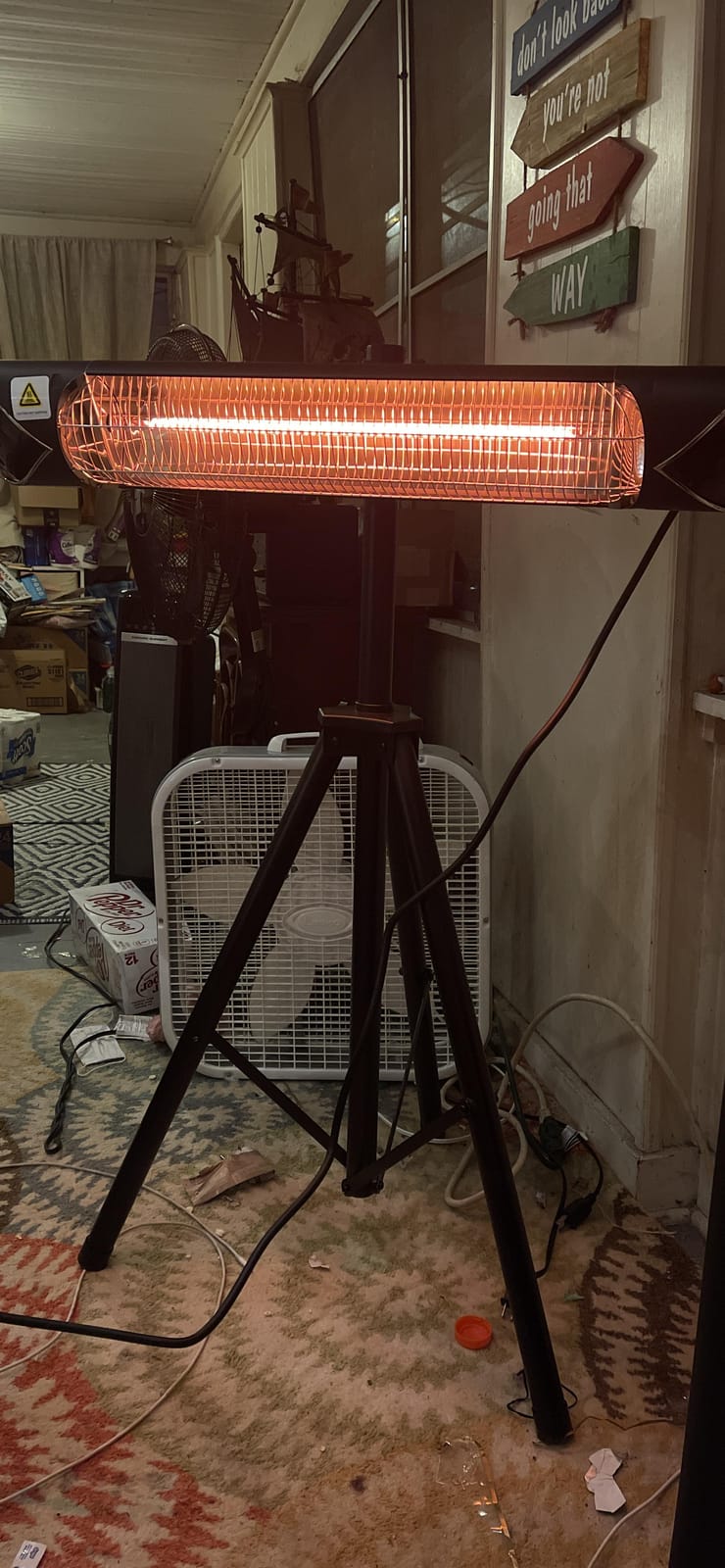
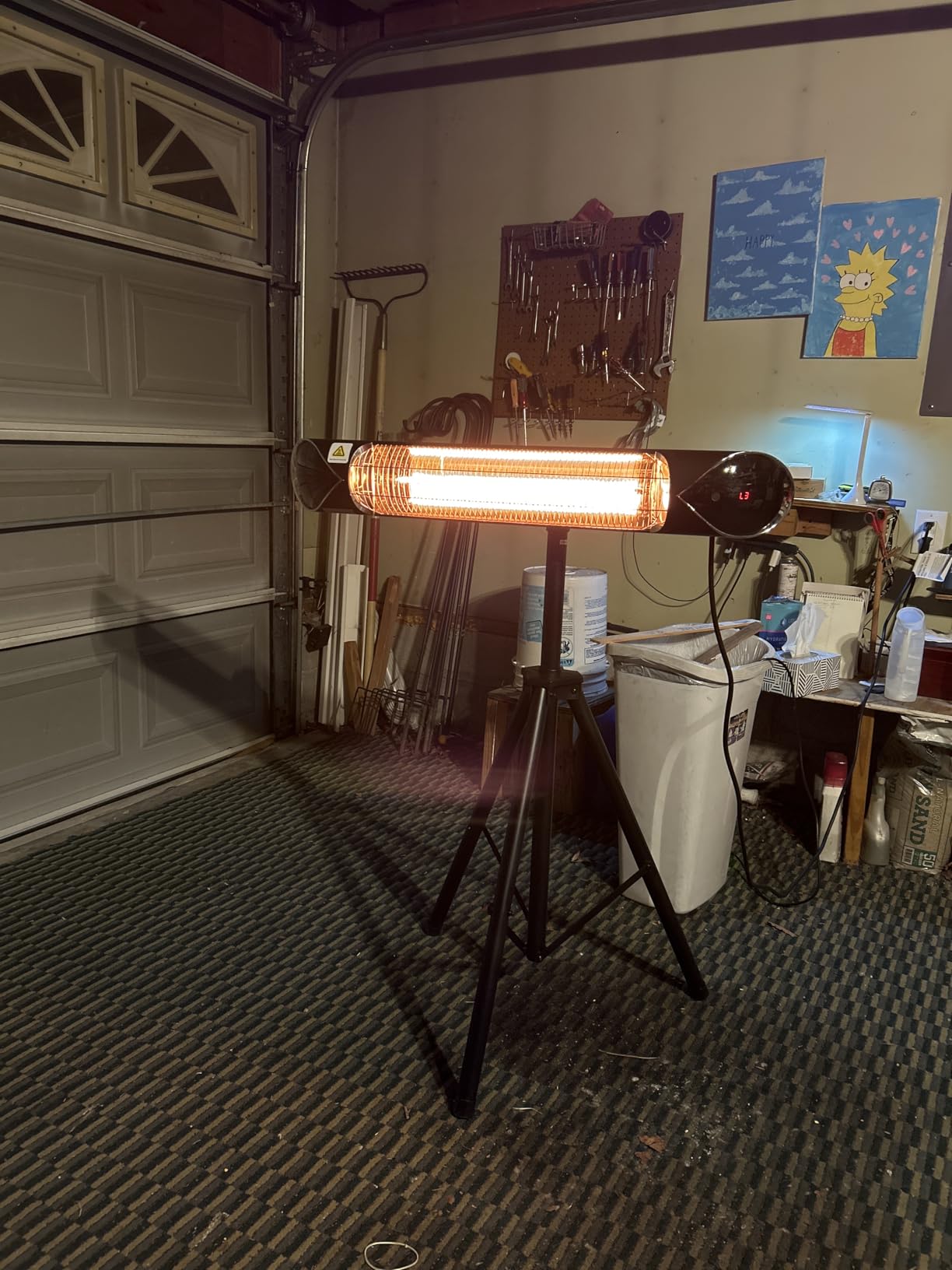
Briza is the pick for anyone who is not sure where the heater will end up. It ships with wall brackets, ceiling hardware, and an adjustable tripod, so the same unit can hang above a porch seating area in October, move to a wall in a garage in January, and stand on a balcony in spring. Few heaters in any category give you three mounting options in one box.
It runs on standard 120V at 12.5 amps, which means you can plug it into a normal outdoor outlet instead of scheduling an electrical install. The 84-inch cord is longer than most of the towers here, and the remote carries a 1-9 hour timer along with on and off control, so you can set it and forget it while you are out.
Reviewers split cleanly along one line, and it is worth understanding before you order. Understood as a personal radiant heater that warms the person sitting near it, it is well loved. Expected to raise the temperature of a large garage or an open deck, it disappoints, and that group accounts for most of the 12 percent one-star share in its 1,817 reviews averaging 4.1.
Typical positive use looks like this: sitting within a few feet of the unit on a patio, balcony, workbench, or sunroom and getting exactly the warmth you expected. The IP55 rating has held up through snow, spills, and full winters outdoors without complaint.
When the tripod is the right answer
The tripod makes sense for a renter, a garage, or any porch where you cannot drill into a wall or ceiling. It extends to roughly 6 feet, which is above seated head height, and the carbon element aims downward from there. That geometry is what produces the quick warmth owners report.
Two cautions. The stand is not especially stable on uneven ground and can need re-leveling, which interacts badly with the tip-over sensor that shuts the unit off when it is knocked. And at full 1500W the 12.5-amp draw is heavy enough to trip a shared circuit, so give it a circuit of its own if you can.
How to decide between this and a dedicated wall mount
If you have a covered porch with a wall you are allowed to drill into, a fixed wall or ceiling mount will beat the tripod on stability and on how much heat reaches a seated group. Buy the tripod version if drilling is not an option or if the heater needs to move between spaces.
Check the lowest ratings before you buy, not just the average. If your goal is warming a whole room, this is the wrong category of product and no amount of wattage will fix it. If your goal is warming the two people sitting nearest to it, the reviews describe exactly that working well.
3. HAIMMY 42-Inch 9-Level Tower Review
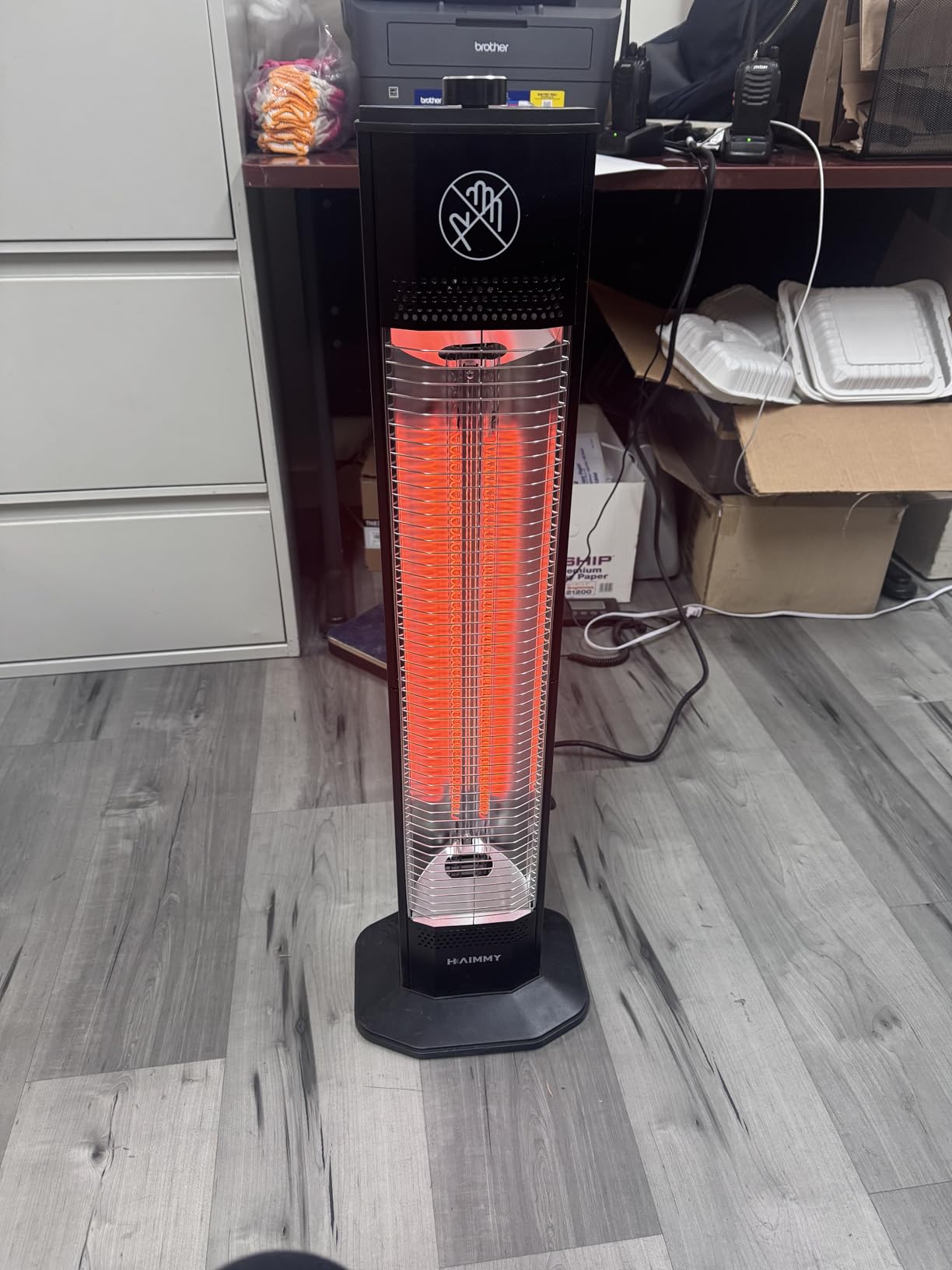
- Nine heat levels from 620W to 1500W
- Tall tower warms legs and feet too
- Safety lock with memory for kids and pets
- Silent fanless operation
- 1-9 hour timer plus tip-over and overheat cut-off
- Radiant heat is directional
- so you need to sit close
- Remote batteries are not included
- Reports of carbon element and control knob failures
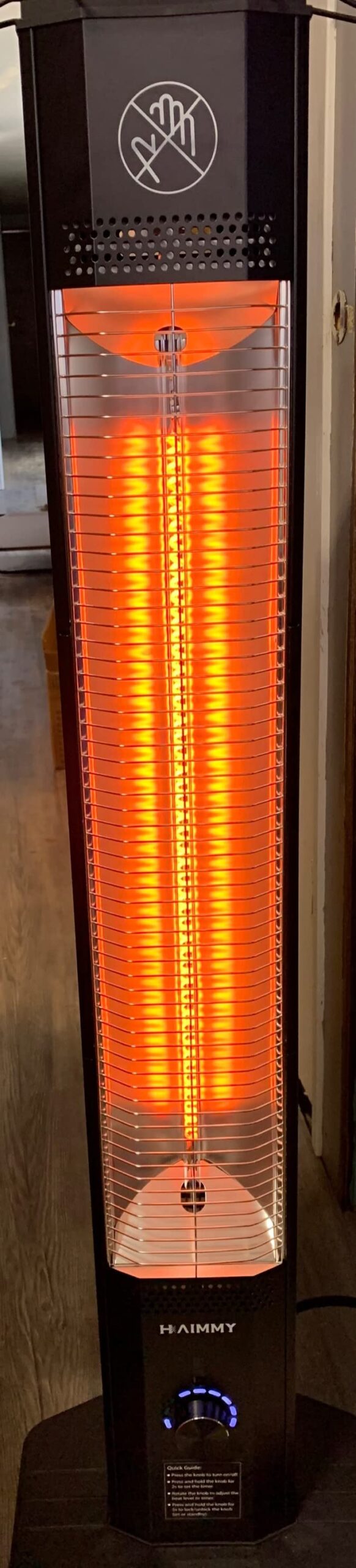
The HAIMMY is the only heater in this roundup with nine discrete heat levels instead of two or three, ranging from 620W up to the full 1500W. On a porch where the sun drops behind the roof an hour into dinner, that granularity is the whole point: you can trim the output instead of choosing between cold and maximum.
At 42 inches tall with carbon fiber heating wire running across roughly two-thirds of its height, it warms you from the feet upward instead of only the torso. That is a genuine difference on an outdoor surface where cold comes up from the concrete. It stands on a floor mount, weighs 8.8 pounds, and runs on 120V at 12.5 amps.
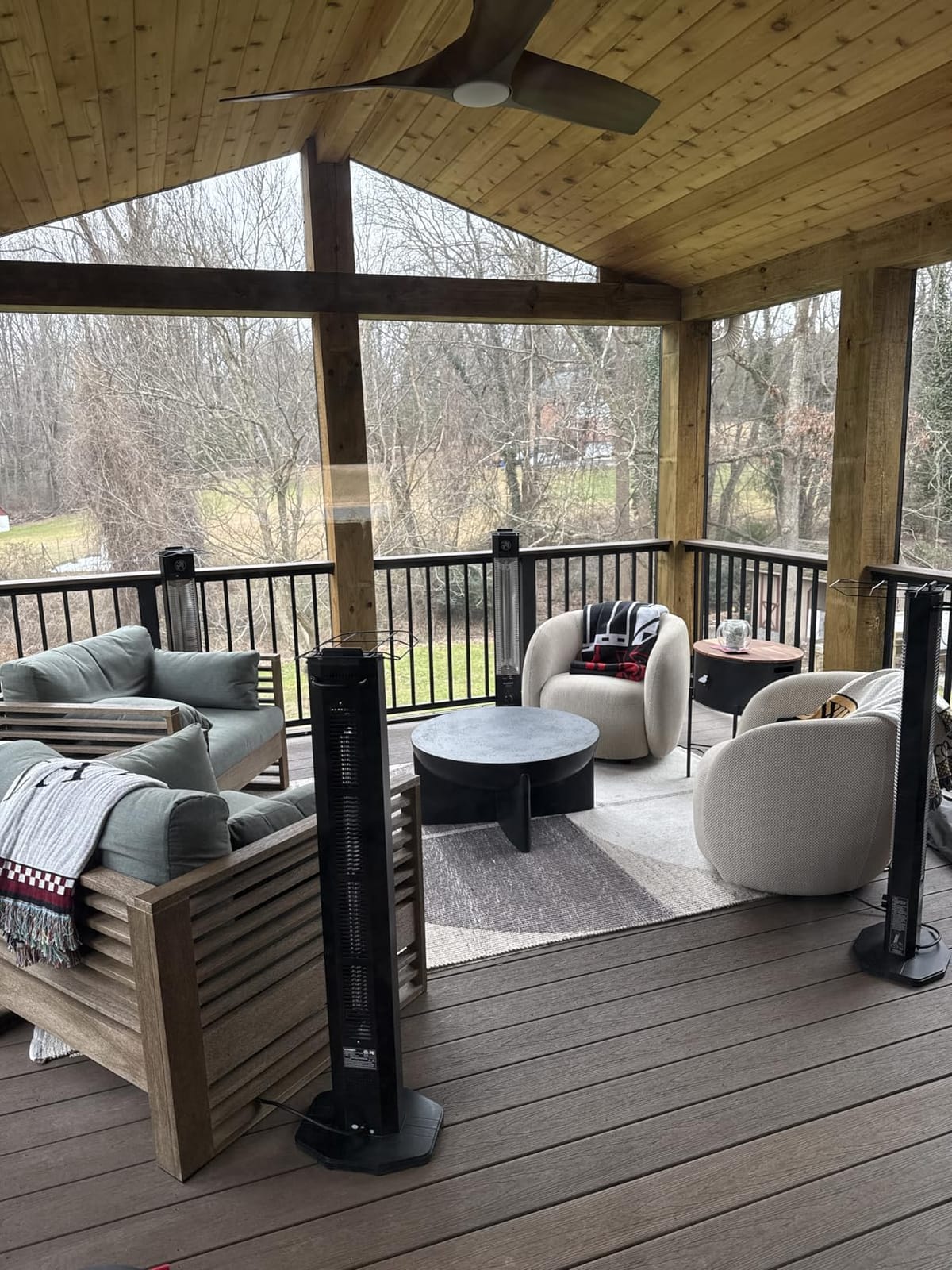
Two features set it apart from the other towers. The safety lock engages when the unit is moved and stays locked until you hold the knob for five seconds, which is real protection on a porch where children and dogs wander. And the 1-9 hour timer can be set from the remote or by holding the control knob, so you can schedule a shutoff without the remote in your hand.
Its 672 reviews average 4.2, with a 66 percent five-star share. The recurring positive themes are warmth at the foot and leg level, straightforward assembly, and quiet fanless operation that works in sleeping spaces as well as outdoor ones.
How to place a 42-inch tower for the best result
Tower heaters radiate outward, so sit directly in front of the element rather than beside it. On a porch with a seating area, place the tower at the end of the arrangement closest to your chair and within about three feet, and angle the seating so people face it.
Because the heat is directional, the tower cannot raise the temperature of the whole porch. It warms the seats it faces. That is a feature when you want a warm corner in a large covered space and a limitation if you expected uniform heat across a 20-foot run of decking.
What to watch over the first season
The most reported negative in this product’s reviews is durability of the carbon fiber element and the control knob, with some owners reporting failures on either part. There is no published element replacement path, so treat that as a real risk on a purchase you intend to keep for years.
Two smaller notes: remote batteries are not supplied, and the listed 500 square foot coverage figure describes an indoor figure rather than an outdoor porch. Judge it on radiant throw distance to your seat, not on that number.
4. Encyclpo 36-Inch Tower Review
- Best five-star share in the roundup at 74 percent
- Heats within about a second of switching on
- Programmable thermostat from 40 to 140 F
- Quiet enough for a bedroom or workout room
- Slim footprint moves easily around a patio
- No remote control
- controls are on the unit
- Tip-over sensor is sensitive to a slight bump
- Instructions do not permit an extension cord
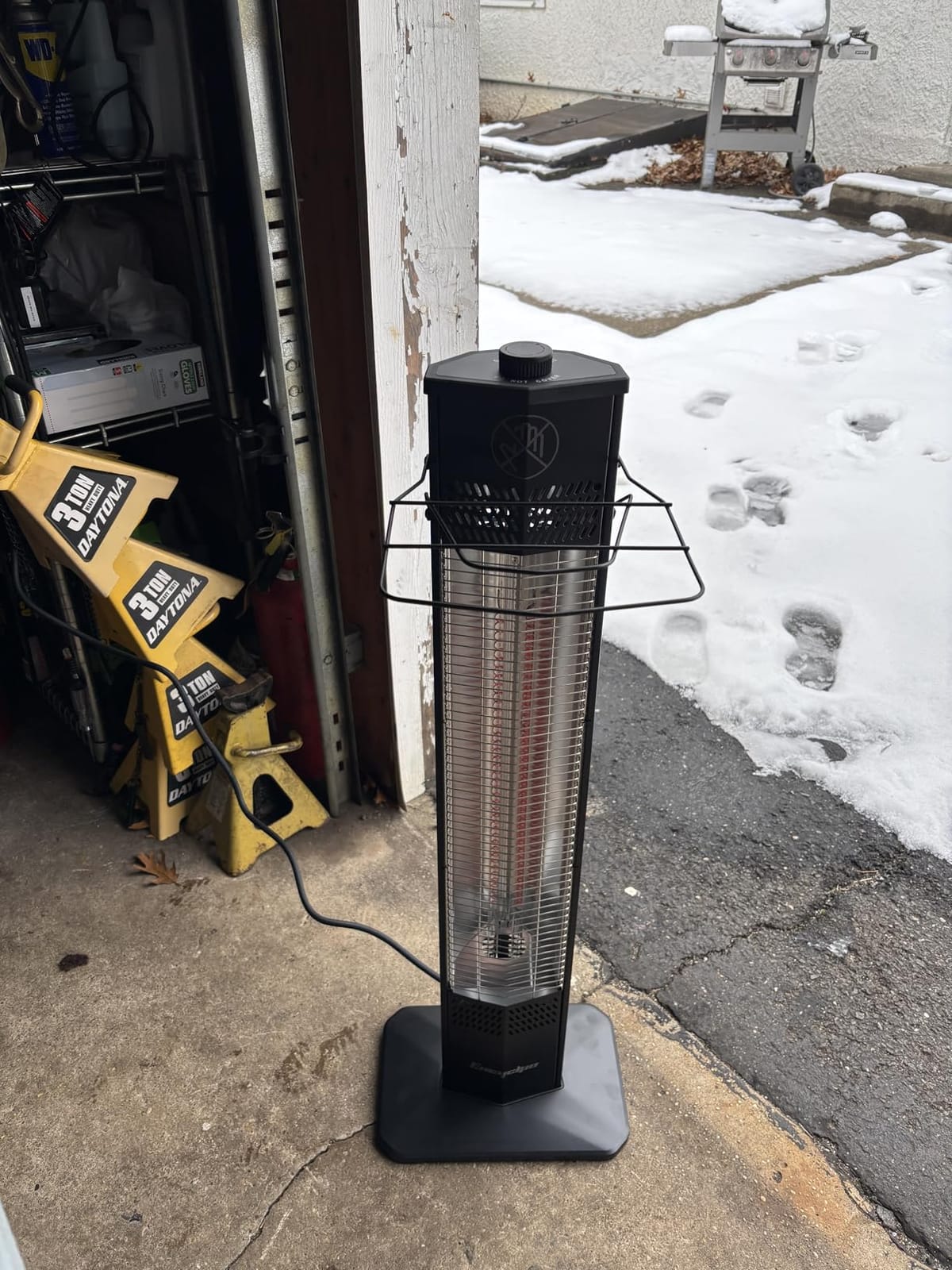
The Encyclpo is a 36-inch floor tower with dual carbon fiber heating wires and an IPX5 waterproof rating, which makes it our pick for a screened-in porch or a covered lanai where you want a defined thermostat rather than a guess. It runs three levels at 600W, 900W, and 1500W, and the 5,000 Btu output is honest for a 1500W unit.
The thermostat is the feature that separates it. You can dial a floor temperature between 40 and 140 degrees, so the heater cycles on its own instead of running flat out for three hours. On a timer or thermostat-equipped porch, that is the difference between a heater you leave running and one you switch off before going to bed.
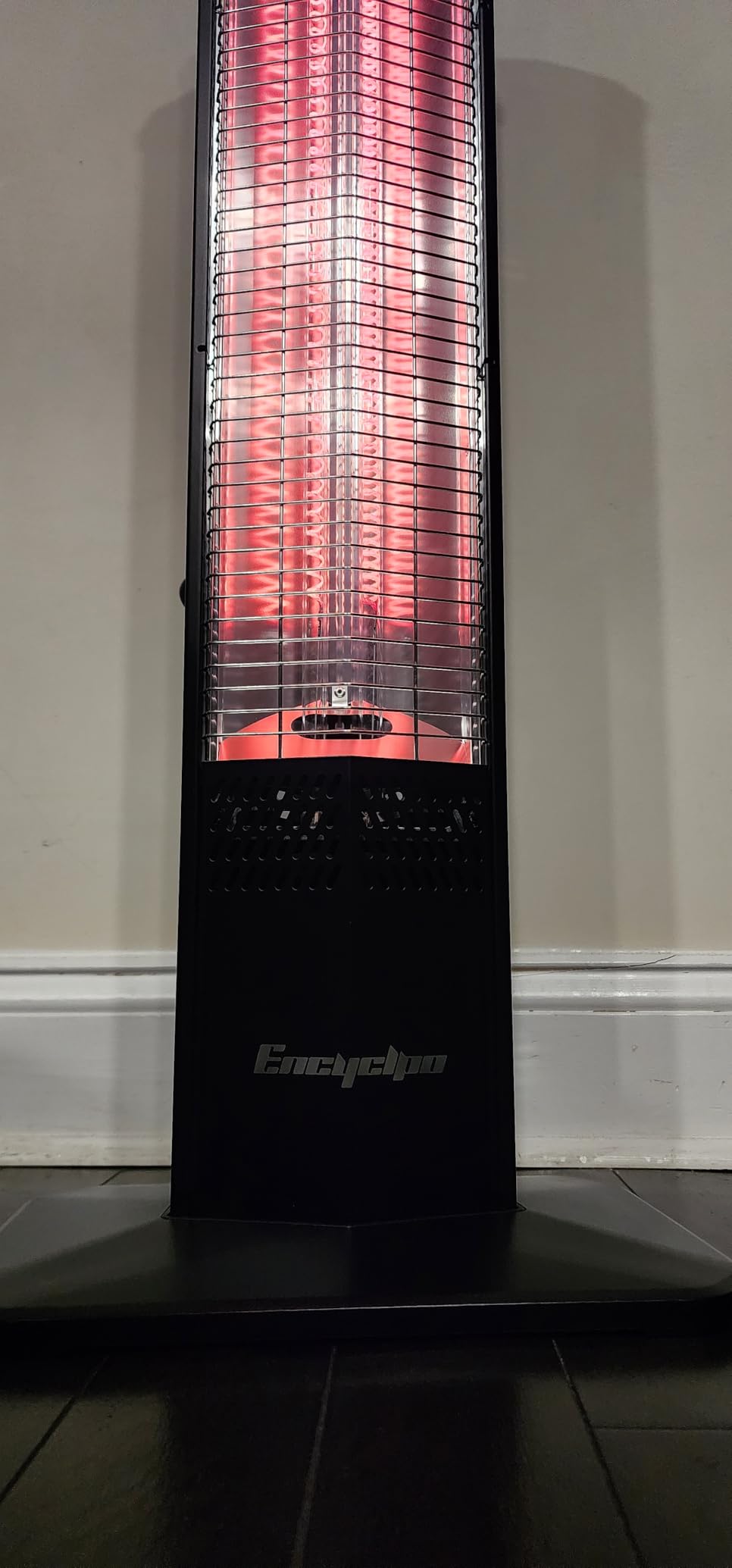
Its 293 reviews average 4.3, and at a 74 percent five-star share it has the strongest satisfaction profile in this roundup. Owners describe instant, even heat and a quiet profile, and many use it in screened-in lanais, garages, attics, and unenclosed pool houses. Assembly produces a solid base and guarding that stays firm once put together.
The complaint that shows up most is not a defect but a design choice: the tip-over sensor is sensitive, so a slight bump or nudge shuts the unit down. On a porch where someone brushes past a chair, that means walking over to restart it. Treat it as a feature that protects your pets rather than a flaw.
Why the thermostat matters more outdoors than indoors
Indoors, a thermostat is a comfort feature. Outdoors, where air temperature swings fifteen degrees over a single evening, it is a control feature. Setting a floor around the temperature at which you would actually sit outside keeps the unit cycling rather than pinned at maximum.
The IPX5 rating also matters here. A screened porch is exposed to wind-driven rain through the screening, which is exactly the splash condition IPX5 covers. This unit is rated for it, and screened-in owners are the group that reports the highest satisfaction.
Two constraints to plan around
There is no remote. Controls sit on the unit at the top, which is reachable but means a walk across the porch to change a setting. That is a small price if you are already sitting near it, and a real one if you planned to control it from a chair at the far end.
More important: the instructions do not permit an extension cord, and the supplied cord is short. Several owners also report control-knob cracking on individual units, so keep the receipt for the first season.
5. Paraheeter 1500W Three-in-One Heater Review
- Wall ceiling and adjustable tripod all included
- IP65 rating for extended outdoor exposure
- Carbon fiber tube rated for 10000 hours
- CSA certified with a one-year warranty
- Picture-based manual is genuinely clear
- Foam pad must be removed from the tube before first use
- Single heat speed with no adjustment
- Heavy at 18.8 pounds to move between mounts
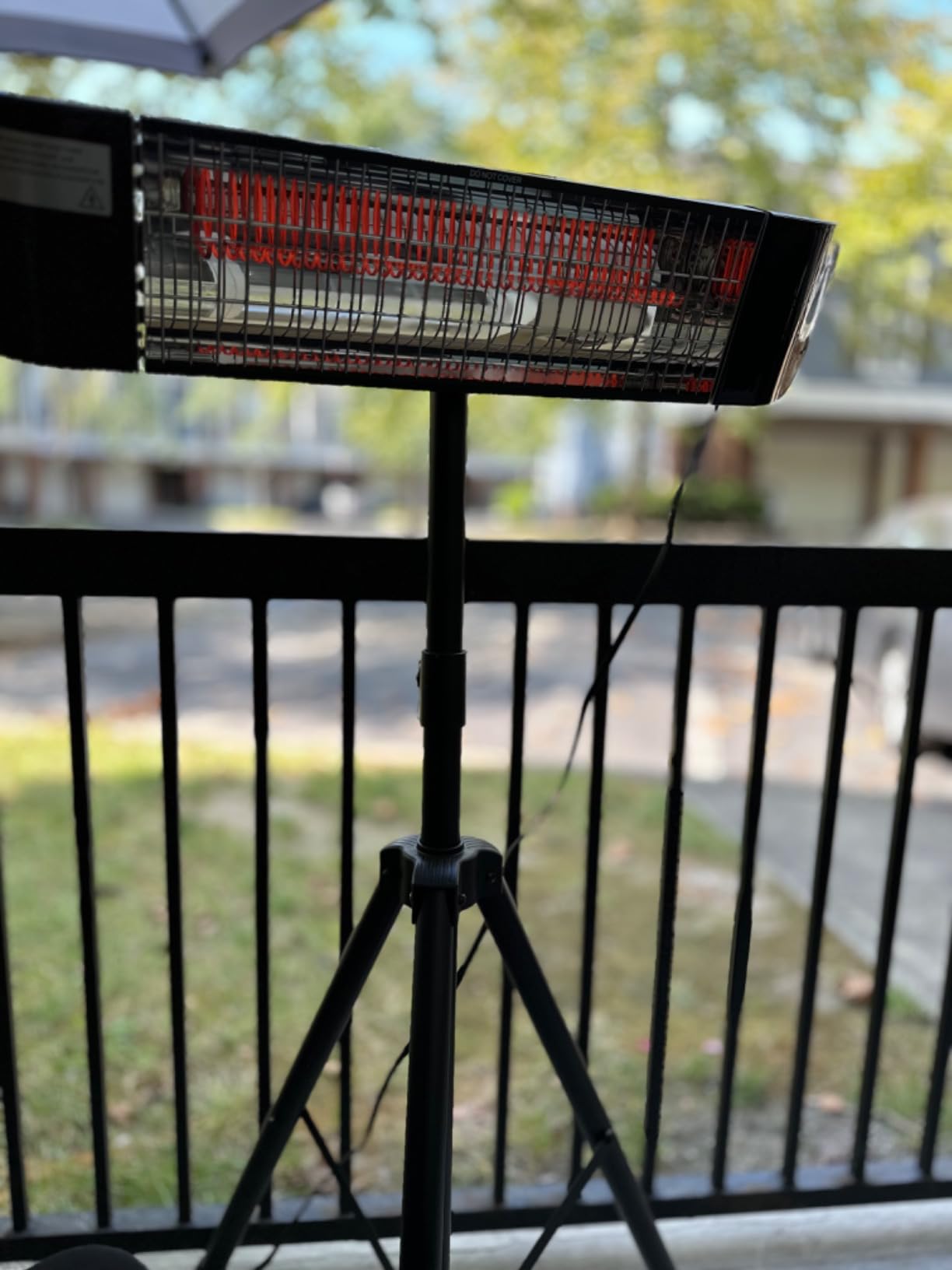
The Paraheeter is the most weather-hardened portable unit in this group, carrying an IP65 rating rather than the IPX4 and IPX5 ratings on most competitors. It also ships with a full three-in-one mounting kit: wall bracket, ceiling hardware, and an adjustable tripod stand, all in the box.
It runs a single 1500W carbon fiber element with a listed 10-15 foot radius and an element rated to 10,000 hours. Owners emphasize value: they get three mounting options and a carbon infrared element whose running cost is roughly a tenth of a comparable propane heater.
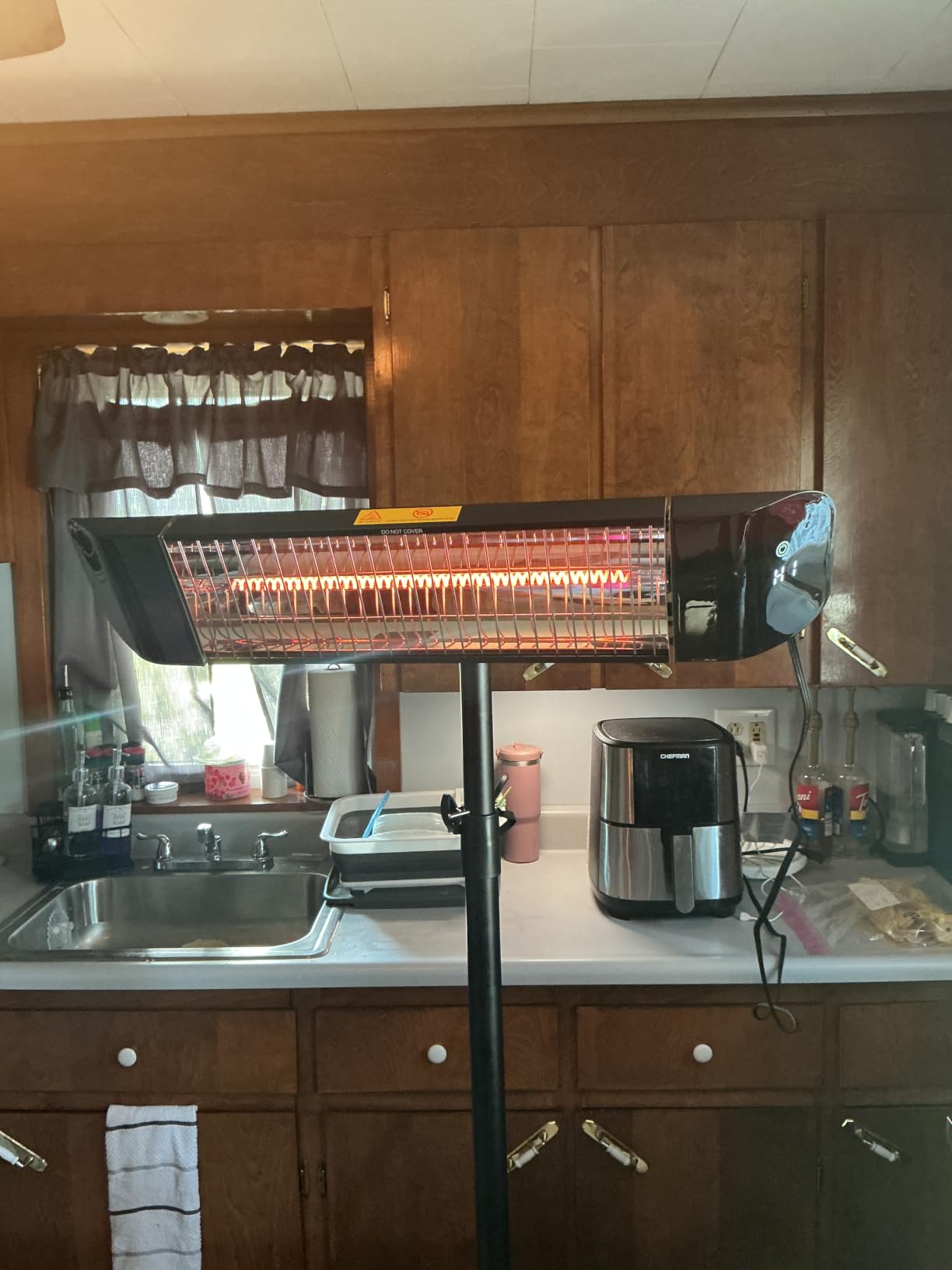
One setup note deserves its own warning because it is the single most common first-use mistake with this model: a protective foam pad ships over the heating tube and must be removed before you power it on. Left in place, it insulates the element and can drive it into overheat shutdown.
Its 268 reviews average 4.3 with a 68 percent five-star share. The positive themes are straightforward assembly, clear picture-based instructions, and mounting flexibility. The negative themes are the foam pad, the single speed, and the weight.
When IP65 matters more than IPX5
IPX5 protects against low-pressure water jets, which covers splash, drizzle, and wind-driven rain on a roofed porch. IP65 adds dust-tight sealing on the second digit, meaning the internals are protected from sand, dust, and pollen as well. On a screened porch near a dusty road, or a coastal location where salt spray is a factor, that extra digit is worth having.
Neither rating means you can leave a heater running in open rain. Ingress ratings describe resistance to water entry, not permission to operate without cover, and no manufacturer’s warranty covers deliberate weather exposure.
Deciding between single speed and three levels
A single speed is simpler, and for a porch where the heater runs for a fixed block of evening time, simplicity is fine. If you want to reduce output as the evening cools, or run the unit at lower power while people are sitting and higher when they arrive, one of the multi-level towers is the better tool.
At 18.8 pounds, this is the heaviest portable unit here by a wide margin. That weight helps it resist tipping on a porch, but it also makes switching between wall, ceiling, and tripod a two-person job on a ladder. Choose your mounting position before you climb.
6. SereneLife 1500W Wall-Mount Review
- Genuine outdoor-rated build in a compact body
- 88 percent efficiency on a 1500W carbon fiber element
- Aluminum alloy frame resists corrosion
- Compact 25.6 inch footprint suits a gazebo
- Mesh safety guard blocks contact with the element
- Small rated coverage of 18 square feet
- Wall-mounted only with a single heat level
- No tip-over or overheat features listed
- Fixed position cannot follow people around
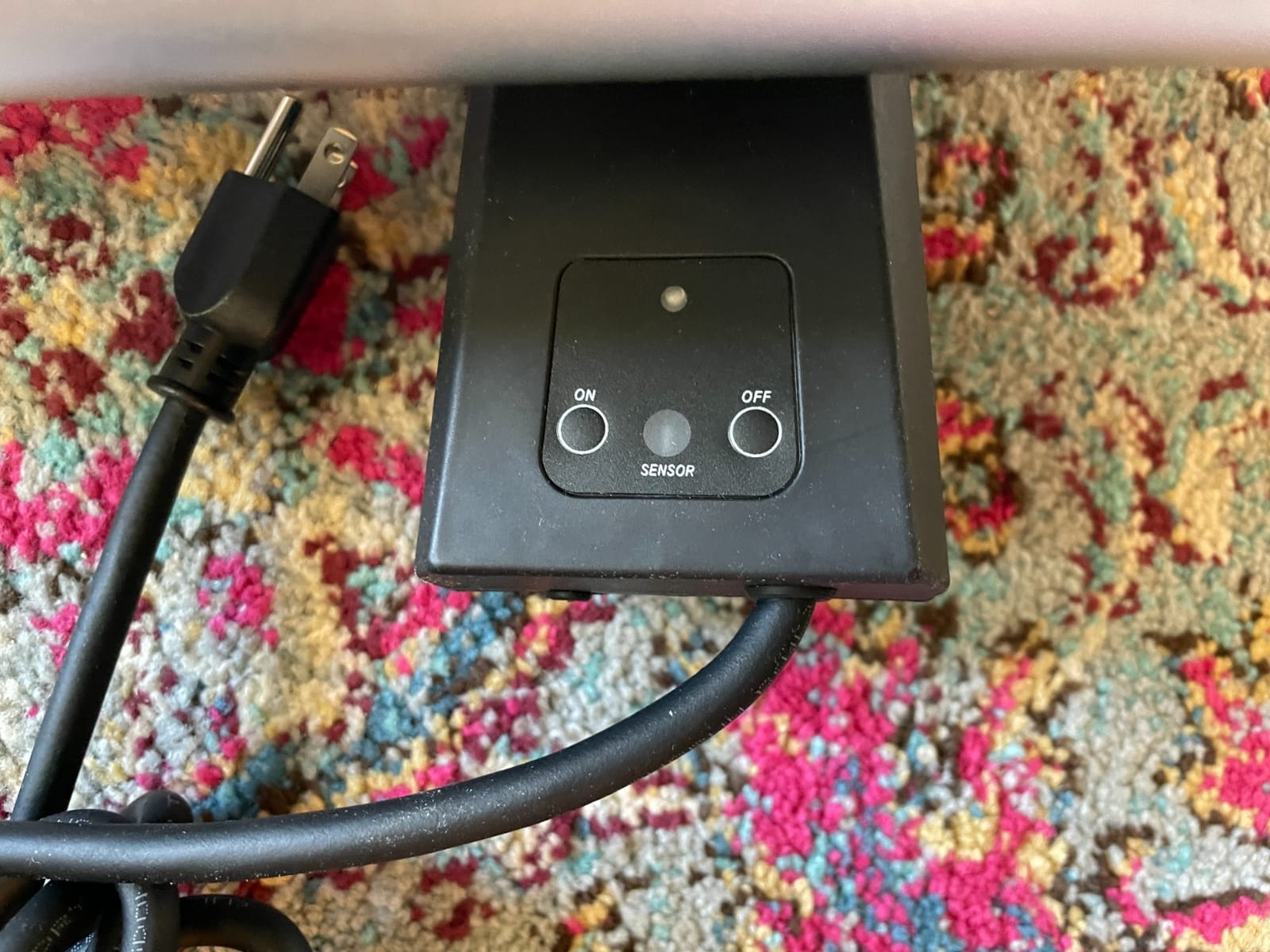
The SereneLife is our compact wall-unit pick and the easiest recommendation on this list to act on: an ETL-certified 1500W carbon fiber wall heater with an IP65 rating and an aluminum alloy frame, and the smallest physical footprint of any outdoor-rated unit we evaluated. It runs on 120V at 12.5 amps, so no electrical work is involved.
The carbon fiber elements carry an 88 percent efficiency rating, which is a manufacturer figure rather than something we measured, but it is consistent with how owners describe the heat. An aluminum reflector behind the element and an LED indicator on the housing give you a visual cue of state, and the mesh safety guard prevents accidental contact with the hot surface.

At 25.6 inches deep, 8.5 inches wide, and 9.6 inches tall and only 5.7 pounds, it is easy to position on a gazebo wall or beside a bistro table. Its 211 reviews average 4.2, and the recurring framing is accurate: this is a targeted heat source for one seated area, not a space heater.
Owners also note the aluminum alloy frame handles weather well and resists corrosion, which matters for a permanently mounted unit exposed to moisture at the mounting plate.
Where a compact wall unit beats a portable tower
A wall-mounted unit solves two problems portable towers create. It cannot be knocked over by a dog or a child, because it is not on the floor, and it cannot be dragged into a draft or a doorway by someone moving furniture. For a fixed gazebo or a covered dining nook, that is a meaningful safety and reliability advantage.
The 18 square foot listed coverage is an indoor-style figure. Outdoors on a porch, the honest expectation is a seated zone of roughly 35 to 50 square feet directly in front of the unit, which is usually two to four people at a table.
What you give up with this form factor
It has a single heat level, so there is no output adjustment for a porch that cools after sunset, and the mounting position is fixed once you drill. No tip-over or overheat protection features are listed for this wall-mounted design, which is not unusual since a unit fixed nine feet up is not going anywhere.
If your seating moves around, or you want to follow the group from a lounge to a table, choose one of the tripod-equipped units instead. If the seating is settled, this is a clean and durable answer.
7. VAGKRI Adjustable-Height Heater Review
- Widest height adjustment in the roundup at 33 to 77 inches
- Wall mount and folding tripod both included
- Three heat levels plus a 12 hour timer
- Wide heavy tripod base resists tipping
- Silent radiant heat that does not dry the air
- Heating element is not user-replaceable
- Heat is best felt within about 3 feet
- 7 foot cord often forces an extension cord
- Remote batteries not supplied
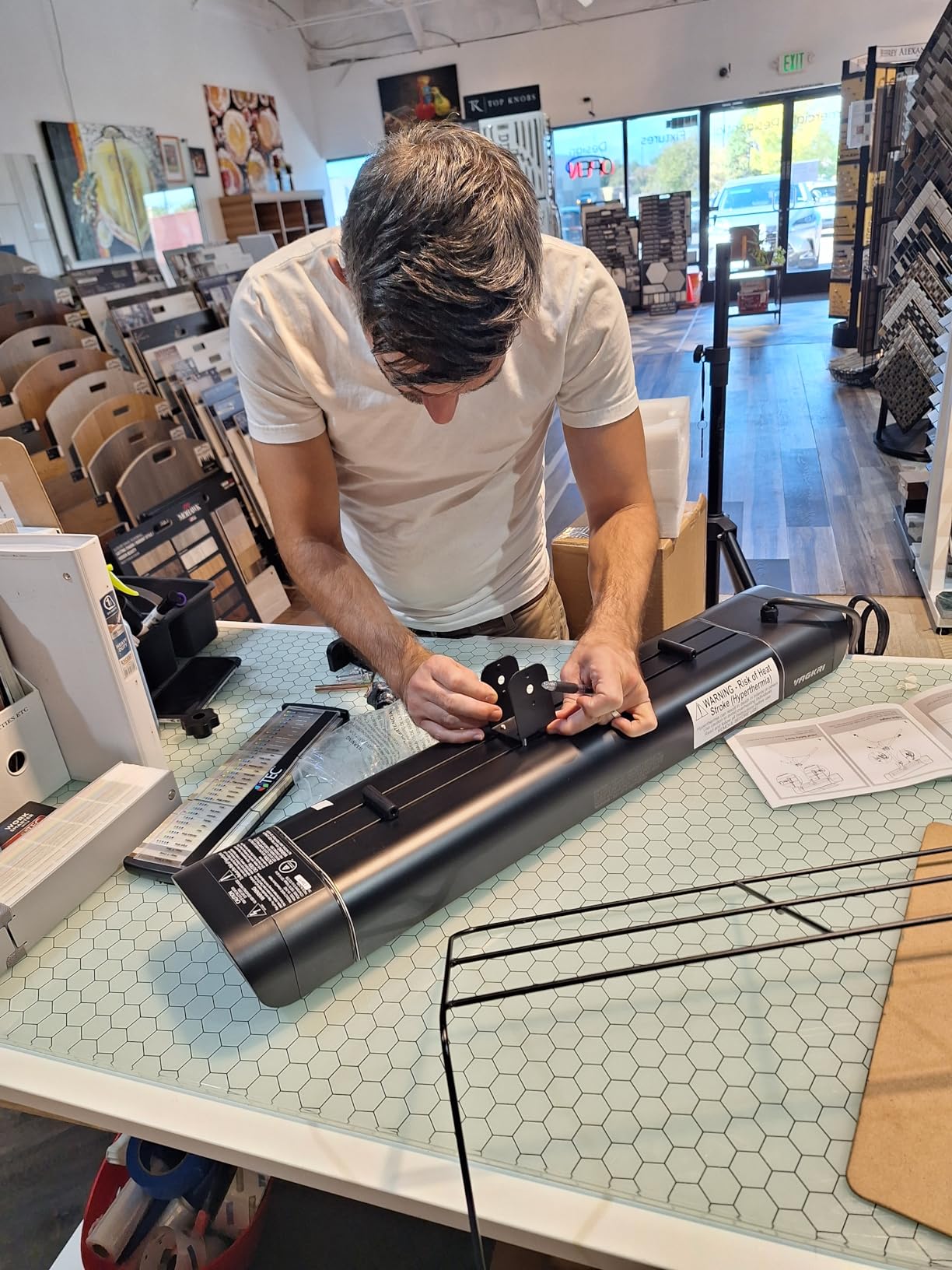
The VAGKRI solves a problem most towers ignore: height. It telescopes from 33 inches up to 77 inches, so you can raise it above a seated group, lower it to warm a small child on the same porch, or set it low beside a table and raise it for a standing conversation. Nothing else in this roundup adjusts over a range this wide.
It converts in seconds between a wall mount and a folding tripod, both included. Three heat levels at 700W, 1000W, and 1500W plus a 12-hour programmable timer give you scheduling control, and the IP65 rating covers wind-driven rain and dust.
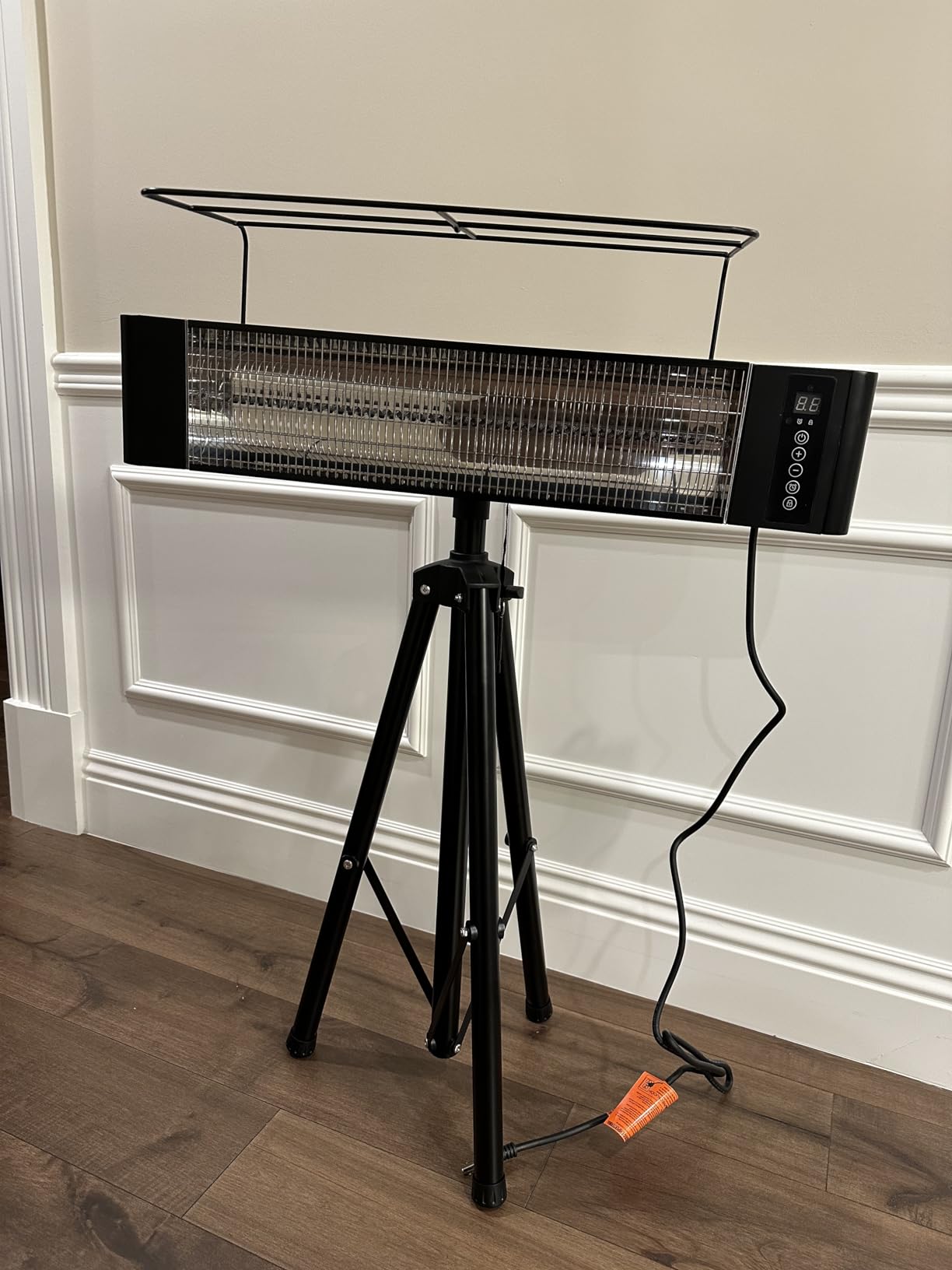
Its 164 reviews average 4.2 with a 71 percent five-star share, and reviewers single out the height adjustment and the wall-or-tripod versatility above everything else. Assembly is quick, and owners report strong output for small groups seated together. The wide tripod base is heavy enough to stay put on decking.
The significant negative, and the source of the 13 percent one-star share, is repairability. The heating element is not user-replaceable if it cracks after a tip or a hard knock, so a damaged element effectively ends the unit’s life rather than a single component’s.
Matching height to your seating
Set the top of the element at or slightly above head height of the people you want to warm. Below that, radiant energy hits the floor and the chair rather than the body. At the 33-inch setting, a seated adult gets the effect across the torso; at 77 inches, a standing group or a table-height gathering does.
On a porch with mixed seating, this adjustability is worth more than an extra heat level. You raise it for the standing group by the grill and lower it for the two people in the chairs, without unplugging anything.
The cord and repairability questions
The 7-foot cord is on the short side, and many owners report needing an extension cord to reach an outlet. Read the electrical section of this guide before you do that, because a 12.5-amp load on a shared circuit plus a long cord run is exactly the combination that trips breakers.
Ask yourself how long you want this to last. With no replaceable element, a cracked tube is a discarded heater. If multi-season durability matters to you, the Nfccra three-year warranty or the Paraheeter’s rated element life are stronger signals than the feature list.
8. Nfccra 34-Inch UL-Certified Tower Review
- Three-year warranty
- the longest in this roundup
- UL-certified with shutoff on tip
- movement or overheat
- Dual carbon tubes give near-instant head-to-toe warmth
- Protruding handle makes it easy to carry
- Silent with no CO2
- smoke
- or drying airflow
- Radiant heat falls off quickly beyond a few feet
- 6.6 foot cord usually means a nearby outlet
- Replacement-only warranty rather than repair
- Only three heat levels
The Nfccra is the durability pick. It carries a three-year warranty, the longest in this roundup, and it is the only unit here with a UL-certified design in a portable tower format. When two heaters in the same category have one-year or unspecified terms, a three-year replacement warranty is a genuine quality signal rather than a marketing line.
The 34-inch tower uses dual carbon element heating tubes that deliver head-to-toe warmth in about a second, across three levels at 600W, 900W, and 1500W. The aluminum alloy frame carries an IPX5 rating, and shutoff triggers on tip-over, movement, or overheat.
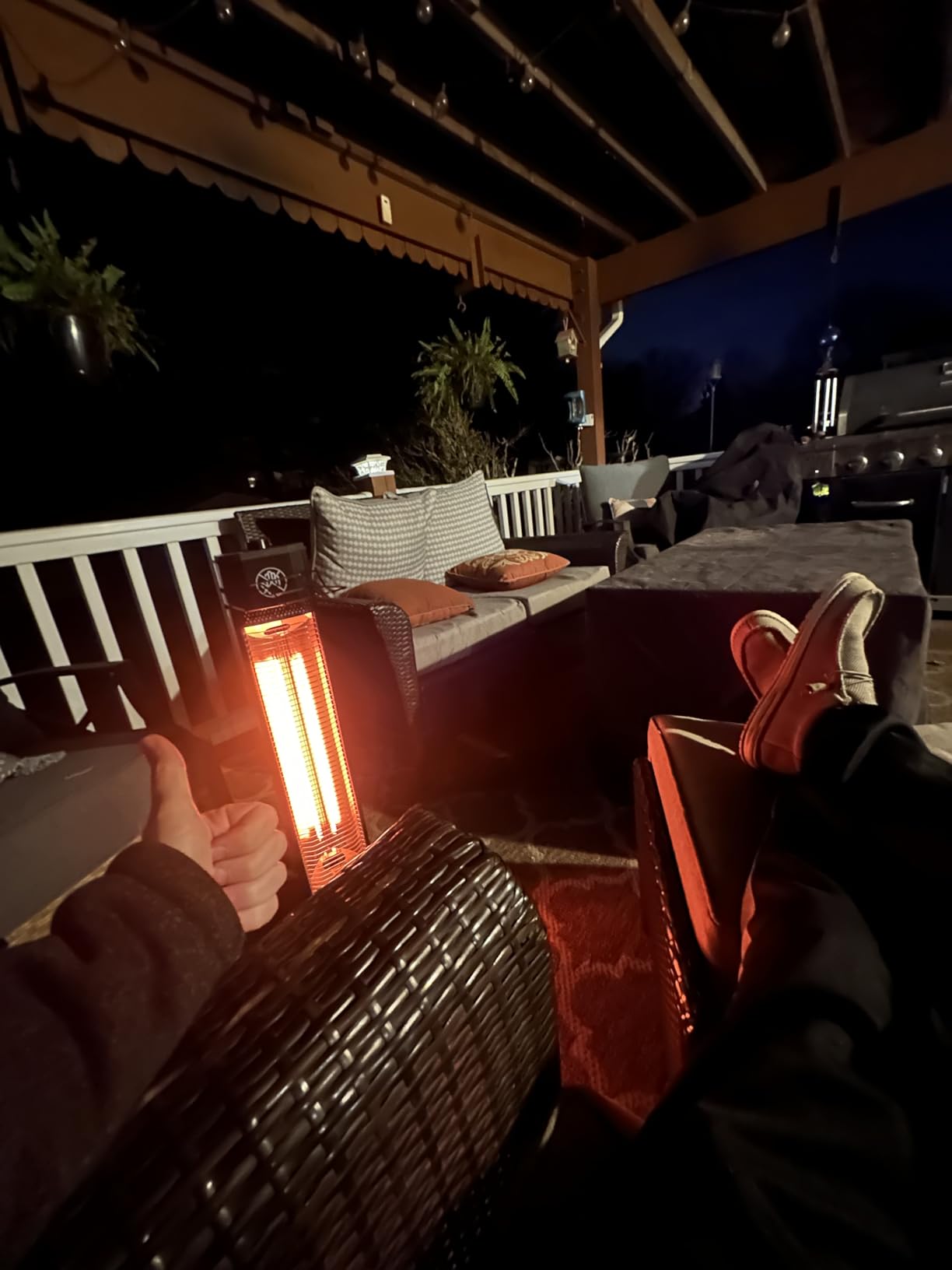
It is 7.5 pounds with an ergonomic protruding handle built into the housing, which is a detail that matters more than it sounds when you are moving between the patio and a garage on a cold night. Operation is silent and produces no CO2, no smoke, and no drying airflow, which owners on the forum boards single out as the difference from fan-based heaters.
Its 133 reviews average 4.3 with a 69 percent five-star share. The smaller review count means less long-term data than the Dr Infrared, but the satisfaction profile is favorable and the certification and warranty terms are the strongest in the group.
What a three-year warranty actually signals
Warranty length on these heaters tracks build quality more closely than it does on most appliances, because there is no parts ecosystem. A one-year warranty usually means a one-season decision, and an 180-day warranty is a red flag we would avoid.
Read the terms carefully. This one is replacement-only, so a failed unit is swapped rather than repaired. That is better than a 90-day return window, but it is not the same as a repairable product. Still, for a heater you will run on a porch for several seasons, three years of coverage changes the math.
Where it fits against the other towers
Against the HAIMMY 42-inch tower, the Nfccra offers fewer heat levels but a better warranty and UL certification. Against the Encyclpo 36-inch tower, it offers a handle and longer warranty but no thermostat and a shorter cord at 6.6 feet.
Its 12.5-amp draw at 120V is identical to most of the 1500W units here, so plan the circuit the same way you would for any of them: on a circuit with little else drawing power at the same time.
How Infrared Heat Differs From Propane on a Porch
Infrared heaters emit radiant energy that your skin and clothing absorb directly, which is why the warmth feels like sunlight rather than like warm air. A propane heater heats air, and outdoor air carries that heat away within minutes. On a roofed or screened porch, radiant heat is dramatically more efficient per watt.
The tradeoff is scale. Converting watts to BTU at roughly 3.5 Btu per watt puts a 1500W electric heater near 5,100 Btu, while a typical 40,000 BTU propane tower delivers roughly eight times that. Electric wins on convenience, safety, and cost; propane wins on raw reach.
One more difference worth understanding: radiant heat has a shape. A round or wide emitter throws a broad pattern, while a narrow bar throws a directional beam. A heater that feels like it covers the whole table from one angle may do nothing from the side, so sit where the manufacturer intends you to sit.
IP Ratings Explained: Is Your Porch Covered Enough?
The first digit of an IP rating covers solids, and the second covers water. On outdoor heaters the first digit is almost always 0 or 6, meaning no meaningful solid protection or fully dust-tight. The second digit is what matters on a porch.
IPX4 means protection against splashing water from any direction, which is the minimum for a roofed porch where rain blows in under the eave. IPX5 means protection against low-pressure water jets, which is the right rating for a semi-exposed wall, a screened-in porch where wind drives rain through the mesh, or a gazebo with open sides. IP65 adds dust-tight sealing on top of the IPX5 water protection.
Our rule: roofed and mostly dry is IPX4, roofed with wind-driven rain or screening is IPX5, coastal or dusty conditions are IP65. Never for deliberate rain exposure, and never as permission to run a unit with no roof at all.
120V Plug-In vs 240V Dedicated Circuit
Most 1500W heaters in this roundup draw 12.5 amps at 120V, which is 84 percent of a standard 15-amp circuit before you add anything else. Plug one into a circuit that also feeds a refrigerator or an outdoor kitchen circuit and you have a trip waiting to happen.
Extension cords are the loudest concern in porch heater forums, so here is the direct answer. A 1500W heater pulls 12.5 amps, so an outdoor-rated 14 AWG cord rated for 1,875W is the manufacturer-stated minimum, and only the shortest possible run should be considered. A dedicated 15-amp circuit is the correct answer, and for the Dr Infrared’s 240V 3000W unit, a dedicated 240V circuit is not optional.
Check the manual of whichever unit you buy, because some manufacturers prohibit extension cords outright. The Encyclpo does. An outdoor-rated GFCI-protected receptacle is a code requirement for these installations, and a metal or unweathered outlet is a no.
If you are unsure whether your existing outlet can carry the load, an electrician is a few hundred dollars of work against a heater you intend to run for years. Our electric garage heater guide covers the same circuit-sizing questions for a different room.
Sizing: How Much Heat Your Porch Needs
Use the seating area, not the floor plan. A 1500W unit comfortably warms roughly 35 to 50 square feet of direct seating area when mounted seven to nine feet above people or positioned within a few feet of their chairs. The rest of the porch stays at outdoor temperature, and no wattage changes that.
For a 10×16 porch with a table seating four, one well-placed unit above or beside the table is usually enough. For a 12×16 with two separate seating zones, run two units on separate circuits or accept that one zone stays cool. For a 20×30 covered patio, two or three units is the realistic minimum, and you are also at the point where propane becomes the more sensible answer.
Vertical placement matters more than wattage on open porches. Ceiling height of nine feet or more lets radiant energy travel further before it disperses, and shielding the unit from cross breezes is worth more than adding a second heater. Owners on homeowner forums describe open-sided porches that act as wind tunnels, and no wattage fixes moving air.
What It Costs to Run an Electric Patio Heater
Running cost is the strongest argument for electric, and the math is simple. A 1500W heater uses 1.5 kilowatt-hours per hour. At 12 cents per kilowatt-hour that is about 18 cents an hour, at 15 cents it is roughly 23 cents, and at 22 cents it lands near 33 cents.
For a typical three-hour evening on a mid-range tariff, that works out to somewhere around 54 cents to just under a dollar. The 3000W Dr Infrared doubles the energy draw and therefore roughly doubles those figures, which still compares favorably to refilling a propane cylinder for the same three hours.
Two habits cut that further. Running a multi-level unit on a lower setting when the group is settled, as the HAIMMY’s nine levels allow, reduces consumption directly. And a thermostat-controlled unit such as the Encyclpo cycles rather than running continuously, so its hourly figure is a ceiling rather than a constant.
Form Factor Guide: Choosing a Mounting Style
Wall mounts such as the Dr Infrared and SereneLife put heat where the seats are and remove the unit from reach of children and pets. They are permanent, require drilling, and cost you the ability to relocate. Wall and ceiling mounting is the right default for a roofed porch you own.
Hanging and high-ceiling placement works best above 8 feet, where the wider throw of a bar heater reaches a group. The Briza, Paraheeter, and VAGKRI all convert between a high mount and a tripod, which is the most useful single feature if your seating moves between seasons.
Floor towers such as the HAIMMY, Encyclpo, and Nfccra are portable, need no tools to move, and can follow your seating. Their trade-off is floor space, a hot element at child height on the shorter models, and the need to keep them clear of traffic to avoid tip-over shutdowns.
Tabletop and low units suit a bistro table or an outdoor kitchen counter where people are close and stationary. They deliver the least reach and the most localized warmth, and they are the easiest to move between spots. Our picks for outdoor patio heaters for game rooms cover high-output setups for enclosed spaces if a porch is only part of your outdoor plan.
Porch Safety: Clearances, Tip-Over and Overheat
Every manufacturer publishes clearance requirements, and you should treat them as limits rather than suggestions. A common baseline across this category is mounting at least 18 inches above head height with 9 inches of clearance on the sides, but your specific manual governs.
Never mount under a low ceiling, an awning, or a fabric umbrella without checking the clearance, because an infrared element radiates upward as well as downward and can scorch or ignite material above it. Forum users report condensation dripping from units mounted under roofs and awnings, so position the unit where water runs off the edge rather than over it.
Tip-over shutoff, movement detection, and overheat cut-off are three different protections. Tip-over covers a knocked or bumped unit. Movement detection covers a unit that shifts on an uneven porch surface. Overheat cut-off is a thermal safety that engages if the element overheats, which is why the Paraheeter’s factory foam pad must come off before first use.
With young children or dogs, add a mesh guard and keep the element out of reach. The SereneLife and Paraheeter both ship with metal mesh guards, and the HAIMMY’s safety lock with memory prevents a child from cycling it on. Keep the heater’s front and grille clear of anything flammable, and never leave one running unattended overnight.
When to Skip Electric and Choose Propane Instead
Skip electric if your patio is large and open with no roof. A 3000W electric unit is the strongest available, and it still heats a seating zone rather than a 20×30 slab. For open patios, propane’s 40,000 BTU is the only realistic answer.
Skip electric if you need sustained heat in genuinely cold weather. A 1500W electric heater is useful down to roughly the mid-40s in a sheltered space and does not extend into sub-freezing outdoor use. Cold-climate owners in forum discussions consistently conclude the same thing.
Skip electric if there is no outlet within reach and you cannot install one. Seven of our eight picks assume a nearby 120V receptacle, and the eighth assumes a 240V circuit. Fighting that constraint is where most projects stall.
Also consider renters, landlords, and associations. Electric units raise no flame and no combustion complaints, which makes them far easier to get permission for than a propane tower in a rental or an HOA-governed community.
How We Picked These 8 Heaters
Every unit here is fully electric and radiant, and every one is rated for outdoor use with a stated IP rating. We excluded gas and pellet heaters entirely, which is the main difference between this roundup and most published patio heater lists, where propane takes most of the slots.
Beyond that we filtered on the criteria that decide real porch performance: mounting options, wattage and the amperage that follows, ingress rating, published safety cut-offs, warranty length, and the availability of replacement parts. Where reviews reported a recurring defect, we named it in that product’s section rather than burying it.
Our limits are worth stating plainly. We did not lab-test these units with thermometers, so runtime coverage figures come from manufacturer specifications and owner reports rather than our own measurements. Ratings and review counts are the live figures from the product listings we analyzed. If a product listing changes after publication, the values here will lag behind the page.
For indoor heating at higher output, our guide to the best infrared heaters for large rooms covers the same technology at a different scale and price band.
Frequently Asked Questions
What is the best patio heater for a covered porch?
The Dr Infrared DR-239 is the best patio heater for a covered porch. It delivers 3000W and 10,260 BTU, the highest electric output available, with an IP55 weatherproof rating, wall and ceiling mounting hardware, and a remote. It needs a 240V dedicated circuit, so budget for installation unless you already have one.
What is the best outdoor heater for a covered porch?
The Dr Infrared DR-239 is our best outdoor heater for a covered porch because its 3000W output doubles every other unit we tested and its IP55 rating handles wind-driven rain. For a porch where drilling is not an option, the Briza offers wall, ceiling, and tripod mounting at 120V in one box.
Which infrared heater is best for use outside?
The best infrared heater for outdoor use depends on your porch. For maximum reach the Dr Infrared DR-239 leads at 3000W and IP55. For true weather sealing the Paraheeter and SereneLife carry IP65 ratings. For the best warranty the Nfccra 34-inch tower offers three years of replacement coverage with UL certification.
Are infrared heaters good for patios?
Yes, with a clear caveat. Infrared heaters warm people and objects directly rather than heating air, which makes them highly effective on covered, roofed, or screened porches where outdoor air would otherwise carry heat away. They are not effective at heating open air or a large uncovered patio, because there is no enclosure to hold the warmth.
What are the drawbacks of infrared heaters?
Five drawbacks come up most. Output is limited, since 1500W is roughly 5,100 Btu against about 40,000 Btu for propane. They need an outlet nearby, drawing 12.5 amps on a standard circuit. Radiant heat is directional, so placement decides how much you feel. Most elements are not user-replaceable when they fail. And IP ratings mean water resistance, not permission to run in rain.
Are extension cords safe for heaters?
A 1500W heater draws 12.5 amps, so an outdoor-rated 14 AWG cord rated for 1,875W is the manufacturer-stated minimum, and only over a short run. A dedicated 15-amp circuit is the correct choice, and some manufacturers including Encyclpo prohibit extension cords entirely. Always use a GFCI-protected outdoor receptacle.
What are the best patio heaters according to consumer reports?
We do not publish a Consumer Reports endorsement and cannot speak for one. Our own selection favors eight fully electric infrared heaters rated for outdoor use, filtered on mounting flexibility, ingress protection, safety cut-offs, and warranty length. Unlike most roundups, no propane heater appears on this list.
Final Verdict: The Best Electric Infrared Patio Heaters for Porches in 2026
For most covered porches, the Dr Infrared DR-239 is the best electric infrared patio heater you can buy: 3000W of output, an IP55 rating, mounting hardware and remote in the box, and 6,096 owner reviews averaging 4.3 to support it. Budget for a 240V circuit before you order.
If you need flexibility or a standard outlet, the Briza gives you wall, ceiling, and tripod mounting at 120V. For fine-grained control and a child lock, the HAIMMY’s nine heat levels are the reason to choose it. For the best warranty, the Nfccra covers three years.
Measure your seating area, confirm your circuit, and buy the unit that matches your porch rather than the biggest number on the box. That is the whole method behind our list of the best electric infrared patio heaters for porches in 2026, and it will serve you better than any wattage figure on its own.