
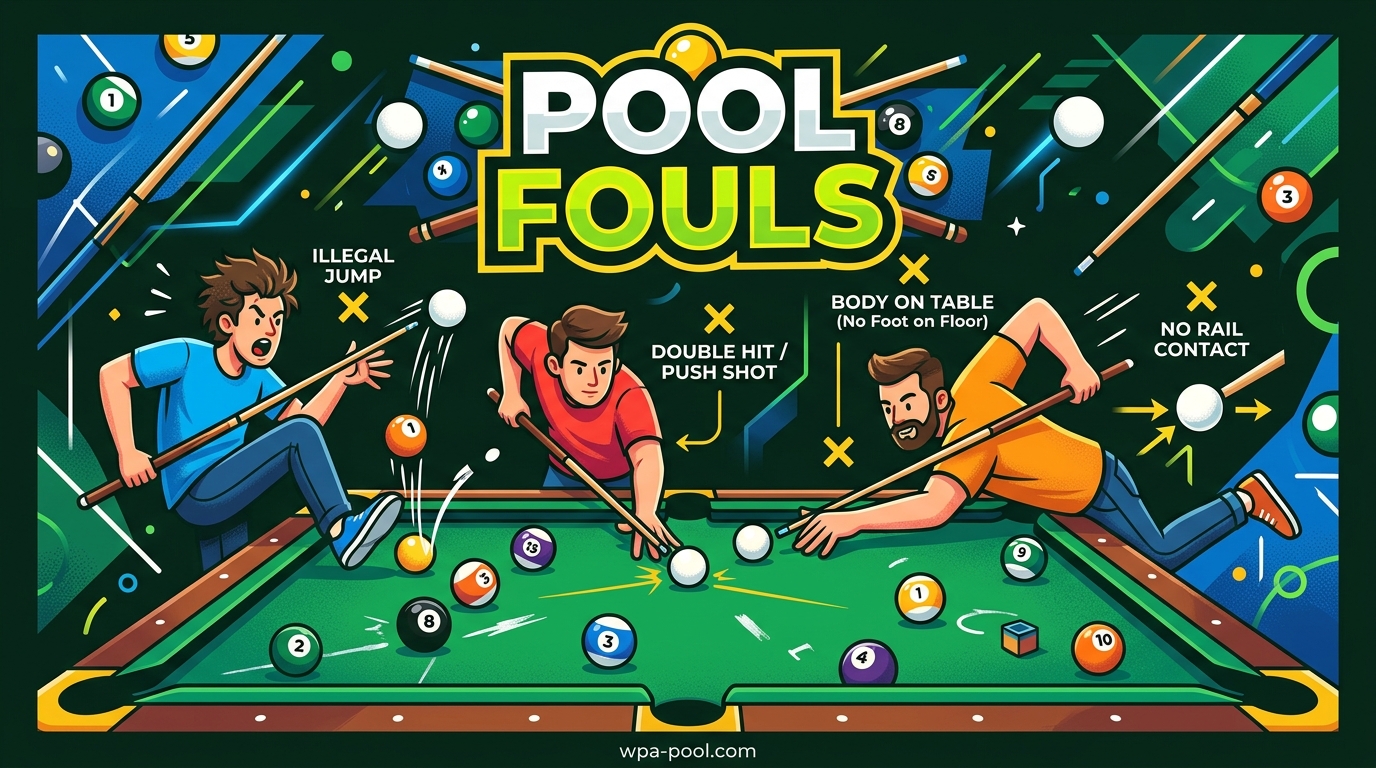
Understanding every pool foul can feel overwhelming when you are just starting out. I spent years playing casual games before I realized how many rules I was breaking without knowing it. This complete guide breaks down every foul in pool, explains why each rule exists, and shows you exactly how to avoid these costly mistakes.
Here is the complete list of pool fouls every player should know:
- Cue ball scratch or off the table
- Wrong ball first
- No rail after contact
- No foot on floor
- Ball driven off the table
- Double hit or frozen ball violations
- Push shot
- Touched or moved ball
- Playing out of turn
- Slow play
- Unsportsmanlike conduct
- Three consecutive fouls (loss of game)
Each foul carries specific penalties, typically ball-in-hand for your opponent. Learning these rules will make you a more confident player and help settle disputes quickly at the table.
Table of Contents
What Is a Foul in Pool?
A foul in pool is any illegal action during a shot that violates the official rules and results in a penalty. The most common penalty is ball-in-hand, which allows your opponent to place the cue ball anywhere on the table for their next shot.
The World Pool-Billiard Association (WPA) defines a legal shot as one where the cue tip contacts the cue ball only once, the cue ball strikes a legal object ball first, and either the object ball is pocketed or any ball contacts a rail after that initial contact. Missing any of these requirements results in a foul.
Understanding the difference between a legal shot and an illegal shot separates beginners from competitive players. Many fouls happen accidentally because players do not know the technical requirements of a proper stroke.
The concept of ball-in-hand is central to pool fouls. When you commit a foul, your opponent receives this advantage. They can place the cue ball in the most strategic position possible, often turning your mistake into their easy run-out opportunity.
Complete List of Pool Fouls
Let me walk you through each foul with clear explanations of what happens and how to avoid it. These rules apply to most standard pool games unless noted otherwise.
Cue Ball Scratch or Off the Table
A scratch occurs when the cue ball drops into any pocket after a shot. This is the most recognized foul in pool and one every beginner commits regularly.
The foul also applies if the cue ball jumps completely off the table surface. Even if it lands on the rail and bounces back onto the playing surface, leaving the table bed constitutes a foul.
After a scratch, your opponent receives ball-in-hand. They can place the cue ball anywhere on the table. In some game variations like 8-ball, specific rules apply about placement behind the head string after the break scratch.
To avoid scratches, focus on controlling cue ball speed and learning proper draw and follow techniques. I found that practicing cue ball position drills reduced my scratch rate by more than half after just a few weeks of dedicated practice.
Wrong Ball First
This foul happens when the cue ball first contacts an object ball other than the one legally required for the shot. In games like 9-ball, you must hit the lowest numbered ball on the table first. In 8-ball, you must strike a ball from your assigned group (solids or stripes).
The wrong ball first rule applies even if you pocket a ball legally after making illegal contact first. The initial contact determines the legality of the shot, not what happens afterward.
Many players confuse this with combination shots. A combination is legal as long as the first ball struck belongs to your group or is the correct ball for the game variation. Hitting an opponent’s ball first before your own is always a foul.
Careful observation of the table layout before shooting prevents most wrong ball first fouls. Take an extra moment to identify the correct object ball, especially in tight layouts where multiple balls sit close together.
No Rail After Contact
This technical foul confuses many players. After the cue ball makes initial contact with a legal object ball, something must hit a rail or drop into a pocket. Either the object ball must be pocketed, or any ball (cue ball included) must contact a cushion.
If nothing touches a rail after the initial object ball contact, the shot is foul. The rationale prevents players from playing soft tap shots that deaden the cue ball without meaningful action.
An exception exists when the cue ball is frozen to the object ball. In that case, the mere act of contact satisfies the rail requirement because the balls are already touching.
To avoid this foul, ensure your shots have enough speed to guarantee rail contact if the object ball does not drop. Adding a slight angle that sends the cue ball toward a cushion provides a safety net for close shots.
No Foot on Floor
At least one foot must remain on the floor during your stroke. This foul often occurs when players stretch across the table to reach a distant shot and lift their back foot for balance.
The rule exists to prevent players from sitting or lying on the table. It maintains a standard posture requirement for all shots.
Both feet do not need to touch the floor simultaneously. You can have one foot raised as long as the other maintains contact. However, any airborne moment for both feet during the stroke constitutes a foul.
If you find yourself stretching for a shot, use the bridge hand more effectively or employ a mechanical bridge instead of compromising your stance. Proper foot positioning provides stability for accurate shooting.
Ball Driven Off the Table
Jumping any object ball off the table surface results in a foul. This commonly happens on jump shots or when striking a ball near a cushion with excessive force.
The jumped ball is spotted according to game-specific rules. Usually, it returns to the foot spot or as close as possible behind it without touching other balls.
Note that the cue ball leaving the table is treated as a scratch, while object balls leaving trigger this separate foul. Both result in ball-in-hand for the opponent.
Controlling shot power and trajectory prevents most ball-off-table situations. When attempting jump shots, practice proper technique to keep the ball on the playing surface.
Double Hit / Frozen Balls
The double hit foul is one of the most technically complex rules in pool. It occurs when the cue tip contacts the cue ball more than once during a single stroke, or when the cue ball and object ball are frozen together and improper technique causes multiple contacts.
When balls are frozen (touching each other), special rules apply. If you shoot directly into the line of centers, the cue ball may push the object ball without the cue tip losing contact, resulting in a double hit foul.
To legally shoot frozen balls, you must approach at an angle or use a jacked-up elevated cue to strike down on the cue ball. This technique prevents the cue tip from maintaining contact through the stroke.
A related foul occurs when the cue ball bounces back and contacts the cue tip a second time after initial contact. This follow-through foul requires careful stroke technique to avoid.
I recommend practicing frozen ball shots with a knowledgeable player watching. The sound of a double hit is subtle but detectable once you learn what to listen for.
Push Shot
A push shot happens when the cue tip maintains contact with the cue ball long enough that the ball is visibly pushed rather than struck. The cue ball should receive a sharp impact, not gradual acceleration.
This foul often occurs on shots requiring very soft touch near the object ball. Players sometimes slow their stroke so much that it becomes a push rather than a legal stroke.
The key distinction is the forward stroking motion. A legal stroke accelerates the cue stick through the cue ball. A push shot drags the cue ball along with the tip.
Maintain proper stroke speed even on delicate shots. Let the soft tip do the work rather than slowing your arm motion to a crawl. Practice soft draw shots to develop the touch needed without pushing.
Touched or Moved Ball
Accidentally touching any ball with your body, clothing, or equipment constitutes a foul. This includes the cue ball during address, object balls during warm-up strokes, or even balls you brush against while chalking your cue.
If you move a ball accidentally, the opponent can choose to leave it in the new position or restore it to its original location. However, the foul still stands regardless of their choice.
Touching the cue ball with your hand during ball-in-hand placement is allowed. But touching any other ball during this process is a foul. Be careful when reaching across the table to place the cue ball.
Develop the habit of standing clear of all balls except the one you are addressing. Keep your bridge hand stable and your body controlled throughout the stroke to avoid accidental contact.
Playing Out of Turn
Shooting when it is not your turn is a foul in most competitive rules. This rarely happens intentionally but can occur when players lose track of whose turn it is.
In some league formats like APA, playing out of turn results in ball-in-hand for the opponent and loss of any balls pocketed on the illegal turn. The balls are spotted back to their original positions.
The best prevention is clear communication between players. Announce when you have completed your turn, especially after a safety shot. Pay attention to whether your opponent is still shooting or has invited you to the table.
Slow Play
Taking excessive time to shoot can result in a foul in tournament play. While casual games rarely enforce this rule, competitive matches often use shot clocks.
The specific time limit varies by tournament. Common limits range from 30 seconds to 60 seconds per shot, with extensions for particularly difficult situations.
Warning is usually given before penalizing slow play. However, repeated violations can result in ball-in-hand for the opponent or even loss of game in extreme cases.
Practice making decisions quickly to avoid this foul. Analyze the table while your opponent shoots so you are ready when your turn arrives.
Unsportsmanlike Conduct
Behavioral fouls cover conduct that disrupts fair play or shows disrespect. This includes distracting the opponent, deliberately miscuing to avoid a shot, marking the table, or using abusive language.
Intentional fouls are a subset of unsportsmanlike conduct. While strategic fouls exist in some advanced play, deliberately violating rules to gain advantage is prohibited.
Tournament directors have broad discretion in assessing these fouls. Penalties range from ball-in-hand to loss of game or even ejection from the event.
Maintaining proper etiquette prevents most unsportsmanlike conduct fouls. Focus on your own game and treat opponents with respect regardless of the competitive stakes.
Three Consecutive Fouls
Committing three fouls in succession without making a legal shot in between results in loss of game. This rule prevents players from endlessly fouling to avoid giving their opponent a shot.
The counter resets after any legal shot, even if that shot does not pocket a ball. Making a proper shot that misses still clears your foul count.
Many beginners do not know this rule exists. I have seen players commit multiple fouls unwittingly, wondering why their opponent suddenly declared victory.
Track your fouls mentally during each rack. If you have committed two fouls, play your next shot with extra care to avoid the automatic loss.
Fouls by Game Type
While most fouls apply universally, specific pool variations have unique rules. Understanding these differences helps you adapt when switching between 8-ball, 9-ball, and other games.
8-Ball Specific Fouls
Scratching on the break in 8-ball gives the opponent ball-in-hand behind the head string. This special placement restriction does not apply to fouls during regular play.
Pocketing the 8-ball prematurely (before clearing your group) is an automatic loss of game. Similarly, scratching while legally pocketing the 8-ball also results in loss.
Hitting the opponent’s group first when groups have been determined is a standard foul. However, on the break shot, hitting any ball first is legal regardless of which group you end up choosing.
The 8-ball has special status throughout the game. Any foul involving the 8-ball carries heavier consequences than fouls with other object balls.
9-Ball Specific Fouls
9-ball uses the three-foul rule more strictly than 8-ball. Because the game flows continuously, tracking consecutive fouls becomes essential to competitive strategy.
The push-out rule creates a unique situation. After a legal push-out, the opponent can either accept the shot (making it their turn) or pass it back. Fouls on push-outs are treated differently than regular fouls.
Pocketing the 9-ball on the break is legal and wins the game in most rule sets. However, scratching on such a break still results in a foul and loss of the win.
Combination shots are legal in 9-ball as long as the lowest numbered ball is contacted first. Hitting the 1-ball into the 9-ball to win is a classic combination that is completely legal.
Other Game Variations
Straight pool (14.1 continuous) has unique foul rules. The penalty for a foul is typically just one point deducted, but the three-foul rule still applies in modified form.
10-ball rules closely mirror 9-ball but with stricter push-out and call-shot requirements. Many fouls that are legal in 9-ball become illegal in 10-ball.
Bank pool and one-pocket have their own extensive foul categories. These games reward defensive play, so understanding their specific fouls becomes even more critical.
| Foul Type | 8-Ball Penalty | 9-Ball Penalty | 10-Ball Penalty |
|---|---|---|---|
| Scratch | Ball-in-hand anywhere | Ball-in-hand anywhere | Ball-in-hand anywhere |
| Break scratch | Ball-in-hand behind head string | Ball-in-hand anywhere | Ball-in-hand anywhere |
| Wrong ball first | Ball-in-hand | Ball-in-hand | Ball-in-hand |
| No rail after contact | Ball-in-hand | Ball-in-hand | Ball-in-hand |
| Three fouls | Loss of game | Loss of game | Loss of game |
| 8-ball/10-ball scratch | Loss of game | N/A | Loss of game |
Penalties and Consequences
Understanding what happens after a foul helps you make strategic decisions during play. Different fouls carry different penalties depending on the game and situation.
Ball-in-Hand Rules
Ball-in-hand means the incoming player may place the cue ball anywhere on the playing surface. This is the standard penalty for most fouls in modern pool rules.
Some older rule sets restricted ball-in-hand to behind the head string only. Most contemporary play uses the more generous anywhere-on-the-table rule.
During ball-in-hand placement, you may use your hand to position the cue ball. Touching the cue ball with your hand is only allowed during this placement phase, not during regular play.
Many players ask whether you can place the cue ball in a pocket during ball-in-hand. The answer is no. The ball must rest on the playing surface, not in any pocket or off the table.
Proper ball-in-hand placement strategy involves analyzing the entire table layout. Look for the easiest path to run out or play a safety that leaves your opponent difficult options.
Three Consecutive Fouls
As mentioned earlier, three fouls without an intervening legal shot results in loss of game. This rule applies across most major rule sets including WPA, APA, and BCA.
The key phrase is consecutive. A legal shot resets the counter to zero, even if that shot misses all balls entirely. As long as the stroke itself was legal, your foul count clears.
Some rule variations require the opponent or referee to warn a player after two fouls. However, in most competitive play, you are responsible for tracking your own foul count.
Avoiding the third foul often means playing a conservative safety rather than attempting a difficult shot. Giving your opponent ball-in-hand once is better than losing the game entirely.
Frequently Asked Questions
What is the 3 foul rule?
The 3 foul rule states that if a player commits three consecutive fouls without making a legal shot in between, they automatically lose the game. The foul counter resets after any legal shot, even if that shot misses. This rule prevents players from repeatedly fouling to avoid giving their opponent a shot.
Is missing a ball in the pool a foul?
Simply missing all balls with the cue ball is a foul because it violates the no rail after contact rule. If no ball is contacted and nothing touches a rail, the shot is illegal. However, if you contact a legal object ball but fail to pocket it, that is not a foul as long as something hits a rail afterward.
What happens if you scratch on the break?
Scratching on the break gives your opponent ball-in-hand. In 8-ball specifically, the opponent must place the cue ball behind the head string and shoot forward. In 9-ball and 10-ball, they have ball-in-hand anywhere on the table. Any balls pocketed on a break scratch remain pocketed in most rule sets.
Can you foul on a safety shot?
Yes, safety shots must still be legal shots. You must contact a legal object ball first and either pocket it or have a ball contact a rail afterward. Playing a safety that misses all balls or contacts the wrong ball first is still a foul and gives your opponent ball-in-hand.
Is it a foul to touch the cue ball with your hand?
Touching the cue ball with your hand is only allowed during ball-in-hand placement. During active play, any hand contact with the cue ball is a foul. The one exception is when you have ball-in-hand and are positioning the cue ball for your shot.
Conclusion
Knowing every pool foul explained in this complete list gives you a significant advantage at the table. You will play with more confidence, avoid costly mistakes, and handle disputes with authority when they arise.
The most common fouls beginners commit are scratches, wrong ball first, and the no rail after contact violation. Focus on eliminating these three first, and your game will improve dramatically.
Print this guide or bookmark it for quick reference during practice sessions. As you internalize these rules, proper play becomes automatic. Keep learning, keep practicing, and enjoy playing pool the right way in 2026.