
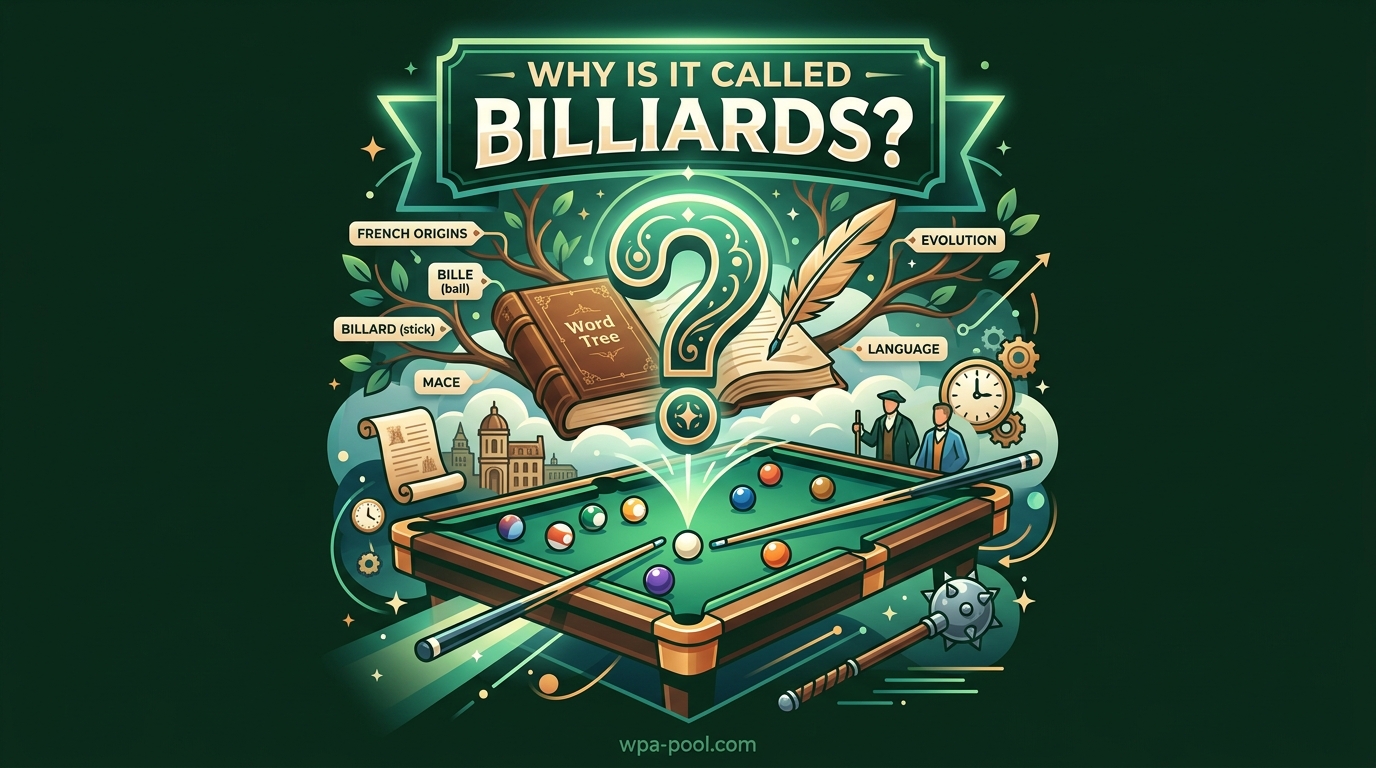
The game is called billiards because the name traces back to two French words: “bille” meaning ball or wooden log, and “billart” referring to the wooden cue stick used to strike the balls. These terms entered the English language in the 1590s, giving us the word we use today for cue sports played on a felt-covered table.
I remember standing in a billiards hall for the first time and wondering where such an unusual word came from. The answer spans centuries of linguistic evolution, from medieval French courts to 19th century American betting parlors. Understanding why it’s called billiards opens a window into the rich history of one of the world’s oldest table games.
Table of Contents
Why Is It Called Billiards? The Complete Etymology Explained
The term “billiards” emerged from the need to describe a game involving both balls and striking implements. In medieval France, nobles played an early form of the game using wooden balls and heavy wooden sticks called maces. The French language provided the perfect vocabulary to capture this activity.
The word took several paths into English. Some linguists point to “bille” as the primary source, while others emphasize “billart.” Both words likely contributed to the final term. The Oxford English Dictionary traces the first English usage to the late 16th century, when the game had already established itself among European aristocracy.
The French Roots: Bille and Billart
To understand why it’s called billiards, we must look at medieval French vocabulary. Two words stand out as the primary contributors to our modern term.
Bille: The Ball Connection
The French word “bille” referred to a ball, log, or wooden stick. This term itself has deeper roots in medieval Latin “billia,” meaning tree or trunk, which may have originated from Gaulish or Celtic languages spoken in ancient France. When French nobles began striking wooden balls across tables in the 1400s, they naturally used “bille” to describe the game pieces.
Some etymologists suggest “bille” specifically meant a ball of wood in Old French, which makes sense given that early billiard balls were carved from wood rather than the ivory or phenolic resin used in modern times. The material connection strengthens the link between the word and the game.
Billart: The Cue Stick Origin
The other French candidate is “billart,” which referred to a wooden stick or staff. Early billiards players used heavy wooden maces to push balls across the table. These implements resembled the “billart” of French vocabulary, a word that described various wooden rods or sticks used in medieval daily life.
Over time, the mace evolved into the modern cue stick, but the terminology remained. The transition from “billart” to “billiards” in English represents a natural linguistic evolution as the game spread across the Channel and established itself in British culture.
From Ground Billiards to Indoor Tables
The game we know as billiards did not begin on tables. In the 14th century, French and English nobles played “ground billiards,” an outdoor lawn game similar to croquet. Players used maces to strike wooden balls through wire wickets or toward targets across grass courts.
The first written records of billiards appear in the 1340s, describing games played by French royalty. These early versions required significant space and good weather, limiting their accessibility. As the game grew in popularity, players sought ways to bring it indoors.
The 15th Century Table Revolution
By the 15th century, European nobility had begun playing billiards on tables covered with green cloth to simulate grass. The flat surface required different techniques than ground play. Players could now strike balls with more precision and develop new rules and strategies.
Louis XI of France reportedly owned a billiards table in the 1470s, marking one of the earliest documented instances of indoor play. The game had become firmly established among European aristocracy, with specialized equipment and dedicated playing spaces.
From Maces to Cues
Early billiards players used a wooden mace with a large, flat head to push balls across the table. This cumbersome implement worked well for simple shots but limited the game’s complexity. In the late 1600s, players discovered they could strike balls more precisely by using the narrow tail end of the mace.
This innovation led to the development of the modern cue stick. French players called the cue a “queue,” meaning tail, since they used the tail end of the mace. English players adopted the term, and “cue” entered the billiards lexicon. The mace gradually disappeared from play, though it remained part of the game’s official equipment into the 19th century.
The leather cue tip, invented by Francois Mingaud in the early 1800s, revolutionized the game by allowing players to apply spin to the cue ball. This development, called “English” in the United States, added new dimensions to billiards strategy and technique.
Why is Billiards Also Called Pool?
The word “pool” has nothing to do with water. Instead, it comes from the French word “poule,” meaning hen. This unlikely connection traces back to a medieval gambling game called “jeu de la poule,” where players threw stones at a tethered chicken. The stakes were pooled together, with the winner taking all.
By the 19th century, “pool” had become synonymous with any collective betting arrangement. When billiards tables appeared in betting parlors where patrons pooled money on horse races, the rooms became known as “pool rooms.” The billiards tables within them gradually became associated with the term.
The American Pool Room Connection
In 19th century America, billiards tables became fixtures in establishments where men gathered to place bets on horse races. These venues, called pool rooms or pool parlors, featured billiards tables to entertain patrons between races. Over time, the game itself became known as “pool” in American English.
The association between pool and betting persisted through the early 20th century. Pool halls developed a rough reputation in some areas, which the film “The Hustler” and its sequel “The Color of Money” later immortalized. Today, the term carries none of that stigma, though the name remains.
Billiards vs Pool: What’s the Difference?
Strictly speaking, “billiards” refers to carom games played on tables without pockets, where players score points by bouncing balls off cushions and each other. “Pool” refers to pocket billiards, played on tables with six pockets. However, common usage has blurred these distinctions, especially in the United States.
In the United Kingdom, “billiards” typically means English billiards, a specific three-ball game combining elements of carom and pocket play. “Pool” in Britain usually refers to blackball or eight-ball played on smaller tables. Americans use “pool” for virtually all pocket billiards games, regardless of table size or specific rules.
Snooker, another cue sport with English origins, adds further complexity to the terminology. Played on a larger table with smaller pockets and 22 balls, snooker developed in British India during the 19th century. The name reportedly comes from a slang term for inexperienced military officers.
Frequently Asked Questions
Why is the game called billiards?
The game is called billiards because the name comes from French words ‘bille’ meaning ball and ‘billart’ meaning wooden stick or cue. These terms entered English in the 1590s to describe the game played with balls and cues on a table. The French words themselves have roots in medieval Latin and possibly Celtic languages.
Should I say pool or billiards?
Both terms are correct but refer to different things. ‘Billiards’ technically describes carom games played on pocketless tables, while ‘pool’ refers to pocket billiards. In the United States, ‘pool’ is the common term for all pocket games including eight-ball and nine-ball. In the UK, ‘billiards’ usually means English billiards specifically. Use whichever term is understood in your region.
Who breaks first in pool?
The first player to break is typically determined by lagging, where both players simultaneously shoot balls from behind the head string to the foot cushion and back. The player whose ball stops closest to the head cushion wins the break. After the first rack, breaking alternates between players in most pool games.
What is the D for in pool?
The ‘D’ refers to the D-shaped area at the head of a snooker or English billiards table. Also called the semicircle, this area marks where cue balls must be placed when a player is snookered or after certain fouls. The curved line is exactly 29 inches in radius from the face of the bottom cushion.
Conclusion
Now you understand why it’s called billiards. The name carries centuries of history, from medieval French courts where nobles struck wooden “billes” with “billarts,” to modern pool halls where players gather for friendly competition. The linguistic journey from French to English reflects the game’s evolution from outdoor lawn entertainment to the sophisticated indoor sport millions enjoy today.
Whether you call it billiards, pool, or pocket billiards, the terminology connects you to a tradition spanning over 600 years. The next time you chalk your cue and line up a shot, remember you are participating in a game that kings, presidents, and hustlers have all played before you.