
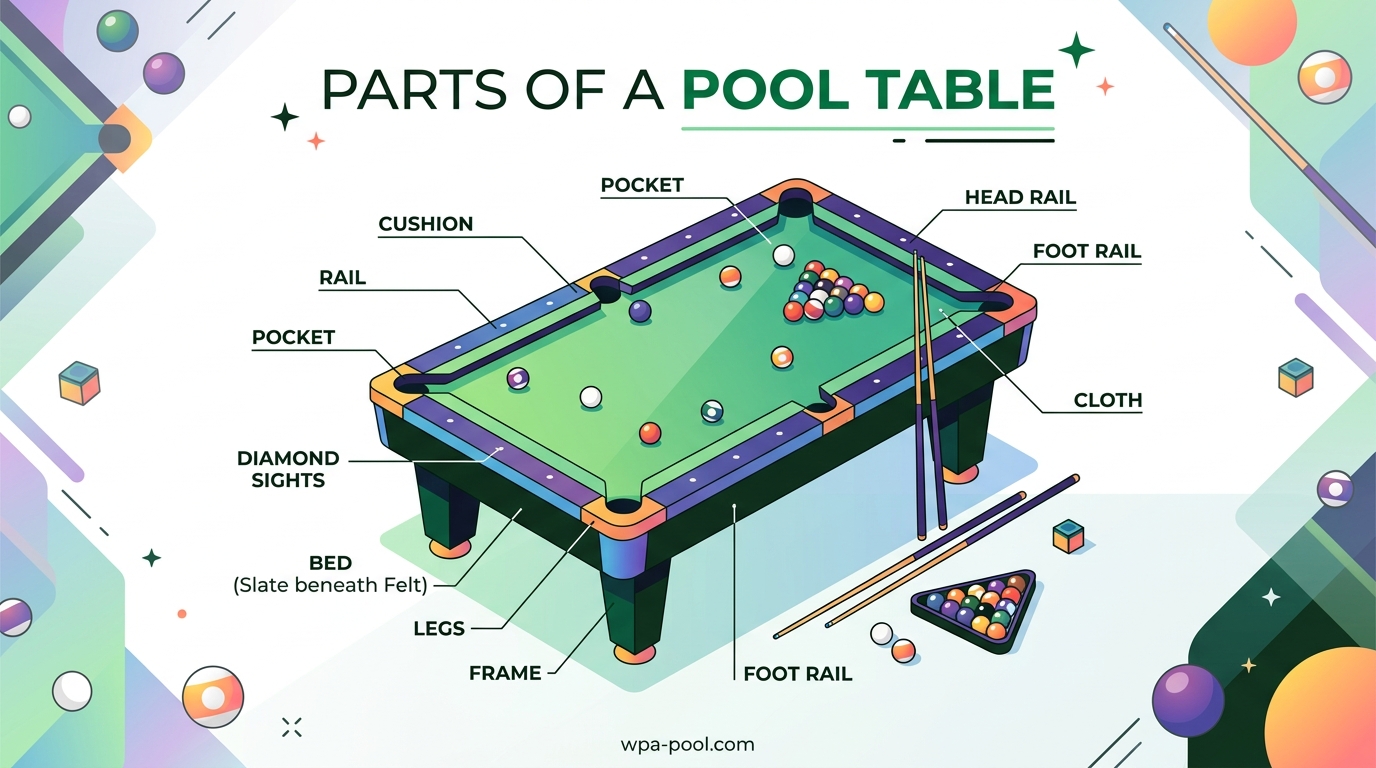
Understanding the parts of a pool table transforms how you play, maintain, and appreciate this classic game. Whether you are shopping for your first table, troubleshooting a repair, or simply curious about what makes a pool table work, knowing the anatomy helps you make informed decisions.
I have spent years around pool tables of every quality level, from worn bar tables to professional tournament setups. The difference between a table that plays true and one that frustrates players often comes down to understanding these components. In this guide, I will break down every major part of a pool table, explaining both what you see and the hidden elements that affect play.
By the end, you will know exactly how the slate bed, cushion rails, pockets, and dozens of smaller components work together to create the playing experience we all enjoy.
Table of Contents
The Five Main Parts of a Pool Table
Every pool table consists of five primary components that determine its quality and playability. These are the foundation upon which everything else depends.
- Slate bed: The heavy stone playing surface that provides the flat, stable foundation for every shot
- Legs and frame: The structural support system that holds the slate and maintains level
- Cloth (felt): The wool-blend covering that allows balls to roll smoothly with controlled speed
- Cushions (rails): The vulcanized rubber bumpers that create consistent ball rebound
- Pockets: The openings where pocketed balls are collected, either in drop pockets or ball return systems
These five elements work together to create what players call “table mechanics.” When one component is off, whether from wear, poor installation, or damage, the entire playing experience suffers. A warped slate bed cannot be fixed by better cushions. Worn felt will not play true regardless of how perfect the rails are.
Each of these main parts contains sub-components and details worth understanding. Let us examine each one thoroughly.
Bed (Slate): The Foundation of Every Pool Table
The slate bed forms the literal foundation of pool table anatomy. This is the flat surface upon which everything else rests. Without a perfectly level, crack-free slate bed, no pool table can deliver consistent play.
Professional-quality tables use natural slate, a metamorphic rock that provides exceptional flatness and stability. Slate comes in two main configurations. One-piece slate offers the most seamless playing surface but weighs over 400 pounds and makes moving the table nearly impossible. Three-piece slate, the industry standard for quality tables, consists of three separate sections that professionals seam together during installation. The seams are filled and sanded flush, creating a playing surface where the division between sections is nearly invisible.
Slate thickness matters significantly. Tournament-grade tables use slate between 1 inch and 1.5 inches thick. Thinner slate, common on entry-level tables, is prone to warping and cracking over time. Some budget tables use particle board or synthetic materials instead of slate. These alternatives save money but sacrifice the dimensional stability that makes slate essential for serious play.
During installation, technicians use leveling shims under the slate to achieve perfect horizontal alignment. Even a fraction of an inch off-level creates visible drift in ball rolls. The slate bed also requires proper support from the frame structure beneath it. Without adequate bracing, slate can crack under its own considerable weight.
Frame and Cabinet: The Structural Support
The frame and cabinet provide the skeleton that supports the massive weight of the slate bed while maintaining rigid structural integrity. A typical slate bed weighs between 400 and 600 pounds, plus the additional load of rails, pockets, and players leaning on the table.
The legs attach directly to the main cabinet, which forms the perimeter box around the table. Quality tables use solid hardwood or engineered wood products for the cabinet, avoiding particle board that swells and weakens with humidity changes. The legs themselves must be substantial enough to prevent wobbling, typically 4×4 inches or larger in cross-section.
Interior frame components include stringers and cross-members that distribute the slate weight across the entire support structure. Stringers run lengthwise beneath the slate, while cross-members span the width. Together they create a grid that prevents sagging. Glue blocks reinforce joint connections throughout the frame, adding rigidity where pieces meet.
The apron, also called the blind, is the vertical panel connecting the playing surface to the cabinet exterior. This decorative element conceals the internal frame while providing a clean visual finish. Some tables feature storage drawers in the apron for cues, balls, and accessories.
Cushions and Rails: The Bouncing System
The cushion rail system creates the characteristic rebound that defines pool shot-making. Without consistent cushions, bank shots become unpredictable and the game loses its mathematical precision.
Rail cushions, often called bumpers, attach to the inner edge of the top rail. They are made from vulcanized rubber, a material that maintains its elasticity and shape for decades when properly formulated. Quality cushions use natural gum rubber compounds that respond consistently across temperature and humidity ranges.
The K-66 profile represents the modern standard for cushion shape. This specific contour, resembling a triangle with slightly curved faces, creates predictable ball rebound angles when struck correctly. The profile name refers to measurements developed by the Billiard Congress of America. Different profiles exist, including K-55 and U-23, though K-66 dominates contemporary tables.
The top rail sits above the cushion, providing the surface where players rest their bridge hand. This rail must be wide enough for comfortable hand positioning while narrow enough not to interfere with stroke mechanics. Side rails run the length of the table, while end rails span the shorter head and foot dimensions.
Feather strips, narrow wooden or synthetic strips, separate the cushion from the playing surface edge. These thin components create a clean transition zone and help maintain cushion positioning. When cushions age and harden, they lose elasticity and produce “dead” rebounds where balls fail to bounce with normal force.
Cloth (Felt): The Playing Surface Cover
Pool table cloth, universally called felt despite not actually being felted material, creates the smooth surface balls roll across. This specialized textile significantly affects ball speed, spin response, and overall playing character.
Modern pool cloth uses a wool-nylon blend, typically 80% wool and 20% nylon. The wool provides the smooth nap that controls ball roll, while nylon adds durability and resistance to wear patterns. Championship-grade cloth uses tighter weaves and higher wool content for premium play characteristics.
Cloth comes in different weights and speeds. Tournament-grade cloth plays faster, with less resistance to ball roll, while recreational cloth prioritizes durability over pure speed. The direction of the nap, the raised fiber orientation, affects how balls behave depending on their travel direction. Professional installers always align cloth nap consistently, typically running from the head end toward the foot end.
Over time, cloth develops wear patterns in high-traffic areas, particularly around the head spot where breaks occur and along the rails where balls frequently contact. Burn marks from miscued shots or excessive cue ball spin create permanent discoloration. Quality cloth lasts 3-5 years with regular home use, while commercial tables may require annual recovering.
Installation requires stretching the cloth tightly across the slate and stapling or gluing it to the underside of the slate perimeter. Wrinkles or loose areas create uneven rolls that no player can predict.
Pockets: Ball Collection Points
Pockets represent the targets of pool gameplay, the destinations where successfully pocketed balls are collected. The design and construction of pockets significantly affect both gameplay difficulty and convenience.
Drop pockets are the simplest design, consisting of net or leather pouches suspended beneath each pocket opening. Pocketed balls fall into these pouches and remain there until manually retrieved. This design appears on most home tables and many commercial setups. The pockets themselves consist of pocket liners, typically plastic or metal, that define the opening shape and size.
Ball return systems use internal channels to collect pocketed balls and deliver them to a central collection point, usually at the foot end of the table. These systems add complexity and cost but eliminate the need to walk around the table gathering balls. Ball return tables use pocket facing, angled metal or synthetic plates that guide balls into the return channels rather than dropping them.
Pocket size varies by table type. American pool tables use larger pockets, typically 4.5 to 5 inches across at the opening, while snooker tables use smaller pockets that demand greater accuracy. The angle of pocket facing affects how balls behave when they contact the pocket edge. Quality facing provides clean entry while rejecting balls that hit the facing directly.
Pocket shelf depth, the distance from cushion nose to pocket opening, influences how difficult shots play. Deeper shelves make corner pockets more challenging because balls must travel farther across the pocket mouth without hitting the facing.
Markings and Sights: The Guidance System
Pool tables include a standardized system of markings that enable consistent gameplay and precise shot positioning. Understanding these reference points is essential for both beginners learning basic shots and advanced players executing complex position play.
The head string spans the width of the table at the head end, 29 inches from the head rail on a regulation 8-foot table. This imaginary line marks where the cue ball is placed for the opening break shot. The foot string performs the same function at the opposite end, marking the boundary beyond which balls must be driven during certain game variants.
Three spots mark specific positions on the table surface. The head spot sits at the intersection of the head string and the center line, the precise location for breaking. The foot spot occupies the corresponding position at the foot end, where the apex ball is placed when racking. The center spot marks the middle of the table, rarely used in standard games but helpful for practice drills.
Diamonds, also called sights, are the small inlaid markers spaced along the top rail edges. These reference points enable the diamond system, a mathematical method for calculating bank and kick shot angles. Each rail typically features 9 diamonds, creating a grid that experienced players use to predict ball paths. The diamond positions are standardized, allowing systems developed on one table to transfer to others.
The kitchen, also called the baulk area in snooker terminology, refers to the space behind the head string. In some game variants, balls within this area are considered safe or subject to specific rules. The precise definition varies by game type.
Interior Anatomy: What You Do Not See
Below the playing surface lies a complex network of structural and functional components that most players never see. Understanding this interior anatomy helps when diagnosing problems or planning maintenance.
The frame interior includes center braces and cross-members that prevent the heavy slate from flexing the cabinet. These structural elements often feature glue blocks at joints, triangular wood pieces that reinforce connection points. Without adequate bracing, the slate bed can develop subtle flex that creates dead spots where balls roll inconsistently.
Leveling shims sit beneath the slate at multiple points, allowing installers to fine-tune the playing surface flatness. These thin wedges of wood, metal, or composite material compensate for minor imperfections in the frame or floor beneath. Professional installation involves adding and adjusting shims until precision levels confirm perfect horizontal alignment across the entire surface.
On ball return tables, an internal network of channels and chutes guides pocketed balls from the six pockets to the collection area. These channels must maintain consistent downward slope without obstructions that could cause jams. The ball return mechanism at the collection point uses gravity and simple mechanical design to present balls for retrieval.
The slate itself rests on a bed of supportive material, often felt or specialized padding, that cushions the stone and prevents cracking from point pressure. This bedding layer distributes the massive weight evenly across the frame structure.
Modern tables may include integrated heating systems beneath the slate. These elements maintain stable temperature and humidity conditions that prevent cloth stretching and slate movement. Tournament tables at the highest level often feature this technology.
Frequently Asked Questions
What are the different parts of a pool table called?
The five main parts are the slate bed, legs and frame, cloth (felt), cushions (rails), and pockets. Additional components include the top rail, pocket facing, diamonds (sights), head string, foot string, and various interior frame elements like stringers and leveling shims.
What are the edges of a pool table called?
The edges of a pool table are called the rails or cushions. The top rail is the wooden surface where you rest your hand, while the cushion or bumper beneath it is made of vulcanized rubber that causes balls to rebound. There are side rails along the long edges and end rails at the head and foot.
What is the head and foot of a pool table?
The head of the pool table is the end where you break from, marked by the head string and head spot. The foot is the opposite end where balls are racked, marked by the foot string and foot spot. The head is typically where the table manufacturer’s nameplate appears.
What is slate in a pool table?
Slate is the heavy stone bed that forms the playing surface foundation. It provides the flat, stable base required for accurate ball roll. Quality tables use natural slate in either one-piece or three-piece configurations, typically 1 to 1.5 inches thick. Slate is preferred over alternatives like particle board because it maintains dimensional stability.
What are pool table cushions made of?
Pool table cushions are made of vulcanized rubber, typically natural gum rubber compounds. This material maintains elasticity over decades of use. The standard shape is called K-66 profile, which creates consistent ball rebound angles. When cushions age and harden, they produce dead rebounds and need replacement.
What is better, a 1-piece or 3-piece slate pool table?
Three-piece slate is generally better for most situations. While one-piece slate offers a completely seamless surface, three-piece slate is easier to transport and install, and professionals can seam the sections together to create a surface nearly as smooth as one-piece. Three-piece slate also accommodates minor adjustments during leveling that one-piece cannot.
Conclusion
Understanding the parts of a pool table gives you the knowledge to choose wisely, maintain properly, and appreciate the engineering behind every shot. From the slate bed that forms the unforgiving foundation to the vulcanized rubber cushions that create predictable rebounds, each component serves a specific purpose.
The next time you play, notice how the cloth speed changes with humidity, how the pocket facing rejects poorly aimed shots, how the diamonds help you calculate that tricky bank. This awareness transforms casual play into genuine understanding.
Whether you are maintaining your home table, shopping for an upgrade, or simply curious about pool table anatomy, you now have the complete picture of how these remarkable pieces of equipment work.