
Pool cues are precision instruments. After spending hundreds (sometimes thousands) on a quality cue, improper storage can ruin it within weeks. Warping, joint damage, and finish deterioration are preventable problems that plague players who simply do not know how to store a pool cue properly.
Our team has spoken with professional players, studied manufacturer guidelines from McDermott and other leading brands, and analyzed countless forum discussions from r/billiards and AZBilliards. The consensus is clear: storage technique matters as much as the cue itself.
This guide will show you exactly how to protect your investment, prevent warping, and keep your cue playing straight for years to come.
Table of Contents
How to Store a Pool Cue Properly
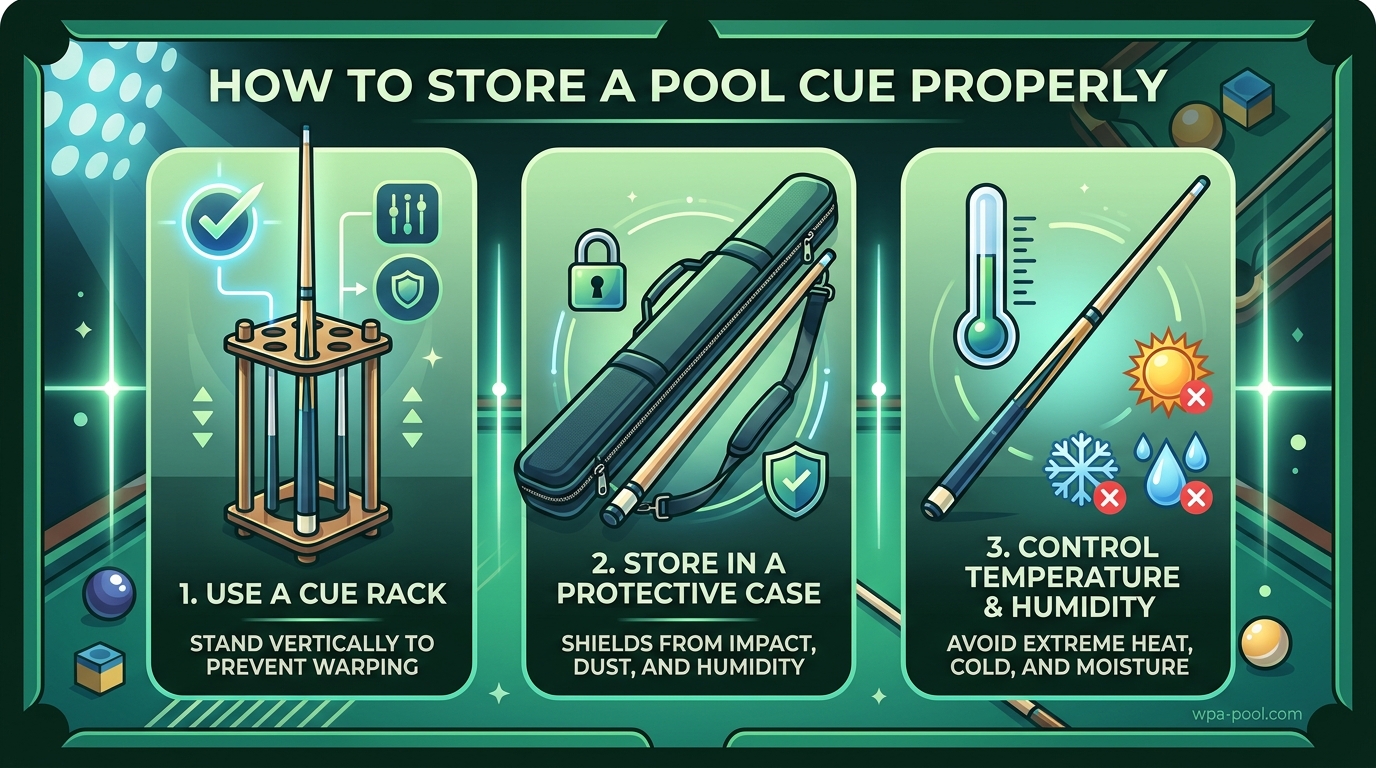
Here are the fundamental rules every pool player should follow:
- Store vertically – Always keep your cue standing upright in a rack or case
- Control the climate – Maintain approximately 70 degrees F and 40-50% humidity
- Never store in vehicles – Cars experience extreme temperature swings that warp cues
- Use joint protectors – These small accessories prevent joint damage and moisture entry
- Avoid leaning – Never lean cues against walls at an angle
These five rules form the foundation of proper pool cue storage. Violate any one, and you risk permanent damage to your cue’s straightness and playability.
Why Proper Pool Cue Storage Matters
Pool cues warp because wood is a living material that responds to gravity, temperature, and humidity. Even after being cut and finished, a cue shaft continues to move microscopically based on environmental conditions.
When you store a cue horizontally, gravity pulls unevenly along its length. Over weeks or months, this constant pressure creates a slight bend. The effect compounds when cues rest on uneven surfaces or soft materials that create pressure points.
Leaning a cue against a wall at an angle is even worse. The bottom bears all the weight while the top floats free. This differential stress warps cues faster than any other storage method. One r/billiards user reported a $400 cue developing visible curvature after just three weeks of leaning against a basement wall.
Beyond warping, improper storage damages the joint. The joint is the most critical part of a two-piece cue. If threads corrode or the connection loosens, your cue will wobble during shots. Joint protectors cost under $10 but prevent repair bills exceeding $100.
Temperature and Humidity Guidelines
McDermott Cues, one of the most respected manufacturers in the industry, recommends storing cues at approximately 70 degrees Fahrenheit with 40-50% relative humidity. This range represents the sweet spot for wood stability.
Temperature fluctuations cause thermal expansion and contraction. When wood heats, it expands. When it cools, it contracts. Repeated cycles stress the grain structure and can cause permanent deformation. Even a few hours in a hot car (120+ degrees) or freezing garage (below 40 degrees) can initiate warping.
Humidity matters equally. High humidity (above 60%) swells wood and can loosen the tip or ferrule. Low humidity (below 30%) dries wood and makes it brittle. Both conditions affect how the cue plays and feels.
If your storage area lacks climate control, consider adding a small dehumidifier or humidifier. Some players keep digital hygrometers in their cue storage area to monitor conditions actively.
Home Storage Options for Pool Cues
Your home setup determines how easily you can follow proper storage guidelines. Fortunately, several effective options exist at various price points.
Cue Racks and Wall Mounts
Wall-mounted cue racks are the most popular home storage solution. They keep cues vertical, visible, and easily accessible. Look for racks with padded cradles that support the cue without gripping too tightly. Avoid racks with hard plastic clips that can dent the shaft over time.
When installing a wall rack, choose an interior wall away from exterior doors, windows, and HVAC vents. This placement minimizes temperature fluctuations and drafts. The rack should mount at a height where cues hang freely without touching the floor.
Freestanding floor racks work well for players who cannot wall-mount. These typically hold 6-10 cues and occupy minimal floor space. Position them against interior walls in climate-controlled rooms, not in garages or basements with poor temperature regulation.
Cue Cases for Home Storage
Many experienced players store cues in cases even at home. A hard case offers the best protection against accidental impacts, dust, and humidity changes. Cases also make it easier to transport cues to leagues, tournaments, or friends’ houses.
When storing cues in cases at home, keep the case standing vertically, not lying flat. Some players store cases in closets or under beds, but ensure these spaces maintain stable temperatures. Attics and unheated garages are unsuitable for case storage.
If you are planning a dedicated game room, understanding standard pool table dimensions helps you design adequate space for both playing and storage.
Hard Cases vs Soft Cases vs Tube Cases
Not all cue cases provide equal protection. Understanding the differences helps you choose appropriate storage for your situation.
Hard Cases
Hard cases feature rigid outer shells, usually made from ABS plastic, aluminum, or composite materials. They provide maximum protection against impacts, crushing, and temperature changes. Professional players and anyone transporting cues regularly should invest in hard cases.
Inside, hard cases use foam padding that holds cues securely without pressure points. Quality cases include separate compartments for shafts and butts, plus storage for accessories like chalk, tips, and joint protectors.
Soft Cases
Soft cases, also called cue sleeves, use padded nylon or leather construction. They protect against scratches and minor bumps but offer little impact resistance. Soft cases work for short trips or storage in controlled environments.
Forum discussions reveal confusion about whether soft cases warp cues. The truth: soft cases do not inherently warp cues, but they provide less protection against environmental factors. If you store a cue in a soft case in a humid basement or hot car, warping can still occur. The case itself is not the problem; the environment is.
Tube Cases
Tube cases, or cue tubes, are cylindrical hard cases designed for single cues. They offer excellent protection in a compact form. Tube cases work well for players who own one primary cue and want maximum protection without bulk.
Some tube cases include adjustable shoulder straps for easy carrying. They fit easily in car trunks and overhead airplane compartments, making them popular for travel.
Travel and Transport Storage Tips
Transporting cues introduces new risks. Temperature-controlled homes are easy to manage. Cars, airports, and tournament venues present challenges.
Never leave cues in vehicles for extended periods. Summer heat can exceed 140 degrees inside parked cars, while winter cold can drop below freezing. Both extremes warp wood cues rapidly. Even insulated cases cannot overcome extreme temperatures indefinitely.
If you must transport cues in a car, keep them inside the passenger compartment rather than the trunk. Passenger areas heat and cool more gradually. Use sunshades and park in shade during summer. In winter, bring cues inside rather than leaving them in the car overnight.
For air travel, hard cases are essential. Baggage handlers are not gentle, and soft cases provide inadequate protection. Consider cases with TSA-approved locks and sufficient padding to withstand impacts.
Long-Term Storage Best Practices
Sometimes you need to store cues for months or years. Seasonal players, collectors, and those relocating face this challenge.
For extended storage, hard cases provide the best protection. Add silica gel packs inside the case to control humidity. Replace these packs every few months as they saturate.
Some experienced players wrap cues in clean cotton sheets or pillowcases inside cases. This adds a moisture buffer and prevents the cue from contacting case materials directly. One AZBilliards forum member successfully stored a cue for three years using this method with no warping.
Check stored cues every few months. Remove them from cases, inspect for warping by rolling on a flat table, and let them air briefly in a controlled environment. This prevents minor issues from becoming permanent damage.
What Is the 30 Rule in Pool?
The “30 rule in pool” actually refers to two different concepts depending on context, which explains the confusion surrounding this PAA question.
First, the 30-degree rule describes the angle at which a cue ball deflects after hitting an object ball with natural roll. When the cue ball contacts the object ball at a 30-degree angle, it travels along a predictable path approximately 30 degrees from the original direction. This rule helps players predict cue ball movement for position play.
Second, some instructors use “the 30 rule” to recommend chalking your cue tip after every 30 shots. This prevents miscues and maintains consistent tip performance. While not a formal rule, it represents good maintenance practice that serious players follow.
Neither version relates directly to cue storage, but both reflect the precision mindset that proper cue care requires.
Frequently Asked Questions About Pool Cue Storage
What’s the best way to store a pool cue?
Always store pool cues vertically in a cue rack or case. Keep them at approximately 70 degrees Fahrenheit with 40-50% humidity. Never lean cues against walls or lay them flat, as gravity can cause warping over time. Use joint protectors to prevent damage to the connection point.
What is the 30 rule in pool?
The 30 rule in pool typically refers to the 30-degree rule, which describes how a cue ball travels approximately 30 degrees from its original path after hitting an object ball. Some instructors also use the 30 rule to suggest chalking your cue tip every 30 shots to prevent miscues.
How to store a cue stick without a hard case?
Without a hard case, hang the cue vertically on a wall rack with padded supports. Alternatively, lay it flat on a completely flat surface with support along the entire length. Avoid leaning it against walls. If using a soft case sleeve, store the cue in a climate-controlled room and never leave it in a vehicle.
Can you leave a pool cue in a cold car?
Never leave a pool cue in a cold car. Temperature extremes, whether hot or cold, cause rapid warping. Cold temperatures make wood contract unevenly, potentially causing permanent bends. Even insulated cases cannot prevent warping during extreme temperature exposure. Always bring cues inside to a climate-controlled environment.
Conclusion: Protect Your Investment
Knowing how to store a pool cue properly separates players who maintain equipment for decades from those who replace warped cues every few years. The formula is simple: store vertically, control the climate, use protective cases, and never expose cues to temperature extremes.
Your cue is a precision tool. Treat it with the same care you would give any valuable instrument. The 30 seconds it takes to properly store your cue after each session can add years to its playable life and save you hundreds of dollars in replacement costs.
Start implementing these storage practices today. Your future self, standing over a straight cue that plays true after years of use, will thank you.