
I still remember the frustration of missing shots I knew I should make. After six months of playing pool casually, I hit a wall. My aim felt inconsistent. Some days I could pocket balls from anywhere on the table. Other days, I could not make a simple straight-in shot to save my life.
That changed when I learned that pool aim is not about talent or natural eye coordination. It is a learnable skill built on visualization, proper stance, and deliberate practice. In this guide, I will share exactly how to improve your pool aim using techniques that took me from a beginner struggling with basic shots to someone who can run racks consistently. Whether you are just starting out or looking to break through to the next level, these methods will work for you.
Table of Contents
How to Improve Your Pool Aim: The Foundation
Pool aiming is fundamentally about geometry and visualization. You need to see the path from your cue ball to the object ball, and from the object ball to the pocket, before you ever bend down to shoot. The best players do this instinctively, but they all started by learning specific techniques.
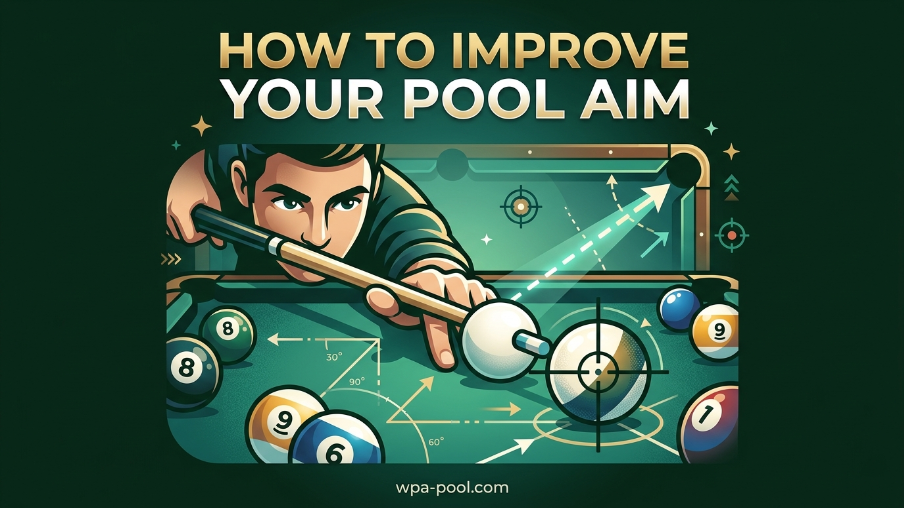
The ghost ball method forms the foundation of modern pool aim. Imagine a ghost ball sitting at the exact spot where your cue ball needs to contact the object ball to send it toward the pocket. Your job is simple: hit the real cue ball so it occupies that ghost ball position at the moment of impact. This is the first pool aiming technique every player should master.
But visualization alone is not enough. Your body must be positioned correctly to deliver the cue along the aiming line. Stance, bridge hand placement, and alignment matter just as much as what you see. We will cover all of these elements in the sections below.
The Ghost Ball Method: Visualize Your Success
The ghost ball method is the most widely taught and used pool aiming system for good reason. It works for shots at any angle and helps you develop the spatial awareness needed for advanced play.
Here is how to use it step by step. First, identify the contact point on the object ball where it needs to be struck to travel toward your target pocket. Draw an imaginary line from that contact point through the center of the object ball and extend it backward. The point where this extended line ends is where the center of your cue ball must be at the moment of contact. That is your ghost ball position.
Now visualize the cue ball traveling along a straight line from its current position to that ghost ball spot. This is your aim line. When you get down on the shot, your cue should point directly along this line toward the ghost ball center.
Many players struggle with ghost ball visualization because they try to hold the image while getting into their stance. The solution is the standing visualization technique I learned from league players: stand upright behind the cue ball, visualize the ghost ball and aim line while your head is high and your eyes are level, then step into the shot without adjusting your aim. Once you are down, trust your visualization and execute your stroke.
Practice this by placing two balls in front of a pocket with just enough space between them for the cue ball to pass. Try to pocket a ball by sending the cue ball through that gap. When you can make a 9-foot straight shot nine times out of ten, your ghost ball visualization is solid.
Contact Point Aiming: Precision Technique
While ghost ball aiming works for most shots, contact point aiming offers an alternative that some players find more intuitive for specific situations. Instead of imagining where the cue ball must go, you focus on the exact spot where the cue ball must strike the object ball.
This method works best for close-range shots and when you need precise control over how the object ball reacts. Look at the object ball and identify the point on its surface that, when struck, will send it toward the pocket. Some players find it easier to spot a physical mark or discoloration on the object ball to use as their target.
The key difference from ghost ball is that you are looking at the object ball itself, not an imaginary cue ball position. This can reduce mental clutter for some players. However, contact point aiming becomes harder at longer distances because you must translate that spot on the object ball into an aim line from the cue ball, which requires the same geometric understanding as ghost ball.
Many intermediate players use a hybrid approach: ghost ball for most shots, contact point for short, delicate shots where feel matters more than geometry. Try both and see which gives you better results for different situations.
Stance and Alignment: The Physical Foundation
Even the best visualization fails if your body is not positioned to deliver the cue along your intended line. Your stance and alignment create the physical platform for accurate aiming.
Start by standing behind the cue ball on the shot line. Your feet should be shoulder-width apart, with your back foot slightly off the line to allow your body to turn naturally into the shot. Many players make the mistake of standing too close or too far from the table. Find a distance that lets you extend your bridge hand comfortably while keeping your head over the cue.
Your bridge hand is your aiming anchor. Place it on the table with fingers spread for stability. The cue should slide smoothly through the groove formed by your thumb and index finger. For longer shots, use an open bridge. For power shots or when you need extra stability, use a closed bridge.
Body alignment is critical. Your head, shoulder, bridge arm, and back foot should all align along the shot plane. A common mistake is dropping the shoulder on the bridge side, which throws off your aim. Keep your shoulders level and your head centered over the cue.
Here is the standing visualization technique that transformed my consistency: before bending down, stand upright and visualize your aim line from above. Spot your target, see the ghost ball, and lock that image in your mind. Then step into the shot keeping your back foot aligned with your intended path. Once you are down, do not look up to check the pocket. Trust your visualization and focus on executing a smooth stroke.
Fractional Aiming for Intermediate Players
Once you have mastered ghost ball basics, fractional aiming gives you a more systematic approach to cut shots. This pool aiming system divides the object ball into fractions and gives you reference points for common angles.
The concept is simple. Imagine the object ball as a clock face or divided into fractions. A straight-on hit is full ball contact. A shot where the cue ball hits the object ball halfway between center and edge is a half-ball hit. Quarter-ball hits and three-quarter ball hits give you reference points for different cut angles.
Fractional aiming works particularly well for mid-range cut shots where ghost ball visualization might feel imprecise. Instead of imagining an invisible ball, you aim at a visible fraction of the object ball. Many players find this more concrete and reliable once they memorize the angles associated with each fraction.
The drawback is that fractional aiming requires memorization and practice to connect each fraction to the correct cut angle. It also works best on shots with standard angles. For unusual cut angles or when the cue ball and object ball are close together, ghost ball or contact point aiming usually works better.
Practice fractional aiming by setting up balls at different known angles and identifying which fraction applies. Over time, you will develop an instinctive sense of which fraction matches which angle.
CTE Aiming: The Pro Technique
CTE, or Center-to-Edge aiming, is the system many professional players use for difficult shots. It sounds complicated, but the basic concept is accessible to intermediate players who want to add another tool to their arsenal.
CTE works by establishing a reference line from the center of the cue ball to the edge of the object ball. From this starting point, you make small adjustments based on the cut angle. The system gives you a concrete visual reference that eliminates some of the guesswork in ghost ball visualization.
To use simplified CTE, start by aiming the center of your cue ball at the edge of the object ball on the side away from the pocket. This is your baseline. For cut shots, you then shift your aim slightly toward the pocket side of the object ball edge. The amount of shift depends on the cut angle.
The advantage of CTE is consistency. Once you learn the adjustments for different angles, you can repeat them shot after shot. The disadvantage is the learning curve. CTE requires dedicated practice to master the various reference points and adjustments.
For most recreational players, ghost ball and fractional aiming will handle 90 percent of shots. Add CTE to your practice routine when you are ready for advanced techniques and want the same system many professionals rely on.
Practice Drills That Actually Work
Knowing the techniques is only half the battle. You need deliberate practice to build the muscle memory and visual skills that make great aim automatic. Here are the drills that delivered real results for me and other players I have worked with.
The standing visualization drill addresses the most common aim problem: losing your visualization when you get down on the shot. Place a ball on the table and stand behind it. Visualize the ghost ball position and aim line while standing upright. Close your eyes and hold that image for five seconds. Open your eyes, step into the shot without looking at the pocket, and execute. Practice this until you can consistently pocket balls without second-guessing your aim after getting down.
The straight-in shot drill builds your foundation. Set up straight shots at increasing distances: 3 feet, 6 feet, and 9 feet. Your goal is to make 9 out of 10 shots at each distance before moving to the next. This drill reveals flaws in your stroke and visualization quickly. If you miss straight shots, your aim is not the problem; your stroke mechanics need work.
The two-ball gap test checks your aim accuracy objectively. Place two balls in front of a pocket with just enough space between them for the cue ball to pass through. Try to send the cue ball through the gap ten times in a row. This drill from league players gives you immediate feedback on whether your aim is truly accurate or just occasionally lucky.
Here is a weekly progression that works. Week one, focus entirely on straight shots and standing visualization. Week two, add half-ball cuts at medium distance. Week three, practice fractional aiming with quarter and three-quarter ball hits. Week four, combine all techniques in random practice. Spend at least 30 minutes per session, three sessions per week.
Track your progress by keeping a simple log of shots made and missed in each drill. When your percentages improve, you know your aim is actually getting better, not just feeling better.
Common Aiming Mistakes and How to Fix Them
After working with dozens of players on their aim, I have seen the same mistakes repeatedly. Here is how to identify and fix them.
Overthinking under pressure is the most common problem. You visualize perfectly in practice, but in a game, you second-guess yourself, stand up, re-aim multiple times, and miss. The fix is establishing a pre-shot routine and trusting it. Once you are down on the shot, you have committed. Execute without looking up. Practice this by playing practice games where you are not allowed to stand up once you get down, regardless of how the shot feels.
Poor stance alignment ruins good visualization. If your body is not aligned with your aim line, you will subconsciously adjust your stroke to compensate, causing misses. Check your alignment by having a friend verify that your back foot, shoulder, and head align with your intended path when you are in your stance.
System switching too often keeps you from mastering any single method. Beginners try ghost ball for one shot, contact point for the next, then fractional for the third. Pick one system as your primary method and use it for 80 percent of shots. Add secondary systems only after your primary one is automatic.
Ignoring table conditions affects aim more than most players realize. Fast cloth, dirty balls, and humidity change how shots play. On fast tables, aim slightly thinner on cut shots because the cue ball travels farther before contacting the object ball. With dirty or worn balls, expect less consistent reactions and adjust your aim accordingly.
Frequently Asked Questions
How to get better at pool aiming?
Focus on three areas: visualization using the ghost ball method, proper stance and alignment, and deliberate practice with specific drills. Stand upright to visualize your aim line before getting down, maintain consistent body alignment, and practice straight shots until you can make them 90 percent of the time. Add cut shot drills progressively as your foundation improves.
What is the 30 rule in pool?
The 30 rule is a guideline for predicting cue ball path after hitting an object ball. When the cue ball hits a full ball or nearly full ball shot, it will deflect approximately 30 degrees from its original path. This helps players anticipate where the cue ball will travel for position play on their next shot.
Why is my aim off in the pool?
Common causes include poor stance alignment, overthinking under pressure, switching aiming systems too often, and ignoring table conditions. Check that your body aligns with your shot line, commit to your aim once you get down, stick with one primary aiming system, and adjust for cloth speed and ball condition.
How to drastically improve aim?
Drastic improvement comes from dedicated practice of fundamentals. Master the ghost ball visualization method, perfect your stance and stroke mechanics, and use the two-ball gap test to verify your accuracy. Practice 30 minutes daily with structured drills, tracking your improvement with specific metrics like percentage of shots made at each distance.
Conclusion
How to improve your pool aim comes down to mastering a few core techniques and practicing them consistently. The ghost ball method gives you a visualization framework that works for any shot. Proper stance and alignment ensure your body can deliver the cue along your intended line. Contact point, fractional, and CTE aiming give you additional tools for specific situations.
Start with the standing visualization drill and straight shot practice. Build your foundation before adding complexity. Track your progress with objective tests like the two-ball gap drill. Most importantly, commit to your aim once you get down on the shot. Trust your preparation and execute with confidence.
Your aim will not improve overnight, but with the techniques in this guide and consistent practice, you will see real progress within weeks. Pick one drill from this guide and practice it today. Your future self will thank you when you start pocketing balls that used to miss.