
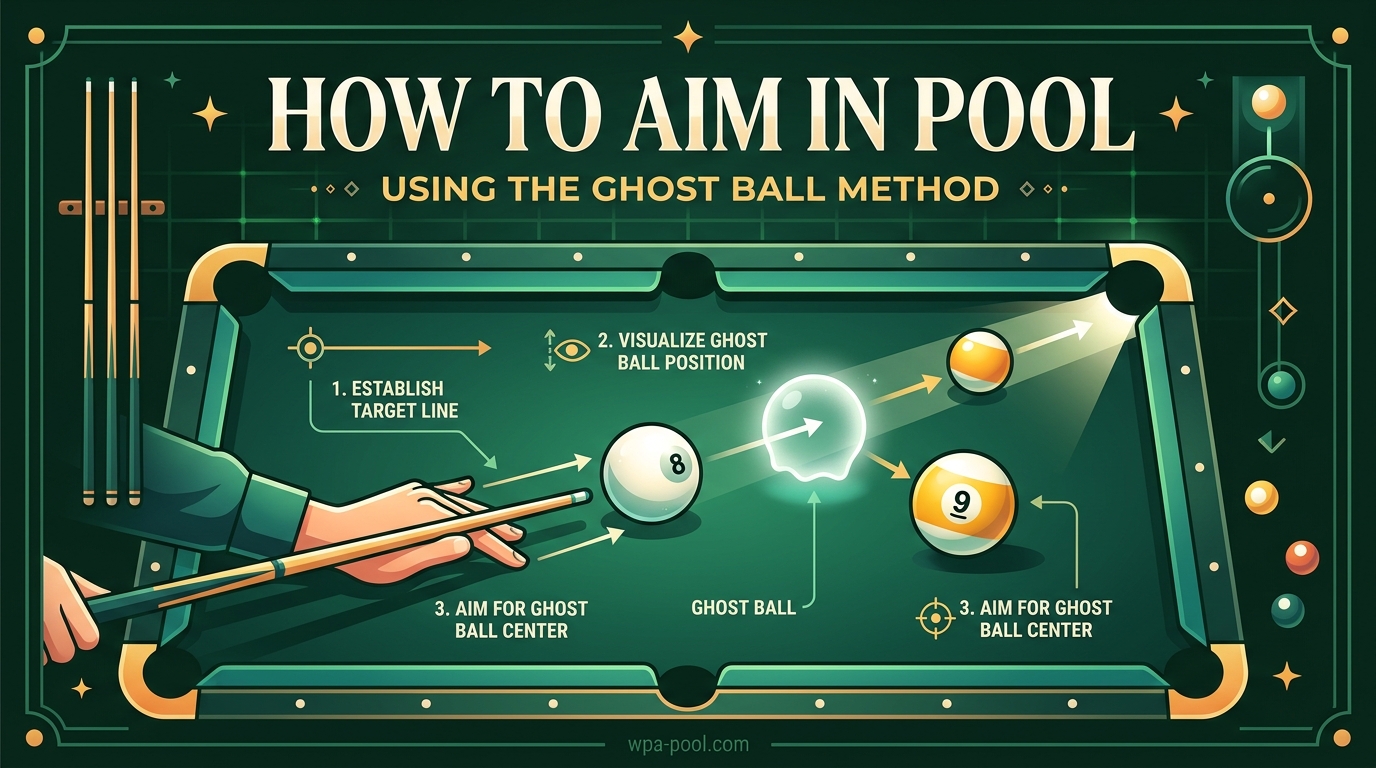
I spent my first three years playing pool missing cut shots I should have made. I would stare at the object ball, try to guess where to hit it, and hope for the best. Some shots went in. Most did not. Then a league player showed me the ghost ball method, and everything changed within a single practice session.
The ghost ball method is the most intuitive aiming system in pool. It replaces guesswork with geometry. Instead of trying to hit an invisible contact point on the object ball, you aim at something you can actually see – the center of an imaginary ball positioned exactly where your cue ball needs to be.
In this guide, I will walk you through exactly how to use ghost ball aiming to make more cut shots immediately. You will learn the step-by-step technique, the common mistakes that ruin your accuracy, and specific drills to build this skill into muscle memory. Whether you are struggling with basic cut shots or want a reliable system you can teach to others, this method works.
Table of Contents
What Is the Ghost Ball Method
The ghost ball method uses an imaginary ball to simplify aiming. When you want to pocket an object ball, you mentally place an imaginary cue ball – the “ghost ball” – in the exact position where your real cue ball must contact the object ball to send it toward the pocket.
Here is the key insight. Your cue ball does not need to touch a specific spot on the object ball. It needs to occupy a specific position in space at the moment of contact. That position is where the ghost ball sits. The ghost ball touches the object ball on the side opposite from the pocket, sitting on the straight line that runs from the object ball to the pocket.
Instead of aiming at a contact point on the object ball surface, you aim at the center of the ghost ball. This gives your brain a concrete target. You are no longer guessing at a contact point. You are shooting at a ball center, something every pool player already knows how to do.
The ghost ball sits on what we call the pocket line. This is the imaginary line that runs from the center of the object ball to the center of the pocket opening. The ghost ball touches the object ball on the far side of this line, exactly one ball diameter away from the object ball center. When your real cue ball occupies that ghost ball position, it pushes the object ball along the pocket line and into the hole.
Professional players use this method instinctively. They may not consciously think “ghost ball” on every shot, but their brains are calculating that same geometry. Learning to visualize it deliberately gives you access to that same accuracy while you build the instinctive version through repetition.
How to Aim in Pool Using the Ghost Ball Method
Mastering ghost ball aiming requires a consistent pre-shot routine. Follow these five steps on every cut shot until they become automatic.
Step 1: Find the Pocket Line
Walk to the pocket where you want to sink the object ball. Look back at the object ball and imagine a straight line running from the pocket center through the object ball center. This is your pocket line. The object ball must travel along this line to drop.
Walk back to your cue ball position. Keep that pocket line in your mind. Some players trace it visually by looking from object ball to pocket and back. Others imagine a string connecting the two. Find what works for your visualization style.
Step 2: Visualize the Ghost Ball Position
Imagine a cue ball touching the object ball on the side opposite from the pocket. This imaginary ball sits on the pocket line, exactly one ball diameter away from the object ball center. Its center lies on that line.
Many beginners struggle with this visualization. If you cannot see it mentally, try this physical reference. Place an actual ball on the table in the ghost ball position. Study it. Then remove it and try to hold that image in your mind. After a few sessions, you will visualize it without the reference ball.
Step 3: Aim Your Cue at the Ghost Ball Center
Get into your stance and aim your cue tip at the center of the ghost ball, not the object ball. This is the critical difference between ghost ball aiming and contact point aiming. You are shooting through space to a target behind the object ball.
Your cue should point directly at the ghost ball center. When you stroke, your cue ball will travel along that line and collide with the object ball at exactly the right spot. The ghost ball center becomes your target just like a real ball would be.
Step 4: Verify Your Cue Ball Path
Before you stroke, double-check that your cue ball will travel along the line to the ghost ball center. Look at the angle your cue ball must travel. It should be the angle that puts you on that ghost ball center.
If the cue ball path looks wrong, your ghost ball position is probably wrong. Go back to step 2 and re-visualize. Most missed shots come from poor ghost ball positioning, not execution errors.
Step 5: Execute Your Stroke
Stroke with confidence toward the ghost ball center. Do not look at the object ball surface. Keep your focus on that imaginary ball behind it. Trust the geometry. When your cue ball reaches that ghost ball position, it will automatically contact the object ball at the correct point and send it toward the pocket.
Follow through normally. The ghost ball method does not require any special stroke technique. It is purely an aiming system. Your normal stroke will work fine once you are aimed correctly.
Why Ghost Ball Aiming Works
Ghost ball aiming works because it aligns with the physics of collision. When two balls collide, the direction of the second ball depends entirely on the point of contact and the line between the ball centers at impact.
When your cue ball occupies the ghost ball position, its center sits on the pocket line. The object ball center also sits on that line. The line connecting the ball centers points exactly at the pocket. When the cue ball pushes the object ball along that line, the object ball has nowhere to go except toward the pocket.
The 90-degree rule explains what happens after contact. When a cue ball hits an object ball with no spin, the cue ball travels at a 90-degree angle from the direction of the object ball. This is why the ghost ball position works so well. It positions your cue ball to make contact while leaving the physics to handle the rest.
Unlike contact point aiming, which requires you to estimate an invisible spot on a curved surface, ghost ball aiming gives you a complete ball to aim at. Your brain processes complete objects better than abstract points. This is why beginners pick up ghost ball aiming faster than other systems.
The method also scales naturally. Thin cut shots simply move the ghost ball farther around the object ball. Thick shots bring it closer. The visualization stays the same regardless of angle. You are always aiming at a ball center.
Common Ghost Ball Aiming Mistakes and How to Fix Them
Even with a clear method, beginners make predictable errors. Here are the five most common mistakes I see and how to correct them.
Mistake 1: Aiming at the Contact Point Instead of the Ghost Ball Center
Many beginners try to aim at the point where the ghost ball touches the object ball. This is wrong. You aim at the ghost ball center, which sits one full ball diameter behind that contact point.
Fix: When you visualize the ghost ball, focus on its center point in space. Imagine a real ball sitting there. Aim at its middle, not its edge. If you catch yourself looking at the object ball surface, reset and look through it to the ghost ball behind.
Mistake 2: Poor Ghost Ball Positioning
The ghost ball must sit exactly on the pocket line. If you place it even slightly off, your shot misses. Most errors come from rushing the visualization step.
Fix: Spend more time on step 1. Really see that pocket line from object ball to pocket. Only then place your ghost ball on that line. When in doubt, walk to the pocket again and look back. Verifying the line takes three seconds. Missing takes thirty.
Mistake 3: Inability to Visualize the Ghost Ball
Some players struggle to hold the mental image. This is normal and fixable. The visualization is a skill you develop, not something you either have or do not.
Fix: Use a physical reference ball for two weeks. Place a real ball in the ghost ball position before every shot. Study it, then remove it and shoot immediately. Your brain will learn to hold the image. Also try practicing in dim light, which makes imaginary objects easier to see.
Mistake 4: Missing Thin Cut Shots
Extreme cut angles require precise ghost ball placement. Small errors become big misses when the ghost ball sits far around the object ball.
Fix: On thin cuts, verify your ghost ball position twice. Look from behind the cue ball, then walk to the object ball side and look back. The extra angle check catches positioning errors. Also stroke more slowly on thin cuts. Speed magnifies small aiming errors.
Mistake 5: Forgetting About Throw
When balls collide, friction causes the object ball to “throw” slightly off the expected line. This is minimal on center-ball hits but becomes noticeable with spin or at slow speeds.
Fix: For now, ignore throw and focus on pure ghost ball technique. Once you are making shots consistently, you can start accounting for throw by adjusting your ghost ball slightly. But learning throw adjustments before you have solid fundamentals just adds confusion.
Ghost Ball Aiming Practice Drills
Drills build the visualization skill into automatic action. Practice these two drills for twenty minutes twice a week, and you will see measurable improvement within a month.
Drill 1: The Line of Five
This drill trains your ghost ball positioning accuracy. Place five object balls in a straight line between the side pockets, spaced one ball diameter apart. Place your cue ball at one end, about two feet from the nearest object ball.
Shoot each object ball into the opposite side pocket using ghost ball aiming. Start with ball one, then two, then three. This gives you five different cut angles with the same cue ball position. You will work through thin cuts, medium cuts, and nearly straight shots.
Shoot the line three times, then switch sides. If you miss, stop and analyze. Was your ghost ball positioned correctly? Did you aim at the ghost ball center? Fix the error mentally, then continue.
Track your progress. In your first session, making three out of five is excellent. After two weeks of practice, you should make four out of five consistently. After a month, five out of five becomes normal.
Drill 2: Progressive Cut Angles
This drill teaches you to handle any cut angle. Place an object ball near a corner pocket. Place your cue ball at progressively steeper angles around it, starting with a straight-in shot and moving to thinner and thinner cuts.
Start with the cue ball directly behind the object ball on the pocket line. This is a straight shot requiring no ghost ball visualization. Make three of these to warm up.
Move the cue ball one diamond to the side. Now you have a slight cut. Visualize your ghost ball and make three shots.
Continue moving the cue ball one diamond at a time. You will work through 15-degree cuts, 30-degree cuts, and eventually 45-degree or steeper angles. Stop when you reach an angle where you cannot consistently make three in a row.
That angle is your current limit. Practice at that angle until you own it, then push farther. Most intermediate players can reliably handle up to 30-degree cuts. Advanced players work comfortably at 45 degrees and beyond.
Advanced Tips for Better Ghost Ball Aiming
Once you have the basics solid, these refinements will take your accuracy to the next level.
Learn when ghost ball is not enough. On extreme cut shots beyond 45 degrees, throw effects become significant. The object ball will throw offline, causing misses even with perfect ghost ball positioning. When you reach this level, consider learning contact point aiming or fractional systems as supplements.
Combine ghost ball with other systems. Many professional players use ghost ball intuitively but verify with contact point systems on tough shots. The systems are not competitors. They are tools for different situations.
Practice with a training ball. Some players find that training balls with marked contact points help them verify their ghost ball visualization. The marked ball shows you where contact actually occurred, letting you check if your ghost ball was positioned correctly.
Teach someone else. Nothing solidifies a skill like teaching it. Once you are making shots consistently, teach the ghost ball method to a friend. Explaining the visualization process will clarify it in your own mind and reveal any gaps in your understanding.
FAQ
How to aim in pool ghost ball?
To aim in pool using the ghost ball method, first find the pocket line from the object ball to the pocket. Visualize an imaginary cue ball (the ghost ball) touching the object ball on the far side of that line. Aim your cue at the center of this ghost ball and execute your stroke. The ghost ball center becomes your target instead of trying to guess a contact point on the object ball surface.
How do ghost balls work?
Ghost balls work by giving you a concrete target to aim at. The imaginary ghost ball sits exactly where your real cue ball must be at contact to pocket the object ball. When you aim at the ghost ball center, the geometry of the shot ensures your cue ball contacts the object ball at the correct point to send it toward the pocket.
What is the best aiming system in pool?
The ghost ball method is widely considered the best aiming system for beginners and intermediate players because it is intuitive and easy to visualize. For advanced players, fractional aiming and contact point systems provide additional precision on extreme shots. Most professionals use ghost ball instinctively and verify with other systems when needed.
What is the 30 rule in pool?
The 30-degree rule states that when a cue ball hits an object ball with no spin, it deflects at approximately 30 degrees from the original direction for many common cut angles. This is related to but different from the ghost ball method, which focuses on aiming rather than predicting cue ball path after contact.
How long does it take to learn ghost ball aiming?
Most players see immediate improvement in their first practice session with ghost ball aiming. Developing consistent accuracy typically takes two to four weeks of regular practice. Mastery, where the visualization becomes automatic, usually requires two to three months of deliberate practice using the drills described in this guide.
Conclusion
The ghost ball method transforms pool aiming from guesswork into geometry. By visualizing an imaginary ball where your cue ball must contact the object ball, you give your brain a concrete target instead of an abstract contact point to estimate.
Work through the five-step technique on every cut shot. Practice the Line of Five and Progressive Cut Angles drills regularly. Correct the common mistakes as they appear. Within weeks, you will make shots you used to miss and approach the table with confidence instead of doubt.
How to aim in pool using the ghost ball method is not just theory. It is a practical skill you can build starting today. Take this guide to the table and start making more shots.