
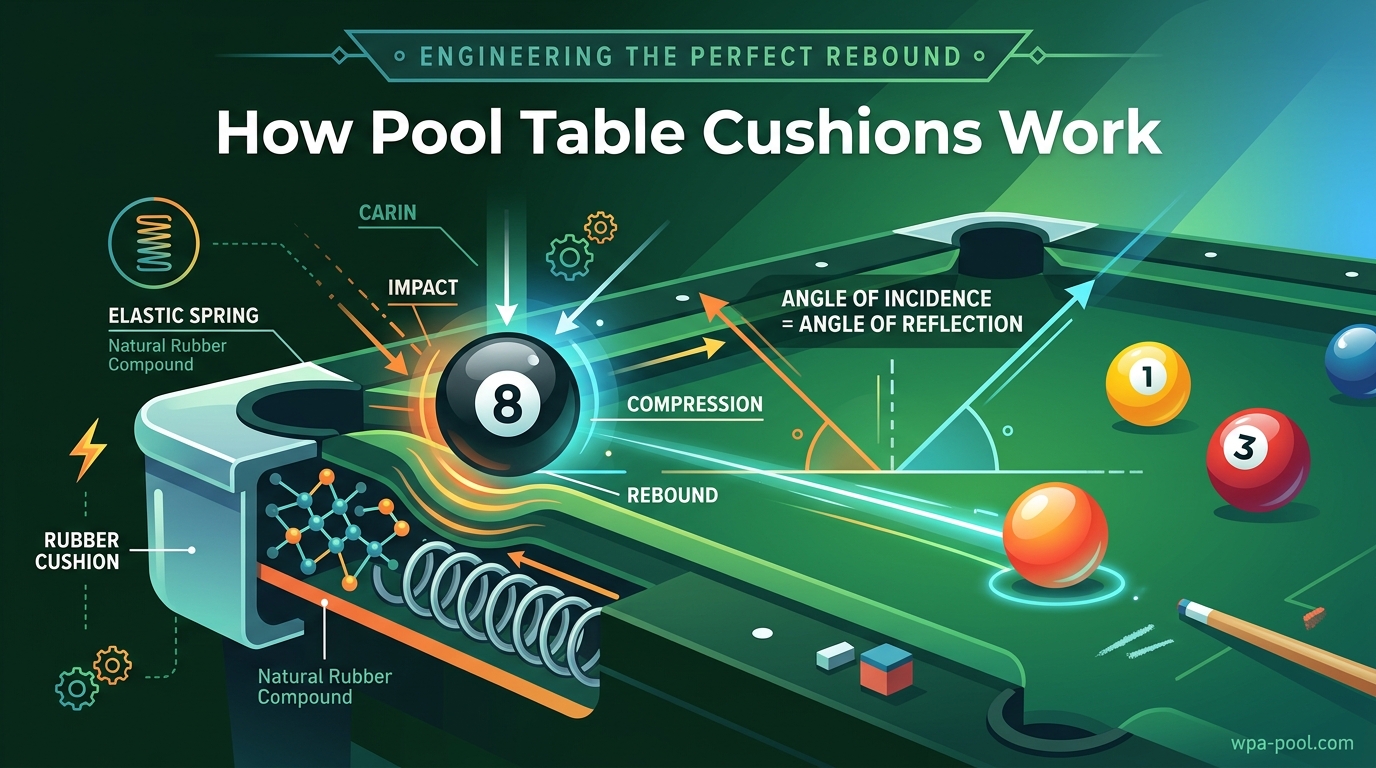
Pool table cushions are the wedge-shaped rubber strips attached to the inner sides of a table’s wooden rails. They compress when a ball hits them and rebound to return energy to the ball, allowing for bank shots and precise angle play.
Understanding how pool table cushions work can transform your game. I have spent years testing tables and talking with professional technicians, and I can tell you that cushion behavior affects every shot you play. The rebound quality determines whether your banks arrive true or fall short.
In this guide, I will explain the physics behind cushion function, the different rubber profiles available, and what factors affect performance over time. By the end, you will know how to test your cushions and recognize when they need replacement.
Table of Contents
How Pool Table Cushions Work
Pool table cushions work through a simple compression-rebound cycle. When a ball strikes the cushion nose, the rubber compresses inward, absorbing the ball’s kinetic energy. The rubber then rebounds outward, returning that energy to the ball and sending it away at a predictable angle.
The physics here is fascinating. The coefficient of restitution describes how efficiently the cushion returns energy. A cushion with high elasticity returns more energy, producing livelier rebounds. Worn cushions lose this elasticity over time, causing balls to rebound with less speed and accuracy.
Here is the insight that changed my understanding of bank shots: faster balls bank shorter than slower ones. This happens because a fast ball compresses the cushion more deeply, causing the rubber to deform further. The cushion rebounds from a point closer to the center of the table, effectively shortening the rebound angle. Slow balls barely compress the cushion and rebound from the outer edge, creating wider angles.
Spin also affects cushion interaction dramatically. Topspin causes the ball to hop slightly off the surface and hit the cushion higher, while backspin can make the ball grab the cloth and compress the cushion differently. Side spin changes the effective angle of approach, creating effects that experienced players use to control position.
The rubber compounds used in quality cushions are specifically formulated for consistent rebound across a range of temperatures and humidity levels. Vulcanized rubber undergoes a curing process that creates cross-linked molecular structures, giving the material both elasticity and durability.
Pool Table Cushion Anatomy and Components
A pool table cushion consists of several key components working together. The rubber body is the heart of the system, typically made from natural rubber compounds with specific hardness ratings measured on the Durometer scale.
The cushion nose is the rounded top edge that balls actually contact. Its height relative to the playing surface is critical. Regulation cushion nose height sits at 63.5% of the ball diameter, or approximately 1.4 inches for standard 2.25-inch pool balls. This positioning ensures balls strike the cushion at the optimal point for predictable rebound.
The profile shape refers to the cross-sectional design of the cushion. Two main profiles dominate the market: K-55 and K-66. These designations refer to specific dimensional standards that affect how balls interact with the cushion face. The profile determines the contact point geometry and influences rebound angle consistency.
Rails form the wooden structure that houses the cushions. Quality rails use solid hardwood, typically maple or oak, laminated for stability. The cushion glues to a vertical face on the rail interior using specialized contact adhesives that maintain flexibility while providing strong bonds.
The cloth covering plays a surprisingly important role in cushion function. The cloth extends partially up the cushion face, affecting how balls transition from the playing surface to the rubber. Worn or loose cloth can cause balls to hop or skid unpredictably before contacting the cushion nose.
K-55 vs K-66 Cushion Profiles Explained
The K-55 and K-66 designations refer to specific cushion profile dimensions standardized by manufacturers. Understanding these differences helps explain why some tables play faster or tighter than others.
K-66 cushions feature a taller, more angular profile. The cushion face sits at a steeper angle relative to the playing surface, creating a contact point that produces consistent rebounds across various ball speeds. Most modern pool tables, especially those built to regulation pool table dimensions, use K-66 cushions as the standard.
K-55 cushions have a lower, flatter profile with a more gradual angle. This design was popular on older tables and is still found on some carom billiard tables. The shallower angle can produce slightly different rebound characteristics, particularly on slower-speed shots.
| Feature | K-66 Profile | K-55 Profile |
|---|---|---|
| Cushion height | Taller profile | Lower profile |
| Face angle | Steeper angle | Shallower angle |
| Common use | Modern pool tables | Older tables, carom |
| Ball contact | Higher on nose | Lower on nose |
| Rebound speed | Faster, more lively | Slightly slower |
When replacing cushions, matching the original profile matters for maintaining familiar play characteristics. Converting between profiles requires rail modifications and can significantly change how a table plays.
Factors Affecting Cushion Performance
Several variables influence how pool table cushions perform beyond the rubber composition itself. Understanding these factors helps diagnose play issues and maintain consistent table behavior.
Cloth condition dramatically affects cushion performance. Fresh, slick cloth allows balls to maintain speed approaching the cushion, resulting in longer banks and more lively play. Dirty, worn, or humid cloth slows balls before they reach the rails, causing shorter rebounds even with healthy cushions. This is why professional tournaments replace cloth frequently.
Humidity and temperature change cushion rubber properties. High humidity can soften rubber compounds slightly, increasing compression and shortening rebounds. Cold temperatures stiffen rubber, potentially creating harder rebounds. Quality cushions are formulated to minimize these effects, but extreme conditions still influence play.
Table construction affects cushion response. Diamond tables are known for very bouncy cushions that tighten bank angles significantly. Commercial tables often use different rubber formulations than high-end home tables. The slate thickness and rail construction also influence how cushions behave under impact.
Age causes rubber to deteriorate through a process called compression set. Over years of use and environmental exposure, rubber loses its ability to rebound fully. The molecular structure breaks down, and cushions become “dead” – absorbing ball energy without returning it effectively. This aging happens even on tables that see little play.
Signs Your Pool Table Cushions Need Attention
Recognizing worn cushions prevents frustration and helps maintain fair play. Here are the key indicators I look for when evaluating a table.
Visual inspection reveals obvious problems. Look for cracks, dry rot, or hardening of the rubber surface. Healthy cushions feel slightly supple and resilient when pressed. Dead cushions feel hard or brittle, sometimes crumbling at the edges.
The ball roll test provides objective feedback. Roll a ball firmly into a cushion from the center of the table. On quality cushions, the ball should rebound across the center line and travel roughly 75-80% of the original distance. If the ball barely crosses the center or stops short, the cushions are likely worn.
Inconsistent response between rails indicates problems. Test all six cushions with the same ball speed. Each cushion should produce similar rebounds. If one rail plays noticeably shorter or longer than others, replacement or adjustment may be needed.
Sound changes with cushion condition. Healthy cushions produce a distinctive “thunk” when struck. Dead cushions sound flat or dull, sometimes with a rattling noise indicating loose attachment or internal deterioration.
Typical cushion lifespan ranges from 10 to 20 years depending on usage and environment. Tables in humid climates or direct sunlight may need replacement sooner. Commercial tables with heavy use often replace cushions every 5-7 years to maintain tournament-quality play.
Frequently Asked Questions
What is the difference between K-55 and K-66 cushions?
K-66 cushions have a taller, steeper profile and are standard on modern pool tables, producing faster, more consistent rebounds. K-55 cushions have a lower, flatter profile found on older tables and carom billiards, creating slightly slower rebound characteristics. The K-66 design has become the industry standard for pocket billiards.
What is the 3 cushion rule?
The 3 cushion rule refers to carom billiards games where the cue ball must contact at least three cushions before hitting the second object ball to score a point. This differs from standard pool where no cushion contact is required for most shots. Three-cushion billiards is considered one of the most difficult cue sports.
How long do cushions last on a pool table?
Quality pool table cushions typically last 10-20 years in home environments with moderate use. Commercial tables may need replacement every 5-7 years due to heavy play. Environmental factors like humidity, temperature extremes, and direct sunlight can shorten cushion lifespan significantly.
What happens if you don’t hit a cushion in pool?
In most standard pool games, failing to hit a cushion after making contact with an object ball results in a foul. The incoming player gets ball-in-hand. This rule prevents players from playing overly defensive safety shots without attempting to pocket balls or create action.
Conclusion
Pool table cushions work through a precise combination of rubber composition, profile geometry, and physics. The compression-rebound cycle converts ball energy into predictable rebounds that make bank shots possible. Understanding how pool table cushions work helps you read angles better and diagnose play issues when they arise.
The key insight remains: cushion behavior varies with ball speed, cloth condition, and environmental factors. Faster balls compress cushions more deeply and bank shorter. Fresh cloth creates livelier rebounds than worn cloth. These variables explain why the same shot plays differently across tables and conditions.
If your table’s cushions show signs of age or inconsistent response, testing them with the ball roll method provides quick feedback. Healthy cushions transform good position into great position, while worn cushions rob you of control. Knowing what to look for keeps your game sharp and your equipment performing at its best.