
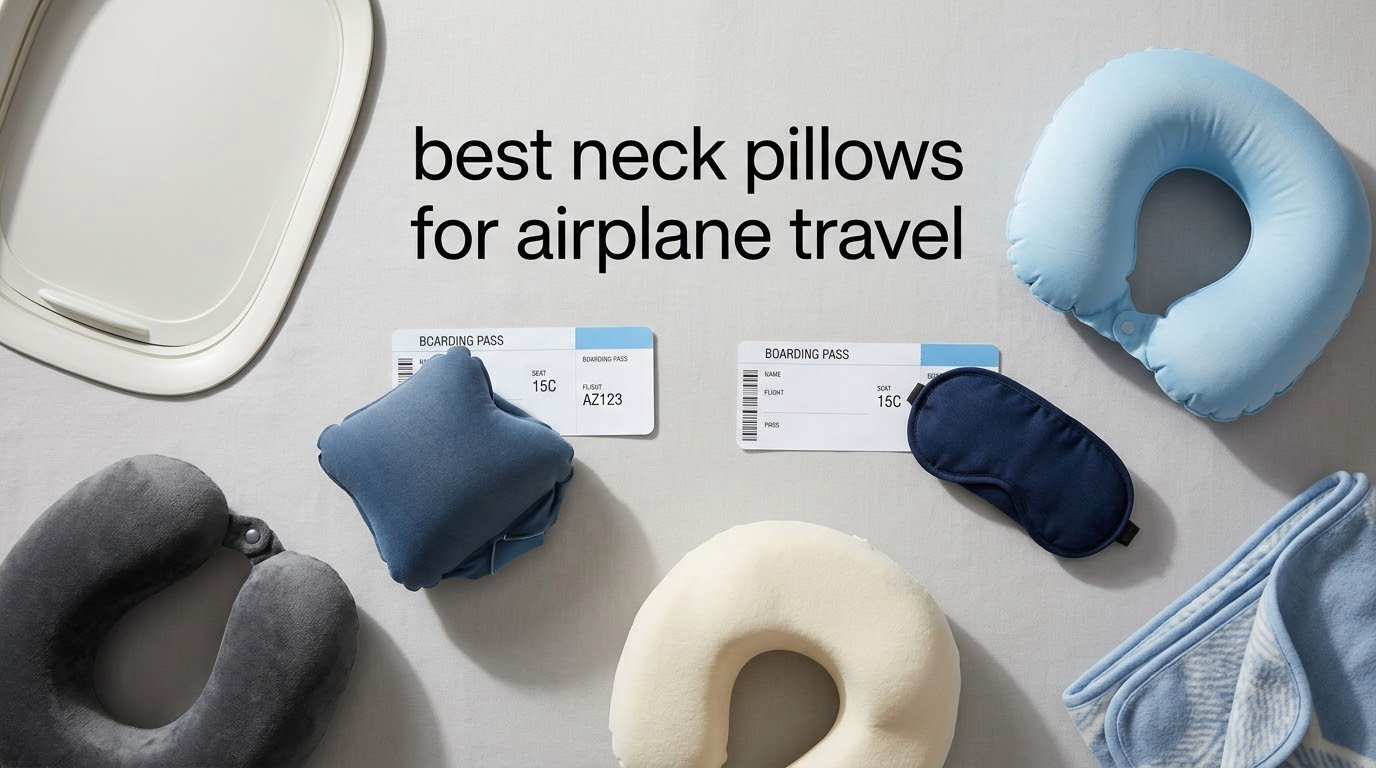
The best neck pillows for airplane travel do one job: they stop your head dropping forward onto the tray table while you are asleep. Ours is the TALLGO Travel Memory Foam Pillow, and after working through ten of the highest-reviewed options we think it is the safest all-round buy for anyone flying four hours or longer.
Most of us have slept wrong on a plane at least once. Your head nods, you jolt awake, and repeat for six hours until you land with a neck that hurts to turn. The reason is mechanical: an airplane seat supports your back and the back of your skull, and almost nothing else. There is no side support, no lap to rest a leg on, and often a headrest shaped like a wing that nudges your skull forward the whole flight. The same tension that builds up over a long flight does not always settle on its own, which is why many travellers also keep one of our neck and shoulder massagers with heat at home for after the trip.
A travel neck pillow fills the gap that the seat leaves empty, and it does it in one of three ways: with foam that holds its shape, with microbeads that mold to you, or with an inflatable chamber. Foam gives the most reliable support and the least packability. Beads feel softer and cooler but flatten over time. Inflatable designs disappear into a jacket pocket but offer almost no cushioning. We covered all three types in 2026, and we also covered the free alternative that some frequent flyers prefer: stuffing a puffy jacket into a zippered fabric envelope.
We ranked the ten picks below on support quality against an airline headrest, packability, washability and how much real owner feedback exists behind each one. Nine of the ten carry thousands of owner reviews, which meant we could separate the marketing claims from what people actually report after a long flight.
Table of Contents
Top 3 Picks for Airplane Travel in 2026
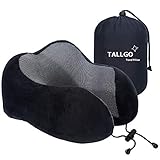
TALLGO Memory Foam Travel Pillow
- Memory foam core with rear hump
- Adjustable rope closure
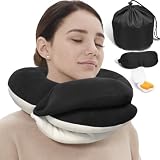
- Zippered washable velour cover

Cloudz Dual Comfort Microbead Pillow
- Microbead fill molds to any position
- Plush side and cool spandex side
- 5.6 ounce weight

Everlasting Comfort 360 Pillow
- Thick foam with 360 degree support
- Rotates for side or front rest
- Washable cover plus eye mask
The TALLGO leads on the combination of rating and owner feedback volume. Cloudz takes the highest rating in the group and the softest feel. Everlasting Comfort is the one to look at if you want the thickest foam and a bundled sleep kit.
The Best Neck Pillows for Airplane Travel in 2026
All ten pillows below earned a place based on owner feedback rather than brand marketing. Read the quick overview first, then jump to the full review for the one that matches your flight length and sleep style.
| Product | Specifications | Action |
|---|---|---|
| TALLGO Travel Memory Foam Pillow |
|
Check Latest Price |
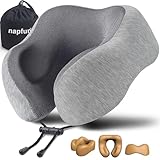 napfun Memory Foam Chin Support Pillow napfun Memory Foam Chin Support Pillow |
|
Check Latest Price |
 BCOZZY Travel Neck Pillow BCOZZY Travel Neck Pillow |
|
Check Latest Price |
| Cloudz Dual Comfort Microbead Pillow |
|
Check Latest Price |
 Dot and Dot Twist Memory Foam Roll Dot and Dot Twist Memory Foam Roll |
|
Check Latest Price |
| Everlasting Comfort 360 Travel Pillow |
|
Check Latest Price |
 Fabuday Memory Foam Travel Pillow Fabuday Memory Foam Travel Pillow |
|
Check Latest Price |
 Cabeau Evolution S3 Travel Pillow Cabeau Evolution S3 Travel Pillow |
|
Check Latest Price |
 BUYUE 360 Degree Travel Pillow Kit BUYUE 360 Degree Travel Pillow Kit |
|
Check Latest Price |
 Proglobe Long Haul Flight Kit Proglobe Long Haul Flight Kit |
|
Check Latest Price |
Do Neck Pillows Actually Work on Airplanes?
Yes, but only when the design matches the failure you are trying to prevent. A pillow cannot fix a badly shaped seat, and no pillow makes a short hop feel like a bed. What it does well is stop the specific motion that causes the stiff neck: the forward and sideways fall of an unsupported head.
Think about what happens in the first ten minutes of sleep. Your neck muscles relax, your head weighs more than it feels like, and it tips. If your chin lands on your chest, the neck is flexed for hours and you wake with a crick. If it tips sideways into the aisle, you wake up with a headache and a dent. A pillow works by filling the empty space so the head stops travelling in either direction.
The catch is that a badly shaped pillow makes things worse. Overstuffed foam can push your head forward, which is exactly the complaint frequent flyers raise most often on travel forums: the airline headrest already leans in, and a thick cushion leans with it. Pillows with a flat angled back and low front profile avoid that. Ones with a tall rear hump do not, which is why we call out the rear height on every pick below.
Our honest verdict: on flights under two hours, a neck pillow is mostly a comfort luxury. Between two and five hours it is genuinely useful. On red-eyes and long-haul flights, where sleep is the only thing standing between you and the time change, it is close to essential. Reviews of long-haul flights repeatedly describe multi-hour sleep once the head is supported, and the difference is felt within a single night.
1. TALLGO Travel Memory Foam Pillow – Best Overall for Long Flights
- Washable zippered velour cover
- Memory foam supports head neck and chin
- Adjustable rope closure stops forward slip
- Compresses into the included storage bag
- Runs firm and can feel tall upright
- Pillow arms short for some necks
- Drawstring takes effort to roll back into the bag
This is the pillow we put in our own bags. The foam core is a single piece of breathable memory foam in a semicircular wrap, and the thing that separates it from the bargain bin is a raised hump at the back. That hump is what stops your head rolling sideways into the aisle when you drop off, which is the half of the problem most U-shaped pillows ignore.
Owners consistently describe the foam as supportive but soft rather than rigid, and a lot of them specifically mention the rear hump in positive reviews. The dual-texture cover zips off completely and goes in a wash, which matters more than it sounds when a pillow sits against your face for eight hours at a stretch.
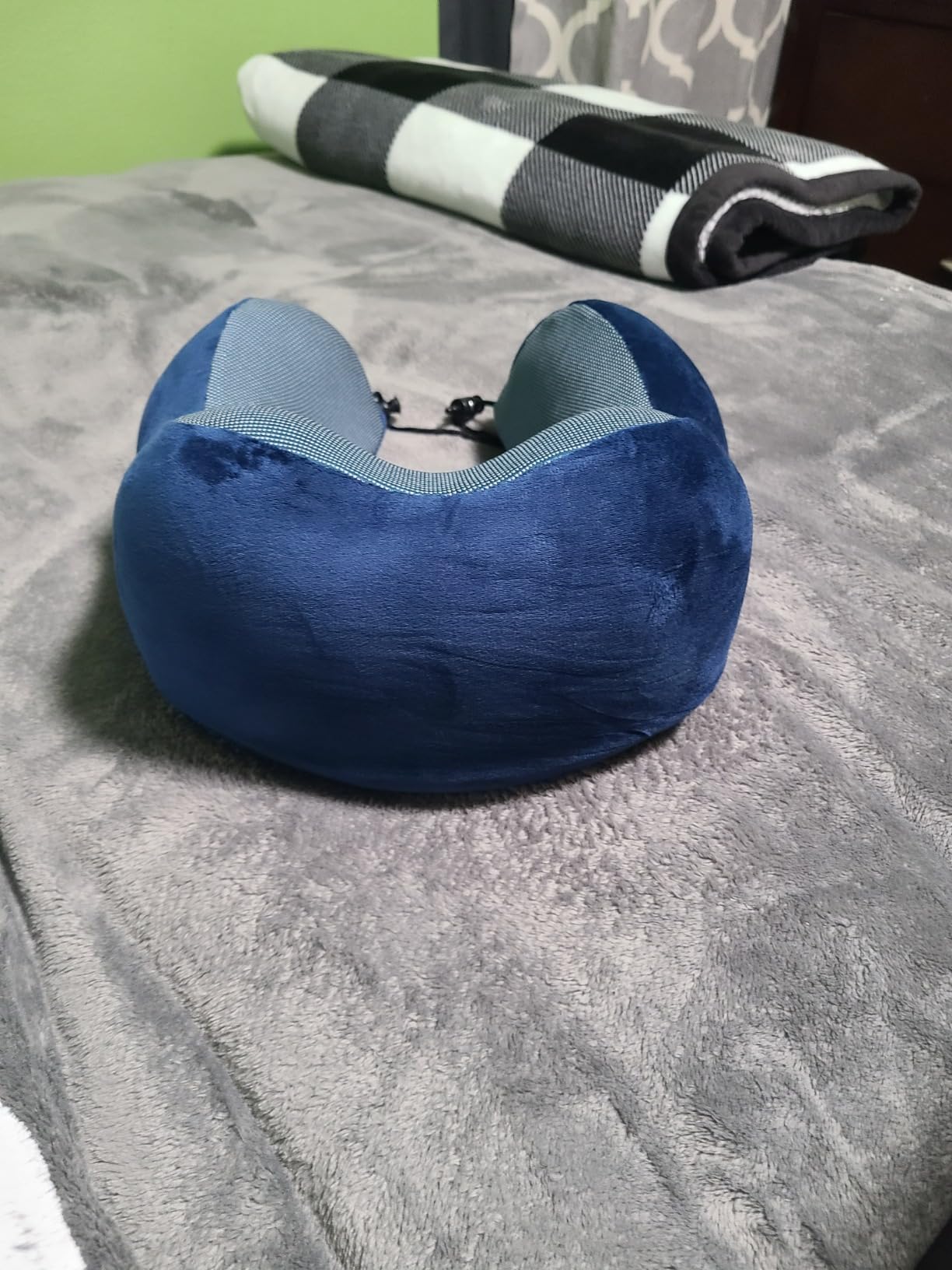
At 11 by 9.2 inches and 0.35 kg it is not the smallest pillow we tested, but it compresses into the supplied drawstring bag well enough to sit in a personal item. The adjustable rope closure is the part we like most: cinch it once and the wrap stays where you put it instead of migrating forward onto your collarbone.
The complaints are consistent and fair. A minority of owners find the foam firmer and taller than they expected in an upright seat, and a few say the arms are short if you have a broad neck. Rolling it back down tight enough to fit the mini bag takes a moment of practice, so pack it before you need it rather than at the gate.

Who this pillow suits
This one suits almost everyone, which is exactly why it is our first pick. It handles chin-droppers, side sleepers and light window leaners without you having to change anything. If your head is a normal size and your neck is between roughly 12 and 18 inches around, the closure gives you enough range to make it work.
Who should skip it
Skip it if you are a light sleeper who dislikes the feel of foam, or if you recline your seat back and rest your head against the headrest without a pillow. In that position the rear hump is behind you rather than under you, and it does nothing useful. Anyone who wants a pillow that flattens into a jacket pocket should look at an inflatable instead.
2. napfun Memory Foam Chin Support Pillow – Best Budget Pick
- Chin shape stops the head falling forward
- Lightweight and compresses small
- Machine washable
- Very wide colour range
- Low shallow profile gives limited head support
- Drawstring feels loose on larger necks
This is the entry point most people should start from. It is pure memory foam in a simple semicircular wrap with a shaped front that gives the chin something to rest on, and it carries more owner reviews than anything else in the category. For a first flight, or for someone who travels four or five times a year, it is difficult to argue with the value.
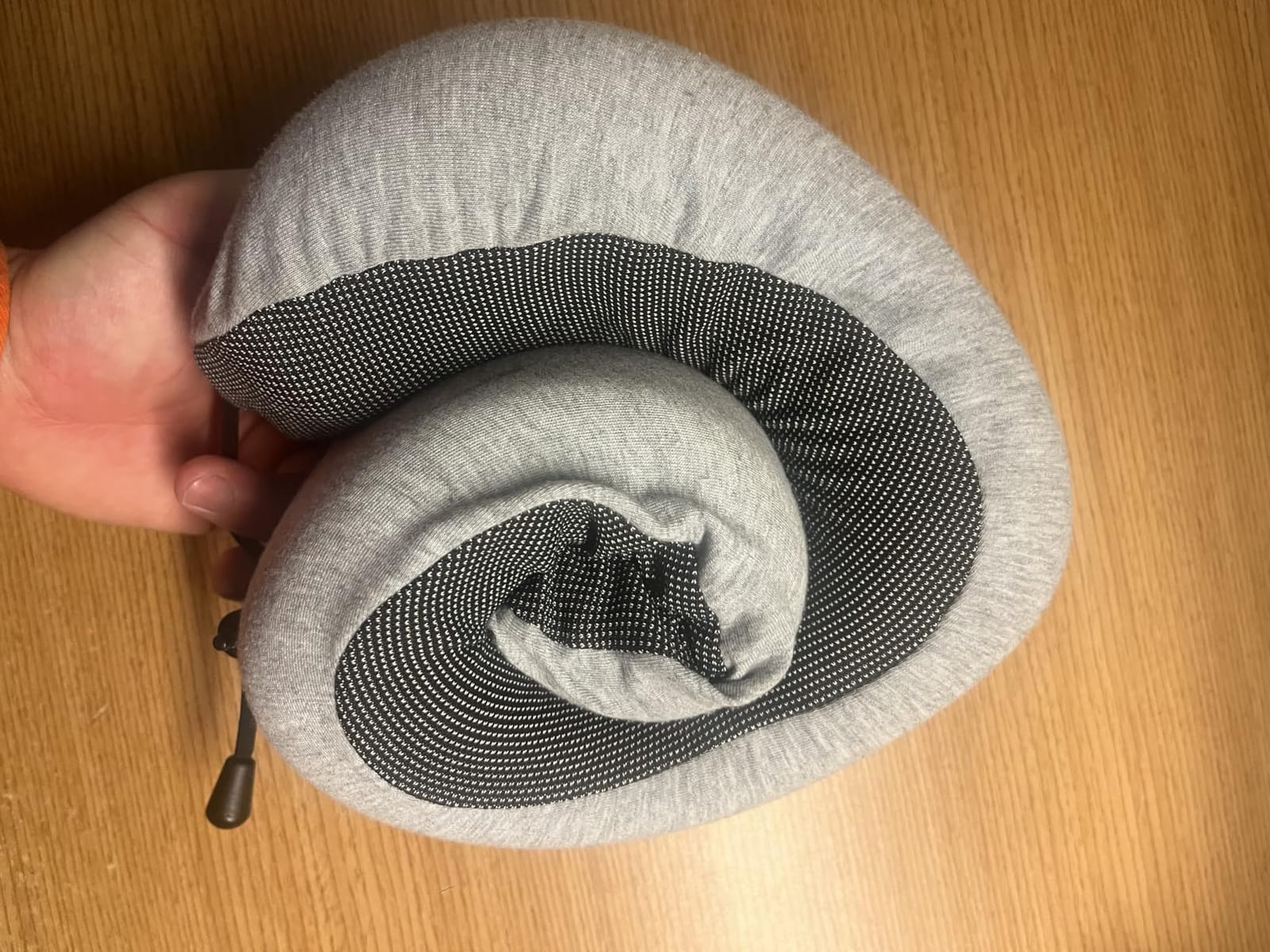
The design is deliberately plain. There is no internal rib, no hinge, no strap, just foam that holds its shape and a cover that zips off for washing. At 10.88 ounces and 11 inches square it compresses into a small pouch without any real fight, which makes it one of the easiest options to live with in a tight personal item.
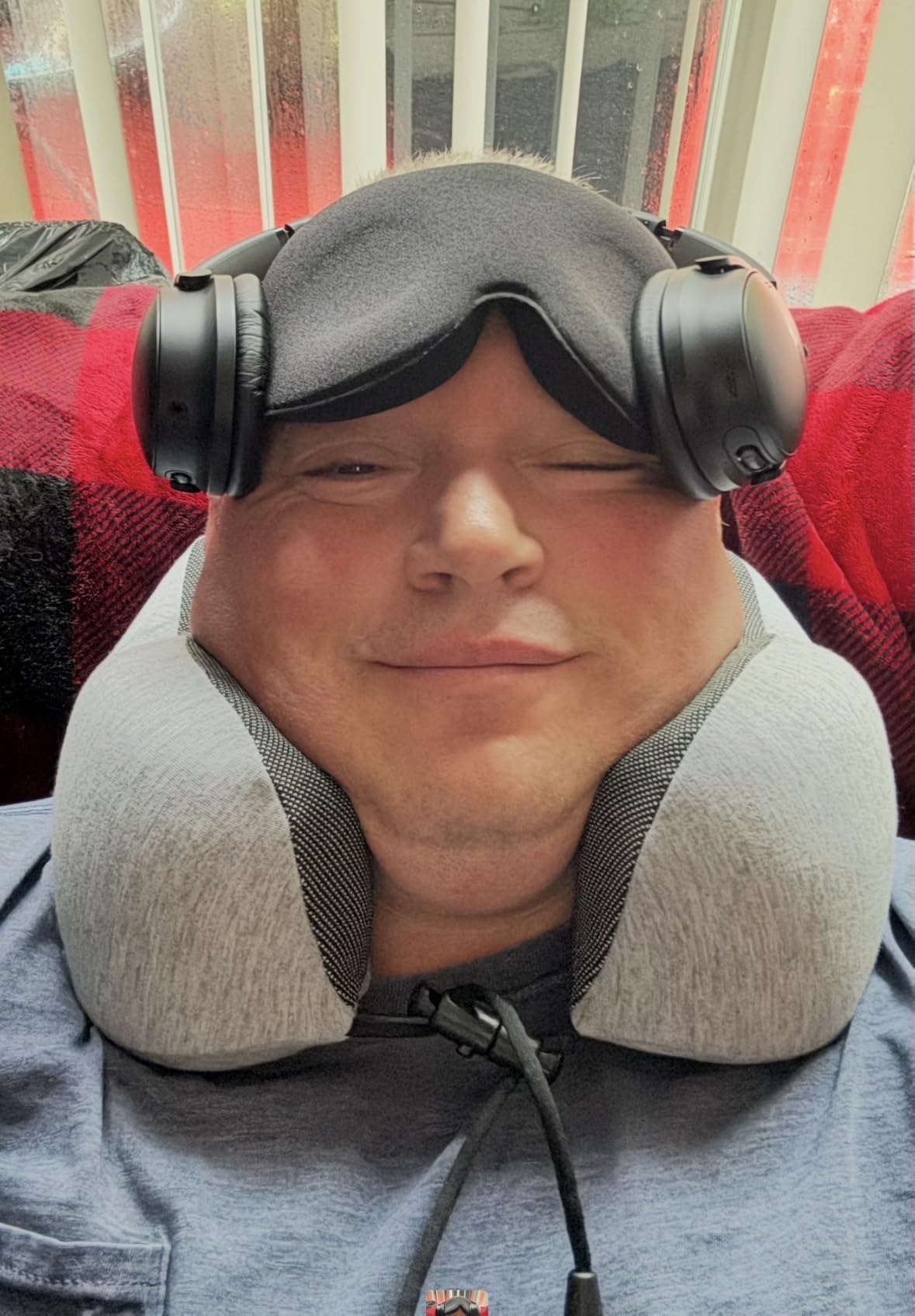
Owner reviews repeatedly single out the chin support as the feature that works, describing it as effective at stopping forward head drop during a nap. The same reviews also mention that the foam is not especially plush, which is fair. It holds you upright rather than embracing you.
The main drawbacks are profile and closure. Several users note the wrap sits low and shallow, so a side sleeper who wants a tall bolster may feel under-supported. Others say the cords are hard to cinch very tight around a larger neck, so the loop ends up looser than the shape needs.
Who this pillow suits
It suits chin-droppers on budget and short-to-medium flights, and anyone who wants a pillow they can wash regularly without thinking about it. It is also a good first flight pillow for a child or teenager who will lose interest in a complicated design after one trip.
Who should skip it
Skip it if you sleep on your side against the window and want a firm side bolster, because the profile is too low to hold a heavy head up. It is also the wrong pick for anyone with a sensitive neck who finds a soft foam edge uncomfortable, and for travellers whose biggest constraint is volume in a small personal item.
3. BCOZZY Travel Neck Pillow – Best Fully Washable Pick
- Patented arms cradle head neck and chin
- Three positions including under chin
- Entire pillow is machine washable
- Carry bag with luggage snap loop
- Polyester bounce-back is less supportive than foam
- Large size caps at a 16 inch neck
- Sits in the higher price band
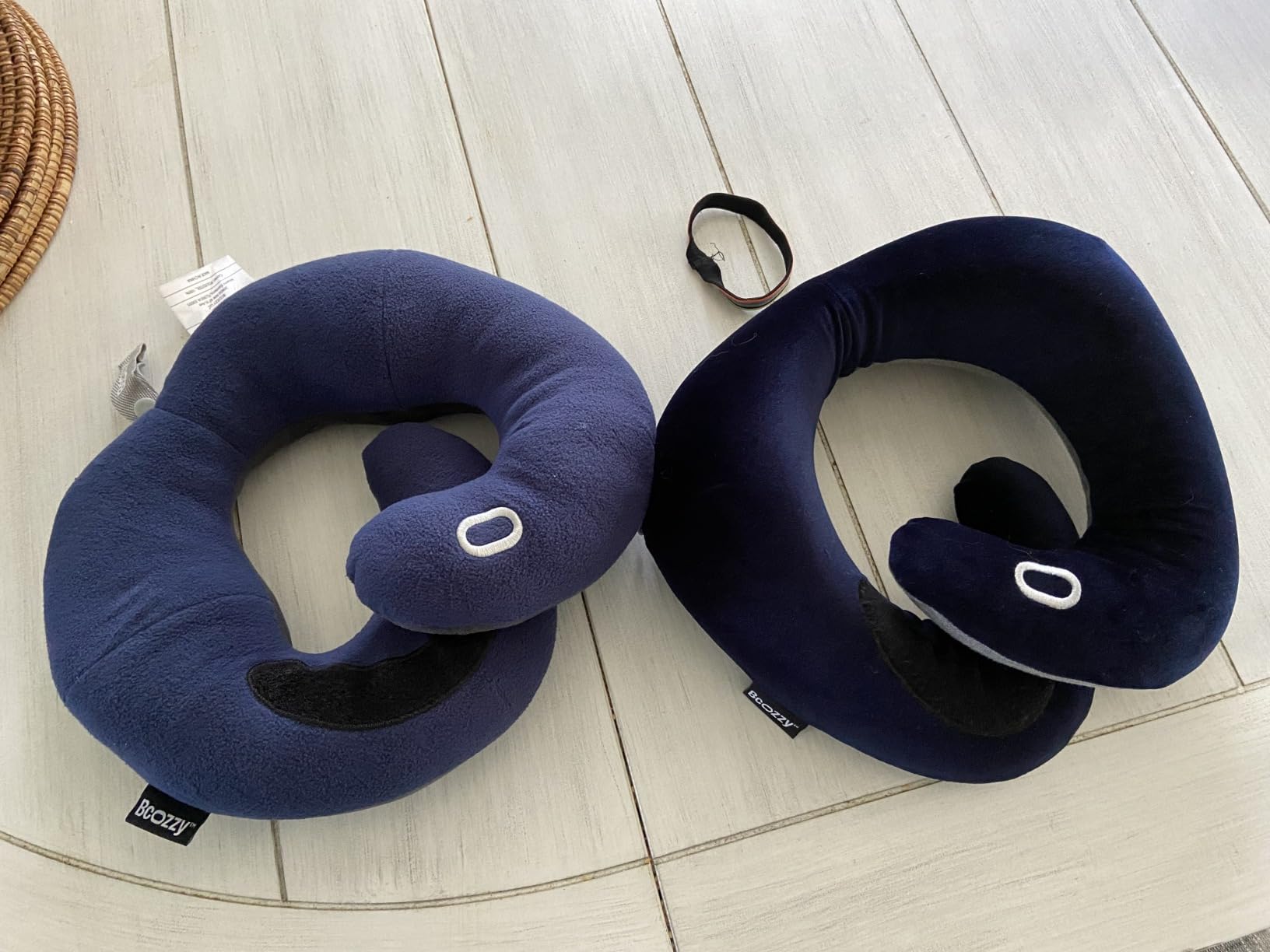
The distinguishing feature here is hygiene. Every other foam pillow on this list has a removable cover and a core you cannot wash. The BCOZZY goes in the machine whole, which for anyone who flies monthly, shares a pillow with a child, or worries about what happens to foam across a summer of trips is a genuine advantage rather than a small one.
Structurally it uses overlapping arms that cradle the head, neck and chin, and the arms can be repositioned three ways: under the chin, folded for side support, or rotated for a combination. The fill is polyester rather than memory foam, so it is softer, it bounces back instead of moulding, and it does not develop the chemical smell new foam sometimes carries.
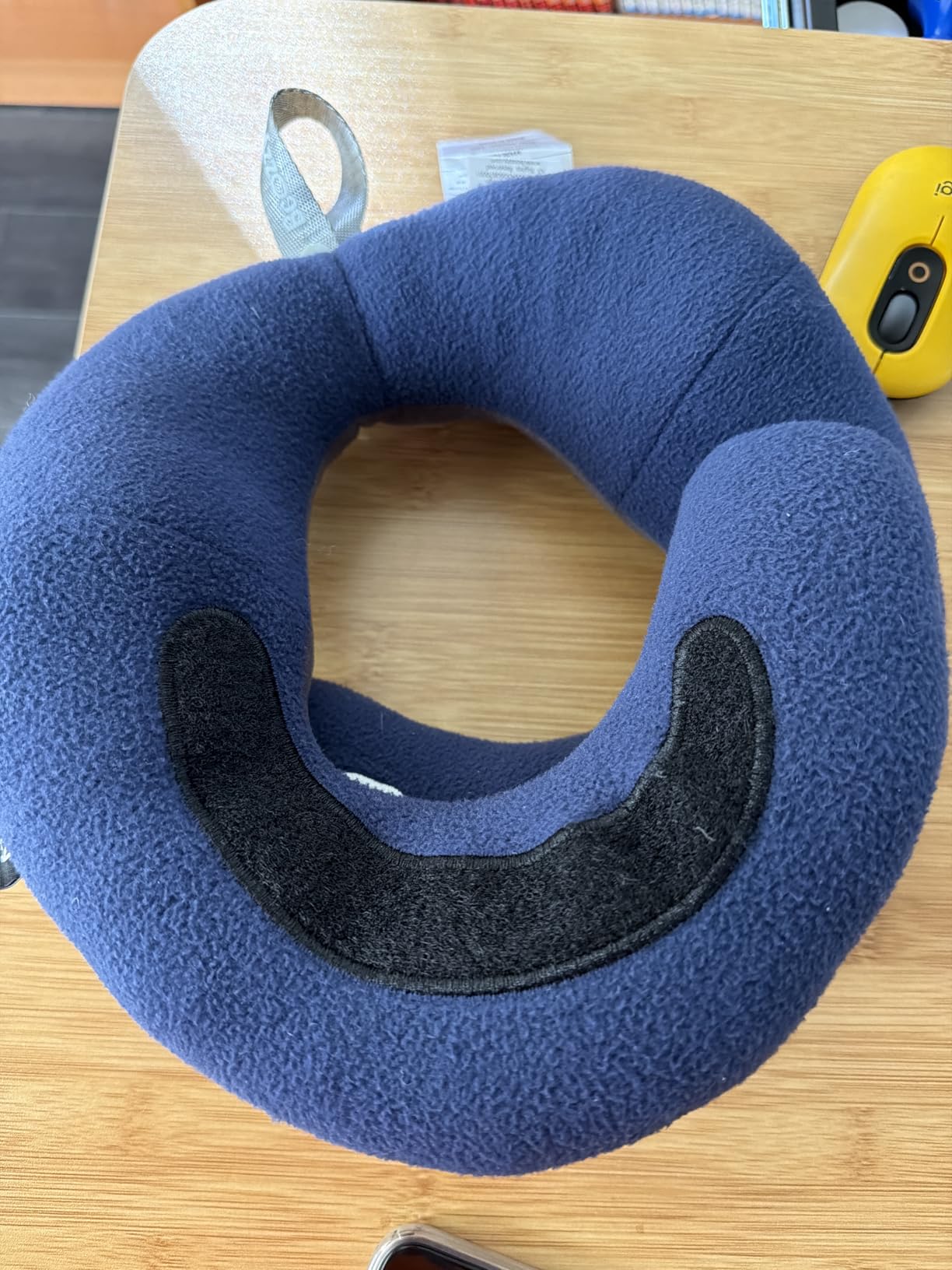
Owner reviews report reliable head and chin support on long flights, and the size guidance is the detail that decides most purchases. The Large fits necks up to 16 inches; if you are above that, the X-Large is the one to look at. Getting this wrong is the single most common complaint pattern we saw with this pillow.
The tradeoff is support depth. Users who prefer a firm foam cradle tend to find the bounce-back filling a little shallow over a full night, even though it is pleasant for the first few hours. It is also one of the heavier commitments in the group to pack, since it does not compress the way a bead or foam wrap does.
Who this pillow suits
This suits frequent flyers who care about washability, and parents who want one pillow that can go straight into a machine between trips. It is also a strong choice for anyone who dislikes the idea of putting a foam core back into a damp bag after a long flight.
Who should skip it
Skip it if you need maximum support from a thin profile, or if your neck measures over 16 inches and you do not want to think about which variant to order. Long-necked sleepers who dislike a snug wrap should also consider a looser, adjustable design instead.
4. Cloudz Dual Comfort Microbead Pillow – Top Rated for Soft Comfort
- Beads conform to any position without crushing
- Reversible plush and cool spandex sides
- Snap closure stops forward head drop
- Also works as lumbar or massage support
- Cover does not detach for washing
- Beads flatten over about a year
- Runs small for larger frames
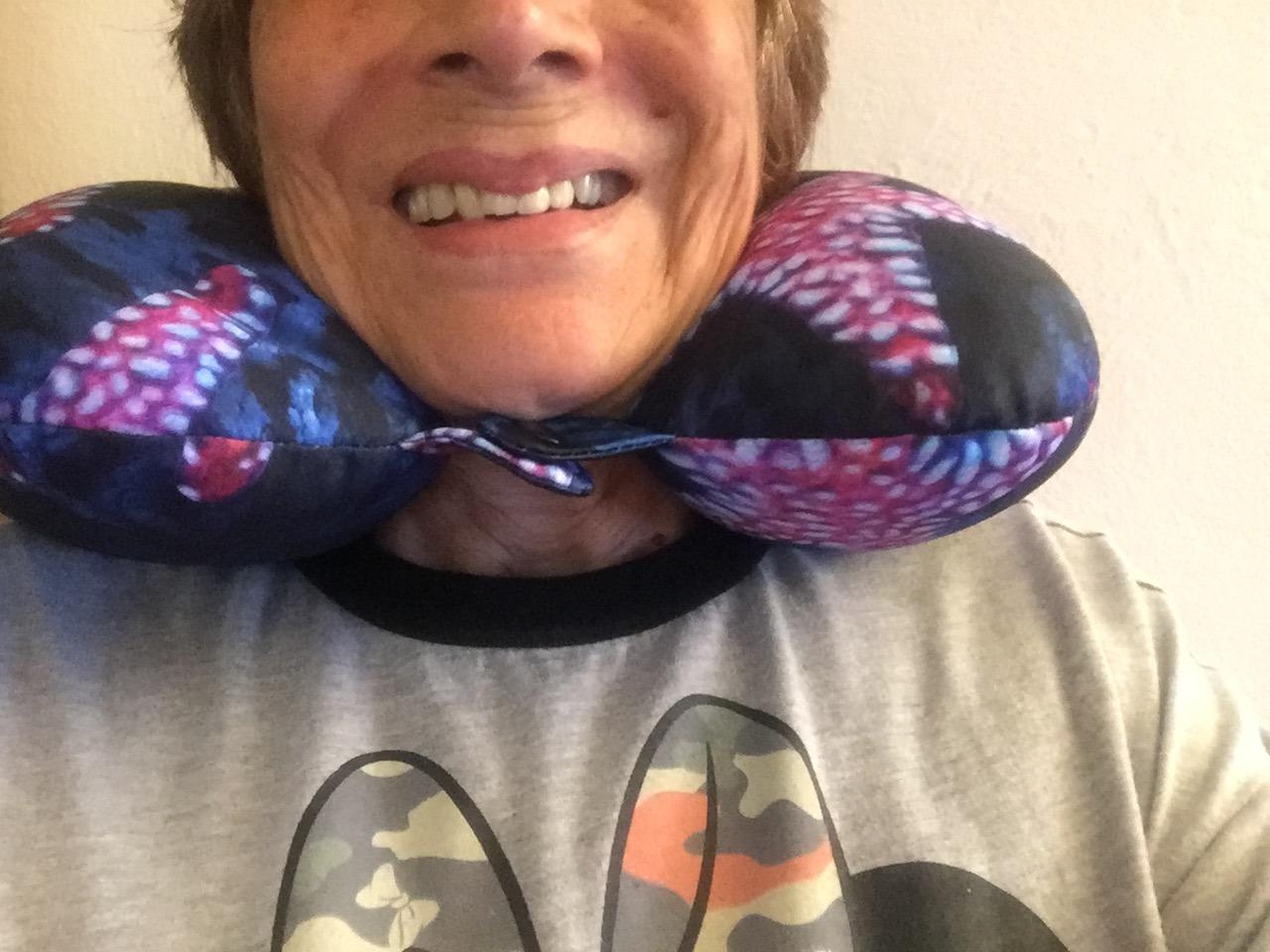
The Cloudz carries the highest average rating in this group, and the reason is the fill. Microbeads move independently, so the pillow takes the shape of whatever you press into it and springs back when you move. There is no memory to reset, which means it works equally well for a chin dropper and for someone who changes position every twenty minutes.
It is also reversible, which matters more than it sounds in a warm cabin. One side is plush, the other is cool spandex, so you can flip to the cool side when the cabin is stuffy without stripping anything off. At 5.6 ounces it is also the second-lightest option we tested, and the snap closure lets you clip it to a luggage handle so it is not taking up a pocket.
Owner reviews favour beads over foam for a softer, cooler, more conforming feel, and the dual-fabric design draws repeated praise. Several people use it beyond flights, as a lumbar support in a car or as a face-down pillow on a massage table, which is a fair measure of how adaptable a travel pillow is.
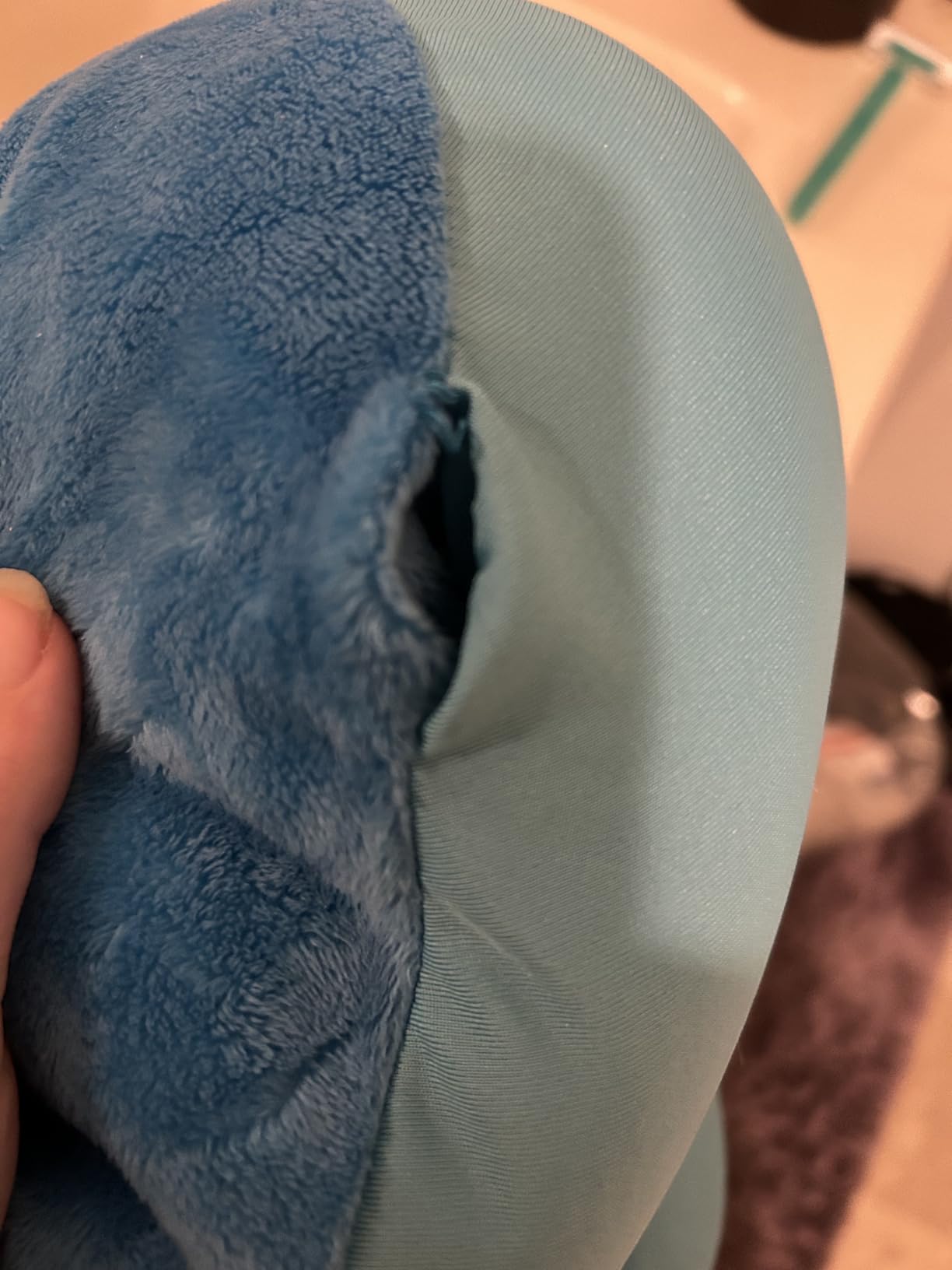
The caveats are about longevity and care. The outer cover does not detach, so the whole thing needs spot cleaning rather than machine washing, and beads gradually flatten over roughly a year of regular use. A rare seam failure can release the fill, which is unpleasant but uncommon.
Who this pillow suits
It suits people who find foam too rigid, who run warm in the cabin, or who move around a lot during a night. It is also one of the better options for anyone who wants to pack light, since the weight is negligible and it compresses into almost nothing.
Who should skip it
Skip it if you want a pillow that feels firm and structured, because beads give way under a heavy head. Anyone who washes their travel gear regularly should pick a model with a removable cover, and anyone planning to keep it for many years should account for the fill flattening over time.
5. Dot and Dot Twist Memory Foam Roll – Best for Shaping to Any Seat
Dot&Dot Twist Memory Foam Travel Pillow, Bendable Neck Pillow for Airplane, Car and Home, 26-Inch Adjustable Roll with Washable Cotton Cover, Gray
- Bends and holds any shape you set
- Works for head back shoulder or lumbar
- Breathable machine washable cotton cover
- Snap closure for luggage or headrest
- Roll format takes practice to position
- Firm foam suits people who like structure
- New foam scent needs airing out
This is the odd one out and the most versatile. Instead of a fixed horseshoe shape, it is a long foam roll with a thin internal rod running through the middle. Twist it into a horseshoe for your neck, straighten it into a bolster behind your lower back, or curve it around a shoulder. The rod means it holds whatever shape you set instead of springing back.
Owner reviews consistently value the twist-and-bend versatility, describing the same roll as a neck cradle on a flight and then as back or shoulder support elsewhere. The cotton cover is breathable and machine washable, and the snap closure lets you secure the roll to a carry-on handle or a car headrest so it does not move while you are asleep.
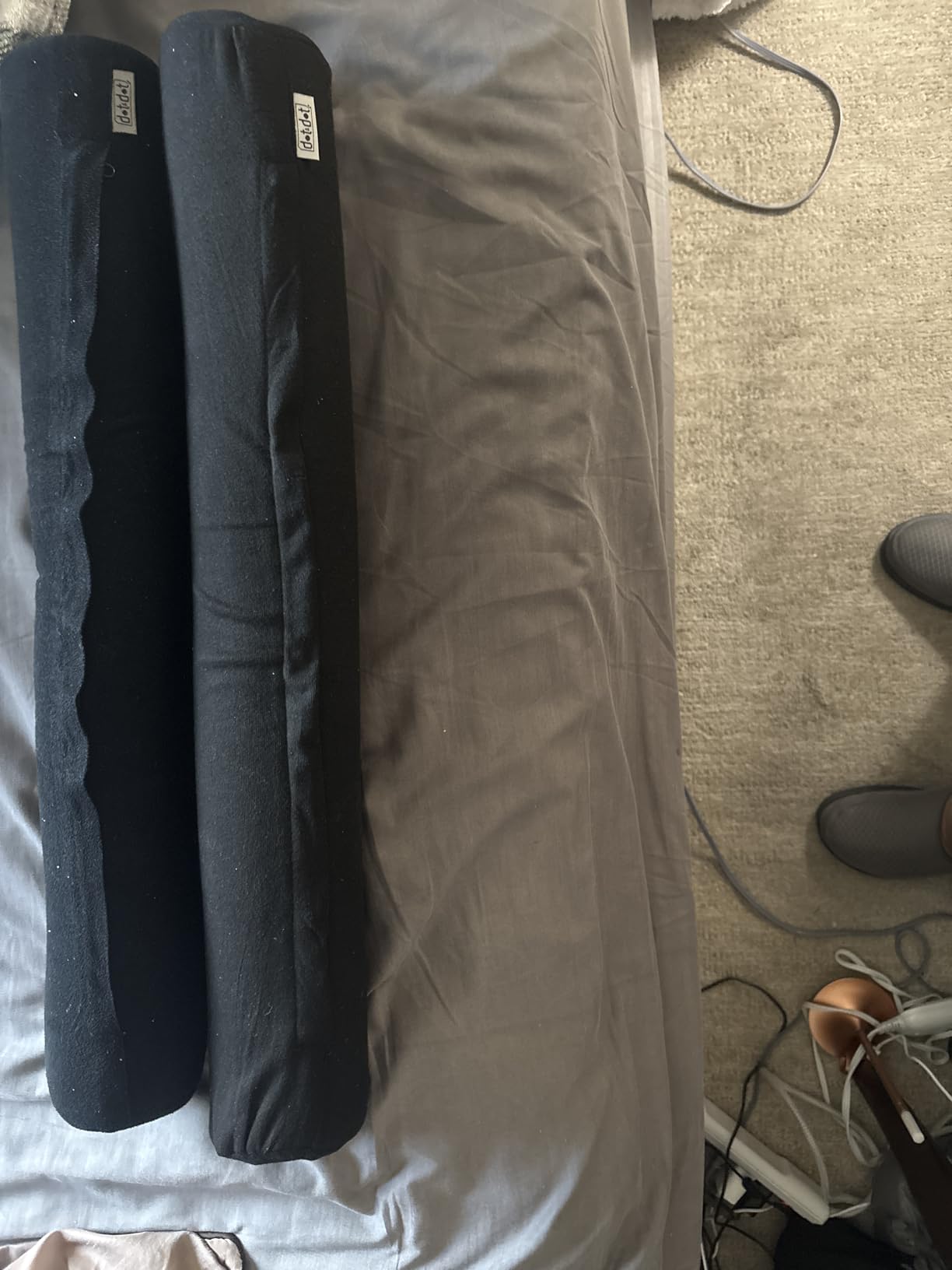
It is listed as firm, and that is the honest characterisation. At 16 ounces and 26 inches long it is one of the larger items here, so it needs a genuine packing plan, but it is not a fixed-shape commodity and that is what earns it a place on this list.
The tradeoffs people mention most are the learning curve and the new-foam smell. Positioning a roll correctly the first time takes a bit of practice, and the memory foam scent needs a day of airing before a first trip. Once set, though, reviews suggest it stays set through a long flight.
Who this pillow suits
It suits anyone who uses a pillow for more than one purpose, or who shares a trip between a flight, a long car drive and a stop on a train. It is also a good answer to the flat-headrest problem, because you can shape the roll to sit in front of the headrest rather than behind your head.
Who should skip it
Skip it if you want something you can pull out at the gate and use in ten seconds, or if you dislike firm foam. It is also a poor fit for a very small personal item, since a 26 inch roll does not shrink the way a horseshoe wrap does.
6. Everlasting Comfort 360 Travel Pillow – Best Thick Support with a Sleep Kit
- Thick foam cradles shoulders chin and neck
- Rotates for side back or front support
- Removable machine washable cover
- Bundled eye mask and earplugs
- Tall rear cushion pushes the head forward
- Runs warm when pressed into the pillow
- Cover can sit uneven on the insert
This is the thickest, most substantial pillow in the group, and for a red-eye on a wide-body aircraft it is the one we would choose. The foam is deep enough to fill the space between your head and the headrest rather than just cushioning the neck, and the shape is designed to take pressure off the shoulders as well as the cervical spine.
It rotates and flips. Turn it for side support, invert it and it becomes a chest and shoulder rest for reading or working, and the front support holds a head that has started to tip. The cover is removable and machine washable on a gentle cold cycle, and a velcro strap flattens the pillow for a carry-on.
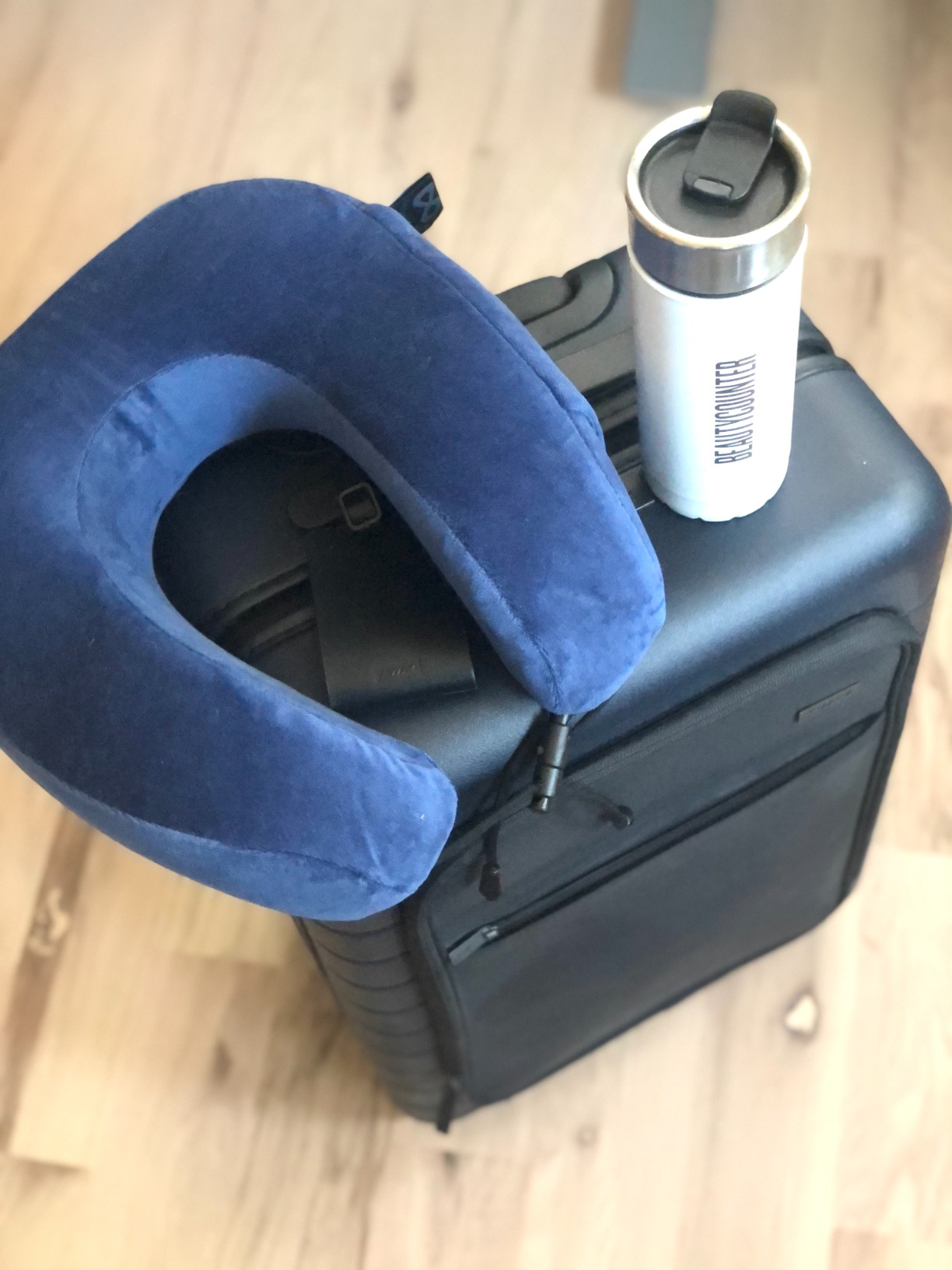
Reviews give heavy praise to the accessory kit as much as to the foam, with owners reporting that the bundled contoured eye mask and earplugs get used more than the pillow. It is also used far beyond flights, on trains, in cars and at desks, which tells you the support is genuinely structural rather than situational.
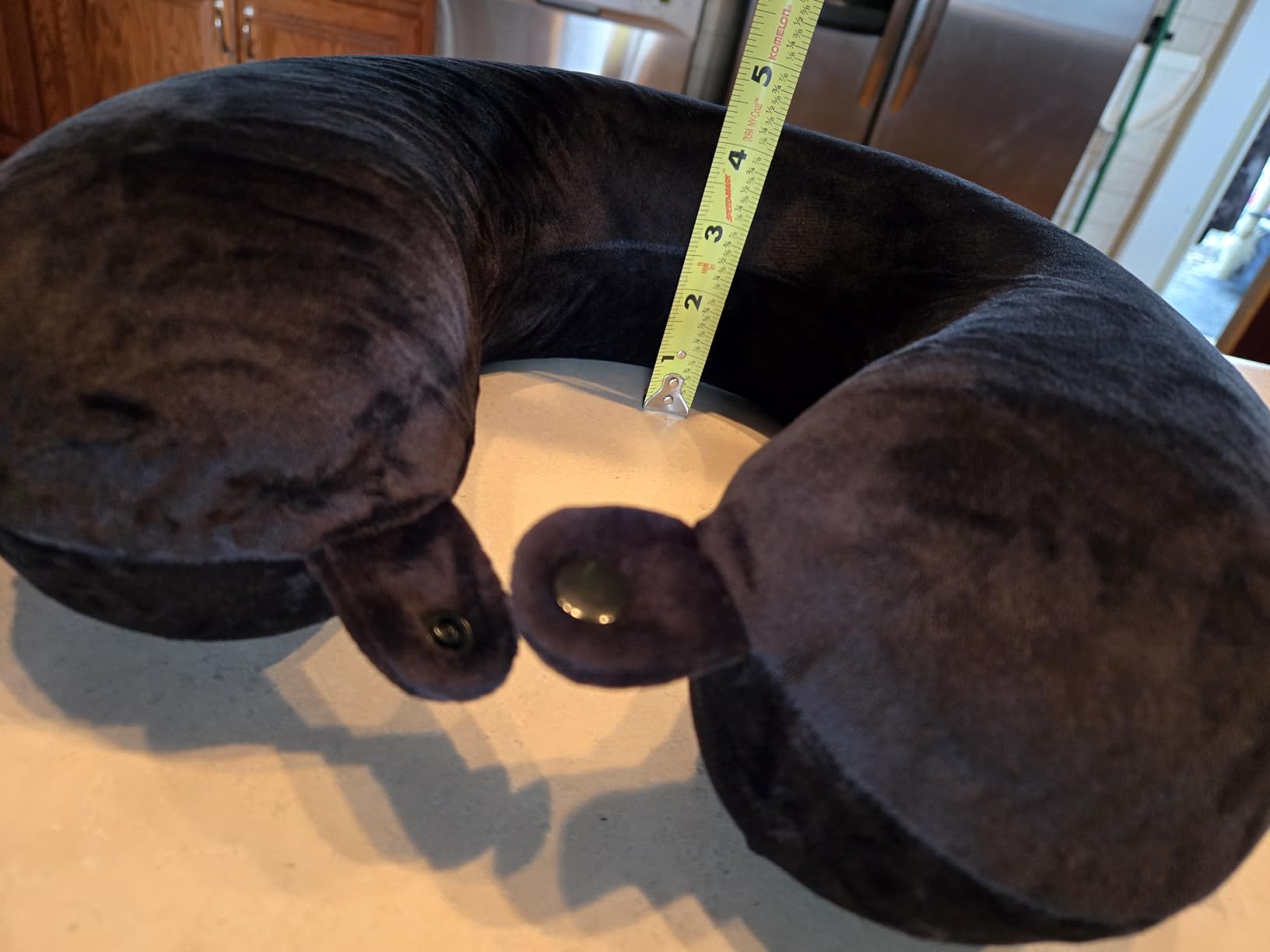
The defining drawback is the tall rear cushion. It is 9 inches deep, and for anyone who reclines their seat and rests their head backwards, that height pushes the head forward, which is the exact problem most travellers are trying to solve. It can also feel warm when your face is pressed into it, and a few owners note the cover does not always realign neatly with the foam.

Who this pillow suits
It suits long-haul and overnight flights where you want real separation between your head and the headrest, and it works well for anyone sleeping in a window or middle seat who cannot lean on a wall. Side sleepers get the most out of the rotating design.
Who should skip it
Skip it if you recline to sleep, because the rear height works against you there. It is also too bulky for a strict personal item, and too warm if you are a person who overheats in a plane cabin or sleeps with a face covering.
7. Fabuday Memory Foam Travel Pillow – Softest Plush Option
- Extra plush foam with a soft short nap cover
- Snug shape that blocks forward tilt
- Detachable machine washable cover
- Snap strap for carry-on attachment
- Foam can split at the rear over time
- Some variants arrive without a storage bag
- Front snap is awkward when lying down
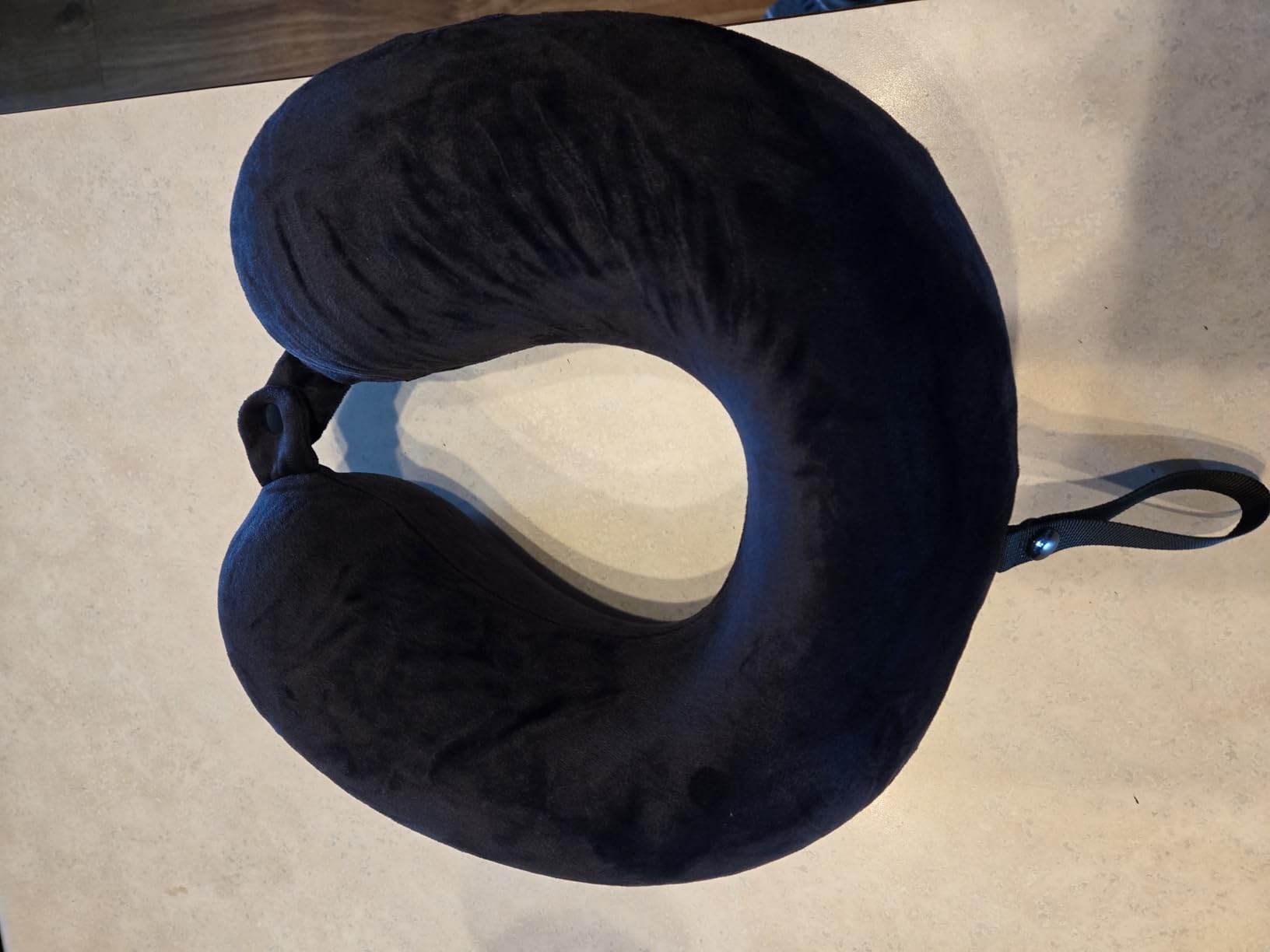
If your complaint about travel pillows is that they feel like a block of foam pressed against your face, this is the one to look at. The filling is high-rebound memory foam with a genuinely plush hand, and the short-nap velvet cover is about as soft as a travel pillow cover gets. Owners frequently single it out as the best-value pick in the category.
The shape hugs the neck more closely than a deep cradle, with a button snap at the front instead of a drawstring. That snap holds tighter than most cord closures, and it stops the head tilting forward without needing a chin strap. An attachable strap lets you clip the pillow to a backpack or carry-on and keep your hands free.
It performs well on planes, in cars, on trains, and at a desk, and the removable cover goes straight into a wash. That combination of soft fabric, plush filling and a tighter closure than its rivals is why it scores so consistently well in comparisons.
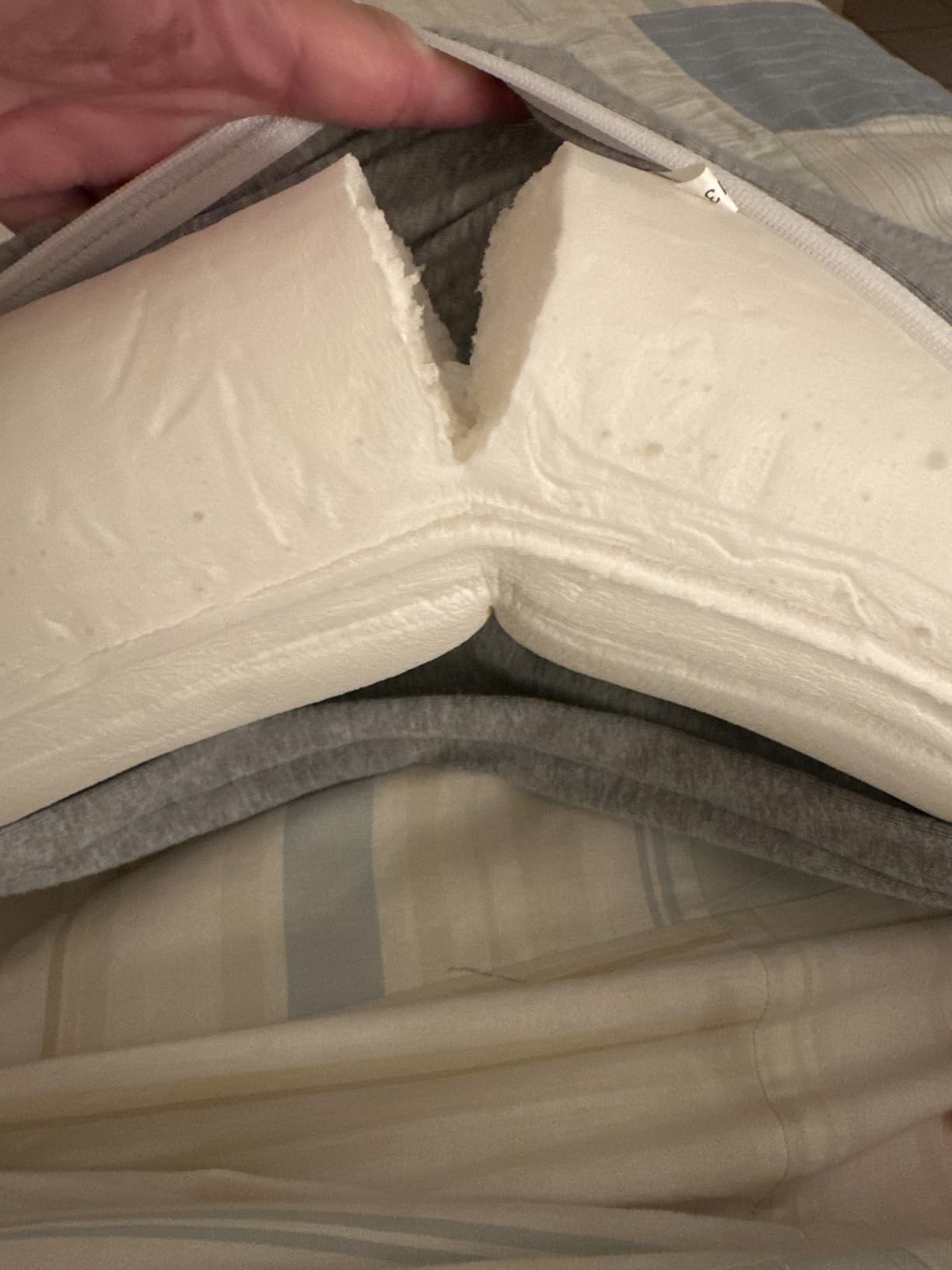
The recurring negative theme is durability. Several reviews report the memory foam core splitting or tearing at the rear after extended daily use, and a few note that some variants arrive without a storage bag. The front snap can also be awkward when you are lying down rather than sitting upright, and there is a normal new foam smell on arrival.
Who this pillow suits
It suits people who dislike the feel of firm foam and want the softest contact on a long night. It is also a good option for anyone who wants a pillow that stays put without a chin strap, and for a couple of trips a year where durability is not the deciding factor.
Who should skip it
Skip it if you plan to use the same pillow daily for years, because splitting foam is a reported failure mode. Anyone who needs a deep bolster to hold a heavy head upright should also look at a thicker design, and travellers with a very large neck may find the snap closure too tight.
8. Cabeau Evolution S3 Travel Pillow – Best for Securing to the Headrest
- Patented straps clip to the seat headrest
- Slim back keeps the spine aligned
- Compresses to one third size
- CertiPUR-US certified foam
- Bulky even when compressed
- Runs hot and can feel constricting
- Clashes with over-ear headphones
This is the only pillow here that attaches to the seat itself. Patented straps loop around an airplane headrest, a car head or an office chair, and the pillow hangs from them rather than relying on friction and your own neck strength to stay in place. If your main fear is waking up face-down on the tray table, this mechanism directly addresses it.
The foam is dual density, which is how it manages to be soft on the side that touches your face and structured on the side that holds your head. The back profile is deliberately slim so your spine stays aligned rather than pitching forward. The cover is moisture-wicking and washable, and the foam is CertiPUR-US certified, which matters if you react to foam odour.
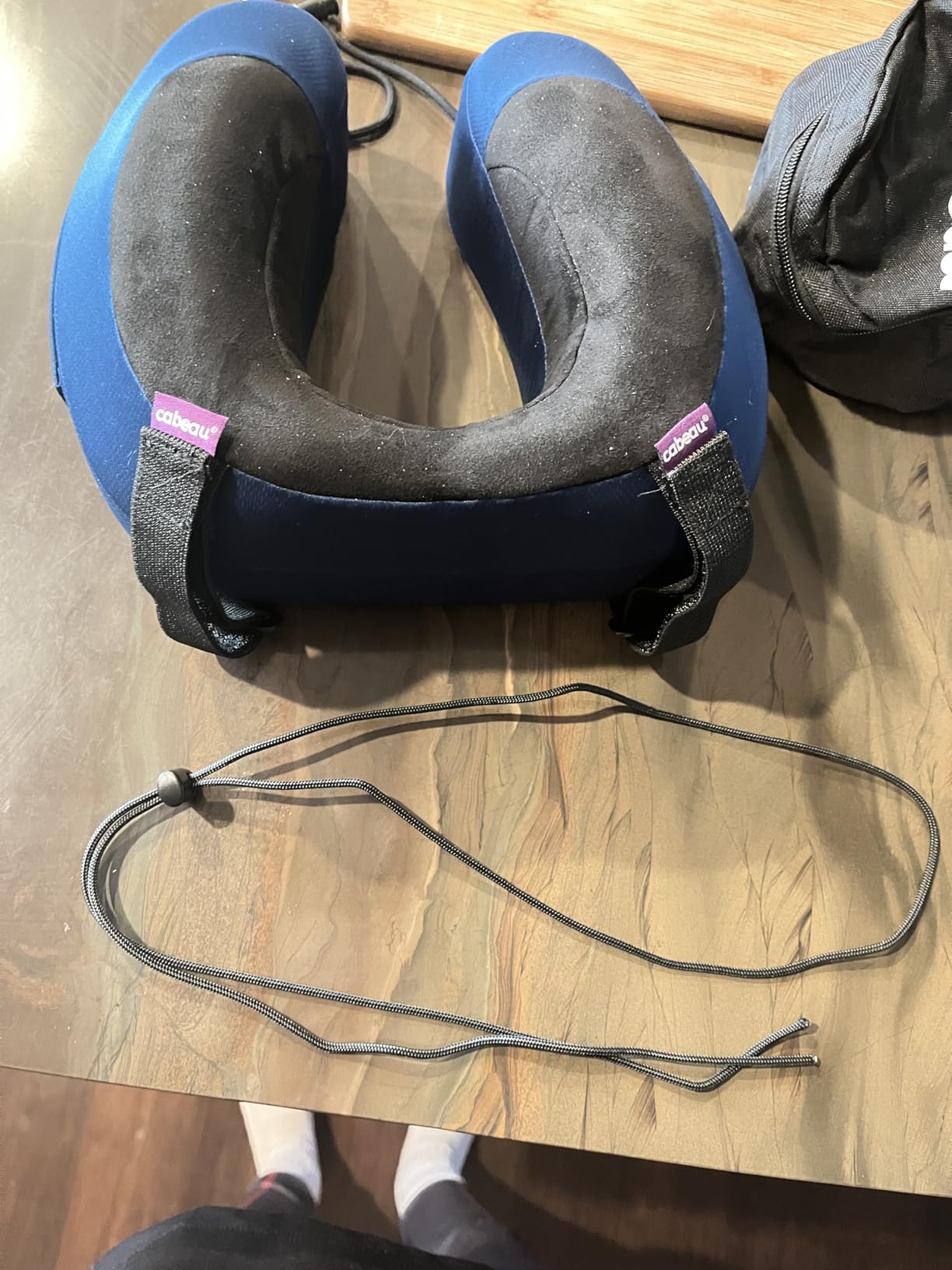
Owners report the strap-to-headrest system is the headline feature in reviews, with frequent accounts of multi-hour sleep on 8 to 14 hour flights. The compression case takes it down to roughly a third of its size and has a luggage clip, so it is genuinely packable even though the volume in your hands is not small.
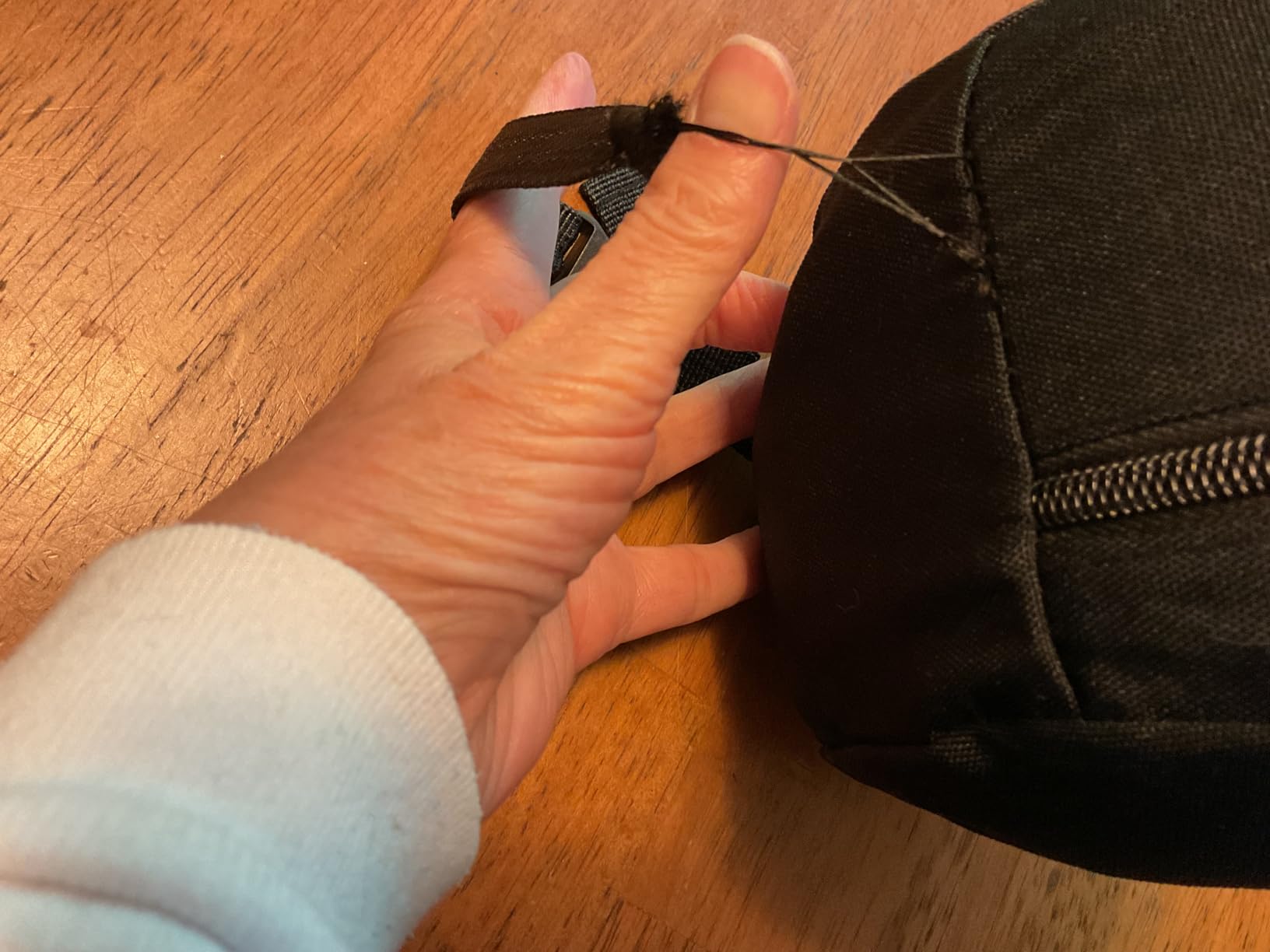
It is listed as fitting neck sizes 12 to 18 inches, and the low ratings cluster around a few predictable issues. Heat builds up inside once you are settled, some users feel constricted when strapped in, and the front cords and clasp do not always cooperate, particularly for long thin necks. It also works poorly with over-ear headphones, which is worth knowing before a transatlantic flight.
Who this pillow suits
It suits anyone whose main problem is forward head drop, and anyone travelling with a neck that measures between 12 and 18 inches. It is also one of the few options here that can be clipped securely in place, which makes it a good choice for light sleepers in turbulence.
Who should skip it
Skip it if you wear over-ear headphones, since the strap and the frame interfere with them. It is also a poor fit if you run hot, if you dislike being enclosed, or if your neck falls outside the 12 to 18 inch range. Travellers with a very strict personal item should measure before committing.
9. BUYUE 360 Degree Travel Pillow Kit – Best for Adjustable Positions
- Triple support shape wraps head neck and chin
- Front support adjusts to three angles
- Complete kit with eye mask and earplugs
- Machine washable removable cover
- Bulky even with the compression pouch
- Adult size can run small for petite users
- Side snaps and pocket instructions are unclear
The distinctive idea here is that the front support moves. It can sit straight ahead for a forward-facing rest, angle up at 45 degrees for a head that has started to tip, or rotate 90 degrees into a side bolster. That range is why the same pillow works in a window, aisle or middle seat, and several owners mention multiple hours of sleep on 12 to 15 hour flights.
The fill is heat-responsive memory foam, so it contours without turning rigid once it warms up, and the cover is soft, breathable and machine washable. The kit also includes a 3D contoured sleep mask, earplugs, a storage bag and a built-in pocket, which makes it a complete sleep setup in a single package.
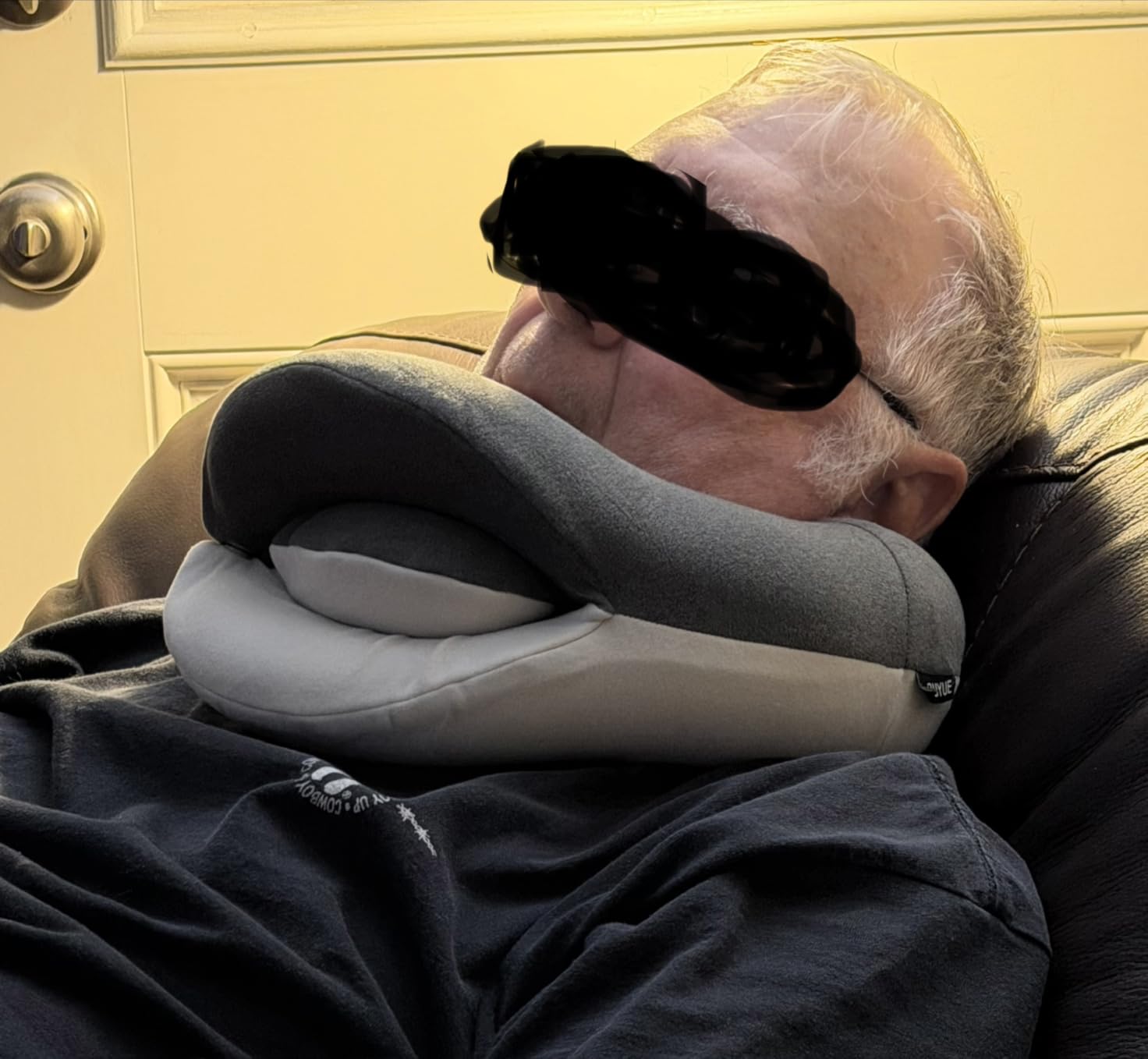
The adult size is rated for necks of 12.5 inches and up, generally for people over 90 pounds, and smaller sizes exist for those under that. Read the size carefully before ordering, since fit is the most common issue reported with this model.
Critiques centre on bulk, sizing and the accessories. Even compressed into the pouch it is a larger item than most, the adult version can run small for petite users, and the side snaps plus the pocket and tab are confusing to work out. Reviewers also tend to find the bundled eye mask of limited value compared with buying one separately.
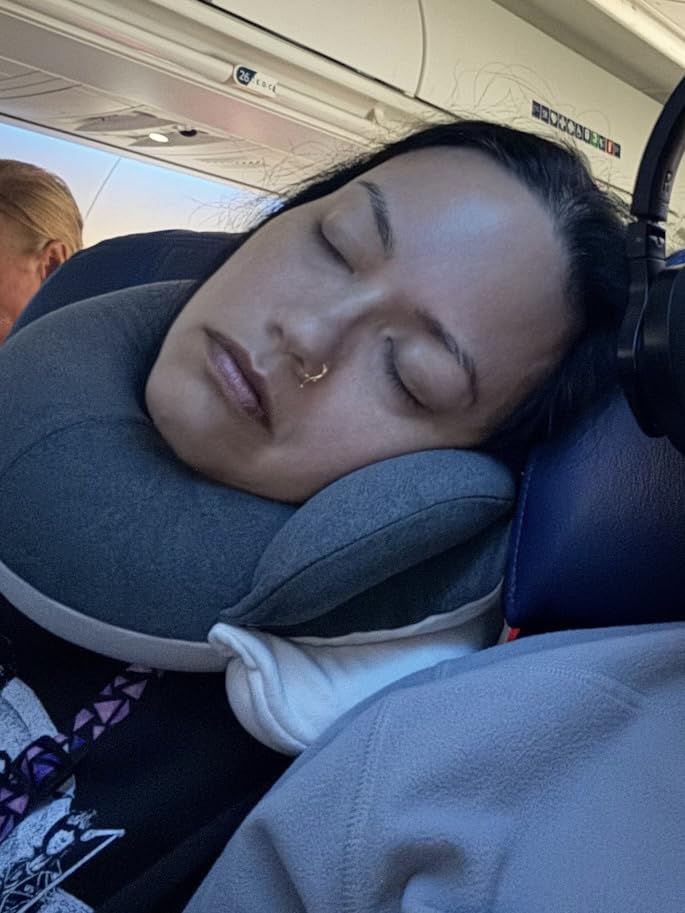
Who this pillow suits
It suits anyone who cannot predict how they will be sitting at 30,000 feet, because the three angles cover most positions. It is also a good value if you want a pillow, a mask and earplugs in one purchase rather than building a sleep kit from three items.
Who should skip it
Skip it if you have a small neck and a strict personal item, since the adult size can swallow a smaller frame and the bulk is real. If you already own a good eye mask and earplugs, the kit contents add cost rather than function, and a simpler design may suit you better.
10. Proglobe Long Haul Flight Kit – Best for Smaller Necks
Proglobe Travel Neck Pillow for Airplanes, Long Haul Flight Kit, Grey
- Velcro adjustment dials in exact support
- Sized well for necks around 13 to 14 inches
- Mesh bag snaps to carry-on
- Removable washable cover
- Wrap can feel tight on larger necks
- Difficult to compress back into the pouch
- Bundled eye mask is basic
Fit is the story with this pillow. Petite travellers with shorter necks say this is one of the few designs that does not swallow their head, and the velcro adjustment lets you set exactly how much neck support you want instead of relying on a drawstring that either cinches or does not. Several owners report multi-hour sleep on transatlantic flights as a result.
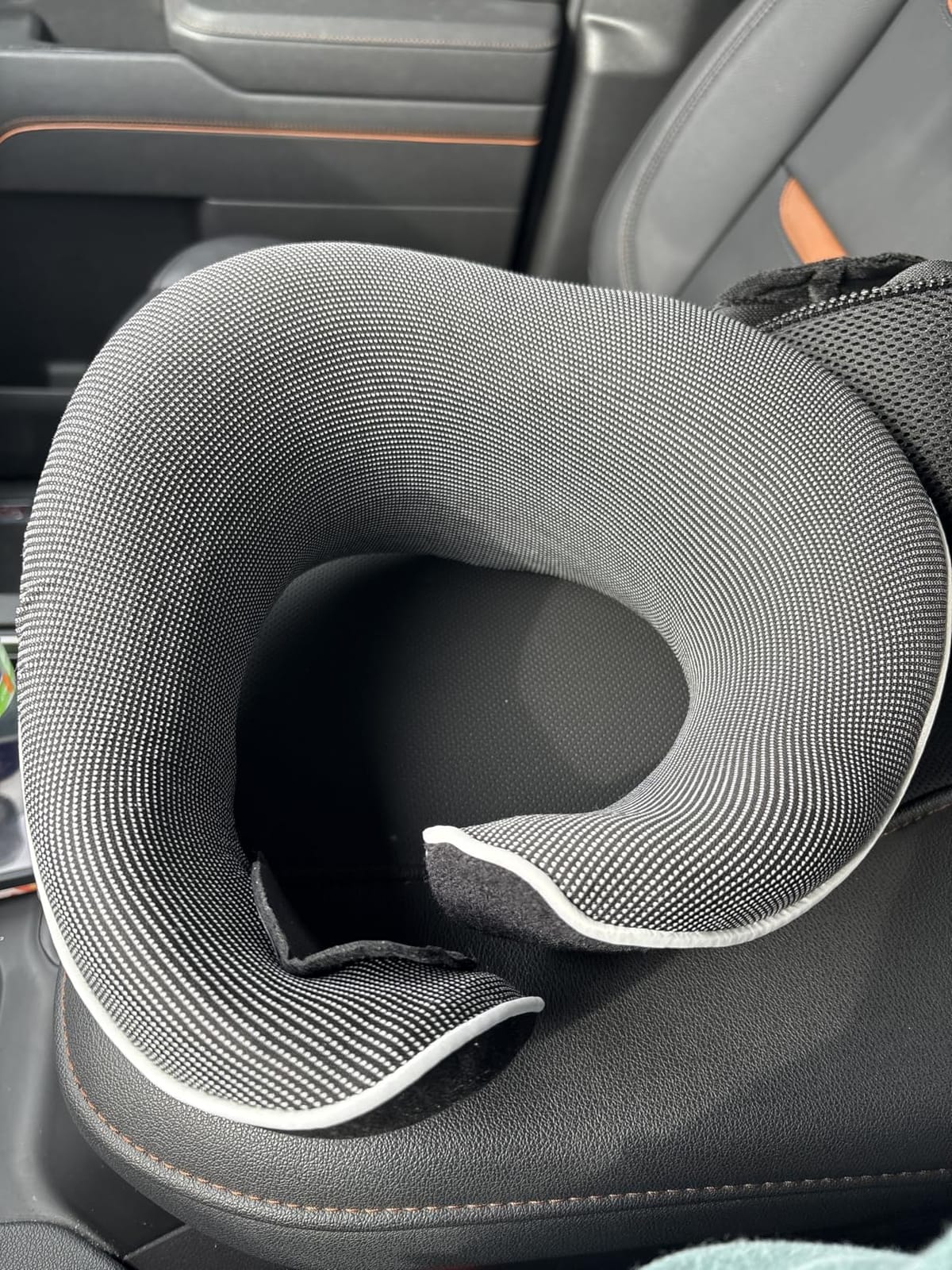
The foam is medium to firm and holds its shape after long use, and the cover is removable, washable and described as moisture absorbing, which is useful in a dry cabin. It rolls into a mesh carry bag that snaps onto a luggage handle, and the kit includes a contoured memory foam eye mask and earplugs.
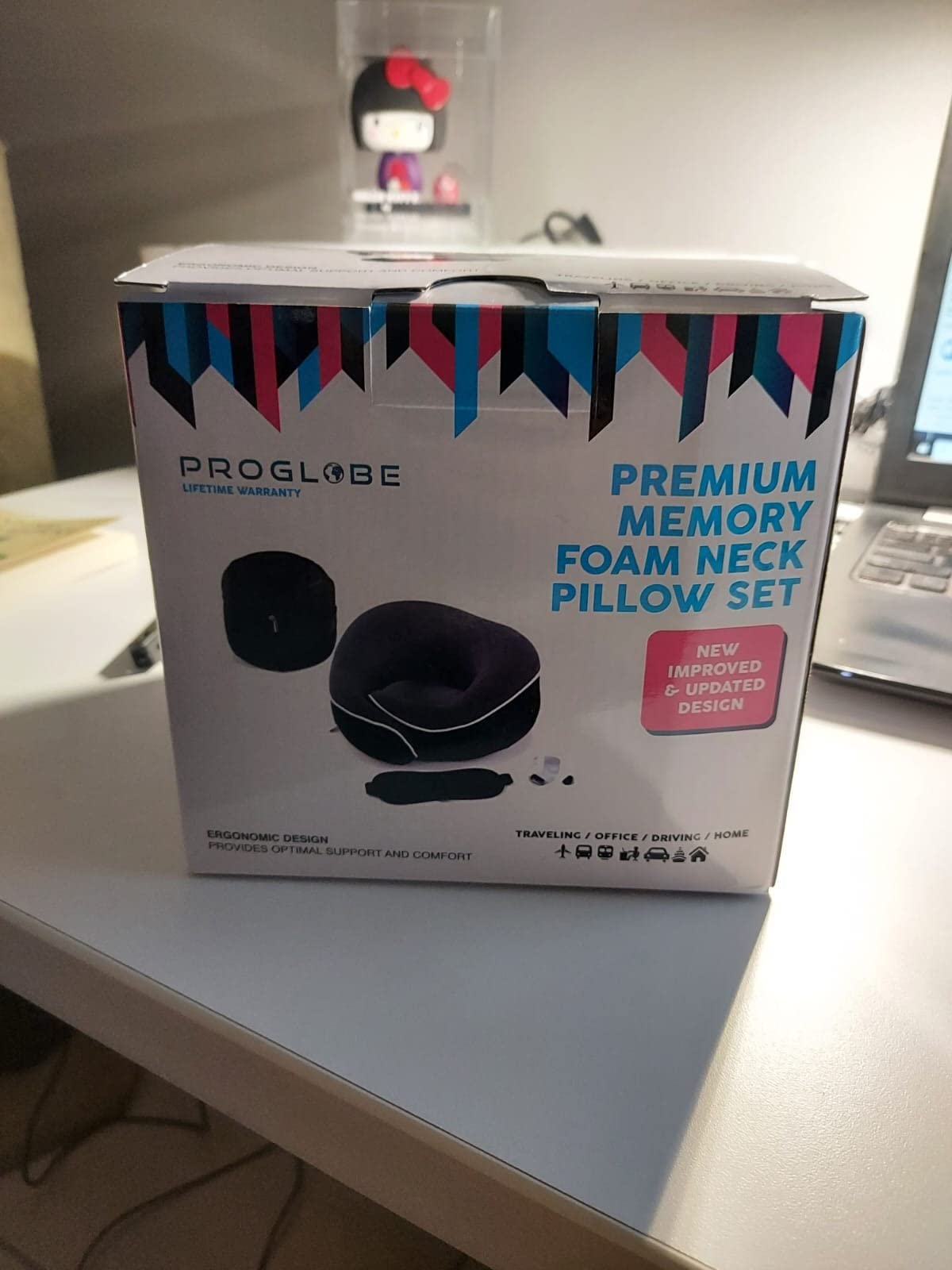
The published size guide suits necks of roughly 13 to 14 inches for women and 15 to 16 inches for men, which is a useful anchor when so many travel pillows are one-size-that-is-not. The fill is listed as breathable and free of latex and chemicals, and it is intended for adults and teens.
The main criticisms are the opposite of the main appeal. On a larger neck the 11 inch wrap can feel tight unless fully loosened, getting it compressed back into the mesh pouch takes real effort, and the included eye mask is considered basic next to aftermarket masks. The cover is hand wash only, which matters for a trip-heavy traveller.
Who this pillow suits
It suits smaller frames and shorter necks, and anyone who has given up on one-size pillows because they always sit too high. It also suits people who want precise control over firmness, since the velcro adjustment changes the tension rather than just the position.
Who should skip it
Skip it if you have a larger neck and dislike a snug wrap, since the fit works against you there. Anyone who packs at the last minute should know the compression pouch is awkward, and anyone who prefers a machine-washable cover will not like hand-wash-only care.
How to Choose a Neck Pillow for Airplane Travel
Most disappointment with travel pillows comes from expecting one shape to solve every problem. The five decisions below are the ones that actually change the outcome, and they matter more than brand or styling. If you already know how you sleep upright, you can skip straight to the matching product and save yourself the rest.
Match the pillow to how you actually sleep upright
Chin-droppers, side sleepers and window leaners need different things, and a pillow that suits one often frustrates the other two. Chin-droppers need a front that stops the head tipping forward, which usually means a chin shelf, a deep front bolster, or straps. Side sleepers need a tall firm bolster on one side or a rotatable front, because their head falls sideways toward the aisle. Window leaners want a low profile and a flat back so the pillow sits in front of them rather than behind their head.
The compromise choice is an adjustable pillow with velcro or a rope closure, or one that rotates. Those handle two or three positions in the same product, which is why they appear so often in owner reviews of long-haul flights. If you know you switch positions, pay for adjustability rather than for extra foam.
Support type and fill decide how long you last
There are three fills, and they fail in different ways. Memory foam is the most supportive and the most predictable, but it does not compress much, it can carry a new-foam smell that needs airing, and it can split after years of daily use. Microbeads conform to everything and feel cooler, but they flatten over roughly a year and the cover often cannot be detached. Inflatable designs pack down to nothing and support almost nothing, which makes them reasonable for a short nap and poor for a long night.
Foam also has downsides people rarely mention until they have hit them. It traps heat against your face, it does not breathe as well as a loose fibre, and once it has taken the shape of a few hundred flights it stops returning fully to its original form. If you share a pillow between two people, or travel in summer, a reversible or breathable cover matters more than the foam density.
Our related reading covers the at-home side of neck support if your real problem is neck pain rather than airplane sleep: our picks for cervical pillows for neck pain and for neck massagers are aimed at a different job.
Size and neck circumference matter more than most shoppers think
Measure your neck before you order. Several designs state their fit explicitly, and the numbers are not interchangeable: one of the picks here fits necks up to 16 inches in its large size with a separate larger variant, another is rated from 12.5 inches upward, and another publishes a guide around 13 to 14 inches and 15 to 16 inches. Ordering the wrong size is the most common reason a good pillow feels bad.
Frame size matters almost as much. Petite travellers report a recurring problem that generic sizing advice does not solve: the pillow is designed around an average adult, so a smaller head sits low inside it and the sides tower above the ears. Adjustable closures and lower-profile designs solve this better than any other single feature. If the discomfort continues long after a flight, an at-home option such as our guides to cervical traction devices for neck pain and shiatsu neck massagers may be worth a look before you re-order another travel pillow.
Packability, weight and airline rules
Weight is the number that matters on a plane. Two of the lightest options here come in around five to eleven ounces, while the roll and the thickest foam pillows sit near sixteen ounces. A foam or bead pillow is not going in a jacket pocket, so plan to attach it to your bag or put it in your personal item. If you travel with only a backpack, an inflatable or a bead-filled pillow is a much more realistic companion.
On airline rules, a neck pillow is an ordinary soft item, so it travels in a carry-on or a personal item without any special treatment, and it is not subject to the liquids rule. The only thing to check is the size limit your airline applies to personal items, and a compression case makes that check far easier. The free alternative that experienced travellers use is to stuff a puffy jacket into a zippered fabric envelope, which gives a soft fill and costs nothing.
Care, odor and multi-trip hygiene
If you fly more than a few times a year, care instructions deserve as much attention as the fill. A removable machine-washable cover is worth paying for, because a pillow that touches your face for eight hours will absorb oil and eventually smell even when the foam itself is fine. Airtight compression bags keep a pillow dry but trap moisture, which is how mildew develops, so let a damp pillow dry fully before bagging it.
Foam odour is normal on arrival and usually clears after a day or two of airing in daylight. It is not a fault, and it is not a reason to return a pillow unless the smell is strong enough to notice when you sit down. A mild scent disappears; a pillow that needs replacing every year because the foam split does not go away, and that is the durability question to ask before you buy.
Traveling with kids
Children need the same principle as adults: stop the forward fall. What changes is size and how forgiving the design is. Look for a smaller variant rather than an adult pillow, because an adult wrap can sit at the wrong height for a child’s neck, and prefer a model with a simple closure a child can adjust themselves. A pillow that clips to the seat back is also useful, because it stays where you put it when the seat reclines.
Washability is worth more than usual here. A pillow a child is likely to press their face into should have a cover that comes off and goes in a machine, and a plush reversible fabric is usually more appealing than a slick polyester at the same weight.
Frequently Asked Questions
Do neck pillows really work on airplanes?
Yes, when the design matches the problem you are trying to solve. A pillow works by filling the gap between your head and the seat headrest, stopping the forward or sideways fall that causes a stiff neck. It does not fix a badly shaped seat, and it is mostly a comfort luxury on flights under two hours. On red-eye and long-haul flights it is close to essential. The exception is a tall rear cushion, which can push your head forward, the opposite of what you want.
What is the best neck pillow for long haul flights?
For long-haul flights, a memory foam pillow with a flat angled back and a secure closure is the most reliable choice, because it holds its shape through many hours and stops the head tipping forward. Our pick for long-haul travel is the TALLGO memory foam pillow for its rear hump and washable cover. If you wear over-ear headphones or run hot in the cabin, a lighter bead-filled pillow may suit you better.
What are the downsides of using a memory foam travel pillow?
The main drawbacks are bulk, heat and durability. Memory foam does not compress much, so it eats personal item space. It traps heat against your face in a warm cabin, it can carry a new-foam smell that needs airing, and it can split or tear after years of daily use. It also cannot go in a washing machine, so only the cover is washable unless the whole pillow is polyester rather than foam.
Will a neck pillow make the airline headrest pushing my head forward worse?
It can, and this is the most common worry on travel forums. A pillow with a tall rear hump adds to the forward lean of a winged headrest instead of correcting it. The fix is a design with a low or flat back and a front support, since that fills the gap in front of your head rather than behind it. If your seat has a pronounced forward-leaning headrest, check the rear depth before you buy.
Are neck pillows allowed in carry-on luggage?
Yes. A travel neck pillow is a normal soft item, so it travels in a carry-on or a personal item and is not affected by liquids rules. The only constraint is your airline’s size allowance for personal items, which is where weight and the compression case matter. An inflatable or bead-filled pillow is easiest to pack, while a thick foam pillow needs a genuine pocket of space in your bag.
The Bottom Line on the Best Neck Pillows for Airplane Travel
Pick the TALLGO memory foam pillow if you want one pillow that handles every sleep style, because its rear hump, adjustable closure and washable cover cover the widest set of situations. Choose the Cloudz if you find foam too rigid or run hot in the cabin. Choose the Everlasting Comfort if you want the deepest support and a bundled mask and earplugs on a red-eye, and pick the BCOZZY if washing the whole pillow between trips matters more to you than foam performance.
Whichever one you choose, the fit questions in the buying guide above decide whether it works for you: measure your neck, check the rear height against your seat, and be honest about how much bag space you have. On any flight of four hours or more, one of these ten will do more for your neck than anything else you can fit in a jacket pocket.