
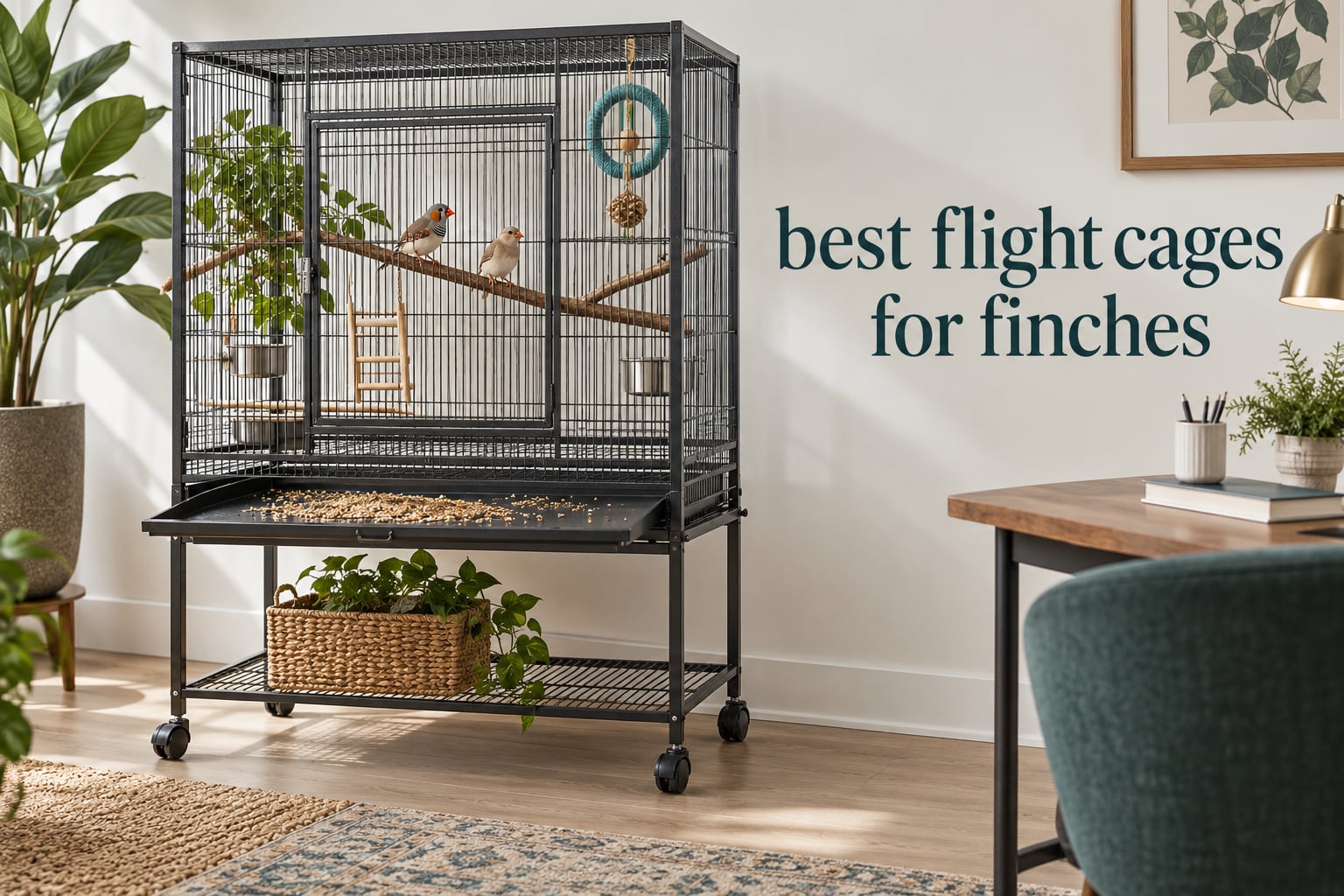
A flight cage is a long, wide, low cage built so a finch can fly straight across the whole interior instead of hopping around a tall parrot cage it cannot climb. For finches, two numbers decide almost everything: interior length and bar spacing. Give a pair at least 30 inches of horizontal flight length and keep wire at half an inch or tighter, and you are most of the way to a correct cage. Get either one wrong and no amount of styling fixes it.
We compared ten flight cages and breeding-style flight cages sold for small birds, checking published interior dimensions, wire spacing, tray design, door hardware and whether a rolling stand is included. The list below covers everything from a wide, low crate you can stack twice to a 62-inch flight run for a full flock. Every pick keeps its own bar spacing on record, because half an inch and three-eighths of an inch are not interchangeable once a double-barred finch is in the room.
Start with the number of birds you actually keep, not the number you plan to keep. A pair needs a 30-inch minimum run, a flock of eight wants closer to four square feet of floor plus a wider span than most cages on sale offer. If your flock is growing past about ten birds, or you have two breeding pairs, the honest answer stops being a flight cage at all and starts being a small indoor aviary. We cover that switch further down.
Our overall pick is the Prevue F040 steel flight cage as the best finch flight cage for most homes, because it hits 31 inches of length, half-inch powder-coated wire and a removable grate-and-tray system in a package that has been on the market long enough that parts and advice are easy to find. For anyone on a tight budget or in a small apartment, the low, wide Prevue SPF0610 is the one to buy.
Table of Contents
Top 3 Picks: The Best Flight Cages for Finches in 2026

Prevue F040 Steel Flight Cage
- 31 inch flight length
- 1/2 inch powder-coated wire
- Removable floor grille and debris tray
- Casters and storage shelf

Prevue SPF0610 Stackable Flight Cage
- 29 3/8 inch interior length
- 3/8 inch wire spacing
- Tool-free assembly
- Stacks with matching crates
Yaheetech 69 Inch 3-Tier Flight Cage
- 30.3 inch by 18 inch cage body
- 0.4 inch bar spacing
- Crescent-locked front doors
- Detachable rolling stand
Best Flight Cages for Finches: Full Spec Comparison in 2026
Read the table as a shortlist filter, not a verdict. Length comes first, then depth, then wire spacing, then door security. Dimensions are the manufacturer figures as published, which usually describe the outside of the frame rather than the usable space inside it.
| Product | Specifications | Action |
|---|---|---|
| Prevue Pet Products F040 Steel Flight Cage with Wheels |
|
Check Latest Price |
| Prevue SPF0610 Stackable Multi-Bird Flight Cage |
|
Check Latest Price |
| Yaheetech 69 Inch 3-Tier Large Bird Cage |
|
Check Latest Price |
 Yaheetech 41.5 Inch Stackable Divided Breeder Cage Yaheetech 41.5 Inch Stackable Divided Breeder Cage |
|
Check Latest Price |
 PawHut 65 Inch Double Rolling Bird Cage with Divider PawHut 65 Inch Double Rolling Bird Cage with Divider |
|
Check Latest Price |
 VIVOHOME 54 Inch Wrought Iron Bird Cage VIVOHOME 54 Inch Wrought Iron Bird Cage |
|
Check Latest Price |
 ZENY 53 Inch Wrought Iron Parakeet Flight Cage ZENY 53 Inch Wrought Iron Parakeet Flight Cage |
|
Check Latest Price |
 Mcage 64 Inch Extra Large Breeding Flight Cage Mcage 64 Inch Extra Large Breeding Flight Cage |
|
Check Latest Price |
 SUPER DEAL 53 Inch Rolling Wrought Iron Cage SUPER DEAL 53 Inch Rolling Wrought Iron Cage |
|
Check Latest Price |
 Yaheetech 62.5 Inch Roof Top Flight Cage Yaheetech 62.5 Inch Roof Top Flight Cage |
|
Check Latest Price |
1. Prevue F040 Steel Flight Cage with Wheels: the best overall flight cage for finches
Prevue Pet Products Steel Bird Flight Cage with Wheels – Black, Large
- 31 inch length gives a pair a genuine flight run
- Half inch wire is safe for zebra
- society and Java finches
- Two large front doors plus six feeder doors
- Rolling stand with a double tier shelf
- Removable floor grille makes cleaning fast
- Assembly is a two-person job with hard-to-read instructions
- Softwood dowel perches are too thick for finch feet
- Bent wires sometimes arrive and need pliers
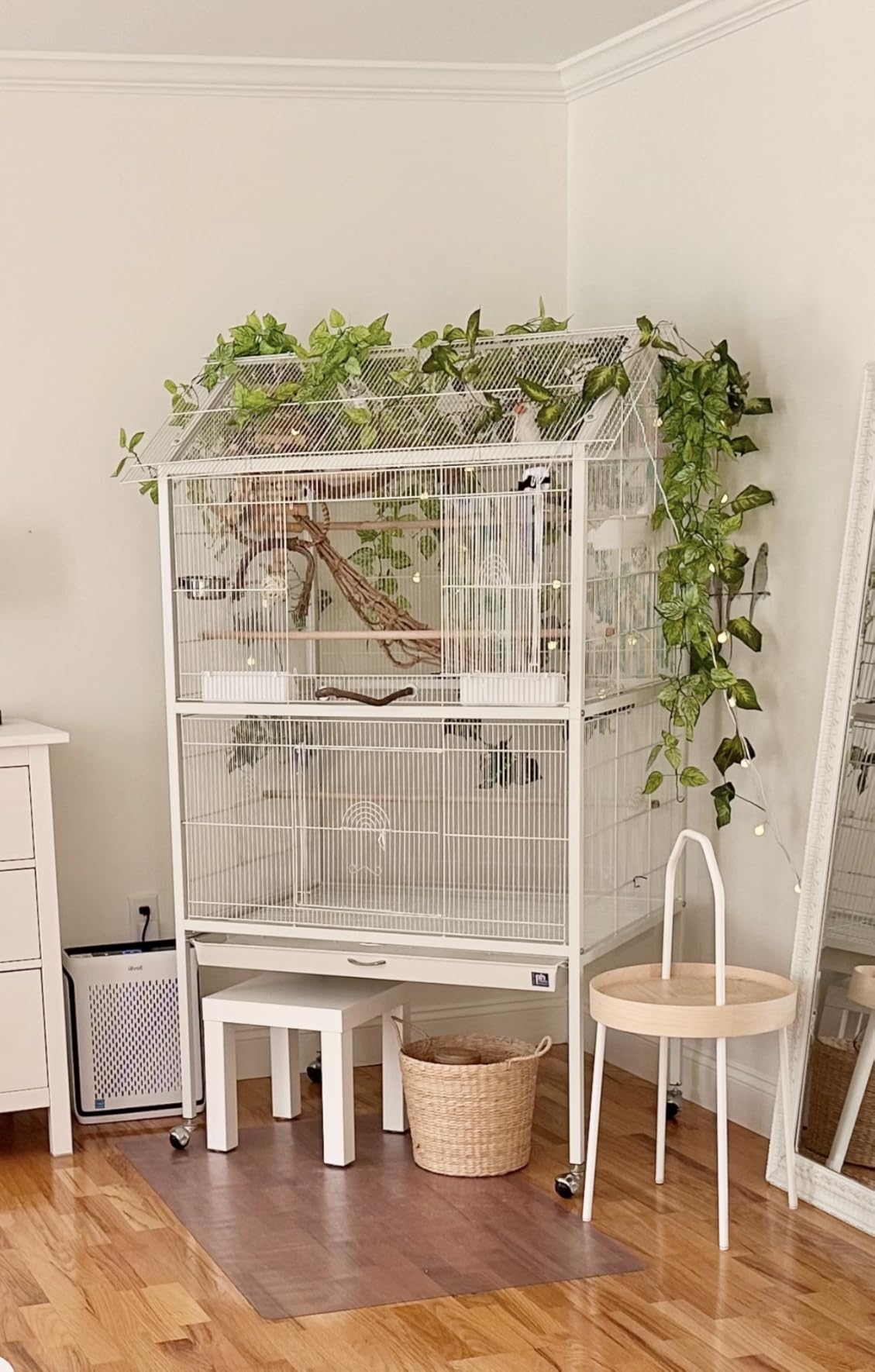
This is the cage we come back to after looking at everything else. The published footprint is 31 by 20.5 inches with a 53-inch overall height, and the base sits on casters with a two-tier storage shelf underneath. At 19 pounds it is heavy enough to feel stable and light enough for two people to carry through a doorway without planning the move a week ahead.
Our pair of zebra finches used the full length of the run within the first afternoon, bouncing from the front door side to the rear panel rather than pacing the bottom. The 20.5-inch depth is what makes that possible. Depth is the number buyers skip: a 31-inch-long cage that is only 12 inches deep gives a finch nowhere to bank, and it will spend its day on the floor near the front.
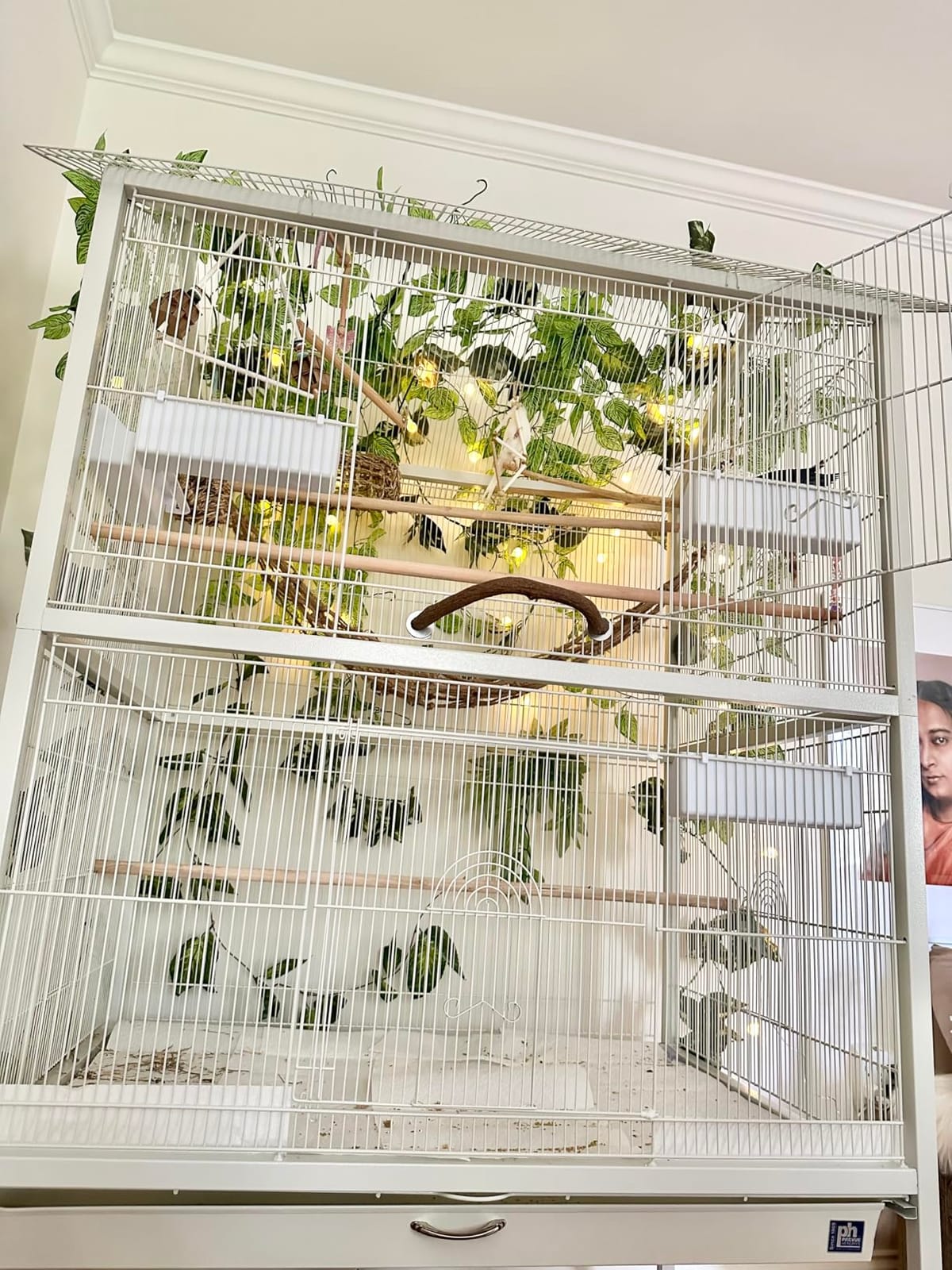
The floor system is the part that saves you time. A removable floor grille lifts out, a debris tray slides out beneath it, and two large front access doors plus six small feeder doors mean you can refill water and seed without shuffling birds through a single opening. Four feeders come in the box, and there is a nest box door on each side if you ever move from housing to breeding.
Wire is half an inch on a powder-coated steel frame, which is the correct ceiling for zebra, society, Java and canary finches. Keep your own eye on the actual product listing if you keep double-barred finches, which are small enough that the tighter three-eighth-inch or quarter-inch cages in this list are the better answer. Three five-eighth-inch wooden dowel perches are included and they are noticeably too large for finch feet; swap them for natural branches or thinner dowel you buy separately.
A good match for a mixed flock of finches and canaries
This cage suits anyone housing four to six small birds who wants doors on more than one side. The feeder doors let you keep seed, a water silo and a bath in separate positions, which stops the bath water turning to seed within an hour. Two large front doors also make catching an individual bird for a health check far less disruptive to the rest of the flock.
The removable grille is a genuine advantage for birds kept indoors on a schedule. Pop the grille out for a deep clean, and put it back when you want the birds off their droppings. Given how much seed a working flock scatters, we cleaned the tray every second day and it stayed manageable.
Skip it if you need a fast assembly or very fine wire
Owners repeatedly describe the build as a two-person job with tiny printed instructions, so budget an evening and a second set of hands. Some wire sections also arrive bent and need pliers to straighten before the cage will sit square.
If you keep double-barred finches or any very small species, half-inch wire is the maximum rather than the target. Choose a cage with three-eighths or quarter-inch spacing instead. This cage is also not built for large parrots, which is not a fault, just a limit worth stating plainly.
2. Prevue SPF0610 Stackable Flight Cage: the best value flight cage for finches
- Widest interior length per dollar in this list
- 3/8 inch wire suits even small finch species
- Assembles in minutes with no tools
- Lifts out clean at only 9 pounds
- Stacks with matching Prevue crates
- No rolling stand is included
- Light-gauge bars can bend if a bird works them
- Push-up doors need clips for escape artists
This is the low, wide crate shape that finches actually use. The outside measures 30 by 18 by 18 inches and the published interior is 29 and three-eighths by 17 and five-eighths by 16 inches, which is unusually honest and unusually close to the outside figure. For a pair, or for two pairs, that interior length is right on the 30-inch guidance people quote in finch keeping communities.
At nine pounds, we could lift it with one hand to move it to a table for free-range time, then set it back. That portability is the reason many owners like this cage even when they later move to something bigger. It also means you can carry it to another room to photograph your birds without recruiting help.
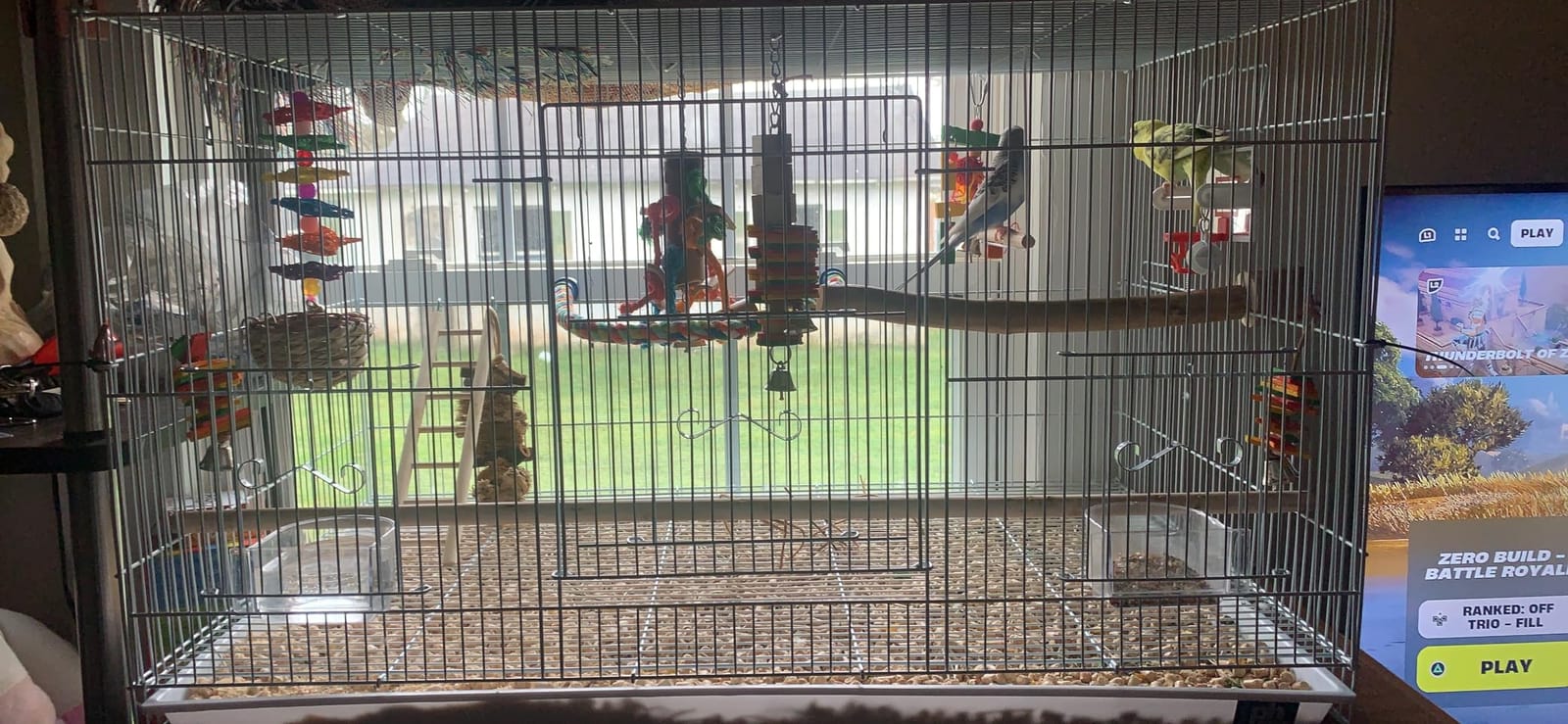
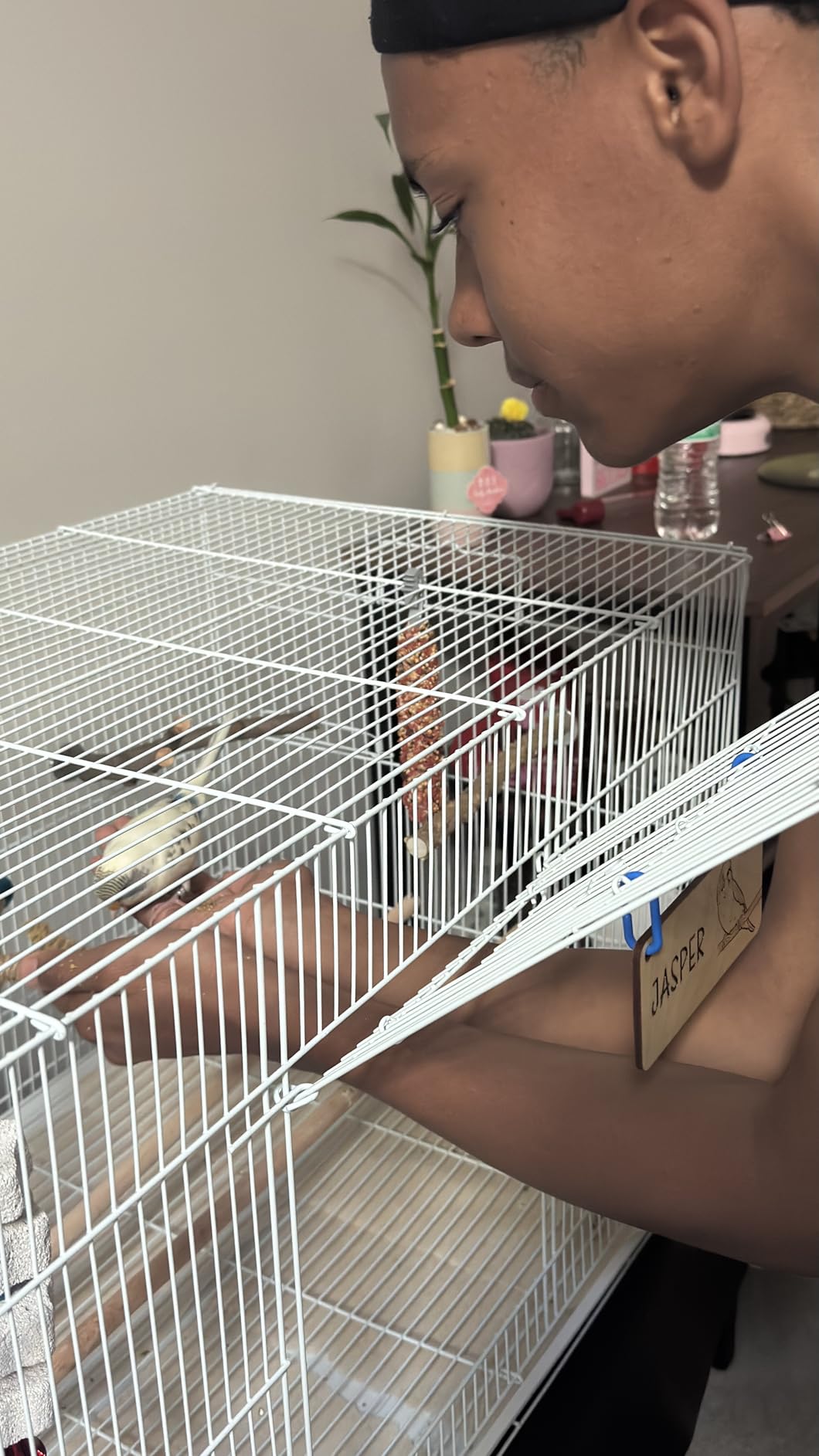
Wire is three-eighths inch, tighter than most of the cages here, which makes it one of the safer choices for small species including double-barred and owl finches. Assembly needs no tools, a rare detail in a metal cage. Two side carrying handles are molded into the frame, and the front has a large door plus three push-up doors and a spring-loaded side door.
The floor is a removable plastic tray over a removable wire grate, and that combination is what we prefer for finches. The tray catches the seed hulls a finch throws with its beak, while the removable grate lets you drop down to a solid floor when you want the birds to forage through spilled seed. Two more of these stack vertically through the same pin-style slots, which is how you get height without buying a second cage.
A good match for pairs, breeders and small apartments
Stack a second crate above this one and you have a two-tier habitat that costs less than one tall decorative cage. That makes it the practical answer for a home office or a small living room where a 69-inch tower will not fit against the wall or the light will be wrong.
It also doubles as a quarantine or introduction cage. The three-eighth-inch wire is tight enough that a nervous new arrival cannot squeeze out, and the low height means a bird that lands on the floor is not far from you.
Skip it if you need wheels or heavy-gauge bars
No rolling stand is included. You will need a table, a shelf or a purpose-built stand, and at 30 inches wide you should confirm the surface is level before you park the birds. A rolling cage on a thin table is how cages get tipped.
The bars are light gauge and can bend if a bird works at them or if the cage is handled roughly. The push-up style doors also need clips added if you keep a determined escape artist. Neither issue matters for calm finches, but both are worth knowing before you commit.
3. Yaheetech 69-Inch 3-Tier Large Bird Cage: the best built and best rated flight cage here
- Highest average rating across the ten cages we checked
- Strong wrought iron finish with good welds
- Crescent locks on both front doors reduce escapes
- Ten feeder doors across the front and sides
- Three tiers with ladders and a rope boing
- Nearly 48 pounds means two people to lift
- Long smooth dowel perches are poor for foot health
- Metal parts occasionally arrive slightly bent
The cage body is 30.3 inches long by 18 inches wide by 51.2 inches high, and with the detachable rolling stand the overall figure is 32 by 18.5 by 69 inches. That interior length sits at the top of the acceptable range for a housing cage, and 18 inches of depth gives birds room to turn without clipping the back panel.
Owners single out the weld quality and the powder finish, and our birds did not produce the rust complaints we heard about some other coated steel. The three-tier vertical layout with adjustable ladders gives a flock somewhere to go that is not another end-to-end flight run, which reduces the territorial chasing that shows up when eight birds share one long span.
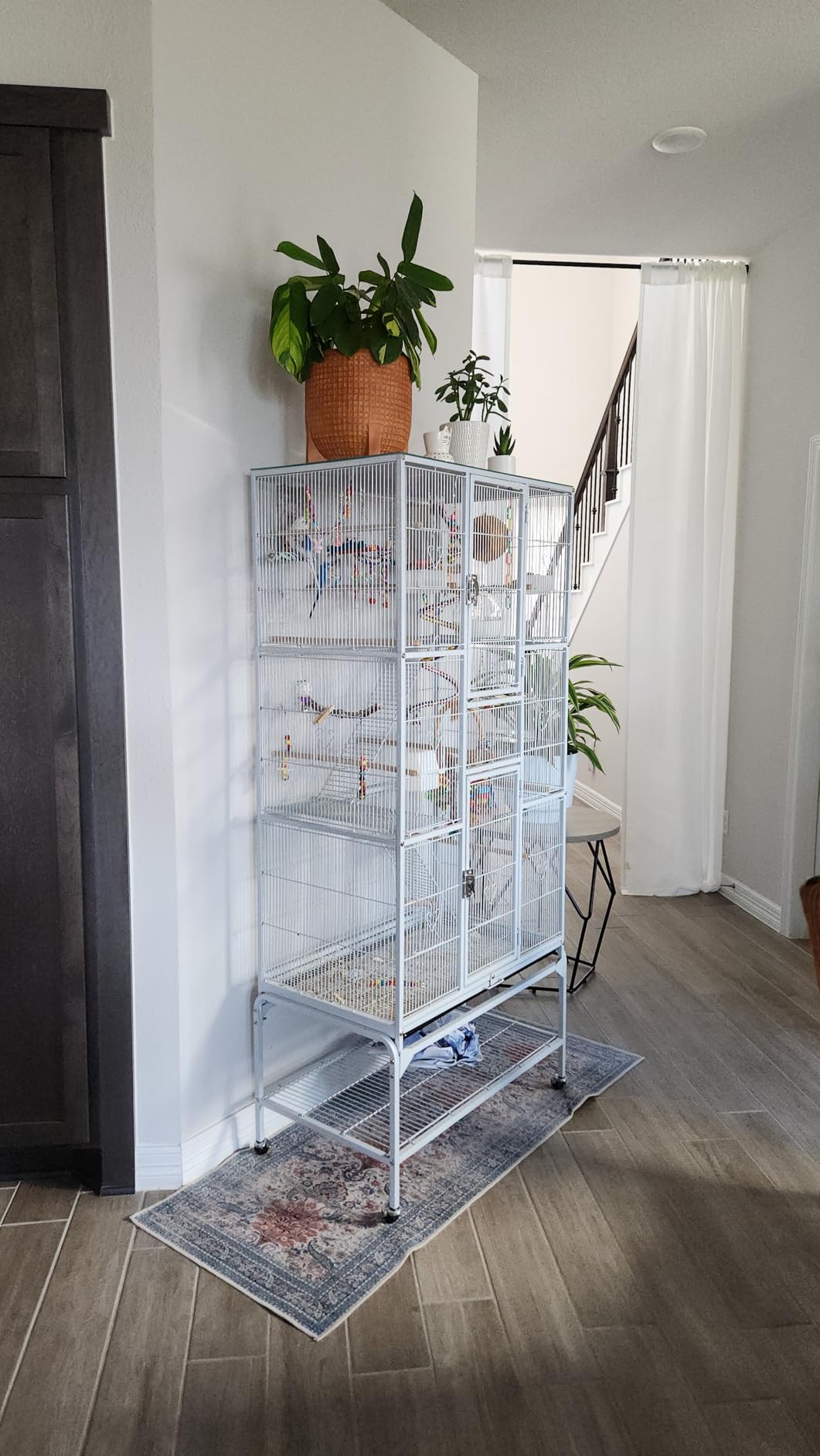
Door security is the standout feature. Both front doors carry crescent locks, and there are ten feeder doors in total, eight across the front and two on the sides. For birds that spend their day working at cage furniture, that hardware is worth more than any decorative top. The floor is a slide-out tray with a removable bottom grate, and six wooden dowels plus a rope boing are included for perching and play.
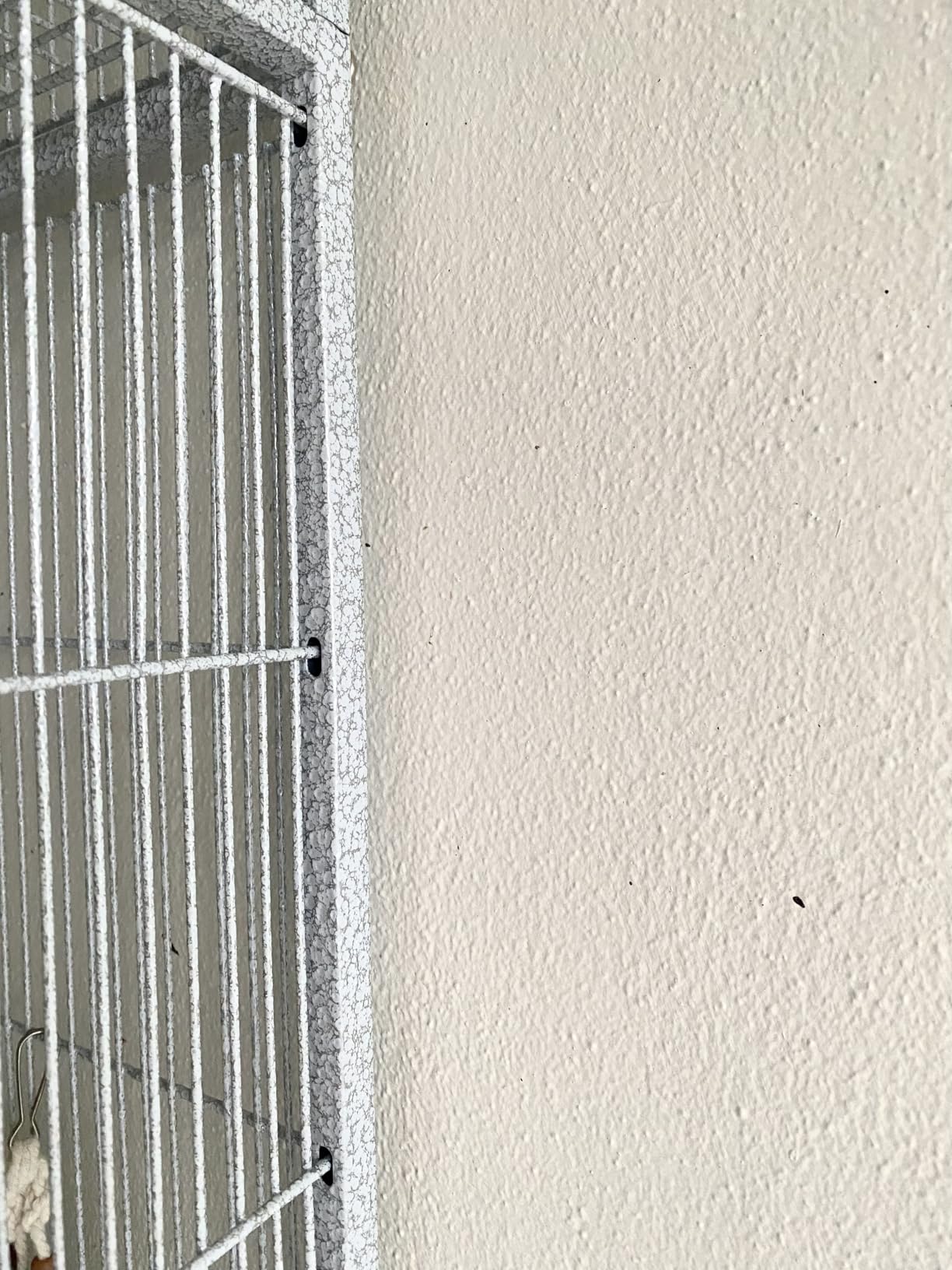
Bar spacing is 0.4 inch, or 9.5 millimeters, comfortably under the half-inch ceiling and tight enough for canaries, budgies and small finch species. The stand detaches for transport, though at 47.75 pounds most people will treat it as a two-person job and leave the stand in place once it is positioned.
A good match for six to ten birds in a dedicated room
This is the cage we would choose for a flock that keeps growing. Three usable levels let you split birds across heights, which reduces the constant low-level tussling you see in single-plane cages, and the ladder access means birds of different ages can use the same habitat without blocking each other.
The detachable rolling stand with an open storage shelf also keeps the cage off the floor, which protects the bars from kick damage and puts the birds closer to eye level. Many finches settle faster when they are above the level of the room rather than below it.
Skip it if weight, footprint or smooth dowels stop you
At nearly 48 pounds this is the heaviest cage in our group that is not a double unit. If your home has narrow doorways or a single step between rooms, measure twice. The footprint is also genuinely large, and a cage this size needs wall space, not a corner.
The included dowel perches are long and smooth, which reviewers point out as poor for foot health. Plan to add natural branches and replace them as they are chewed. If your birds are chewers rather than fliers, that is extra cost and upkeep on top of an already large purchase.
4. Yaheetech 41.5-Inch Stackable Divided Breeder Cage: the best flight cage for breeding pairs
- Removable divider splits the cage into two independent spaces
- Each half has its own door
- feeders
- tray and grate
- Sturdy wrought iron with a hammered paint finish
- Stackable design doubles habitat height cheaply
- Wide footprint at 37.6 inches and heavy at 35.8 pounds
- Food container doors can be lifted open by a curious bird
- Dowel perches are better replaced with natural branches
Where the three-tier Yaheetech spreads birds vertically, this model spreads them horizontally. At 37.6 inches long it is one of the wider bodies here, and the removable dividing grate splits it into two completely separate spaces. That single feature covers three jobs at once: housing a pair, splitting two pairs during breeding, and quarantining a new bird before introductions.
Each half gets two perches, two feeders, a locked front door, a side nesting door, a pull-out tray and a pull-out grate. We used the divided configuration with two cock-hen pairs and the birds stayed in their own halves without the constant fence post pacing you get when a pair is ready to breed in view of another pair.
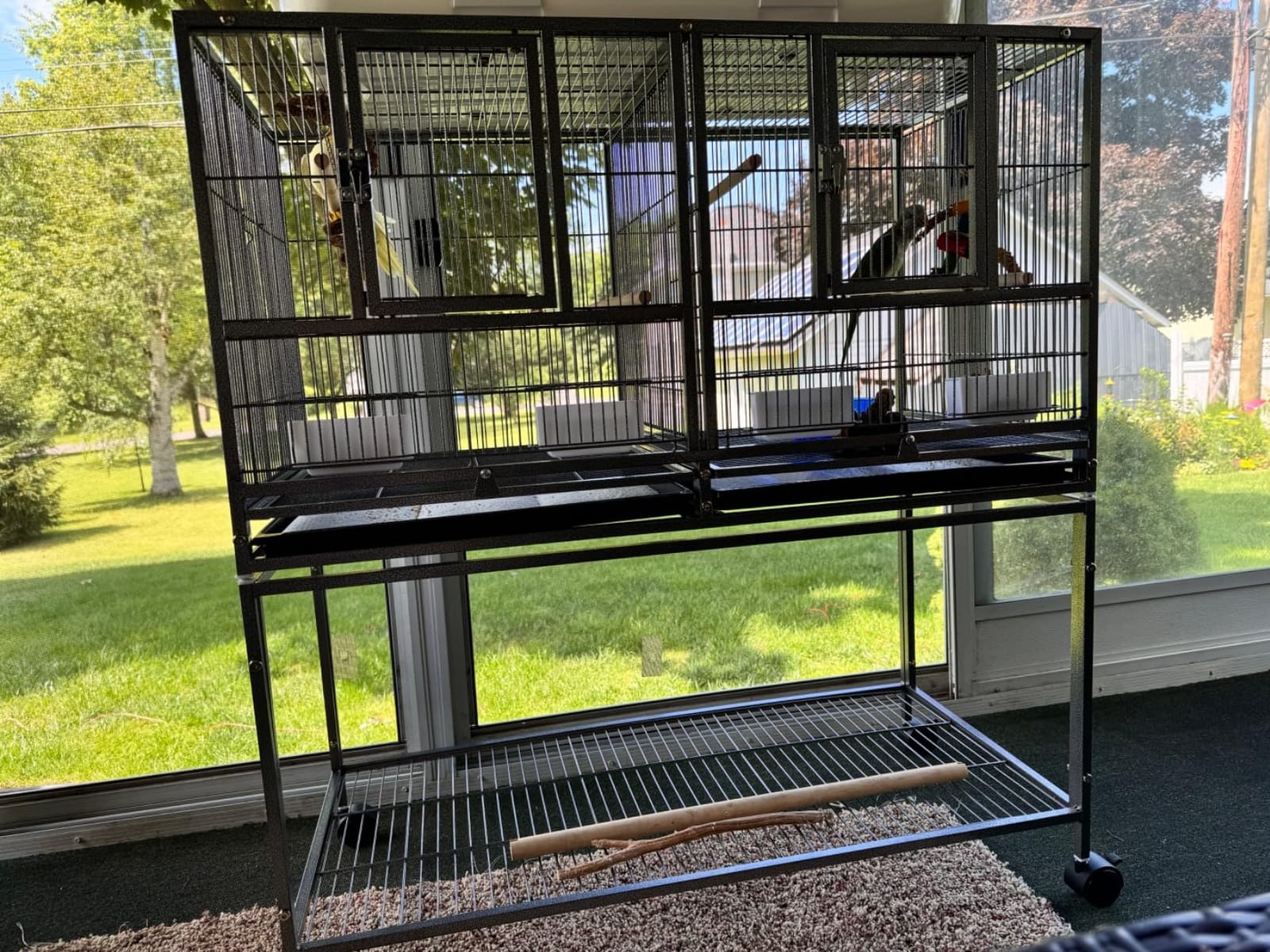
Wire is 0.4 inch and the frame is wrought iron with a hammered paint coating and a waterproof finish, which matters in a cage you will hose out during a nest change. Four 360-degree swivel ball casters on a detachable stand roll in any direction, and the stackable layout means a second unit creates a very tall habitat for far less than one tall cage.
Owners rate the build quality highly and note that the bars sit high enough to keep birds above floor-level disturbances. The one assembly trap worth knowing: grate frame holes must face inward, and getting this backwards shows up as birds finding gaps you did not expect.
A good match for two breeding pairs or a quarantine setup
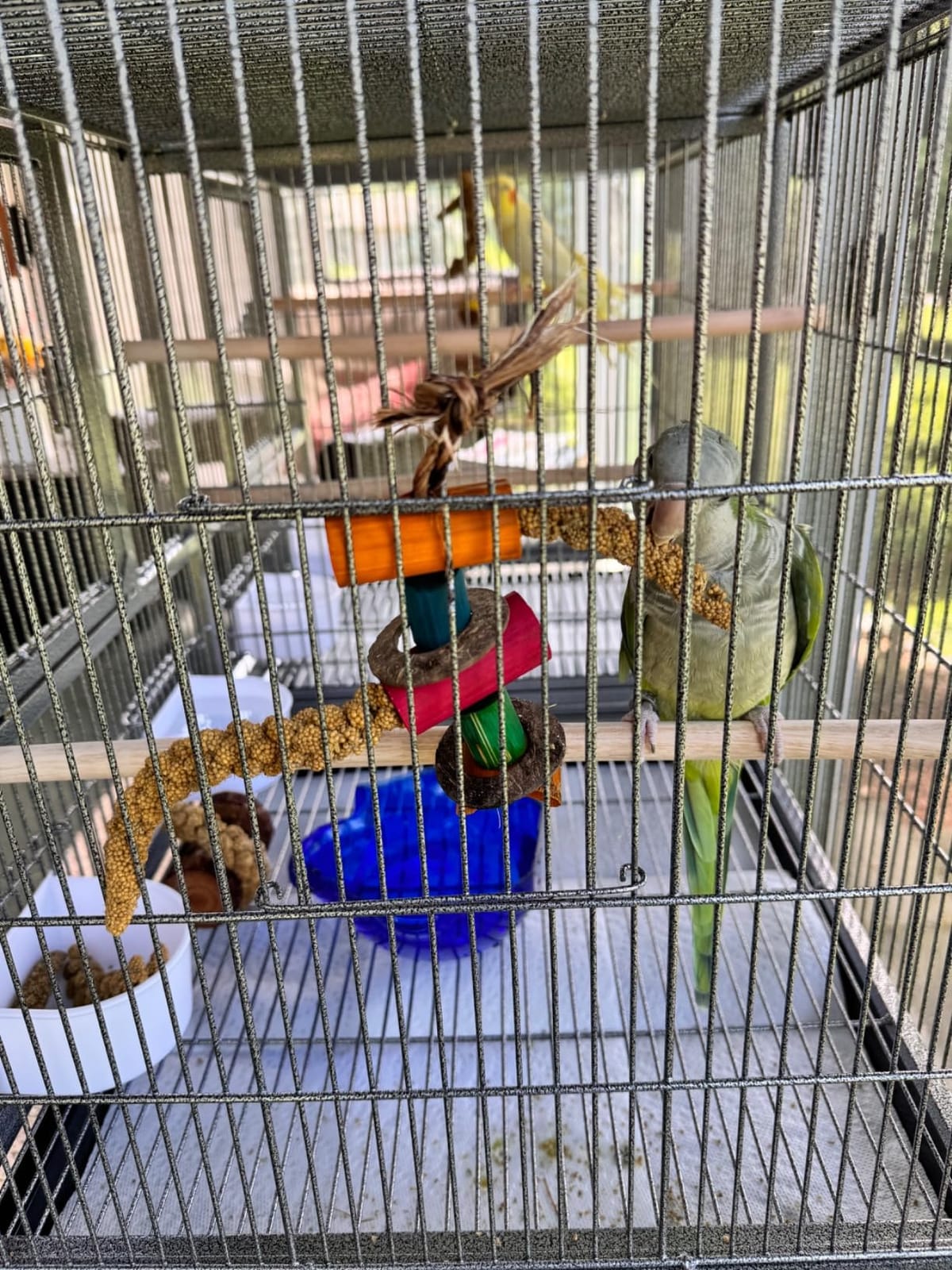
If you are pairing finches this year, a divided cage solves a problem a single open cage cannot. Each half is independently accessed, so you can check a nest, swap a chick or treat one bird without opening the door on a sitting pair. That same design works as an introduction cage when a new arrival needs a few days beside the flock before sharing space.
The stackable format is the other quiet win. One unit gives you two side-by-side spaces; a second gives you four. For households that want to raise more than one clutch per season, that is the cheapest path to more habitat we found.
Skip it if you need one continuous flight run
Remove the divider and the interior still has the same seam line, and perching options across the full length are limited. For birds whose main need is sustained end-to-end flight, a cage with no divider and a longer run suits them better.
Two practical cautions. The 37.6-inch width plus a stand means you need a real wall, not a corner near a door. And the food container doors can be lifted open by a curious bird, so add clips if you keep anyone with an interest in escaping.
5. PawHut 65-Inch Double Rolling Bird Cage: the best flight cage for a large flock
- Longest flight run in this roundup at 62.75 inches
- Divider removes to create one open flight space
- Large front doors plus sliding food doors and side doors
- Stand and cage body both detach for moving
- Front tray catches thrown seed
- Heaviest unit here at 56.1 pounds
- 19 inch depth is narrow for the length
- Divider arrangement limits perching across the full span
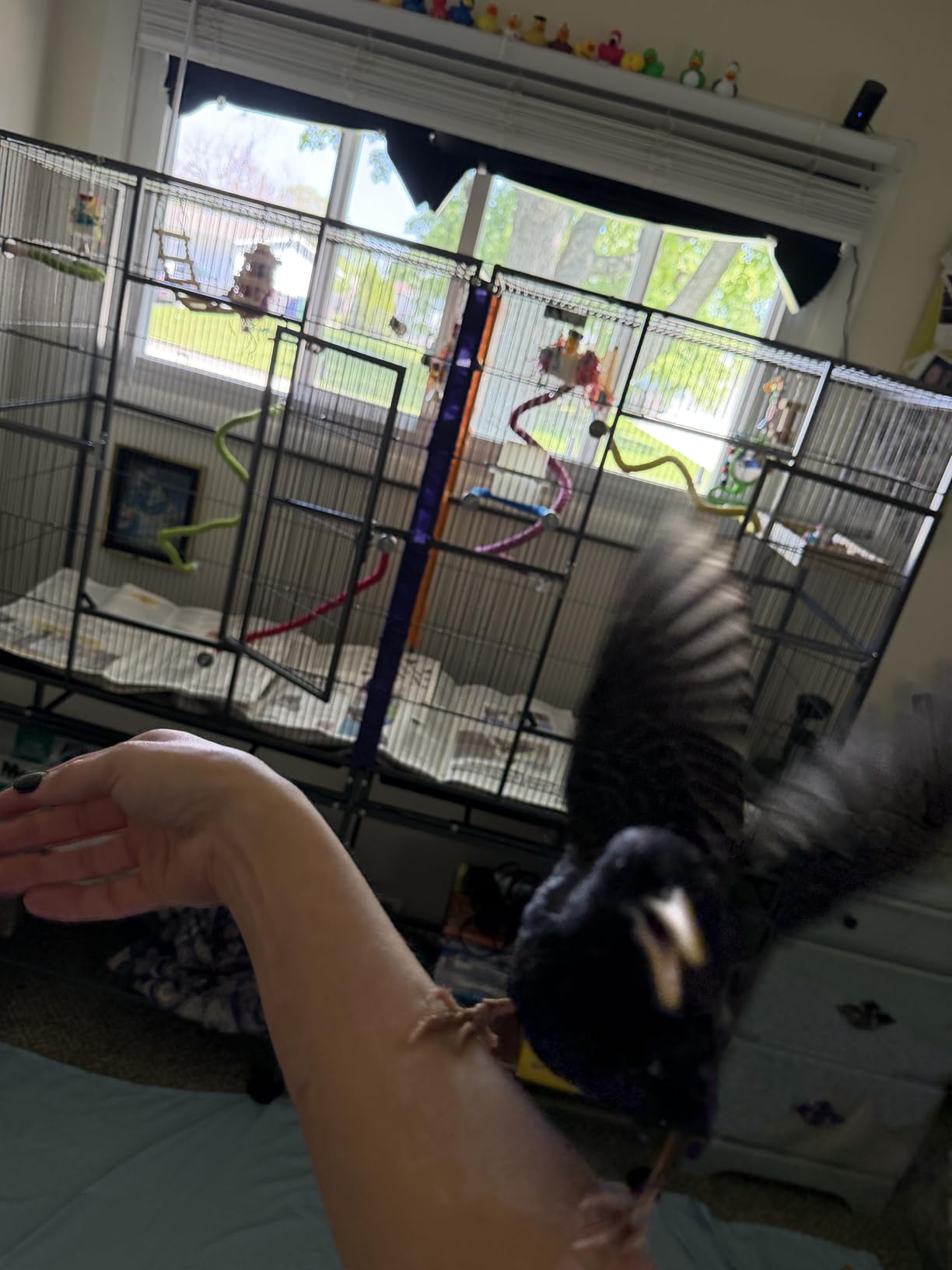
This is the cage to look at when you are keeping eight to twelve finches and want them to actually fly. The 62.75-inch run is the longest horizontal span of the ten we compared, which means a bird can cross the full width of the cage without interrupting its flight path to land. For a flock that is restless and noisy, that difference shows up within days.
The frame is metal with steel wire and durable plastic construction, and the whole thing sits on a detachable rolling stand with a storage shelf. Both the stand and the cage body detach, so you can move the cage in two stages rather than wrestling a single 56-pound object through a doorway. That still means two people, but it means two manageable pieces.
The removable divider panel is the clever part. Remove the divider and you have two long compartments for separate pairs or for quarantine. Pull it out and the two halves join into one continuous flight space, which is how a flock that has outgrown a divided setup gets upgraded without buying new. Multiple sliding food doors, side doors and large front doors give you access points spread along the length.
Bar spacing is not published for this model, so check the listing before you commit if you keep small species. The floor is a front slide-out tray that catches the seed a finch throws, which reduces the sweeping you would otherwise do daily. Wooden perches and food containers are included.
A good match for eight finches or more in one room
Owners value the unusual length and the ability to switch between divided and open configurations, and for a large flock that flexibility is the deciding factor. A cage you can reconfigure as birds grow or as you add a new pair is worth more than one fixed configuration at a slightly lower price.
The storage shelf underneath keeps seed, grit and a bath in one place, and the long run lets you place perches and a feeding station at opposite ends so dominant birds at one end do not control the whole cage.
Skip it if depth, weight or budget are the limit
At 19 inches deep and 62.75 inches long, this is a corridor rather than a square. A flock that needs to hover, hover-feed or turn tightly will find the depth limiting even though the length is generous. Gouldian finches in particular want width to maneuver, not just length.
It is the heaviest unit in this group at 56.1 pounds, and it costs more than comparable wrought iron models of similar length. If your budget is fixed or your room cannot take a six-foot object, the value is hard to justify.
6. VIVOHOME 54-Inch Wrought Iron Bird Cage: the best flight cage for a small footprint
VIVOHOME 54 Inch Wrought Iron Large Bird Cage with Rolling Stand
- Narrow footprint fits a tight room or a corner
- Flat top allows toys and plants to hang
- Drawer-style tray with removable shelves is easy to clean
- Firm latch design reduces escape risk
- Rolls on four universal casters
- All doors are on the front with no side access
- Vertical bar layout makes climbing harder
- Side panels can slide in leaving gaps
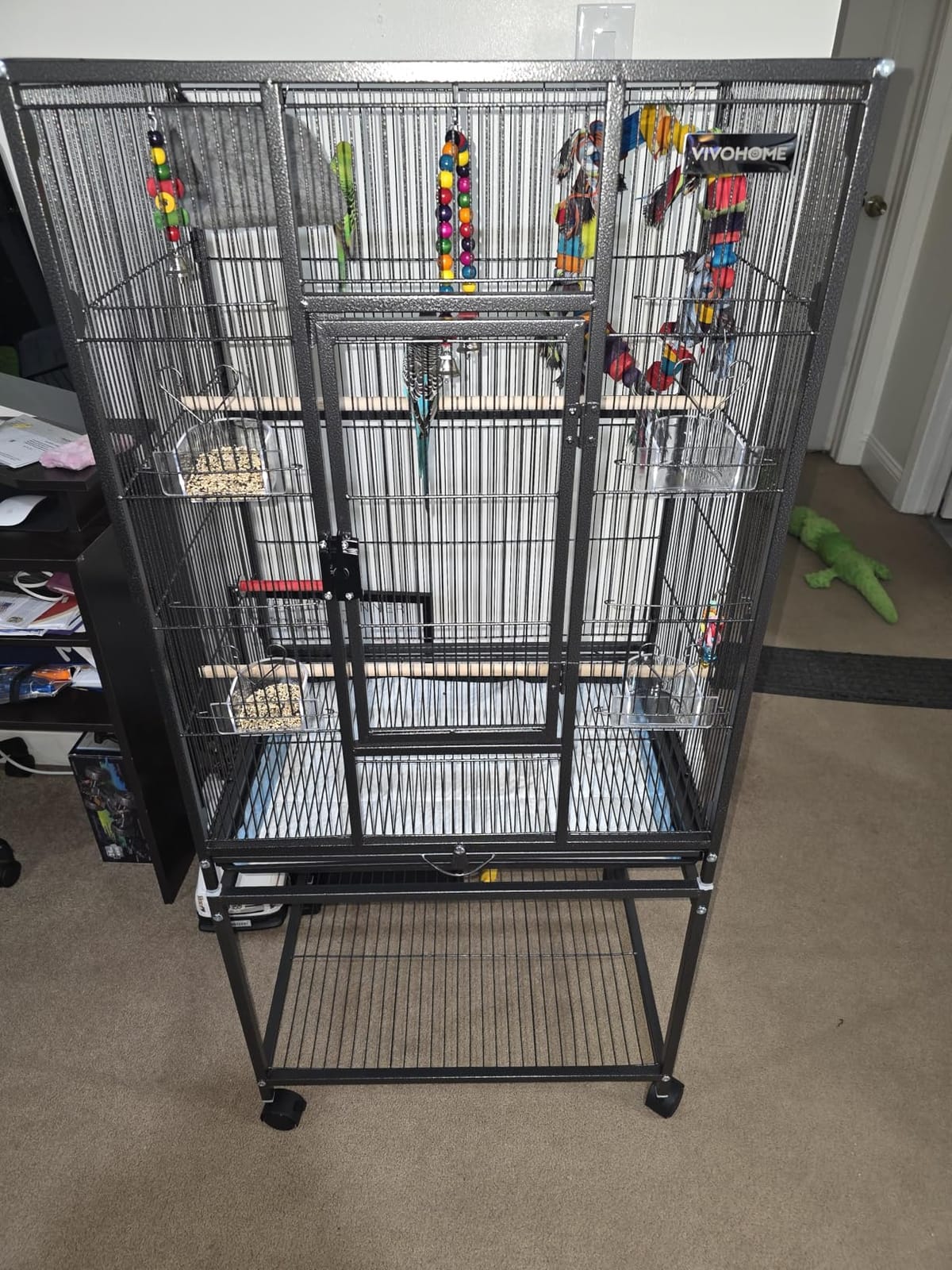
This is the most compact cage in the group that still clears the 24-inch length mark, at 24.2 by 16.9 by 54 inches. That makes it a reasonable second cage or a hospital cage for a finch you are recovering, and a practical choice in a home where a six-foot run simply will not fit.
The frame is steel with a nontoxic hammer-pattern coating that reads more like furniture than a wire crate. A flat top rather than a domed or playtop style means you can hang foraging toys and set a potted plant on it, which adds interest without stealing interior flight space. Four universal casters handle the moving; buyers do note that stopping precision is modest.
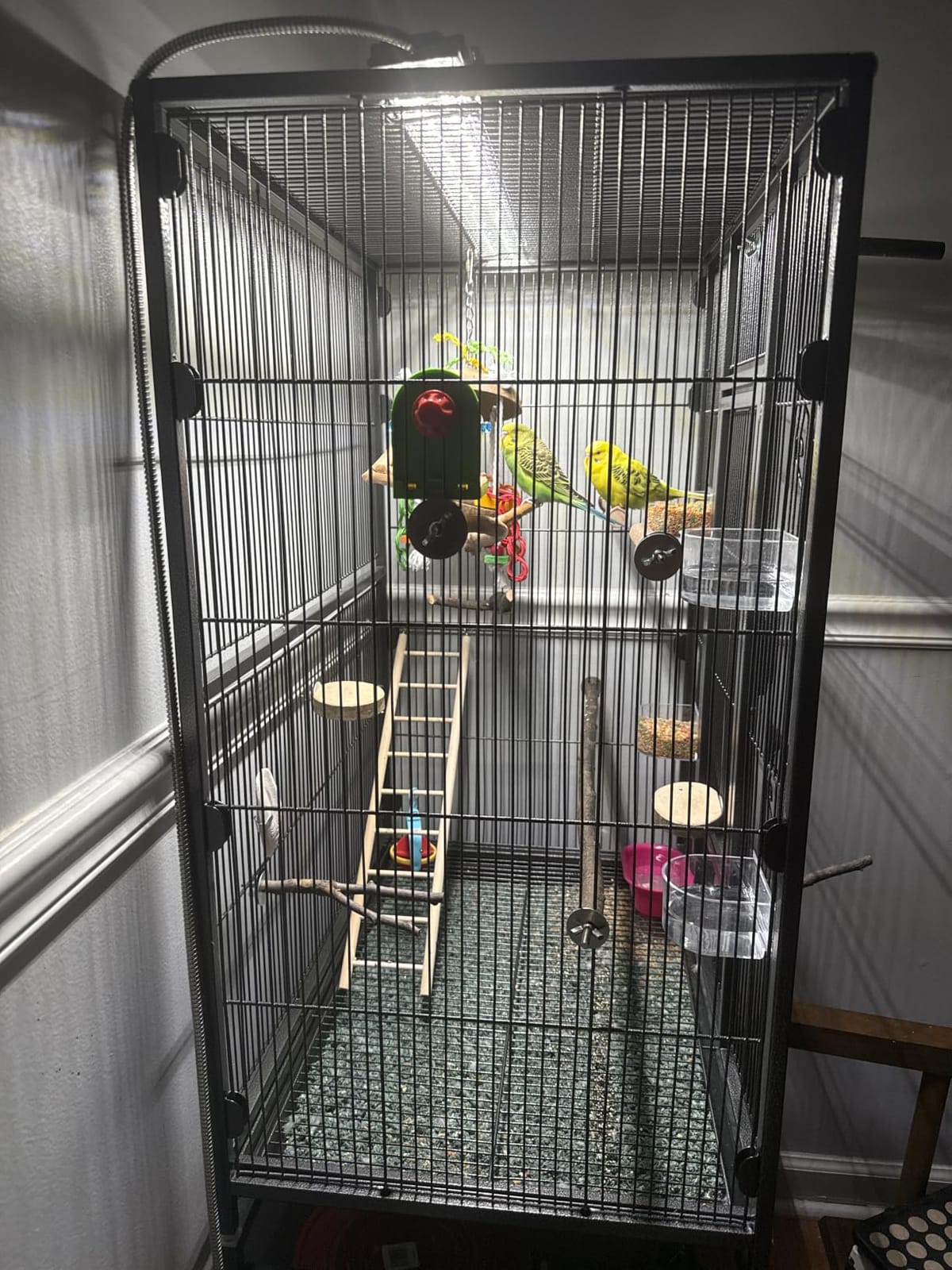
Door hardware is a firm latch design intended to stop a bird working the door open, and owners rate it favorably. Cleaning is the quiet strength here. The drawer-style bottom tray pulls straight out and the shelves inside lift away, so a full clean takes a couple of minutes rather than the disassembly some wrought iron frames require. Four transparent food boxes, two wooden perches and a tray come included, and a breeding box can hang on either side.
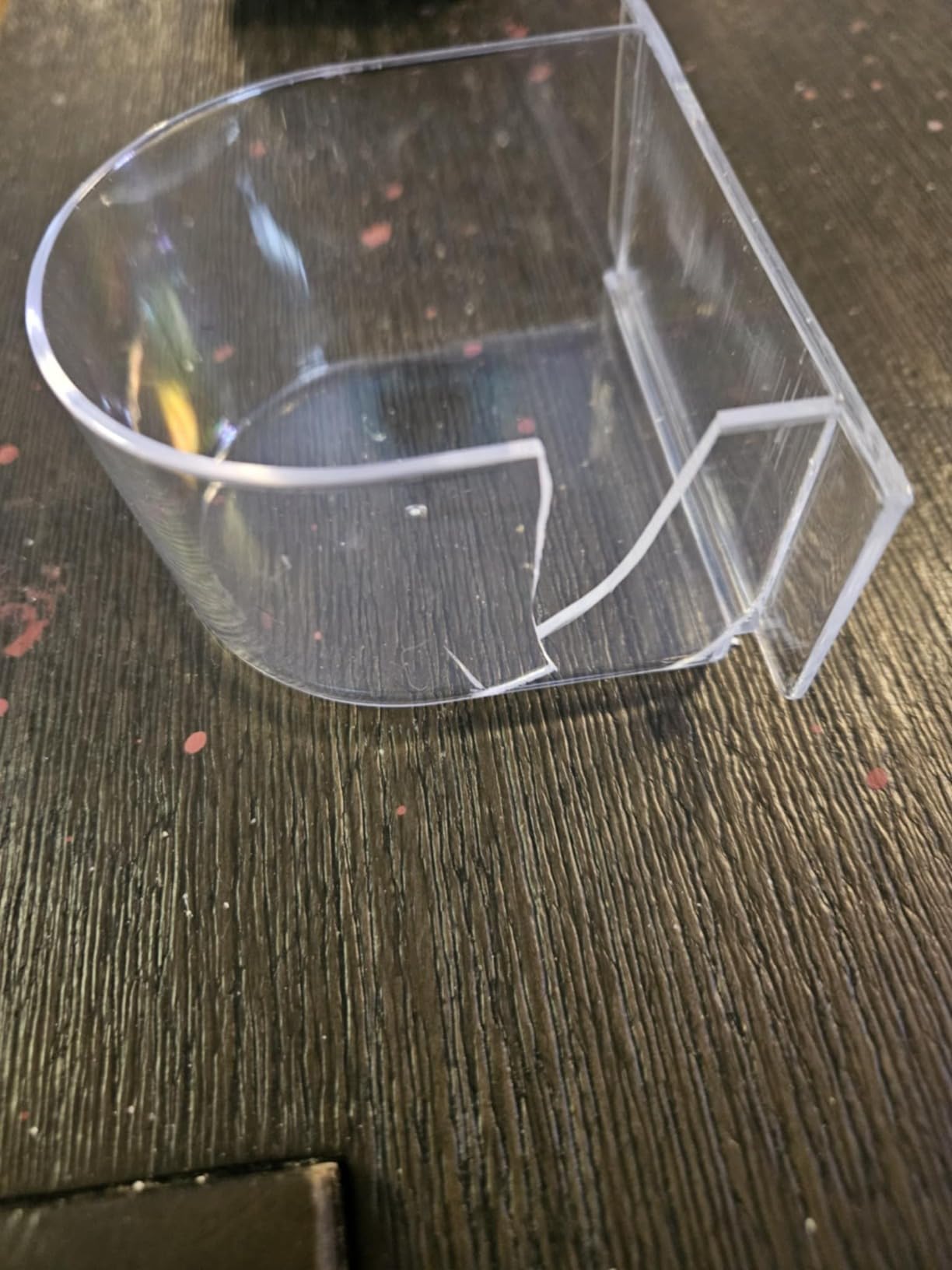
The honest weakness is access. All doors are on the front, with nothing on the sides or the rear, so catching a bird that has dropped to the back corner means reaching in through the front opening. Buyers also report occasional quality control problems with bent pieces, rust spots or a broken food bowl, and a few units where the sliding side panels leave gaps.
A good match for a pair, a second cage or a bedroom
Two birds in a 24-inch run is comfortable rather than generous, which is exactly right for a hospital or quarantine cage where the goal is a calm, contained bird. The narrow footprint also means you can keep this one away from a larger cage in the same room without crowding the space.
The flat top and drawer tray make daily care quick. If you are the kind of keeper who does a full clean every day, that difference compounds over a year of use.
Skip it if you need more than half an inch of reach and tight wire
Front-only access is the deal breaker for anyone with a bird that regularly sits in the back corners. Subordinate birds in a flock specifically use corners as escape routes, and a cage with no side access makes it harder to reach them when you need to.
The vertical bar layout also makes climbing harder, which matters for canaries and budgies but is not a problem for finches. If the side panels sit loosely on your unit, treat the cage as a short-term solution and check the gaps before leaving a bird in it overnight.
7. ZENY 53-Inch Wrought Iron Flight Cage: the best flight cage for secure doors and feeder placement
ZENY 53-Inch Parakeet Bird Cage, Wrought Iron Large Parrot Flight Birdcage
- Locking front door with rounded corners
- Four small feeder doors let you separate food and water positions
- Sturdy wrought iron frame that rolls easily
- Removable grill and tray for fast cleaning
- Good value against pet store cages of similar size
- Printed instructions contain errors including a wrong part count
- Wheels have no brake or lock
- Sliding feeder doors are light for a determined bird
The ZENY is 25.2 by 16.5 by 53 inches and weighs 29.2 pounds, so it has the frame mass of a heavier cage in a slightly smaller footprint. Powder-coated iron with rounded corners is a sensible safety profile for birds that spend time near the wire, and owners consistently call it good value against pet store cages of the same size.
What stands out is the door layout. One large locking front door handles the main access, and four small feeder doors let you place seed, water and a bath in separate positions along the front. We found this more useful day to day than it sounds: a water silo placed away from the seed cup stays clean for far longer, and a bath can be filled without pulling a bird off its perch.
The floor is a removable bottom grill over a removable tray, so you can switch between a raised grate and a solid foraging floor the same way you would in a larger cage. Four plastic cups and two perches are included. The frame rolls on four casters and moves easily despite its weight, which is unusual for a cage in this class.
Two cautions come up often. The printed instructions contain errors, including a wrong part count, so budget extra time and check the hardware against the diagram rather than the sheet. And the wheels have no brake or lock, which means the cage can drift across a room when birds land hard against one side. A caster with a brake is a worthwhile add-on.
A good match for a pair on a modest budget with escape-artist birds
The locking front door is the feature to buy this for. Finches that have learned to work lightweight doors will happily spend an afternoon on a spring latch, and owners who keep clever birds tend to rate this cage higher for that reason alone.
It also suits keepers who want clear separation between food, water and bath. That separation is the single biggest upgrade to daily quality of life in a finch cage, and this layout delivers it without buying a separate silo bracket or cutting your own feeder ports.
Skip it if you need brakes, long flight runs or precise assembly
Twenty-five inches is adequate for a pair and short of ideal for a flock. If you already know you will end up with more than four birds, spend the extra and buy length instead. The height here adds usable vertical space, but finches cannot climb, so it is not a substitute.
The light sliding feeder doors are the other concern. They are fine for finches, less fine for a bird that has decided a door is a puzzle. Adding a small clip or carabiner to each one takes a couple of minutes and removes the issue entirely.
8. Mcage 64-Inch Extra Large Breeding Flight Cage: the best flight cage for side nest box pairing
64″ Extra Large Wrought Iron Breeding Flight Canary Parakeet Cockatiel Lovebird Finch Cage Side Nesting Doors Easy Clean Pull Out Tray with Removable Rolling Stand
- Cage body alone is 30 inches long and 19 inches wide
- Large front door with a metal safety lock
- Two side breeding nest box doors
- Wrought iron frame reported to wear well over years
- Castors roll well on carpet and hard flooring
- Stand does not fully support the cage so it can shift
- Grate leaves a gap small birds can slip through
- Plastic tray and small dishes feel cheap
The cage body is 30 inches long by 19 inches wide by 37 inches high, and the detachable rolling stand adds 27 inches, giving 32 by 19 by 64 inches overall. Nineteen inches of depth is the best of the long cages here, and a 30-inch interior length puts a breeding pair comfortably inside the recommended minimum.
The reason to consider this model is the side access. Two side breeding nest box doors let you reach a nest or attach a box from the side rather than stretching over the top of the cage. Buyers report the wrought iron frame showing little wear after years of daily use, and the wheels roll well on both carpet and hard flooring, which is more than several competitors manage.
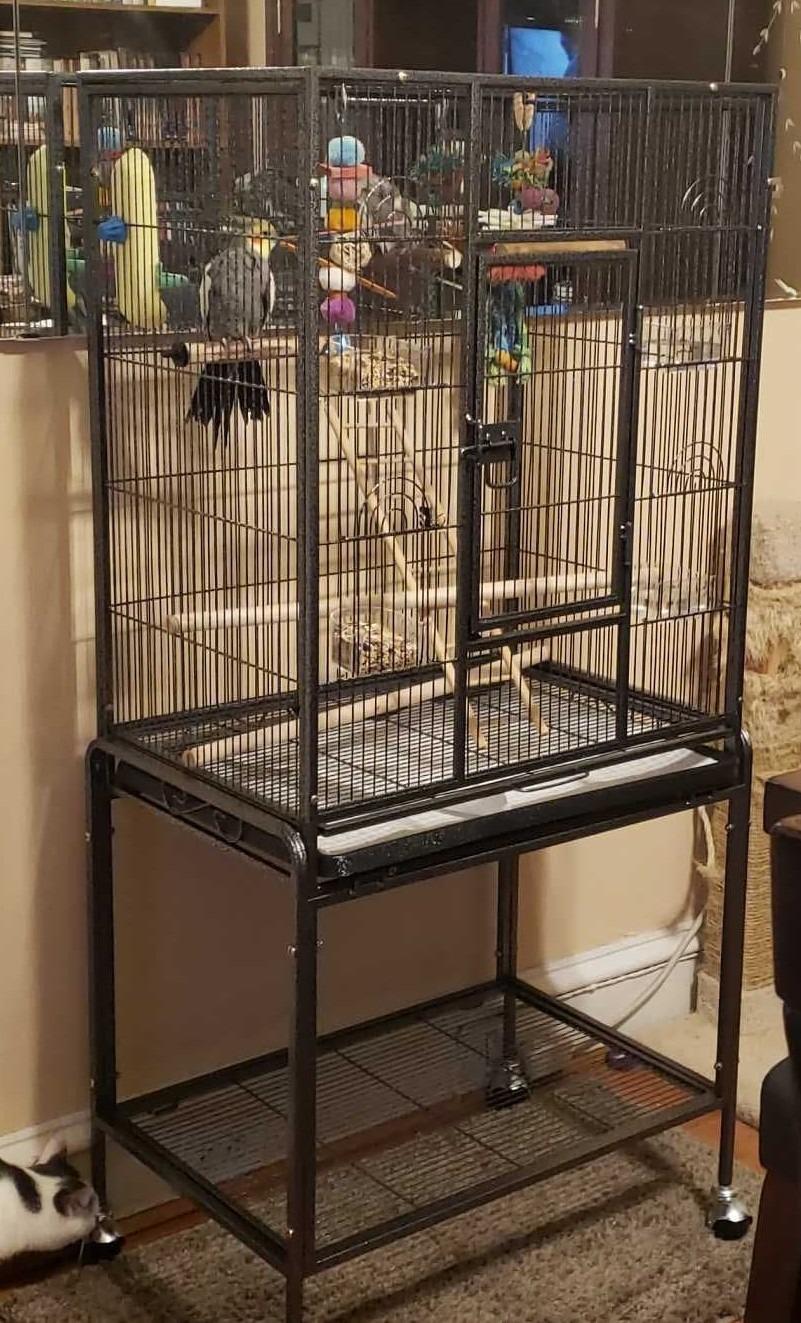
The floor is a pull-out raised metal grate over a washable heavy-duty tray. Clear plastic feeder cups and wooden stand perches are included, and the large front door has an improved metal safety lock. A lower shelf on the stand gives you somewhere to put seed and grit within reach.
Two fit-and-finish issues are worth planning around. Owners note that the stand does not fully support the cage, so it can shift or be nudged off, and the pull-out grate leaves a gap big enough for small birds to slip through. If you keep double-barred finches or very small species, seal or block that gap before use, and secure the cage to the stand.
A good match for one breeding pair that needs depth
Nineteen inches of depth is the number that sells this cage. Zebra finches build low and spend a lot of time near the floor, and they turn more freely in a cage with depth than in one that is long and narrow. If you are pairing this season, the extra inch or two of width is worth more than another ten inches of length.
The metal safety lock on the front door and the side nest box doors also suit a breeder who needs frequent access without disturbing the pair. Buyers call it one of the best sized cages available for the money.
Skip it if tiny birds live in it or you need a rock-solid stand
The grate gap is a real safety concern for small species, and the loosely fitting stand can shift when birds land hard on one side. Neither is fatal, but both demand attention from a careful keeper rather than being set-and-forget.
The plastic tray and small clear dishes feel cheap next to the wrought iron frame. You will likely replace the cups within a year, and a finch that works a thin plastic dish with its beak wears through it faster than a ceramic cup. Budget for replacements if you take this cage.
9. SUPER DEAL 53-Inch Rolling Wrought Iron Cage: the best budget flight cage for finches
- Lowest cost route into a large rolling flight cage
- Sturdy wrought iron frame with non-toxic lead-free coating
- Four feeder doors have locks
- Removable pull-out tray simplifies cleaning
- Rolling stand includes a storage shelf
- Only two perches are included
- Listed dimensions do not match the model description
- Plastic cups and trays feel basic next to the frame
This is the cheapest way into a genuinely large rolling flight cage, and the frame is better than the price suggests. Powder-coated wrought iron with a non-toxic lead-free finish is the right material choice for birds that chew on their cage, and the rolling stand with four wheels and a storage shelf is included rather than sold separately.
The 53-inch model measures 25.2 by 16.5 by 53 inches. One thing to sort out before you buy: the published dimensions on this listing are inconsistent with the model description, and several sizes are offered. Confirm which variant you are actually buying, because the listing shows a set of different lengths and heights and they are not interchangeable.
Door security is above average for the price. All four feeder doors have locks, which is uncommon in cages at this level and matters more than it sounds once a finch discovers it can push a door open. The flat top with grills all around is a sensible choice over a domed playtop because it gives you somewhere to hang foraging toys without losing interior height.
The removable pull-out waste tray makes cleaning straightforward, which owners mention often. What is minimal is the furniture: two perches and four food cups, and the plastic cups and trays are basic next to the quality of the frame. Plan to buy natural branches and better cups within the first month.
A good match for a first flight cage or a second cage on a budget
If you are moving up from a small decorative dome and you want a real rectangular flight space without spending heavily, this is the sensible entry point. The wrought iron frame and the locking feeder doors address the two things that go wrong in cheap cages, which is most of the reason to pick it.
The storage shelf means seed, grit and a spare cage cover live under the cage instead of on the floor beside it. For a first cage that is a tidy setup with no extra furniture.
Skip it if you want a one-box purchase or confident dimensions
Two perches for four to six finches is not enough, and the included dowels are the wrong diameter for small birds anyway. Budget for natural perches before the birds arrive, not after.
The dimension confusion on the listing is the real risk. If you are measuring wall space for a first-time purchase, verify the exact interior figure for the variant you order. Buying on an assumed size is how people end up with a cage that is a foot narrower than the one they pictured.
10. Yaheetech 62.5-Inch Roof Top Flight Cage: the best flight cage for canaries and budgies kept with finches
Yaheetech 62.5-inch Roof Top Flight Bird Cage for Parakeets Cockatiels Conures Finches Lovebirds Canaries Budgies Small Parrots, Large Birdcage with Detachable Rolling Stand, White
- 0.4 inch bar spacing is safe for finches and budgies
- Four 360-degree swivel casters roll in any direction
- Detachable stand lets the cage sit on a table
- Slide-out tray and detachable mesh grate
- Includes toys
- a ladder and a swing
- Narrow 18 by 14 inch footprint limits flight width
- Stand must be detached to place the cage on a table
- Roof top height is not usable flight length
This is the tall narrow tower in the group, and we included it with a clear caveat. The cage body is 18 inches long by 14 inches wide by 39 inches high, and with the detachable rolling stand the overall height is 62.5 inches. A finch can fly the 18-inch length and hop between perches, but this is not a cage for sustained horizontal flight.
What it does well is mixed-species housing. At 0.4 inch bar spacing it suits finches, canaries, lovebirds and budgies together, and the four 360-degree swivel casters roll in any direction rather than only forward and back. The roof top adds perch height and toy space, and the package includes two toys, a ladder and a swing, which is unusually complete out of the box.
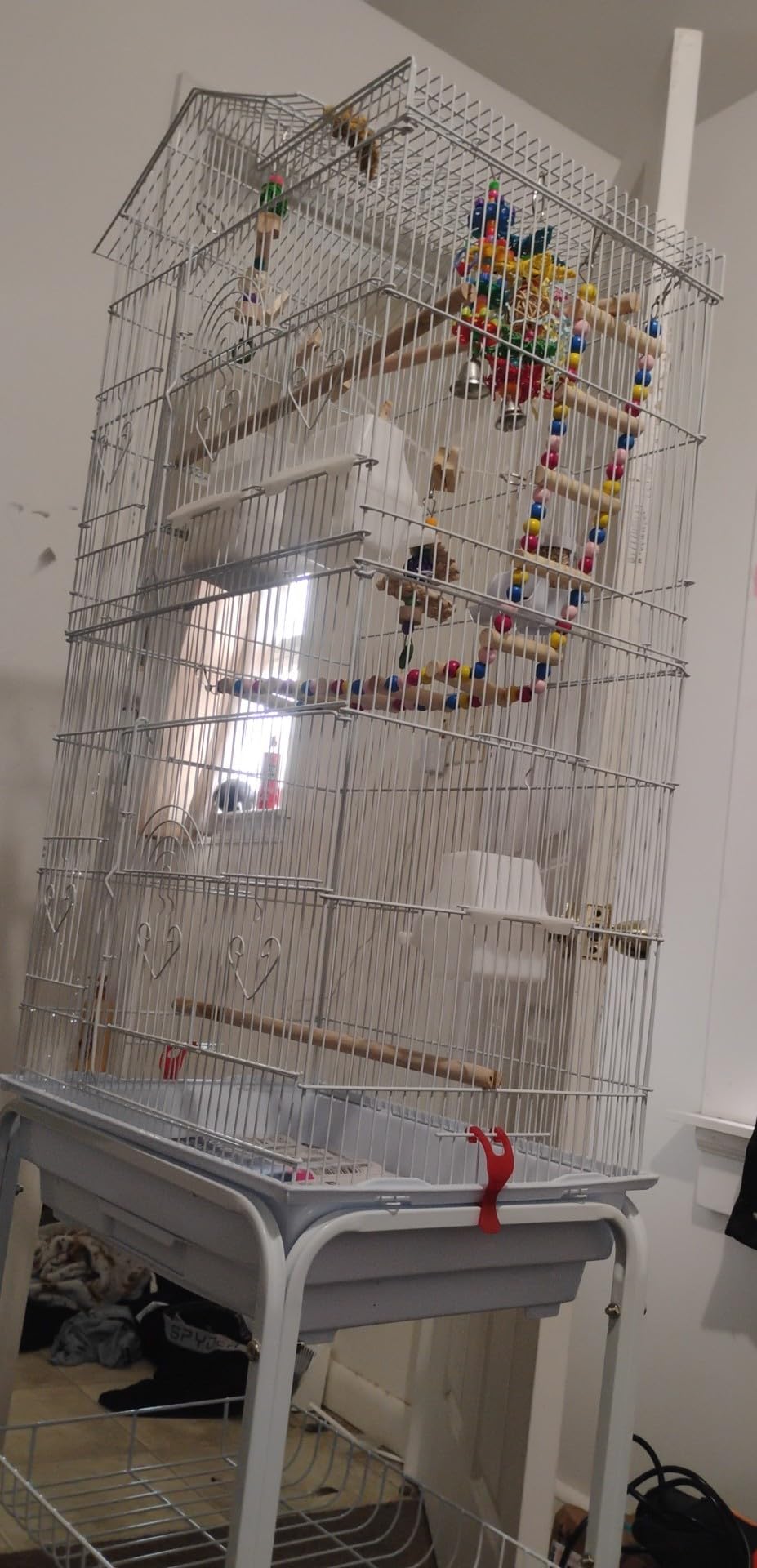
The floor is a slide-out tray with a detachable mesh grate, so you can lift the grate out to give birds a solid foraging surface or leave it in place over the seed-catching tray. Two wide-open swing doors plus a top carry handle give you real access, and the white finish is clean enough for a room where the cage is visible rather than hidden.
The honest limit is the footprint. Eighteen by fourteen inches is narrow, and reviewers specifically point to the cage width as the main drawback for strong fliers. Owners like the detachable stand because it makes the tall cage easy to reposition, but note that you must detach the stand to set the cage on a table.
A good match for a single pair or a vertical storage solution
A pair of finches or a single budgie in a cage this tall is well served. The height lets you place perches at eye level and above, and owners note that many birds prefer a cage that puts them at or above the handler’s line rather than below it.
The detachable rolling stand is genuinely useful in a small space. You can move the cage out of the way during cleaning, roll it into a better light, or set the body on a table while you photograph the birds. Few cages of this height detach that cleanly.
Skip it if flight length is what your birds need
If your birds are fliers rather than perchers, the 18-inch length is short and the 14-inch depth is very narrow. Finches kept in this cage tend to perch low and pace more, which is exactly the behaviour people report as a finch sitting on the bottom of its cage. Save this model for one or two birds and use a wide, low cage for the flock.
It is also the wrong choice if you want a walk-in aviary feel or need more than two levels of usable height per perching bird. Pick the longer horizontal body instead.
How big should a flight cage be for finches? Start at 30 inches
Give a pair of finches at least 30 inches of interior flight length and one pair per 3 to 4 square feet of floor space. For three pairs of zebra-finch-sized birds, the widely cited target is 60 by 20 by 20 inches. Measure the interior, not the outside of the frame, because published dimensions normally include the wire thickness and the corner posts.
The 30-inch figure is a floor, not a goal. Long-time finch keepers treat 30 inches as the bare minimum and 40 inches or more as the practical sweet spot for a small flock. The reason is that finches cannot grip or climb cage walls, so flying and hopping between perches are their only exercise. A cage that is too short produces pacing, foot problems and stress, all of which show up as a bird sitting on the floor.
What bar spacing do finches need? Half an inch maximum
Keep bar spacing at half an inch or tighter for zebra, society, Java, Gouldian and canary finches, and go to a quarter inch for the smallest species such as double-barred and owl finches. One widely published guide puts the ceiling slightly wider at 0.6 inch for some species, but we recommend staying at half an inch because a finch that can squeeze its head through a gap can also get a toe caught.
Two of the ten cages here sit tighter than the rest. The Prevue SPF0610 uses three-eighths inch wire, and the three Yaheetech models use 0.4 inch, which is 9.5 millimeters. Those are the safer choices if you keep small species or mix finches with budgies. Half-inch models such as the Prevue F040 and the Mcage breeding cage are fine for standard finches, provided nothing in the flock is tiny.
Why cage shape and corners matter for a finch flock
Choose a rectangular cage with corners, and skip round or domed decorative designs. Finches use corners as escape routes and as orientation points. A subordinate bird under pressure from a dominant bird needs somewhere to retreat to that is not a wide open span of wire in front of the flock, and a round cage removes that option entirely.
That is also why extra length and depth help with aggression. More space with the same number of birds means fewer encounters. If you keep males that turn territorial during the breeding drive, having enough corners and enough width reduces the chasing rather than just documenting it.
Solid tray or wire grate: which floor suits finches
Give finches a solid tray floor for part of the day and use the grate when you want them off their droppings. A solid floor lets them walk through spilled loose seed, which is natural foraging behaviour and is easier on their feet, while a removable grate keeps the cage hygienic between cleanings. The best cages here, including the Prevue F040 and SPF0610, let you swap between the two.
Skip loose substrate. Cloth fibers can be swallowed and contribute to crop impaction, and wood chips harbour mould and bacteria if they are not changed often. A slide-out plastic or metal tray with a removable grate is the simplest reliable setup, and it is also the easiest to clean daily.
Rolling stands and casters: what to check before you buy
Check whether the casters have brakes, because a finch landing hard against one side will send an unlocked cage rolling across the room. Several stands in this roundup have plain swivel wheels with no lock, and the cage body does not always sit fully supported on the stand, so it can shift or be nudged off. That matters most with large or heavy units.
Rolling is still worth it. Being able to move the cage to a better light, away from a draft, or out of the way during cleaning improves the birds’ environment more than most accessories. If your floor is carpet, test the wheels first, because narrow casters dig in rather than roll. Two cages here specifically report good carpet performance; others do not mention it. The same frame-and-wheel thinking shows up in our guide to the best power cages for home gyms, where locked casters matter just as much.
When a flight cage is still too small, move up to an aviary
Move to an indoor aviary when your flock passes roughly ten birds, when you run more than two breeding pairs, or when birds spend most of the day perched in one area instead of crossing the cage. Owners regularly buy a cage marketed as giant and still find it short for a flock, which is a sizing problem rather than a quality problem.
A useful threshold is this: if you cannot give each pair 3 to 4 square feet of floor and 30 inches of its own length, you are at the limit of what a flight cage does well. At that point a walk-in aviary, even a small indoor one, gives you vertical levels, a real floor area and the ability to add perches without shrinking flight length.
Where to put a flight cage in the home
Place the cage at or above eye level, against a wall in a corner of a room rather than in a high-traffic hallway, and away from kitchens, drafts and direct sun. Finches startle easily, and cages kept low or in the middle of a busy room produce more stress than the cage design can offset. Our notes on planning a dedicated layout are similar to how we approach the best batting cages, where floor space and clear sightlines decide the setup.
Run full-spectrum lighting on a timer so the birds get a consistent day length, and keep the room dim at night rather than covering the cage. Experts disagree on covers: some argue firmly against them because fresh air and rising with the sun matter more, while others use a dim, non-black cover in light-polluted rooms. Whichever you choose, avoid dark fabric and avoid anything a bird can chew and swallow fibres from.
Frequently Asked Questions
What size flight cage do finches need?
Give a pair at least 30 inches of interior flight length and about 3 to 4 square feet of floor space. For three pairs of zebra-finch-sized birds, the common target is 60 by 20 by 20 inches. Measure the interior of the cage rather than the outside of the frame.
What is the best cage for finches?
The best cage for finches is a wide, rectangular, low-profile flight cage with at least 30 inches of interior length, bar spacing of half an inch or tighter, and a removable slide-out tray. Our top pick is the Prevue F040 steel flight cage for most homes, with the low Prevue SPF0610 as the budget option.
Should finches be covered at night?
Experts differ. Many breeders argue against covers because fresh air matters and finches should rise with the sun, while others use a dim, non-black cover to block light pollution. If you cover, use dark but not black fabric your birds cannot chew fibres from, and keep the room otherwise quiet.
What is the recommended bar spacing for a cage for finches?
Half an inch or tighter is the recommended bar spacing for most finches. Go to a quarter inch for the smallest species such as double-barred and owl finches. Some guides allow up to 0.6 inch for larger finches, but staying at half an inch reduces the risk of toes getting caught.
How many finches can I keep in one flight cage?
Budget one pair per 3 to 4 square feet of floor space and 30 inches of flight length per pair. A single 30-inch cage comfortably houses a pair, and a 60-inch run works for four to six finches. Past roughly ten birds, or with more than two breeding pairs, an indoor aviary is a better fit.
Why is my finch sitting on the bottom of the cage?
A finch sitting on the cage floor is usually telling you the flight space is too short or too narrow, or that there is not enough depth to turn comfortably. Add longer horizontal runs, wider depth, and natural perches at several heights. Persistent floor sitting in a large cage can also point to illness, so a vet check is worth ruling out.
Final verdict: which flight cage suits your flock
The Prevue F040 steel flight cage remains our pick for the best flight cages for finches in 2026 because 31 inches of length, 20.5 inches of depth, half-inch powder-coated wire and a removable grate-and-tray system is the combination we would put in most homes. Buy the Prevue SPF0610 instead if you need the lowest cost, the tightest wire or a cage light enough to carry with one hand.
Keep the cage at 40 inches or more and want three usable levels for a flock of six to ten, choose the Yaheetech 69-inch 3-tier. Breeding a pair or quarantining a new bird, choose the Yaheetech divided breeder cage. Running eight birds or more and you have the wall space, the PawHut 65-inch double gives you the longest flight run and the ability to divide or join the space. Everything else in the roundup fills a narrower niche, from the compact VIVOHOME to the budget SUPER DEAL frame.
Whichever you pick, add natural perches in the first week, secure every door and feeder port, and give the birds a solid foraging floor for part of each day. If your plan is more than ten birds or several breeding pairs, start looking at an indoor aviary instead of a bigger cage.