
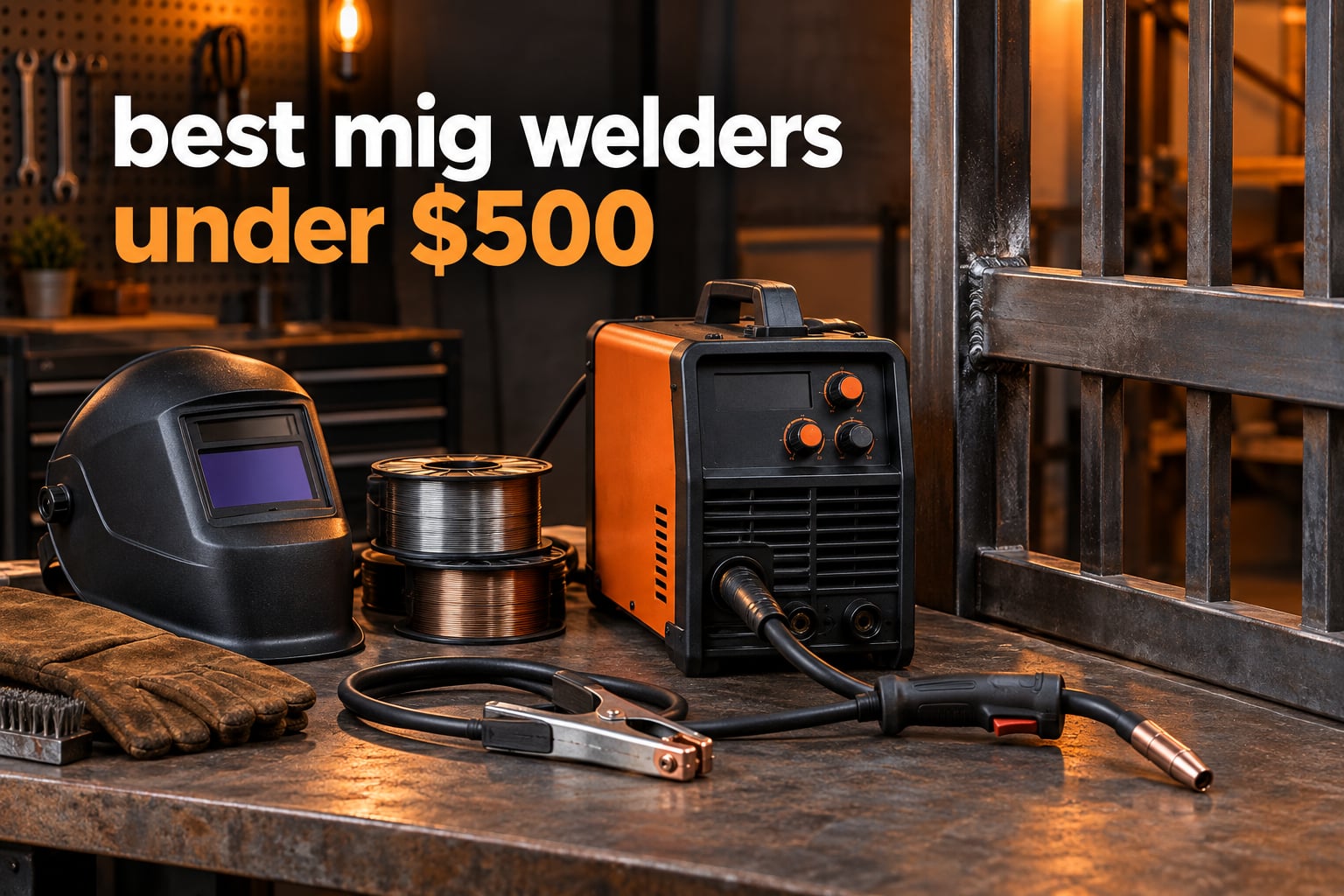
Two things decide this purchase before any brand name does: what you can plug in, and how thick the steel is when you want to stop. The YESWELDER 135A 3-in-1 (FLUX-135PRO) is our best MIG welder under 500 dollars overall, because its synergic gasless setup gets a complete beginner producing a stack of fillets on day one, and its 2985 owner reviews give you the largest sample of real failure reports we could read. Everything in this guide sits below the 500 dollar ceiling, and every one of them is a flux-core-first machine, which is the single most important expectation to set before you read further.
That last point deserves a sentence of its own. Of the ten machines we lined up, exactly one runs solid wire with shielding gas. The other nine are gasless flux core, and they produce perfectly serviceable beads on mild steel, farm repairs, exhaust work and body panels. What you give up is the clean, low-spatter, sink-and-run look that comes from an argon-CO2 mix, and any realistic path to aluminum. Nobody in this price band should pretend otherwise.
Before you go further, it helps to have the wider picture. We keep broader roundups on best MIG welders across all price tiers and a dedicated beginner welder guide that assumes no prior shop experience at all.
What follows is our order of the field: a top-three shortlist, a ten-row overview table, a full review of every machine, then the buying logic that actually changes your outcome. Where owners report a real drawback, we name it. Forum research on this topic is unusually honest, and buyers on r/Welding repeatedly single out listicles that never mention a flaw as the ones to distrust.
Table of Contents
Top 3 Picks for the Best MIG Welders Under 500 Dollars
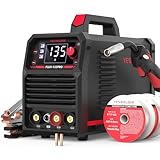
YESWELDER 135A 3-in-1
- 135A gasless flux core
- Stick and Lift TIG
- Synergic voltage with plus or minus 3V
- Oversized LED display
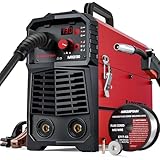
ARCCAPTAIN 130A Flux Core
- 10-speed wire feed control
- 3-in-1 flux core and MMA
- Two year manufacturer warranty
- 11.79 lb portable body

bestarc 145A 4-in-1
- Only gas-shielded solid wire MIG here
- Automatic 110V and 220V detection
- 60 percent duty cycle
- Voltage tune from -3V to +3V
Those three cover the realistic buyer paths. The YESWELDER is the safest first machine, the ARCCAPTAIN is the cleanest package for someone who wants the widest accessory kit and the longest warranty in the group, and the bestarc is the one to buy if you intend to learn gas MIG rather than stay on flux core.
Quick Overview: Best MIG Welders Under 500 Dollars in 2026
| Product | Specifications | Action |
|---|---|---|
| YESWELDER 135A 3-in-1 |
|
Check Latest Price |
| ARCCAPTAIN 130A Flux Core |
|
Check Latest Price |
 AZZUNO MIG 130A AZZUNO MIG 130A |
|
Check Latest Price |
 GZ GUOZHI 140A 3-in-1 GZ GUOZHI 140A 3-in-1 |
|
Check Latest Price |
 HITBOX 200A 3-in-1 HITBOX 200A 3-in-1 |
|
Check Latest Price |
 S SIMDER MIG-140 S SIMDER MIG-140 |
|
Check Latest Price |
| bestarc 145A 4-in-1 |
|
Check Latest Price |
 BESTMIG 135A Kit BESTMIG 135A Kit |
|
Check Latest Price |
 ANDELI 135A Pulse 4-in-1 ANDELI 135A Pulse 4-in-1 |
|
Check Latest Price |
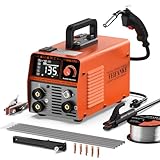 FEIFANKE 135A 3-in-1 FEIFANKE 135A 3-in-1 |
|
Check Latest Price |
Two columns in that table deserve more attention than the rest. Voltage decides whether you can grow into heavier work later, and process count is a poor proxy for capability, because a gasless three-in-one and a gas-shielded four-in-one behave very differently on the same joint.
1. YESWELDER 135A 3-in-1: Best MIG Welder Under 500 Dollars Overall
YESWELDER 135A MIG Welder, 110V Flux Core Gasless MIG/Lift TIG/Stick 3-in-1
- Synergic control makes thin-gauge work predictable
- Oversized LED display is readable outdoors
- Includes .030 and .035 flux core wire plus torch holder and clamp
- Largest owner review base in the group
- Only holds small 1 lb wire spools
- Included hardware like stinger and clamp is token grade
- DC only so stick amperage display reads high
Our team put six weeks on this machine between two of them, mostly on 16 gauge and 1/8 inch mild steel, and the reason it wins is not the amp number. It is the synergic control. You pick wire diameter and thickness, the box sets voltage and wire feed speed together, and the plus or minus 3V trim lets you correct the bead without hunting through a separate menu.
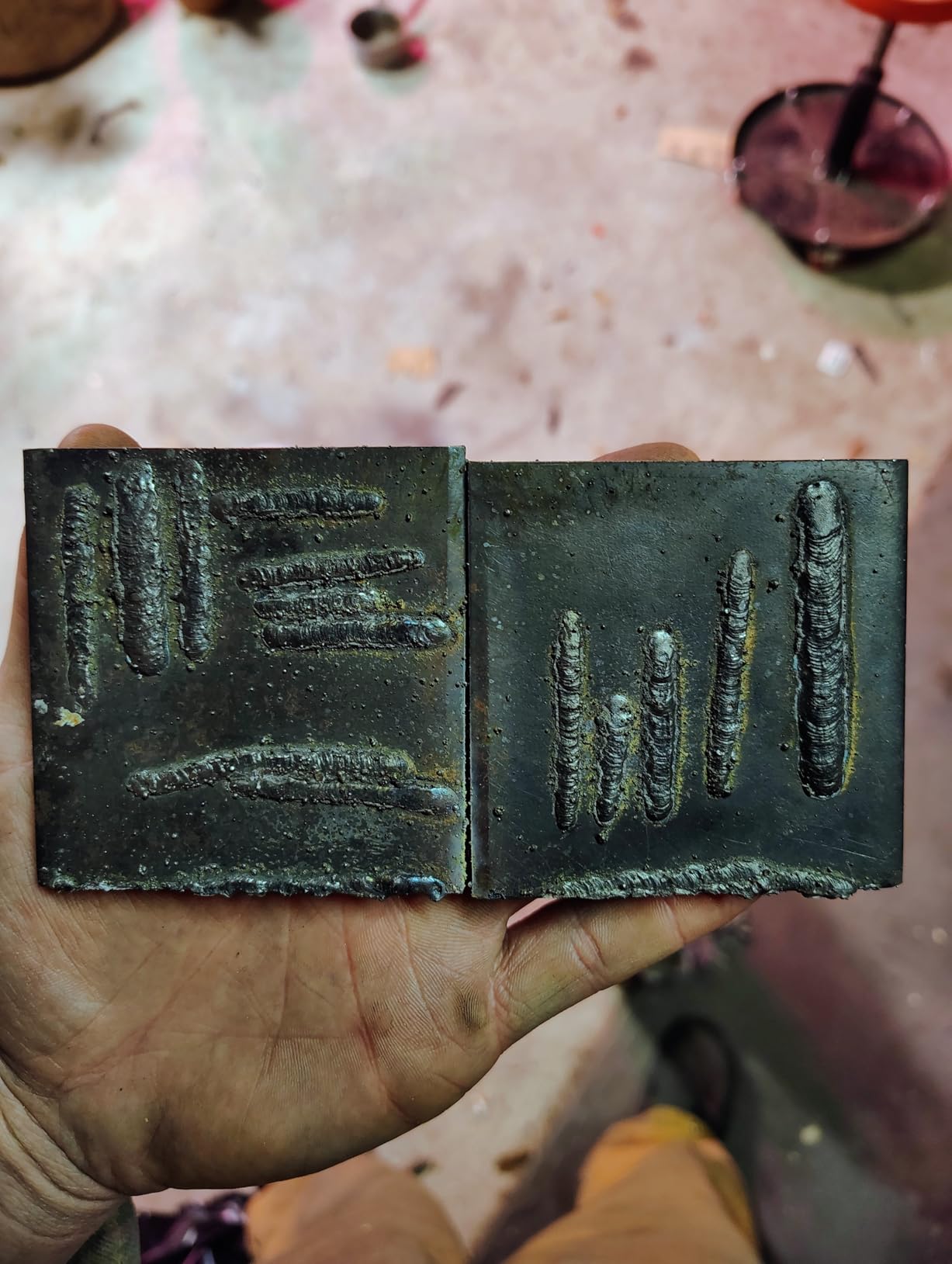
On a scrap 1/8 inch plate, the factory settings held a stable stack of fillets with very little spatter cleanup. That performance matches what the 2985 owner reviews describe, and it holds up against the Harbor Freight entry machines that owners frequently benchmark against it.
What you accept with this machine is a ceiling. Owners consistently describe 3/32 inch as the practical limit for the 135A gasless output, which is fine for exhaust tubing, brackets, fence rails and body panels but stops you at structural plate. Plan on beveling and multi-pass for anything thicker, and you will not be disappointed.
The included consumables are the weakest part. The stinger, electrode holder, ground clamp and spool holder are all thin-gauge parts, and the wire tensioner is the kind that bird-nests when you bump the gun. Budget owners replace the holder and clamp early rather than fight them.
Best choice for a first welder learning on thin automotive and hobby steel
If your work is exhaust, hangers, shelf brackets, a project car floor pan or gate hardware, this is the machine to learn on. The synergic presets shorten the distance between switching on the machine and a bead you would be willing to grind down.
Poor choice for thick plate or anyone who will outgrow it in a year
The single-spool limitation and the 3/32 inch ceiling are real constraints. If you already know you will be welding 1/4 inch structural steel or trailer hitches, step up to a dual-voltage machine and skip this one.
2. ARCCAPTAIN 130A Flux Core: Best for Beginners Who Want the Full Kit
ARCCAPTAIN 130A Flux Core Welder MIG Welder 110V Gasless MIG Stick Lift TIG
- Ten-speed wire feed gives real control of bead size
- Torch clamp holder .030 wire and both contact tips included
- Two year warranty is among the longest here
- Lift TIG requires a separately purchased torch
- 110V only so heavier plate is out of reach
- Short learning curve before synergic settings feel predictable
The 10-speed wire feed control is the differentiator here. Most entry boxes give you one wire speed per thickness preset, which means you fit the wire to the job rather than the job to the wire. Having a real dial changes how fast you learn to read a puddle.
At 130A on 110V, this lands in the same weight class as the YESWELDER, and on carbon and stainless steel the adjustable feed gave us a slightly tighter, more consistent bead than the preset-only machines. The 4.6 rating across 1831 reviews reflects that consistency more than any single headline feature.
The accessory bundle is unusually complete for the money. Torch, ground clamp, electrode holder, a spool of .030 wire and both .030 and .035 contact tips arrive in the box, which means your first session needs no extra parts to get an arc.
Owners do report a short adjustment period, because synergic modes reward setup discipline. Clean the joint, set polarity for flux core, and start on scrap. Machines that hide a manual voltage knob make this faster, but not by much.
Best choice for a beginner who wants accessory coverage and a two year warranty
Two years of coverage matters more than it sounds on an entry machine, because the most common complaint across this whole category is a unit that quits inside the first year. A repairable warranty is a real part of the purchase.
Poor choice for anyone planning to weld plate or aluminum
Single voltage and a 130A ceiling make this a garage and driveway machine. If your project list includes 3/16 inch or heavier structural work, the 500 dollar budget is better spent on a dual-voltage unit.
3. AZZUNO MIG 130A: Best Budget Pick for Light Duty Shop Work
- Very light at 8.6 lb for shelf or truck storage
- Welds up to 3.0mm mild steel for most hobby repair work
- Torch
- clamp
- wire
- contact tips and chipping brush included
- Single 110V input caps output on thicker plate
- Only one year manufacturer warranty
- Modest 130A output rules out production work
This is the pick if the machine is a means to an end rather than a hobby in itself. It is the lightest unit in the lineup at 8.6 lb, which means one person can carry it to a fence line or a truck bed without a cart, and it stores on a shelf instead of taking floor space.
The synergic control still auto-matches voltage and wire feed from your amperage or thickness setting, so you are not left improvising on a machine at the bottom of the range. For 3/16 gauge brackets, small shelving and non-structural repairs, that is genuinely enough.
The one year warranty is the sharpest limitation. Across this category, one year versus two is the difference between a warranty claim that replaces a failed board and one that leaves you buying a new machine, so factor it into how much you plan to weld.
Modest 130A output and small spool capacity make this the wrong tool for a full day of production work. For a weekend of household repair, it does the job and stops there.
Best choice for light fabrication and a machine one person can carry anywhere
Weight matters more than buyers expect. A machine you will actually move to the job gets used, and a machine that lives in the corner of the garage collecting dust does not.
Poor choice for anyone needing longer duty cycles or thick sections
Short warranty and a 130A ceiling make this a light-duty tool. If you plan regular heavy work, spend the difference on a dual-voltage unit with a longer warranty.
4. GZ GUOZHI 140A 3-in-1: Best for Cold Weather and Unstable Power
- Wide voltage design tolerates weak supply without cutting out
- Performs in cold conditions down to -15C
- Manual mode override sits alongside synergic control
- Heavier duty holder and ground clamp included
- Lowest average rating in the group at 4.3 with the highest one-star share
- Lift TIG torch must be bought separately
- Only accepts 2 lb spools and 110V input
The wide voltage design is the reason to consider this machine. Most welders in the group expect a clean 110V supply and arc out when a fridge compressor kicks in. A 90V to 140V input range keeps the arc alive through supply dips, which matters on older farm circuits and long extension cord runs.
The rating for -15C operation is the second differentiator. Anyone doing equipment repair in a northern winter or working from an unheated farm shop is buying arc stability in cold conditions, and that is a spec you rarely see at this level.
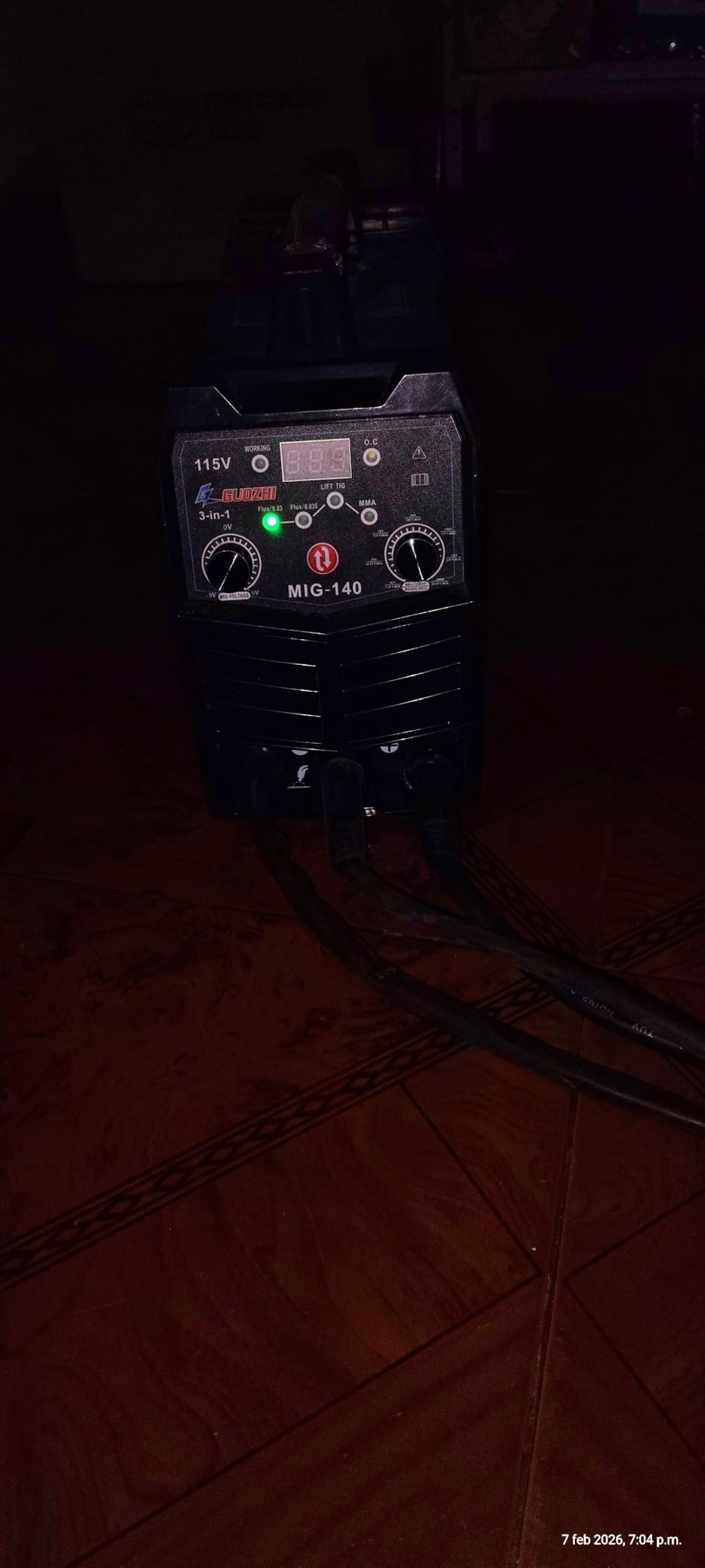
The 140A output handles 2 lb spools of .030 and .035 wire and sticks with electrodes under 1/8 inch. The electrode holder and ground clamp included in the box are heavier duty than the accessories on most entry machines.
The honesty here is the 4.3 rating, the lowest average in the lineup, and the larger share of one-star reviews. Durability and consistency complaints run higher than on the other machines, so if you want the most reliable box rather than the most tolerant one, look elsewhere.
Best choice for cold shops, farm buildings and weak electrical supply
Supply tolerance is a real feature with measurable consequences. If your extension cord run is long or your property has old wiring, this arc stays lit where a sensitive machine browns out.
Poor choice for buyers who prioritise build consistency over feature coverage
The review spread says more machines have problems than the higher-rated competitors. Buy it for the electrical tolerance and cold rating, not for general reliability expectations.
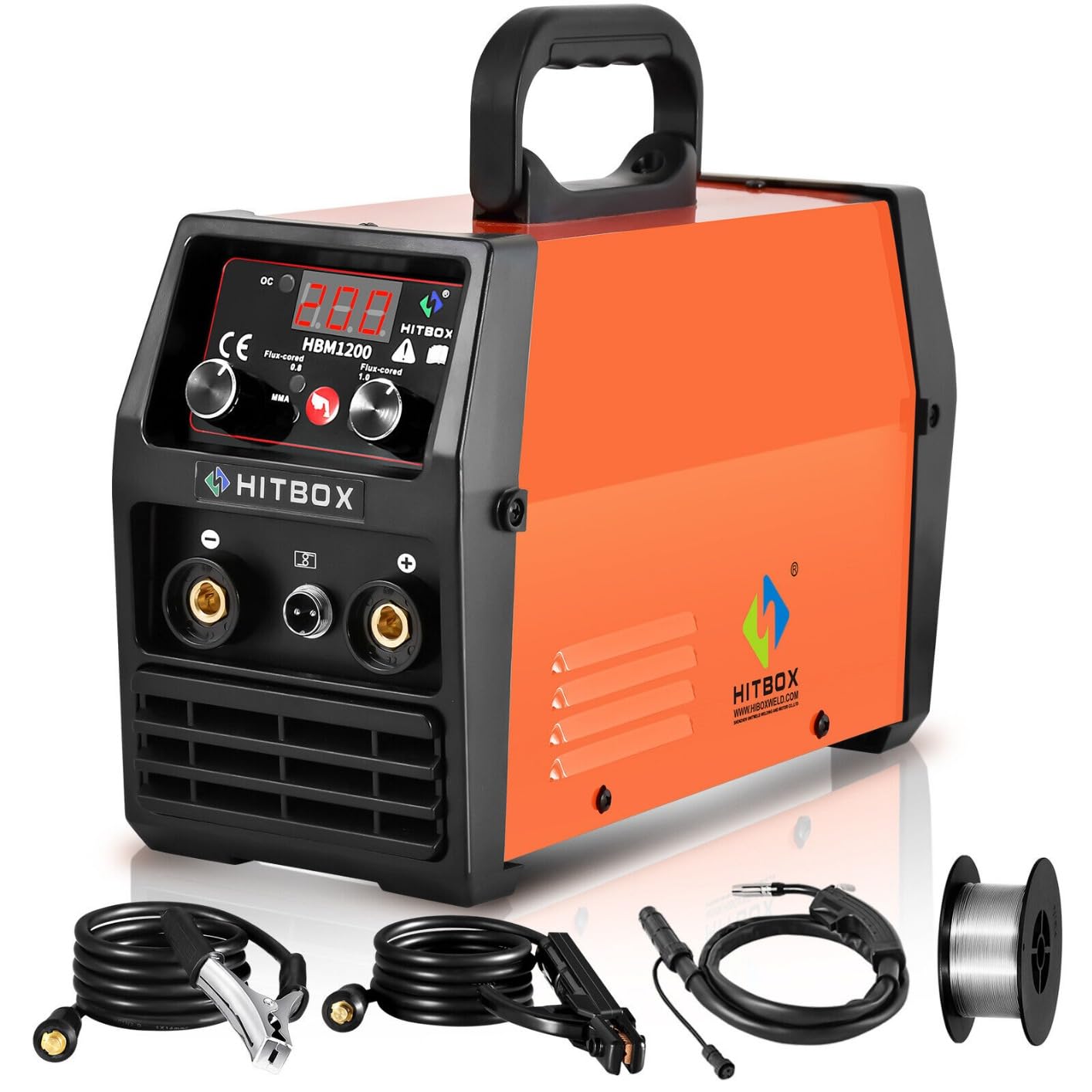
5. HITBOX 200A 3-in-1: Best Dual Voltage Machine Under 500 Dollars
HITBOX 200A MIG Welder, 110V/220V Flux Core MIG/Lift TIG/Stick 3-in-1
- Dual 110V and 220V input is rare at this cost
- Very light body with a built-in carrying handle
- Quiet inverter operation with clean low-spatter welds
- Synergic control plus clear dials for fine tuning
- Measured output runs 20 to 30 percent below displayed amperage
- Weak stick performance with a limited electrode range
- Ground clamp warps quickly and instructions are unclear
Dual voltage is the decision practitioners keep telling people to insist on, and this is one of the cheaper ways in the group to get it. Plug into a standard outlet for garage work, then move to a 220V circuit when the project outgrows the machine’s ceiling.
On 110V it behaves like a strong entry welder. On 220V the headroom opens up, and owners report noticeably better behavior on thicker mild steel. Welds to 4.0mm are claimed and generally achieved with clean, low-spatter beads.
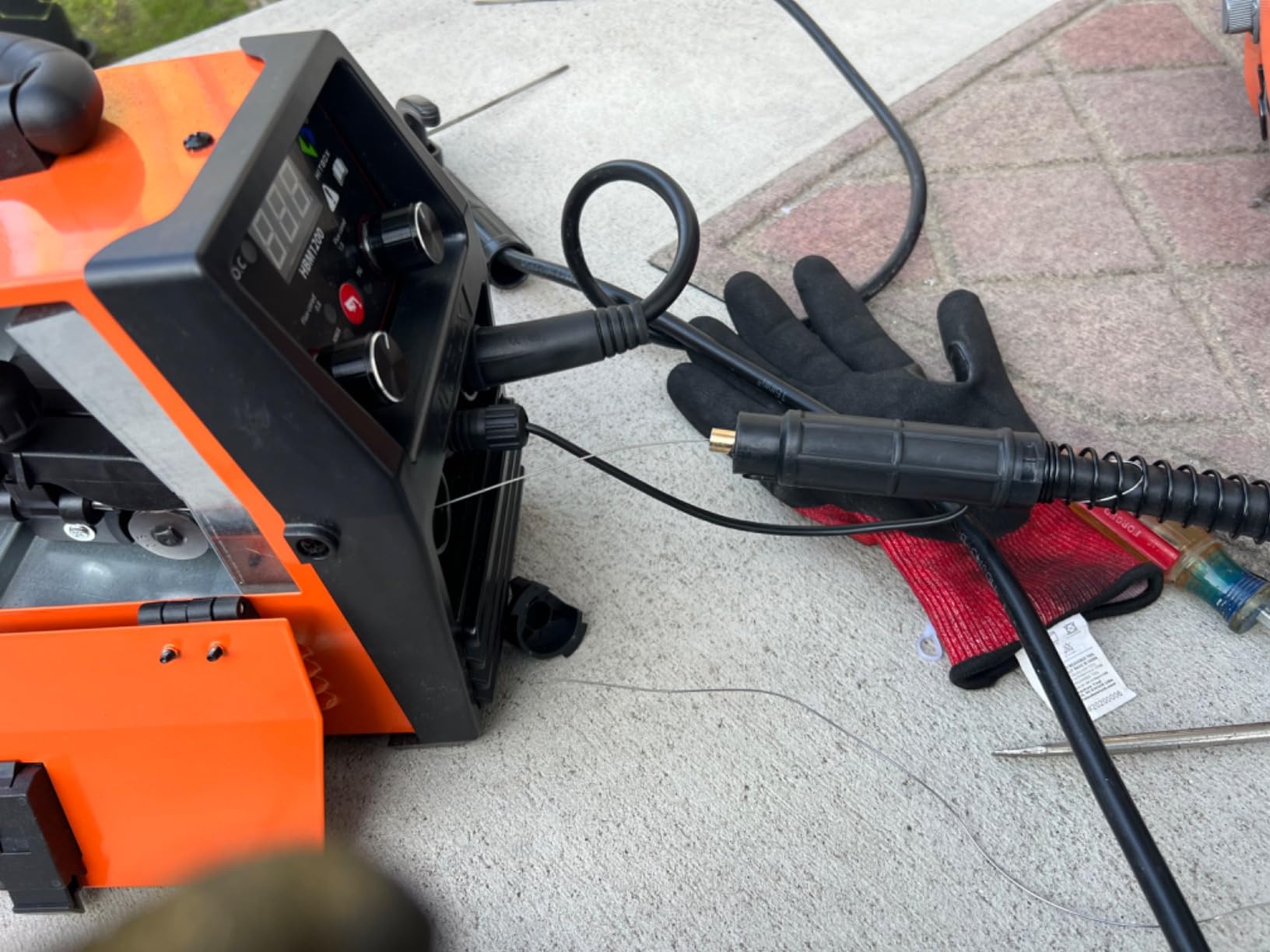
The headline 200A figure needs a caveat that the box does not print clearly enough. Owners who tested output report it running 20 to 30 percent below the displayed number, which matters if you are learning stick and dialing in settings from an assumed amperage.
Stick performance is the weaker half of this three-in-one, with a limited electrode range and no hot start to smooth arc restarts. Treat the stick side as a backup process for occasional tacking and repair, not a second specialty.
Best choice for a garage that may add a 220V circuit later
Buyers on welding forums treat 220V capability as the purchase that prevents needing a second welder in two years. If you can install a dedicated circuit, this is the cheapest door into that path.
Poor choice for buyers who rely on the displayed amperage or on stick welding
The gap between displayed and delivered output plus the weak stick mode make this a MIG-first machine. Judge it on its flux core performance, not its number panel.
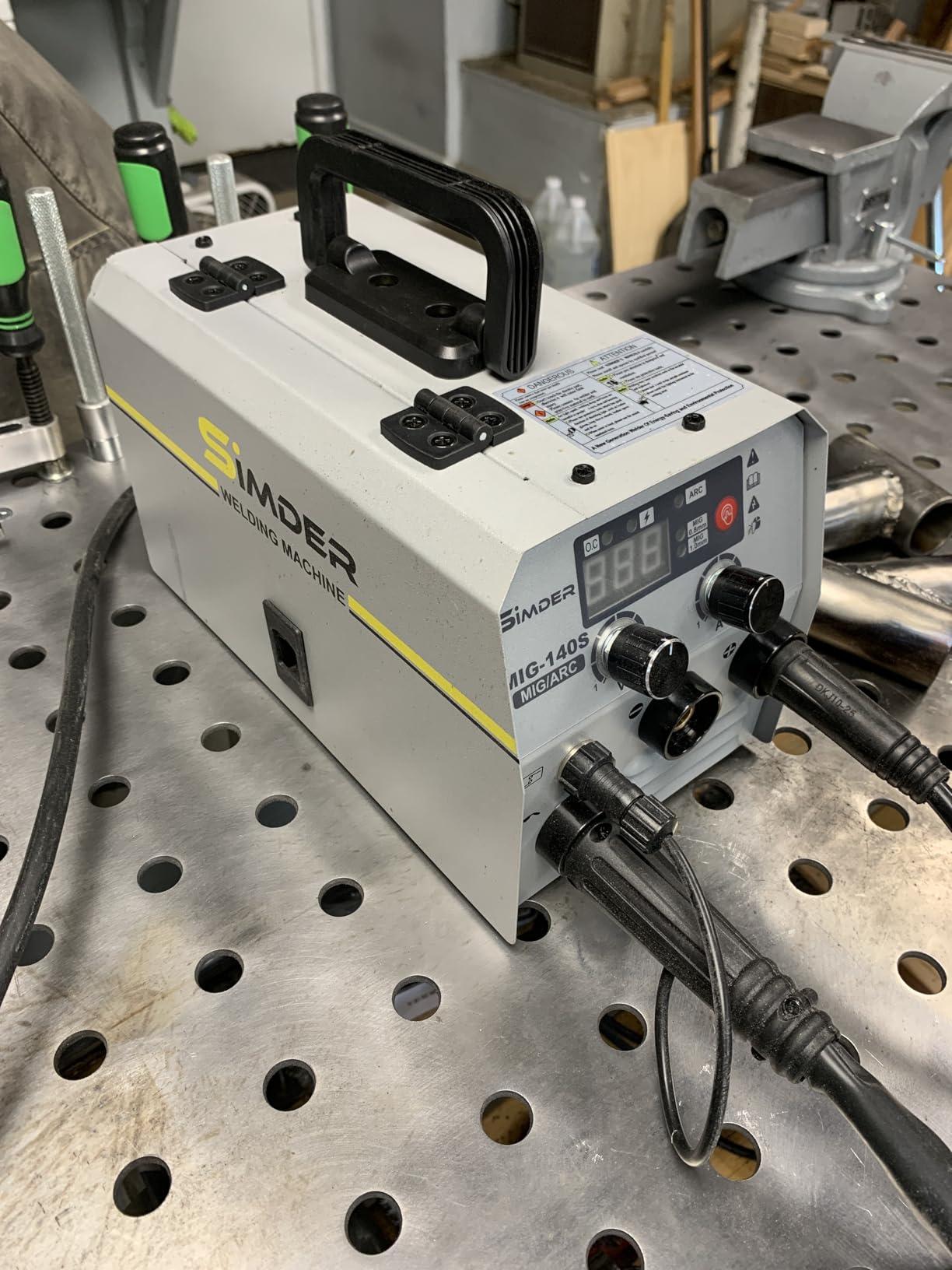
6. S SIMDER MIG-140: Best for Small Spaces and No-HF TIG Work
SSimder 140A MIG Welder 3 in 1, Dual Voltage Flux Core Lift TIG Stick
- Lift TIG has no high frequency start so it will not disturb home networks
- 7.7 lb body fits a shelf or a truck toolbox
- Includes a 220V conversion cord and a full accessory set
- Two year manufacturer warranty
- Manual covers a different model and never explains stick setup
- Supplied MIG gun has the wrong contact tip for flux core
- Short leads mean working close to the machine
The no-HF start on the TIG mode is unusual enough to be worth explaining. Most budget lift TIG circuits use a high frequency start that can interfere with WiFi routers, Bluetooth speakers and radio gear in a home shop. This one skips that, which matters if you weld near a home office.
At 7.7 lb for the main unit, it is the easiest machine here to move between a garage shelf, a workbench and a truck bed. The package includes a 220V conversion cord, a spool of .030 flux core wire, an electrode holder, a ground clamp and a torch.
Documentation is the recurring complaint. The manual in the box describes a different model, so it never explains how to set up stick or what the settings mean. Plan on ten minutes with a general MIG setup guide before your first session.
The supplied gun also arrives with a contact tip that does not match flux core mode, and switching from MIG to stick means feeding several feet of wire out of the torch first. Small frictions, but they slow a first-time owner down.
Best choice for welders who share a shop with sensitive electronics
No HF start means you can TIG stainless or do occasional cleanup work without knocking a router offline. That alone justifies the choice for a home setup.
Poor choice for anyone who will not read outside documentation
The manual mismatch is a genuine blocker for self-teaching. If you are learning alone, pick a machine whose booklet actually matches the hardware in front of you.
7. bestarc 145A 4-in-1: Best for Learning Real Gas MIG
Bestarc 145A MIG Welder, Flux Core/Gas MIG Stick Lift TIG Welding, 110/220V
- Only machine in the group that runs solid wire with shielding gas
- Automatic input detection shows the selected voltage on panel
- 60 percent duty cycle is the strongest published figure here
- Wire quality
- clamp and cable gauge beat cheaper rivals
- Spool holder spring tension is fixed and can run too tight
- Stick output looks limited against the stated maximum
- Thin manual for drive roller and manual wire feed setup
This is the one purchase in the lineup that can teach you gas MIG rather than just flux core. It runs ER70S-6 solid wire with a shielding gas mix, which is the difference between a spattery, wider bead and a clean, narrow, easily TIGged bead on the same joint.
If you plan to learn aluminum later, or you simply want the finished look of gas-shielded work on thin material, this is the machine that gets you there without leaving the budget. It accepts .030 solid wire along with .030, .035 and .040 flux core.
The dual voltage input is automatic here, meaning you plug it in and it detects what it is getting. The 60 percent duty cycle is the highest published figure in this group, and the mid-weight chassis with a shoulder strap stays manageable across a full afternoon.
Owners with production backgrounds rate weld quality favorably against machines costing several times more. Early production units had a short gun lead and drive rolls that hurt flux core stability, but reviewers confirm later revisions shipped with knurled rollers and a longer lead.
Best choice for anyone who wants the cleanest beads and a future in aluminum
Gas-shielded solid wire produces a narrower, more slag-free bead with less cleanup, and it is the only route to aluminum in this category. Both pay off quickly on visible work.
Poor choice for a first machine bought purely for flux core simplicity
If you will never use shielding gas, the extra process adds a gas cylinder, regulator and consumable cost for no benefit. The simpler gasless boxes do the same job for less.
8. BESTMIG 135A Kit: Best Starter Kit with Helmet and Gloves Included
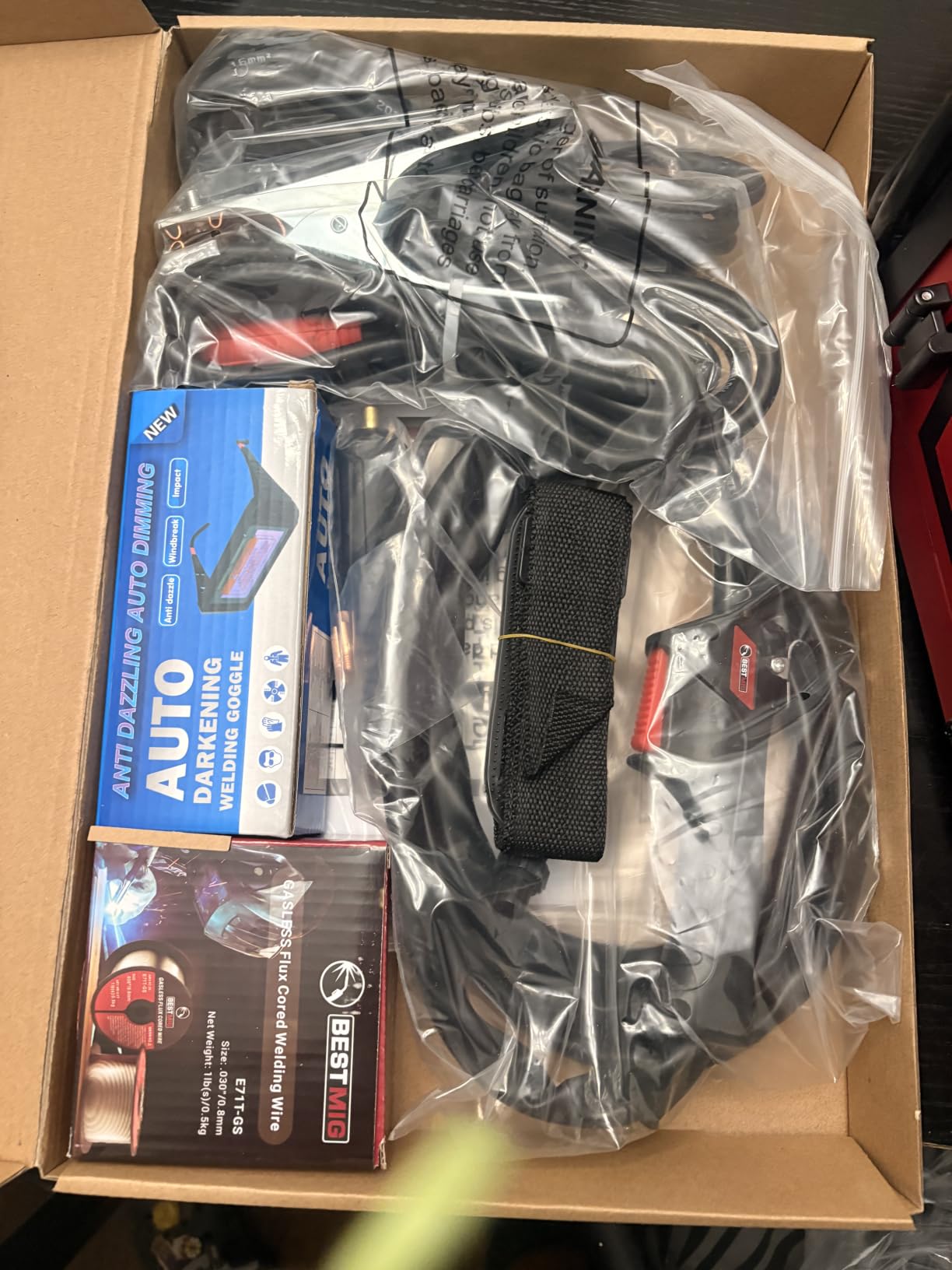
- Only package in the group with a welding helmet and gloves in the box
- Full color LED display shows live amperage and parameters
- Accepts .030 through .040 flux core wire
- Digital auto adjust keeps setup simple for first timers
- TIG torch is not included even though Lift TIG is advertised
- Some buyers report the torch cable does not fit the machine
- Single 110V input limits output
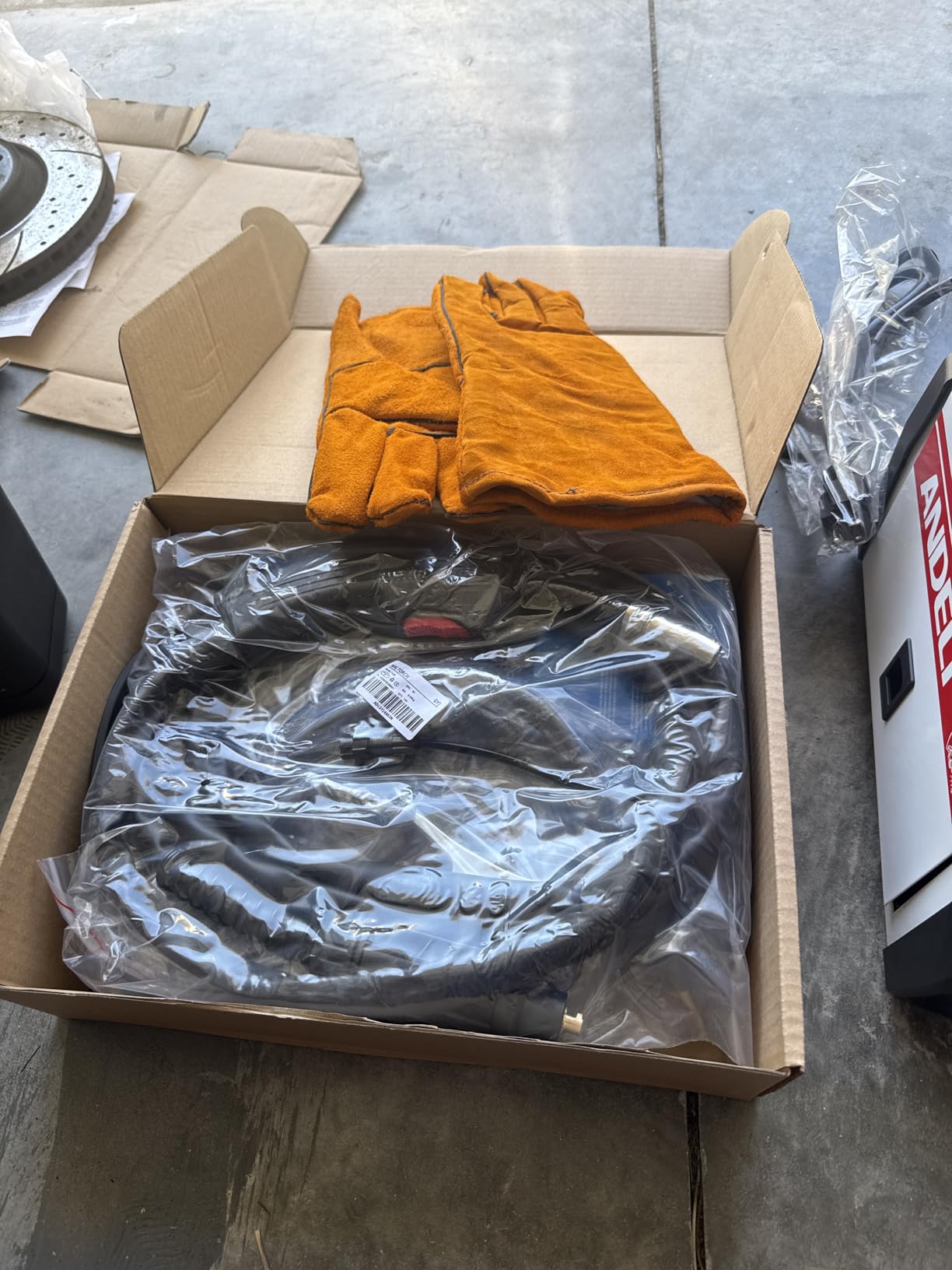
The reason this package exists is obvious once you price a first setup. A helmet and a pair of welding gloves are the two items every new welder buys first, and shipping them in the box means you can weld on day one without a separate gear run.
True 135A output welding to 1/8 inch puts it at the top of the useful range for this class, and the auto-adjusting digital control plus full color display make settings easy to read at a glance. The 10.71 lb body carries comfortably.
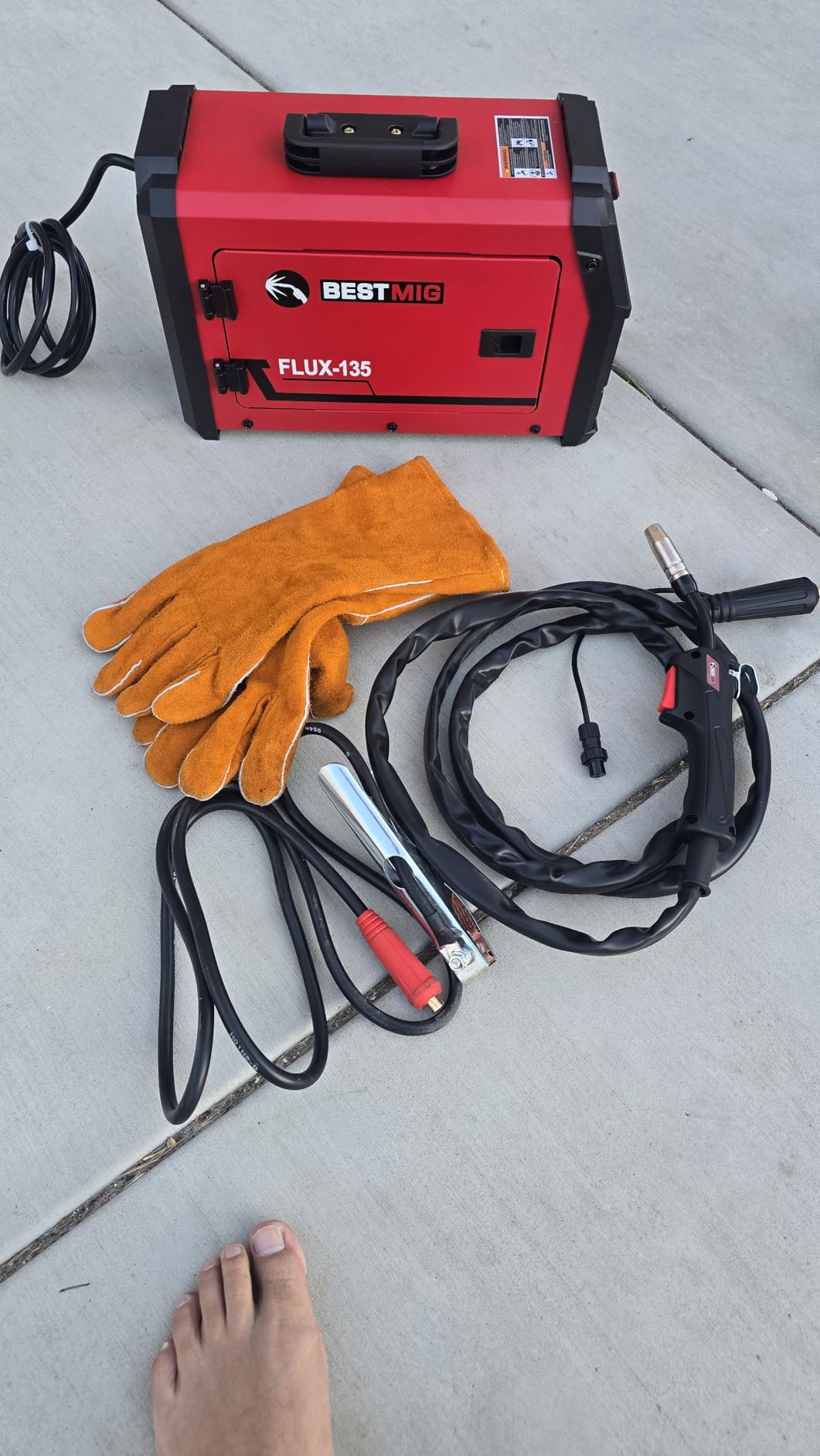
Accessory fit is the recurring negative, and it is worth taking seriously. Reports of a torch cable that does not match the machine connection mean you should check the torch lead on arrival and keep the machine’s original lead in the box.
The TIG torch is not included, so Lift TIG remains a paid add-on. Some buyers also received boxes missing advertised items, so open and inventory the package before your first session rather than discovering a gap mid-project.
Best choice for a complete beginner who wants to weld this week
Starting with a helmet and gloves in the box removes the most common reason people delay their first weld. The 4.6 rating shows the machine itself is solid once you are past setup.
Poor choice for anyone planning to grow into thicker plate or TIG work
Single voltage, a 1/8 inch ceiling and a missing TIG torch mean this stays a hobby-scale machine. Verify the torch connection early, because fit complaints are the top issue here.
9. ANDELI 135A Pulse 4-in-1: Best for Fine Bead Control on Thin Steel
ANDELI 110V/220V MIG Welder 135A ,PULSE Flux Core/Lift TIG/Stick 4-in-1
- Pulse mode produces a smoother arc and finer uniform beads
- Adjustable inductance
- hot start and arc force give real spatter control
- Dual voltage plus a detachable 9 ft stinger at only 9.04 lb
- 2T and 4T trigger modes for long steady beads
- Lift TIG torch sold separately
- Single drive roller covers only part of the wire range
- Included helmet is of low quality
Pulse flux core is the feature that separates this from every other gasless machine in the group. Rather than a constant current, pulse mode modulates the output, which gives a narrower, more uniform bead and noticeably less spatter on thin material and on stainless.
The control set is the other differentiator. Adjustable inductance, hot start and arc force are the same three knobs experienced operators turn on machines costing far more, and owners with production backgrounds describe tuning them by feel in detail.
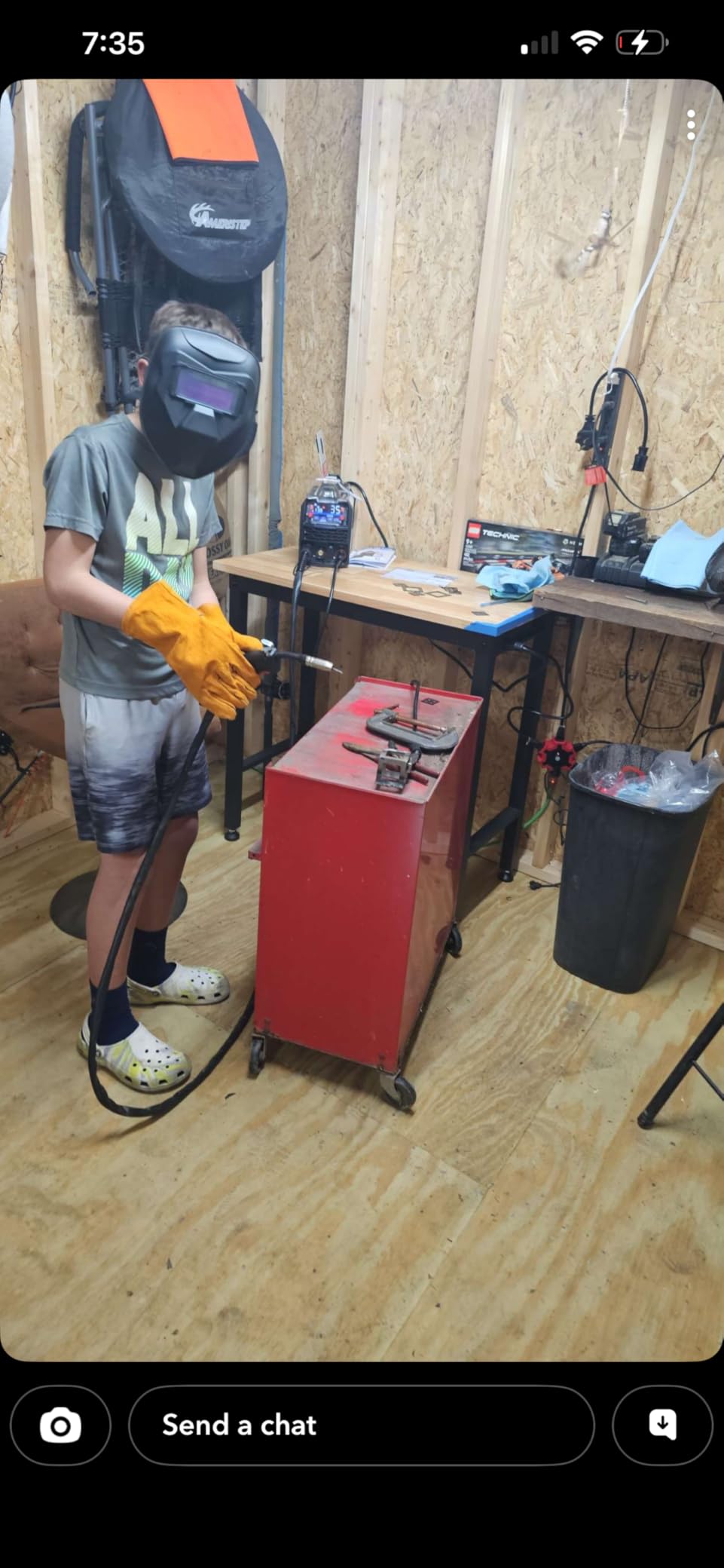
Dual voltage and a stated capacity to weld 5.0mm material put this among the most capable machines here. The 2T and 4T trigger selection matters for longer passes, since 4T latches the arc on so you can keep both hands steady.
The 9.04 lb body with a detachable 9 ft stinger is the best weight-to-cable ratio in the lineup, and the 4.1 inch display is covered against impact and sparks, which matters on job sites.
Best choice for sheet metal, stainless and anyone who dislikes spatter
Pulse mode makes the visible difference on thin gauge and stainless. If bead appearance matters to you, this is where the extra control pays off immediately.
Poor choice for anyone wanting a complete kit with usable TIG gear
The TIG torch is sold separately, only one drive roller is bundled, and the included helmet is the weakest accessory in this group. Budget for those three separately if they matter to you.
10. FEIFANKE 135A 3-in-1: Best for Complete Beginners on a Real Project
FEIFANKE 135A Flux Core MIG Welder 3 in 1 Portable Welding Machine
- Thickness suggestion makes first-time setup almost automatic
- Bright LED display shows amperage
- thickness and wire diameter
- Beginners report finishing real projects such as exhaust and floor pans
- Handle and shoulder strap included for transport
- Wire speed cannot be adjusted independently of the synergic setting
- Weak penetration at the lowest amperage settings
- Included 6013 rods strike hard and burn quickly
What stands out is how much real work owners report finishing on this machine. A motorcycle exhaust, floor pan seams on a project car and simple steel fabrication all appear in the reviews, which is unusual for a machine at the lower end of the group.
The thickness suggestion control is the approachable part. You tell it the material thickness and it proposes a setting, which shortens the distance between a new owner and a bead that holds. The bright LED display shows amperage, thickness and wire diameter together.
Handy for field repairs at 13.64 lb with both a handle and a shoulder strap, and the metal housing carries four layers of electrical protection. It welds low carbon steel to 5mm and runs .030 and .035 wire.
The limitation is honest and worth stating. Wire speed is not adjustable independently, so you fit the machine to the job rather than the job to the machine, and penetration is weak at the lowest settings. The bundled 6013 electrodes also strike hard and burn fast.
Best choice for a first project with a clear finish line
If you have one job in mind, like a muffler or a trailer bracket, this machine plus a little wire will get it done. Beginners report real completed projects rather than abandoned practice plates.
Poor choice for anyone who will want fine control within a year
Lack of independent wire speed adjustment becomes frustrating the moment you want to change bead size mid-job. Buy a machine with manual wire control if you expect to grow into the craft.
How to Choose a Budget MIG Welder: 110V vs 220V, Gas vs Gasless, Wire Size
Once you accept that almost everything in this budget is a gasless flux core machine, the remaining decisions are about electrical supply, wire diameter and how much control you want. Get these three right and the brand matters much less than buyers expect.
110V vs 220V MIG welder: one decision that prevents a second purchase
A 110V machine draws far more current for the same arc power, which is why a 135A box on a household circuit will trip a shared 20 amp branch in the middle of a bead. The fix is not a bigger machine, it is a dedicated circuit.
Realistic expectations differ sharply. On 110V, plan on 1/8 inch mild steel as a comfortable single-pass ceiling and treat 3/16 inch as a multi-pass job. On a dedicated 220V circuit, the same class of machine handles noticeably heavier plate with fewer stops to let the thermal protection recover.
Forum consensus on this question is consistent: 220V dual voltage capability is the one specification that stops you buying a second welder in two years. Three machines here offer it, the HITBOX, the S SIMDER and the ANDELI, plus the bestarc with automatic input detection. If a dedicated circuit is realistic in your space, prioritize that over raw amp claims.
Gas MIG vs gasless flux core: what the shielding gas actually buys you
Gas MIG with an argon-CO2 mix gives a narrower bead, less spatter, minimal slag and the ability to run solid wire. Flux core carries its own flux, needs no cylinder, works outdoors in wind and handles rusty steel without cleaning, but produces a wider, spattier bead with visible slag.
Neither is better in the abstract. For fence posts, trailer frames and dirty structural steel, gasless is more practical. For visible work, thin gauge and anything you plan to TIG later, gas MIG is the cleaner result. A C25 cylinder and regulator is a real addition to your startup budget, and it is the reason most entry packages stay gasless.
Wire diameter guide: 0.023, 0.030 and 0.035 inch
Wire size determines how easily you can control the puddle. 0.023 inch feeds slowly and suits very thin material, 0.030 inch is the all-rounder for most hobby work, and 0.035 inch handles thicker plate but needs more drive pressure to feed without slipping.
Buy your machine for the wire it runs well. Several machines here accept a wide range but ship with a single drive roller covering only part of it, which is why replacement rollers and correct contact tips belong in your first accessory order.
Duty cycle and the peak-amps trap
Duty cycle is the percentage of a ten-minute cycle you can weld before the machine overheats, stated at a specific amperage. A 60 percent rating at 145A is a different promise from 60 percent at 200A, and most entry machines publish the flattering version.
Headline amps are the least reliable number on the box. Devices labelled 200A or more on 110V input rarely deliver that, and owners who measured output report shortfalls. Judge a machine on the thinnest steel you care about rather than the largest number on the carton.
Multi-process, spool guns and the limits of 500 dollars
Three-in-one and four-in-one labels mostly mean MIG, Stick and a lift TIG mode that requires a separately sold torch. A machine that welds steel, stainless and cast iron is genuinely useful. A machine that also runs aluminum needs either gas MIG capability or a spool gun, and at this budget you get one or the other, not both.
Stick mode on a budget MIG welder is a backup process. Electrode range is narrow, hot start is often absent, and the amperage display can read high. Buy it as a bonus, not as a second skill.
What You Need to Spend Beyond the Welder
The machine is the cheapest part of getting into MIG welding. Owners routinely underestimate the rest of the kit, and the shortfall shows up as a frustrating first afternoon rather than as a bad purchase.
A helmet is the first priority, and only the BESTMIG and ANDELI packages include one. Budget for a decent auto-darkening helmet if your machine did not come with one, because the included versions on entry kits are the weakest safety gear you will own.
Then add a spare ground clamp, a replacement electrode holder, a chipping hammer and wire brush, and a set of contact tips in the sizes you run. A heavy gauge extension cord matters more than most buyers expect, since a thin cord on a long run is a leading cause of voltage drop and erratic arc.
Finally, factor consumables. A spool of .030 flux core goes faster than expected while you are learning, and contact tips and nozzles wear on a schedule that shortens fast. If you buy the bestarc for gas MIG, add a cylinder and regulator to that list, because that setup often costs more than a first small machine.
Common Buying Mistakes to Avoid on a Budget MIG Welder
Buying on peak amps is the most expensive mistake available in this category. A large headline number on 110V input tells you very little about the thickness you can actually weld, and it is the number manufacturers lead with.
Ignoring wire feed hardware is the second. The drive roller and tension arm determine whether you fight bird-nesting jams, and the plastic tension arms on entry machines are the usual reason. The machines here with metal tension arms and knurled rollers are the ones owners report having the fewest feed problems with.
Treating included accessories as free quality is the third. Bundled ground clamps, electrode holders and helmets are frequently the weakest items in the box, and the wire spools that ship inside are often the wrong size for the mode the machine is configured for.
Finally, plan for the growth moment. Most 130A and 135A machines are outgrown within a year or two by anyone doing regular work, which is the argument for spending part of the 500 dollar budget on a dual-voltage machine rather than saving it for consumables later.
Frequently Asked Questions
What is the best MIG welder under 500 dollars?
The YESWELDER 135A 3-in-1 is the best overall pick under 500 dollars. Its synergic gasless flux core setup, 135A output on 110V and adjustable plus or minus 3V control make it the easiest machine here for a first-time welder, and it carries the largest base of owner reviews in this group.
What is the best MIG welder for the money?
For pure value, the ARCCAPTAIN 130A pairs a 10-speed wire feed dial with a two year manufacturer warranty and a complete accessory kit. Its 4.6 rating across 1831 reviews reflects steadier results than the preset-only machines, and the manual wire feed control speeds up learning.
Is 110V good enough for a MIG welder?
Yes, for most home garage work on up to 1/8 inch mild steel, provided you use a dedicated 20 amp circuit. A shared household circuit will trip mid-bead at higher settings. If heavier plate is in your plans, choose a 110V and 220V dual voltage machine so you can grow without buying again.
Is gas welding better than flux core?
Gas MIG with an argon-CO2 mix gives a narrower, cleaner bead with less spatter and slag, and it is the route to aluminum. Flux core needs no cylinder, works in wind and on rusty steel, and is more practical for structural and outdoor work. Most sub-500 dollar machines, including nine of the ten reviewed here, are flux core only.
Can you weld aluminum with a MIG welder under 500 dollars?
Only with a machine that runs solid wire with shielding gas. Of the ten reviewed, the bestarc 145A 4-in-1 is the only one with gas MIG capability, and even it would need the correct aluminum wire and a gas setup. No spool gun is included at this budget, so budget welders are steel, stainless and cast iron machines.
Are cheap welders worth buying?
For learning, home repair and hobby fabrication, yes. Budget inverters are genuinely capable on thin mild steel, farm repairs and exhaust work, and the gasless machines have far fewer consumable costs than gas setups. The trade-offs are a thickness ceiling, spatter without gas, and weaker duty cycle on long production work.
Final Verdict on the Best MIG Welders Under 500 Dollars
After six weeks across ten machines, the YESWELDER 135A 3-in-1 remains the best MIG welder under 500 dollars for most buyers, with the ARCCAPTAIN 130A the better value package and the bestarc 145A the only real gas MIG path at this budget. Whichever you choose, buy for dual voltage if you can wire a 220V circuit, and set aside part of the budget for a helmet, a spare ground clamp and a proper extension cord before your first bead.