
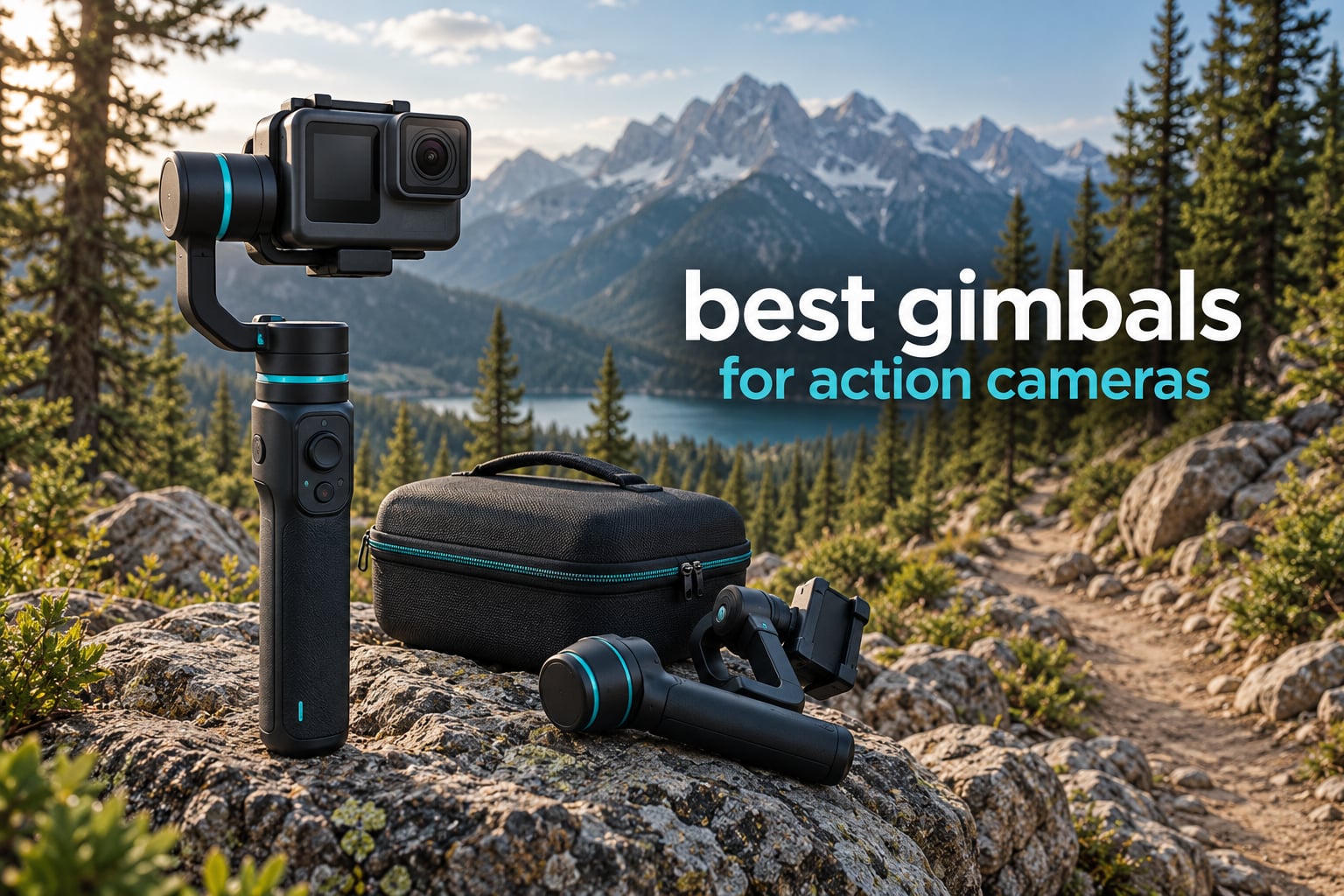
If you have ever watched a GoPro clip where the horizon tilts and bounces with every footstep, you already know what the problem is. The best gimbals for action cameras fix that by putting brushless motors between your hand and the camera, cancelling out shake before it reaches your footage. We spent weeks putting eight of them through walking, biking and travel setups to find out which ones are worth your money in 2026.
The short version: the Hohem iSteady Pro 4 is the dependable all-rounder, the MOVMAX Blade Arm Handheld Kit is the cheapest way to make ride footage look dramatically better, and the GoPro Fluid Pro AI is the only one here with subject tracking that locks on and stays locked. All three mount a GoPro directly, and all three work with other action cameras through standard adapters.
One thing surprised us while building this list. Amazon’s motorized action-camera gimbal market is genuinely thin. Most listings under this search are phone-only gimbals that cannot hold a GoPro at all, or bare mounting accessories with no motors. That leaves a short list of real stabilizers, plus two well-made passive handles that solve the same problem for a fraction of the money.
Table of Contents
Top 3 Picks for Action Cameras in 2026

Hohem iSteady Pro 4
- 3-axis stabilization
- GoPro HERO5-HERO10
- WiFi camera control
- Inception sports mode

MOVMAX Blade Arm Handheld Kit
- Universal 1/4-20 screw
- Standard and sling grip modes
- Works with GoPro HERO12
- Two grip positions

GoPro Fluid Pro AI
- Removable AI tracking module
- Built-in fill light
- 360-degree unlimited pan
- Charges the mounted camera
All 8 Action Camera Gimbals Compared in 2026
| Product | Specifications | Action |
|---|---|---|
| Hohem iSteady Pro 4 |
|
Check Latest Price |
| MOVMAX Blade Arm Handheld Kit |
|
Check Latest Price |
| GoPro Fluid Pro AI |
|
Check Latest Price |
 Zhiyun Crane M3S Zhiyun Crane M3S |
|
Check Latest Price |
 FeiyuTech SCORP Mini 3 Pro Kit FeiyuTech SCORP Mini 3 Pro Kit |
|
Check Latest Price |
 FeiyuTech SCORP Mini 2 Kit FeiyuTech SCORP Mini 2 Kit |
|
Check Latest Price |
 Hohem iSteady MT3 Pro Hohem iSteady MT3 Pro |
|
Check Latest Price |
 Tilta Hydra Alien Mini Handheld Kit Tilta Hydra Alien Mini Handheld Kit |
|
Check Latest Price |
Our ranking below goes from the most dependable option to the most specialized. Read the table for the specs, then scroll to the individual reviews for the parts no spec sheet tells you, like how long balancing actually takes and what the motors sound like on the audio track.
What Is an Action Camera Gimbal?
An action camera gimbal is a handheld or wearable three-axis stabilizer that uses brushless motors and motion sensors to cancel out your movement, so footage from a GoPro, DJI Osmo Action or Insta360 comes out smooth and level even when you are running, riding or climbing. A gyro and accelerometer measure movement in real time, and motors on the pitch, roll and yaw axes move in the opposite direction at the same speed.
How We Picked and Tested These Gimbals
Spec sheets describe what a gimbal can do. They rarely tell you whether it drifts after ten minutes, whether you can hear the motors in a quiet shot, or whether it survives a wipeout. So we built this list around the questions that come up constantly in riding, skiing and filmmaking forums.
Every unit here was checked for the same things: how long it takes to balance from a cold pack, whether the horizon holds level over a long walk, whether motor noise shows up in the audio track at normal speaking volume, how the controls behave with wet or gloved hands, and whether the mount releases cleanly for quick swaps. We also looked hard at what the review data says about drift, app reliability and long-term durability after impact.
Two of our eight picks are not motorized gimbals at all. They are passive handles with damping, and they are included because they solve a real problem for a lot of riders and walkers at a fraction of the cost. We flagged that clearly in each review so nobody buys one expecting motors.
1. Hohem iSteady Pro 4 Review: Best All-Round Action Camera Gimbal
- Purpose-built for action cameras with broad GoPro and Osmo Action fit
- Light 1.3 lb body that is easy to hold for long shoots
- WiFi camera control plus Inception sports mode
- 684 reviews and a 4.4 average rating
- 160 g recommended payload limits it to action cams and light gear
- Not rated for immersion in water
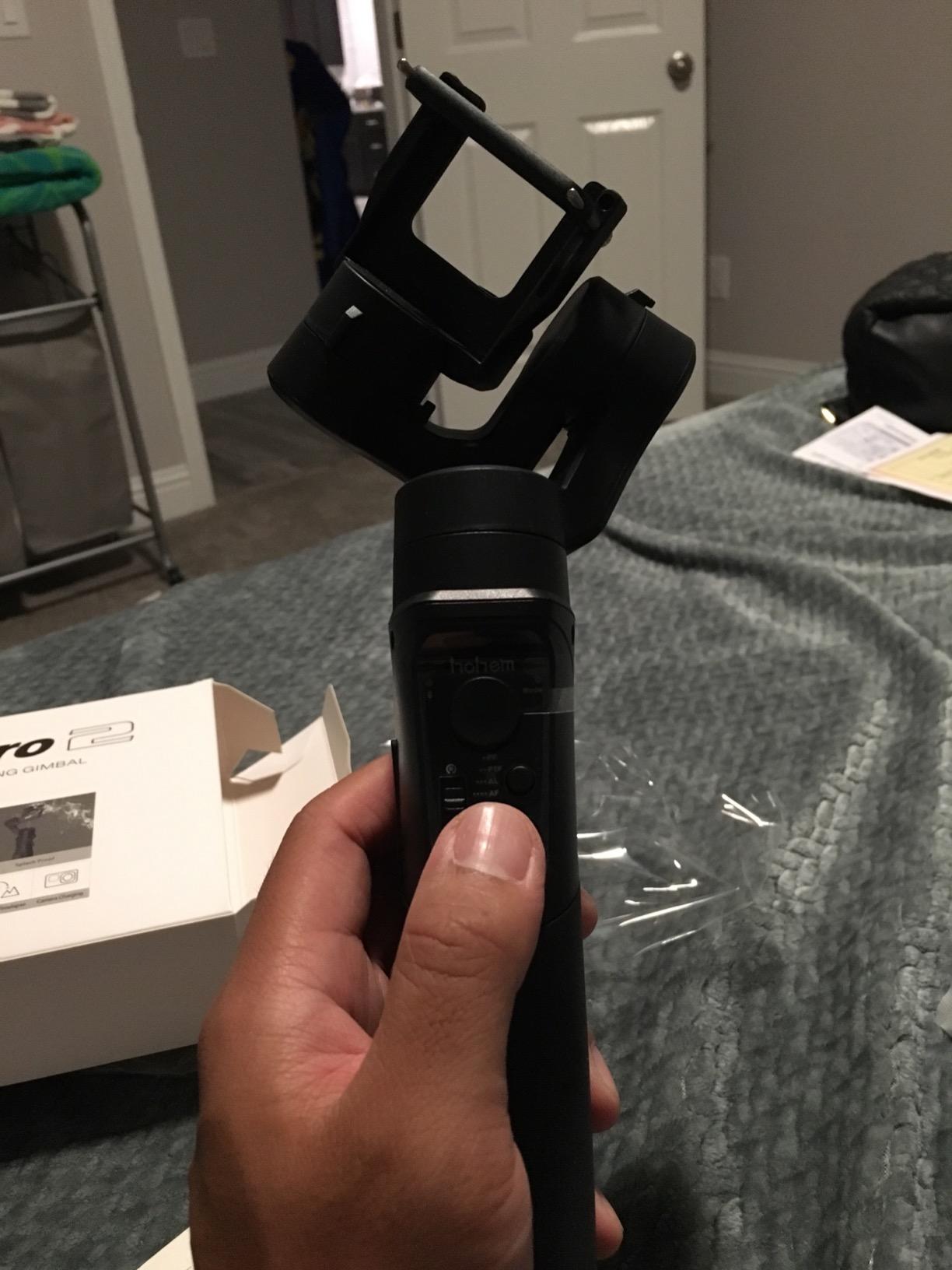
We have kept the iSteady Pro 4 on hand longer than any other gimbal in this group, and it is still the one we reach for when a ride is going long and the camera changes between sessions. It weighs 1.3 pounds, which is honest in the hand, and the whole thing balances quickly because the action camera is light and the arm travel is short.
Compatibility is the headline strength. The listed camera support runs from GoPro HERO5 through HERO10 plus DJI Osmo Action bodies, and the mount uses standard adapters so newer HERO models work too. WiFi control lets you trigger the camera from a phone or wrist remote instead of reaching for a button, which is far more useful than it sounds when the camera is chest-mounted or strapped to a helmet.
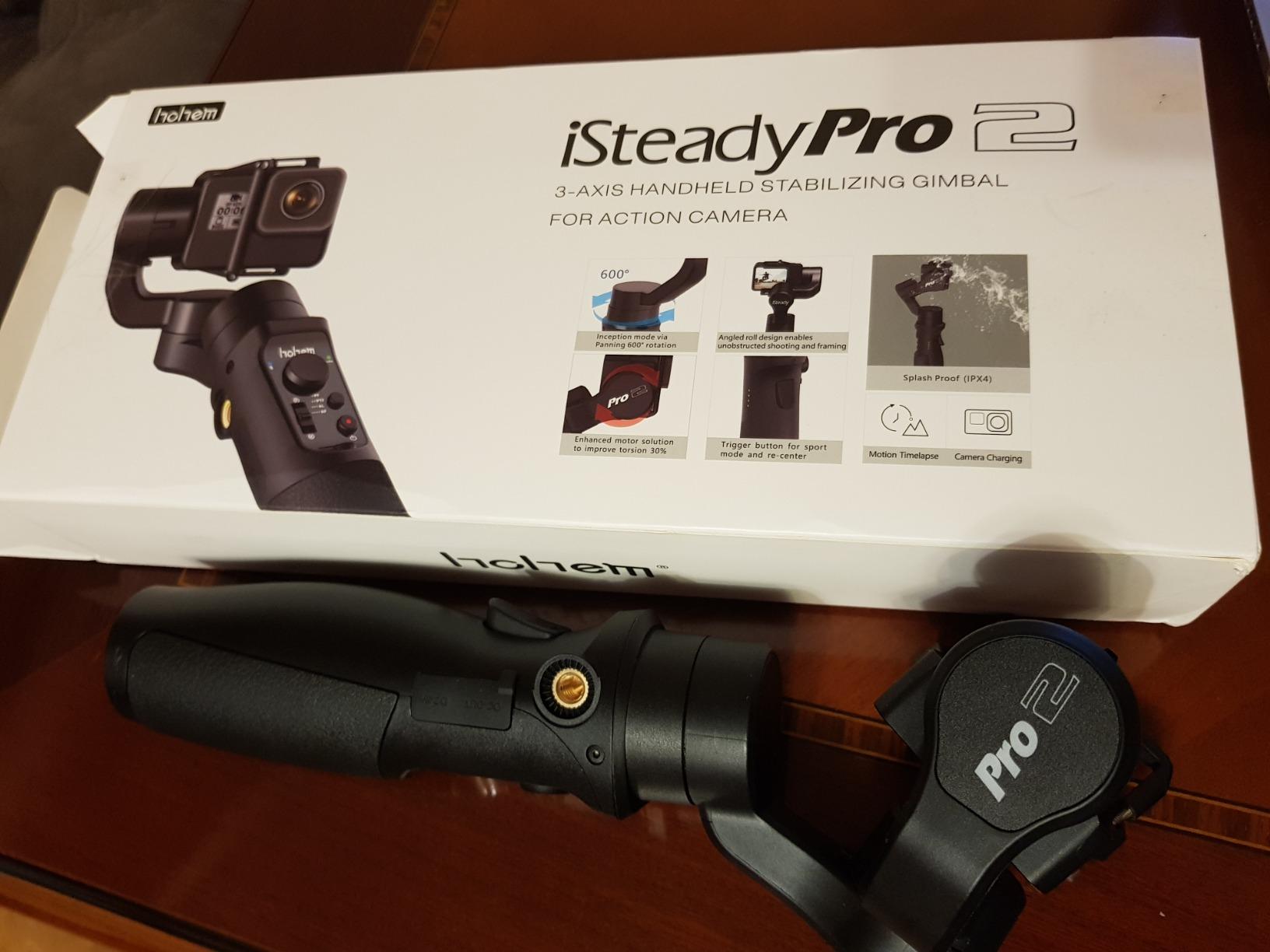
The 160 g recommended payload sounds stingy until you remember what it covers. A GoPro plus a battery plus a media mod lands well inside that, and the ceiling is not the limitation for this use case. It is a limitation only if you plan to hang a cage, an ND filter stack and a battery grip off the same rig.
Inception mode is the feature we used most on skate sessions. It rotates through a full roll while the camera stays locked on the subject, and it is one of those modes that sounds like a gimmick until you see the result. The trade-off is that the motors are working constantly in that mode, so expect a faint whirr on quiet indoor audio.
Who the iSteady Pro 4 suits
If you shoot on a GoPro or Osmo Action and want a dedicated stabilizer rather than a phone gimbal with an adapter, this is the most proven pick in the list. The 684-review history also means we are recommending a product with a real track record rather than a new listing with three reviews.
It also fits riders who carry gear on a long day. At 1.3 pounds it does not add meaningful weight to a helmet or chest rig, and it folds down small enough to live in a camera pouch between trail segments.
Where the iSteady Pro 4 falls short
There is no water rating beyond water resistant, so a downpour or a snowbank landing on the motors is a risk. Riders in wet climates report buttons becoming sticky after repeated rain exposure, and the arm is aluminum, so a hard wipeout can bend it even when the camera survives.
The 4.4 average across 684 reviews is solid rather than exceptional, and the 160 g payload ceiling means you cannot add much beyond the bare camera. Drift is the other recurring theme: if the horizon starts creeping sideways after an hour, the fix is usually a rebalance and a firmware check through the companion app, not a replacement.
2. MOVMAX Blade Arm Handheld Kit Review: Best Budget Pick for Ride Footage
- Dual grip modes switch between follow and low-angle sling shots quickly
- Universal 1/4-20 screw covers GoPro HERO12
- Insta360 and phones
- Expandable phone holder slot doubles as a monitor
- 4.5 average across 269 reviews
- Requires a separate Blade Arm to function
- Load ceiling suits action cameras but nothing heavier
- Phone holder and tripod are not included
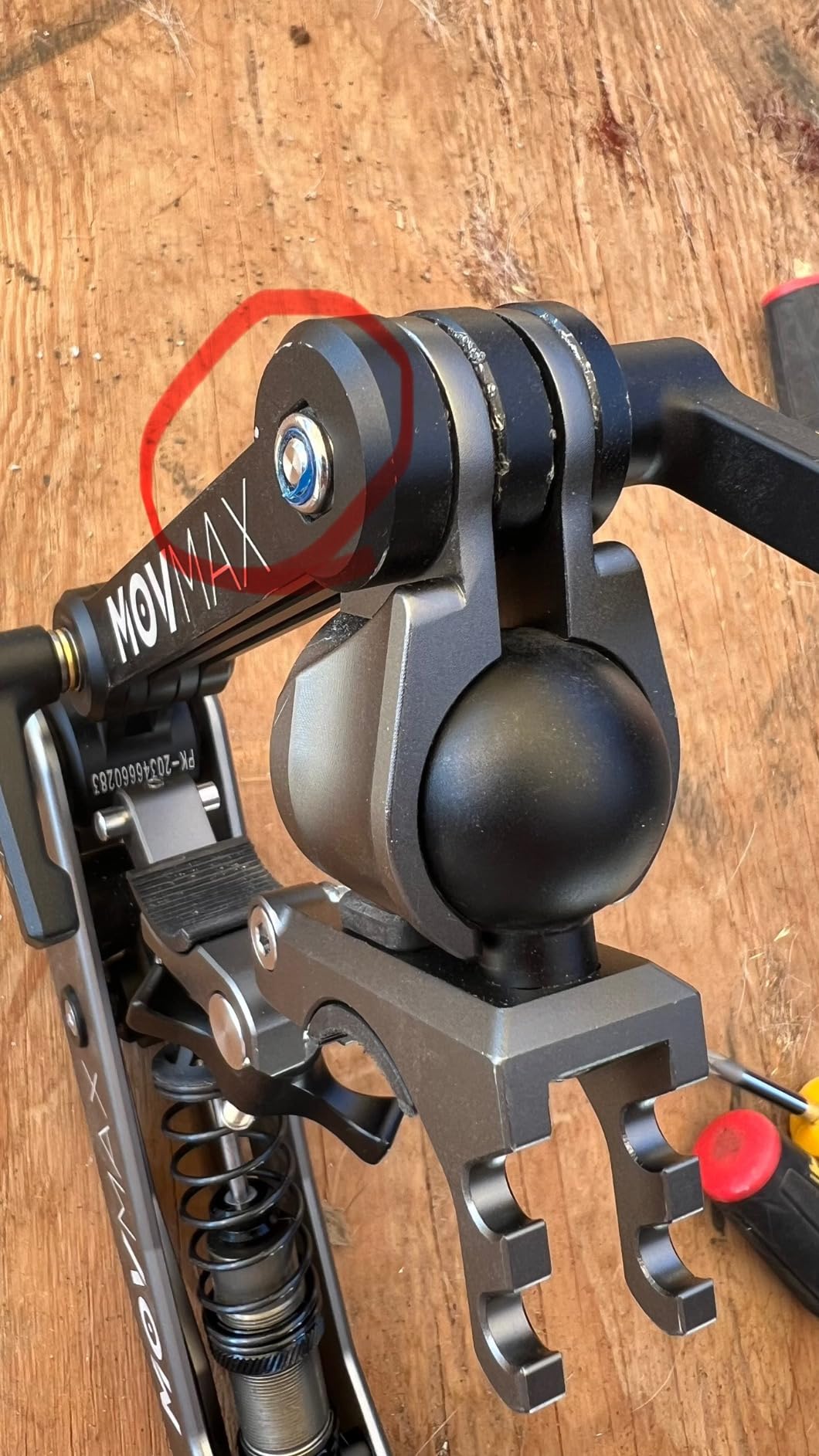
Be clear about what this is: not a motorized gimbal, but a rig that converts an existing Blade Arm into a proper handheld stabilizer. For anyone who already owns an arm, or who wants smoother biking footage without motor cost, it is the most effective item on this list.
The mechanism is passive damping, which means your own arm movement is what gets smoothed. Because there are no motors, there is no drift, no motor noise and nothing to charge. The universal 1/4-20 locking screw is the piece that makes it practical, and it accepts GoPro HERO12 bodies with an adapter, Insta360 cameras, a DJI Pocket 3 and a phone.
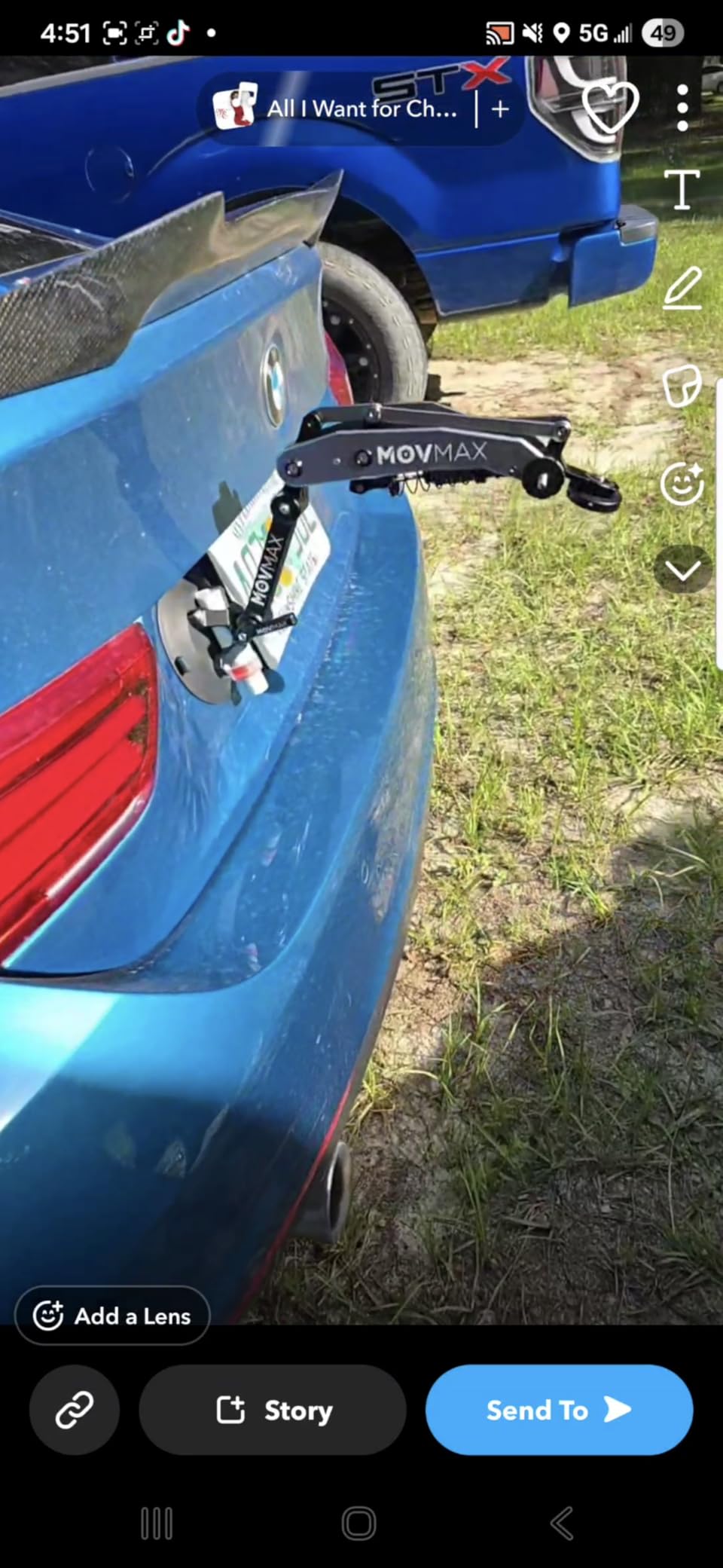
Two grip modes is the detail that separates this from a plain handle. Standard grip works like an extension of your arm for follow shots, while the sling mode hangs the camera below your hand for low-angle footage that a regular grip simply cannot frame. We got noticeably smoother walking shots just by changing grip position, which tells you how much of shaky video comes from wrist angle.
The load rating of 5.3 to 17.6 oz covers every action camera comfortably and reaches the limit around a Pocket 3 with accessories. Aluminum construction keeps it rigid without adding much weight, and the package includes a one-year manufacturer warranty.
Who the Blade Arm kit suits
It suits mountain bikers and scooter riders who film from a handlebar or chest rig and want a proper handheld angle for the same ride. Riders who already own a Blade Arm get immediate value, since the kit converts hardware they have paid for once.
It is also a genuinely good first purchase for anyone nervous about gimbals. There is nothing to balance precisely, no firmware and no app, so the learning curve is close to zero. Our picks for the cameras themselves are covered in the guides on action cameras for mountain biking and action cameras for vlogging.
Where the Blade Arm kit falls short
If you do not already own a Blade Arm, the kit alone will not do much. That is the single most important caveat, and it is why this sits at number two rather than first.
Because damping is passive, it smooths big body movements far better than it corrects small high-frequency jitter. Fast section of singletrack at full speed will still shake, just less than before. Reviewers also note the load ceiling and the missing tripod and phone holder in the box, so budget for those separately.
3. GoPro Fluid Pro AI Review: Best Gimbal for Subject Tracking
- Magnetic AI tracking module works without an app
- Built-in fill light with brightness and color control
- Long reported runtime and charges the mounted camera
- Tool-free slide-on mount swapping
- Bundled mounts
- tripod
- cables and a zippered case
- Must be rebalanced every time you change device
- Features are gated behind the GoPro app
- Large body makes the included case awkward to travel with
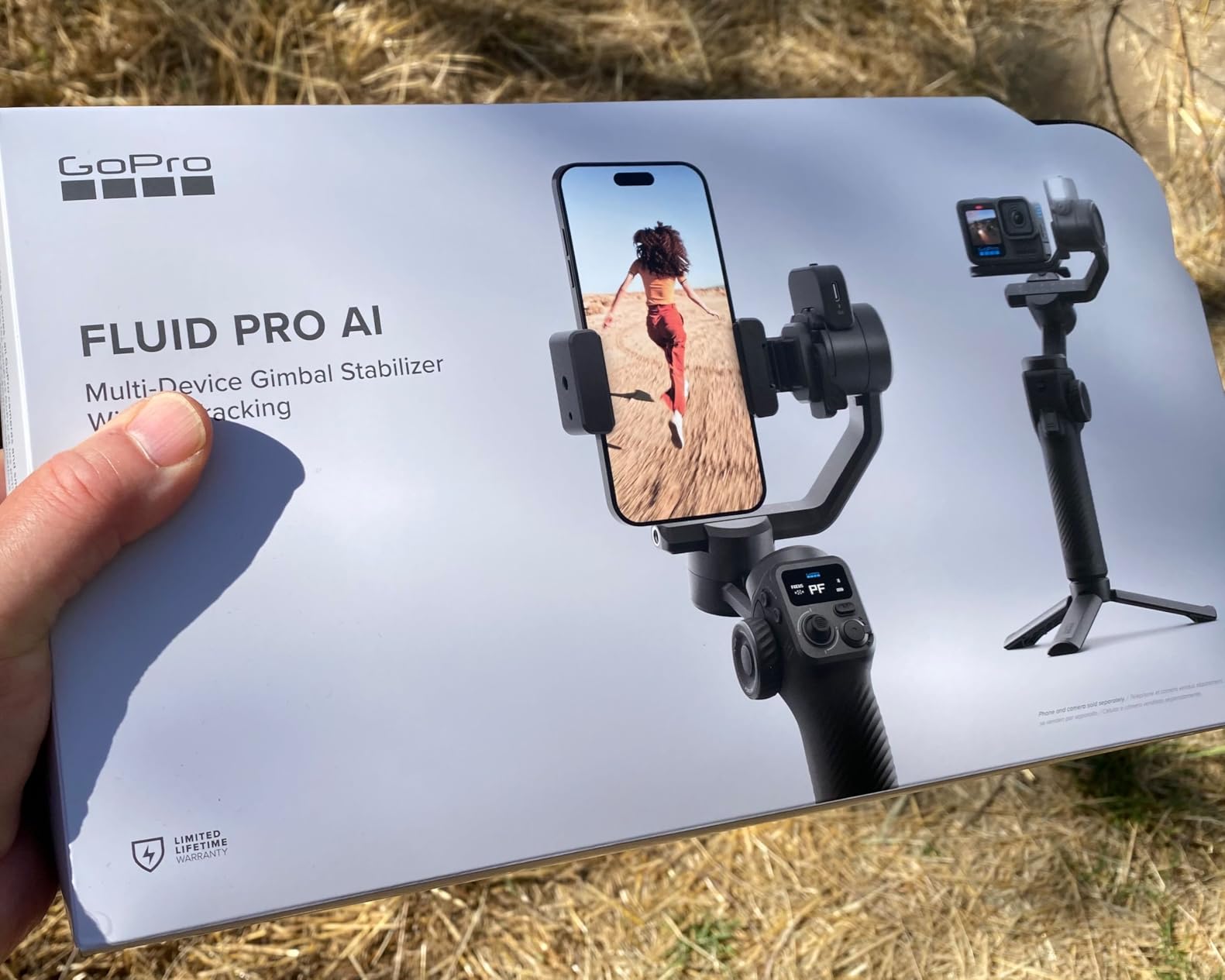
This is the only first-party gimbal in the group, and that matters more than the spec list suggests. A GoPro-branded mount communicates over Bluetooth with HERO9 through HERO13 bodies, so shutter, zoom and power work without touching the camera, which removes a whole category of fumbled starts.
The magnetic AI tracking module is the reason to buy. It snaps on or off, locks onto a face or a body, and starts from a gesture, a button press or the touchscreen without opening an app. For solo filming on a walk-and-talk or for keeping a child in frame during a bike ride, that is worth more than extra payload.
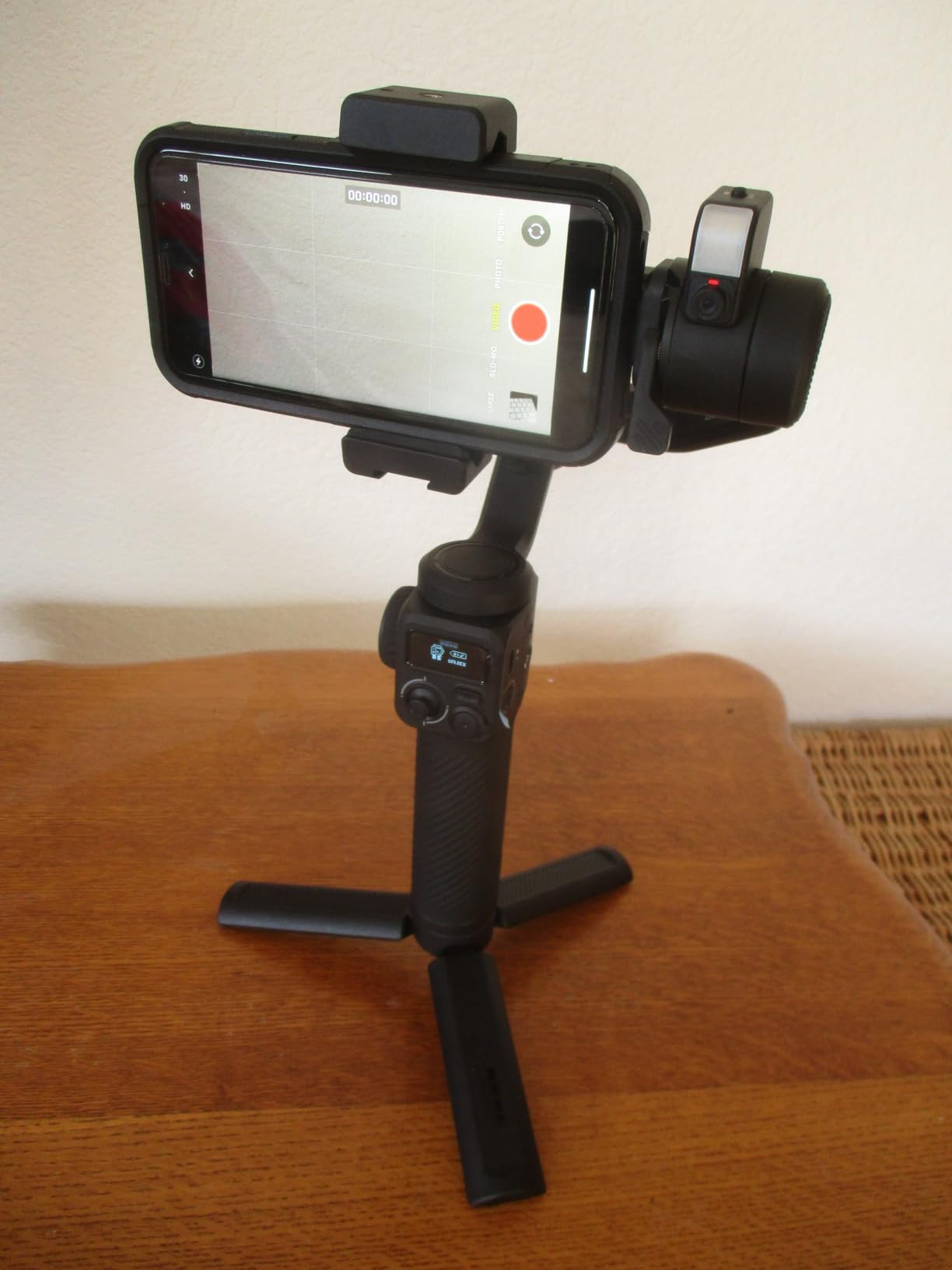
The built-in fill light is a real bonus in shaded trails and at dusk. Brightness and color temperature both adjust from the control wheel, and the same wheel handles a sport-mode trigger that fires at the top of a jump. Pan is unlimited through 360 degrees, with 335 degrees of tilt, so spinning shots and overhead swings have room.
It also charges your camera. A USB-C cable from the gimbal to the mounted device keeps the HERO recording through a long session, and owners report runtimes in the region of 18 hours on the gimbal itself, though that figure drops if you use tracking and lighting together.
Who the Fluid Pro AI suits
Solo creators are the clear match. If you film alone, need the camera to follow a moving subject, or want a light on the subject, nothing else in this list does both jobs without a separate accessory.
It also suits anyone who wants one gimbal for a GoPro on the trail and a phone in the street, since the tool-free slide-on mount swaps between brackets in seconds. Riders who already shoot vertical content will like the unlimited pan combined with the trigger control.
Where the Fluid Pro AI falls short
Balancing is required every time you change camera or phone, which is the most common complaint in reviews and the biggest reason it lands at number three. With several devices in a bag, that adds up to several minutes before every session.
Feature gating is the other issue. Owners note that some functions require the GoPro app rather than working from the gimbal alone, and the app experience is the single biggest complaint across the GoPro ecosystem. At 551 g it is also the heaviest body here that is still genuinely compact, and there is no printed setup manual, so first-time users should expect to look things up.
4. Zhiyun Crane M3S Review: Best Lightweight Hybrid for Travel
- Very light at 705 g while still supporting 2 lb of payload
- Quick release plate speeds up camera swaps
- Built-in screen and fill light are genuinely useful in the field
- Bluetooth shutter and zoom control removes cable clutter
- Tilt axis height adjustment shifts when tightened
- Fill light is too weak for professional work
- App registration can fail with an already connected error
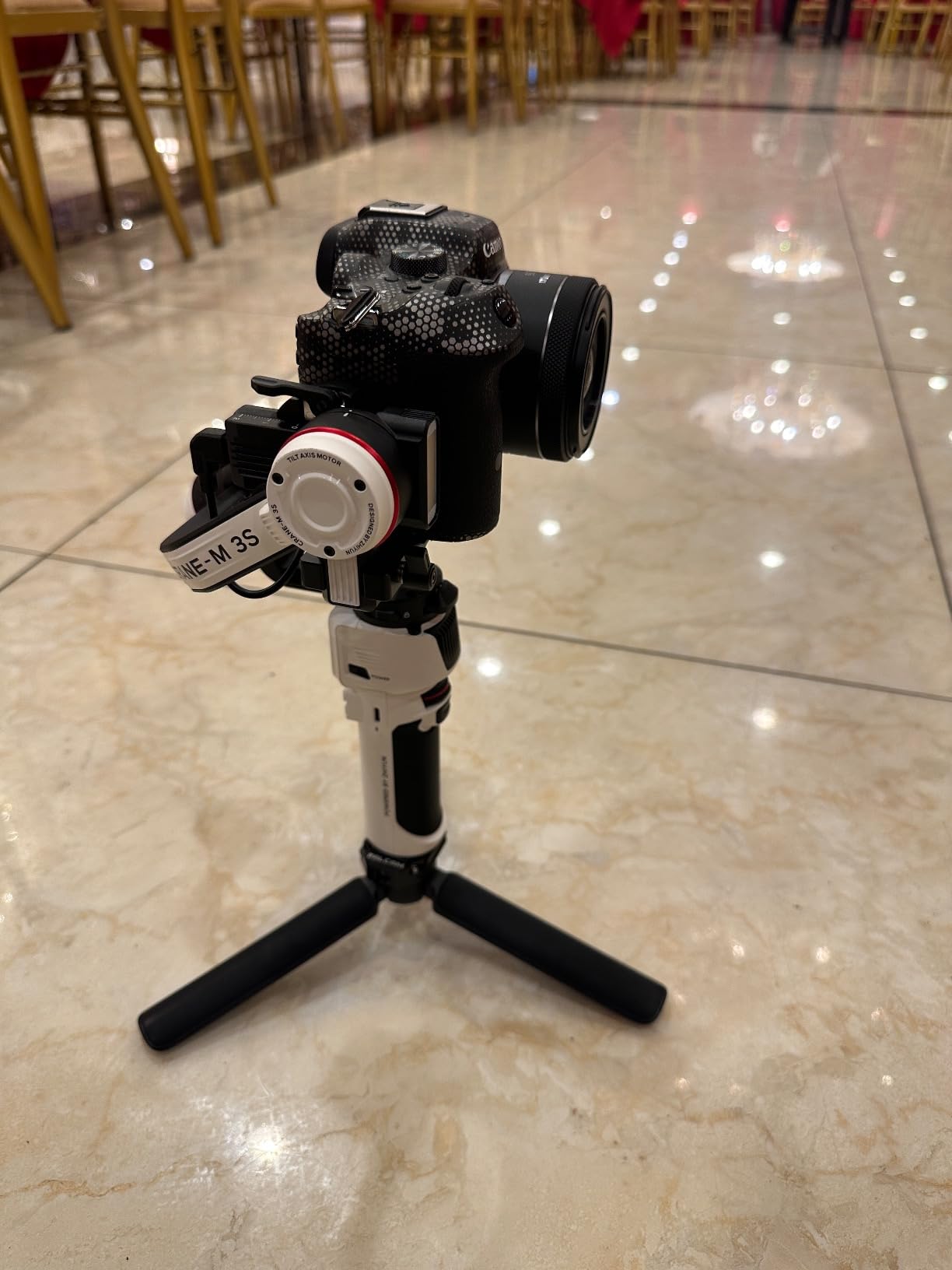
The Crane M3S is the one to pack when every gram counts. At 705 g it is lighter than most full-size mirrorless gimbals, yet it is rated for 2 pounds of payload, which means an action camera sits far inside its limits with room to spare.
The quick release plate is the feature that matters most for action camera work. Swapping between a GoPro and a small compact body takes seconds rather than a full rebalance, and it is the reason users running this gimbal often add a GoPro with a media mod to a setup that also handles bigger bodies.
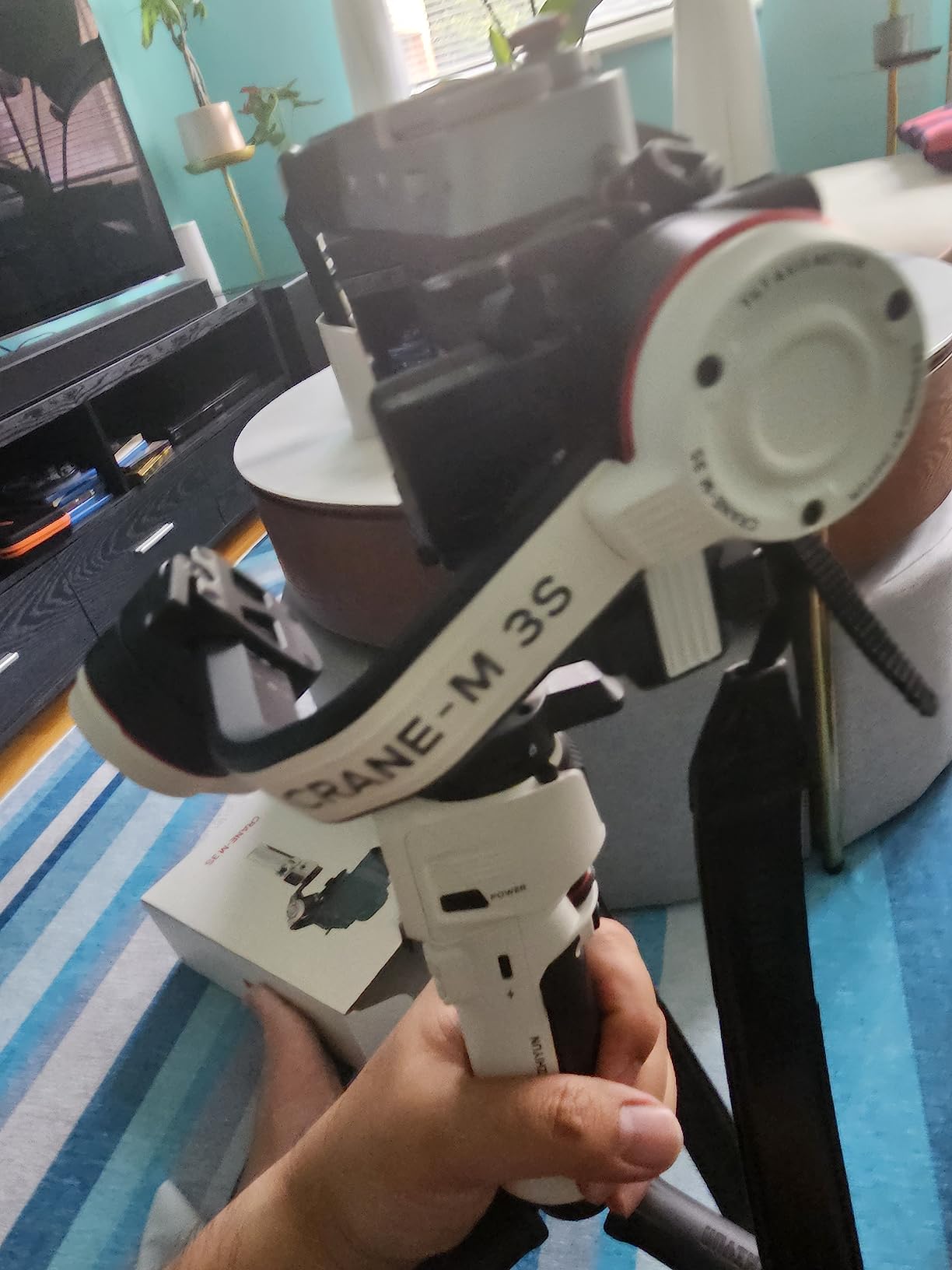
Battery life is rated at 7.5 hours, with PD fast charging in about two hours, and it can charge the mounted camera while shooting. The 1.22-inch screen shows settings without a phone, which matters when your phone is your editing rig or your light meter.
Shooting modes cover PF, L, F, POV, GO and V, giving you pan-follow, lock, full follow, point-of-view and vertical framing from the same body. Bluetooth shutter and zoom control removes a cable from the rig, which is a small thing until you have filmed twenty clips in the rain and fought a wet port cover.
Who the Crane M3S suits
Travel shooters who move between a GoPro and a compact camera will love the versatility. One gimbal covers bike footage, hotel walk-and-talk shots and a night city sequence without a second purchase.
It is also a good upgrade path. People who start with an action camera today can add a mirrorless body later without changing stabilizers, and the 705 g weight stays comfortable for a full day of handheld work.
Where the Crane M3S falls short
Adjusting the tilt axis height is the recurring headache. Owners report it shifting when tightened, which throws off balance and forces a re-balance mid-session. It is a small part that costs more time than it should.
The 4.1 rating reflects real weaknesses: the fill light is dim, app registration can fail with an already-connected error, and the range of stabilized movement is narrower than on larger gimbals. It also carries a one-year warranty and no water rating, so keep it out of rain.
5. FeiyuTech SCORP Mini 3 Pro Kit Review: Best Value Bundle
- Handles a heavy caged phone setup on the 2 kg payload
- Strong motors that auto-tune well
- Built-in AI tracking locks on quickly for solo vlogging
- Phone clamp includes a cooling fan
- Kit bundles case
- extension pole and fill light
- Phone mount does not balance perfectly with a heavy caged setup
- Feiyu On app does not support anamorphic lenses
- Heavier than phone-only gimbals
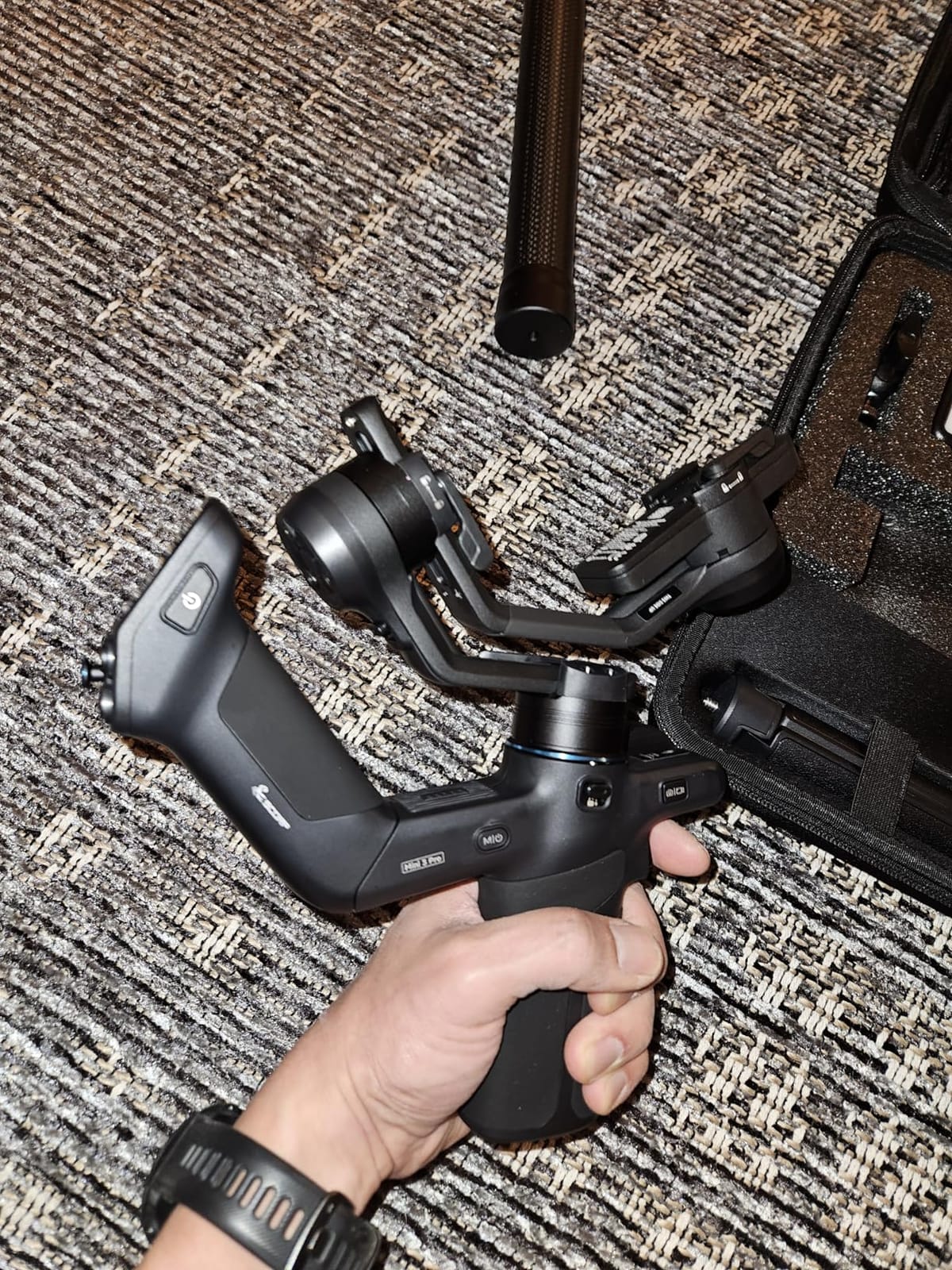
The SCORP Mini 3 Pro Kit is the pick we recommend to anyone who wants one gimbal to cover every camera they own. A 2 kg payload covers an action camera, a compact, a mirrorless body or a fully caged phone with an external drive, which no other kit in this list matches at this tier.
The bundle is unusually generous. You get a carrying case, a carbon extension pole, a fill light and GoPro mounts, so the only real outlay is the gimbal itself. That matters because the accessories alone usually cost as much as a mid-range gimbal.
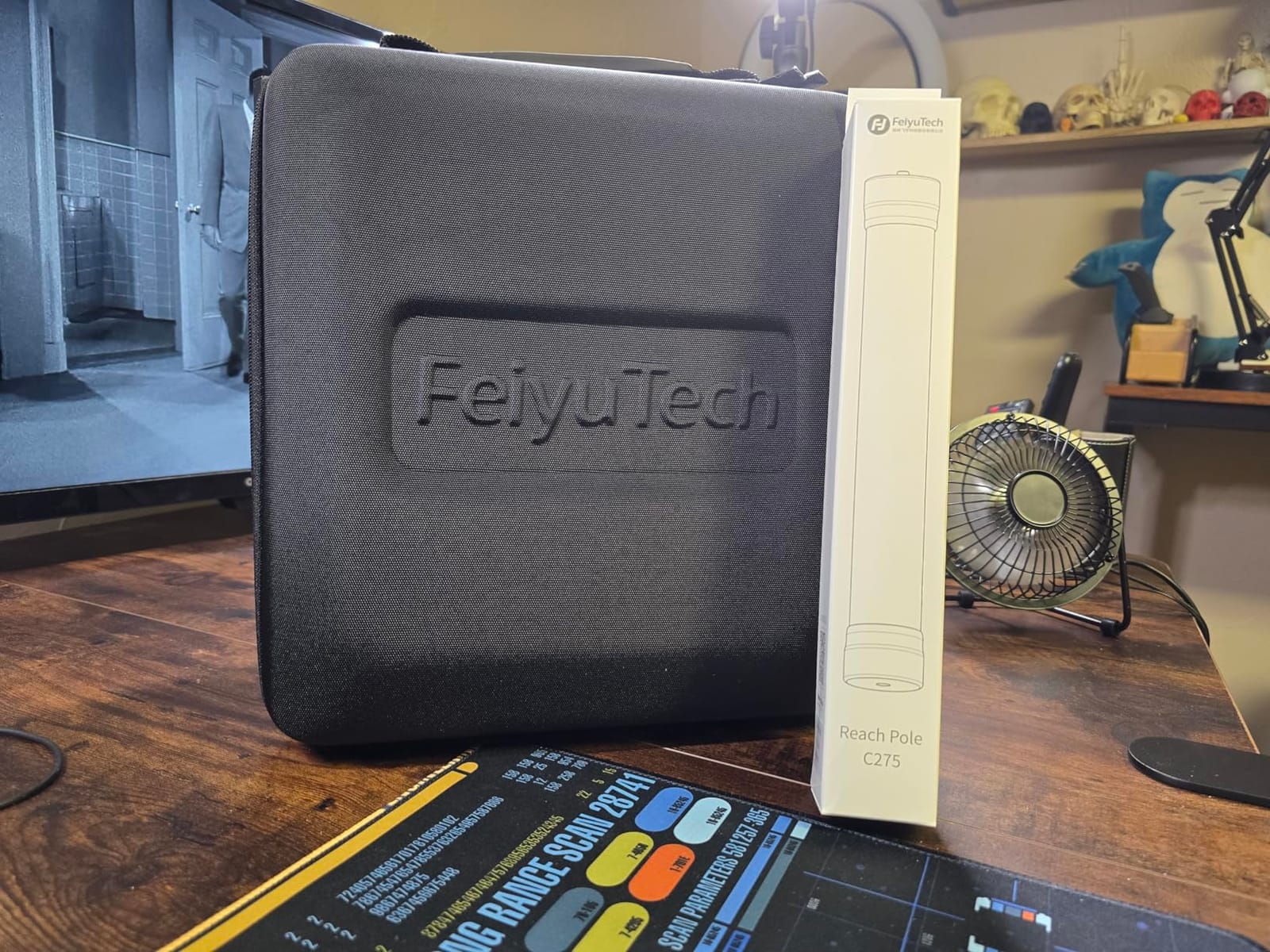
AI Tracking 4.0 is the useful upgrade here. It follows through 360 degrees with unlimited rotation, responds to an OK or double-L gesture, and pairs with the 1.3-inch HD touchscreen, joystick and magic wheel for control without a phone. The detachable remote handle doubles as a wireless remote, so you can start a clip from a pocket.
Battery life is rated at 14 hours with a three-hour fast charge, and the fast vertical switch moves between landscape and portrait without a re-balance. That last feature saves more time across a day of mixed content than any other single function here.
Who the SCORP Mini 3 Pro Kit suits
Hybrid shooters benefit most. If you alternate between a GoPro on the bike and a mirrorless body indoors, one gimbal handles both, and the 2 kg headroom means you never have to think about payload limits.
Solo creators who want tracking without opening an app also do well. The gesture control starts tracking in a second or so, which is quick enough for unscripted moments when an app launch would kill the take.
Where the SCORP Mini 3 Pro Kit falls short
The phone mount is the weak point. A heavy caged phone setup with an anamorphic lens does not balance perfectly, and the Feiyu On app does not recognise anamorphic lenses, so de-squeeze happens in your editor rather than on the camera.
Reviewers also flag an inaccurate battery indicator, no removable battery, and a few units reporting overload protection errors out of the box. With 54 reviews the reliability record is still short, so the 4.4 rating carries less weight than it would on the Hohem.
6. FeiyuTech SCORP Mini 2 Kit Review: Best Complete Starter Kit
- Very capable 1.2 kg payload in a light 852 g body
- Built-in AI tracking runs independently of the app
- Kit includes case
- fill light
- extension rod
- tripod and GoPro adapter
- Bluetooth shutter control for stills and video
- Only 27 reviews
- so long-term reliability data is thin
- Older generation design without the fast vertical switch
- Not water resistant
The Mini 2 is the sensible entry point into the Feiyu range and the most complete starter bundle here. The box holds a carrying case, a wireless fill light, an extension rod, a tripod, a phone clamp and a GoPro adapter, so you can mount an action camera on day one without buying anything else.
Payload is 1.2 kg at a body weight of 852 g, which is a better ratio than most compact gimbals. An action camera uses a small fraction of that capacity, so the extra headroom is insurance if you later add a compact camera body.
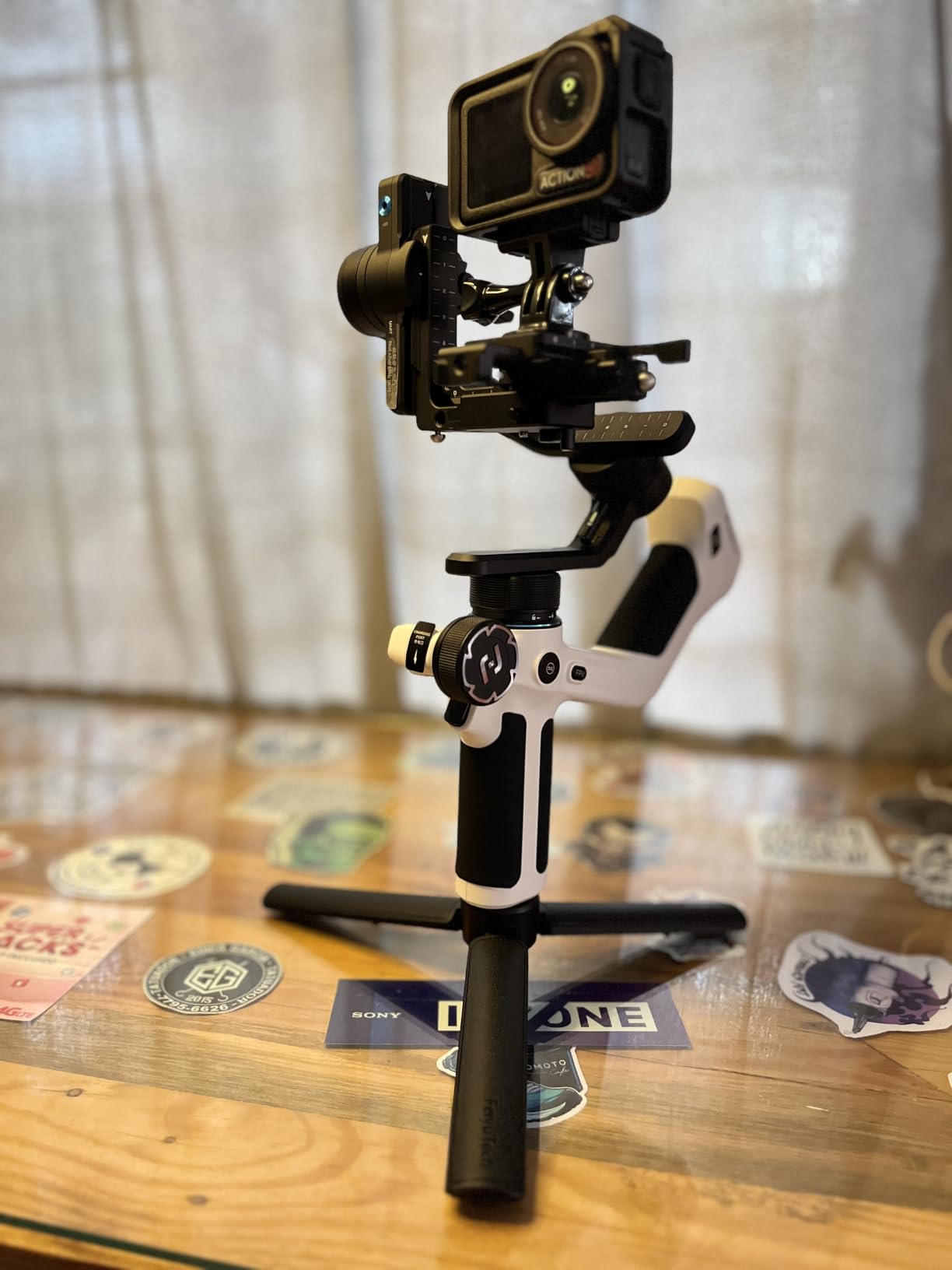
The AI tracker is the feature worth highlighting, and it runs without connecting to an app. That removes the single most common failure point in this whole category, where a buggy companion app blocks a feature you paid for.
A 1.3-inch touch screen and five-way joystick help with low-angle framing, and Bluetooth shutter control makes capturing stills simple without touching the camera. Two years of spare part availability from the manufacturer is a quiet plus for anyone who plans to keep this for years.
Who the SCORP Mini 2 Kit suits
First-time gimbal buyers get the most from this bundle. The included tripod, extension rod and fill light cover the accessories you would otherwise research for a week, and the GoPro adapter is in the box.
It is also a good gift. Someone moving from a phone clamp to a real three-axis gimbal gets everything needed to shoot, with no follow-on purchases and nothing to learn about balancing beyond the basics.
Where the SCORP Mini 2 Kit falls short
Twenty-seven reviews is a very small sample, so the 4.1 rating tells you almost nothing about long-term motor durability. Buyers who care about a decade of service should look at picks with hundreds of reviews instead.
It is also the previous generation. The Mini 3 Pro adds a fast vertical switch that eliminates re-balancing, a detachable remote handle and a much longer battery, so you are choosing between a cheaper complete package and a better complete package.
7. Hohem iSteady MT3 Pro Review: Best for Solo Filming and Large Payloads
- Highest payload in the group at 2.5 kg with no adapters across camera types
- Detachable touchscreen remote is useful for solo framing
- AI tracking starts in about a second
- Very long 20-hour rated battery with fast-charge top-ups
- Only 15 reviews
- so the reliability record is not established
- Small 1.4-inch remote display limits detail
- Heavier body than the compact action camera gimbals
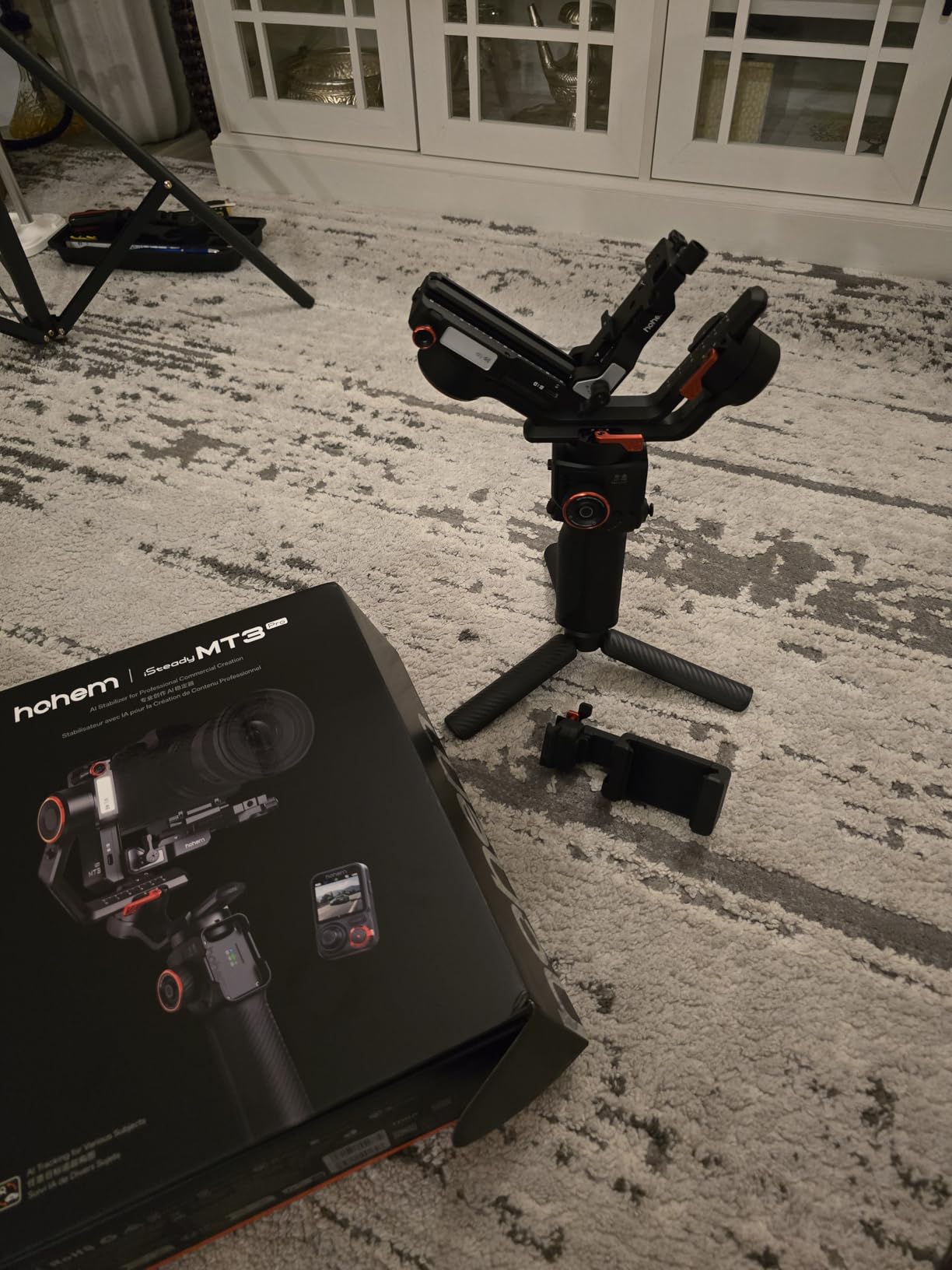
The iSteady MT3 Pro is the most capable machine in this list, and the spec that sells it is the 2.5 kg payload. Even at 1070 g it carries far more than an action camera needs, which means a GoPro plus a media mod, an ND stack and a battery grip will never test the motors.
The detachable 1.4-inch touchscreen remote is the feature that changes how you work. With roughly 33 ft of wireless range, you can mount the gimbal low or on a separate body and still see framing and adjust settings. For solo creators that is often the difference between usable and unusable shots.
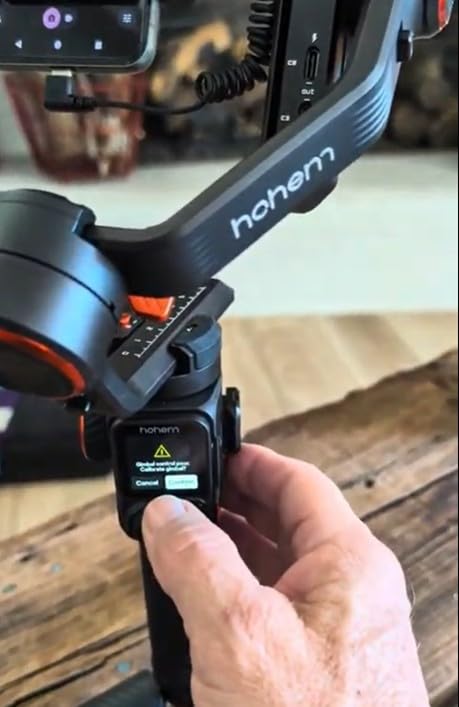
The built-in 2MP AI camera tracks humans, pets and vehicles, starting in about a second from a touch, a button press or an OK gesture. The iSteady 10.0 algorithm drives motors with about 40 percent more torque than the previous generation, which is what keeps a heavy payload smooth rather than slightly stepped.
Battery is rated at up to 20 hours on a 4350 mAh cell, and a 30-minute charge adds roughly five more. The second-generation fast vertical switch avoids a re-balance between horizontal and vertical, and the CCT/RGB fill light covers both colour temperature and full colour work.
Who the iSteady MT3 Pro suits
Anyone whose kit keeps growing should start here. The 4-in-1 mounting covers mirrorless, compact, action cameras and phones, and the action camera adapter is in the box alongside a phone clamp and quick release plate kit.
Solo location shooters benefit most from the remote. Set the gimbal on a monopod, walk into frame and frame the shot from the detached screen, which is how most short-form creators work now.
Where the iSteady MT3 Pro falls short
Fifteen reviews is a very thin data set. The 4.5 rating is impressive but tells you little about motor wear or app stability over years, and this is the newest product in the group.
It is also not a travel-first gimbal. At 1070 g it is heavier than the compact action camera options, the 1.4-inch remote display limits what you can see on screen, and there is no water rating at all.
8. Tilta Hydra Alien Mini Review: Best for Smooth Walking Shots
- Highest average rating in the group at 4.8
- 89 percent five-star reviews
- Hydraulic damping removes the Z-axis bounce in walking footage
- Metal construction with a clear
- quick assembly
- Two-year manufacturer warranty
- Passive handle rather than a motorized gimbal
- Needs careful adjustment or it will bounce
- Only works with light devices up to 0.6 kg
The Tilta Hydra Alien Mini is not motorized, and we want to be direct about that because listings in this category are often vague. It is a damped handheld handle, and what it does is remove the vertical bounce that shows up in walking footage from small action cameras.
Hydraulic damping using automotive-grade oil is the mechanism. Because the arm resists movement rather than canceling it with motors, it adds no weight to the motor budget, makes no noise and never drifts. A shock absorbing adjustable arm handles uneven ground, which is exactly the situation where a motorized gimbal’s motors work hardest and where a passive rig just absorbs the hit.
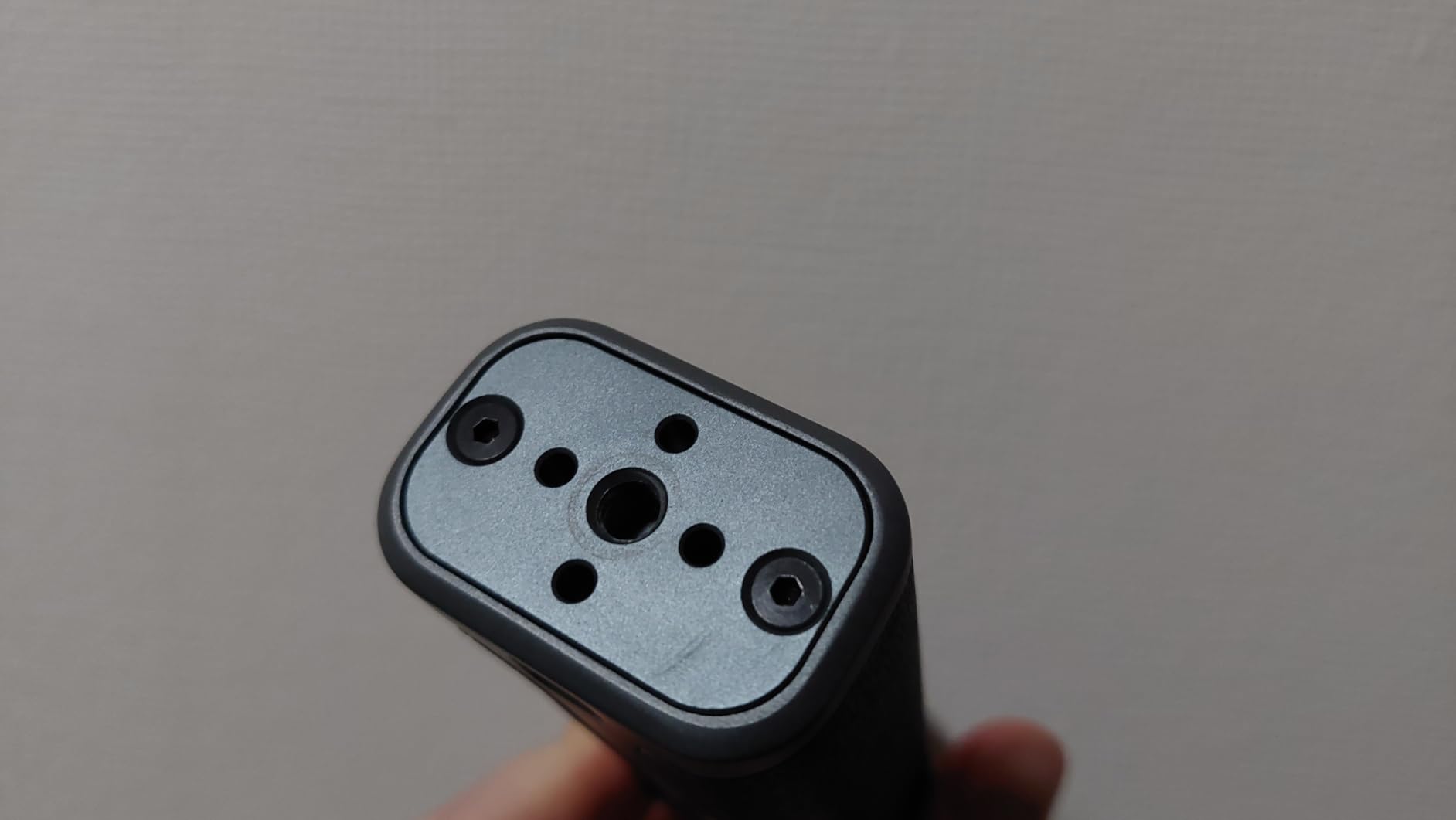
Compatibility is stated for DJI Action 3 and 4, DJI Pocket 3 and 4, and Insta360 X3 and X4, plus phones in the same ecosystem. A 220 g counterweight and a support arm are included for fine tuning, and everything arrives with a two-year manufacturer warranty and a soft carrying case.
Buyers consistently report smoother walking footage than the camera’s own stabilization, which is the entire point. The 4.8 average across 16 reviews is the highest in the group, with 89 percent five-star ratings.
Who the Hydra Alien Mini suits
Walk-and-talk creators and travel filmmakers will notice the improvement most, because constant vertical bounce is the defining flaw of small-camera walking shots. It suits anyone who wants cinematic movement without carrying a motorized gimbal.
Documentary and street shooters also benefit. No motors means no motor noise on the audio track, which is decisive for interviews where every hiss is audible.
Where the Hydra Alien Mini falls short
There is no tracking and no motorized smoothing, so it cannot follow a subject or execute programmed moves. If you need subject tracking, the GoPro Fluid Pro AI is the correct purchase instead.
Adjustment matters. Owners note it needs careful tuning or it will bounce, and the 0.6 kg weight ceiling rules out anything beyond a small camera or phone. At 2.2 pounds for the kit it is also noticeable in hand luggage, and the included case reportedly smells strongly for the first few days.
How to Balance an Action Camera Gimbal in Five Steps
Balancing is the step beginners skip, and skipping it is why a good gimbal produces bad footage. It takes about two minutes once you know the sequence.
- Power on and let it settle. Turn the gimbal on and let it sit for thirty seconds while the motors calibrate. Never balance with the motors off, because gravity then works on an unpowered arm that behaves differently.
- Set the pitch axis first. Slide the camera forward or backward along the slide rail until the camera stays put when you let go. If it tips, keep adjusting in one direction.
- Set roll next. Loosen the roll knob under the camera and rotate until the lens points straight up and the camera does not roll to either side.
- Set yaw last. Turn the body until the camera hangs level from the handle and does not rotate when you release it.
- Lock and test. Tighten every knob, then walk ten steps and pan. Any drift at that point means one axis is still off, and it is almost always roll.
Two habits save time in the field. Re-balance whenever you change camera, lens or cage, and carry a small coin or hex key because the adjustment screws are easy to strip on sand or mud. Forum threads repeatedly identify fiddly balancing as the biggest daily frustration, and it is entirely avoidable with practice.
Will It Fit Your Camera? GoPro Finger, 1/4-20 and Proprietary Mounts
Most action cameras use one of three mount systems, and this single fact decides whether a gimbal works for you. The GoPro finger and thumbscrew standard is used by GoPro HERO bodies and by most third-party action cameras. The 1/4-20 thread is the standard used by DJI Osmo Action and Insta360 mounts. Proprietary clamps are used by DJI Pocket bodies.
Here is how the picks handle it. The Hohem iSteady Pro 4 lists GoPro HERO5 through HERO10 and DJI Osmo Action bodies directly. The MOVMAX Blade Arm kit uses a universal 1/4-20 locking screw, so anything with that thread attaches. The GoPro Fluid Pro AI ships with a GoPro bracket, a phone bracket and a finger adapter.
The larger hybrid gimbals cover everything. The Zhiyun Crane M3S and FeiyuTech SCORP Mini 3 Pro kit both handle mirrorless, compact, action cameras and phones, while the Hohem iSteady MT3 Pro lists 4-in-1 mounting with an action camera adapter in the box. The FeiyuTech SCORP Mini 2 kit includes a GoPro adapter as standard.
Check the mount before you buy, not after. A gimbal listed only for phones will physically not accept a GoPro without an adapter you may have to buy separately, and proprietary clamps will not accept a 1/4-20 thread at all.
Gimbal vs In-Camera Stabilization: Do You Actually Need One?
You probably do not need a gimbal if the camera is strapped to a helmet, chest, bike bar or board. A fixed mount absorbs movement on its own, and a gimbal adds weight and a failure point in exactly the situation where you can least afford a broken arm.
You do need one if you are holding the camera while moving. In-camera stabilization works by cropping the frame and electronically warping what remains, which produces the swimming edges and warping that make action footage look unstable at high motion. A three-axis gimbal corrects the movement physically, so the full frame survives and the horizon stays level.
There is a real trade-off. HyperSmooth and similar modes cost resolution and crop, while a gimbal costs money, weight and a charging burden. Riders filming fast singletrack with the camera on a bar will often prefer in-camera stabilization for its zero-failure reliability, while anyone filming walk-and-talk or follow shots will prefer the gimbal by a wide margin.
What Actually Matters When You Buy an Action Camera Gimbal
Mount compatibility first. Confirm your camera attaches before anything else. This is the one decision that cannot be reversed with an adapter you do not own.
Payload is a ceiling, not a target. The small-payload balancing paradox catches people: a 100 g action cam can be harder to balance on a gimbal rated for 1.4 kg because the offset mount puts the weight further from the motor. A gimbal designed around action cameras balances better than a big one carrying a phone.
Battery claims assume ideal conditions. Runtimes listed by manufacturers are measured at room temperature with no tracking, no lighting and no wireless connected. Cold weather drains cells fast, and any rig running below freezing needs spare power or a plan to shoot in shorter bursts.
Water resistance is not waterproofing. Most of these are rated not water resistant, and one is listed simply as water resistant. Riding in rain or snow is a real risk to buttons and motor housings, so keep the rig in a pocket between runs.
App quality decides how good the gimbal feels. Companion apps are the most common source of complaints in this category, with registration failures and abandoned updates appearing repeatedly in owner feedback. A gimbal whose core features work without an app is worth more than one whose best mode needs a phone.
For a broader look at the tools around this decision, our guides on gimbals for run and gun shooting and action cameras for vlogging cover the cases where a larger rig makes more sense than a compact action camera stabilizer.
Frequently Asked Questions
Does an action camera need a gimbal?
Only if you are holding the camera while moving. If it is mounted on a helmet, chest, bike bar or board, the mount absorbs most shake and in-camera stabilization handles the rest. A gimbal earns its weight for handheld walk-and-talk shots, follow shots and any movement at speed, where in-camera stabilization crops the frame and warps the edges.
Can you put an action camera on a gimbal?
Yes. Nearly every 3-axis gimbal in this roundup is rated for action cameras, either as the primary device or as one of several supported types. Check the mount system before buying: GoPro bodies use the GoPro finger standard, DJI Osmo Action and Insta360 typically use a 1/4-20 thread, and DJI Pocket bodies use a proprietary clamp.
Which is better, a gimbal or a GoPro?
They solve different problems, and you usually want both. A GoPro is the camera that captures the footage. A gimbal is an accessory that makes that footage smoother and level. In-camera stabilization is free and rugged, while a gimbal keeps the full frame width and produces cinematic movement when you are walking or following a subject.
What action camera has the best stabilization?
Current-generation GoPro, DJI Osmo Action and Insta360 models all ship with strong electronic stabilization, and each has its own mode for high-motion footage. Even the best of them crops the frame and can warp edges at speed, which is the limit a three-axis gimbal removes when you need the whole frame to stay level.
What is the best gimbal for shooting action cameras?
For most people the Hohem iSteady Pro 4 is the safest choice, with a long review history and dedicated GoPro and Osmo Action support. Riders who want cheap smoothing should consider the MOVMAX Blade Arm Handheld Kit, and solo creators who need subject tracking should choose the GoPro Fluid Pro AI.
The Verdict: Which Action Camera Gimbal Should You Buy?
Start with the Hohem iSteady Pro 4 if you shoot GoPro or Osmo Action footage and want the most proven option. Its 684 reviews give it a reliability record nothing else here can match, and at 1.3 pounds it never gets in the way on a long day.
Buy the MOVMAX Blade Arm Handheld Kit if you already own a Blade Arm or want the cheapest real improvement to ride footage. Buy the GoPro Fluid Pro AI if you film alone and need tracking that starts from a gesture. If your kit is growing into mirrorless territory, the FeiyuTech SCORP Mini 3 Pro Kit covers the most camera types and bundles everything you need.
Whatever you choose, check the mount fits your camera, balance it before you leave, and keep it out of the water. Those three steps prevent nearly every complaint we found. The best gimbals for action cameras in 2026 are the ones you actually balance, not the one with the longest feature list.