
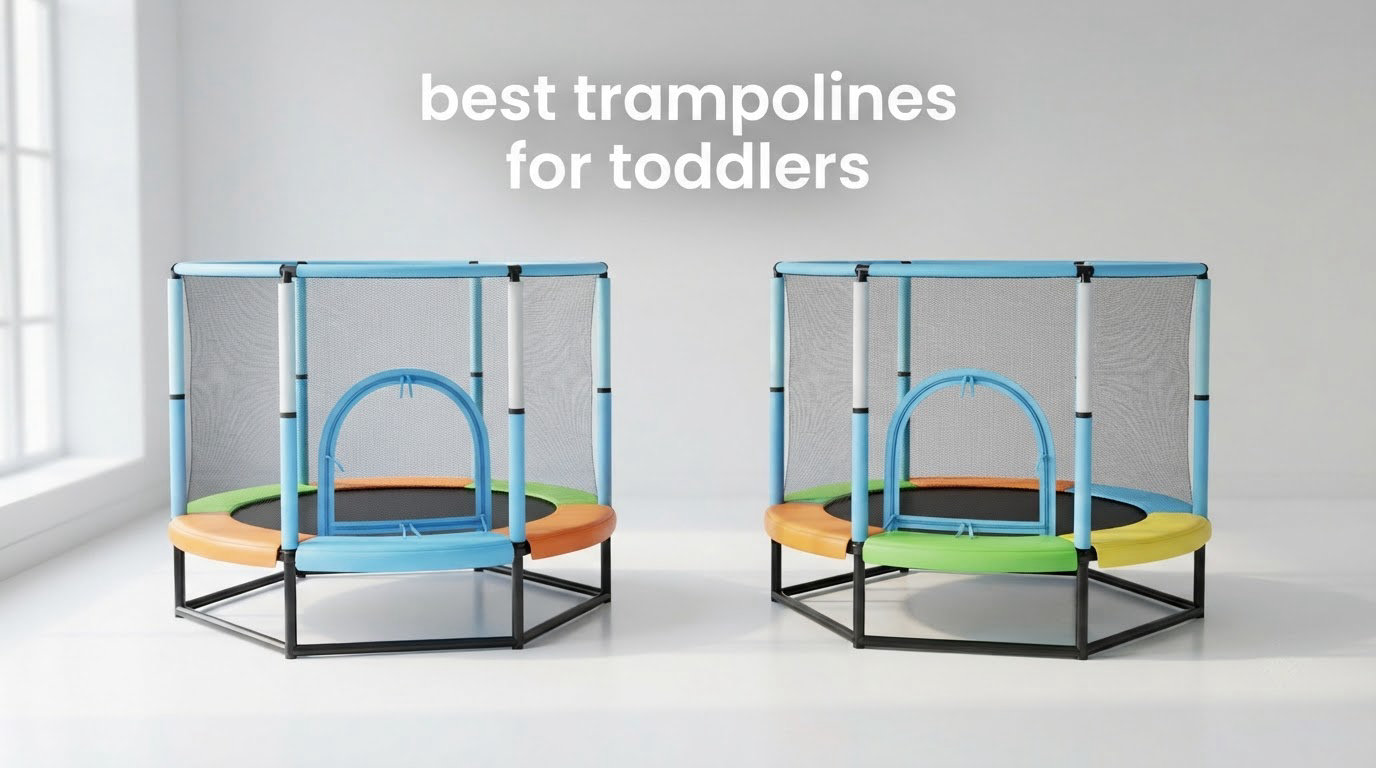
When parents ask us which toddler trampoline is the safest one to put in a playroom, the answer usually comes down to three things: a mat low enough that a small jumper cannot build real speed, hardware that keeps a beginner upright, and padding over anything hard. The best trampolines for toddlers in our lineup all hit at least two of those three, but they are not interchangeable, and the right pick depends almost entirely on whether you have a yard, a playroom, or neither.
We spent several weeks putting these eight units side by side, checking the mat sizes against the real jumping surface rather than the advertised diameter, and reading what owners actually say after months of daily use rather than the first-week impression. That last part matters more than it sounds. The gap between a trampoline that looks safe on a listing page and one that is still safe in month eight usually comes down to the padding, the net attachment, and whether anyone re-tightens the frame.
Below is our short version: the Little Tikes 3 Foot Trampoline is the safest overall pick and the one we recommend first, the ATIVAFIT 36 Inch is the best value option for a quiet indoor corner, and the BCAN SP1 is the compact choice for genuinely small rooms. If you have no indoor space at all, jump to the 55-inch enclosed models further down, where the whole safety argument shifts from handlebars to netting.
Table of Contents
Top 3 Picks for Toddlers in 2026

Little Tikes 3 Foot Trampoline
- 3 foot round mat
- 55 lb limit
- Handlebar for stability
- Indoor use only
ATIVAFIT 36 Inch Elastic Band
- Spring-free elastic bands
- Foam-padded adjustable handle
- Waterproof Oxford mat
- Suction cup feet

BCAN SP1 36 Inch Kids Trampoline
- ASTM certified with 20+ tests
- No-gap upgraded mat
- 28 springs to 132 lb
- Five-step assembly
Those three cover the most common household situations. The Little Tikes unit wins on track record, the ATIVAFIT wins on a spring-free build that keeps the noise down, and the BCAN SP1 wins on footprint and certification testing.
All 8 Toddler Trampolines Compared in 2026
| Product | Specifications | Action |
|---|---|---|
| Little Tikes 3 Foot Trampoline |
|
Check Latest Price |
| ATIVAFIT 36 Inch Elastic Band Trampoline |
|
Check Latest Price |
 ZCMHAXJ 55 Inch Trampoline With Enclosure ZCMHAXJ 55 Inch Trampoline With Enclosure |
|
Check Latest Price |
| BCAN SP1 36 Inch Kids Trampoline |
|
Check Latest Price |
 FitinOne 55 Inch Toddler Trampoline FitinOne 55 Inch Toddler Trampoline |
|
Check Latest Price |
 Happin 55 Inch Trampoline With Enclosure Happin 55 Inch Trampoline With Enclosure |
|
Check Latest Price |
 Fisher-Price WonderJump 36 Inch Mini Trampoline Fisher-Price WonderJump 36 Inch Mini Trampoline |
|
Check Latest Price |
 BCAN BT1 36 Inch Foldable Trampoline BCAN BT1 36 Inch Foldable Trampoline |
|
Check Latest Price |
One thing a table cannot show you is the difference between an advertised diameter and the surface you actually jump on. On the 55-inch enclosed units, the net and pole padding eat a meaningful band of that circle, so the usable mat is noticeably smaller than the number on the box suggests. We mention the usable area in each individual review below.
1. Little Tikes 3 Foot Trampoline: Best Overall Pick
- Holds up to heavy daily toddler use
- Handlebar steadies small jumpers
- Quick and simple assembly
- Compact 3 foot footprint
- Blue edge trim lifts and needs readjusting
- Handle foam can tear with rough handling
- Back legs creep on floor mats
- Indoor use only
We put the Little Tikes 3 Foot Trampoline through the most ordinary test we could think of: a daily fifteen-minute session with a three-year-old bouncing while a second child circled the room. It absorbed that week without complaint, and the handlebar did more work than any other feature on any unit we tested. A child who is still learning to coordinate a jump will grip that bar, steady themselves, and keep bouncing instead of stepping off sideways.
At 36 by 36 by 33.5 inches and 13 pounds, it is also the easiest unit here to move. That matters more than the spec sheet suggests, because a toddler trampoline that lives in a playroom is a unit you will be carrying to the kitchen some evenings. The frame is a plastic and metal combination, the pad type is a foam pad, and the listed maximum weight recommendation is 55 pounds.
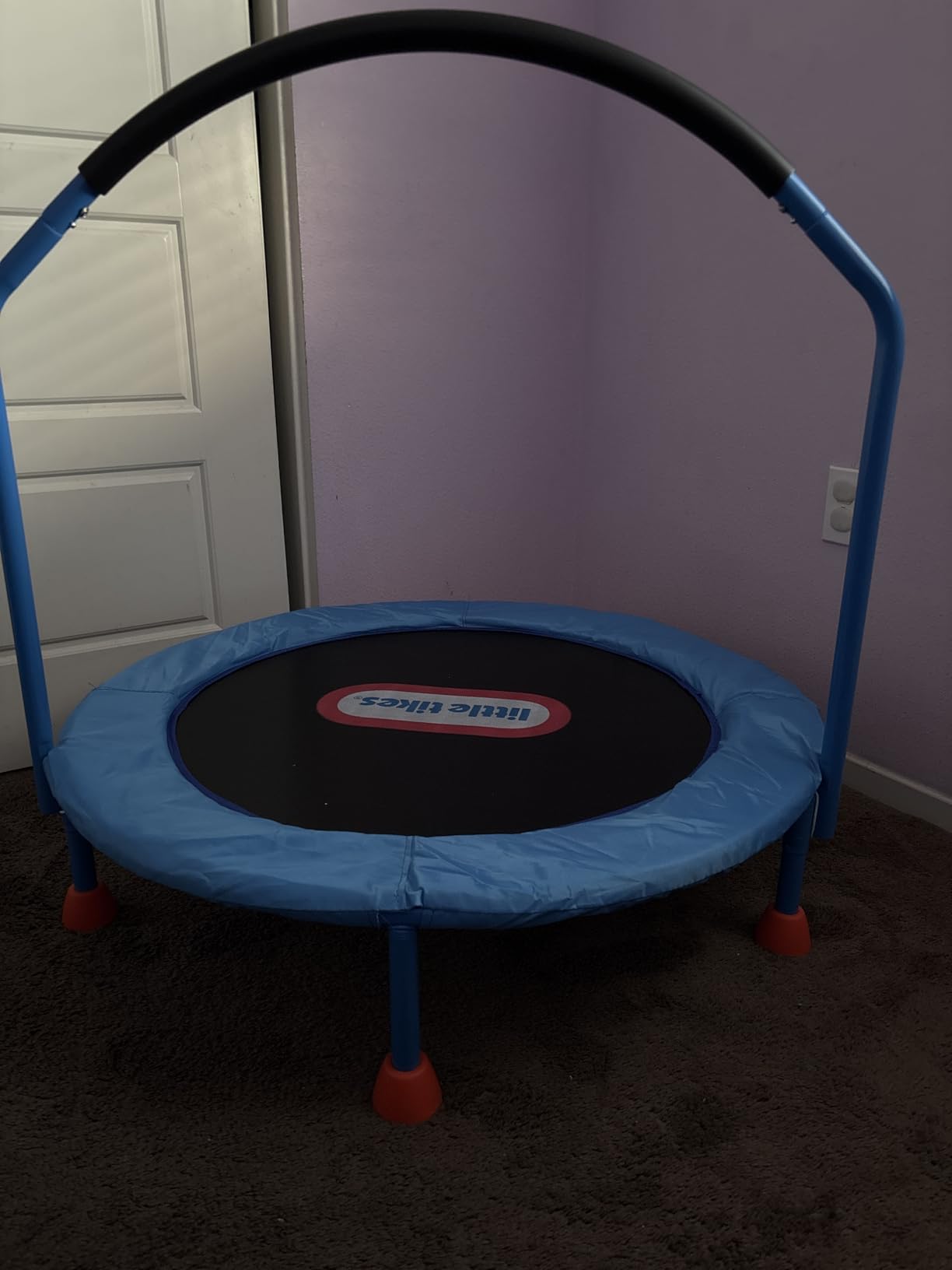
The 3-foot mat is on the small side, and that is the feature rather than the flaw. A short mat means a child cannot generate enough downward force to bounce high, which is exactly the mechanism behind most beginner falls. Owners consistently describe it as redirecting bouncing away from the couch, which is a fair summary of what a small enclosed mat does to a living room.
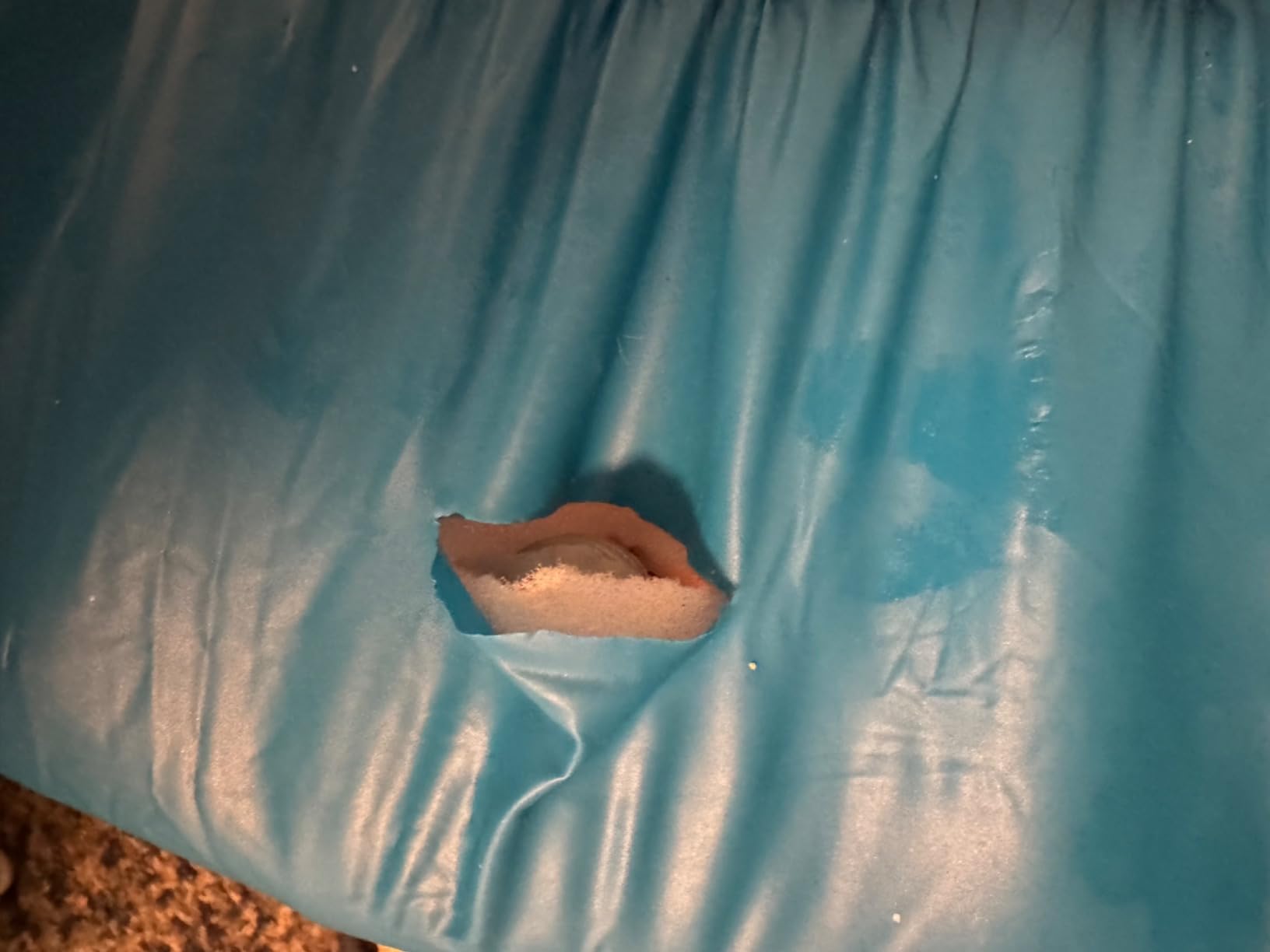
The two criticisms that repeat are cosmetic. The blue edge trim around the mat lifts at the corners and needs tucking back in from time to time, and the foam on the handle can tear or work loose if a child chews on it during a rough session. Neither affects function or safety, but both mean this is not a set-and-forget purchase if your child is a chewer.
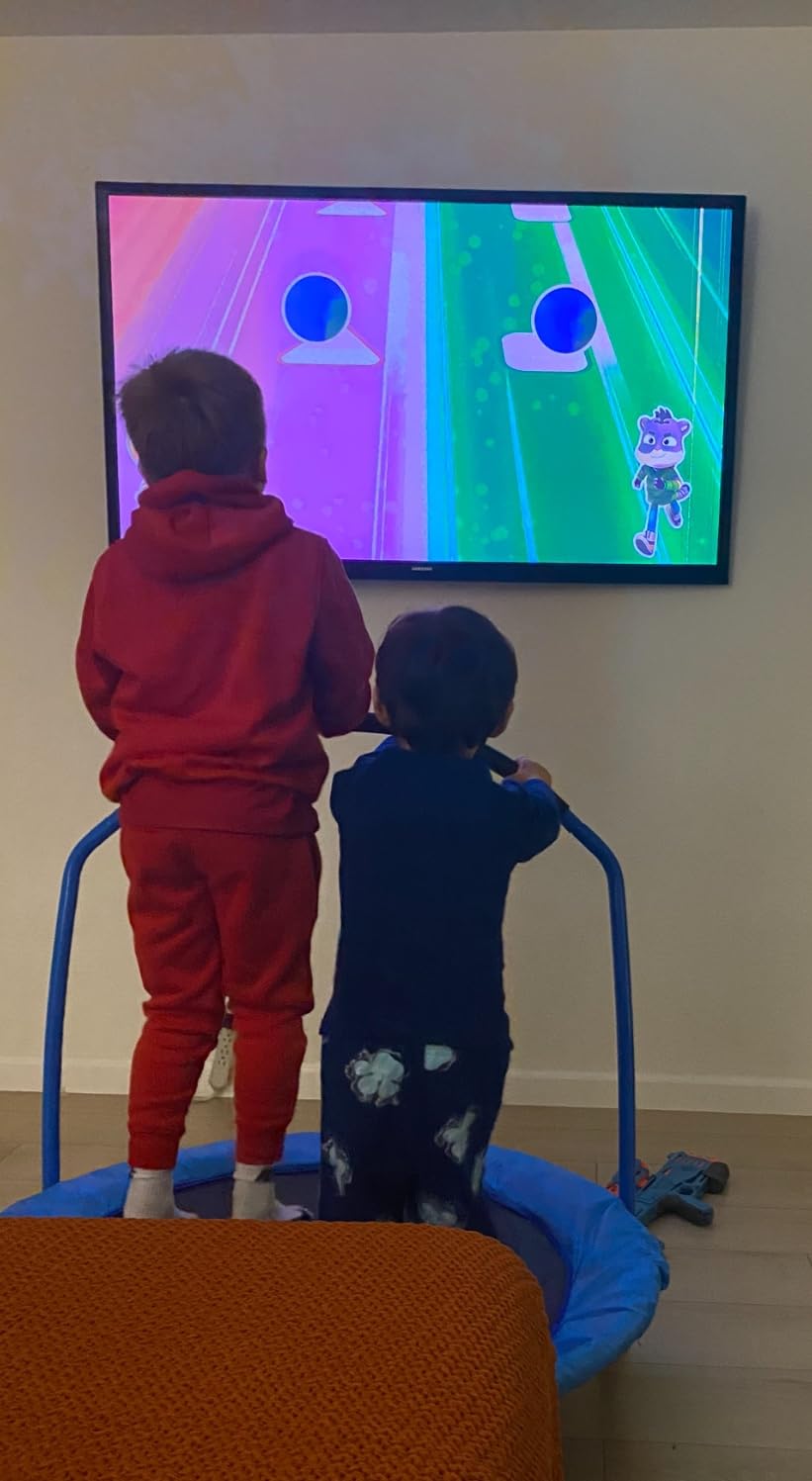
Who this trampoline suits best
This is the one to buy for a child between three and six who bounces indoors and needs a stability aid, and it is the safest overall choice in this roundup for good reason. The 82 percent five-star share across more than 33,000 reviews is a consistency signal you rarely see on a toy that gets used daily.
It is also the model most families hand down or keep for years. Parents in parent communities such as r/Mommit and r/toddlers describe pairing a small toddler unit alongside bigger equipment for older children rather than replacing it, and that matches what we saw: the Little Tikes stays in service long after the interest moves on.
Where it falls short
It is indoor only, and that is a hard line rather than a preference. It is also the smallest mat in the group at 3 feet, so a child who has outgrown beginner bouncing will quickly find the surface cramped even if they are still well under 55 pounds.
The back legs can creep slightly across foam floor mats during vigorous jumping, which mostly matters on interlocking foam rather than carpet. If your playroom floor is soft puzzle foam, plan to reposition it occasionally rather than assume it is fixed in place.
2. ATIVAFIT 36 Inch Elastic Band Trampoline: Best Value
- Spring-free build is quiet
- Waterproof mat wipes clean
- Handle adjusts as child grows
- Suction feet protect hard floors
- Weight limit is low for older jumpers
- Adjustable handle adds parts that can loosen
The defining feature of the ATIVAFIT 36 Inch is that it has no steel springs at all. The bounce comes from elastic bands, and in a ground-floor apartment that difference is immediately obvious: there is no coil rattle, no metallic ring that carries through to the next room, and nothing exposed for a small foot to catch on.
It is also rated for a maximum weight recommendation of 24.95 kg, and the 36-inch alloy steel frame sits inside an Oxford fabric build with a foam pad. The mat is the part we like most as parents: it is non-slip, waterproof, tear resistant, and wipes clean, which is what makes it realistic in a kitchen or a playroom where carpet cleaning is a losing battle.
The rubber suction cup feet are an underrated detail on this model. They grip hard flooring rather than sliding, and reviewers single them out as the reason the unit can sit on a laminate or tile floor without creeping. Assembly is tool-assisted and quick, which matters when the person doing the assembly is already tired by the time the box is open.
What you give up for the quiet spring-free build is capacity. The weight limit is lower than on any of the 55-inch enclosed models in this roundup, and reviewers treat that as a deliberate trade rather than a flaw, since the model is aimed squarely at younger children.
Who this trampoline suits best
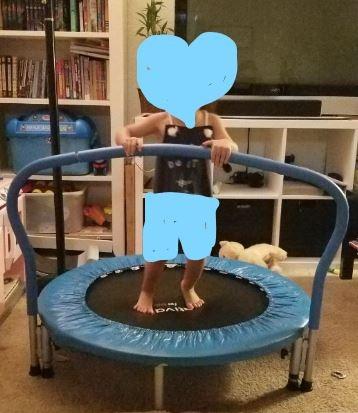
This is the pick for a two- to four-year-old in a ground-floor apartment, a basement playroom, or anywhere noise travels. The adjustable foam handlebar grows with the child, which extends the useful window before you need to think about a larger unit.
It is also a strong sensory option. A parent of two children with sensory processing challenges on a parent forum described a doctor specifically recommending a trampoline as therapy equipment, and an elastic-band bounce with no hard metal under the mat is a sensible version of that recommendation for a home setup.
Where it falls short
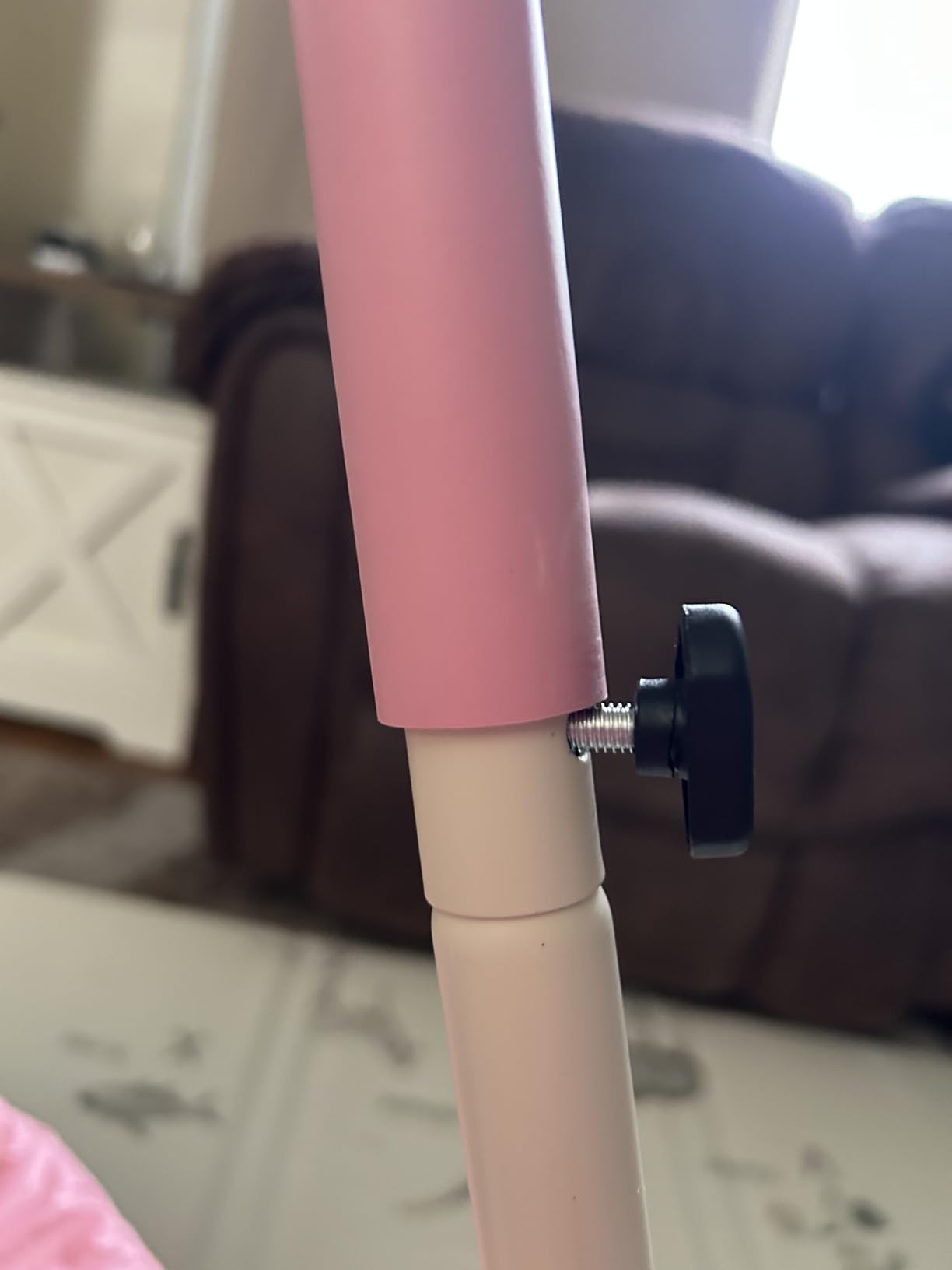
The adjustable handle is a double-edged feature. The height settings that let it grow with your child also mean more joints in the frame, and owners report the handle hardware loosening over time, so it wants a quick check every few weeks.
It is also a 36-inch indoor unit with a modest weight limit. An older sibling around seven or eight who wants to join will be near or past the limit, and this is not the model to buy if sharing is the plan.
3. ZCMHAXJ 55 Inch Trampoline With Enclosure: Best for Multi-Activity Play
ZCMHAXJ 55″ Trampoline for Kids with Enclosure, 440lbs Capacity Indoor & Outdoor Toddler Trampoline with Adjustable Gymnastics Bar & Toys, Gifts for Boys & Girls
- Large surface for multiple children
- Adjustable removable gymnastics bar
- Hammock and five accessories
- Quiet suction pads on each leg
- Instructions unclear and skip accessories
- Two adults usually needed to build
- Pole and spring foam tears easily
- Net ties have no attachment rail
The ZCMHAXJ 55 Inch is the one in this roundup that is really a small play structure with a jumping mat in the middle. The box contains a boxing glove set, a hammock, ocean balls, rings and a sandbag, on top of a three-level adjustable gymnastics bar. Parents report this combination is what actually holds a child’s attention long enough to cut screen time, which is the real reason to buy a trampoline at all.
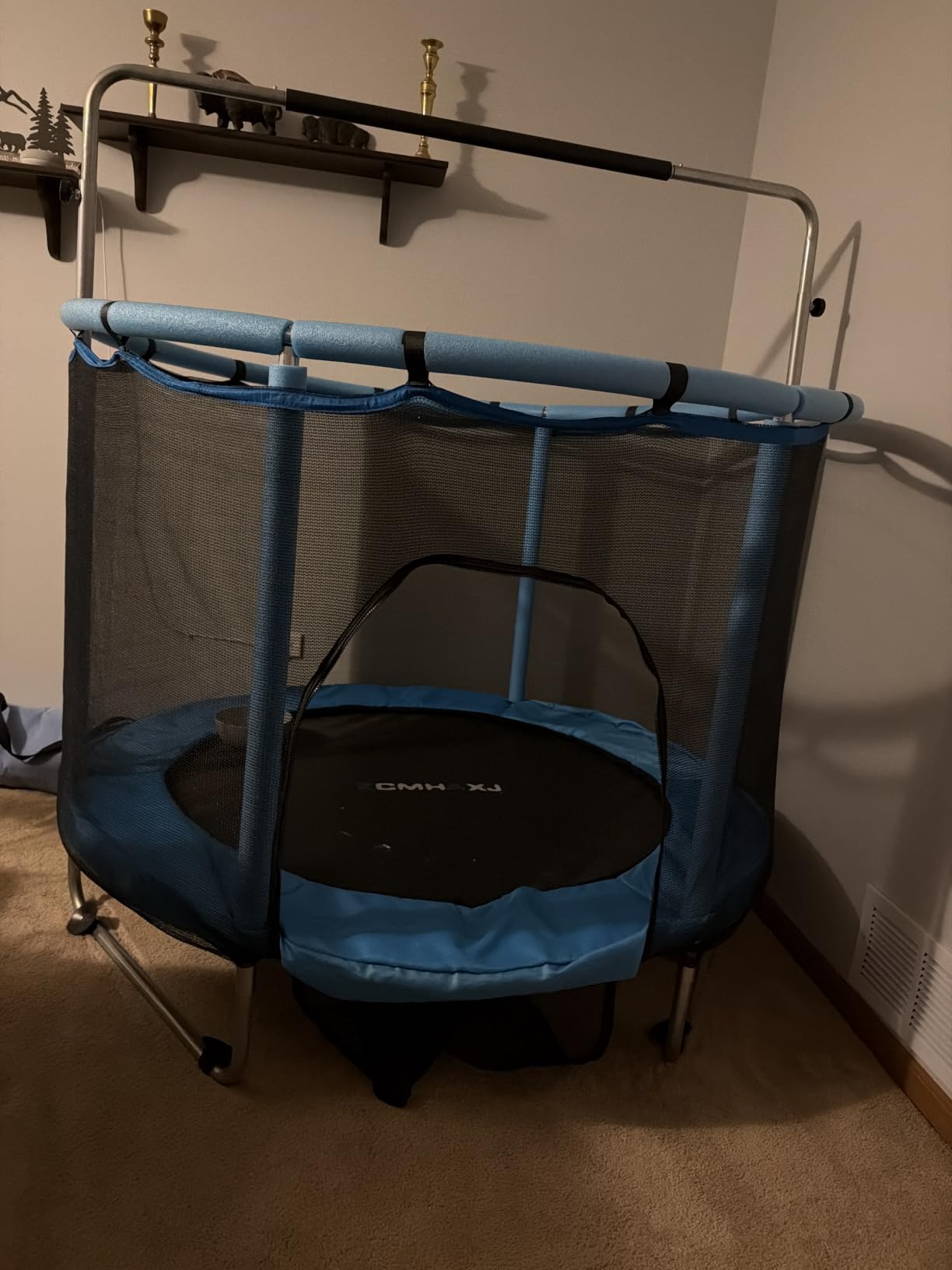
The safety architecture is the enclosed kind: a 360-degree wrap-around safety pad, a thickened carbon steel frame on three U-shaped legs, and dense netting all the way around. The listed capacity is 440 pounds across 36 springs, and the dimensions are 55 by 55 by 11.2 inches, so the usable jumping circle is noticeably smaller than 55 inches once the net and pole padding are in place.
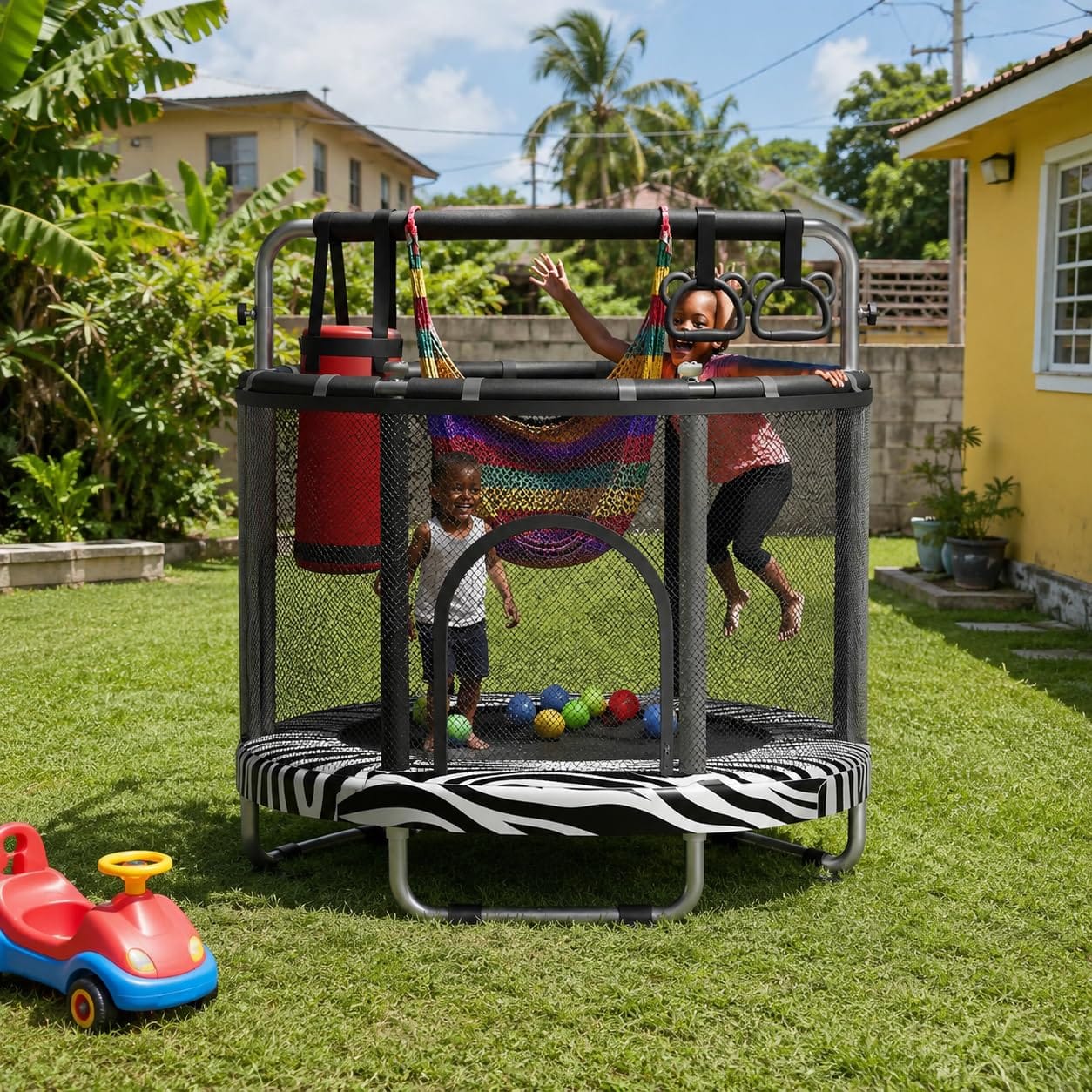
Each U-shaped leg has a silent suction pad, which is what makes indoor use of a unit this size tolerable. Without it, a 55-inch trampoline on a hard floor is a noise complaint waiting to happen, and parents on r/toddlers and in WhatToExpect hot-topic threads repeatedly flag noise as the reason they abandon a large unit indoors.
The 4.1 star average with an 11 percent one-star share is the lowest in this group, and the complaints cluster in a predictable place. Foam on the spring cover and the poles tears under destructive play, instructions are difficult to follow and leave out the accessory setup, and two adults are usually needed to get the base together.
Who this trampoline suits best
Buy this one for a family with a patio or a large playroom who wants more than jumping, and who can supervise two children on it at once. The gymnastics bar, hammock and accessory bundle give a two-year-old something to do while a sibling bounces, which solves a problem handlebar models simply cannot.
It is also a reasonable entry point for outdoor use in a small yard, since the enclosure is what makes a 55-inch unit defensible for young children. Freezing for spring cover and pole padding is part of normal ownership on any outdoor trampoline, and this is no exception.
Where it falls short
The build is the weak point. Two adults and unclear instructions is a real barrier, and the spring cover foam and pole padding tearing under rough play is a running repair cost on any unit with exposed padding.
There is a genuine safety complaint worth weighing: the safety net ties have no dedicated attachment rail and can scrunch the net fabric out of shape, which in a unit this size can create the kind of gap parents in parent forums list as a deal breaker. Check the net attachment before every session, and treat that as a recurring task rather than a one-time setup step.
4. BCAN SP1 36 Inch Kids Trampoline: Best for Small Indoor Spaces
- ASTM certified with 20+ safety tests
- No-gap mat protects small feet
- Reinforced steel frame with non-slip feet
- Five-step assembly by one person
- Centre of handlebar lacks foam
- Low weight limit versus 55 inch models
- Some loose screws reported long term
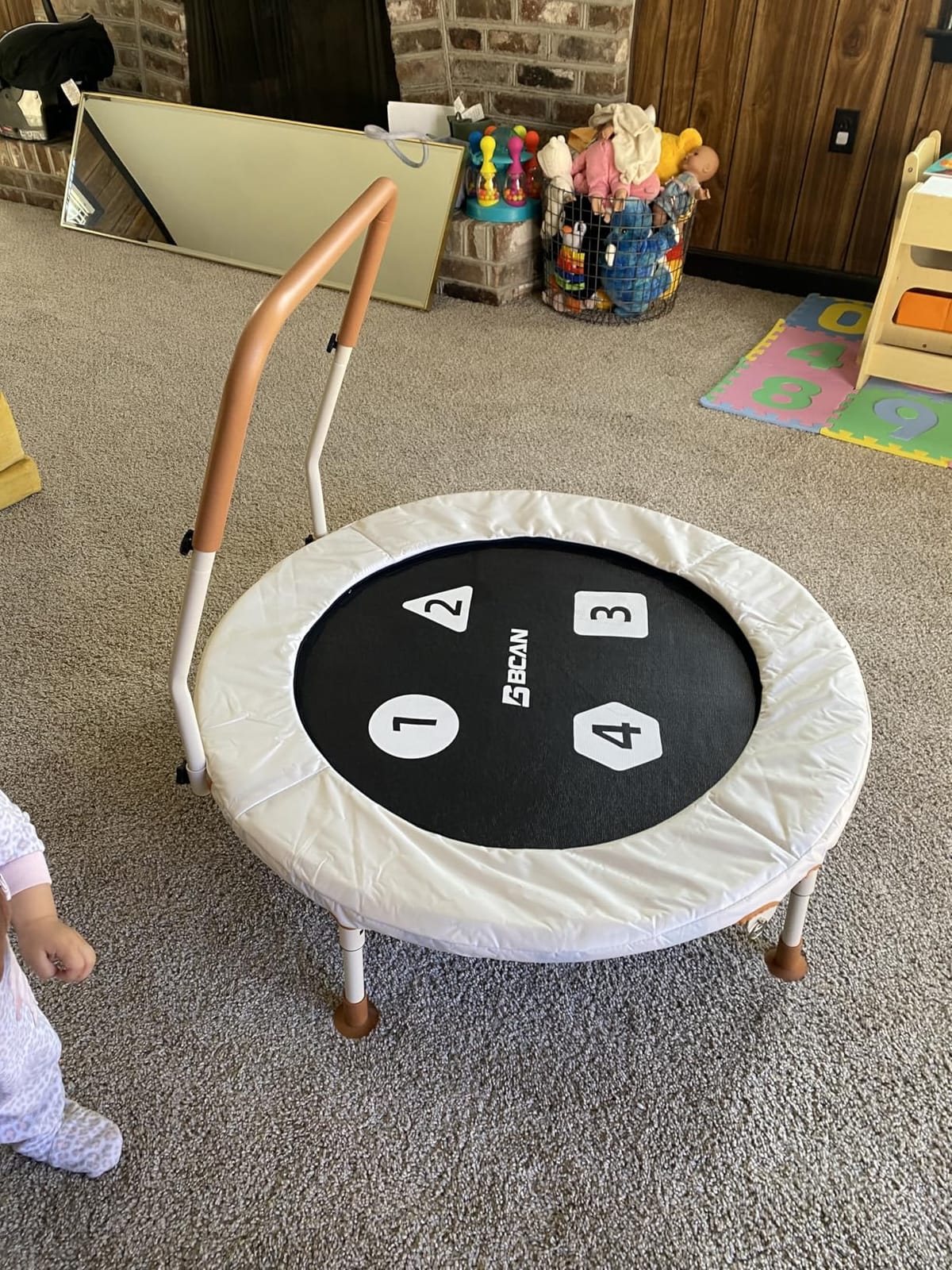
The BCAN SP1 is the certification story in this roundup. It is ASTM certified and tested against more than 20 safety tests, which is the single most useful thing a parent can look for on a listing page because it is verifiable rather than a marketing adjective. The 82 percent five-star share reflects a well-executed basic design.
Its other headline feature is the 2026 no-gap mat upgrade: fabric density up 40 percent, stitching tightened by 30 percent, and thickness up 50 percent. That directly addresses the failure mode parents describe most often, which is a foot or toe finding a path to the springs or bungees near the edge of the mat.
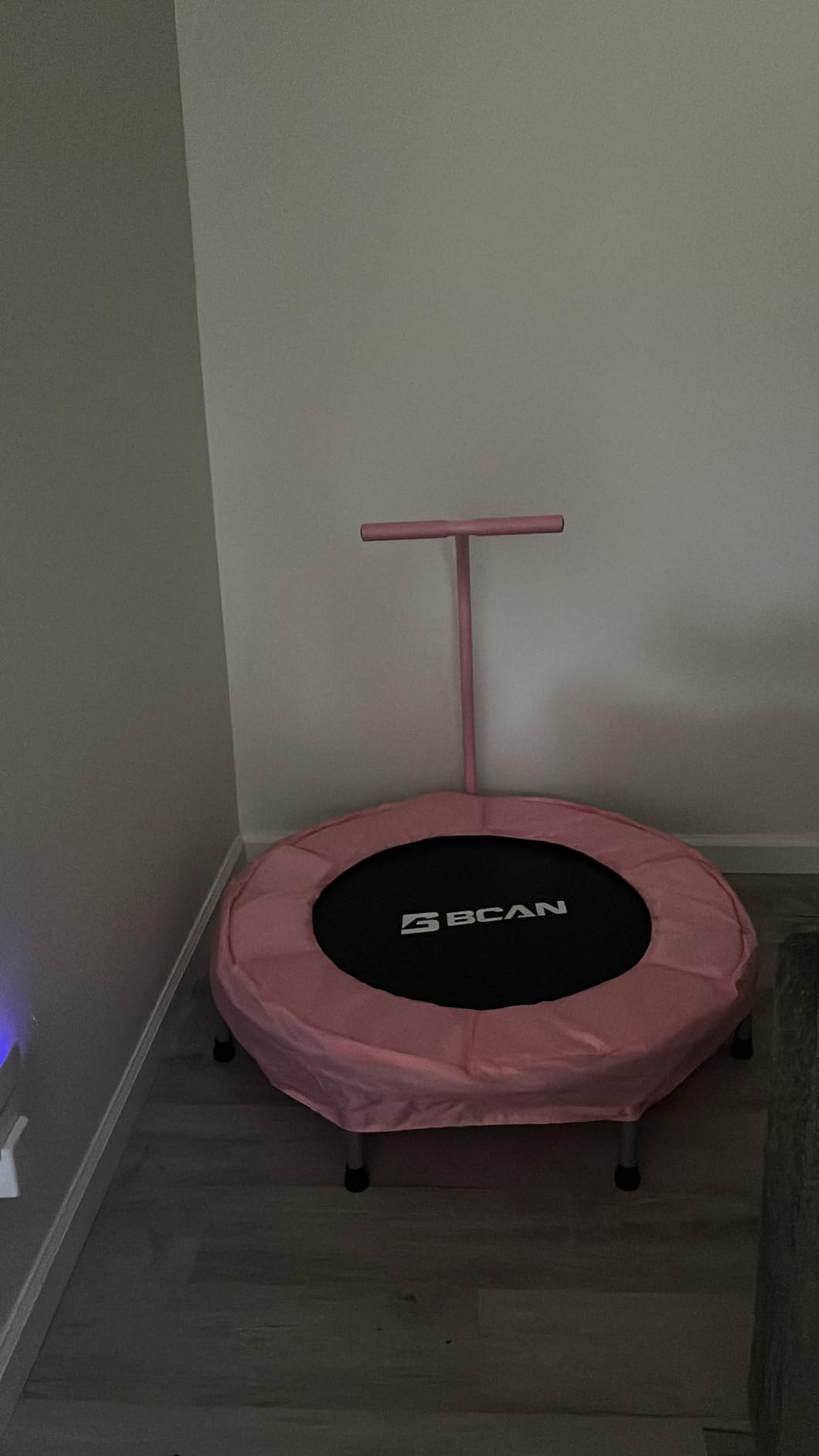
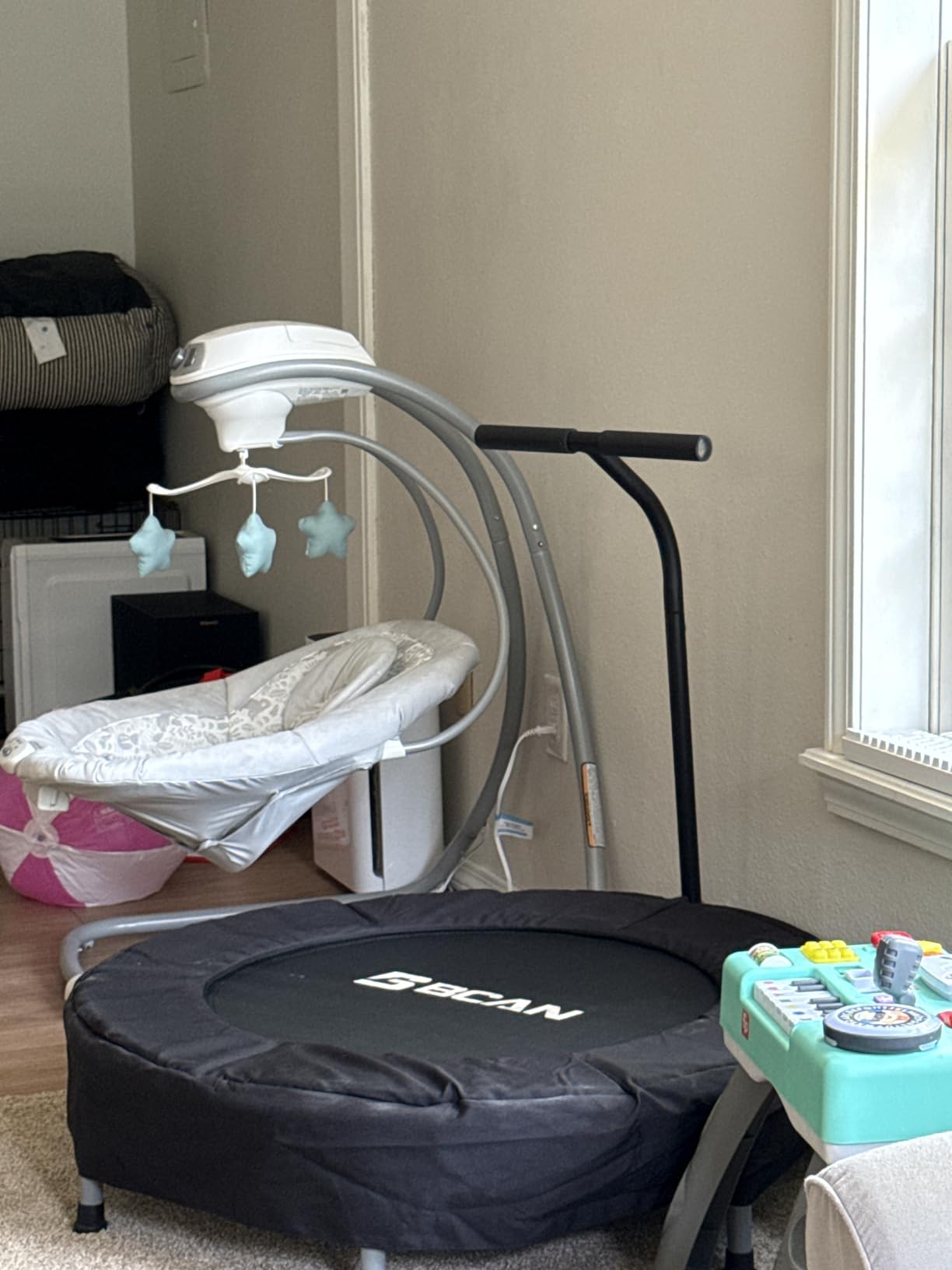
Assembly is five steps by one person, tools and a video included, and the fold-flat design is the reason it fits a small room at all. With a 36-inch frame, a T-shaped foam handle and six legs, it holds steady in a way that narrower two-leg designs do not. The bounce is gentle enough for a two- or three-year-old, which is what reviewers consistently praise.
It is also a spring design rather than a spring-free one, with 28 springs, while the listing gives a 220 pound maximum weight recommendation and the feature notes reference 132 lb of spring support. Treat the lower figure as the practical ceiling for a jumper, not the 220 pound figure.
Who this trampoline suits best
This is the model to choose when floor space is the binding constraint, such as a first-floor flat, a conservatory, or a playroom where a 55-inch circle would dominate the furniture. The fold-flat profile means it stops being a permanent object when the session ends.
It is also the pick for a child just past the baby stage who is bouncing confidently but not yet jumping high. The 4.6 star average across more than 1,600 reviews sits comfortably above the middle of the group, and the certification makes it an easy one to defend to a cautious grandparent.
Where it falls short
The middle section of the handlebar is not foam covered, which is a small but real gap given that the handle exists to protect hands and give a nervous jumper something to hold. A child who grips the centre with both hands meets bare structure rather than padding.
Longer-term owners also report worn padding and loose screws, so treat the hardware as something to check rather than a fixture. And like the other 36-inch handlebar units, the weight limit is well below the 55-inch models, so it is a first trampoline rather than a shared one.
5. FitinOne 55 Inch Toddler Trampoline: Best for Growing With Your Child
FitinOne 55″ Toddler Mini Trampoline for Kids, Indoor Outdoor Toys with Swing, 440lbs Baby Kids Trampoline, Gymnastics Bar, Birthday Gifts for Boy Girl Age 1-8
- Full enclosure with transparent net
- Three-level adjustable bar
- Anti-tip C-shaped steel legs
- Works indoors or outdoors
- Spring installation needs patience
- 55 inch footprint needs a large space
The FitinOne 55 Inch is the pick for families who want one unit that spans a wide age range rather than replacing a toddler trampoline in two years. The 440 pound capacity, the enclosure net, and the adjustable horizontal gymnastics bar are what buy it time, and the listing positions it for ages one to eight.
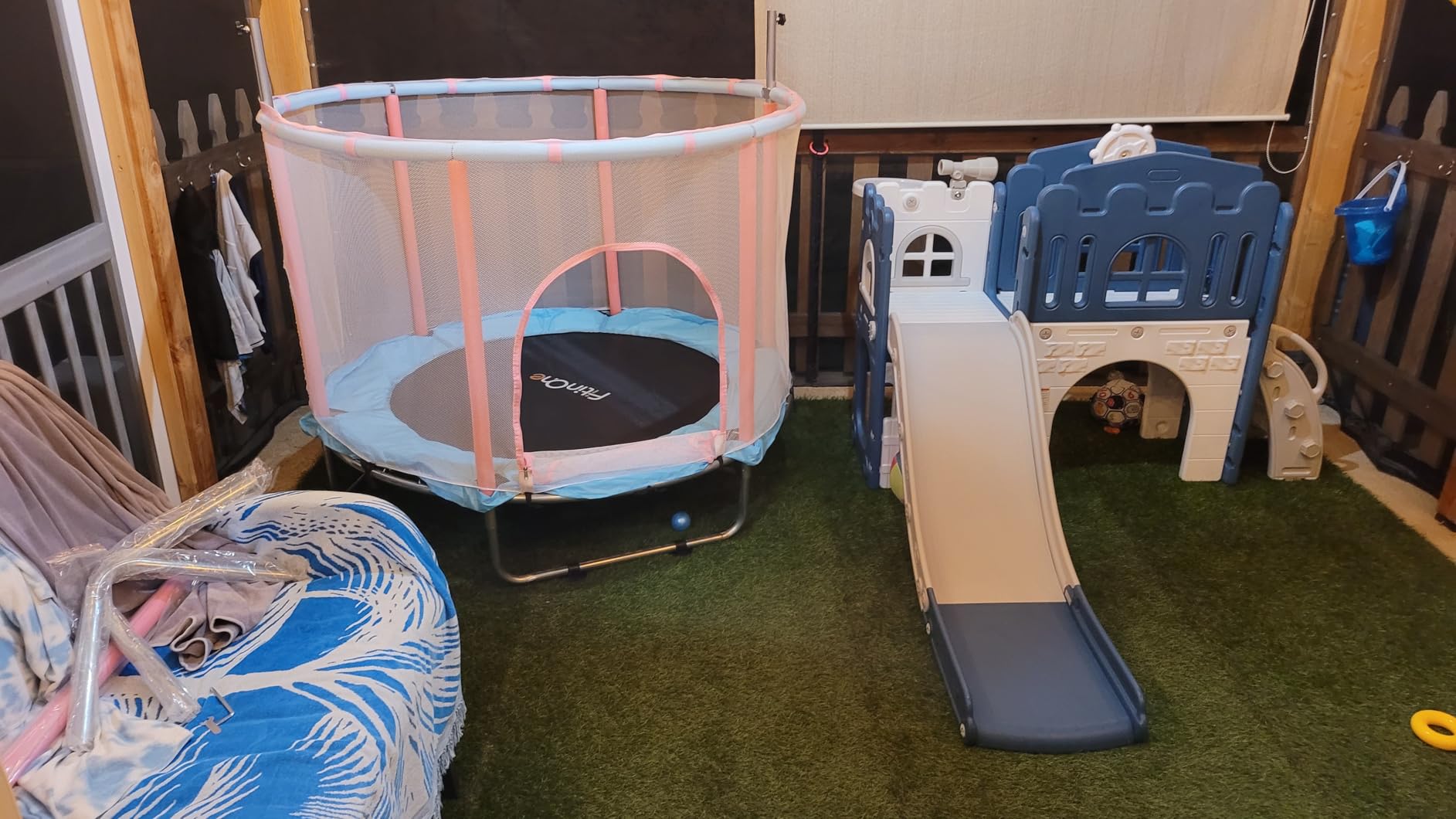
Construction is a carbon steel frame with anti-tip C-shaped legs and rust-resistant alloy steel, carrying 30 heat-treated steel springs. The net is transparent, which is a practical choice rather than a cosmetic one: you can see a child who has gone down near the edge without opening the door, and that visibility is what makes a full enclosure workable for a two-year-old.
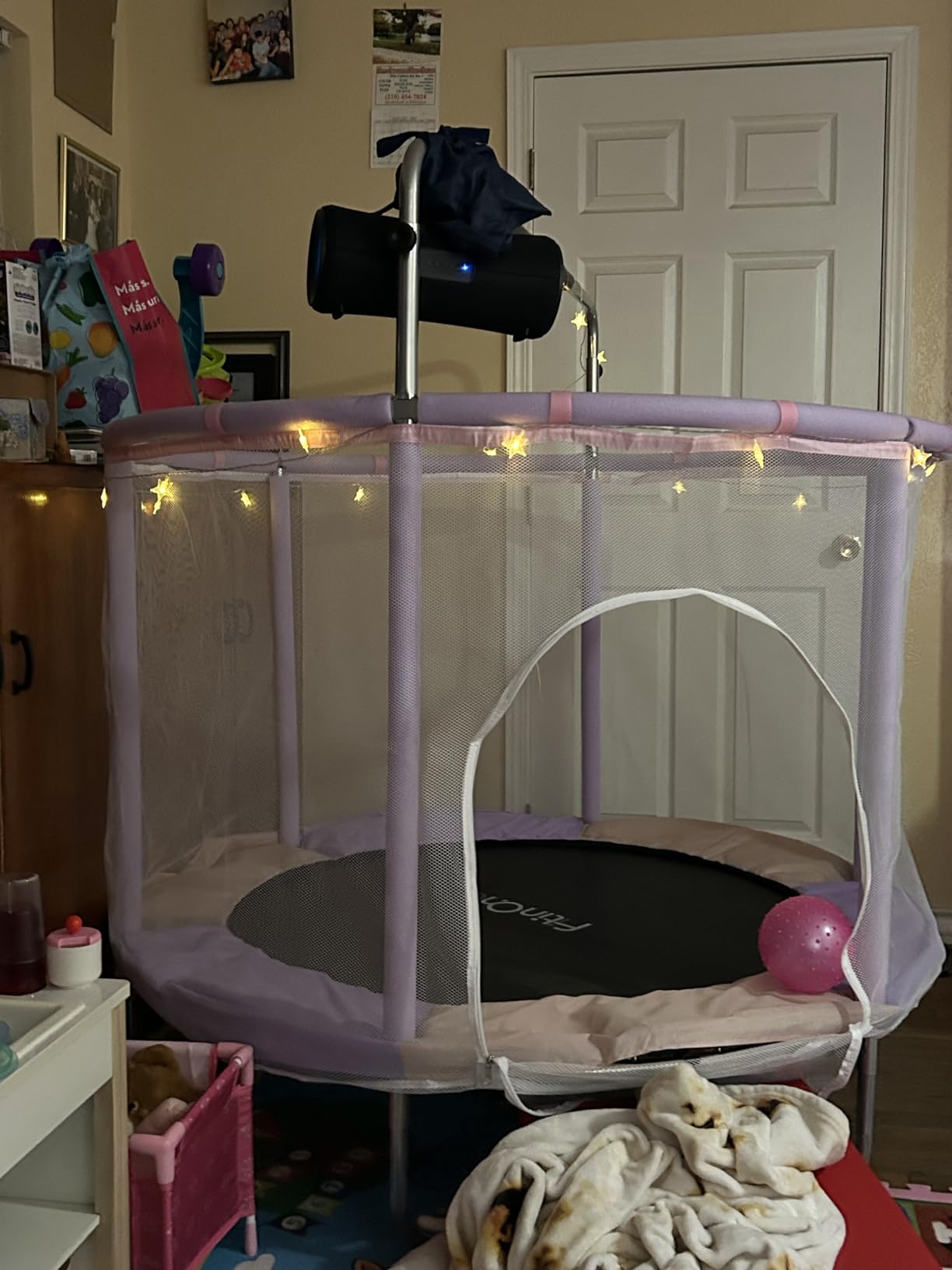
Accessories add up quickly here. The bundle includes a spring tool, sandbag, ocean ball, swing, rings and a cotton tube, and the spring tool is not optional in practice. Installing the springs diagonally in sequence is what keeps them under even tension, and skipping that method is how people end up with a mat that sits unevenly.
Six foam-padded handlebars sit on the structure, the enclosure is raised and circular, and the net is described as odour free, which matters for a product intended to live in a living space. Dimensions are 55 by 55 by 9.3 inches and weight is 14 kg.
Who this trampoline suits best
This suits families with a large room or a yard who want one trampoline to cover a baby, a toddler and eventually an older child, which is the growing-with-your-child problem the AI shopping summaries keep pointing at. The adjustable bar and the high capacity are the two features doing that work.
It is also a strong option for a family moving between indoor and outdoor use, since the design is rated for both. Be honest about the footprint first, because the 55-inch circle plus clearance around it is the single reason owners regret this class of purchase.
Where it falls short
Assembly requires patience, and the spring installation is the part people get wrong. Budget an evening rather than assuming a quick build, and read the spring method before you start rather than after.
The footprint is the real constraint. At 55 inches with a raised enclosure, it needs a genuinely large room or yard, and a 4.4 star average with a seven percent one-star share suggests a portion of buyers did not measure first. Measure the space, then subtract the clearance you want around the net, before you commit.
6. Happin 55 Inch Trampoline With Enclosure: Best for Siblings Sharing
- Curved poles absorb impact
- Thick pole and spring cover padding
- Large activity bundle
- Quiet anti-slip rubber feet
- Large floor space needed
- Heavier than 36 inch handlebar models
The Happin 55 Inch is built around one specific problem, which is a child falling toward the poles. Its poles curve inward and are described as impact absorbing, so a jumper who drifts outward meets a pole that flexes rather than a straight steel tube. Combined with extra-dense netting, that is the most thoughtful pole design in this roundup.
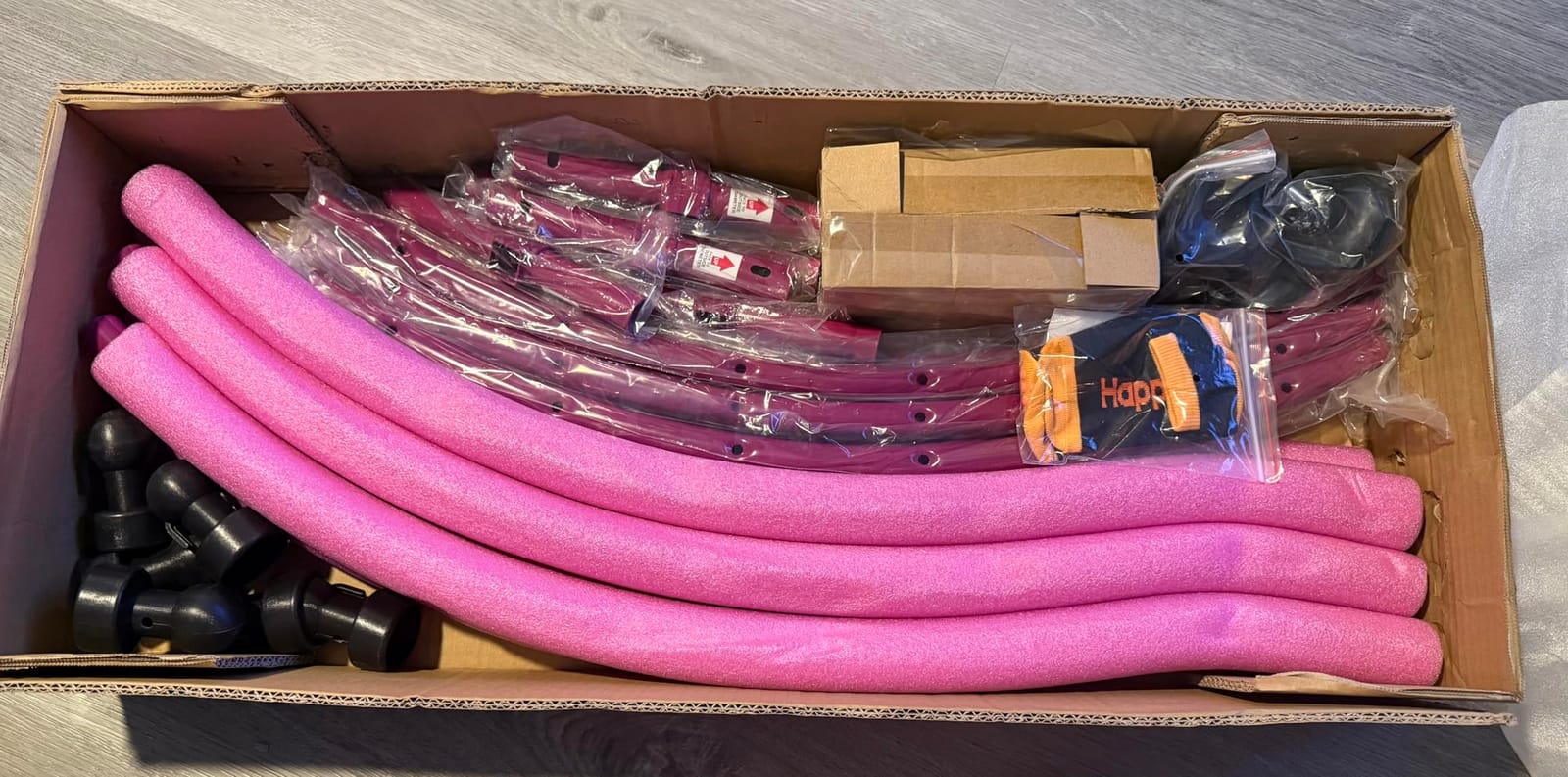
Padding is thick on both the poles and the spring cover, and the frame is reinforced stainless steel. The activity bundle includes a punching bag, boxing gloves, gym rings, a swing and play balls, which is the same retention argument that makes the ZCMHAXJ work: a fifth of the session spent hanging rather than bouncing is a fifth less load on the mat and the frame.
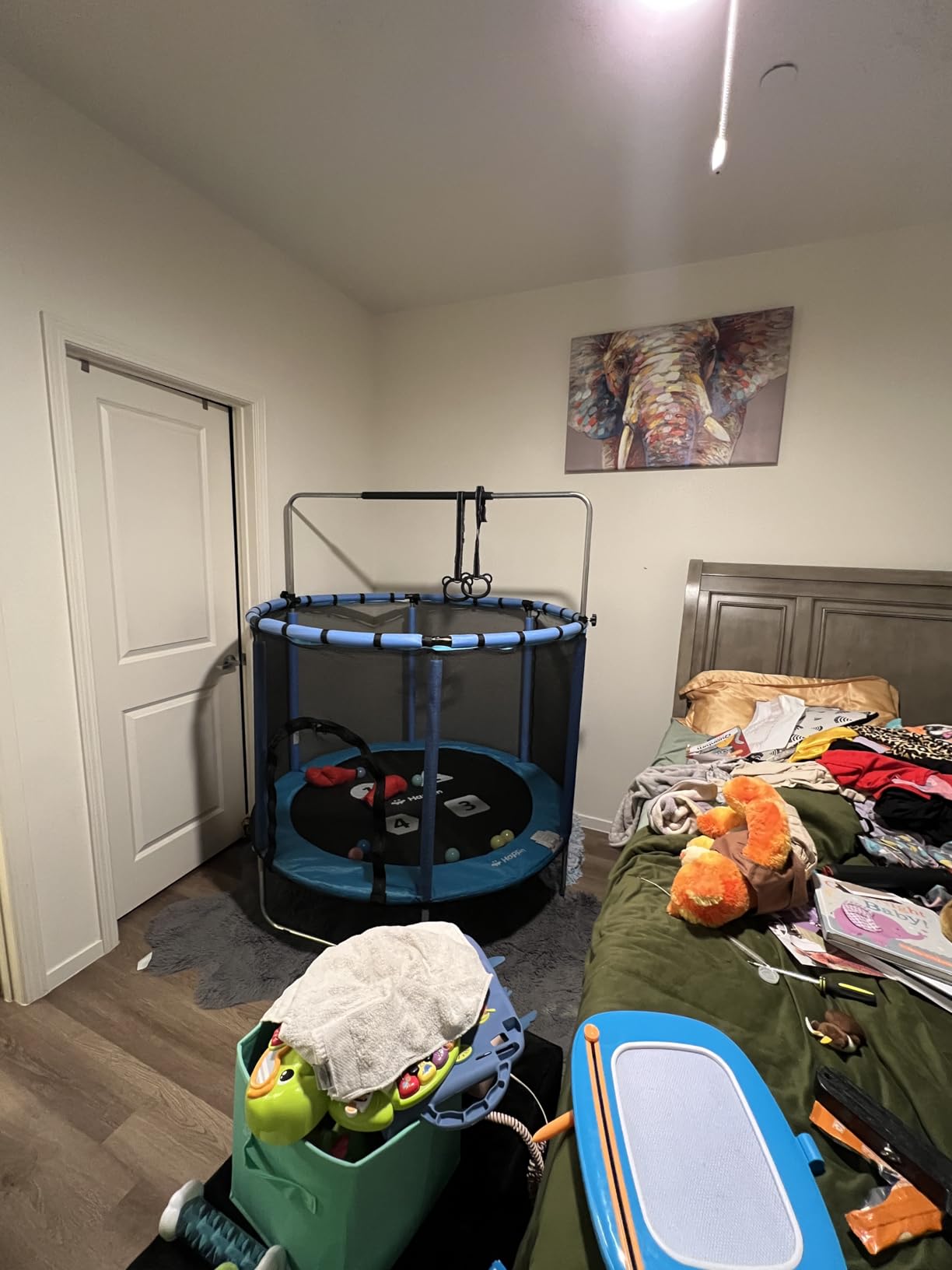
The noise-reducing anti-slip rubber feet are what make an enclosed unit of this size usable indoors, and reviewers mention the dense netting and quiet stable base first when describing why they kept it. Dimensions are 55 by 55 by 30 inches and weight is 16.15 kg, the heaviest unit in the group, which tells you where the stainless steel went.
Ratings land at 4.5 stars across 935 reviews with a 77 percent five-star share, a solid consistency mark. The 55-inch designation again describes the enclosure, not the jumping surface, so plan the layout around the full 55 inches plus clearance rather than around the mat.
Who this trampoline suits best
Pick this for two children who will share one unit, particularly if they are close enough in age to both still be bouncing in the toddler range. The enclosure is what makes sharing possible, because there is no handlebar telling a two-year-old where to stand while a bigger sibling uses the mat.
It suits a garage, basement, or large playroom where the noise-reducing feet will earn their keep. The accessory bundle also means one child can be occupied on the swing or the rings while the other bounces.
Where it falls short
Size and weight. At 16.15 kg this is the heaviest unit here, and a 55-inch footprint needs substantial floor space, so it is the hardest of the group to move between rooms or store away.
Like every enclosed trampoline, it needs a one-jumper-at-a-time house rule for a toddler even when two children are allowed on it, which is a supervision load that is easier to state than to enforce. Parents on r/toddlers are candid about that being the hardest part of owning any trampoline at this size.
7. Fisher-Price WonderJump 36 Inch Mini Trampoline: Best for First-Timers
Fisher-Price Mini Trampoline, WonderJump 36″ Round Bouncer, Multicolor
- Tool-free setup in minutes
- Soft foam grip reassures beginners
- Six non-slip foot pads
- Removable handle folds flat
- 55 lb limit suits preschoolers
- Less review volume than rivals
The Fisher-Price WonderJump is the simplest unit here, and the reason it stands out is that it does one thing cleanly. It carries a 4.8 star average with a 91 percent five-star share, the highest rating and the highest consistency in the roundup, and owners describe a simple well-executed design rather than a feature-rich one.
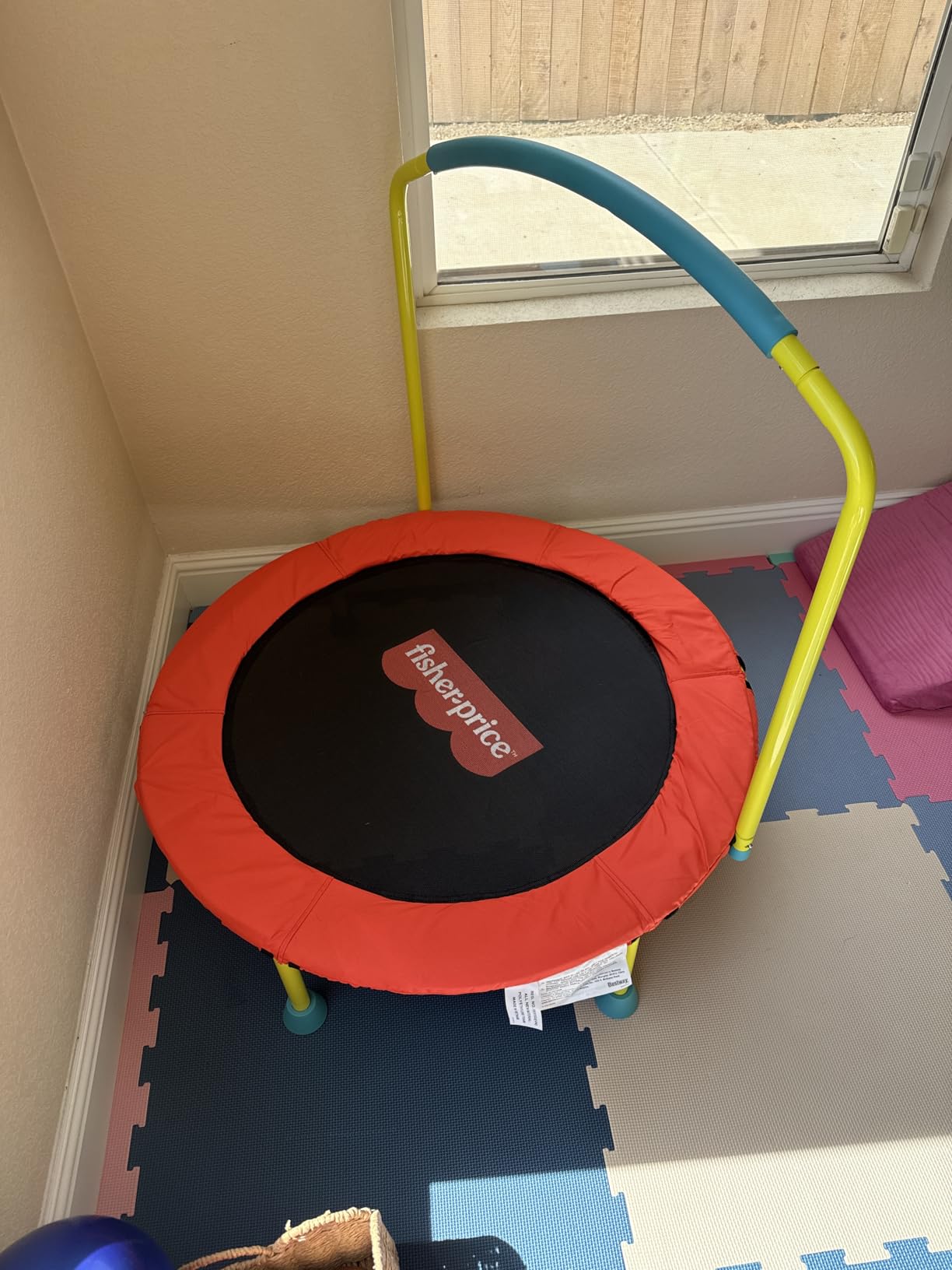
Assembly is tool-free and takes minutes, which matters when the person building it is not feeling patient. The frame is powder-coated steel with six non-slip foot pads, listed at 55 lb support, and the soft foam grip handlebar is the feature that reassures a nervous first-time jumper enough to keep bouncing.
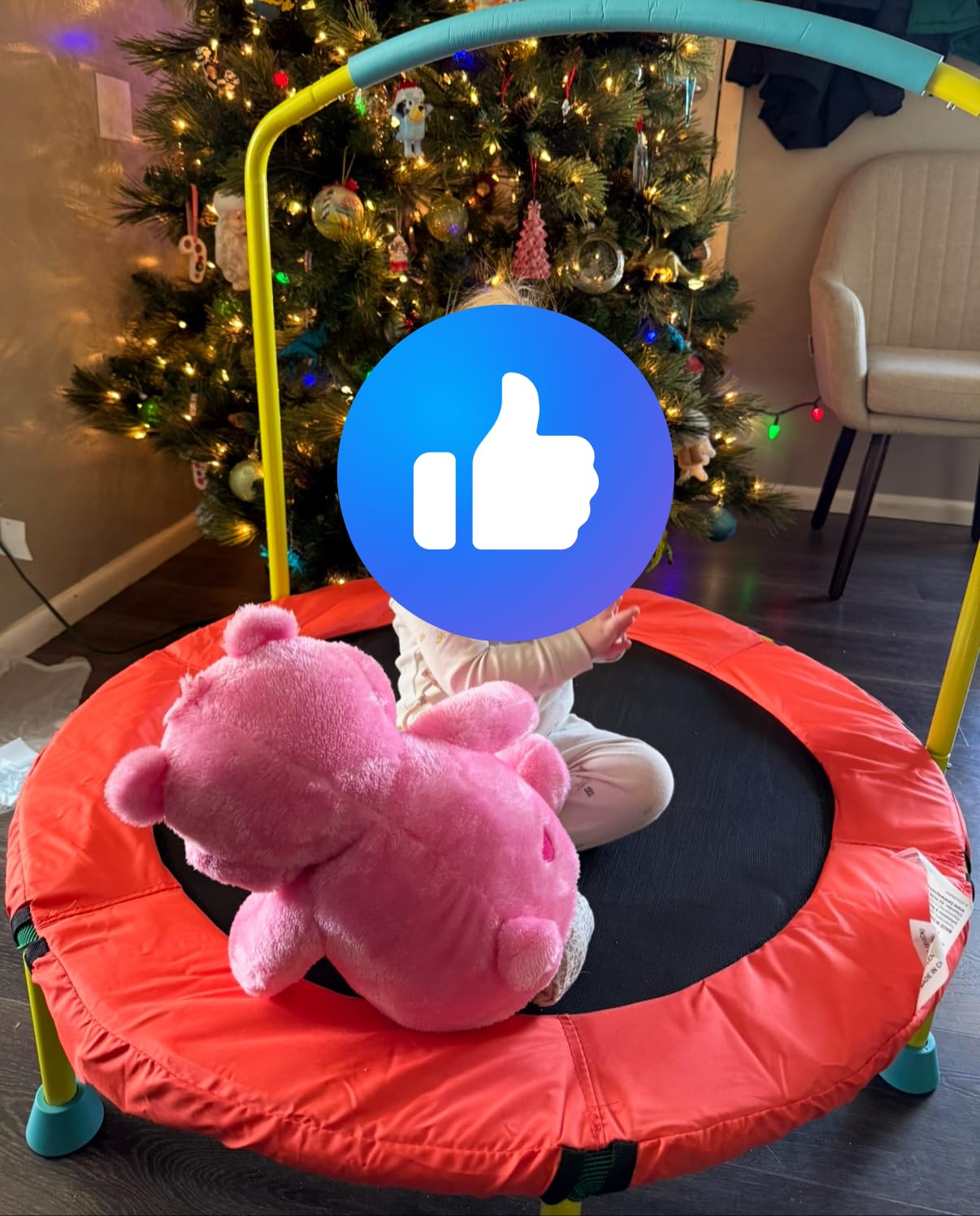
Both the handlebar and the frame fold for compact storage, and the removable handle is what lets the unit disappear when the room needs to be a room again. For a family in temporary accommodation or a small rented flat, that flexibility is worth more than an accessory bundle.
The trade is the 55 lb limit, which reviewers name as the boundary most often. It suits preschoolers rather than older children, and with 298 reviews the volume of owner feedback is far thinner than the models with tens of thousands, so read a handful of recent reviews before you buy rather than relying on the aggregate.
Who this trampoline suits best
This is the one for a child taking their first independent jumps, and for a household where assembly time and storage flexibility matter more than features. The foam grip handle and the simple single-bounce design remove the two things beginners struggle with, which is landing off-centre and losing confidence.
It also works for a grandparent house, a holiday let, or anywhere the trampoline needs to come out for a weekend and go back into a cupboard on Monday. The listed age guidance starts at three, so if your child is younger, pair it with a handlebar unit rated down to two.
Where it falls short
It has no enclosure, so a handlebar is the only thing standing between a beginner and the frame, and it offers none of the spring coverage of the enclosed models. The 55 lb limit is the hard stop, and older siblings will not fit comfortably within it.
At 36 by 36 by 36 inches with no listed weight for the unit itself, it is also a sparser spec sheet than the rest of the group. The design is simple by design, but you are buying fewer documented features in exchange for the cleanest execution on the list.
8. BCAN BT1 36 Inch Foldable Trampoline: Best for Tight Storage
- Folding legs collapse for storage
- Spring-free no-gap mat
- Handle adjusts for ages 1-6
- Tool-free five-minute assembly
- Frame shifts on hard floors when bouncing vigorously
- Heavier than some folding rivals
The BCAN BT1 solves a problem the other fold-flat models only half solve. The folding leg design collapses to about 3.5 inches, so it goes under a couch or into a closet rather than standing folded against a wall. Owners describe setting it up and putting it away several times a day, which is a real pattern in small homes.
Like the ATIVAFIT, it is spring-free, with the cover stitched inside the mat so there is no gap for a foot to reach a bungee point. The handle is a thickened foam bar with two height levels covering ages one to six, which is the widest age range of any handlebar unit in this roundup and makes it a genuine option for a younger child.
Anti-tip details are the quiet strength here: non-slip rubber legs, inward-curved handles, and safety pins on the frame. The Oxford material build and the neutral beige colour are both practical choices for a unit meant to sit in a living space rather than a playroom.
The one recurring drawback owners name is movement. The frame can drift across hard floors during vigorous bouncing, so an active jumper needs supervision and the unit works best on carpet or a rug. The 4.6 star average across 362 reviews is strong for the volume.
Who this trampoline suits best
This is the pick for a small home where a permanent play structure is not acceptable, and for a child between one and six who needs a handle low enough for a beginner. The two-level handle and the ages one to six range make it the most forgiving of the 36-inch units for younger children.
The absence of metal springs is singled out by owners as a safety plus with no bounce penalty, and the fold-to-3.5-inches profile means it can live in a hallway cupboard between sessions. Tool-free five-minute assembly is another plus for a home where the person building it changes day to day.
Where it falls short
The frame shift on hard floors is the honest drawback. On laminate or tile, an active jumper will move the unit, and the fix is surface rather than product, so put a rug under it or accept a little repositioning.
It is also heavier than some folding rivals, so the storage win is about where it goes rather than how easily one person lifts it. And with 362 reviews the owner feedback pool is thin, so treat the specification as good and the long-term picture as less certain than the high-volume models.
Indoor or Outdoor: Which One Fits Your Space
Go indoor with a 36-inch handlebar model when your space is a room, not a yard. A 3-foot or 36-inch unit needs a footprint roughly the size of a coffee table plus clearance, which is why they suit playrooms, basements, conservatories and ground-floor flats. You also gain the option of a spring-free or bungee build, and those are meaningfully quieter, which matters in shared walls.
Go outdoor with a 55-inch enclosed model when you have yard or patio space and want the trampoline to be the real thing. The enclosure is the entire safety argument at that size, because there is no handlebar to hold and the net is doing the work. Outdoors you also get UV exposure and seasonal weather on the net and padding, which means a seasonal check on every strap and seam.
Two practical points push families from outdoor to indoor. The first is heat: parents on parent forums report outdoor mats becoming unbearably hot in summer, which is a frequent reason for moving indoors. The second is hygiene, since outdoor mats collect grass, dust and dog hair in a way an indoor mat does not.
If you want both, our guides to the best trampolines for kids of every age and to trampolines with enclosures tested for safety cover the larger end of the range, and our look at in-ground trampolines for backyards covers the option that removes the fall height entirely.
Bungee Bands or Steel Springs: What a Toddler Should Have
A spring-free bungee or elastic band build is the safer choice for a toddler, and the reason is reach. A steel spring is a hard metal coil with stored energy, and a child who finds a path to the spring ring can land a finger or a toe on it. An elastic band system removes the coil entirely, so there is no metal ring to catch on, and the mat can be stitched to the cover with no gap at the perimeter.
Two of the picks here, the ATIVAFIT 36 Inch and the BCAN BT1 36 Inch, use that approach. The quieter bounce is a real bonus in a shared wall, since there is no coil rattle, and the reduced rebound means a beginner is less likely to shoot off the mat.
The trade is capacity and feel. Spring systems are livelier, which is what makes enclosed 55-inch units satisfying for an older child, and a spring-free mat is firmer. For a two- or three-year-old learning to bounce, the firmer, quieter, safer mat wins. If you are buying for a six-year-old, the argument reverses, and the difference matters less than the enclosure and the weight limit.
What Age Is Safe to Start, and When to Size Up
Should a two-year-old use a trampoline at all? The short answer is yes, on a purpose-built toddler unit, with an adult in the room. What is not appropriate is a full-size trampoline, a trampoline park visit, or a beginner bouncing on an open-frame unit without a handlebar or an enclosure. A toddler trampoline is a different product category, and the reason it works is mechanical: a short mat stops a small child generating enough speed to bounce off it.
For a one-year-old, treat bouncing as supported play rather than independent jumping, and check the age label before anything else. The BCAN BT1 is rated for ages one to six with a two-level foam handle, which makes it the most accommodating option in this roundup for the youngest end. At twelve to eighteen months, the goal is sensory regulation and guided bouncing while holding the bar, not distance.
For a two-year-old, the handlebar models are the right fit, and the Little Tikes 3 Foot or the BCAN SP1 are the two we would choose. For a three-year-old, a 36-inch handlebar model still works well, and this is often the moment when a 55-inch enclosed unit starts making sense if two children will share it.
Size up when your child can step off the mat without jumping, when they are riding a scooter age and clearly wasting the bounce, or when the weight limit approaches half capacity. Parents on WhatToExpect hot-topic threads describe the most common regret as buying a 3-foot unit that a three-year-old outgrows in months, so if you are between two sizes, buy the larger one only if you have the floor space for it.
How to Choose the Safest Trampoline for a Toddler
The safest trampoline for a toddler is the one with the fewest reachable hard parts. Dr. Skaria, quoted by HSS in a roundup covering trampoline safety, frames it directly: you want thick, well-fitted padding over the springs, frame and hooks so kids are not landing on hard surfaces. That single sentence is the filter to apply to every listing.
Beyond padding, four checks decide the answer. First, no-gap design: the net or cover should attach directly to the jump mat with no gap for toes. Second, the net should run all the way around the jump mat, and any door should use a zipper plus buckle rather than a pull-apart flap. Third, the weight limit should be printed clearly and comfortably above your child’s weight rather than close to it. Fourth, an adult should be supervising every session, without exception.
Enforcement is the part owners underestimate. One jumper at a time is the most repeated rule across parent forums, and it is also the one most often broken in practice. Long-term owners who report six and seven years without an injury share one trait: they enforced that rule from day one rather than treating it as a suggestion.
Finally, expect to maintain the unit. Net lifespan is shorter than trampoline lifespan, and owners of netted outdoor units in parent forums report a good run at six to seven years, but only with the net, spring cover and pad replaced when they degrade. Check the net attachment, the padding, and the frame bolts before each session, and expect that habit to matter more than any spec on the box.
Frequently Asked Questions
What is the safest trampoline for a toddler?
The safest toddler trampoline is the one with the fewest reachable hard parts: thick well-fitted padding over the springs, frame and hooks, a no-gap design where the mat meets the net or cover, and either a padded handlebar for small units or full netting for large enclosed ones. In our testing the Little Tikes 3 Foot Trampoline is the safest overall pick, and the BCAN SP1 leads the group on documented ASTM certification with more than 20 safety tests. An adult supervises every session, and one jumper at a time.
Should 2 year olds use trampolines?
Yes, on a purpose-built toddler unit, with an adult in the room the whole time. A two-year-old should never use a full-size trampoline, an open-frame model with no handlebar or enclosure, or a trampoline park. A toddler trampoline works because the mat is short, usually 3 feet or 36 inches across, so a small child cannot build enough speed to bounce off it. Hold the handlebar for beginners and keep sessions short.
What is the safest trampoline for a 3-year-old?
For a three-year-old, a 36-inch handlebar model is the safest practical option, and a 55-inch enclosed model is the choice if siblings will share. Handlebar models keep a beginner upright and stop small feet reaching the frame edge, while enclosed models trade a handle for a full net. Our pick for a three-year-old is the BCAN SP1 36 Inch for documented certification, or the Little Tikes 3 Foot for a longer ownership record and a steadier handle.
What is a good toddler trampoline for a 2-year-old?
For a two-year-old, look for a short mat, a foam-padded handlebar at a height a small child can grip, and either a spring-free build or a no-gap mat. Good fits include the Little Tikes 3 Foot Trampoline for the handlebar stability, the BCAN BT1 36 Inch for its two-level handle rated from age one, and the ATIVAFIT 36 Inch if noise through shared walls is your main concern. All three stay well under a full-size frame.
Is it safe for a 1 year old to be on a trampoline?
Supported bouncing is reasonable for a one-year-old on a toddler-rated unit, but treat it as guided sensory play rather than independent jumping. Check the stated age range first, because a 36-inch model rated for ages three and up is not the right choice here. The BCAN BT1 36 Inch carries a two-level foam handle and an ages one to six range, and the Little Tikes 3 Foot starts at age three. Keep hands on the handle and stay within arm’s reach.
Which toddler trampoline is best rated?
By star rating, the Fisher-Price WonderJump 36 Inch Mini Trampoline leads this roundup at 4.8 stars with a 91 percent five-star share across 298 reviews. By verified review volume, the Little Tikes 3 Foot Trampoline leads with more than 33,000 reviews at 4.7 stars, which is a stronger signal of long-term reliability. For documented safety testing, the BCAN SP1 36 Inch is ASTM certified with more than 20 safety tests.
Final Verdict
The Little Tikes 3 Foot Trampoline is the best trampoline for toddlers in 2026 because it does the two things that matter most, a mat short enough that a small child cannot bounce off it and a handlebar that steadies a beginner, and it has done them consistently across more than 33,000 reviews. Add the ATIVAFIT 36 Inch if shared walls are a concern and the BCAN SP1 if floor space is, and the choice is made in about a minute.
Whatever you pick, the safety hardware only works if you use it. Pad the springs, close the net, enforce one jumper at a time, and check the frame before every session. For larger trampolines once your child outgrows these, our guide to the best trampolines with basketball hoops covers the next step up.