
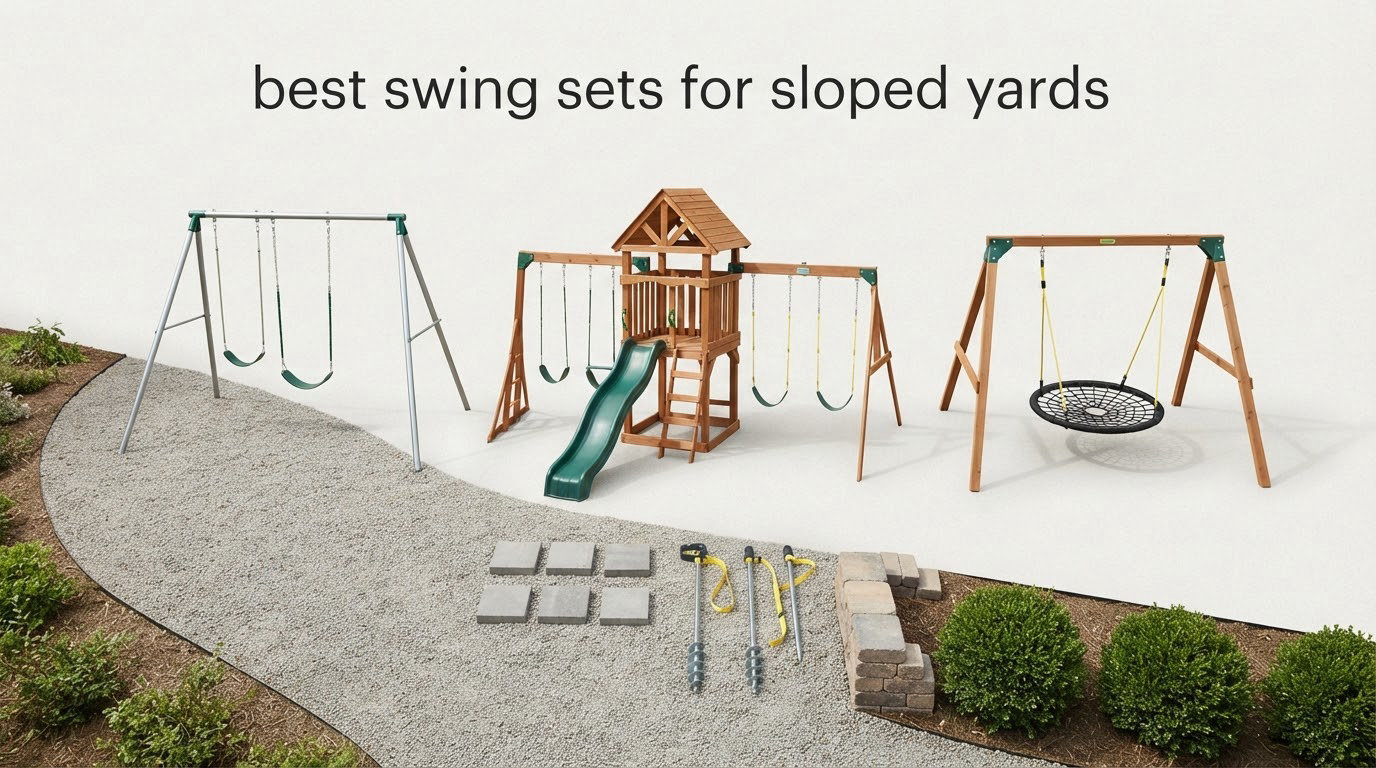
Most families discover their yard’s slope at the worst possible moment: after the swing set is already chosen, the boxes are already open, and the first post is going into the ground. The lawn looks flat enough from the kitchen window, but the string line shows a drop of a foot or more across the set’s footprint, and suddenly the whole plan is in question. This guide is about the best swing sets for sloped yards specifically, ranked on the things that actually decide whether a set survives a grade: how wide the A-frame base is, how tall the structure is relative to its footprint, whether anchors are included, and whether the frame can be shimmed or shored without rebuilding it.
Here is the good news. A sloped yard is a solvable problem, and for many lots the answer is not a grading project at all. A wide-based steel A-frame tolerates a surprising amount of uneven ground because each leg is an independent vertical post, and the joints between them do not depend on the two ends of the frame sitting at the same elevation. That is the single most important structural fact in this entire article, and it is why almost every set we ranked is steel rather than cedar.
We went through the specs, capacities, and real buyer reports on ten metal swing sets to sort out which ones hold their geometry on uneven ground, which ones need serious ground work first, and which ones are only appropriate for a nearly level pad. If you are still narrowing down the basics, start with our [guide to kids swing sets](https://www.wpa-pool.com/best-kids-swing-sets/), then come back here for the slope-specific filtering. If the household includes a toddler and a teenager, the age split matters as much as the terrain, and our [toddler swing set picks](https://www.wpa-pool.com/best-toddler-swing-sets/) cover that side. For anyone weighing a set that adults will use too, the [patio swing set roundup](https://www.wpa-pool.com/best-patio-swing-sets-for-adults/) is the other half of the conversation.
Table of Contents
Top 3 Picks for Sloped Yards in 2026
Trekassy 440lb A-Frame Set
- 440 lb capacity powder-coated steel A-frame
- Belt swing plus 32 inch saucer swing
- Ground anchors included
- Tool-free seat height adjustment

Hapfan 600lb Heavy Duty Set
- 600 lb combined capacity
- 45 inch platform swing plus two belt swings
- 4 anchor stakes included
- Powder-coated steel A-frame
XDP Fun Forever 8-User Set
- 800 lb group capacity
- Six play stations for up to 8 kids
- Welded galvanized steel frame
- 5-year frame warranty
Quick Overview: All 10 Sets for a Sloped Yard in 2026
Every set below is steel. That is not a coincidence, and the slope tolerance cheat sheet further down explains why. The three numbers to scan in this table are the assembled footprint width, the total weight capacity, and whether ground anchors come in the box.
| Product | Specifications | Action |
|---|---|---|
| Trekassy 440lb A-Frame Set |
|
Check Latest Price |
| XDP Fun Forever 8-User Set |
|
Check Latest Price |
 Lunafun 440lb A-Frame Set Lunafun 440lb A-Frame Set |
|
Check Latest Price |
 Sportspower Super Saucer Set Sportspower Super Saucer Set |
|
Check Latest Price |
| Hapfan 600lb Heavy Duty Set |
|
Check Latest Price |
 HLC 3-in-1 Metal Set HLC 3-in-1 Metal Set |
|
Check Latest Price |
 XDP Crestview 6-Station Set XDP Crestview 6-Station Set |
|
Check Latest Price |
 Costzon 550lb A-Frame Stand Costzon 550lb A-Frame Stand |
|
Check Latest Price |
 XDP SuperDisc 5-User Set XDP SuperDisc 5-User Set |
|
Check Latest Price |
 Lifetime Metal 3-Station Set Lifetime Metal 3-Station Set |
|
Check Latest Price |
Can You Actually Put a Swing Set on a Slope?
Yes, as long as the drop across the set’s footprint stays modest, each leg is anchored independently, and you orient the swing beam across the fall line rather than down it. Most steel A-frames handle a drop of roughly a foot over their width using shims, taller footings on the downhill legs, and proper anchoring. Beyond that, you are looking at a grading job or a custom site-built set, not a weekend project.
Three rules decide the outcome before you buy anything:
- Keep the drop under 6 inches per 10 feet and the set simply sits on the site. Above that, you are shimming or footing the downhill legs.
- Above about 12 inches of drop across the footprint, grade first. That is the point where a wide A-frame stops being the economical answer.
- Run the beam across the fall line. A grade running front-to-back under the swing arc turns a small bounce into a longer downhill roll.
One figure comes up constantly in this category, and it is the most useful number in the whole discussion. A major custom swing set manufacturer states that it installs on a space dropping 12 inches over 20 feet, and that past that figure landscaping is required. Treat that as the practical ceiling for a professionally installed set, and as the point where you start comparing grading costs against a smaller-footprint metal set.
How to Measure Your Slope in 10 Minutes Before You Buy
Do this before you compare a single model. Knowing whether you have 2 inches or 20 inches of drop eliminates most of the lineup and saves you from a bad delivery-day surprise.
Method 1, string line. Drive a stake at the uphill end of the planned footprint and another 10 feet downhill. Tie mason’s line between them at a fixed height, about knee level, and pull it taut. Where the string is level with the middle of that space, measure the drop from the string down to the ground. That measurement in inches is your drop per 10 feet. Repeat it side to side, because a yard can fall front to back and stay level across, which is the good case.
Method 2, level and a straight board. Lay a 10-foot 2×4 on the ground with a 6-foot level on top. Bump the board until the bubble sits centered, then measure the gap under the high end. That gap is your drop. Repeat along both axes of the footprint and write down the larger number, because the set will feel the higher of the two.
Method 3, the phone. If you have no level, lay a 10-foot board, put a phone on it, and open a level app. Less precise, but it reliably separates a 2-inch yard from a 20-inch one, and that is all you need to shortlist products.
Write the number down and keep it in your pocket while you shop. If you have under 6 inches across the whole footprint, every set in this roundup is fair game. Between 6 and 12 inches, favor the wide A-frames with included anchors. Over 12 inches, skip straight to a grading conversation.
1. Trekassy 440lb A-Frame Set – Best Overall for a Gentle Grade
Trekassy 440lbs Swing Sets for Backyard, 2 Seat Saucer & Belt Swing – Green
- Widest capacity-to-height ratio in the group for a two-swing set
- Includes belt swing and 32 inch saucer swing so two ages share the frame
- Pre-drilled holes make field height adjustment fast
- Ground anchors are included in the box
- Compact enough for a side yard
- Light enough to shift if anchoring is skipped
- Included spiral stakes struggle in rocky or compacted soil
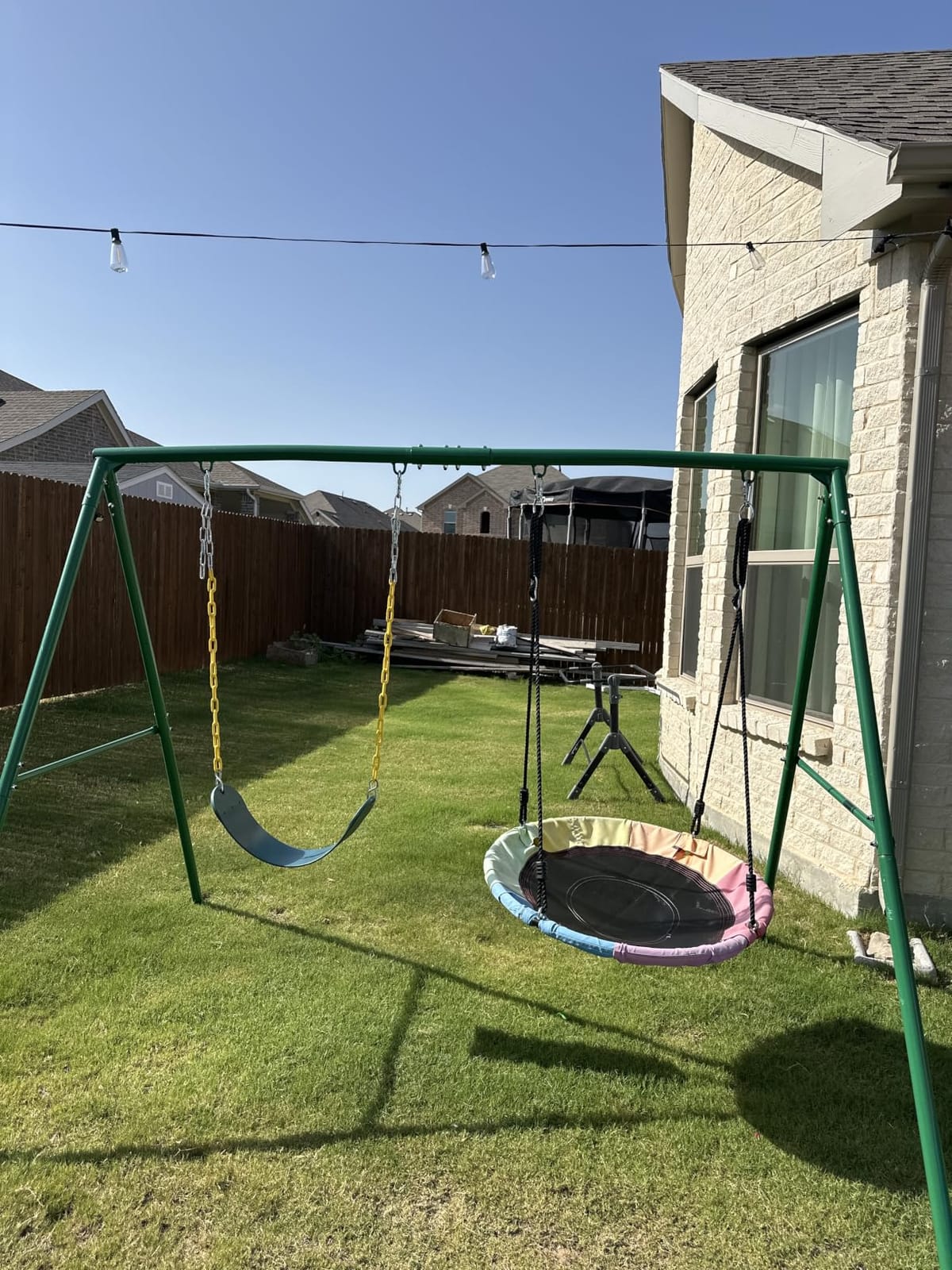
This is the set I would put on a yard that drops somewhere between 2 and 8 inches across the footprint, and it wins our roundup for a simple reason: the frame is wide relative to how far the swings travel, which is exactly the geometry that tolerates uneven ground. At 86.61 inches wide and 66.93 inches tall, the A-frame legs sit far enough apart that a few inches of grade between them changes the lean of the structure by a small angle rather than a visible one.
Capacity is rated at 440 pounds, and the powder-coated steel A-frame is reinforced with multiple cross support bars. The set measures 64.57 inches deep by 86.61 inches wide by 66.93 inches high, which is one of the more compact footprints here, and that matters more than usual on a grade because a tight footprint is easier to find level ground for.
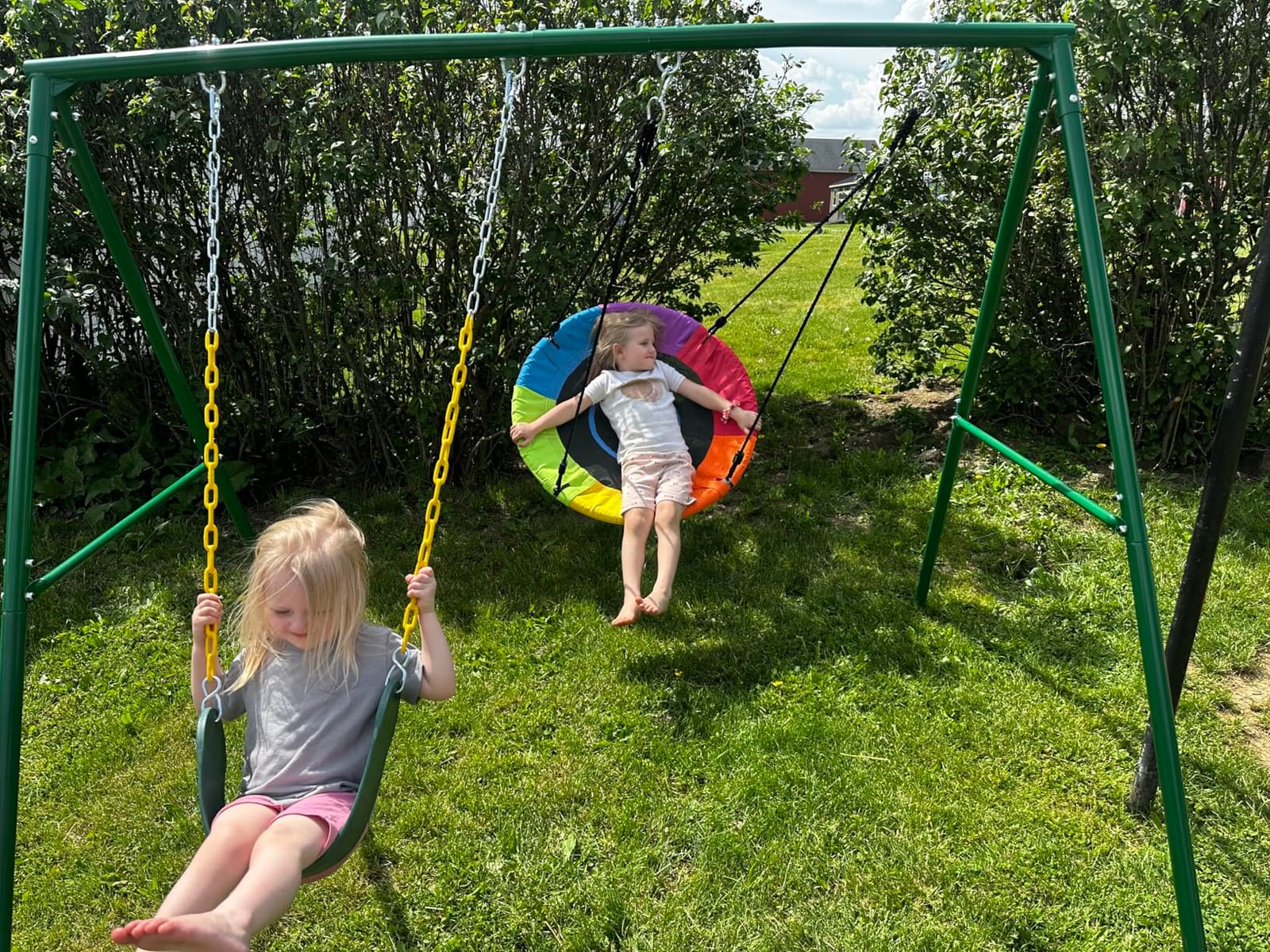
Two swing types ship with it: a classic belt swing and a 32 inch saucer swing with adjustable rope. The saucer is the better fit for a younger child while the belt serves an older one, so a household with a wide age spread gets both off a single beam. Seat height adjusts without tools, and the attachment points are swappable, which means you are not locked into the original configuration.
The single most repeated buyer note across nearly 1500 reviews is about anchoring, not the frame. Owners consistently call the set sturdy, quick to assemble and good value, and the recurring caveat is that the frame lifts or tips without better-grounded stakes, especially in rocky or compacted soil. If your slope measurement came back above 6 inches, budget for upgrading the included stakes before you assemble anything.
What a 6 inch drop means for this set
At 6 inches across an 86 inch span, the angle is about 4 degrees, which the A-frame absorbs without any structural modification. Shimming the high side with treated lumber or building one small pier under a single leg is enough. The failure mode is not the frame geometry, it is a leg that lifts off the soil when someone swings hard, which is why the anchors matter more than the slope here.
Where it will disappoint you
If you have teenagers, a 440 pound total rating means two adults swinging hard is a realistic test of the frame, and reviewers do report rocking and a lifted leg in that scenario. The included spiral stakes are also the weak point in rocky or compacted soil, where they refuse to drive. On a steep or hard-packed site, plan on better anchors from the start rather than fighting the supplied ones.
2. XDP Recreation Fun Forever 8-User Set – Most Play Stations
- Welded rather than bolted joints resist racking on uneven ground
- Eight-user capacity suits shared or neighbor play
- Five-year frame warranty is the longest in the group
- Foam leg guards and chain covers cut pinch points
- 16-foot footprint needs real yard depth
- Frame-only warranty leaves slide and seats uncovered
- Two adults and 2.5 hours minimum to assemble
At 104 inches deep by 192 inches wide by 74 inches high and 119 pounds, this is the largest set we ranked, and on a sloped yard that cuts both ways. The wide stance spreads whatever grade exists across a long base, so each leg is a fairly vertical post and the welded joints do not have to absorb a racking force. But a 16-foot footprint is genuinely hard to fit on a lot that is already narrow, and it is impossible if your slope runs the wrong direction.
What you get in exchange is six play stations for up to eight children, with 100 pounds per seat and an 800 pound total. The station list covers a super disc swing, a wave slide, a see-saw, a stand-and-swing, and belt seating. For a family that shares a set with neighbors or a daycare-like arrangement, the density of stations per square foot is the best in this roundup.
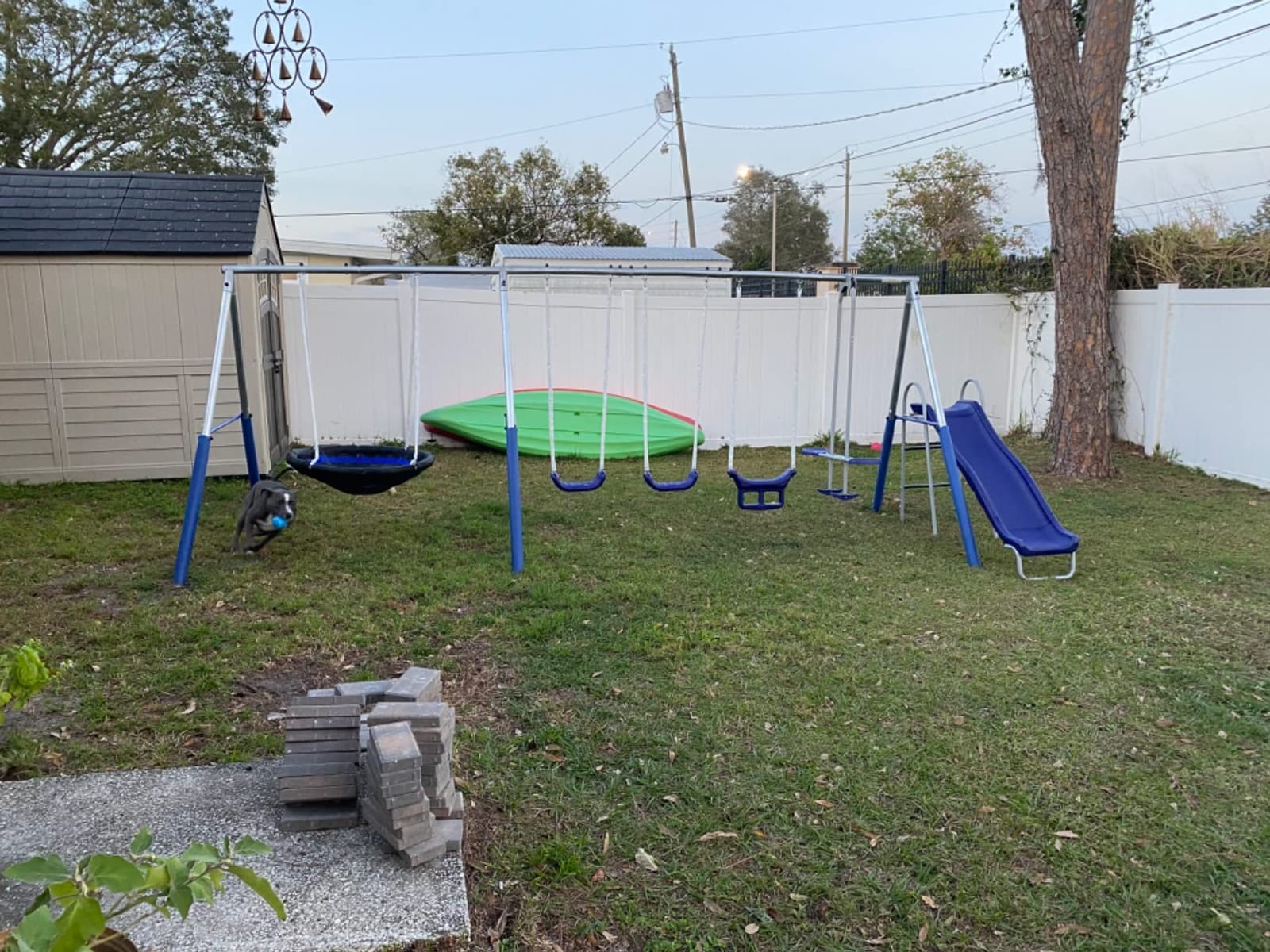
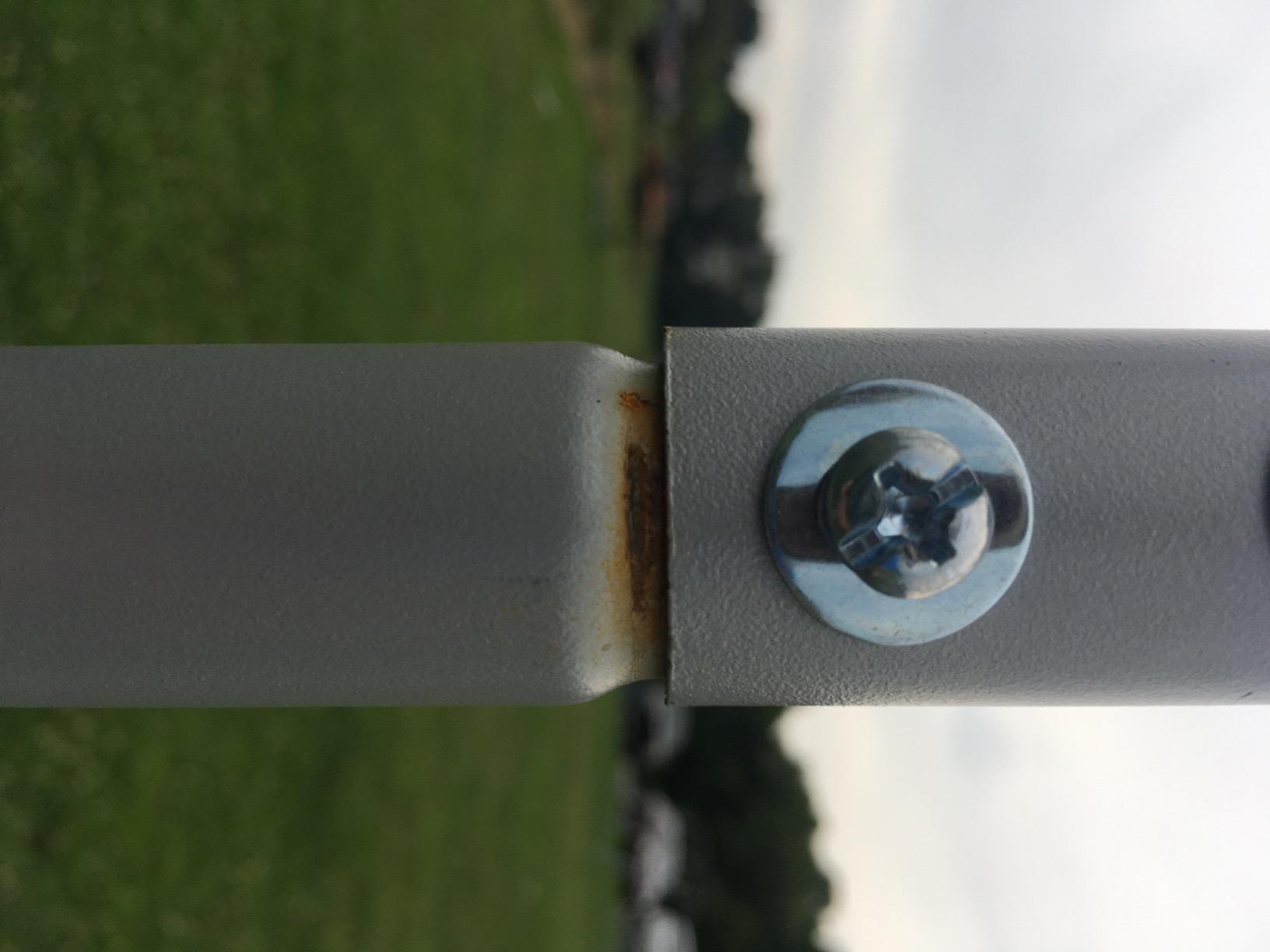
Construction details matter more than usual here. The frame is galvanized steel with welded rather than bolted frame joints, which is a meaningful upgrade on a grade because bolted joints develop play as soil settles and the frame slowly racks. A five-year warranty on the frame backs that up. Foam frame leg guards and PVC-covered chains address pinch points around the legs, which is the part of the frame a child’s body actually contacts.
Setup is listed at 2 to 2.5 hours with two adults, and it weighs 119 pounds assembled. On a grade, budget extra time for shimming, because the same code says the assembled dimensions are 196 inches by 102 inches by 74 inches, and getting both ends of that run to sit properly on uneven soil takes patience.
What a 10 inch drop means for this set
Ten inches of drop across 192 inches is about 3 degrees, which the long base absorbs comfortably as long as each leg is individually supported. Concrete footings on the two lowest legs and treated shims on the highest corner will do it. The set does not need a level pad, it needs four independently supported posts, and at this length the middle of the frame can bow a little without affecting play.
Where it will disappoint you
The warranty covers the frame only, so the wave slide and the swing seats are yours to replace. If your lot is under about 30 feet across the usable area, this set is simply the wrong scale and you should look at a compact frame instead. Two-adult assembly is not optional, and reviewers note that the published 2 to 2.5 hours assumes flat ground.
3. Lunafun 440lb A-Frame Set – Best for a Narrow Side Yard
Lunafun Swing Sets for Backyard, 440lbs Swing Set with Heavy-Duty A-Frame Metal Stand, 1 Saucer Swing Seat & 1 Belt Swings Seat
- Narrowest footprint in the roundup at 70 inches
- Carabiner hangers let you swap seats without tools
- Lightest serious frame at 40.3 pounds
- Textilene saucer resists fading
- Saucer seat rusts and transfers color when wet
- Frame can wobble or lift a leg under vigorous swinging
- Seats are bolt-on and not easily removable
When the usable space is a side yard, footprint beats every other consideration, and at 70 inches wide by 59.6 inches deep by 70.87 inches tall this is the most compact serious set we found. On a narrow strip of ground that also happens to slope, a small A-frame is a much better bet than a large one, because the shorter span means a smaller angle for the same number of inches of drop.
It weighs 40.3 pounds assembled, which matters more than it sounds. A set you can walk to the site and reposition is far easier to shim into place than a 119-pound structure, and repositioning after the first wet season is a realistic scenario on a slope. The frame is alloy steel with reinforced inner tube joints and carabiner swing hangers, rated to 440 pounds.
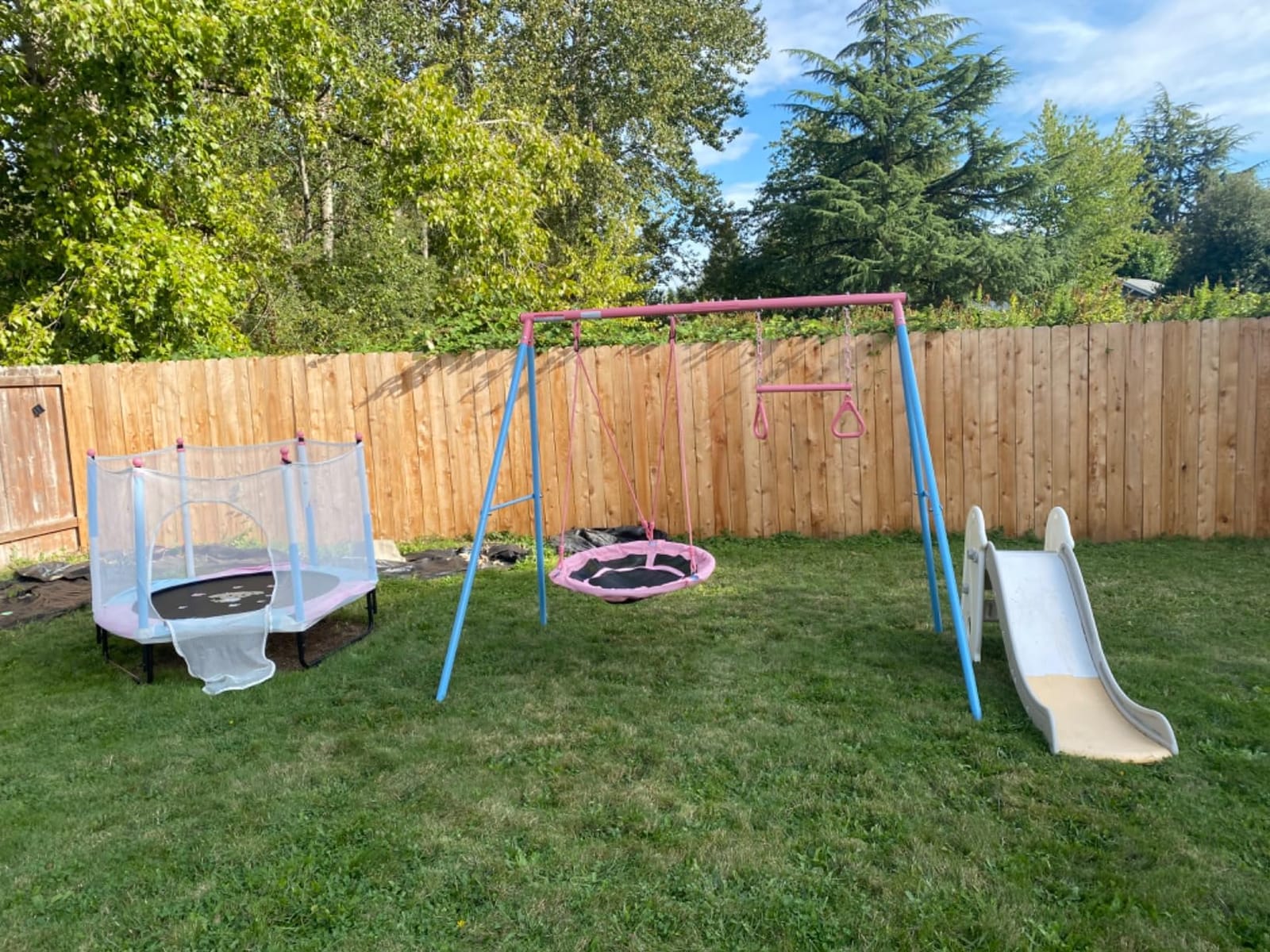
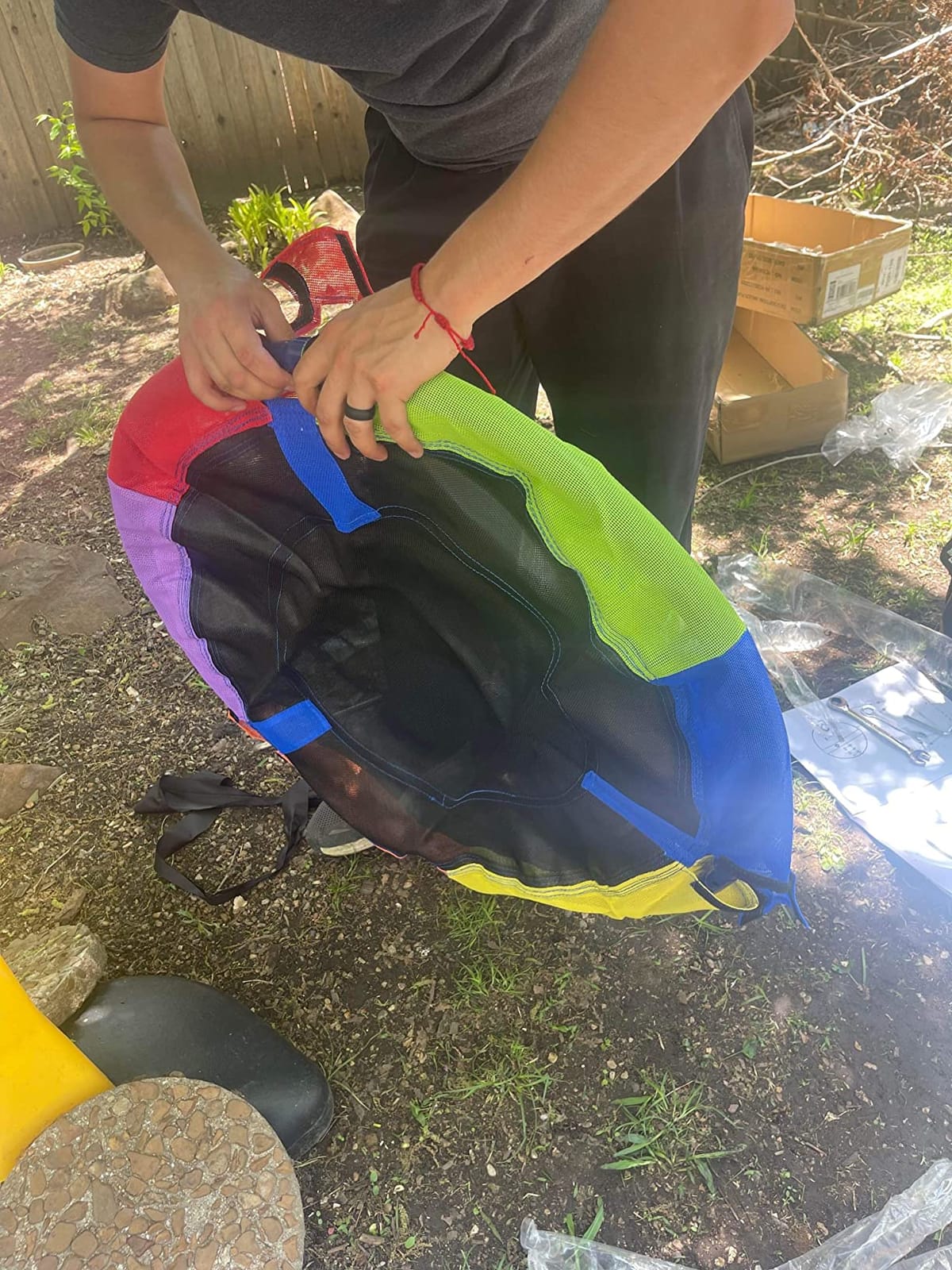
The carabiner design is genuinely useful on uneven ground. Swapping a toddler seat for a belt or a trapeze bar takes seconds with no tools, so you can adjust the setup for the child who is actually using it that week rather than committing to one configuration. The set includes a 32 inch saucer swing with a textilene seat and a belt swing, in blue or pink.
Buyer feedback is split in an instructive way. Owners like the size, the assembly speed and the price, and the frame is widely described as sturdy for light use. Two complaints recur: the saucer seat rusts and stains clothing with color transfer when wet, and the frame can rock or lift a leg under vigorous swinging even with heavy-duty anchors, with some owners substituting trampoline J-hooks for anchoring.
What a 6 inch drop means for this set
Six inches across 70 inches is roughly 5 degrees, which is a steeper angle than the wider frames tolerate. Because the base is short, the correction has to come from the ground rather than the frame. Two short piers under the downhill legs, or a small crushed-stone pad under the whole footprint, will bring it into plumb with modest effort and no cutting.
Where it will disappoint you
This is a light-use frame. If more than one child is on it at a time, or if adults swing on it, the wobble reports become relevant, and on a slope that wobble translates into a leg lifting. The three-point saucer mount also tends to swing out of line, which looks worse on a tilted set than on a flat one. If your grade is over 8 inches, choose a wider frame.
4. Sportspower Super Saucer Metal Set – Best With a Built-In Slide
Sportspower Super Fun Swing & Saucer Metal Swing Set for Kids Ages 3-8 with 2 Blow-Molded Swings, 2-Person Saucer Swing, on 5ft Slide, Heavy, Bonus Anchor Kit
- Well-made steel frame that holds up in wind and holds adult weight on the saucer
- Easy for one person to assemble with pre-drilled aligned holes
- Customizable slide and swing positions
- 4-piece anchor kit included
- Foam leg pads degrade quickly in direct sun
- Saucer sits high so young children need lifting in
- Some buyers report hardware holes that did not align
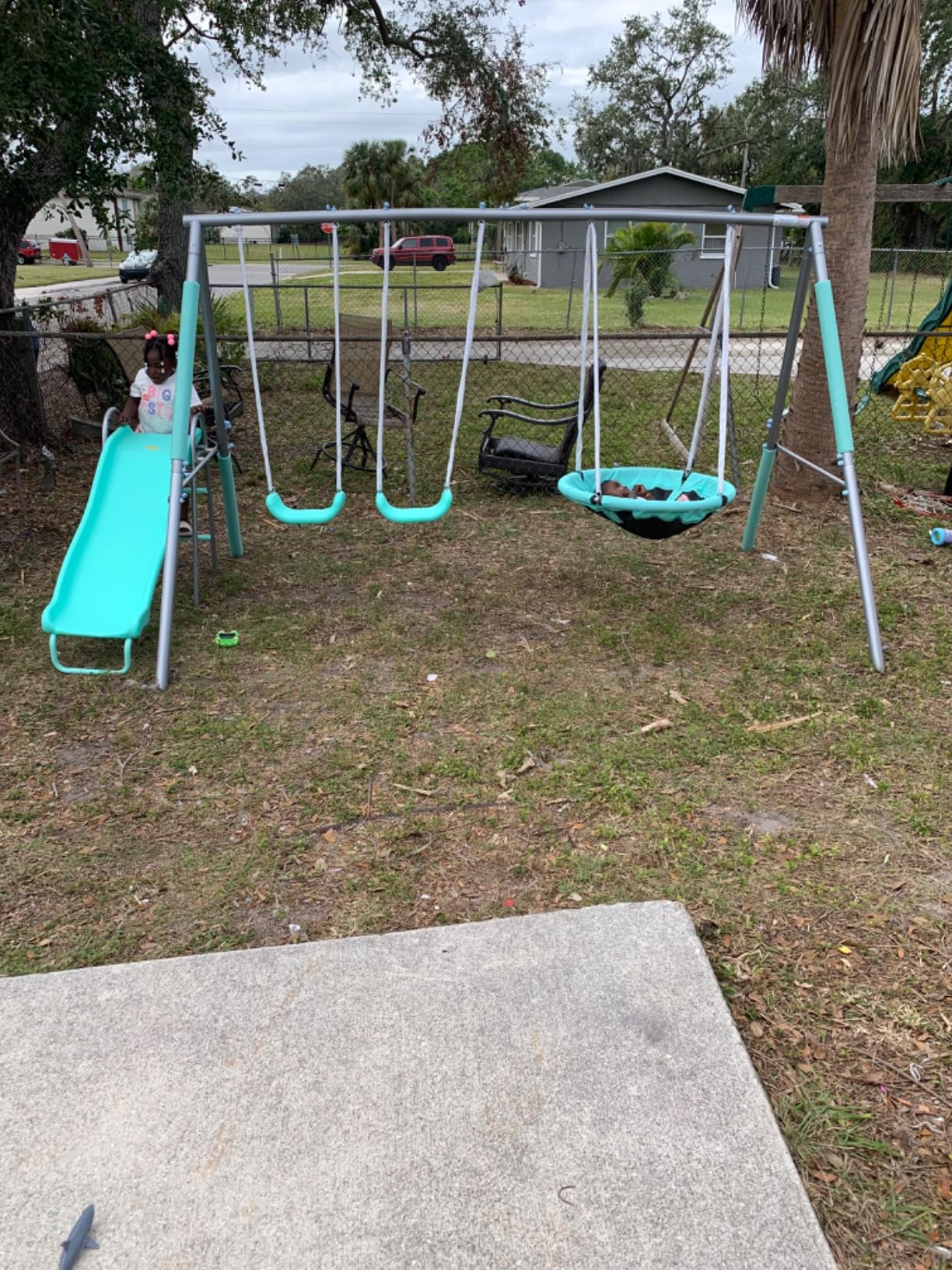
This set measures 12.2 feet long by 6 feet wide by 5.9 feet tall, and that narrow 6 foot width is the interesting number for a sloped yard. A deep, narrow footprint tolerates cross-slope far better than a wide, shallow one, because the drop you are compensating for happens along the 6 foot dimension rather than the 12 foot one. If your grade runs side to side, orienting this set so the grade crosses the short axis is the whole trick.
Capacity is 500 pounds with room for up to five children at 100 pounds each. The frame is 2-inch steel tube with foam-coated legs, and the manufacturer states it meets or exceeds ASTM safety standards. Buyers report the steel frame holds up in wind and will take adult weight on the saucer, which is not a given at this price tier.
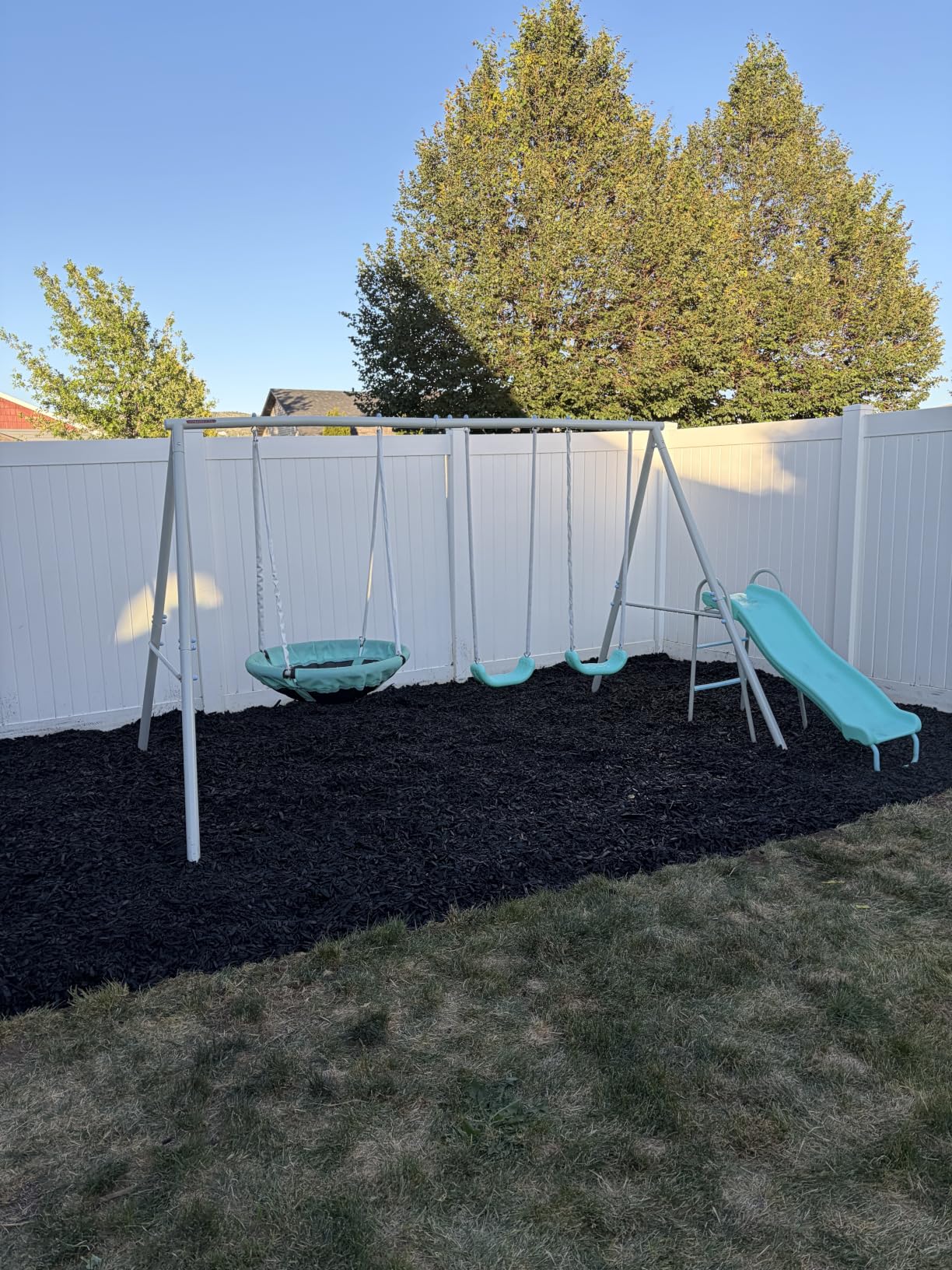
It ships with two blow-molded belt swings, a two-person padded saucer swing, and a 5-foot wavy slide, which makes it the one set here that gives you a slide without a separate structure competing for the same footprint. A limited lifetime warranty applies to the slide. The saucer fabric drains water well, which matters on a slope where water pools at the low end of the yard.
Assembly gets a specific mention from reviewers: several say one person can put it together because the holes are pre-drilled and aligned. That is a real advantage on a slope, where a second adult is often hard to recruit. Buyers also like that slide and swing positions can be rearranged with universal accessories, so the layout can change as the yard settles or the children grow.
What a 6 inch drop means for this set
Six inches across the 6 foot width is a 6.8 degree tilt, which is at the edge of what should be shimmed. The included 4-piece anchor kit handles the mild case. For a steeper section, set the downhill legs on poured footings and bring the uphill legs up on a treated crib, because the 2-inch tube legs will accept added height without any modification to the frame itself.
Where it will disappoint you
The foam leg pads are the first thing to go, degrading quickly in direct sun, and on a slope that faces the afternoon sun you should expect to replace them within a couple of seasons. The saucer sits high enough that small children need to be lifted into it. A few buyers also hit hardware holes that did not align between the saucer and slide, so check those before you start.
5. Hapfan 600lb Heavy Duty Set – Best for Big Kids and Teens
Hapfan 600lb Heavy Duty Swing Set for Outdoor Backyard with 3 Swings Black
- Sturdy frame that does not wobble with older children
- Highest capacity per station in the roundup
- 45 inch platform swing serves teens
- Adjustable swing heights with a taller variant available
- Some kits arrive short a few bolts and washers
- Tubes can ovalize and the beam flex if overtightened
- Seats sit close together with limited spacing
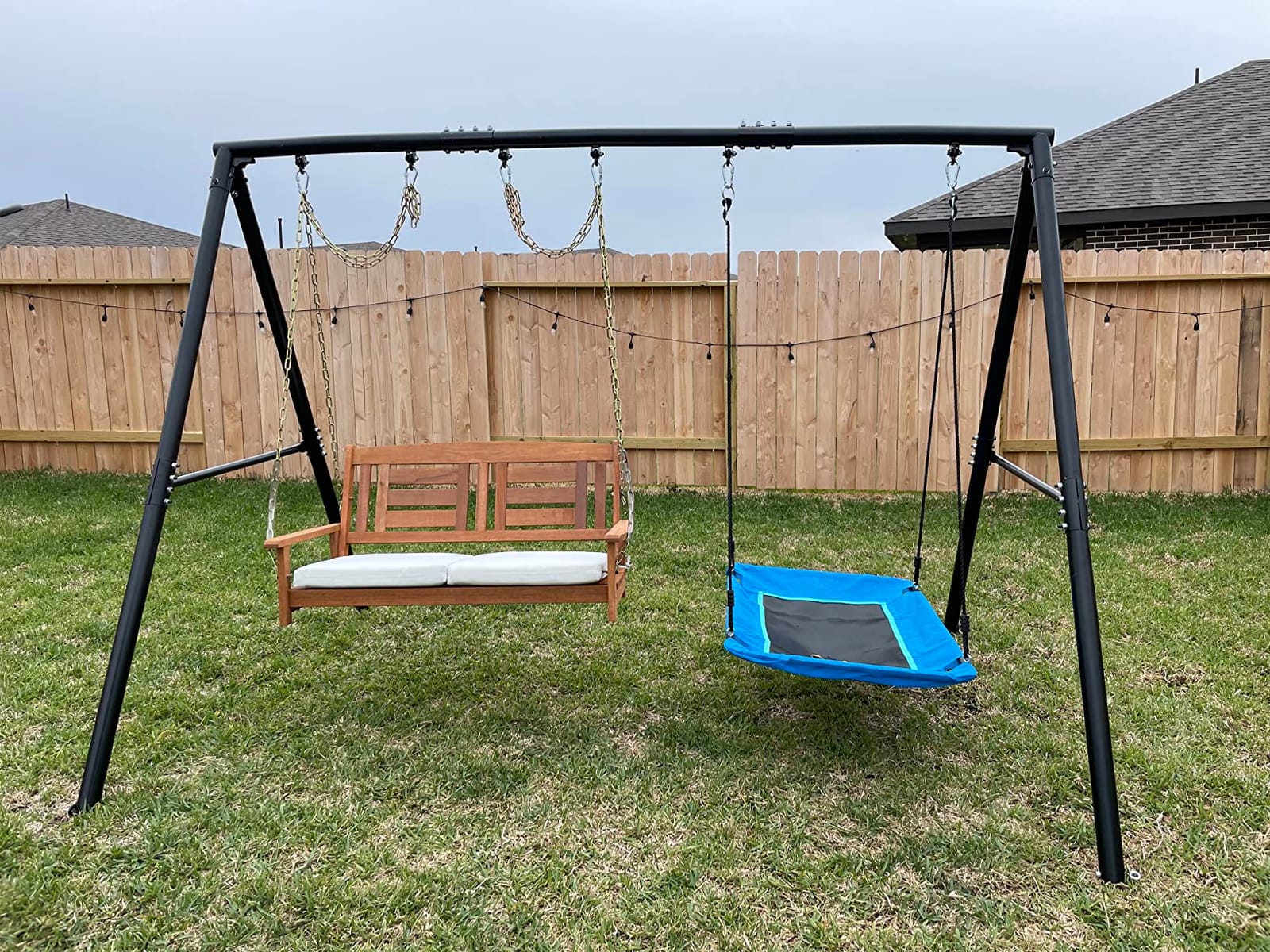
When the kids are old enough to swing hard, capacity becomes a slope issue rather than just a weight issue, because more force on the beam means more racking on legs that are sitting on uneven soil. This set is rated at 600 pounds combined across a 45 inch platform swing and two belt swings, each seat taking up to 200 pounds, and it is built from 60mm steel pipe. It measures 78 inches deep by 118 inches wide by 78 inches tall and weighs 94.1 pounds.
Builders consistently report a frame that does not wobble even when a larger child swings high, which is the specific complaint we heard most from owners of the lighter sets in this roundup. Assembly takes roughly 2 to 3 hours with clear instructions and an install video, and the manufacturer states it meets or exceeds ASTM safety standards and is CPSC compliant.
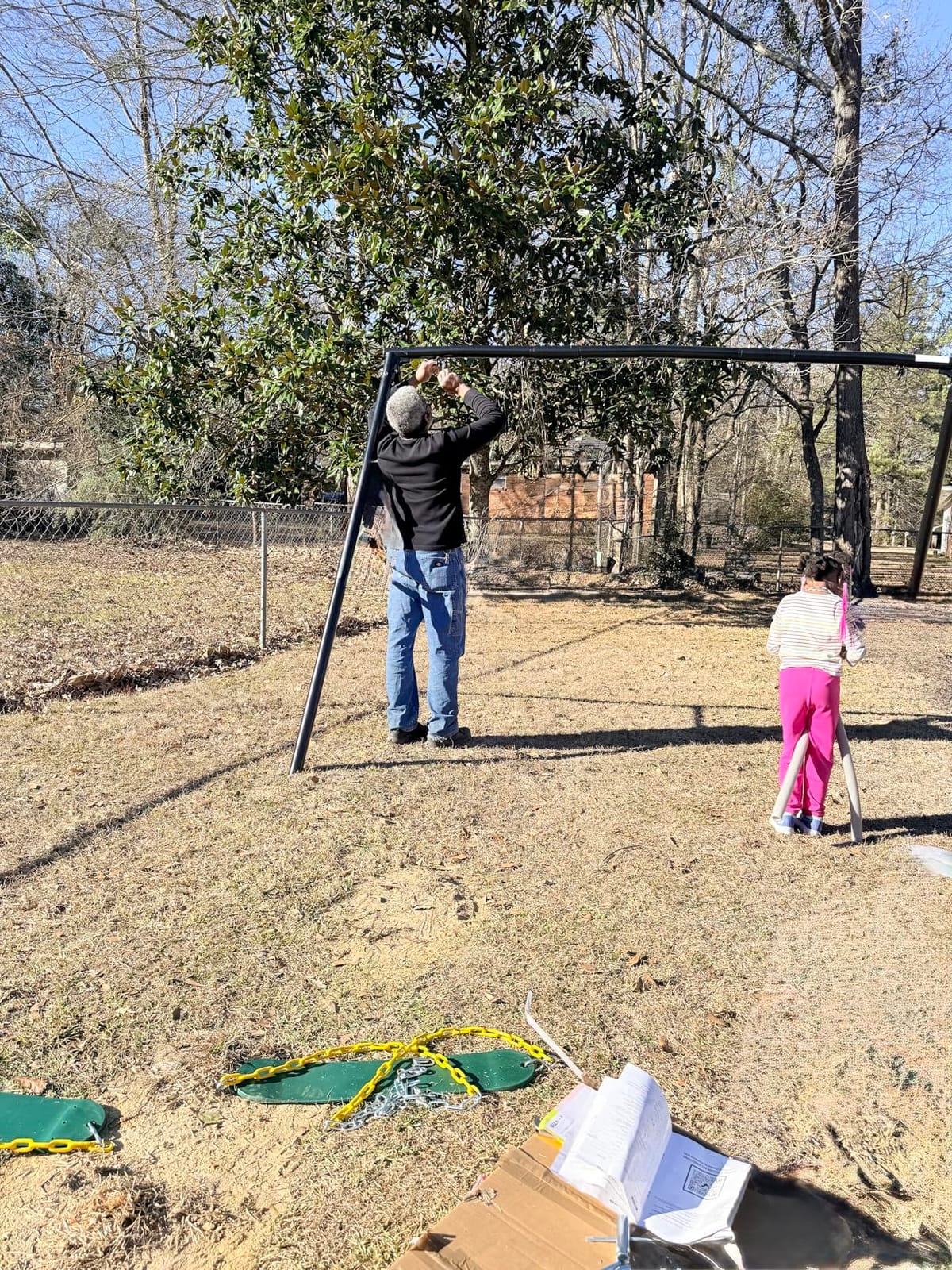
Four anchor stakes are included, which is more than most of the sets here include, and that matters when the ground is the variable. Adjustable swing heights and a taller variant at 87.4 inches exist for older children, so a household that will grow into the set does not have to replace it. Protective sleeves cover the joints against rust and wear, which on a sloped site is worth having since moisture collects in the low corner.
Not everyone agrees with the capacity claim. A minority of buyers report the tubes ovalizing and the beam visibly flexing, and a few dispute the 600 pound rating after seeing sag with older children, particularly if the hardware is tightened aggressively. Some kits also arrive short a few bolts and washers, so count the hardware before you start.
What a 6 inch drop means for this set
Six inches across 118 inches is about 3 degrees, and the 60mm pipe legs are stiff enough to hold plumb through that without any help beyond shims. The included stakes cover the mild case, though on rocky soil you will want to drive something deeper on the downhill side so the leg cannot walk as the beam loads and unloads.
Where it will disappoint you
The three seats sit close together, so three children swinging at once is crowded. If the set is going to carry a teenager plus younger siblings simultaneously, the closeness becomes the issue rather than the capacity. And with 600 pounds of potential load, an under-anchored set on a slope is exactly the configuration that produces the beam flex a few buyers describe.
6. HLC 3-in-1 Metal Set – Most Versatile for a Mild Grade
- Packs two seats and a glider into a small footprint
- Numbered labeled parts speed assembly
- Footrests under the glider add comfort
- Foldable for indoor storage
- Lightweight frame rocks and feels unstable on hard surfaces
- Joints can loosen and plastic seats get slippery
- Hardware occasionally missing from the box
This is the budget entry in the roundup, and it is worth considering only if your measured drop is small. It measures 60.6 inches deep by 122.8 inches wide by 72.8 inches tall, so it is wide and shallow, which means cross-slope is the harder case here rather than the easier one. Total capacity is 440 pounds across four users at 120 pounds per seat, with two seats plus a glider attachment.
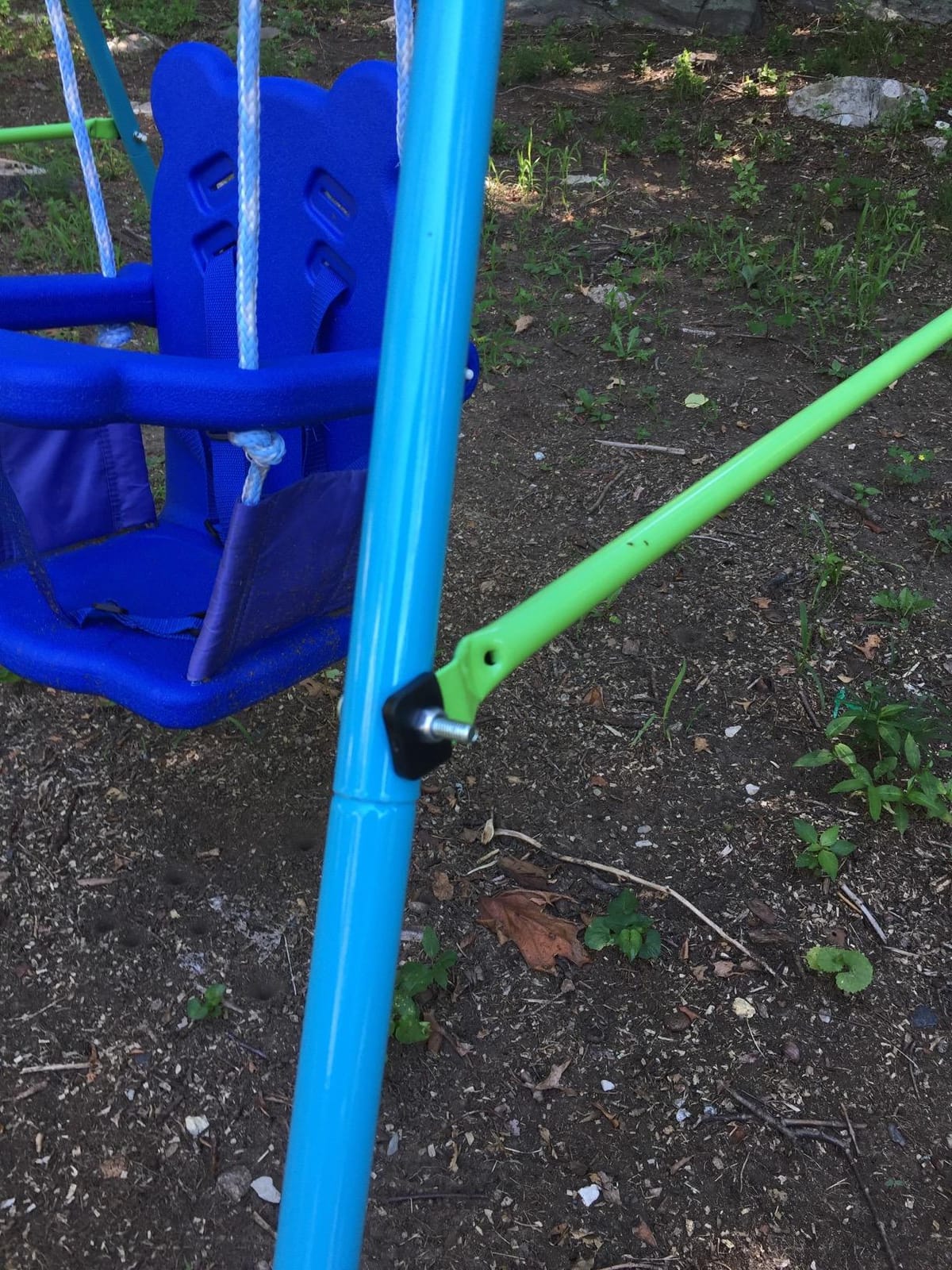
The distinguishing detail for a sloped yard is the triangle structure with ground holders and hooks, which are designed so the legs grip the ground for stability rather than relying on friction alone. The toddler seat has a U-shaped curve with footrests under the glider, and the whole set is described as compact enough for patios and gardens, which is also the vocabulary people use for narrow side yards.
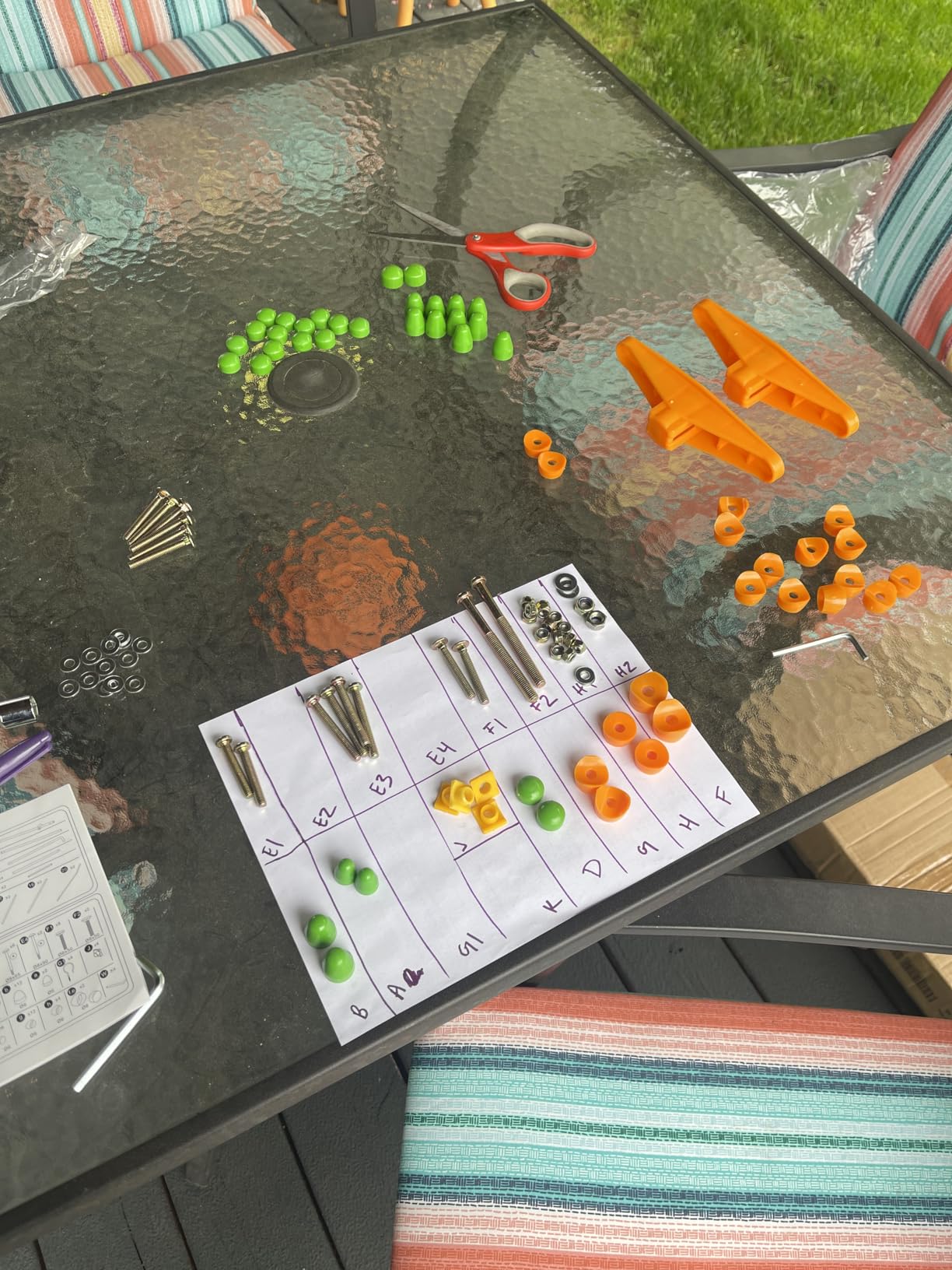
Owners like how much play value fits in a small footprint and how quickly it assembles with numbered, labeled parts. On a grade, a fast assembly matters more than usual, because the number of times you have to shift and re-shim a partly built frame is what turns a two-hour job into a weekend.
The recurring concern is stability. Reviews note rocking on hard ground, joints that loosen under load, and occasional missing hardware that has to be sourced separately. On a slope those complaints compound, because a rocking frame on a tilted grade can walk downhill over a season. This set is best suited to children around age four and under, and to ground that is soft rather than hard-packed.
What a 4 inch drop means for this set
Four inches across 122.8 inches is under 2 degrees, which this frame absorbs easily with treated shims under the uphill legs. That is the realistic ceiling for shimming. Because the frame is light, the correction has almost no weight to fight, so a small crib under the high corner and a solid ground stake on the low side will keep it planted through a wet season.
Where it will disappoint you
Hard surfaces and steep grades are the problem combination here. The lightweight frame rocks, and a set that rocks on a grade eventually settles downhill. Joints loosening under load and slippery plastic seats are the other recurring notes. If your drop is more than about 6 inches, or your kids are past the four-and-under range this set is built for, pick something heavier.
7. XDP Recreation Crestview 6-Station Set – Most Stations per Dollar of Width
XDP Recreation Crestview Metal Swing Set with 2 Swings & Slide, Green/Tan
- Six stations including slide glider and seesaw
- Comes with all parts and tools for assembly
- Self-aligning hardware on welded corner fittings
- Chain covers and bolt caps plus foam padding
- Ground anchors are not included
- Reported wobble and give in the overhead bar
- Seesaw described as flimsy and crooked
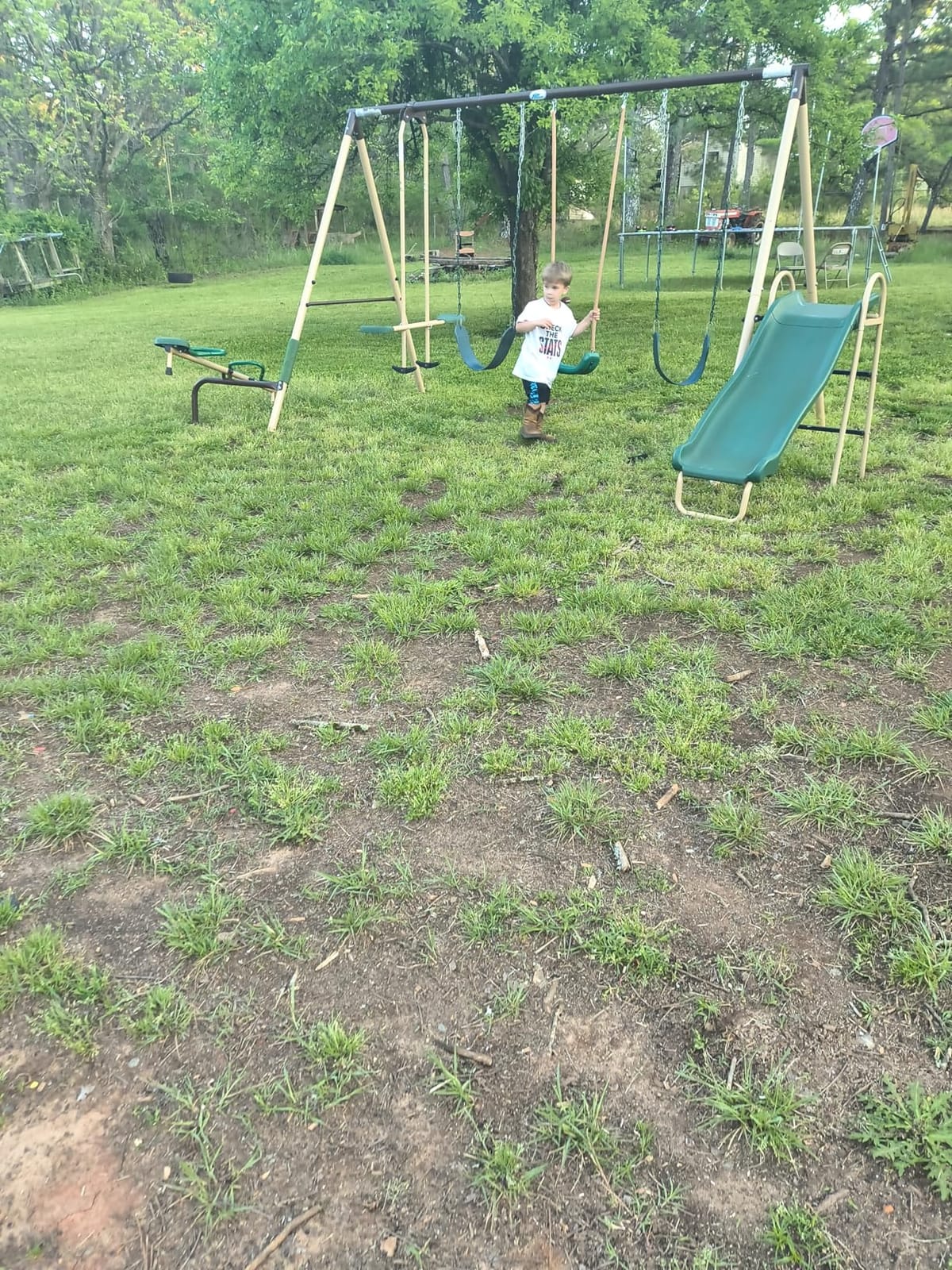
The Crestview is 106 inches deep by 192 inches wide by 75 inches tall and carries 800 pounds at 100 pounds per user, with six stations covering a slide, swings, a two-seat fun glider, a stand-and-swing, and a seesaw. On a slope, the wide welded base and self-aligning hardware are genuine advantages, and the four 2-inch powder-coated foam-padded legs are stiff enough to shim.
What complicates the recommendation is that ground anchors are not included with this model. On a level pad that is a minor omission, since the set’s weight holds it in place. On a grade it is the single most important accessory, and you will be sourcing your own anchoring before assembly starts rather than opening a box and finding stakes inside.
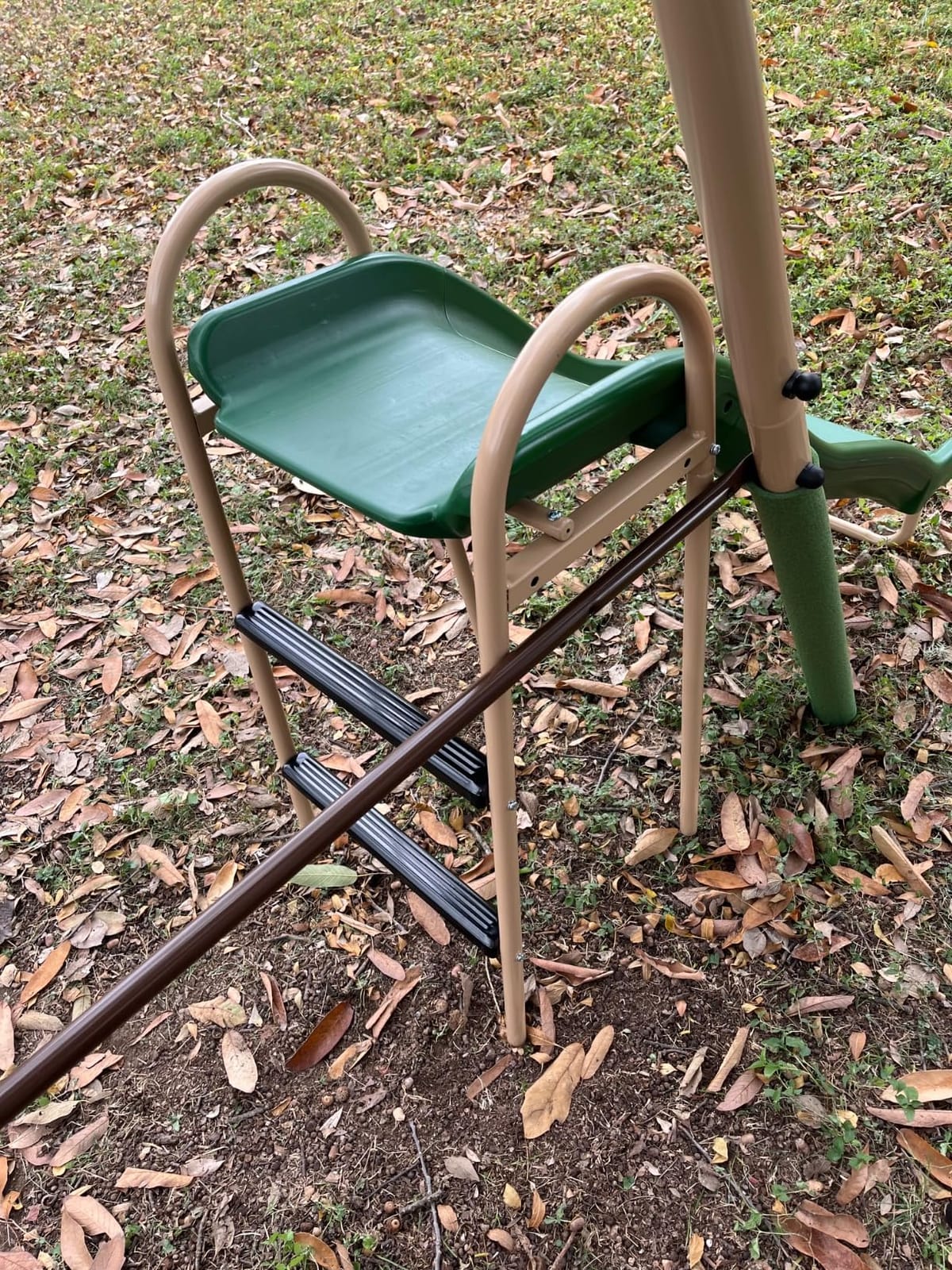
It is recommended for ages 36 months through 8 years, and it comes with all parts and tools for assembly, which removes the most common complaint about budget imports. Non-slip seats, SafeTouch chain covers, and a 5-foot slide with a safe landing zone address the basics that reviewers otherwise pick at.
Durability feedback is genuinely split, and on a slope the split matters more. Several buyers describe wobble and give in the overhead bar and warn against the set for safety, and others call the seesaw flimsy and crooked. Reviewers also point out that the top support bar is joined in three pieces, creating a stress-prone joint right where a swinging child loads the structure. The play value is excellent, but this is not a set to put on a slope without excellent anchoring.
What a 10 inch drop means for this set
Ten inches across 192 inches is about 3 degrees, and the long base handles that geometry the same way the Fun Forever does. The three-piece top bar joint is the real concern under that loading, so poured footings on the two lowest legs, plus properly sized anchors on all four, is the minimum sensible approach. Skipping the anchors is not a realistic option here.
Where it will disappoint you
The overhead bar wobble is the reason this set sits mid-roundup rather than near the top, and a wobbling bar on a tilted frame compounds in a way it does not on flat ground. The seesaw complaints suggest a tolerance issue during assembly that will show on uneven soil. If your drop exceeds 12 inches, this is not the set.
8. Costzon 550lb A-Frame Stand – Best Universal Stand for Swings You Already Own
- Wide 76.5 inch base resists tipping on uneven ground
- Accepts nearly any swing seat including patio swings and yoga belts
- Four ground stakes are included in the box
- Anti-rust painted finish for year-round use
- Sold as a stand so a seat is not always included
- A-frame legs must be level and fully staked to avoid movement
- Wide base needs a clear area to set up
If the goal is to solve the slope problem rather than to buy a whole playset, a stand is the cleanest answer. The frame is an A-shape built from roughly 1.5 inch diameter iron tubes rated to 550 pounds, measuring 73 inches deep by 76.5 inches wide by 71 inches tall at roughly 14.97 kg. Four ground stakes are included, and the wide base is the reason it resists tipping on a grade.
The universal fit is the real feature. It accepts net swings, saucer swings, patio swings and yoga belts, hanging on rotatable loops or fixed metal loops. For a family that already has a seat, or that wants a single swing rather than a structure, this solves the terrain problem with the least possible mass sitting on uneven soil.
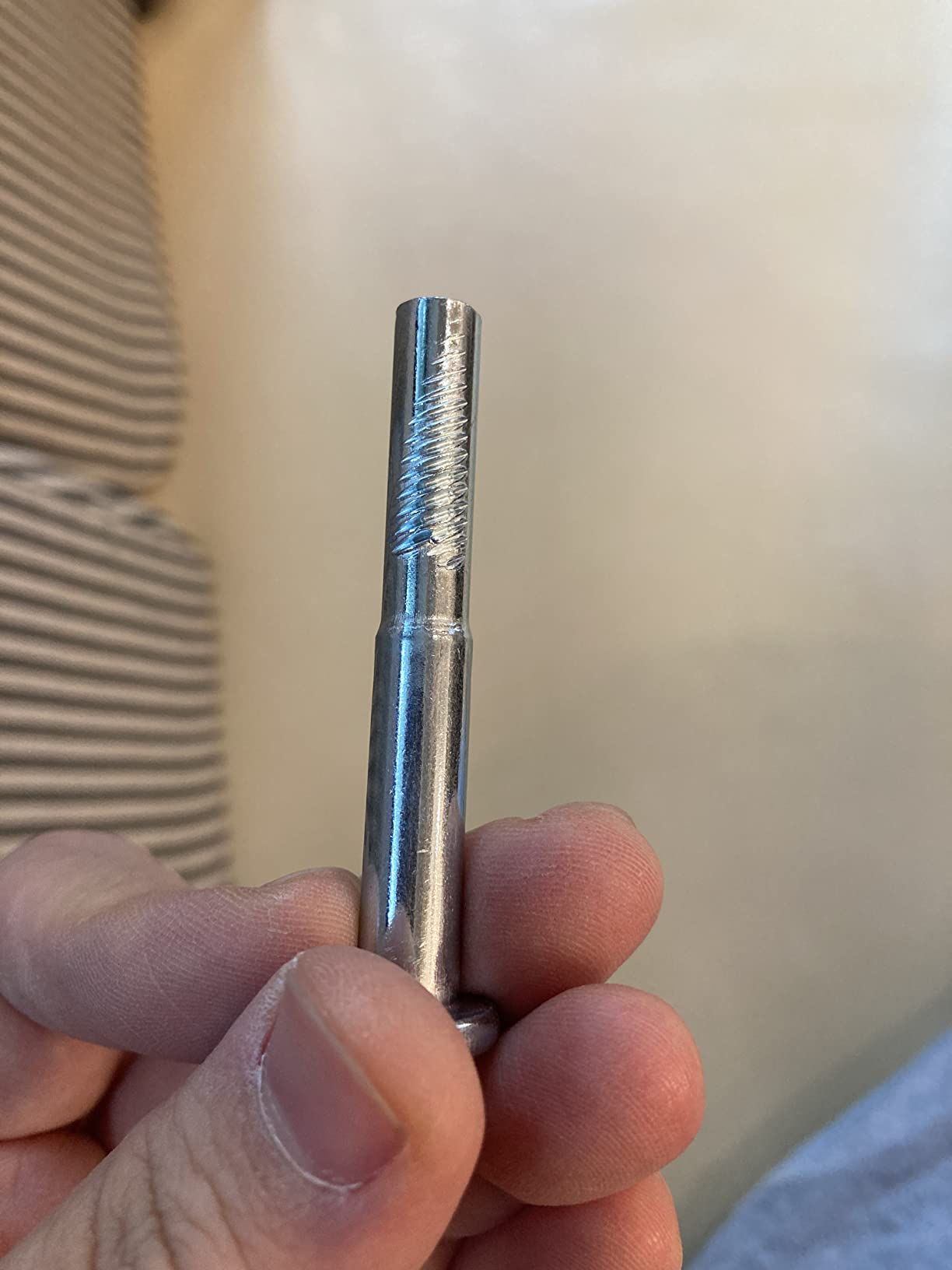
Buyers rate the frame as stable and well built for the money, and the anti-rust painted finish holds up across seasons. A single stand is also the easiest way to test how a child responds to swinging before committing to a full set, which is useful when the installation is going to involve footings and a weekend of work.
Two practical warnings. First, this is sold as a stand, so a swing seat is not always included depending on the variant, and you should confirm which one you are ordering. Second, reviewers stress that the A-frame legs must be level and fully staked to avoid side-to-side movement, and on a slope that leveling step is the entire job. Set the legs on a small crushed-stone pad and the frame will stay square.
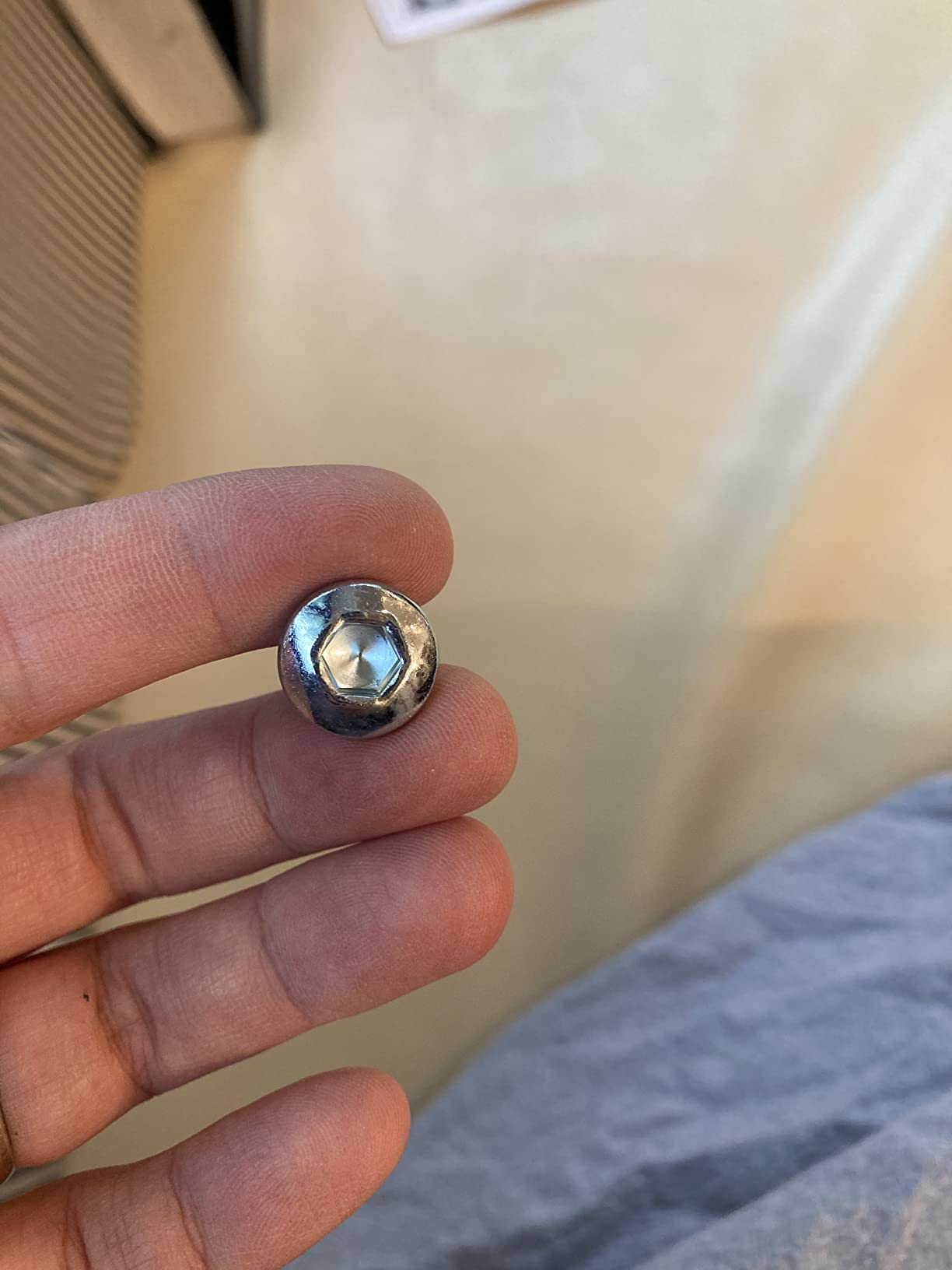
What a 8 inch drop means for this stand
Eight inches across a 76.5 inch base is about 6 degrees, which is real but manageable because there are only two legs to support and both are independent. Two concrete footings of different heights, or a crib under the uphill leg, bring the beam level in an afternoon. With only two contact points, the correction is precise and quick compared with a four-legged structure.
Where it will disappoint you
This is not a playset. There is no slide, no glider, no platform, and if a child needs more than one activity you will outgrow it quickly. The wide base also needs clear space in all directions. And the same caution applies with more force here, because an unleveled A-frame with a swinging load will move, which on a slope means walking downhill.
9. XDP Recreation SuperDisc Set – Best for Soft or Uneven Ground
SuperDisc Swing Set – 5 User, Playground Set for Kids with Frame Anchors
- Frame anchor kit included specifically for securing legs on soft natural surfaces
- Four stations for up to five kids
- Two-child disc swing plus two adjustable belt swings
- Welded steel frame and ASTM and CPSIA compliance
- Upper frame described as somewhat flimsy in use
- Assembly ran well past the stated time for some buyers
- Some hardware reported missing or incorrect
The reason this set makes the list is narrow and specific: it ships with a 4-piece frame anchor kit, and the manufacturer’s own description of that kit is securing legs on soft natural surfaces. If your slope measurement came back in the middle range and your soil is loam rather than hard-packed, having the anchoring already specified removes the most common reason a metal set ends up rocking.
It measures 93 inches deep by 148 inches wide by 74 inches tall and weighs 80 pounds. Capacity is 500 pounds at 100 pounds per seat for up to five children, and the frame is welded heavy-duty steel with padded legs. Buyers like the play value, the frame quality for the money, and the straightforward assembly.
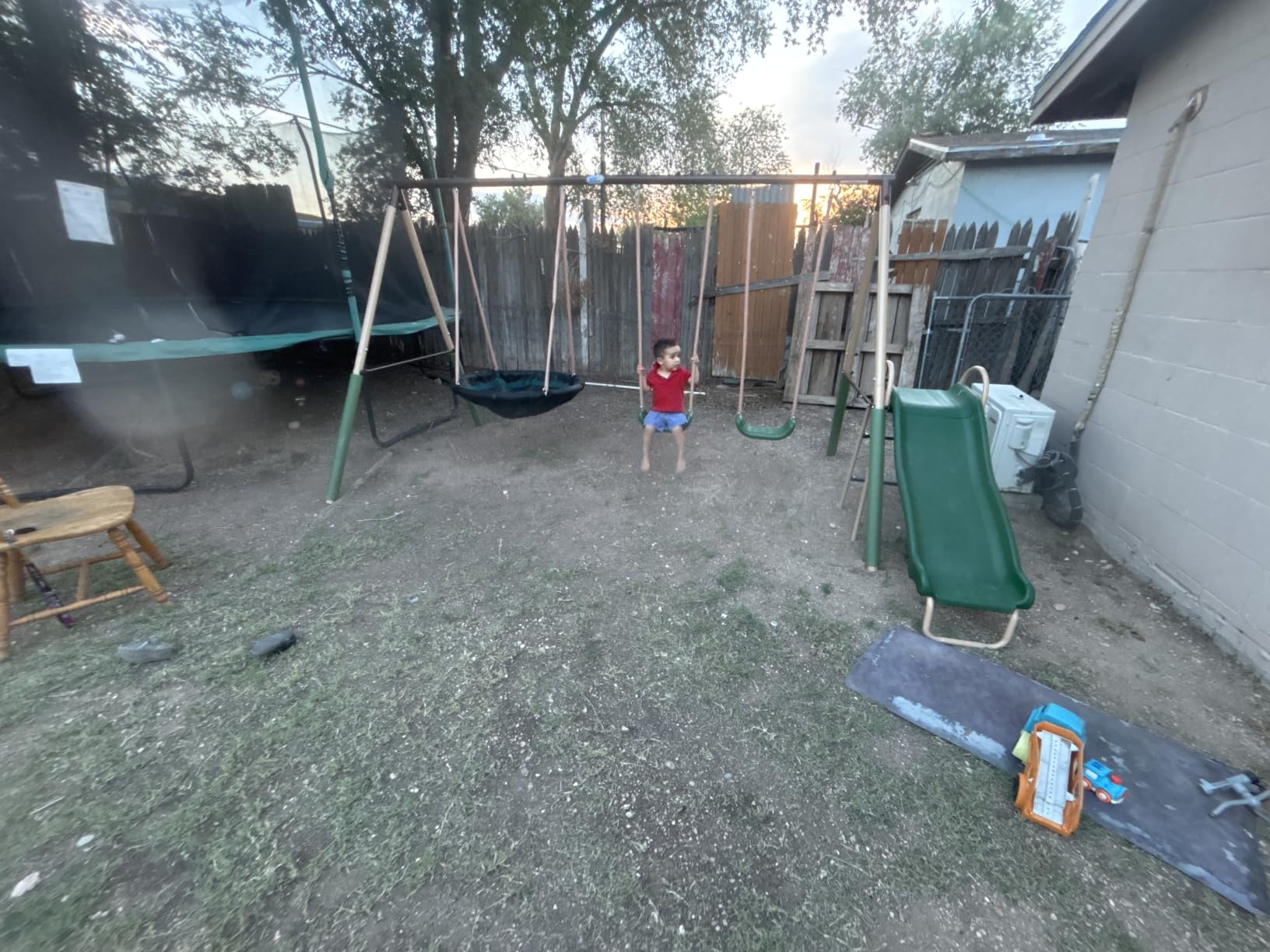
Four stations are included: two adjustable-height non-slip belt swings, a two-child SuperDisc swing, and a 5-foot slide with a raised exit. The raised slide exit is a real safety detail on a slope, because it keeps a child’s landing position higher and further from the low side of the yard where water collects and where a downhill roll would carry them.
The review base is small at 94 entries but consistent. The recurring negatives are missing or incorrect hardware on the slide, a top section that feels thin in use, and assembly time running well over the stated 2 to 2.5 hours. On uneven ground, expect that overrun. It is ASTM and CPSIA compliant, which is a reasonable baseline to expect at this tier.
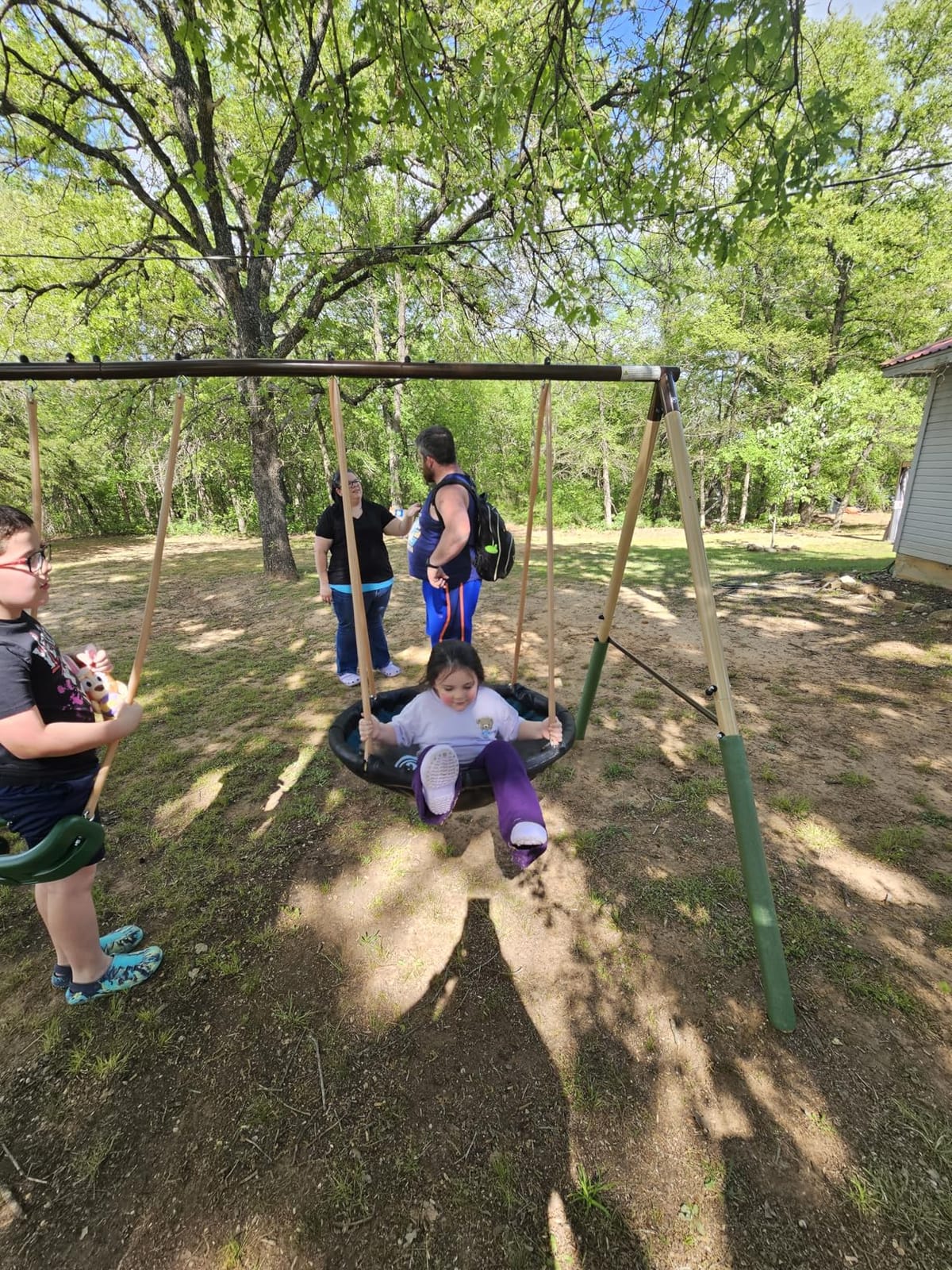
What a 6 inch drop means for this set
Six inches across 148 inches is a little over 2 degrees, and with the anchor kit in the box you can deal with a grade this size in a single session. Shims under the uphill legs plus the supplied anchors on all four points is enough. The kit is the reason this ranks above comparable sets when the ground is soft, since soft ground is exactly where a steel frame without proper stakes starts to walk.
Where it will disappoint you
The upper frame is described by some owners as somewhat flimsy, and a thin top section is the last place you want a compromise on a tilted structure. Missing hardware on the slide will cost you an afternoon unless you check the box contents against the parts list on delivery day. Budget for it.
10. Lifetime Metal 3-Station Set – Best Maintenance-Free Build
- Five-year limited warranty and a durable powder-coated finish
- Injection-molded bases add stability without cementing
- Three stations including a trapeze bar
- No sanding
- painting or staining ever required
- Largest footprint in the roundup at 135 by 115 inches
- Heaviest frame listed at 104.5 pounds so repositioning is hard
- 300 lb total capacity is modest for a set at this tier
The Lifetime is 115 inches deep by 135 inches wide by 88 inches tall and weighs 104.5 pounds, and the feature that matters most on a sloped yard is the injection-molded bases. They add stability to each leg without cement, which removes the single most labor-intensive task in a slope installation. No mixing, no formwork, no waiting on a cure time before the set can be used.
It is a three-station design with two molded belt seats and a rubberized steel trapeze bar, rated to 300 pounds total. Powder-coated steel construction passes playground performance and safety standards, and the manufacturer states it needs no sanding, painting or staining at any point in its life. A five-year limited warranty backs it.
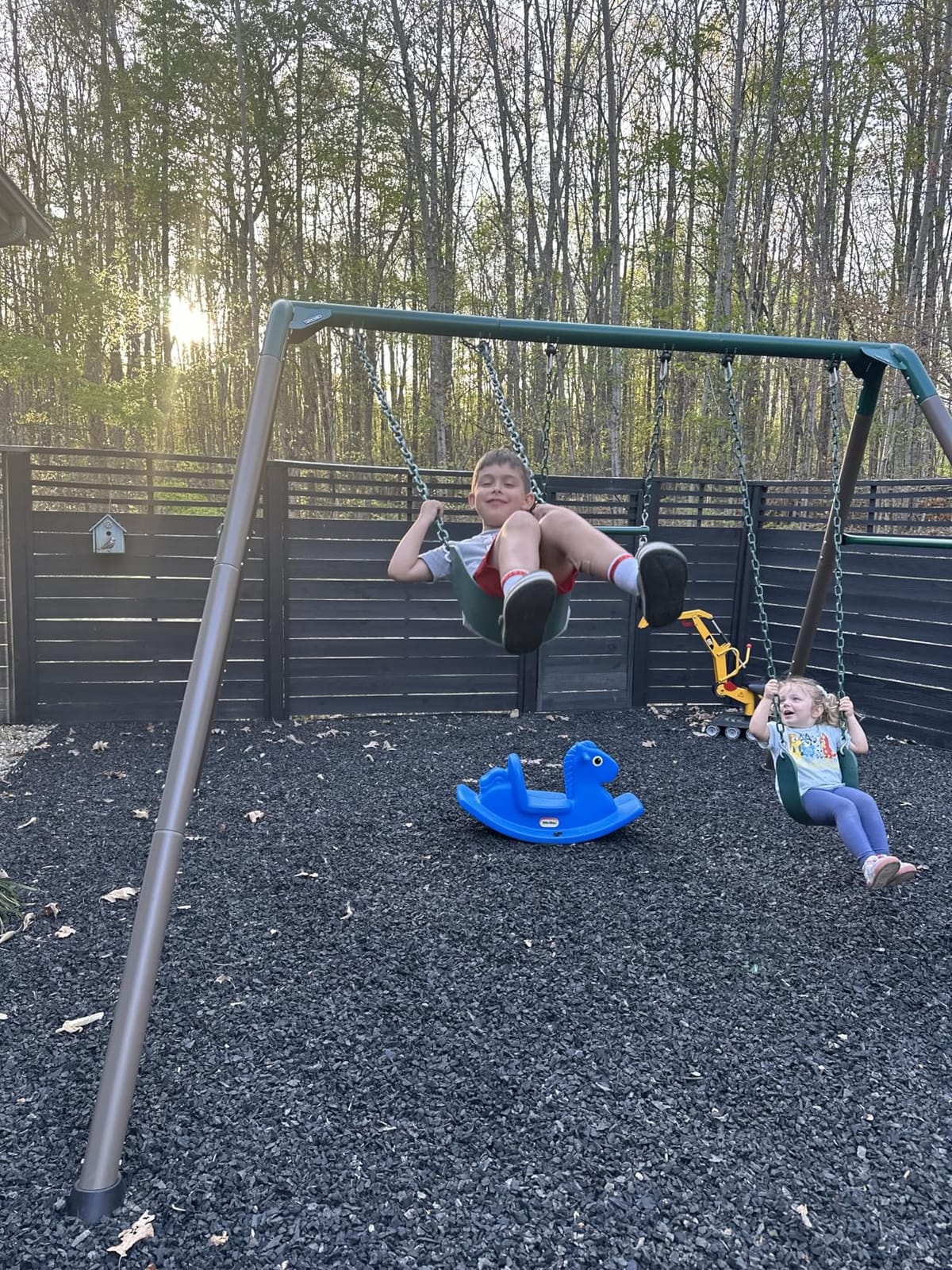
Engineered brackets with two-way steel end supports keep swing motion consistent, and rubberized chain grips protect fingers. Owners point to the cement-free stability bases as the main upgrade over a basic two-swing set, along with the trapeze bar for hanging and core play. For a yard that is on a grade and where you would rather not dig, that is a meaningful advantage.
The trade-offs are size and mass. This is the largest footprint in the roundup at 135 by 115 inches, and at 104.5 pounds it is the heaviest frame here, which means repositioning it after assembly is a genuine chore and a bad idea on a slope once it has settled. The 300 pound total rating is also modest for a set at this price tier, so it suits two children rather than a crowd.
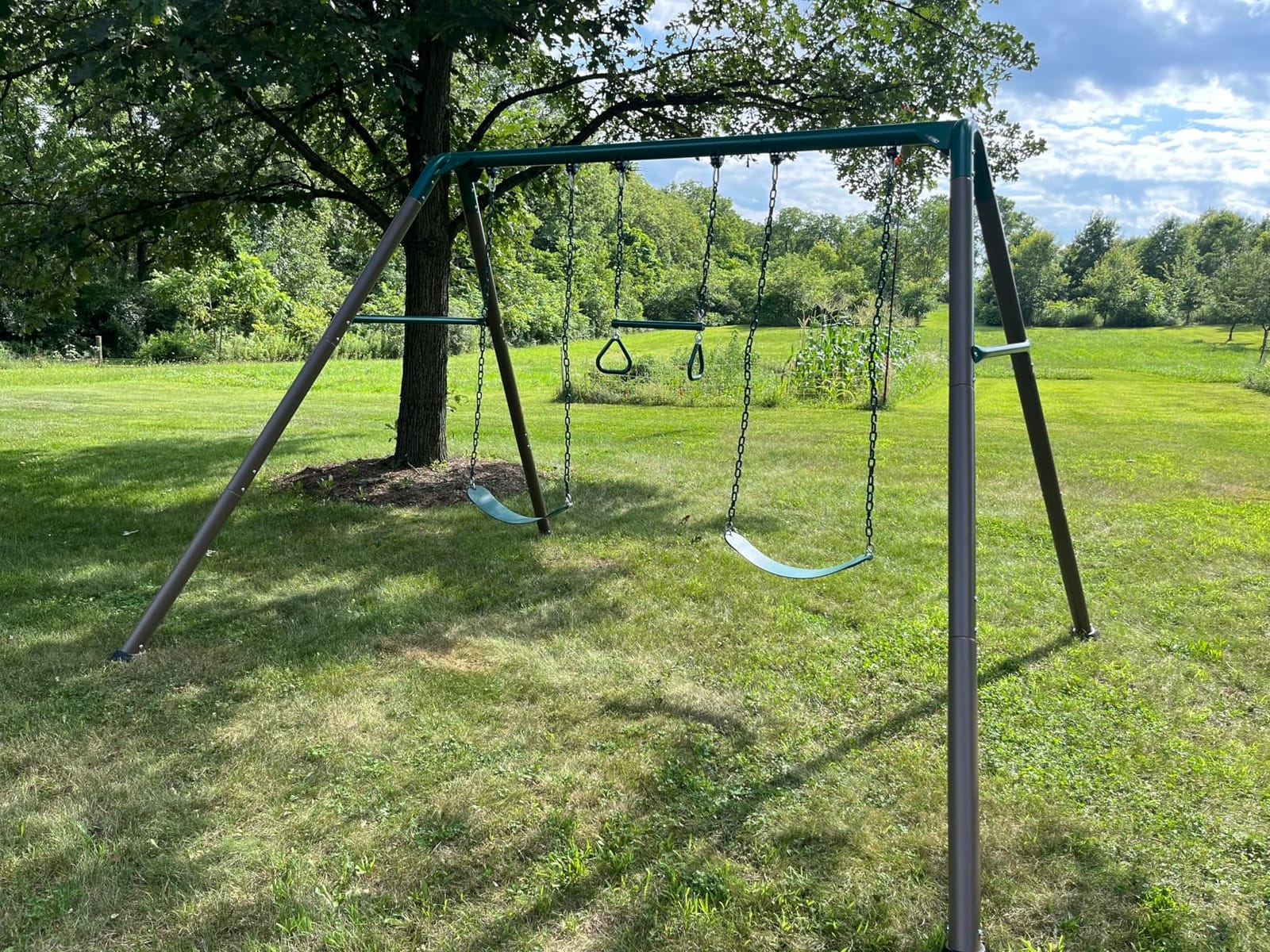
What a 6 inch drop means for this set
Six inches across 135 inches is about 2.5 degrees, which the molded bases absorb well because they are broad and add contact area at each leg. The cement-free design means the correction is pure shimming, done with treated lumber packing under the bases until each leg reads level. That is a much shorter job than pouring and curing footings, which is why this set ranks well for a mild grade.
Where it will disappoint you
Capacity is the limitation. At 300 pounds total with two belt seats, this is a set for two children, and larger siblings sharing it will exceed the rating. The footprint is also large for a narrow side yard, and the weight means that if the ground settles over the first two seasons and the set needs adjusting, you are hiring help rather than grabbing a lever.
Slope Tolerance Cheat Sheet: How Much Drop Each Build Can Take
Nobody publishes a slope tolerance number for residential swing sets, so here is the working version based on frame geometry, joint type, and how builders describe uneven-ground installs. Read the drop figure as inches of vertical fall measured across the set’s narrower dimension, because that is the dimension that governs how far the frame has to lean.
- Wide powder-coated steel A-frames, roughly 10 feet or wider: 6 to 8 inches of drop with shims and anchors. This category covers the Trekassy, the Hapfan, the XDP eight-user and Crestview sets, and the Costzon stand.
- Compact steel A-frames under about 6 feet wide: 4 to 6 inches before the angle becomes visible. The Lunafun, the HLC, and the Lifetime set sit here, and the Sportspower set is the exception because its 6 foot width is paired with a 12 foot length that can be oriented across the grade.
- Lightweight tube frames under 500 pounds capacity: 4 inches or less. The light frames tolerate grade poorly because a small push lifts a leg rather than loading it.
- Multi-leg sets with welded rather than bolted joints: the best-case category on a grade, because welded joints do not develop play as soil settles. The XDP eight-user, Crestview, and SuperDisc sets use welded frames.
- Site-built custom sets with engineered footings: up to 12 inches of drop over 20 feet, which is the figure a major custom manufacturer states before recommending landscaping.
- Anything past 12 inches of drop across the footprint: grade first. One homeowner in a Connecticut forum thread measured 37 inches of fill needed on the low side of a lot, and the grading quote came in far above the cost of any set in this roundup.
One more variable belongs in this list: the direction of the grade. A drop that runs parallel to the swing beam is far more dangerous than the same number of inches running across it, because the beam arcs forward and the child travels downhill with the motion. Rotate the set 90 degrees if the space allows, and a 10 inch cross-slope becomes a far easier problem than a 10 inch fall-line slope.
Wood vs Metal vs Vinyl: Which Holds Up Best on a Grade
Every set in this roundup is steel, and that is a deliberate filter rather than a lack of options. Cedar playsets are built around 4×4 posts that are expected to bear on a level pad, and a manufacturer-direct guide to swing set shopping notes that a space dropping 12 inches over 20 feet is the limit for a professionally installed set, with landscaping needed beyond it. Retail-grade wood sets use thinner posts, while commercial-grade wood uses 4×6 posts with recessed bolts, and even the commercial tier is specified for flat ground.
Steel wins on a grade for structural reasons rather than marketing ones. Each steel leg is an independent vertical post, so a foot of drop between two legs produces a small angular difference at the top joint rather than a twisting force through a continuous post. Wood posts are continuous members, and the ones that see the most load on a slope are the ones that twist and check. Homeowner reports of warped 4×4 posts and loosened hardware within 18 months on ungraded slopes are common enough to be a category, not an anecdote.
Vinyl sits in the middle. A molded vinyl set has no wood to rot and no steel to rust, and the shell is dimensionally stable, but the posts and swing hardware are still a fixed-length assembly that expects a prepared surface. If you are choosing vinyl, you are choosing lower maintenance on a flat pad, not better slope behavior.
There is one case where wood is genuinely the better answer: a very steep lot with no level area at all. A custom or site-built cedar set with engineered piers can be designed around a grade in a way a boxed set cannot, and that is a project for a professional installer, not a weekend.
Anchoring and Footings on Uneven Ground
Anchoring is where sloped-yard installs succeed or fail, and the failure shows up a season later as a set that has shifted or now rocks. On level ground a simple auger stake is enough because the frame’s weight holds it. On a grade, the downhill leg carries most of the lateral load every time someone swings, and a shallow stake in that exact spot will let the leg walk.
Three options, in order of how well they handle a grade:
- Concrete footings. The most permanent and the most work. Footing depth and size both increase on a slope, and the uphill legs need to be built up taller rather than the downhill legs dug deeper, so every leg finishes at the same height. One homeowner bridged a 12 inch drop over 20 feet using 18 inch footings with 2×8 spanning beams, and it worked, but it took two weekends.
- Auger or screw ground anchors. The corkscrew stakes that ship with several of these sets, and the fastest option. They are weaker in sandy or loose soil and on a steep grade, which is exactly where you will feel a leg lift. Reviewers of the Trekassy set recommend upgrading the included stakes, and reviewers of the Lunafun report switching to trampoline J-hooks for anchoring.
- Screw piles. Helical steel piles driven to refusal. They are the best permanent answer for a set on steep or loose soil because the depth is not limited by where the rock starts, and they double as a fix for a set that has already started to walk downhill.
One forum pattern repeats across sloped-yard threads: sets that were fine in the first season started leaning because anchoring was never adapted for the grade. Whatever method you pick, the two downhill legs get the deepest treatment, and it is worth checking the frame for plumb again after the first wet season, since new fill and softened soil settle.
Level It, Raise It, or Work With It? Three Ways to Handle a Grade
Path 1, level it. Grade the footprint flat, then install anything in this roundup without special measures. This is the right call above about 12 inches of drop, or when the drop runs along the swing beam rather than across it. It is also the most expensive path, and one New England homeowner measured 37 inches of fill needed on the low side of a lot before a contractor quoted the grading work alone.
Path 2, raise it. Keep the soil where it is and bring the uphill leg up with cribbing or a taller footing until the frame is level. This is the answer for 6 to 12 inches of drop, and one family that went this route reported zero issues after three years on an 8 inch drop over 20 feet using a commercial-grade 4×6 post set with a professional crew. In steel terms, it means packing treated lumber under the molded bases or building a small pier under the two uphill legs, which is a Saturday of work rather than a project.
Path 3, work with it. Choose a set whose geometry does not care, rotate it 90 degrees so the grade runs across the beam, and anchor all legs independently. This works under about 6 inches of drop with any of the wide A-frames in this roundup, and it is why we ranked metal so heavily. The honest limit is that assembly takes longer, because you will be shimming and re-checking level repeatedly rather than bolting together on flat soil.
Before choosing Path 1, ask whether a retaining wall or a grading crew is cheaper than a set with a smaller footprint. Several families in homeowner discussions ended up buying a metal A-frame specifically because nothing wooden would fit their side yard without grading first, and that trade has been a good one for them.
Safety on a Grade: Fall Zone and Downhill Swing Direction
Slope introduces a safety consideration that does not exist on flat ground: the direction the child travels when they fall. Residential swing sets are built to a CPSC and ASTM F1487 standard that calls for a clear use zone around play surfaces, and that clearance is measured on the actual grade, not on a flattened version of it. On a fall-line orientation, the child’s arc and their slide on the ground both run downhill, and the clearance you measured downhill is the clearance that matters.
Rotate the swing beam so the grade crosses it, not runs along it, whenever the yard allows. A narrow set with a short beam, oriented across a moderate grade, is safer than a long beam set aligned with the drop, even though the second one looks more impressive. The cost of a 90 degree rotation is zero when you plan it before delivery and significant when the set is already assembled.
Two more grade-specific notes. First, drainage. A set with a solid base or a large footprint can block the natural water path on a sloped yard, and water pooling under a playset is a recurring complaint from homeowners. Leave a gap or a path for runoff before you build, rather than excavating a wet pit later. Second, freeze-thaw. Footings on a graded site move with the soil, which is the seasonal version of the settling problem, and it is a good reason to re-check plumb each spring rather than only in the first week after assembly.
What to Avoid When Your Yard Is Not Flat
Avoid buying a large cedar playset first and measuring the slope afterward. The most common regret in homeowner threads is discovering the drop after committing to a model whose footprint will not fit, and the fix is always to measure before you shortlist, not after you have narrowed to favorites.
Avoid sets that ship without ground anchors if your ground is soft or sloped. The Crestview in this roundup is otherwise capable, but on a grade the missing anchors become the deciding factor against it. Several sets in this group do include stakes or a full anchor kit, and those are the ones to favor.
Avoid light frames above about 4 inches of drop. Anything rated in the low hundreds of pounds that rocks when pushed will lift a leg on a grade, and a lifted leg on a slope becomes a set that migrates downhill over a few seasons.
Avoid bolting a heavy beam frame to a slope with shallow stakes. Multiple forum accounts describe frames that looked fine at first and started leaning after a wet spring, and the fix is always deeper anchoring on the downhill side, not tightening the hardware. If a kit is missing bolts or washers, replace them before assembly rather than substituting whatever is in the drawer.
Also worth flagging for anyone shopping big-box retail kits by brand alone: build quality varies a lot between lines, and the assembly instructions for retail wood kits rarely address uneven ground at all. Check the specific model’s post size, hardware, and anchoring provisions rather than the brand name on the box.
Frequently Asked Questions
Can I put a swing set on a slope?
Yes, if the drop across the set’s footprint stays under roughly 12 inches, each leg is anchored independently, and the swing beam runs across the fall line rather than down it. Wide steel A-frames handle 6 to 8 inches of drop using shims and taller footings on the downhill legs. Beyond about 12 inches, grade the site first or commission a custom set.
How do I install a swing set on uneven ground?
Measure the drop first with a string line or a level on a 10 foot board. Choose a set with a wide, self-supporting A-frame base, set the swing beam across the fall line, and level each leg independently. Shim or crib the uphill legs, pour deeper footings under the downhill legs, and use ground anchors on every leg. Recheck plumb after the first wet season.
How much slope can a swing set handle?
A custom manufacturer states it installs on a space dropping 12 inches over 20 feet, and that landscaping is needed beyond that. For boxed residential sets, 6 to 8 inches of drop across a wide steel A-frame is comfortable, 4 to 6 inches is the practical ceiling for a compact frame, and anything past 12 inches should be graded before installation.
How do you level a sloped yard for a playset?
There are three routes. Level the whole footprint flat, which is the most expensive but simplest installation. Raise the uphill legs with cribbing or taller footings so the frame is level without moving soil, which works for 6 to 12 inches of drop. Or work with the grade by choosing a set with a wide base, orienting it across the fall line and anchoring all legs independently.
Can you level a sloped yard without a retaining wall?
Yes, for moderate grades. Cribbing or taller footings under the uphill legs raise the structure to level without excavating or building a wall, and that is the standard approach for 6 to 12 inches of drop. A retaining wall only becomes necessary when the drop is large enough that the fill would not stay put, which is generally past 12 inches.
Do swing sets have to be perfectly level?
The structure needs to be level, but the ground under it does not. What matters is that the frame sits plumb and that each leg is independently supported, which is why a steel A-frame tolerates uneven soil better than a wood playset built around continuous posts. The use zone around the set, however, is measured on the actual grade.
Is KidKraft or Gorilla better for a sloped yard?
Both cedar-heavy brands are built for a prepared flat pad, and their assembly instructions do not address uneven ground, which shows up in homeowner reports as warped posts and loosened hardware. For a sloped yard, a wide-base steel A-frame with included anchors is a better fit, or a custom site-built set with engineered piers if the grade is severe.
What is the best swing set for a sloped backyard?
A wide steel A-frame with a footprint of 10 feet or more and included ground anchors handles a gentle grade best, because each leg is an independent post and the long base spreads the tilt. Sets with welded rather than bolted frame joints hold their geometry better as soil settles. Measure your drop before buying, and treat 12 inches across the footprint as the point where grading takes over.
Bottom Line: Which Set Fits Your Slope
Measure your drop before you choose anything, because that single number eliminates most of the market. Under 6 inches and almost any of these sets works, with shims. Between 6 and 12 inches and you want a wide steel A-frame with included anchors, and the Trekassy 440lb set is the one we would put on a gentle grade, with the Hapfan 600lb set taking over when the kids are old enough to swing hard. Past 12 inches, grade the site first, and compare that cost honestly against a smaller-footprint metal set.
Whichever route you take, anchor the two downhill legs deepest, run the beam across the fall line, and leave a path for runoff. Those three details are what separate a set that is still square after three winters from one that is leaning. If you want a broader starting point before you go deep on terrain, our [kids swing set guide](https://www.wpa-pool.com/best-kids-swing-sets/) covers the non-slope factors like age range and growth path.