
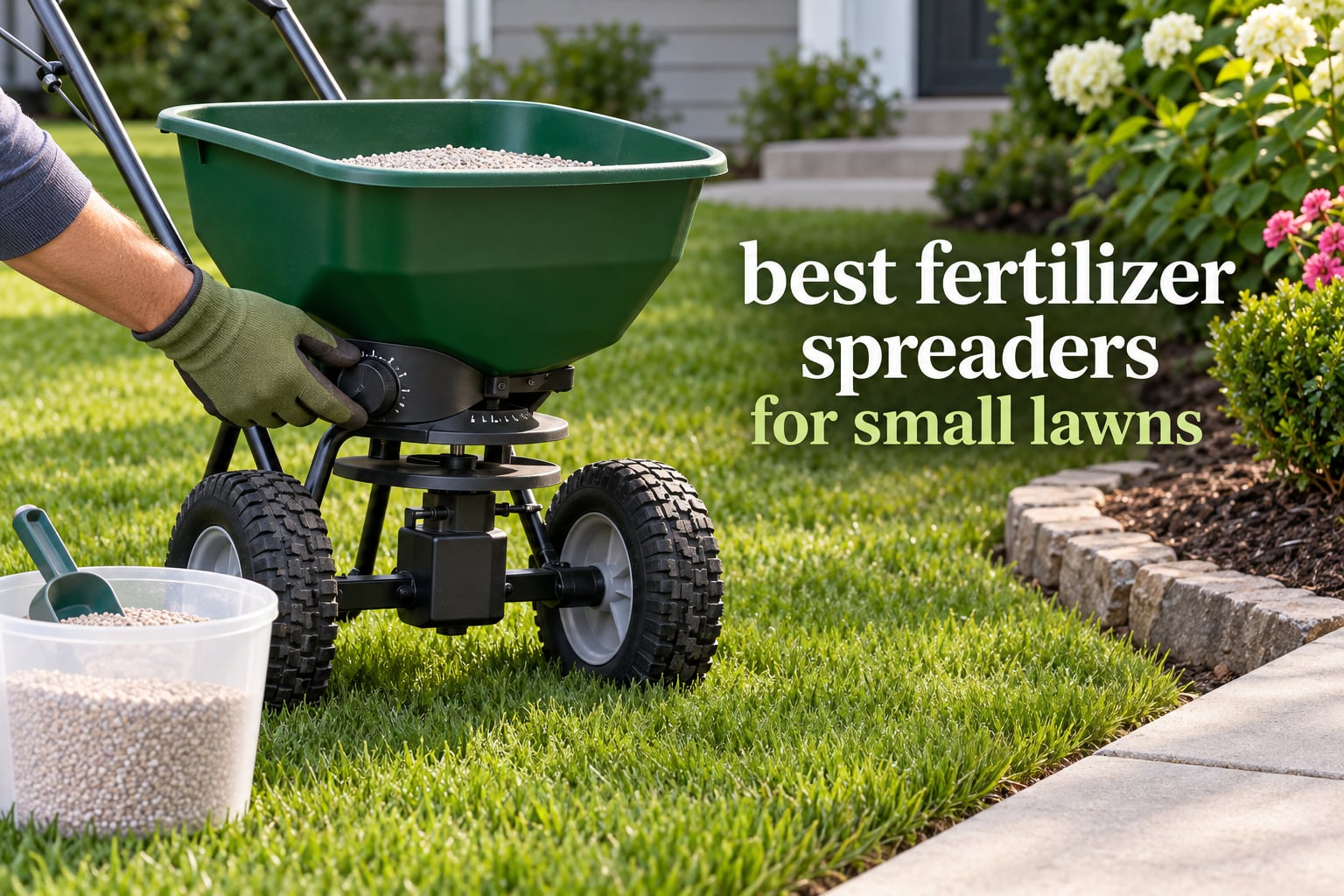
If your lawn is under about 5,000 square feet, the best fertilizer spreaders for small lawns are compact units that you can load in one trip and store in a corner of the garage. A 50-pound or 130-pound commercial hopper is the wrong tool here: it is awkward to push, impossible to steer around a flower bed, and it dumps far more product than a small yard can absorb evenly.
We spent weeks with eight different spreaders across front lawns, side yards and post-construction repair patches, working from a small city lot to a suburban half-lot of roughly 5,000 square feet. We were looking for one thing above all else: an even spread pattern with no dark stripes, because that is the single complaint that shows up again and again on r/lawncare and LawnSite threads about small-yard spreaders.
Every pick below runs lean. None of them requires an assembly step, and all of them double as ice melt or seed spreaders when the season turns. If your outdoor space is tight in other ways too, our guides to garden fountains for small spaces and oscillating sprinklers cover the rest of the seasonal lawn kit.
Table of Contents
What Is the Best Fertilizer Spreader for a Small Lawn?
The best fertilizer spreader for a small lawn is a mini walk-behind broadcast unit rated for roughly 5,000 square feet, because it balances a one-fill capacity with a narrow frame that still fits between beds. Under 1,500 square feet, a hand-cranked handheld is the better tool, and for patches under 200 square feet a simple shaker bottle does the job.
Best overall for small lawns: a mini walk-behind broadcast spreader with an edge guard and a 5,000 square foot hopper rating.
Best under 1,500 square feet: a hand-crank handheld with a dial-controlled flow rate and a wrist support brace.
Best for bare patches and steps: a plastic shaker bottle with selectable lid openings for different granule sizes.
That size band matters more than any feature list. Match the hopper to the lawn and everything else becomes a preference rather than a necessity.
Top 3 Picks for Small Lawns in 2026
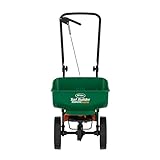
Scotts EdgeGuard Mini
- Covers 5000 sq. ft.
- Pre-calibrated
- EdgeGuard side shield
- Folds flat for storage

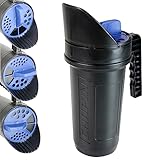
CHAPIN 8740A
- 64 oz shaker bottle
- Three lid openings
- Stores with product inside
- Year-round use
All 8 Spreaders Side by Side in 2026
| Product | Specifications | Action |
|---|---|---|
| Scotts Turf Builder EdgeGuard Mini |
|
Check Latest Price |
| Scotts Whirl Hand-Powered |
|
Check Latest Price |
| CHAPIN 8740A Shaker |
|
Check Latest Price |
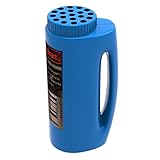 Stalwart 82-YJ487 Shaker Stalwart 82-YJ487 Shaker |
|
Check Latest Price |
 Snow Joe SJSPD1 Handheld Snow Joe SJSPD1 Handheld |
|
Check Latest Price |
 SOLO 421S Chest-Mount SOLO 421S Chest-Mount |
|
Check Latest Price |
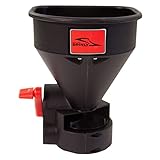 Brinly 5 lb Handheld Brinly 5 lb Handheld |
|
Check Latest Price |
 EarthWay 2750 Bag Spreader EarthWay 2750 Bag Spreader |
|
Check Latest Price |
How We Picked These Eight Spreaders
Every model here had to clear four filters before we spread a single granule. First, capacity had to fit a small lawn, which meant nothing above roughly 25 pounds of product. Second, the unit had to arrive ready to work, because assembly on a Saturday morning is a poor use of a fertilizing weekend.
Third, we weighed even distribution heavily, watching the spread pattern for dark or light bands across a known area. Fourth, we factored the storage problem, since a spreader you cannot fit in the garage is a spreader you will not use.
We also logged how each one handled cleanup, because fertilizer left in a hopper for a month is how plastic frames crack and gears seize. Models that clogged, shed product into their own wheels or lost their calibration between materials got flagged even when their ratings were strong.
1. Scotts Turf Builder EdgeGuard Mini Broadcast Spreader – Best Overall for Small Lawns
- No assembly and pre-calibrated out of the box
- EdgeGuard side shield keeps product off walks and beds
- Folds flat for shelf or wall storage
- Rust-proof body hoses off clean
- Covers a 5000 sq. ft. lawn in one fill
- Hollow wheels can collect wet product and throw it back onto the plate
- Small rear stand makes it tip easily when refilling
- Light-duty plastic feels thin compared with metal units
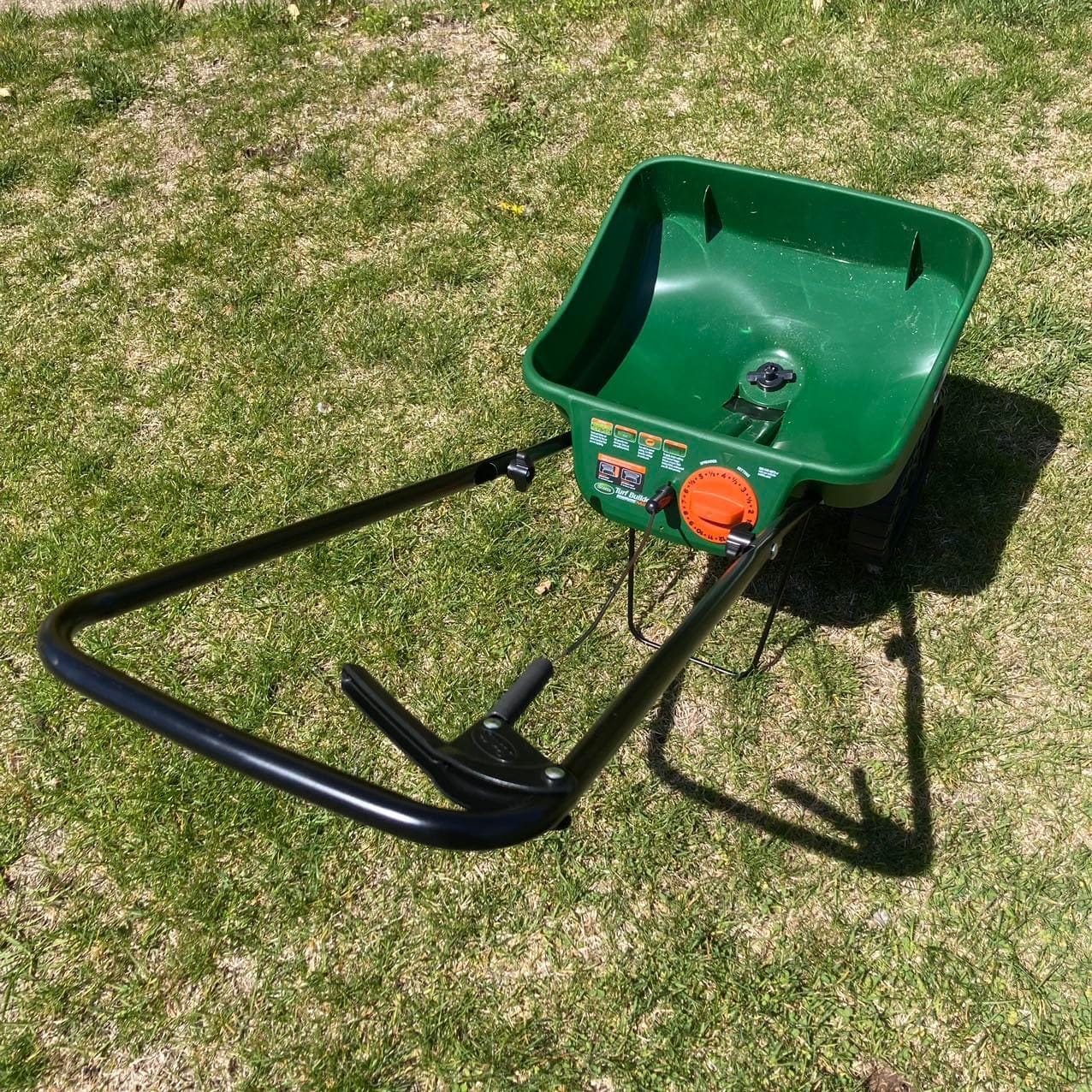
This is the one we keep reaching for. The 5,000 square foot rating lines up almost exactly with a small suburban half-lot, and the frame is narrow enough to steer between a walkway and a shrub border without repositioning the whole machine. It comes pre-calibrated, so the first pass happens about ten minutes after the box is open.
The EdgeGuard side shield is the feature that earns its keep on a small lawn. On a tight lot, a normal broadcast model throws a meaningful amount of product onto the sidewalk and into the bed edge, and that material washes into the gutter or burns the border grass. The shield blocks the near-side throw and keeps the arc on turf.
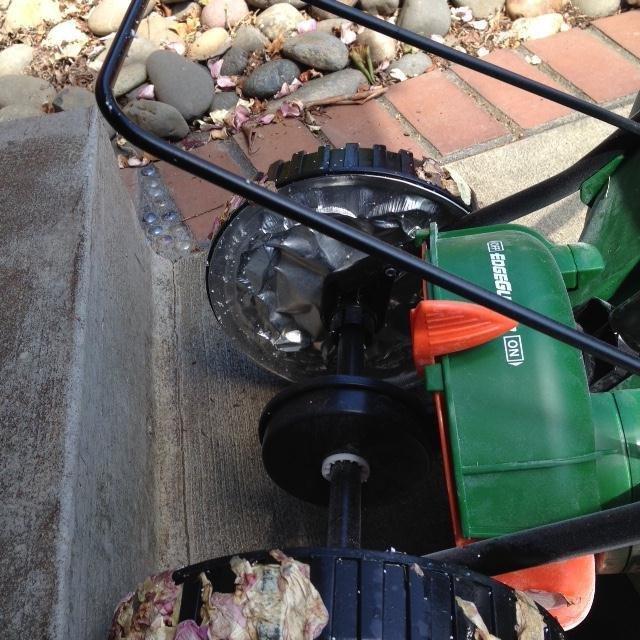
Where it needs attention is the drive train. The hollow wheels are a known weak point: when the lawn is damp, they pick up wet granules and carry them up to the rotary plate, which changes the discharge rate mid-pass. The hopper also sits high on a small rear stand, so filling it on a slope invites a tip-over.
The all-plastic frame is a genuine advantage on a yard with a dog or a wet garage floor, since it will not rust. The trade is weight and stiffness, and it does feel lighter in the hand than a metal unit. That light frame is also what makes the small rear stand the part to watch when you refill.
When the EdgeGuard Mini is the right buy
Buy it when your lawn runs from about 2,000 to 5,000 square feet and you want to walk the whole thing in a single pass. It is also the easiest option to store, because the handle folds flat against the hopper and the whole body leans against a wall in a shallow closet.
Pair it with a small handheld for the edges. Most owners use the mini for the open turf and a hand-crank model for the strip along the fence, where a walk-behind frame simply will not fit.
When the EdgeGuard Mini disappoints
Skip it for a lawn under about 1,200 square feet, where the extra walking distance does not pay for itself. It is also a poor fit for steep, uneven ground, since a single-wheel drive can starve the hopper on a lean and leave a visible stripe behind.
If you spread wet coated granules or compost-style material, expect more wheel pickup than the marketing photos suggest. Weigh the plastic frame carefully if you have had durability trouble with lighter units before.
2. Scotts Whirl Hand-Powered Spreader – Best Manual Handheld
- Highest average rating in the group
- Arm support brace cuts wrist fatigue on a full load
- Smooth crank gives a consistent rotary speed
- Light and easy to work around tight beds
- Doubles as a salt and ice melt spreader
- 1500 sq. ft. means frequent refills on anything larger
- Full hopper tires the arm over long stretches
- Steady cranking rhythm is required for even output
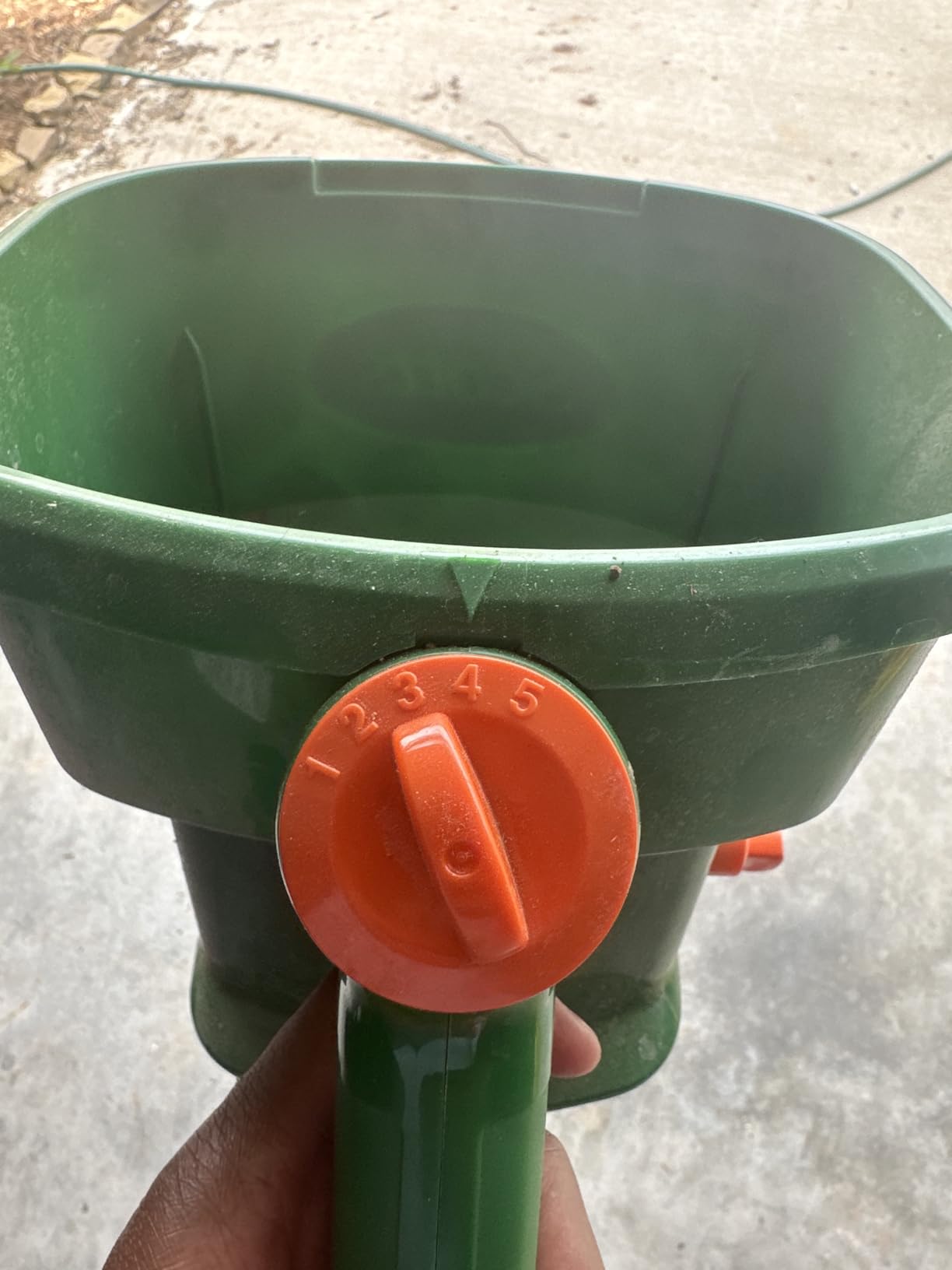
This handheld has the highest average rating of anything we tested, and after a season of use the reason is obvious: it is simple in a way that nothing else here is. No battery, no motor, no charging. You crank with one hand and walk with the other, and the flow dial on top does exactly what the label says it does.
The arm support brace is the detail most people miss. It spreads the hopper load across your forearm instead of hanging it from your wrist, which is the difference between a comfortable ten-minute job and a sore evening. Without it, a full hopper on a 1,500 square foot lawn is genuinely tiring.
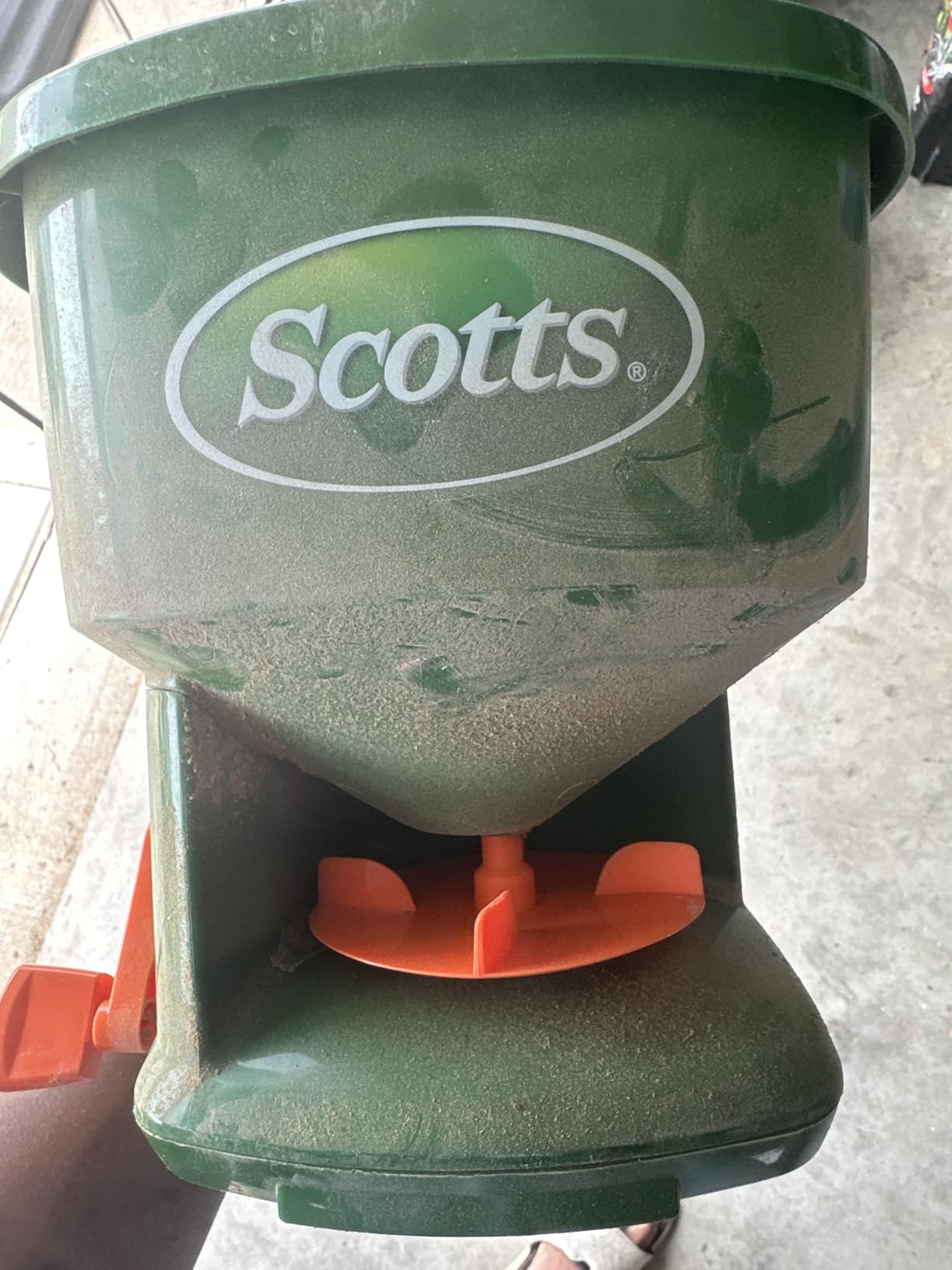
Capacity is the hard limit. At a 1,500 square foot rating, this is a spot and small-lawn machine, not a whole-property machine. Feed a 3,000 square foot yard with this alone and you will be refilling mid-lawn, and every refill is a chance to change your flow setting by accident.
The hopper is small enough to maneuver between a raised bed and a fence post, which is exactly where walk-behind units get abandoned. It also handles ice melt and salt in winter, so the purchase earns its keep across the full year rather than sitting in a shed from January to October.
Who the Scotts Whirl suits
It fits homeowners with roughly 1,500 square feet or less of turf, plus anyone who wants a dedicated edge and repair tool alongside a walk-behind spreader. Reviewers frequently describe it as the companion unit they use for overseeding bare patches and feeding the strip along a back fence.
It is also the one to choose if you want zero maintenance items. There is no battery to replace and no motor to clog, and a simple hose-out keeps it clean.
Where it falls short
The 1,500 square foot ceiling rules it out as a whole-lawn solution above about 1,800 square feet. Crank speed also matters more than most buyers expect, since a fast, uneven crank is the fastest way to get an inconsistent pattern.
Anyone with a shoulder or wrist limitation should test it empty first. The crank load rises noticeably once the hopper is full and the rotary is spinning.
3. CHAPIN 8740A Shaker Spreader – Best for Tiny Yards and Steps
CHAPIN 8740A 64 oz All-Season Hand Shaker Spreader, Seed, Fertilizer & Salt
- Three lid openings match flow to seed
- salt or ice melt
- Stores with product still inside
- Compact enough for a closet or vehicle
- Hand wash and reuse
- Handles small and large hands with gloves
- Screw lid can be stiff for weaker hands
- Coarse salt bridges in the widest opening
- No intermediate flow setting
- Shaking is less consistent than a rotary on bigger patches
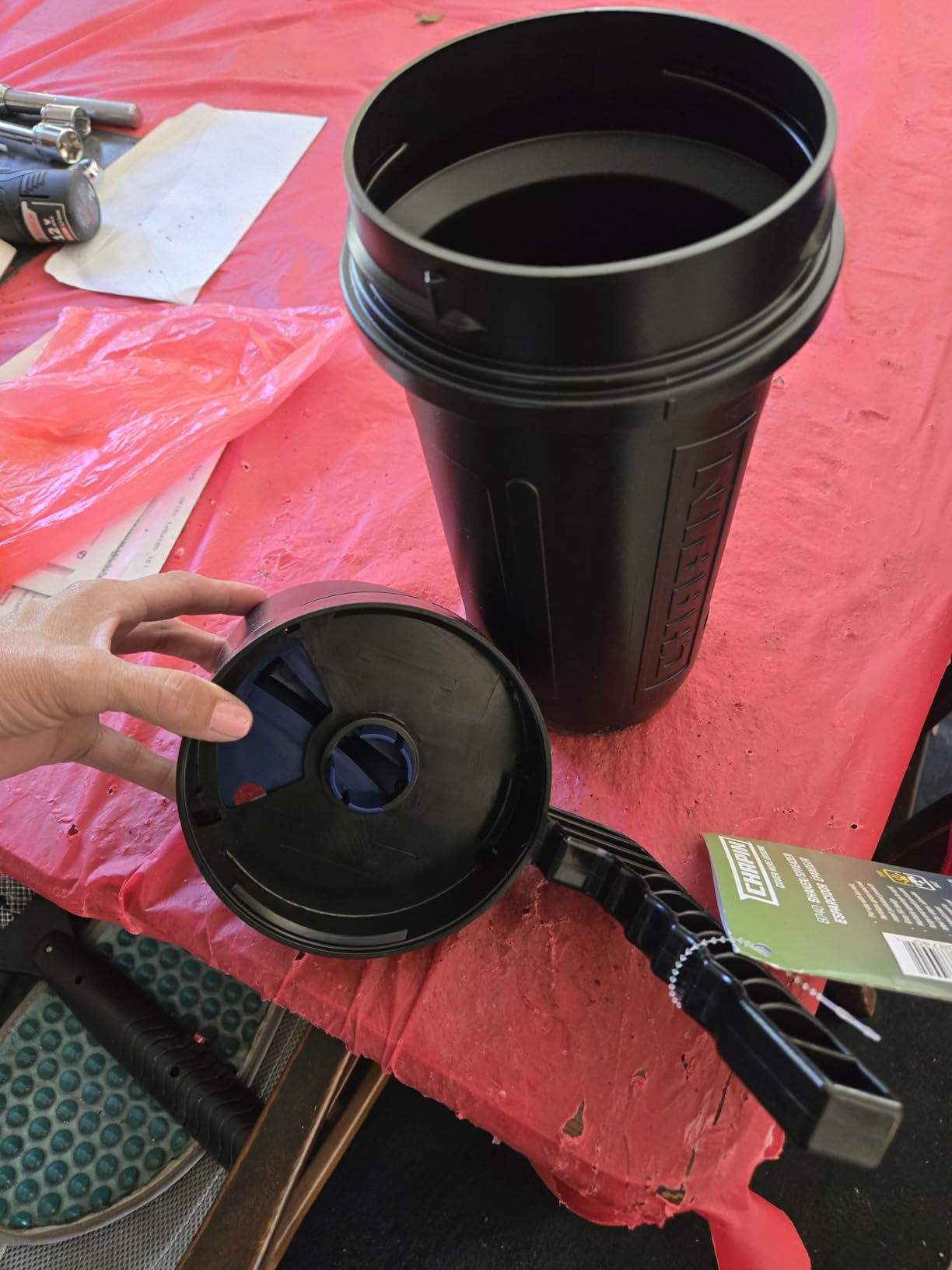
For a lawn measured in hundreds of square feet, or for the front steps and a short walkway in winter, a shaker is the correct tool and everything else is overkill. The three lid openings are the reason this one works: small, large and wide openings each suit a different granule size, so you are not forcing ice melt through a hole built for grass seed.
The wide mouth makes filling quick, and the handle is sized so you can work it with gloves on in February. It also stores with product still inside, which is unusual among hand tools and means it lives in the closet instead of being cleaned out every time.
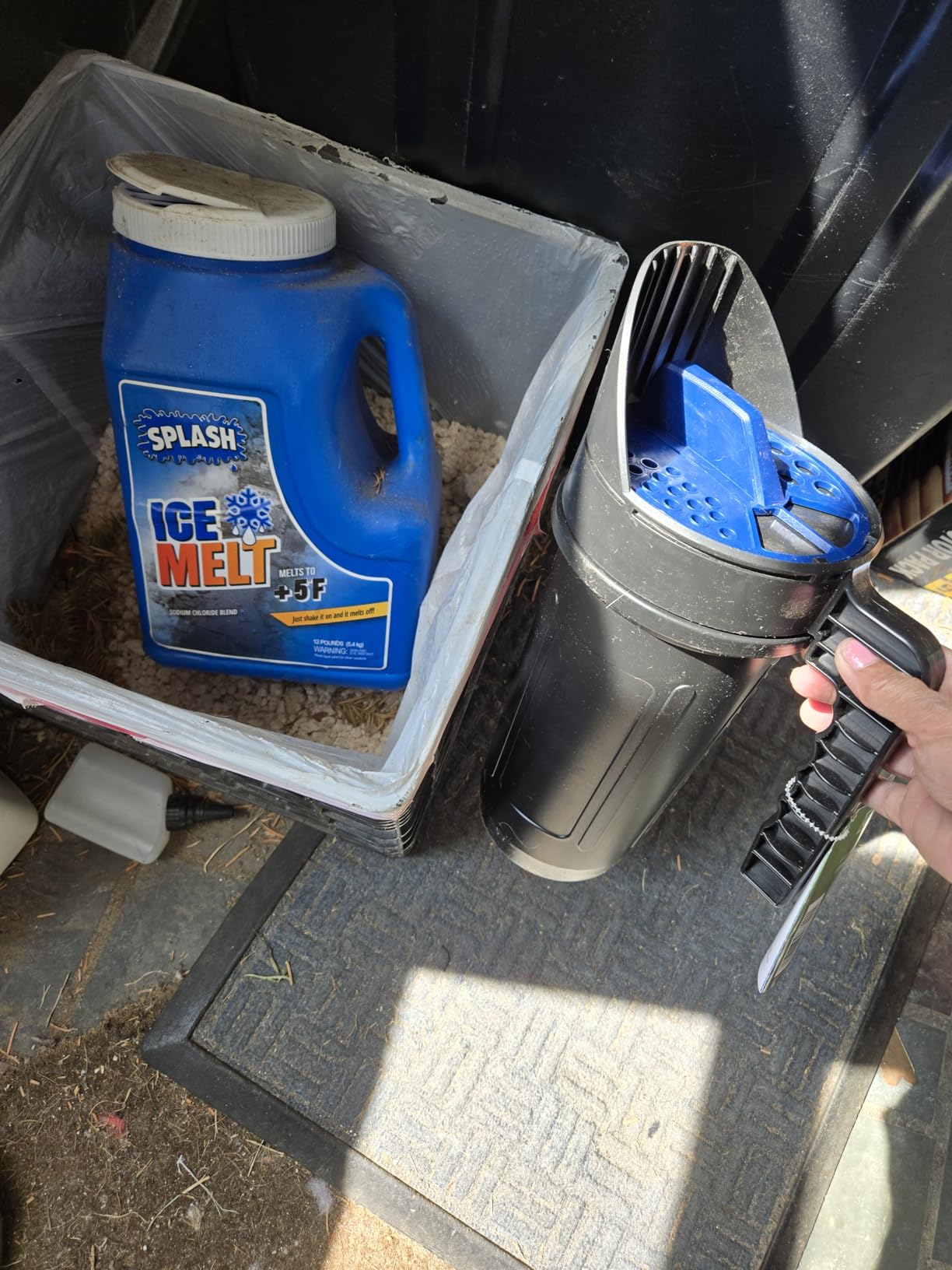
Consistency is the honest limitation. Shaking by hand produces more variance than a calibrated rotary, so on anything larger than a patch you will see overlap marks. The screw-on lid is also a recurring complaint from users with arthritic hands, since the threads are tight.
Coarse rock salt is the worst-case material here. It clumps and bridges in the widest opening, and the largest setting is generally more flow than most steps actually need.
Best use for the CHAPIN shaker
Reach for it on patch repair, overseeding a thin corner, feeding a shaded strip under a tree, and de-icing steps. It also does a good job topdressing a small repaired area after construction, where a walk-behind model cannot reach.
Owners pair it with a walk-behind spreader, using the shaker for everything the big machine cannot touch. That combination covers a whole small lawn without overbuying.
When a shaker is the wrong answer
Any lawn above roughly 1,000 square feet of continuous turf will finish faster and more evenly on a rotary unit. The manual shaking motion also fatigues the forearm on a long pass, and the wide opening gives no mid-setting to dial back.
If your priority is a clean, uniform look rather than convenience, spend the extra effort on a rotary handheld instead.
4. Stalwart 82-YJ487 Shaker Spreader – Best Multi-Season Value Handheld
- 2.3 liter capacity cuts down on refills
- Light and comfortable to shake for longer stretches
- Wide mouth fills fast from a bag
- Holds up in cold weather without cracking
- Handles seed and fertilizer as well as sand and ice melt
- Dispensing holes cannot be closed so it cannot be stored filled
- Small lid opening makes spilling likely while filling
- Poor with coarse rock salt which clumps and drops in one spot
- Plastic can degrade with long sun exposure
The Stalwart sits between the tiny CHAPIN and the bigger Snow Joe, and that middle position is exactly where it works. At 2.3 liters it holds enough to treat a meaningful patch or a full set of steps without the refill dance, and it weighs almost nothing in the hand.
Reviewers praise it for cold-weather durability, which matters more than it sounds. A thin plastic can that cracks the first time you use it in January is useless, and this one holds together through repeated seasonal cycles. The wide ergonomic handle also makes it easier to control than a narrow can.
Where the Stalwart earns its slot
It is a strong second shaker for anyone who already owns a small one and wants more capacity for a side yard or a longer walkway. Buyers use it for fertilizer, seed, sand, ice melt and even baking soda on moss patches, which makes it a genuine four-season tool.
For storage, keep it empty. It is small enough to hang on a wall hook, and the twist-off lid empties in seconds.
What to watch out for
The dispensing holes never close, so unlike the CHAPIN it has to be emptied before it goes back on the shelf. That is the most repeated complaint in the reviews and the reason we placed it below the CHAPIN despite the larger capacity.
Coarse rock salt is its other weak point, since the holes are not sized for chunky material. Fine ice melt and standard fertilizer granules work well.
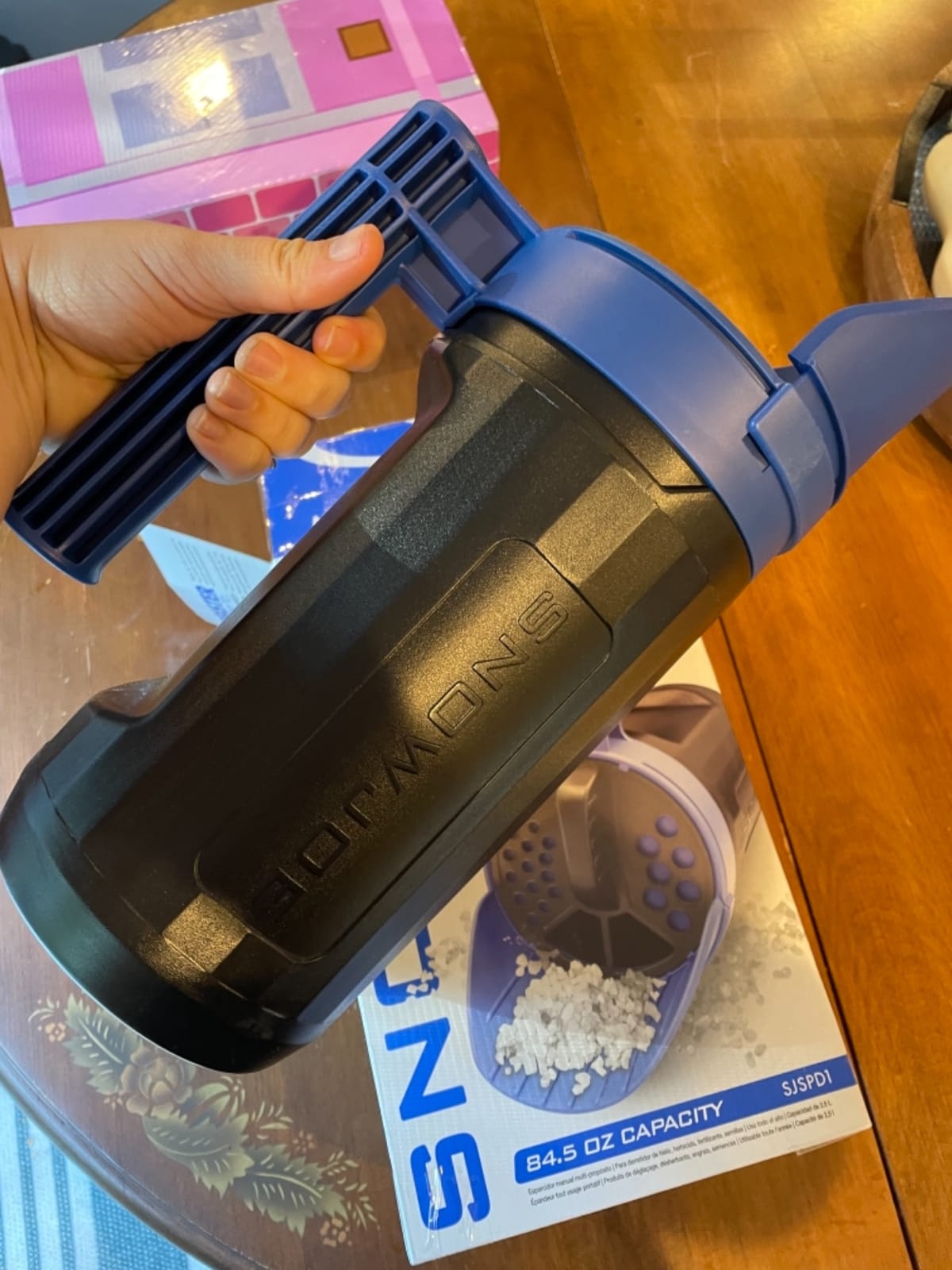
5. Snow Joe SJSPD1 Handheld Spreader – Best for Ice Melt and Driveways
- Thick plastic build resists cracking under heavy use
- 5 lb capacity covers a long driveway in about two fills
- Dial plus lid angle give real control over output
- Lid works as a measuring scoop for gloved refills
- Ridged handle grips well with winter gloves
- Twist-off lid is stiff for small or arthritic hands
- Side-to-side shaking tires some users out
- Wider body is fussier in tight planting beds
This is the one to buy if winter is half your use case. The 5 pound hopper is the largest of the small hand shakers we tested, and the adjustable dial between coarse and fine openings gives you a real handle on how much material lands per pass.
The lid that doubles as a scoop is a small idea that saves real time. You can lift, measure and pour in one motion while wearing gloves, which matters on a cold morning when you would rather not make three trips to the bag.
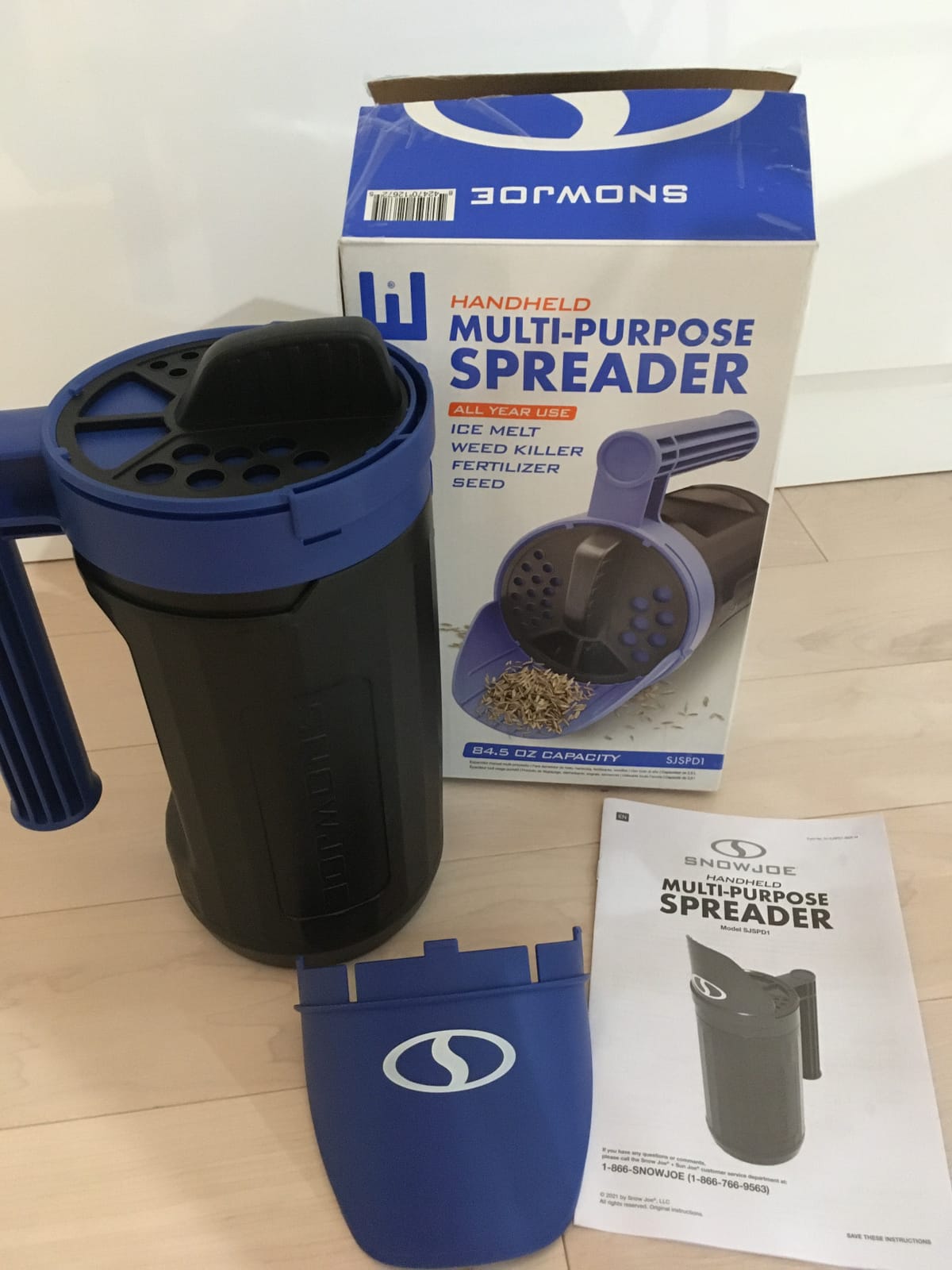
Owners consistently describe the plastic as thick and uncracking, even after a full winter of use. That build quality is why we rank it above the other hand shakers for driveway work, where the weight of ice melt in the can stresses the seam far more than seed does.
The main friction point is the twist-and-lock lid. It is secure against spills, which is a virtue on ice, but several reviewers with weaker hands find it hard to remove. Test it once before committing.
Why the Snow Joe suits winter work
It handles a long driveway or a front walk in about two fills, and the ridged grip stays readable with thick gloves on. The flow dial also helps you cut waste, since over-application on a walkway is both sloppy and expensive.
In spring and summer the same hopper carries seed and granular fertilizer, so the tool is not confined to a few cold months.
When it is the wrong tool
Skip it for dense planting beds, where the wider body is harder to maneuver than a slim shaker. The shaking motion also tires the arm faster than a crank-driven rotary, so it is not a good whole-lawn choice.
If fine hand control matters more than capacity, the three-opening CHAPIN gives you a cleaner range of settings.
6. SOLO 421S Chest-Mount Spreader – Premium Pick for Bigger Small Lawns
- Best build quality of the eight
- 20 lb capacity means very few refills
- Spreads wide and evenly across a big pass
- Clear lid lets you watch remaining product while walking
- Handles tiny seed such as clover without clogging the impeller
- Flow lever sits against your chest and is found by feel
- Full 20 lb load rests heavily on shoulder and neck
- Flow setting is sensitive and needs rechecking as load changes
- Crank is right-handed only
When a small lawn is really a larger lot, or you also maintain food plots, this is the one that changes how the job feels. The chest harness carries the load across your shoulders instead of your forearm, and the 20 pound hopper means you fill once and work for a long stretch.
Build quality is the standout. The components are described as serviceable and chemical-resistant, and the crank turns freely even under load. Reviewers with long ownership histories call it the only commercial-grade carry spreader they have owned, and several note it handles tiny seeds like clover without jamming the impeller, which is where cheaper units fail.
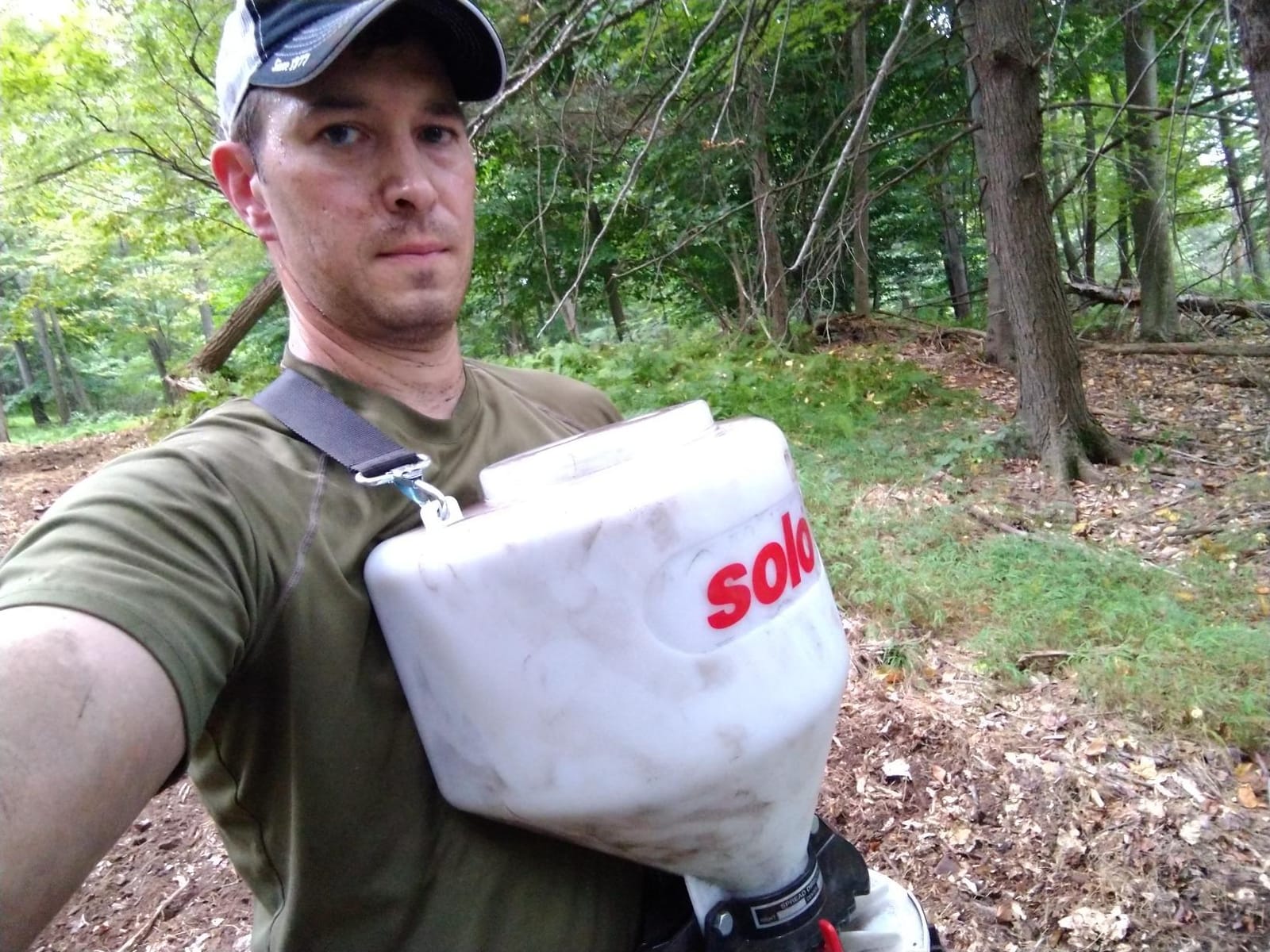
The clear hopper lid is more useful than it sounds. You can see how much product remains mid-pass, so you finish the row you are on instead of walking a half-row and coming back to an empty machine.
Comfort is the honest cost. Fully loaded with dense ice melt, the loaded weight sits heavily on your shoulder and the back of your neck, and the strap hooks hang the unit lower than ideal. The flow lever is pressed against your chest, so you adjust it by feel rather than sight.
Who should spend up for the SOLO 421S
It suits owners of a 5,000 square foot or larger lawn who would otherwise make six refills with a handheld, plus anyone seeding food plots or small plots. The capacity to precision trade is exactly what you want when you are covering a lot of ground per pass.
Reviewers report covering large areas quickly with no refill interruptions, and the direction fan gives more control over spread width than a simple lever.
Where it is overkill
On a lawn under about 3,000 square feet, 20 pounds of product is more than you can use in one session, and you will be storing unused material. The chest harness also adds bulk to store in a small garage.
Cranking is one-sided, so this unit suits right-handed operation only. Adjust the flow lever as the load drops, or the rate will drift across the lawn.
7. Brinly 5 lb Handheld Spreader – Best for Beds, Side Yards and Walkways
Brinly 5lb. All-Season Handheld Spreader with Easy-Fill Design for Seed, Ice Melt, & Fertilizer
- Enclosed gears and dense hopper feel built to last
- No assembly and an easy-fill contoured lip
- Extra-long crank makes a full hopper comfortable
- Knob flow gate gives reasonable rate control
- Lightweight poly body at 1.59 lb
- Prone to jamming with granular fertilizer and ice melt
- Throw pattern of about 5 ft means many passes
- Wide body is awkward for smaller hands
- Some buyers find the plastic smaller than the marketing suggests
This is the crank-driven answer for anyone who wants a real rotary spread without pushing a walk-behind. The Brinly is built for the awkward parts of a yard: side yards, the gap between a bed and a fence, and the strips along a walkway where a walk-behind frame will not go.
The long crank is the detail that makes a 5 pound load workable. The enclosed gears run smoothly and the dense hopper has a reinforced lip that makes filling fast, and at under two pounds empty it is easy to carry up steps or down to a side gate.
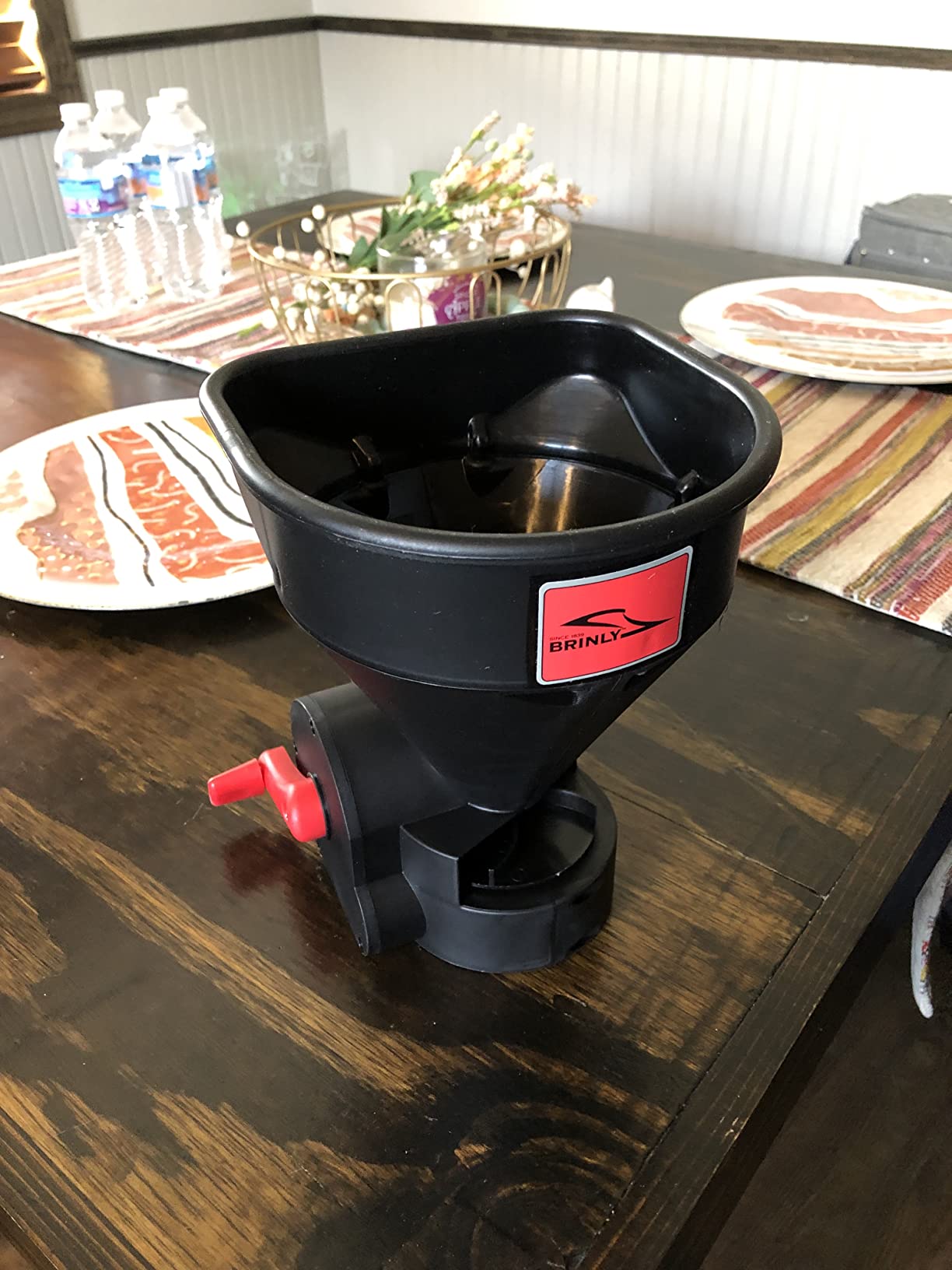
The average rating here is among the lowest of the eight, and the reason is consistent in the reviews: it jams. Granular fertilizer and ice melt both have a habit of packing the impeller, and once it clogs mid-pass the pattern goes wrong until you clear it. Seed users report far fewer problems, so buy it for seeding rather than routine feeding.
The 5 foot throw is also narrow. On anything beyond a patch, you will be making a lot of closely spaced passes, and the pattern overlaps are where stripes start.
Where the Brinly earns its place
It is the right pick for spot seeding a small plot, overseeding thin areas, and working edges a walk-behind cannot reach. One reviewer switched to it specifically to escape the battery replacement cycle on a battery handheld, which is a common frustration with that category.
Because it needs no batteries and no motor, it is the low-friction choice for anyone tired of maintaining a powered handheld.
When it is not the right buy
Avoid it as your main fertilizer spreader if you apply heavy granular products regularly, given the jamming reports. Smaller hands may struggle to hold the body, trigger the gate and crank at the same time.
For steady full-lawn feeding, the larger-capacity options in this list will finish faster and hold calibration better.
8. EarthWay 2750 Nylon Bag Spreader – Best for Overseeding and Large Seed Jobs
- 25 lb capacity in a 2 lb frame
- Sealed gearbox handles small oily seed without clogging
- Spring shutoff stops flow the moment you let go
- Water-resistant bag wipes clean and stores flat
- Strap keeps hands free for walking patterns
- Soft nylon bag feels less precise than a hard hopper
- Lowest average rating here with 11 percent one-star reviews
- Side spread control is coarser than a directional fan
- Narrower pattern than a walk-behind
- Real learning curve across seed types
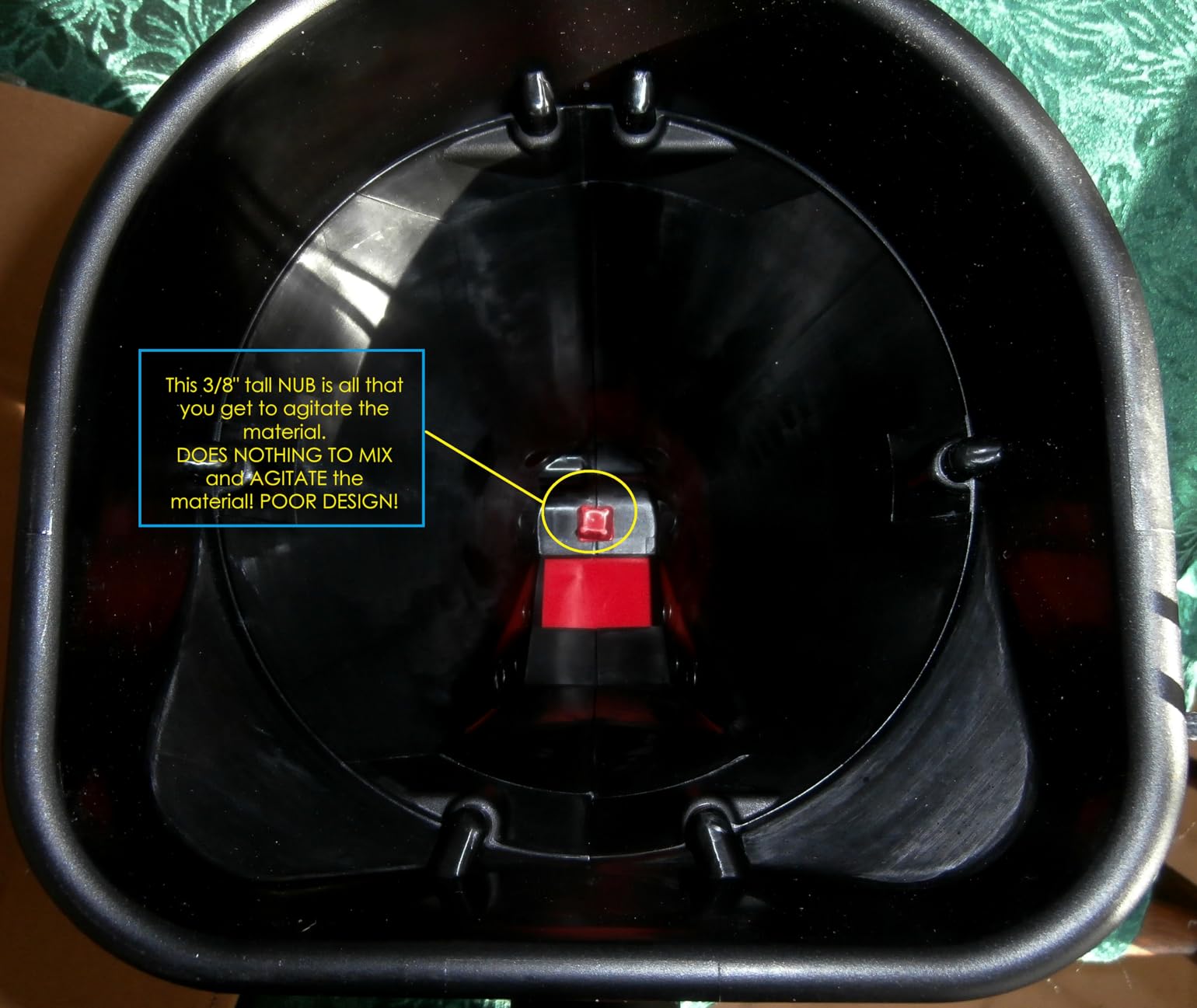
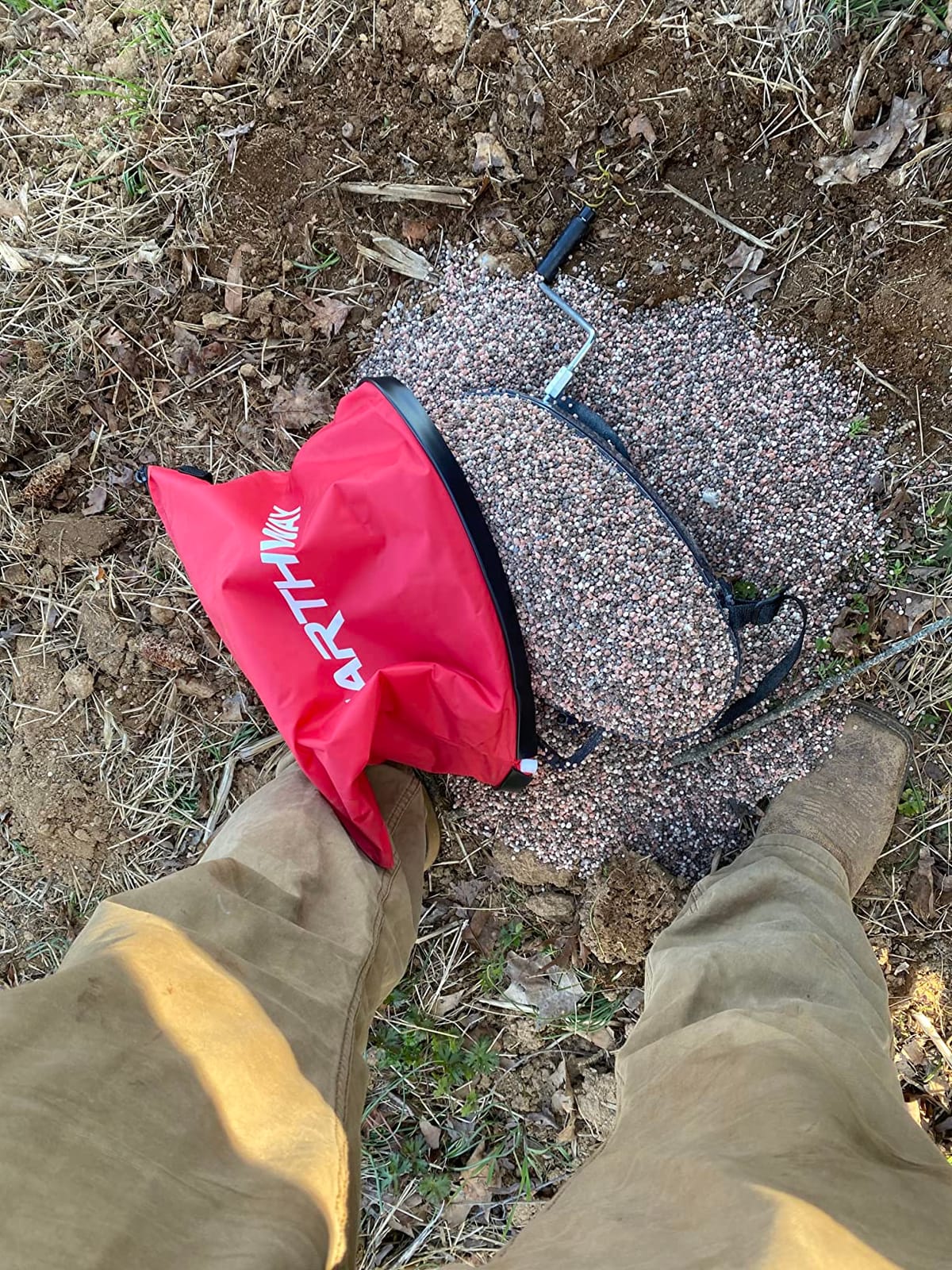
The EarthWay is a seeding specialist. The sealed gearbox and integrated agitator are built to move small, oily seed without clogging, and food plot and hunting owners rate it highly for exactly that reason. For a small yard, the case is overseeding a thin, worn lawn in a single session.
The 25 pound capacity in a 2 pound frame is unusual value in engineering terms. The spring-close shutoff stops delivery the instant you release the handle, which is genuinely useful when you are walking a pattern and do not want seed dumping onto one spot.
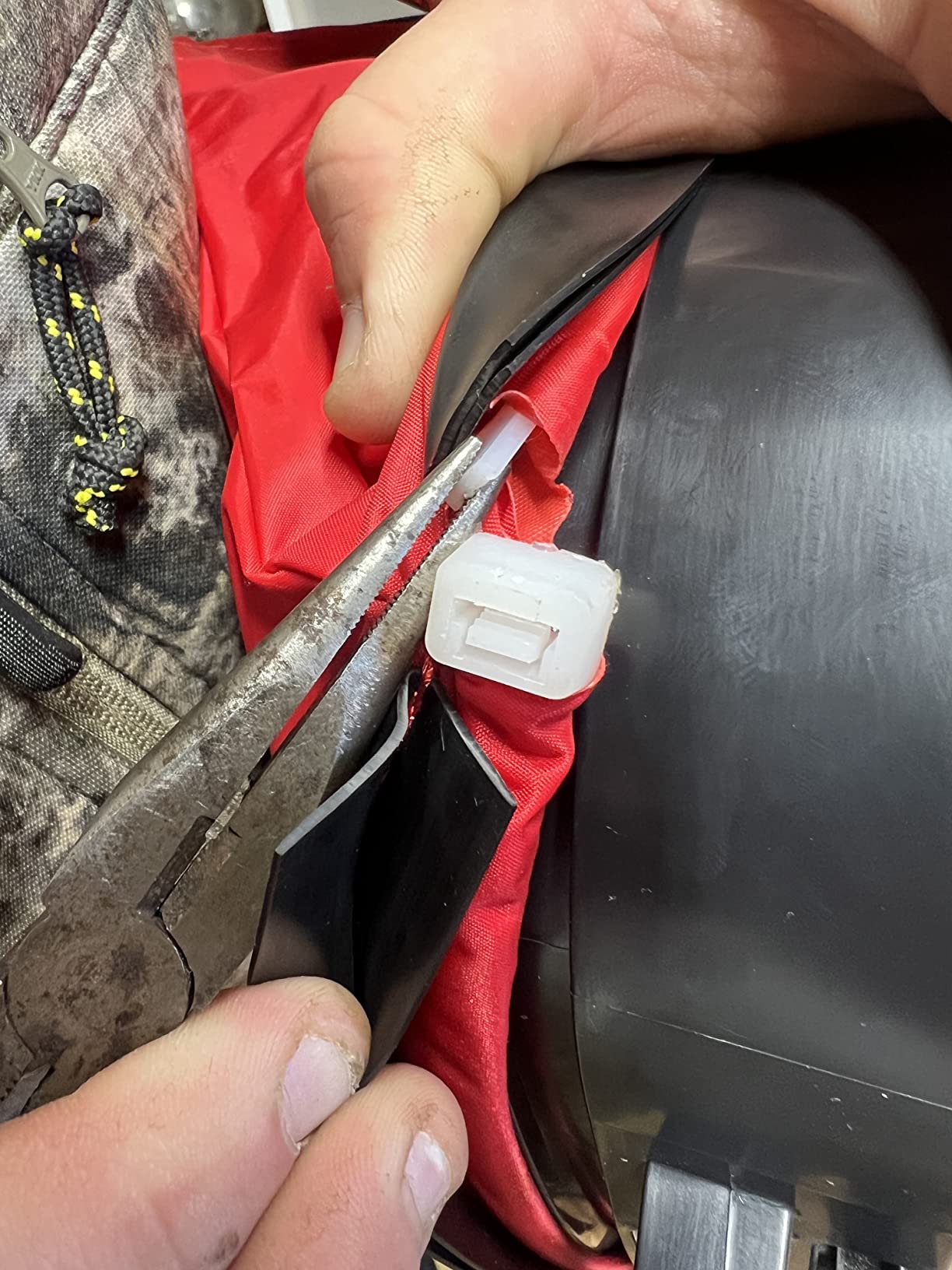
The soft bag is the main compromise. A nylon hopper collapses as it empties, which makes the discharge rate less predictable than a rigid plastic hopper and is the most common reason the ratings spread so wide. Side spread control is also coarser than a direction fan, and the pattern is narrower than a walk-behind, so passes take longer.
It also carries the largest one-star share in the group. Most of those complaints come from buyers who expected hard-hopper precision from a bag.
Who the EarthWay 2750 works for
Choose it when seed is your main material: overseeding a thin small lawn, filling post-construction patches, or working a small plot. The sealed gearbox tolerates seed types that choke cheaper open-gear handhelds, and the bag wipes clean and folds flat for storage.
The shoulder strap also keeps both hands free, which helps you follow a straight line, and straight lines are the beginning of even coverage.
When a rigid hopper is the better buy
If your primary job is granular fertilizer, the soft bag will feel vague by comparison and you will spend time learning the settings. It is also wider and slower than a walk-behind for a full-lawn pass.
Expect to tune the flow control as you work. Do not set it once and assume it holds across materials.
Which Spreader Size Do You Actually Need?
Match the hopper to the square footage and you will avoid the most common small-lawn mistake, which is buying a machine built for acreage. Here is the sizing logic we use:
Under 600 sq. ft., lawn or island only: a shaker bottle. Patch repair, a small front bed island and step de-icing are all it will ever handle.
600 to 1,800 sq. ft.: a hand-crank handheld rated to 1,500 square feet. One load covers most of the lawn, and you can reach every edge without repositioning.
1,800 to 3,000 sq. ft.: a hand-crank handheld with a 5 pound hopper plus a shaker for the steps and edges. Refills are manageable and the tool stores in a closet.
3,000 to 5,000 sq. ft.: a mini walk-behind broadcast rated to 5,000 square feet. This is the sweet spot for most small suburban lots, since you fill once and walk the lawn.
Above 5,000 sq. ft., or you also seed food plots: a chest-mount or bag spreader with 20 to 25 pounds of capacity, provided you have somewhere to hang it.
One rule matters more than all of these: a 60 pound spreader on a 2,000 square foot lawn wastes product, steers badly and is impossible to store. Oversizing hurts coverage far more than undersizing does.
Broadcast vs. Drop Spreader: Which One Suits a Small Lawn?
A broadcast spreader throws material out in a wide rotating arc, so you cover ground fast but lose some control at the edges. A drop spreader releases product straight down between the wheels, which is slower but far more precise and never throws anything onto a walk or a bed.
Speed: broadcast wins clearly, covering several times the area per pass.
Edge control: drop wins, because the material never leaves the wheel track.
Best small-lawn use: broadcast for open turf, drop for bed-heavy yards with lots of planting and paths.
For a small lawn that is mostly open grass, a broadcast model with an edge guard is the right default. The shield reproduces most of the drop spreader’s edge discipline in a fraction of the time.
Honest note: none of the eight models we tested is a drop spreader. Every unit in this roundup is a broadcast rotary or a shaker, which is what the most-reviewed small-lawn options on the market turned out to be. If your yard is mostly beds, paths and a small island of turf, a dedicated drop spreader is the category to shop instead.
Using a drop spreader is simple. Walk parallel passes with the wheel tracks touching, start at the edge of the lawn rather than the middle, and shut the flow off before you stop moving. Overlap by about an inch and you will get a clean, even result without stripes.
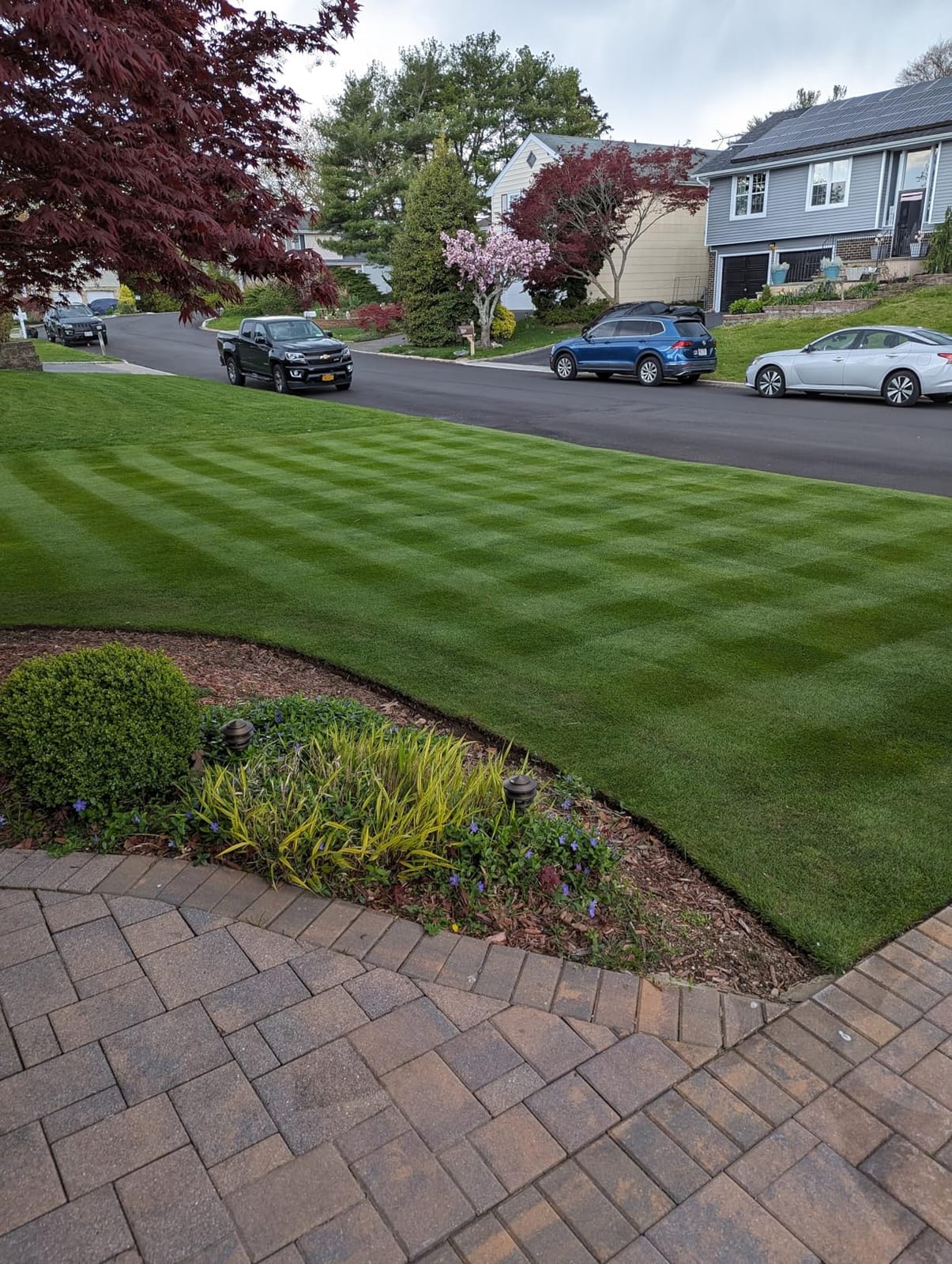
Why Small Lawns Get Stripes, and How to Fix Them
Stripes are dark or light bands left behind by uneven application, and on small lawns they are the most common reason a spreader gets replaced. The causes are physical and mostly fixable. One owner put it plainly on r/lawncare after switching away from a Scotts model: “Got sick of my Scott’s spreader causing lines so I switched to the echo spreader and I am happy with it.”
Product caught in the wheels. This is the big one, and it is why hollow-wheel models draw complaints. Wet granules stick inside the wheel and get carried up to the rotary plate, dumping a concentrated load onto one strip of lawn. Check your wheels before every pass, and scrape the insides clean if the previous application was damp.
Static holding product in the hopper. As the hopper empties, granules cling to the walls and never discharge, so your final pass puts down less than the others. Tap the frame as you near the end of a row, and if the last portion will not shake loose, that is normal on some hopper shapes and worth knowing before you buy.
Walking pace. A spreader delivers a rate per unit of distance, not per unit of time. Slowing down on the last row applies more product there. Walk a consistent pace or use a metronome app for the first pass.
Overlapping passes. Every pass should overlap the previous one by roughly a foot so the arcs blend. Leaving gaps produces the pale lines, and heavy overlap produces the dark ones.
Starting and stopping. Open the flow while moving and close it while still moving. Every stop-start dumps a concentrated pile, and those piles are the dark dots at the end of a row.
Uncalibrated rate. The number on the fertilizer bag assumes a particular spreader. If your setting is wrong, no technique will fix the result. Run a pan test and set the dial once per product.
How to Calibrate Your Spreader and Apply Fertilizer Evenly
Calibration takes about ten minutes and it is the difference between a good lawn and a striped one. Start by reading the rate on the bag. The label lists a setting for a particular granule type, and it changes between dry fertilizer, coated granules and seed, so never carry a setting over from one product to the next.
Set the dial to the number on the bag, then run the pan test. Set the spreader on a level driveway, weigh or measure a known quantity of product into the hopper, and walk ten paces on a sheet of tarp or a piece of cardboard. Weigh what lands. If the output is short, step the setting up; if it is over, step it down. Repeat once to confirm.
Then use the half-and-cross method. Start at the midpoint of the longest run, set the first pass to discharge half the normal rate, and walk back along that same line. Move to the far edge, set the dial to full rate, and work back toward the starting point. Repeat across the lawn in this start-middle, finish-edge pattern so the heavier overlap lands on areas you will re-cover anyway.
Keep walking at a steady pace and keep the flow open only while moving. Close the hopper before you turn, not after, so the turn itself does not become a deposit.
Clean up the same day. Empty the hopper, hose the interior, dry it fully and wipe the plate and the gate. Fertilizer left in contact with damp plastic or steel for weeks is how frames crack and gates seize, and a spreader that discharges the last of its contents freely is one that keeps its calibration.
Is a Fertilizer Spreader Worth It on a Small Lawn?
It depends almost entirely on square footage and how often you treat. Under roughly 1,000 square feet with one feeding a year, hand-casting from a bucket can be adequate, and a small shaker handles the edges. From about 1,500 to 5,000 square feet, a spreader is clearly worth it, because hand application on that area reliably produces over-application in patches and thin spots elsewhere.
The cost argument is really a replacement argument. A forum owner on RugerForum described going through three Scotts Deluxe Edge Guard spreaders in five years, while a different r/lawncare user justified a premium carry spreader with the phrase “Buy once…cry once.” Both experiences are real, and they point the same way: the cheapest spreader is not always the cheapest per application if it gets replaced every other year.
There is a hidden cost with battery handhelds too. Owners of that category report units going from clogging to needing batteries replaced constantly, which turns a tool into a recurring expense. A hand-crank model has no consumables at all, and that is why it is our top handheld recommendation.
Our honest guidance: if you fertilize or seed at least twice a year, buy the best spreader you can reasonably afford in the capacity tier that matches your lawn, and skip the oversized units.
Storage and Cleaning for Small-Garage Owners
Storage is a real constraint on a small property, and it is the reason some good spreaders stay assembled in the garage doorway for years. The walk-behind model in our top spot folds its handle flat against the hopper and leans against a wall in about the footprint of a folded chair.
Handhelds and shakers store on a shelf or a wall hook. Ones with a clear lid can stay filled; ones with fixed dispensing holes must be emptied, so keep a scoop and a bucket next to them to make that less annoying.
The chest-mount and bag spreaders are the awkward ones. Hang the bag spreader by its strap and it folds completely flat, while a chest harness needs a wall hook at roughly shoulder height in a corner you can actually reach.
Before it goes away, wash out the hopper, dry the plate and gate, and oil the moving parts lightly. A fold-down handle is also the first thing to check if the unit ever feels wobbly, since repeated folding loosens the hinge.
Frequently Asked Questions
What is the best fertilizer spreader for a small lawn?
A mini walk-behind broadcast spreader rated for about 5,000 square feet is the best all-round choice for a small lawn, because one fill covers a typical suburban lot and the narrow frame still fits between flower beds. Under 1,500 square feet, a hand-cranked handheld is faster and easier to store, and under 600 square feet a shaker bottle is enough for patches and steps.
Which is better, a broadcast or drop spreader?
A broadcast spreader throws material in a wide rotating arc, so it covers ground fast but needs an edge guard to protect walks and beds. A drop spreader releases product straight down between the wheels, which is slower but precise enough for bed-heavy, precisely planted or small heavily landscaped yards.
What is the best handheld lawn spreader?
Among the handhelds we tested, the manual hand-crank model rated to 1,500 square feet is the best all-round handheld, with the highest average rating in the group and an arm support brace that reduces wrist fatigue. For ice melt and driveways, a 5 pound hopper handheld with an adjustable flow dial covers more ground per fill.
How many pounds does a Scotts Wizz spreader hold?
We did not include the battery-powered Wizz in our tested group, so we cannot publish a verified hopper figure for it. Two battery handhelds are worth knowing about: the 5 pound hopper model here holds up to 5 lb, and the chest-mount carry spreader holds 20 lb. Check the manufacturer specification page for the exact Wizz capacity before buying.
Is a fertilizer spreader worth it?
Above roughly 1,500 square feet, yes, because hand application reliably causes over-application in patches and thin areas elsewhere. Under about 1,000 square feet with one feeding a year, a small shaker may be enough. Judge cost by years of use rather than sticker price, since owners report replacing cheaper spreaders every couple of seasons.
What are people saying about the Miracle-Gro lawn seed drop spreader?
We did not test a Miracle-Gro drop spreader, so we cannot report real user findings on it. What we can say from our own testing is that drop spreaders suit small, bed-heavy yards where a broadcast model would throw product onto walks and borders, and that none of the eight models we tested was a drop spreader.
How do I keep my spreader from leaving stripes?
Stripes come from product caught in the wheels, static holding material in the hopper, an uneven walking pace, gaps or heavy overlap between passes, and starting and stopping with the flow open. Clear the wheel insides before each pass, keep a steady pace, overlap every pass by about a foot, open and close the flow only while moving, and run a pan test to set the dial for each product.
What capacity spreader do I need for my yard?
Under 1,800 square feet, a handheld rated to 1,500 square feet is enough. Between 3,000 and 5,000 square feet, use a mini walk-behind rated to 5,000 square feet. Above 5,000 square feet, or if you seed food plots, move to a 20 to 25 pound carry spreader and make sure you have somewhere to store it.
Our Verdict by Lawn Size
For most small lawns between 2,000 and 5,000 square feet, the mini walk-behind broadcast spreader is the right buy, and the EdgeGuard side shield is the feature that justifies it over a cheaper open broadcast. Below 1,500 square feet, step down to a hand-crank handheld with a wrist brace, and keep a small shaker on the shelf for steps and patches.
Whichever tier you choose, calibrate before you spread and clean out the same day. Those two habits fix most of the striping complaints we saw, and they cost nothing.
If you are still working out the rest of your lawn setup, our guides to sprinkler systems for lawns and illuminated lawn decorations cover watering and the rest of the season.
Use the comparisons above to match capacity to your square footage, then check the current listing details for the model you want before you buy.