
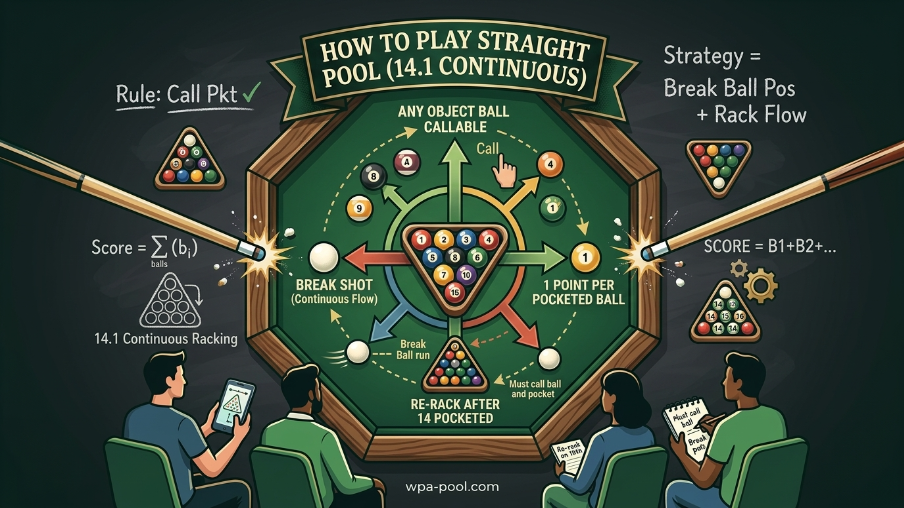
Learning how to play straight pool transforms your understanding of cue sports. This classic game, also known as 14.1 continuous, challenges players to think several shots ahead while mastering precision ball control. Our team has spent years studying WPA Pool rules and practicing these techniques to bring you this complete beginner’s guide.
Straight pool differs fundamentally from games like 8-ball or 9-ball. Instead of pocketing designated groups or specific balls in sequence, you call and pocket any ball into any pocket. The objective is accumulating points through continuous play until reaching an agreed total. Most matches target either 100 or 150 points.
This guide covers everything you need to start playing. You will learn proper equipment setup, breaking rules, scoring systems, fouls and penalties, plus proven strategies from experienced players. By the end, you will understand exactly how to play straight pool by yourself or against opponents.
Table of Contents
What Is Straight Pool?
Straight pool is a cue sport played with fifteen numbered object balls and one cue ball. The game originated around 1910 as an evolution of continuous pool. Jerome Keogh is credited with developing the modern 14.1 continuous format that defines straight pool today.
The name “14.1 continuous” describes the core mechanic. Fourteen balls are pocketed normally, then the fifteenth remains on the table while the fourteen are re-racked. This creates an unbroken sequence of play where skilled competitors can achieve remarkably long runs.
Unlike rotation games, straight pool allows pocketing balls in any order. You simply call your intended object ball and target pocket before each shot. This freedom demands strategic thinking about positioning and breakout patterns rather than following predetermined sequences.
How to Play Straight Pool: Objective and Scoring
The primary goal in straight pool is reaching a predetermined point total before your opponent. Standard match lengths are 100 points for shorter games or 150 points for full matches. Players must agree on the target score before beginning play.
Each legally pocketed ball counts as one point toward your total. There are no bonus points for specific balls or combinations. This straightforward scoring system rewards consistency and minimizes risk-taking compared to other pool variants.
The first player to reach or exceed the agreed point total wins immediately. You do not need to finish the rack or complete a specific number of innings. The game ends the moment your called ball drops into the called pocket, giving you the winning point.
Equipment and Table Setup
Straight pool requires standard pool equipment with specific setup procedures. You need a regulation pool table, fifteen object balls numbered 1 through 15, one cue ball, and a triangle rack. Understanding regulation pool table dimensions ensures you practice on proper equipment.
The balls are arranged in a triangle formation with the apex ball positioned on the foot spot. The foot spot marks the precise center point between the foot cushion and the second diamonds on the long rails. Place the 1-ball at the apex with the other balls filling the triangle randomly behind it.
Unlike 8-ball or 9-ball, straight pool uses all fifteen balls in every rack. You do not remove balls from play as you pocket them. Instead, spotted balls return to the table and re-racked balls continue the game until someone reaches the winning score.
The Foot Spot and Ball Placement
The foot spot serves as the anchor point for every rack in straight pool. This small marked point sits exactly between the second diamonds on each long rail, measured from the foot cushion. Precision ball placement here affects break shots and opening patterns significantly.
When re-racking balls, the apex ball must contact the foot spot precisely. If the fifteenth ball from the previous rack occupies that position, special racking procedures apply. The referee or players may need to shift the rack slightly while maintaining the triangular formation.
How to Play Straight Pool: Breaking Rules
The opening break in straight pool follows specific regulations that differ from other games. The breaker has cue ball in hand behind the head string, meaning you can place the cue ball anywhere between the head cushion and the head string before breaking.
A legal break requires pocketing a called ball or driving at least two object balls to a rail plus the cue ball to a rail. This two-ball-to-rail rule prevents soft breaks that simply tap the rack without meaningful dispersion. You must call your intended ball and pocket before executing the break shot.
Breaking fouls carry harsher penalties than standard fouls. A breaking foul results in minus two points rather than the standard minus one. This penalty reflects the advantage gained from an illegal break that might unfairly position balls for the opponent.
Legal Break Requirements
Meeting break requirements demands careful cue ball control and power application. You must either pocket a called ball or ensure two object balls plus the cue ball contact rails. Failing either requirement constitutes a breaking foul.
Many beginners struggle with generating enough cue ball movement while maintaining accuracy. The break is not about maximum power but controlled force that spreads the rack while keeping the cue ball accessible. Practice breaking at 70 percent power initially, focusing on cue ball position over pocketing balls.
Basic Gameplay and Calling Shots
After a legal break, gameplay proceeds through called shots where you designate both the object ball and target pocket. You must clearly identify which ball you intend to pocket and which pocket will receive it before shooting. This called shot requirement eliminates luck-based outcomes.
A legally pocketed called ball earns one point and entitles you to continue shooting. You may call any ball to any pocket on each shot, providing maximum strategic flexibility. Your turn continues until you fail to pocket your called ball legally or commit a foul.
Safety play offers a strategic option when no clear shot exists. By declaring “safety” before shooting, you indicate intent to end your turn regardless of outcome. The called ball is spotted if pocketed, no points are awarded, and your opponent faces the resulting table position.
Understanding Safety Play
Calling safety is essential for advanced straight pool strategy. When blocked or facing difficult angles, a well-played safety leaves your opponent without viable options. The safety declaration must occur before shooting to prevent disputes about intent.
After a called safety, any pocketed balls are spotted without awarding points. Your turn ends immediately, transferring play to your opponent. Mastering safety play separates intermediate players from advanced competitors who can control table dynamics.
Ball Spotting Procedures
Illegally pocketed balls or balls pocketed during safeties return to the foot spot area. The referee or opposing player spots these balls before the next shot. If multiple balls require spotting, they line up on the long string behind the foot spot when space permits.
When the foot spot is occupied, spotted balls take the closest available position toward the foot cushion along the long string. This systematic placement ensures consistent positioning that does not unfairly advantage either player.
Fouls and Penalties
Straight pool enforces specific foul penalties that affect your score directly. Understanding these penalties helps minimize point losses during competitive play. Each foul type carries distinct consequences ranging from simple point deductions to severe combination penalties.
Standard fouls deduct one point from your score. Common standard fouls include failing to drive an object ball to a rail after making contact, not having at least one foot on the floor during shooting, and touching balls illegally with hands or clothing. The cue ball remains in position after standard fouls unless it was pocketed.
Breaking fouls carry a minus two point penalty as previously mentioned. These occur when the opening break fails to meet legal requirements regarding rail contacts or called ball pocketing. Breaking fouls give your opponent cue ball in hand behind the head string.
Consecutive Foul Penalties
Three consecutive fouls trigger a severe fifteen-point penalty in addition to individual foul deductions. This rule prevents players from repeatedly committing minor fouls to avoid difficult situations. The penalty resets after any legally completed shot by the fouling player.
A referee or opponent should warn players after two consecutive fouls about the impending severe penalty. This warning system gives players opportunity to adjust strategy before triggering the minus fifteen point deduction that can drastically alter match outcomes.
Scratch Penalties
Pocketing the cue ball constitutes a scratch, classified as a standard foul with minus one point. After a scratch, your opponent receives cue ball in hand behind the head string. This positioning allows strategic placement anywhere between the head cushion and head string.
Scratches occurring during safety attempts still count as fouls and end your turn. The called ball spots if pocketed during a scratch, and your opponent takes over with cue ball in hand. Minimizing scratches through precise cue ball control is fundamental to straight pool success.
Re-racking Procedure
The re-racking procedure distinguishes straight pool from all other major pool variants. When fourteen balls have been legally pocketed, leaving only one object ball on the table, play pauses for re-racking. This continuous nature gives 14.1 its strategic depth and enables long runs.
The fifteenth remaining ball stays exactly where it lies on the table. Fourteen racked balls are placed in standard triangle formation with the apex ball contacting the foot spot. If the fifteenth ball occupies the foot spot or interferes with racking, special procedures apply.
After racking completes, the player continues from their current cue ball position. There is no break shot when re-racking during active play. You simply proceed with normal called shot requirements, now facing a fresh rack of fourteen balls plus the original fifteenth.
Special Racking Situations
When the fifteenth ball rests on or near the foot spot, racking becomes challenging. If the ball occupies the foot spot exactly, the apex ball is frozen to it as closely as possible without moving the fifteenth ball. The rack shifts slightly from ideal position while maintaining triangular formation.
Should the cue ball interfere with proper racking placement, it moves to the center of the table on the long string. This center position provides neutral placement that does not advantage either player. Play resumes normally after the adjustment.
Beginner Tips and Strategy
Mastering straight pool requires specific skills that differ from casual 8-ball or 9-ball play. Our research across billiards forums reveals consistent advice from experienced players. Forum discussions emphasize stop shot mastery as the fundamental skill every beginner must develop.
A stop shot occurs when the cue ball slides to a complete halt upon contacting the object ball. This shot eliminates cue ball movement, leaving perfect position for subsequent shots. Practice stop shots from various distances until you can execute them reliably without unintended follow or draw.
Limiting cue ball movement is crucial in straight pool. Unlike rotation games where cue ball travel helps, straight pool punishes excessive movement that buries the cue ball in the rack. Experienced players describe this as “keeping the cue ball quiet” to maintain clear paths to multiple balls.
Pattern Play Fundamentals
Pattern play involves planning sequences of three or more balls in advance. Before shooting, identify your current target, the next ball, and ideally the third ball in sequence. This foresight prevents getting trapped after pocketing easy balls without considering subsequent position.
The break ball concept is essential for continuing runs. A break ball sits near the rack in a position where pocketing it sends the cue ball into the packed balls, spreading them for continued play. Identifying and preserving break balls extends your turn and scoring potential.
Positioning for the Next Rack
As you approach fourteen pocketed balls, plan for re-racking continuity. The key ball is the final ball before the break ball that positions the cue ball perfectly for that crucial opening shot on the new rack. Planning this three-ball sequence separates intermediate from advanced players.
Forum players consistently recommend simplifying patterns when learning. Focus on straightforward stop shots and minimal cue ball travel rather than attempting complex english or multi-rail position play. Mastering fundamentals produces higher runs than flashy shots with poor percentage success rates.
How to Practice Straight Pool Alone
Solo practice provides the most effective path to straight pool improvement. Playing alone eliminates pressure while allowing unlimited time for shot analysis and technique refinement. Many professional players credit solo practice sessions for developing their pattern recognition skills.
Begin solo practice with simple high-run attempts. Try pocketing five consecutive balls without missing, then gradually increase your target to ten, twenty, and beyond. Track your personal best runs to measure improvement over weeks and months of consistent practice.
The “ghost player” method adds competitive pressure to solo sessions. Play a complete 100-point match against an imaginary opponent who never misses. You must reach 100 points before accumulating 100 imaginary points through your own misses and fouls. This simulation trains mental focus during long runs.
Solo Drills for Skill Building
Position drills isolate specific skills for targeted improvement. Place the cue ball and object ball at measured distances, practicing stop shots at one-foot intervals from one foot to six feet. This systematic approach reveals your reliable range and identifies distances requiring additional work.
Break shot practice deserves dedicated sessions. Set up typical break ball positions and experiment with different speeds and cue ball contacts. Document which approaches produce favorable rack spreads versus difficult clusters. Understanding your personal break effectiveness improves match performance significantly.
Professional Straight Pool and High Runs
Straight pool remains relevant in professional billiards, though it has been largely replaced by 9-ball and 10-ball in major tournaments. The game still features in specialized competitions and serves as the standard practice game for professionals worldwide. Many elite players consider straight pool the purest test of cue sports skill.
High runs represent the pinnacle of straight pool achievement. A high run is the maximum consecutive balls pocketed without missing in a single inning. These records demonstrate extraordinary concentration, pattern play, and shot-making under the pressure of extended perfection.
Willie Mosconi held the record with 526 consecutive balls for over six decades. John Schmidt surpassed this mark in 2026 with a verified run of 626 balls. Jayson Shaw currently holds the modern record at 832 balls, showcasing how professional equipment and technique evolution enables unprecedented performances.
Modern Tournament Play
While straight pool lacks the television appeal of rotation games, dedicated tournaments continue worldwide. The World Pool-Billiard Association maintains official rules that govern professional competition. Regional organizations host events where players compete for prize money and ranking points.
Streamed matches on platforms like YouTube have renewed interest in straight pool among younger players. Watching professionals execute long runs demonstrates pattern concepts difficult to explain in text. We recommend studying recorded high runs to visualize proper cue ball paths and breakout techniques.
What are the rules for playing straight pool?
The rules require calling both the object ball and target pocket before each shot. Players earn one point per legally pocketed ball and continue shooting until missing or fouling. The first player reaching 100 or 150 points wins. Fouls deduct points, with standard fouls costing minus one point and breaking fouls costing minus two points. After 14 balls are pocketed, they are re-racked while the 15th remains on the table.
How do you win straight pool?
You win by being the first player to reach the predetermined point total, typically 100 or 150 points. Each legally pocketed called ball counts as one point. The game ends immediately when you pocket the ball that gives you the winning point total.
How do you rack the balls for straight pool?
Place all 15 object balls in a triangle rack with the apex ball on the foot spot. The 1-ball sits at the apex with remaining balls arranged randomly behind it. The cue ball starts behind the head string for the opening break. When re-racking during play, leave the 15th ball in position and rack the other 14 balls with the apex ball contacting the foot spot.
Is straight pool still played professionally?
Yes, though less commonly than 9-ball or 10-ball in major television tournaments. Specialized straight pool competitions continue worldwide under WPA governance. The game remains the standard practice format for professional players and maintains an active competitive scene with high-run record attempts receiving significant attention in the billiards community.
What is the difference between straight pool and 8-ball?
Straight pool uses all 15 balls continuously with players calling any ball to any pocket for points. The objective is reaching a point total like 100 or 150. Eight-ball divides balls into solids and stripes with players pocketing their assigned group before the 8-ball. Straight pool emphasizes continuous runs and pattern play while 8-ball focuses on group clearance and tactical blocking.
How many points to win straight pool?
Standard matches are played to either 100 points or 150 points. The specific target is agreed upon before play begins. Some informal games may use different totals, but 100 and 150 represent the recognized standard match lengths used in competition and serious practice.
What happens when 14 balls are pocketed in straight pool?
When 14 balls are pocketed, the 15th remaining ball stays exactly where it lies on the table. The 14 pocketed balls are then re-racked in standard triangle formation with the apex ball on the foot spot. Play continues without a break shot, with the player proceeding from their current cue ball position to pocket the 15th ball and begin working on the fresh rack.
Conclusion
Learning how to play straight pool opens access to the most strategic and rewarding cue sport experience available. The combination of called shots, continuous re-racking, and point-based scoring creates gameplay that rewards planning over luck. Your skills in position play, pattern recognition, and mental focus will improve dramatically through straight pool practice.
Start by mastering the fundamentals covered in this guide. Focus on stop shots, limit cue ball movement, and practice solo runs to build confidence. Understanding the complete rule set including fouls, penalties, and re-racking procedures prepares you for competitive play against experienced opponents.
Whether you pursue high runs, tournament competition, or simply enjoy the intellectual challenge, straight pool offers lifetime improvement potential. Grab your cue, rack the balls, and begin your journey into 14.1 continuous. The satisfaction of executing a well-planned ten-ball run exceeds anything casual pool games provide.