
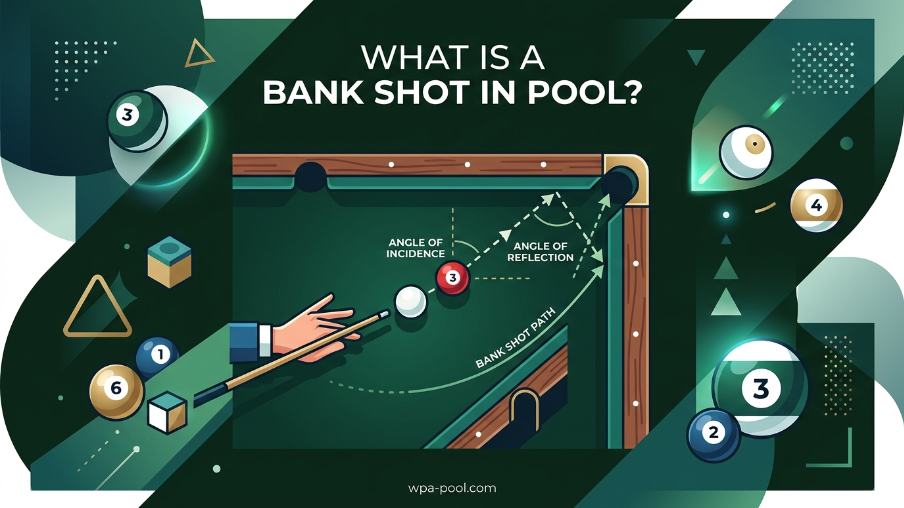
A bank shot in pool is when you hit the cue ball into an object ball, which then bounces off one or more rails before dropping into a pocket. This differs from a kick shot, where the cue ball itself hits the rail first before reaching the object ball. Bank shots are essential shots that every serious pool player needs in their arsenal.
After playing pool for 15 years and teaching beginners at my local hall, I have seen how mastering bank shots transforms a player’s game. You stop being limited to straight shots and open up entirely new angles on the table. This guide will teach you everything you need to know about what a bank shot is and how to execute one with confidence.
Table of Contents
What is a Bank Shot in Pool
A bank shot is any shot where the object ball strikes a cushion or rail and rebounds into a pocket. The cue ball hits the object ball first, then the object ball travels to the rail, bounces off, and finds its way to the intended pocket. This contrasts with a kick shot, where the cue ball hits the rail first before making contact with the object ball.
The physics behind a bank shot follows a simple principle: the angle of incidence equals the angle of reflection. When the object ball strikes the rail, it rebounds at essentially the same angle it arrived. I say “essentially” because real-world factors like speed, spin, and table conditions create small variations that experienced players learn to account for.
The distinction between bank shots and kick shots confuses many beginners. I remember when I first started playing, I used the terms interchangeably. A bank shot sends the object ball to the rail. A kick shot sends the cue ball to the rail. Understanding this difference helps you communicate with other players and search for the right tutorials when you need help.
How Bank Shots Work: The Physics
The fundamental rule governing bank shots is that the angle of incidence equals the angle of reflection. If your object ball approaches the rail at a 30-degree angle, it should leave the rail at approximately a 30-degree angle on the opposite side. This principle forms the foundation of every banking system and aiming method.
When the object ball hits the cushion, the rubber inside compresses and then rebounds. This compression absorbs some energy and can slightly alter the angle depending on how hard you hit the ball. Harder shots compress the cushion more, which can cause the ball to “skid” or rebound at a slightly different angle than softer shots.
The simple equal-angles rule works best on a theoretical table with perfect cushions. Real pool tables have worn rubber, varying cloth speeds, and environmental factors that affect every shot. Professional players develop an intuitive feel for their local tables through hours of practice. Beginners should start with the basic rule and adjust from there.
The Mirror System: Your Foundation for Aiming
The mirror system is the most intuitive way to aim bank shots. Imagine a mirror running along the edge of the rail you are banking off. The pocket you want to hit has a mirror image on the opposite side of that rail. You aim at this imaginary ghost pocket rather than the real one.
To use the mirror system, visualize a line from your object ball through the rail at the point where the reflection would occur. Find the point on the rail where the angle to the object ball equals the angle to your target pocket. Many players find it helpful to stand behind the imaginary ghost ball position and sight back through the rail to the object ball.
I teach beginners to practice this visualization without even hitting balls at first. Walk around the table and point to where you think the bank point should be. Check yourself by measuring equal angles with your cue stick. This builds the spatial awareness you need before you add the complexity of actually stroking the shot.
The ghost ball technique helps apply the mirror system practically. Imagine where the cue ball needs to contact the object ball to send it along the correct banking line. Aim for that ghost ball position just as you would on a straight shot. This combines your regular aiming skills with the bank angle calculation.
The Diamond System for Bank Shots
The diamonds on your pool table rail are not just decorative. They serve as reference points for calculating bank angles. Most regulation tables have diamonds spaced evenly along the rails, and understanding how to use them transforms your banking game.
For a simple one-rail bank, count the diamonds from the object ball to the target pocket. The banking point on the rail lies proportionally between these counts. If your object ball sits two diamonds from the corner and your target is three diamonds away, the banking sweet spot usually falls around the middle of that range, adjusted slightly toward the target side.
I recommend starting with the basic “diamond line” drill. Place an object ball on the second diamond from the corner pocket. Try banking it into the opposite corner pocket. Note where you actually need to hit the rail versus where the simple mirror system suggests. This gap between theory and reality teaches you your table’s unique characteristics.
Advanced diamond systems exist for two-rail and three-rail banks, involving more complex calculations. I suggest mastering one-rail banks thoroughly before attempting these. The same principles apply, but each additional rail compounds any error in your initial calculation.
Speed and Its Effect on Bank Shots
Shot speed significantly changes how bank shots behave. Many beginners hit bank shots too softly, which causes overcutting as the ball loses momentum against the rail’s resistance. The cushion essentially “grabs” a slow-moving ball and throws it offline.
Faster shots compress the cushion more deeply and can create slightly different rebound angles. The ball penetrates the rubber further and may come off at a flatter angle than expected. This effect is subtle but noticeable on thin-angle banks where small errors become large misses.
I teach students to use a medium, firm stroke for most bank shots. Not crushing the ball, but giving it enough speed to rebound cleanly off the rail. You want a confident, smooth stroke with good follow-through. This medium speed minimizes the cushion’s grab effect while maintaining predictable angles.
Using English (Spin) on Bank Shots
English, or side spin, changes how balls interact with rails. Running english refers to spin that follows the natural direction the ball is traveling. When banking, this spin helps the ball hug the rail and can actually widen the effective rebound angle slightly.
Counter english spins against the ball’s natural path. This can tighten angles and is sometimes used for precise adjustments when the mirror system puts you slightly off line. However, counter english is harder to control and I do not recommend it for beginners.
For most bank shots, I suggest hitting the cue ball with a touch of running english. If banking to the left, use left english. This helps the object ball roll off the rail cleanly. Avoid excessive spin, which can create unpredictable results. A small amount of running english acts more as insurance than a major angle changer.
Many beginners overuse english on bank shots. They spin the cue ball wildly hoping to “help” the object ball. This usually hurts more than helps. Master straight, clean banks first. Add spin only after you can make basic banks consistently without it.
Common Types of Bank Shots
The cross-side bank is one of the most common and useful shots in pool. You bank the object ball from one side of the table to the opposite side pocket. These shots come up constantly when playing position or when your opponent leaves you blocked from direct angles.
Corner pocket banks send the object ball into one of the four corner pockets after hitting a rail. These often provide easier angles than side pockets because the corners offer larger targets. Cross-corner banks, where you bank across the table into the diagonal corner, are particularly common in eight-ball and nine-ball games.
Two-rail banks add a second cushion to the equation. These are advanced shots where the object ball hits one rail, travels across the table, and hits a second rail before pocketing. Three-rail banks exist too, though they are rarely practical in real games outside of artistic pool competitions.
Defensive banks deserve mention even though they are not aimed at pockets. Sometimes banking the cue ball or object ball to a safe position is the smart play. Understanding bank angles helps you execute these tactical shots that frustrate opponents and win matches.
Common Mistakes Beginners Make
The most common error I see is hitting bank shots too slowly. Beginners worry about controlling the ball and unconsciously baby their stroke. This causes the ball to die on the rail or overcut badly. Commit to a firm, confident stroke on banks.
Another frequent mistake is misjudging the angle without proper visualization. Players just walk up and guess where to aim. They miss consistently because they never developed a reliable reference system. Take time to find your mirror angle or diamond count before every bank shot.
Many beginners ignore table conditions and wonder why their banks act differently week to week. Old cushion rubber bounces differently than new rubber. Humid days make rails stickier and slower. Pay attention to how your local table plays and adjust accordingly.
Using too much spin ranks high on the mistake list. I mentioned this earlier, but it bears repeating. Spin complicates an already difficult shot. Until you can make basic banks without english, avoid adding this variable to the equation.
How Table Conditions Affect Bank Shots
Cushion rubber ages and changes its bounce characteristics over time. Old, compressed rubber becomes harder and less responsive. New rubber is springier and can cause livelier rebounds. Understanding your table’s cushion condition helps you adjust your banking calculations. Regulation pool table dimensions include specific cushion specifications that affect how shots play.
Cloth speed and direction matter too. Fast cloth allows balls to retain more energy through the bank, while slow cloth steals momentum. The nap direction, the way cloth fibers lay, can subtly affect bank angles on certain shots. Most modern pool cloth has minimal nap, but it is still worth noting.
Humidity creates dramatic effects on some tables. Damp air makes cushions play slower and stickier. The object ball may not rebound as sharply as expected. Professional players always test a few banks early in a session to see how the table is behaving that day.
Practice Drills to Master Bank Shots
The cross-corner drill builds your foundation. Place five object balls evenly spaced along the long center line of the table. Bank each ball into the opposite corner pocket. This gives you five different angles to practice with consistent target points. Do this drill until you can make four out of five consistently.
The diamond line drill teaches rail interaction. Place object balls on every other diamond along one long rail. Bank each ball across to the opposite long rail and back to the original rail. You are not pocketing balls here, just learning how different positions create different rebound angles. This builds your intuitive feel for banking.
Progressive angle practice starts with easy banks and moves to harder ones. Begin with straight-on banks where the mirror system is obvious. Gradually work to thinner angles where calculation becomes trickier. Document which angles give you trouble and spend extra time there.
I recommend dedicating fifteen minutes of every practice session to pure banking drills. Do not mix them into regular games at first. Isolate the skill until it becomes automatic. Then you will find banks happening naturally during matches without conscious thought.
How do bank shots work in a pool?
Bank shots work by using the principle that the angle of incidence equals the angle of reflection. The object ball strikes the rail at a certain angle and rebounds at approximately the same angle on the opposite side. Players aim using systems like the mirror system or diamond system to predict where the ball needs to hit the rail to reach the target pocket.
What is the difference between a kick shot and a bank shot?
The difference is which ball hits the rail first. In a bank shot, the cue ball hits the object ball first, then the object ball travels to the rail and bounces into a pocket. In a kick shot, the cue ball hits the rail first, then travels to hit the object ball. The kick shot uses the rail to change the cue ball’s path, while the bank shot uses the rail to change the object ball’s path.
How do you do a bank shot?
To execute a bank shot, first visualize the mirror image of your target pocket across the rail you are banking off. Find the point on the rail where the angle from the object ball equals the angle to the target. Aim the cue ball to strike the object ball so it travels to that rail point. Use a medium, firm stroke with a touch of running english for best results. Practice with drills like the cross-corner drill to build consistency.
Are bank shots more accurate?
Bank shots are generally less accurate than straight shots because they involve more variables. The cushion introduces uncertainty from compression, the angle calculation must be precise, and table conditions affect the rebound. However, bank shots become highly reliable with proper technique and practice. Professional players make bank shots with remarkable consistency because they have developed the feel and visualization skills through thousands of repetitions.
Conclusion
Understanding what a bank shot in pool is opens up new dimensions in your game. You learned that bank shots send the object ball to the rail, while kick shots send the cue ball there first. The angle of incidence equals the angle of reflection forms the foundation, though real-world factors require adjustments.
Start with the mirror system for visualization and add the diamond system for precise aiming. Use medium speed with a touch of running english. Practice the drills I outlined until banking becomes second nature. Bank shots intimidate beginners but reward dedicated practice with one of pool’s most satisfying skills.