
Your cue tip is the only point of contact between your cue and the cue ball. When it wears down, your game suffers in ways you might not immediately notice. I’ve seen players struggle with miscues and wonder why their draw shots no longer bite, only to discover their tip was completely glazed over.
Learning when to replace a cue tip can save you from frustrating missed shots and inconsistent play. In this guide, I’ll walk you through the exact signs to watch for, how often different types of players should expect to replace their tips, and simple maintenance tricks that can extend your tip’s life significantly. If you are also setting up your playing space, check out our guide on regulation pool table dimensions to ensure you are playing on the right equipment.
Table of Contents
When to Replace a Cue Tip
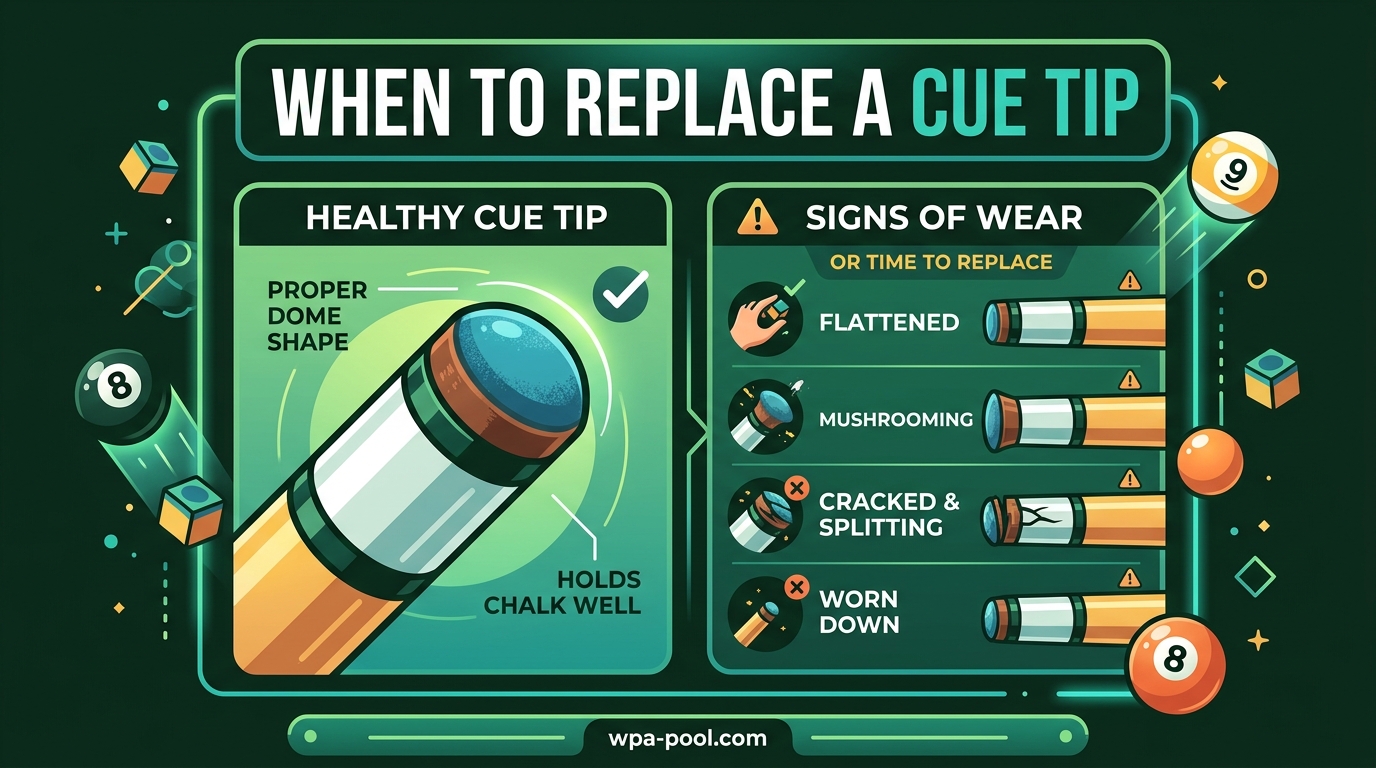
Replace your cue tip when you notice any of these four key indicators:
- Mushrooming or flattening of the tip edges
- Cracks, chips, or delamination in the tip surface
- Hardening or glazing that prevents chalk from sticking
- Thickness worn down to approximately the thickness of a dime
Most regular players should expect to replace their cue tip every 6 months to 2 years depending on how frequently they play and the type of tip they use.
4 Clear Signs Your Cue Tip Needs Replacement
Over my years of playing and talking with cue technicians, these four signs are universally recognized as the signals that it is time for a new tip. Ignoring them leads to inconsistent performance and can actually damage your ferrule.
Sign 1: Mushrooming or Flattening
Mushrooming happens when the sides of your cue tip flare out wider than the ferrule underneath. The tip literally mushrooms over the edge. Flattening is similar but affects the top surface, creating a worn, concave area where you strike the ball.
Both conditions reduce your ability to apply spin effectively. The rounded edge that helps grip the ball for draw and follow shots disappears. I check for this by running my finger along the edge of the tip. If it feels uneven or overhangs the ferrule, it is time to address it.
Minor mushrooming can sometimes be trimmed and reshaped, but if the tip has lost significant material or the mushrooming keeps returning, replacement is the better option.
Sign 2: Cracks, Chips, or Delamination
Cracks and chips are obvious signs of damage. Any visible splitting in the tip material means the structural integrity is compromised. You might also notice small pieces breaking off during play.
Delamination is specific to layered tips like Kamui or Moori. These tips are built from multiple layers of leather pressed together. When the layers start separating, you will see gaps or peeling between the layers. According to forum discussions among regular players, layered tips like Kamui can last 2+ years with proper care, but once delamination starts, the tip is finished.
Playing with a cracked or delaminated tip risks chunks breaking off mid-shot. Worse, sharp edges can damage your cue ball over time.
Sign 3: Hardening and Glazing (Poor Chalk Retention)
This is the sign I see players miss most often. Over time, cue tips compress and the surface becomes smooth and hard. When this happens, chalk no longer adheres properly. You will notice yourself rechalking constantly or seeing the chalk slide off rather than embedding into the tip.
The technical term for this is glazing. The tip surface becomes slick and glass-like. When you strike the cue ball, a glazed tip cannot grip properly. Miscues become more frequent, especially on shots requiring significant spin.
Try the fingernail test. Gently press your fingernail into the tip surface. A healthy tip should show a slight impression. If it feels rock-hard and your nail cannot make any mark, the tip has hardened and needs replacement.
Sign 4: Worn Down Too Thin (The Dime Rule)
The community consensus among players and technicians is the dime thickness rule. When your cue tip wears down to approximately the thickness of a dime (about 1.35mm or 0.053 inches), it is time to replace it.
A thin tip lacks the cushioning needed for proper ball contact. You might start hearing a clicking sound when you strike the ball. That is the sound of the ferrule making contact through a worn tip. Continuing to play like this risks cracking your ferrule, which is far more expensive to repair than replacing a tip.
Some players prefer the nickel thickness rule for softer tips, which allows slightly more material. Either way, once you are down to coins-for-comparison thinness, do not wait.
How Often Should You Replace Your Cue Tip
Replacement frequency varies significantly based on how much you play and your playing style. Here is what I have learned from both personal experience and community feedback:
Casual players (1-2 times per month) can often go 1 to 2 years between tip replacements. Light use means slow wear, and the tip naturally maintains its shape longer.
Regular players (1-2 times per week) typically need replacement every 6 months to 1 year. This is the most common playing frequency, and most players in this category should inspect their tip every few months.
Frequent or competitive players (3+ times per week) may need replacement every 3 to 6 months. Heavy use accelerates wear, and competitive players need optimal performance.
Break cue tips wear faster than playing tips. The force of break shots compresses the tip material rapidly. Some players report replacing break tips every few months even with moderate use.
Phenolic tips are the exception. These hard synthetic tips do not compress like leather and essentially last until they physically break. Some players use the same phenolic tip for years.
Factors That Affect Tip Longevity
Several factors influence how long your cue tip will last. Understanding these can help you predict when replacement is coming.
Tip hardness: Soft tips wear faster than hard tips. They compress more and mushroom more easily. However, soft tips offer better spin control, so many players accept the trade-off. Hard tips and phenolic tips last significantly longer.
Playing style: Players who use lots of spin, draw shots, and English wear their tips faster. The increased friction from these shots wears down the tip surface more quickly. Break shots are particularly hard on tips.
Climate and storage: Leather tips can dry out, especially in low-humidity environments. A dried tip becomes hard and loses its playability even if it has plenty of material left. Store your cue in a climate-controlled environment when possible. Some players use tip moisturizers, though opinions on their effectiveness vary.
Chalk quality: Lower-quality chalks can be more abrasive or contain fillers that clog the tip pores. Good quality chalk helps maintain tip texture and extends life.
Simple Maintenance Tips to Extend Tip Life
Regular maintenance can significantly extend the life of your cue tip. Here is what works based on player consensus:
Scuff regularly: Use a tip scuffer or fine sandpaper to roughen the surface when you notice it getting smooth. This restores chalk retention and prevents glazing. I scuff my tip lightly every few sessions.
Shape as needed: Use a tip shaper or dime tool to maintain the proper curvature. The ideal shape matches a nickel or dime radius. Flattened tips mushroom faster and lose spin control.
Avoid moisture extremes: Do not store your cue in a car trunk, garage, or anywhere with temperature swings. Extreme heat dries out leather tips. High humidity can cause swelling.
Use a cue case: A good case protects the tip from accidental damage and helps maintain consistent humidity around the tip.
Do not over-chalk: Excessive chalk buildup can actually harden on the tip surface. Apply a light, even coat before each shot.
Frequently Asked Questions
What are the signs of a worn cue tip?
The four main signs are: 1) Mushrooming or flattening of the tip edges, 2) Cracks, chips, or delamination in the tip material, 3) Hardening and glazing that prevents chalk from sticking, and 4) The tip wearing down to approximately the thickness of a dime. You may also notice increased miscues and poor spin control.
How much does cue tip replacement cost?
Professional cue tip replacement typically costs between $15 and $60 depending on your location and the tip quality. Basic leather tips are on the lower end, while premium layered tips like Kamui or Moori cost more. DIY replacement with a kit costs $10-25 for materials.
Can I replace a cue tip myself?
Yes, with the right tools and patience. You will need a tip clamp, razor blade, sandpaper, and glue. Many players successfully replace their own tips, though professionals ensure proper alignment and ferrule protection. If your cue is valuable or you are unsure, a professional installation is worth the cost.
Final Thoughts
Knowing when to replace a cue tip is essential for any serious player. The four signs I have covered here are your roadmap: mushrooming, cracks or delamination, hardening and glazing, and wearing down to dime thickness. Catching these early prevents damage to your cue and keeps your game consistent.
Regular maintenance like scuffing and proper storage can extend tip life significantly. But when the signs appear, do not delay replacement. A fresh tip transforms your cue’s performance and restores the confidence you need at the table.