
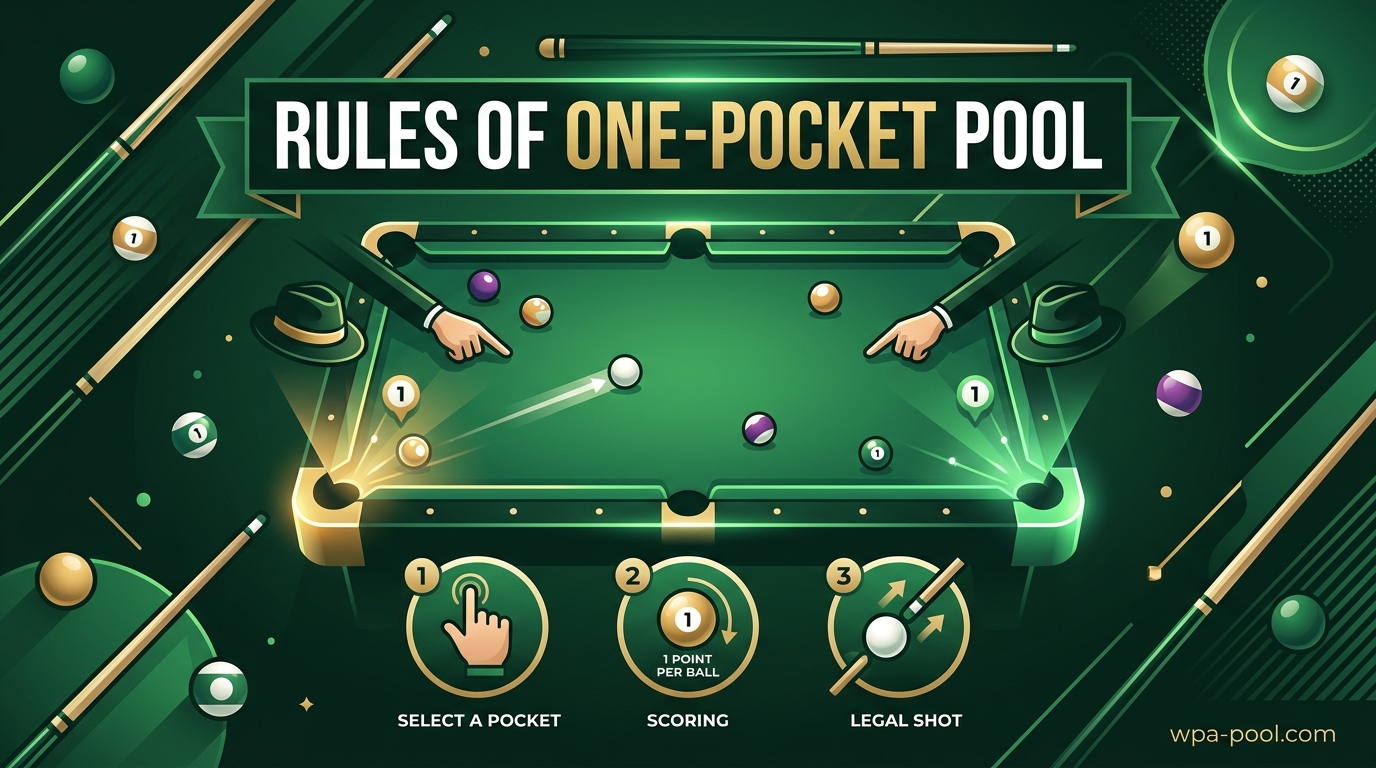
Learning the rules of one-pocket pool opens up one of the most strategic and rewarding games in the billiards world. Unlike eight-ball or nine-ball where speed and shot-making dominate, one-pocket rewards patience, positioning, and tactical thinking. Our team has studied the official BCA and WPA regulations to bring you a complete guide that covers everything from the break shot to the winning conditions.
Whether you are a beginner curious about this chess-like pool variant or an experienced player looking to brush up on the finer points of the rules, this guide has you covered. We will walk you through the objective, setup, fouls, and even some basic strategy to get you started.
Table of Contents
What is One-Pocket Pool?
One-pocket is a pocket billiards game played between two players or two teams. The game uses all fifteen object balls plus the cue ball on a standard pool table with standard pool table dimensions.
The defining feature of one-pocket is that each player is assigned exactly one pocket. All balls must be pocketed into that specific pocket to count toward your score. The game is often called the “chess of pool” because it emphasizes safety play, strategic positioning, and long-term planning over flashy shot-making.
Unlike rotation games where you shoot at any ball, or eight-ball where you have a suite of balls, one-pocket restricts scoring to a single designated pocket. This constraint creates a unique tactical environment where players battle for position and try to force errors from their opponents.
Rules of One-Pocket Pool: The Complete Guide
The rules of one-pocket pool are governed by the Billiard Congress of America (BCA) and the World Pool-Billiard Association (WPA). These official regulations ensure consistency whether you are playing in a local tournament or at the Derby City Classic.
Object of the Game
The object of one-pocket is to be the first player to legally pocket eight balls into your designated pocket. The game ends immediately when the eighth ball drops into your assigned corner pocket at the foot of the table.
This simple objective belies the complexity of the game. Because you and your opponent share the same table space and the same set of balls, every shot must consider both offense and defense. Pocketing a ball is good, but leaving your opponent a shot is often disastrous.
Key Rules at a Glance
- First player to pocket 8 balls in their designated pocket wins
- Each player chooses one of the two foot corner pockets
- The other four pockets are neutral pockets (balls pocketed there are spotted)
- Any foul results in a one-ball penalty (opponent spots one of your previously pocketed balls)
- Three consecutive fouls result in loss of game
- All balls must be spotted except the game-winning 8th ball
Table Setup and Designated Pockets
Before the game begins, players must determine which pockets they will use. The two foot pockets, located at the breaking end of the table, are the only pockets that can be used for scoring. One player chooses the left foot pocket, and the other player takes the right foot pocket.
The four remaining pockets are called neutral pockets. Any ball pocketed in a neutral pocket does not count for either player. Instead, the ball is spotted back on the table at the foot spot, and play continues.
It is traditional for the breaking player to choose their pocket first, though this can be determined by mutual agreement or lag. Once chosen, pockets cannot be changed during the game. Marking your pocket with a coin, chalk, or other marker helps avoid confusion during play.
The Foot Spot and Head String
Understanding table geography is essential for one-pocket. The foot spot is the small dot or diamond located at the intersection of the foot string and the long center line of the table. This is where spotted balls are placed.
The head string runs horizontally across the table at the opposite end from the scoring pockets. After certain fouls, the incoming player receives ball in hand behind the head string. This means they can place the cue ball anywhere behind that imaginary line but cannot shoot at balls also behind the head string.
The Break: Starting the Game
The break shot in one-pocket is unique compared to other pool games. The fifteen object balls are racked in a standard triangle formation behind the foot string. The apex ball of the rack is placed on the foot spot. The cue ball can be placed anywhere behind the head string for the break.
Legal Break Requirements
A legal break requires the cue ball to contact the racked balls with sufficient force to move at least two object balls to new positions. Alternatively, any ball (including the cue ball) must cross the head string. If neither condition is met, the break is illegal.
If the break is illegal, the opponent has the option to accept the table as-is or require a re-break. Play then continues normally with the breaking player shooting again, assuming no foul occurred.
What Happens After the Break
After a legal break, the breaking player continues shooting. Unlike eight-ball, there is no requirement to pocket a ball on the break or to call a ball and pocket. The breaking player simply continues their inning as long as they make legal strokes without fouling.
If the cue ball scratches into a pocket on the break, it is a standard foul. The opponent receives ball in hand behind the head string and also spots one ball from their count as the penalty.
Continuing Play: Innings and Legal Shots
An inning consists of a player turn at the table. A player remains at the table until they fail to execute a legal stroke or until they commit a foul. A legal stroke requires the cue tip to contact the cue ball and drive either the cue ball or an object ball to a cushion, unless a ball is pocketed on the shot.
Legal Stroke Definition
To execute a legal stroke, the shooter must strike the cue ball with the cue tip. After contact, at least one ball must either pocket in a legal pocket or contact a cushion. Failure to meet these requirements results in a foul.
Unlike some games, there is no requirement to hit a specific ball first in one-pocket. You may contact any ball on the table, including your opponent’s balls, as long as you execute a legal stroke.
Safety Play in One-Pocket
Safety play is a fundamental part of one-pocket strategy. A player may declare a safety before a shot, indicating they are not attempting to pocket a ball. If the shot is legal but no ball is pocketed, the inning passes to the opponent.
Declaring safety protects the shooter from certain foul penalties related to not driving a ball to a cushion, provided the shot is otherwise legal. However, if a ball is accidentally pocketed during a declared safety, normal scoring rules apply.
Scoring in One-Pocket Pool
Scoring in one-pocket is straightforward but requires tracking. Each time you legally pocket a ball in your designated pocket, you score one point. The first player to reach eight points wins the game.
Tracking the Score
Players typically use coin markers, tally marks, or a scoreboard to track how many balls each player has pocketed. It is common practice to place a coin or token near your pocket to represent each ball you have scored.
The concept of “owing balls” is important in one-pocket. When you commit a foul, you owe your opponent one ball from your count. This is taken immediately if you have balls to give, or it is remembered as a debt to be paid when you score.
The Game-Winning Ball
The eighth ball that wins the game is not spotted. Unlike other balls pocketed during the game, the game-winning ball stays in the pocket. The game ends immediately upon the legal pocketing of the eighth ball, regardless of whether other balls were pocketed on the same shot.
If a player pockets their eighth ball and also scratches or commits another foul on the same shot, the foul is ignored and the player still wins. The game-winning shot takes precedence.
Fouls and Penalties Explained
Understanding fouls is essential to mastering the rules of one-pocket pool. Every foul carries a one-ball penalty in addition to any other consequences. This means your opponent gets to spot one ball from your previously pocketed balls, or you go into debt owing a ball.
Common Fouls in One-Pocket
- Scratch: Pocketing the cue ball in any pocket
- Wrong pocket: Pocketing a ball in your opponent’s designated pocket
- Neutral pocket: Pocketing a ball in a non-scoring pocket (ball is spotted, plus foul penalty)
- Illegal stroke: Failing to drive a ball to a cushion or pocket a ball
- Double hit: Hitting the cue ball twice on the same stroke
- Push shot: The cue tip remains in contact with the cue ball too long
- Ball off table: Knocking any ball off the playing surface
Ball in Hand Rules
After most fouls, the opponent receives ball in hand behind the head string. This means they can place the cue ball anywhere in the kitchen (the area behind the head string) but cannot shoot at balls that are also entirely behind the head string.
If all object balls are behind the head string, the ball nearest the head string is spotted at the foot spot to allow a legal shot. This situation is rare in one-pocket because play naturally gravitates toward the foot of the table where the scoring pockets are located.
The One-Ball Penalty
The one-ball penalty is what makes one-pocket a game of precision and caution. Every foul costs you one ball from your score. If you have pocketed three balls and commit a foul, you immediately lose one, dropping to two.
If you have not yet pocketed any balls, you go into debt. You must pocket a ball to get to zero before you can start building a positive score. This “owing balls” concept adds significant pressure to avoid mistakes.
The Three Fouls Rule
The three fouls rule is a game-ending penalty that keeps players honest and prevents excessive safety play or intentional fouling. If a player commits three consecutive fouls, they lose the game immediately.
A streak of three fouls is counted only if they occur on consecutive innings by the same player. If the opponent has any legal turn at the table between your fouls, the count resets. However, any foul still carries the one-ball penalty regardless of the consecutive count.
To avoid the three fouls penalty, players must sometimes take risky shots rather than play yet another safety. This rule adds drama and forces action when games might otherwise stall into endless defensive exchanges.
Spotting Balls and Frozen Ball Rules
Spotting balls is a frequent occurrence in one-pocket. Whenever a ball is pocketed illegally, knocked off the table, or needs to be returned for any reason, it is placed on the foot spot or as close as possible behind it along the long string.
The Foot Spot Procedure
If the foot spot is occupied by another ball, the ball to be spotted is placed as close as possible behind that ball along the long center line of the table. If that position is also blocked, the ball is placed on the long string as close as possible to the foot spot without touching another ball.
Balls are spotted immediately when required, before the next shot is taken. The only exception is the game-winning eighth ball, which is not spotted even if it was pocketed under unusual circumstances.
Frozen Ball Rules
A ball is considered frozen to a cushion when it is touching that cushion. When the cue ball is frozen to a cushion, the shooter must either drive the cue ball to another cushion after contacting an object ball, or cause an object ball to contact a cushion.
This rule prevents players from simply tapping the cue ball when it is frozen. The normal requirement to drive a ball to a cushion still applies. A referee or opponent may call for a check to determine if a ball is truly frozen before a shot is executed.
Jump Shots in One-Pocket
Jump shots are legal in one-pocket under most circumstances, but with important restrictions. A player may execute a jump shot to clear an obstructing ball, provided the shot is executed with a legal stroke.
The cue ball must be struck with the cue tip below the center line of the cue ball to execute a legal jump. Scooping under the cue ball or using an illegal technique results in a foul. Additionally, if the cue ball jumps off the playing surface of the table, it is a foul regardless of whether it returns to the table.
Many one-pocket players avoid jump shots because the risk of a foul often outweighs the benefit. The penalty structure makes aggressive shots dangerous, and the strategic nature of the game favors careful positioning over high-risk maneuvers.
Strategy Tips for Beginners
Now that you understand the rules of one-pocket pool, let us talk about how to actually win. One-pocket rewards patience and planning far more than raw shot-making ability. Here are some foundational strategies to help you get started.
Opening Strategy
After the break, your first priority is often to establish safety rather than run balls. Look for opportunities to hide the cue ball behind a cluster of balls while leaving your opponent no direct path to their pocket. A good safety in one-pocket can be more valuable than pocketing a ball.
The Importance of Banks
Bank shots are essential in one-pocket. Because both players are shooting toward adjacent pockets, balls often end up on the wrong side of the table. Learning to bank balls into your pocket from difficult positions separates intermediate players from beginners.
Know When to Play Safe vs. Aggressive
The best one-pocket players know when to push their advantage and when to play defensively. If you have a simple runout, take it. But if the shot is risky and you have a lead, consider playing a safety and forcing your opponent to make the mistake.
Remember the three fouls rule. If your opponent is on two consecutive fouls, you can play more aggressively because they must avoid a third foul at all costs. Conversely, if you are on two fouls, sometimes you must take a difficult shot rather than risk the game-ending penalty.
A Brief History of One-Pocket
One-pocket has a rich history dating back over a century. The game evolved from straight pool and other early billiards games as players sought a format that emphasized strategy over speed. It became popular in gambling halls where the slow, deliberate pace allowed for side betting and extended play.
Famous One-Pocket Players
The pantheon of one-pocket legends includes names like Grady Mathews, known as the “Six-Foot-Hour Man” for his deliberate pace, and Efren Reyes, arguably the greatest all-around pool player in history. These players elevated one-pocket from a gambling game to a respected test of cue sports mastery.
Other notable names include Johnny Vives, Willie Mosconi, and Rudolph “Minnesota Fats” Wanderone. While these players are known for other games, they all respected one-pocket as the ultimate test of tactical thinking.
The Derby City Classic
Today, one-pocket enjoys a renaissance through events like the Derby City Classic in Louisville, Kentucky. This annual tournament brings together the best one-pocket players from around the world to compete for significant prize money and bragging rights. The event has helped standardize rules and introduce new generations to the game.
Eddie Robin’s book “Winning One-Pocket” remains the definitive strategy guide and helped formalize many of the concepts modern players take for granted. The game continues to evolve while maintaining its reputation as the purest test of pool intelligence.
Frequently Asked Questions
What happens when you scratch in One Pocket?
When you scratch in one-pocket, it is a foul with two consequences. First, your opponent receives ball in hand behind the head string. Second, you must spot one ball from your previously pocketed count as a penalty. If you have not pocketed any balls, you go into debt and owe a ball to be spotted when you eventually score.
Is jumping allowed in One Pocket?
Yes, jump shots are allowed in one-pocket provided they are executed legally. The cue ball must be struck below its center line with the cue tip. Scooping or using an illegal technique results in a foul. If the cue ball leaves the playing surface entirely, even if it returns, it is a foul.
What happens if you make the opposite pocket in One Pocket pool?
Pocketing a ball in your opponent’s designated pocket is a foul. The ball does not count for your opponent but is spotted at the foot spot. You still incur the one-ball penalty for the foul. If you pocket a ball in a neutral pocket (one of the four non-scoring pockets), the ball is spotted and you receive the one-ball foul penalty.
What is a foul in One Pocket pool?
Common fouls in one-pocket include scratching the cue ball, pocketing a ball in the wrong pocket, failing to execute a legal stroke (not driving a ball to a cushion), double-hitting the cue ball, pushing the cue ball instead of striking it cleanly, and knocking a ball off the table. Every foul carries a one-ball penalty where your opponent spots one of your previously pocketed balls.
How do you win at one pocket pool?
You win at one-pocket by being the first player to legally pocket eight balls into your designated pocket. The game ends immediately when the eighth ball drops into your assigned corner pocket. The game-winning ball is not spotted. Even if you commit a foul on the winning shot, the victory stands.
How many balls do you need to win one-pocket?
You need to pocket exactly eight balls in your designated pocket to win one-pocket. Each legally pocketed ball counts as one point, and the first player to reach eight points wins the game. The game-winning eighth ball stays in the pocket and is not spotted.
What are the designated pockets in one-pocket?
In one-pocket, the two foot corner pockets are the designated scoring pockets. One player chooses the left foot pocket, and the other player takes the right foot pocket. The other four pockets on the table are neutral pockets where pocketed balls are spotted back onto the table with a foul penalty.
Conclusion
Understanding the rules of one-pocket pool opens the door to one of the most intellectually rewarding games in the cue sports world. From the opening break to the final eight ball, every decision matters. The combination of designated pockets, the one-ball penalty system, and the three fouls rule creates a game that truly deserves its reputation as the chess of pool.
If you are new to one-pocket, start by practicing your safety play and bank shots. Learn to think two or three shots ahead. Study the great players at events like the Derby City Classic. Most importantly, find an opponent and start playing. The rules may seem complex at first, but they quickly become second nature once you experience the flow of a well-played game.
Whether you play for fun, for practice, or for stakes, one-pocket will improve your understanding of position, safety, and strategic thinking. Now that you know the rules, it is time to rack the balls and see who can pocket eight balls first.