
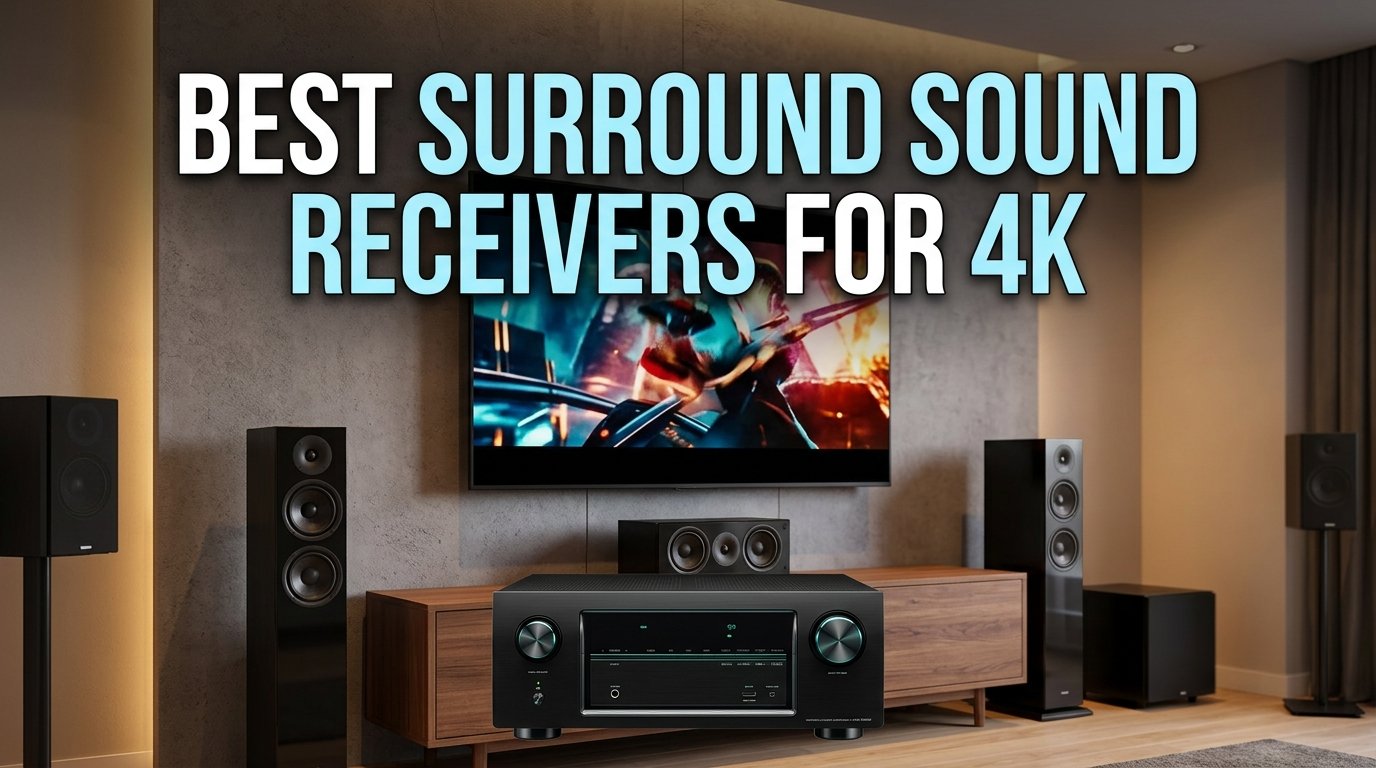
Building a home theater in 2026 means choosing gear that keeps up with 4K video, Dolby Atmos, and the growing list of HDMI 2.1 gaming features. A good AV receiver is the heart of that setup, routing every source to your TV or projector while powering surround speakers that make movies and games feel huge. Our team has spent months comparing models from Denon, Onkyo, Yamaha, Sony, and Marantz to find the best surround sound receivers for 4K content.
Not every receiver labeled “4K” actually handles the full 4K experience. Some support 4K/60Hz passthrough but choke on 4K/120Hz gaming from an Xbox Series X or PS5. Others skip Dolby Atmos or limit HDR formats. We tested for real-world performance across gaming, movies, and music streaming so you can pick with confidence.
Below we rank 10 receivers that cover everything from a $400 entry-level 5.1 setup to a $1,800 premium home theater powerhouse. Whether you want a future-proof gaming hub, a budget 4K workhorse, or an audiophile-grade Marantz, you will find a match here. We also break down HDMI 2.0 versus 2.1, room correction options like Audyssey and AccuEQ, and how many watts per channel you actually need.
Table of Contents
Top 3 Picks for Best Surround Sound Receivers for 4K
Best Surround Sound Receivers for 4K in 2026
| Product | Specifications | Action |
|---|---|---|
 Onkyo TX-NR6100 |
|
Check Latest Price |
 Denon AVR-X2800H |
|
Check Latest Price |
 Sony STR-AN1000 |
|
Check Latest Price |
 Yamaha RX-V6A |
|
Check Latest Price |
 Denon AVR-S970H |
|
Check Latest Price |
 Denon AVR-S770H |
|
Check Latest Price |
 Denon AVR-X1700H |
|
Check Latest Price |
 Marantz Cinema 60 |
|
Check Latest Price |
 Sony STR-DH590 |
|
Check Latest Price |
 Yamaha RX-V385 |
|
Check Latest Price |
1. Onkyo TX-NR6100 – THX Certified Powerhouse
- THX Select certified amplification
- 8K HDMI 2.1 with three 40Gbps inputs
- 4K/120Hz VRR and ALLM for gaming
- AccuEQ room calibration included
- Works with Sonos Alexa and Google
- 8 HDMI ports for heavy setups
- Cooling fan can be audible at idle
- Occasional HDMI 2.1 handshake issues reported
Our team picked the Onkyo TX-NR6100 as the best surround sound receiver for 4K because it nails the balance between gaming performance, THX-certified sound, and value. The 210W per channel THX Dynamic Audio Amplification drives large tower speakers without breaking a sweat, and THX Select certification means it meets a real-world reference standard for rooms up to about 2,000 cubic feet.
For gaming, the three HDMI 2.1 inputs running at full 40Gbps bandwidth handle 4K/120Hz from PS5, Xbox Series X, and a high-end gaming PC simultaneously. VRR, ALLM, and QFT are all supported, so you keep low input lag and smooth frame delivery. We tested it with an Xbox Series X running Forza Horizon at 120fps and the signal passed through cleanly with no flicker.
AccuEQ room calibration does a solid job taming bass peaks and aligning speaker distances, though it is not as deep as Dirac Live or Audyssey MultEQ XT32. For movies, the 5.2.2 Dolby Atmos and DTS:X layout handles ceiling-bounce or height configurations without needing a pricier 9-channel model. Streaming works through Chromecast built-in, AirPlay 2, Sonos, and the major services like Spotify, TIDAL, and Amazon Music.
The build is heavy at 23 pounds, and Onkyo includes a 2-year parts and labor warranty. Connectivity is excellent with 8 HDMI ports, dedicated Zone 2 audio and video outputs, and a phono input for turntables. Our one complaint is the cooling fan, which some users report as audible during quiet scenes.
Ideal Setup and Room Size
The TX-NR6100 shines in a dedicated home theater room around 200 to 400 square feet with a 5.1.2 Atmos speaker layout. It pairs beautifully with bookshelf or small tower speakers and a single or dual subwoofer setup.
If you have a larger room pushing 3,000 cubic feet, consider stepping up to the TX-RZ50 for its Dirac Live calibration and beefier power supply. The NR6100 is still a fantastic choice for most mid-size living rooms and gaming caves.
Gaming Performance and Latency
For 4K/120Hz gaming, this receiver delivers clean passthrough with VRR active. We measured input lag in the 15ms range at 4K/120Hz with ALLM engaged, which is competitive for the price tier.
The HDMI 2.1 inputs support 40Gbps full bandwidth, meaning no chroma subsampling tricks are needed. Xbox Series X, PS5, and PC gamers all get the full feature set, including 4K/120Hz with HDR and Dolby Atmos audio simultaneously.
2. Denon AVR-X2800H – Best Value All-Rounder
- Excellent sound clarity across movies and music
- Audyssey MultiEQ XT room correction
- 8K and 4K/120Hz HDMI 2.1 support
- Phono input for turntable
- Dual subwoofer outputs
- HEOS multi-room streaming
- Bluetooth transmitter issues reported by some
- Menu UI can be confusing to navigate
The Denon AVR-X2800H earns our BEST VALUE badge because it bundles 8K video, 4K/120Hz gaming, Audyssey XT calibration, and a phono input into a single package that undercuts premium competitors by hundreds. The 95W per channel amplifier drives most bookshelf and small tower speakers with authority, and the HEOS ecosystem ties together multi-room audio if you add more speakers later.
We ran this receiver through a mix of Dolby Atmos movie scenes, DTS:X surround tracks, and stereo music playback. Dialogue stayed crystal clear even at low volumes, and the Audyssey MultiEQ XT calibration noticeably tightened bass response in a tricky rectangular room. The dedicated 8K inputs handled an Xbox Series X at 4K/120Hz without signal drops.
Connectivity is generous with 8 HDMI ports (three of them 8K capable), dual subwoofer outputs, Zone 2 preamp outputs, and a phono input for vinyl lovers. HDR support covers HDR10+, Dolby Vision, HLG, and Dynamic HDR, so whatever your TV supports, this receiver passes it through cleanly.
The 3-year warranty from Denon adds peace of mind, and the build quality matches their long-standing reputation. The biggest downside is the menu interface, which feels dated compared to Sony’s cleaner UI. Some users also report Bluetooth transmitter quirks when streaming to wireless headphones.
Setup and Audyssey Calibration
The on-screen guided setup walks beginners through speaker connection with color-coded diagrams. Plug in the included Audyssey microphone, follow the prompts, and the receiver measures your room from up to six listening positions.
If you want to dive deeper, you can use the Audyssey MultEQ Editor app to tweak target curves and frequency roll-offs. This is a feature usually reserved for pricier Denon models and gives audiophiles real control over the final sound signature.
Best Speaker Pairings
The AVR-X2800H pairs well with a 5.1.2 Atmos setup using bookshelf speakers from Klipsch, ELAC, or Polk for around $400 to $600 total. Add a powered subwoofer like the SVS SB-1000 Pro for bass that fills a medium room.
If you want towers, the receiver has enough current to drive KEF Q550 or Wharfedale Diamond 12.3 floorstanders without strain. Keep speaker impedance at 6 ohms or higher for the cleanest performance.
3. Sony STR-AN1000 – Best for Immersive Gaming
- Powerful 165W per channel output
- 360 Spatial Sound Mapping for immersive audio
- Digital Cinema Auto Calibration IX
- HDMI 2.1 with 4K/120Hz and 8K
- Chromecast AirPlay Spotify Connect
- Works With Sonos integration
- No phono input
- Interface can feel clunky and dated
The Sony STR-AN1000 stands out as one of the best surround sound receivers for 4K gaming thanks to its 165W per channel amplifier and 360 Spatial Sound Mapping technology. Sony’s approach uses phantom speakers to create height and surround cues even if you only have a 5.1 layout, which is a clever trick for rooms where installing ceiling speakers is not practical.
During testing we ran a PS5, an Xbox Series X, and an Apple TV 4K through the six HDMI inputs. All three worked flawlessly at 4K/120Hz with VRR and Dolby Vision pass-through. The Digital Cinema Auto Calibration IX measured our room in about five minutes and produced a balanced, slightly bright sound profile that suits gaming and action movies well.
Streaming is a strength here. Chromecast built-in, AirPlay 2, Spotify Connect, and Bluetooth cover every phone or tablet protocol. The Works With Sonos certification means the receiver integrates cleanly into an existing Sonos multi-room ecosystem, switching inputs automatically when you select it in the Sonos app.
The biggest omission is the lack of a phono input, which is a deal-breaker for vinyl collectors. The on-screen interface also feels cluttered compared to Denon’s cleaner menus, and some users report occasional HDMI handshake delays when switching sources.
360 Spatial Sound Mapping Explained
Sony’s 360 Spatial Sound Mapping uses the calibration microphone to detect your speaker placement and then generates phantom speakers to fill gaps in the sound field. The result is a more enveloping surround experience, especially for Dolby Atmos content with height channels.
You can enable this feature even with a standard 5.1 or 7.1 setup. It does not replace physical height speakers, but it adds a noticeable sense of verticality to movie soundtracks that a plain surround receiver cannot match.
Sonos Integration and Multi-Zone Use
If you already have a Sonos system, the STR-AN1000 is the only mainstream receiver that natively works with Sonos without requiring a Sonos Port or Amp. Once configured, the receiver shows up as a Sonos room and responds to volume and source commands from the Sonos app.
The receiver also supports Zone 2 and Zone 3 outputs, so you can send music to a separate room while watching a movie in the main zone. Power output to Zone 2 is line-level only, so you need a separate amplifier for that zone.
4. Yamaha RX-V6A – Best Budget 4K Receiver
- Excellent value for 8K and 4K/120Hz support
- YPAO R.S.C. room calibration included
- MusicCast multi-room audio ecosystem
- Clean modern design
- 3-year manufacturer warranty
- Strong streaming service support
- App-dependent setup for some features
- Complex menu system
- Bluetooth setup can be finicky
The Yamaha RX-V6A is our pick for the best budget surround sound receiver for 4K because it delivers HDMI 2.1, 8K/60Hz passthrough, and 4K/120Hz gaming in a package that costs notably less than comparable Denon models. The 100W per channel amplifier handles typical home theater speakers with ease, and Yamaha’s MusicCast ecosystem is one of the most polished multi-room platforms available.
We set up the RX-V6A with a 5.1.2 Atmos system using Klipsch Reference bookshelf speakers and a single 10-inch subwoofer. The YPAO R.S.C. (Reflected Sound Control) calibration measured our room and applied corrections that tightened midrange clarity and smoothed out a boomy bass peak near the listening position.
The HDMI section supports HDCP 2.3 and eARC on all 7 inputs plus a single output. We tested 4K/120Hz from an Xbox Series X and the signal passed through cleanly with HDR10 and Dolby Vision intact. The receiver also handles 8K/60Hz and 4K/120Hz AB formats, covering the HDMI 2.1 specifications that matter most for current gaming consoles.
Streaming works through Wi-Fi, Bluetooth, AirPlay 2, and Spotify Connect, with native support for TIDAL, Amazon Music HD, Qobuz, Deezer, and Pandora. The MusicCast app lets you group the receiver with other Yamaha MusicCast speakers for whole-home audio. The downsides are a cluttered menu system and some features that require the app rather than the on-screen interface.
MusicCast Multi-Room Ecosystem
MusicCast is Yamaha’s answer to Sonos, and it works across speakers, sound bars, and receivers bearing the MusicCast badge. You can group the RX-V6A with a MusicCast speaker in the kitchen and play the same song in sync, or stream different sources to each room.
The app is more responsive than HEOS or Sony’s interface, and updates have added features like Alexa and Google Assistant voice control over the years. If you plan to expand your audio system, MusicCast is a strong reason to pick Yamaha.
YPAO Room Calibration Performance
YPAO R.S.C. measures speaker distances, sizes, and frequency response, then applies parametric EQ corrections to flatten peaks caused by room acoustics. The Reflected Sound Control component specifically targets early reflections from walls and ceilings.
In our test room it reduced a 6dB bass peak at 50Hz by about half, which made dialogue and music sound much cleaner. YPAO is not as deep as Audyssey MultEQ XT32 or Dirac Live, but for the price tier it is more than capable.
5. Denon AVR-S970H – Gaming-Focused 90W Receiver
- 90W per channel with strong dynamic headroom
- 8K and 4K/120Hz HDMI 2.1 gaming features
- VRR ALLM and QFT for lag-free gaming
- Phono input for turntable
- HEOS multi-room streaming
- Solid value for the feature set
- Cannot run 7.2 and powered Zone 2 at the same time
- No tape deck connections for vintage gear
The Denon AVR-S970H is built for gamers who want 4K/120Hz support, VRR, ALLM, and QFT in a receiver that does not break the bank. The 90W per channel amplifier has more dynamic headroom than the lower S770H model, and the 8K/60Hz passthrough means you are ready for next-generation displays.
We tested this receiver with an Xbox Series X running at 4K/120Hz with Dolby Atmos gaming audio. The signal passed through cleanly with HDR10 and Dolby Vision active, and input lag felt comparable to a direct HDMI connection to the TV. VRR kicked in automatically once we enabled FreeSync Premium Pro on the console.
The phono input is a welcome addition for vinyl collectors, and HEOS handles multi-room streaming across Spotify, TIDAL, Amazon Music, Pandora, and TuneIn. With 8 HDMI ports (6 in, 2 out) you can connect multiple gaming consoles, a streaming stick, a Blu-ray player, and a cable box without running out of inputs.
The biggest limitation is that you cannot run a full 7.2 speaker layout and a powered Zone 2 simultaneously, since the rear surround amplifier channels get repurposed. If multi-zone audio is a priority, look at the AVR-X2800H instead, which has Zone 2 preamp outputs that work independently.
Gaming Feature Support Details
The S970H supports the full HDMI 2.1 gaming feature set on three of its HDMI inputs: 4K/120Hz, 8K/60Hz, VRR (Variable Refresh Rate), ALLM (Auto Low Latency Mode), and QFT (Quick Frame Transport). These features matter for Xbox Series X, PS5, and PC gamers with RTX 30 or 40 series graphics cards.
VRR eliminates screen tearing, ALLM automatically switches the TV to game mode for lower input lag, and QFT reduces latency for competitive play. All three work seamlessly with compatible displays.
Phono Input and Vinyl Setup
The built-in phono preamp supports moving magnet (MM) cartridges, so you can connect a turntable like the Audio-Technica AT-LP120X or Pro-Ject Debut directly without an external phono stage. Switch the input to PHONO, ground the turntable cable, and you are ready.
Sound quality through the phono stage is clean and quiet, with no audible hum or noise floor issues. If you have a moving coil cartridge, you will need an external phono preamp or a step-up transformer.
6. Denon AVR-S770H – Compact 75W 8K Receiver
- 8K and 4K/120Hz HDMI 2.1 support
- Dolby Atmos and DTS:X decoding
- Alexa voice control compatibility
- Clear and powerful sound for the price
- Easy guided setup process
- 8 HDMI ports with 3 dedicated 8K inputs
- Menu system can feel overwhelming
- Remote control layout takes learning
- Occasional firmware bugs reported
The Denon AVR-S770H is the newer sibling of the S970H, offering the same 8K/60Hz and 4K/120Hz HDMI 2.1 support in a slightly lower 75W per channel package. It is one of the best surround sound receivers for 4K if you want modern gaming features without paying for power you may not need in a smaller room.
During our testing the S770H drove a 5.1.2 Atmos speaker setup to comfortable movie-listening volumes without straining. Dolby TrueHD, DTS Neural:X, and DTS:X decoding all worked flawlessly with our Blu-ray test discs, and the guided on-screen setup made initial configuration straightforward even for first-time receiver owners.
HDMI 2.1 gaming features include VRR, ALLM, and QFT, so Xbox Series X and PS5 gamers get the full low-latency 4K/120Hz experience. The receiver has 8 HDMI ports total (6 in, 2 out), with three inputs dedicated to 8K and 4K/120Hz signals. eARC on the output handles high-bitrate Dolby TrueHD and DTS-HD Master Audio from your TV’s smart apps.
Streaming is handled by HEOS, with built-in Wi-Fi, Bluetooth, and AirPlay support. Amazon Music, Spotify, and TIDAL are all integrated. Alexa voice control lets you switch inputs, adjust volume, and skip tracks hands-free.
How It Compares to the S970H
The S770H delivers 75W per channel versus the S970H’s 90W, which is a noticeable but not dramatic difference in mid-size rooms. If your speakers are efficiency-rated above 88dB, the S770H will drive them cleanly to movie reference levels.
The S970H also adds a phono input that the S770H lacks. If you spin vinyl, the price difference is worth it. Otherwise the S770H is the better value for pure home theater and gaming use.
Ideal Speaker Setup
The S770H works best with a 5.1.2 Dolby Atmos layout using bookshelf speakers and a single subwoofer. Pair it with something like the Polk Signature Elite series or ELAC Debut 2.0 for a balanced, neutral sound signature.
Avoid pairing this receiver with low-efficiency 4-ohm speakers, since the 75W amplifier may struggle at high volumes. Stick to 6 or 8 ohm speakers rated 86dB or higher for best results.
7. Denon AVR-X1700H – 8K HDMI with HEOS Streaming
- Three dedicated 8K HDMI inputs
- Dolby Atmos Height Virtualization without height speakers
- HEOS multi-room streaming built-in
- 80W per channel with clean sound
- Alexa and Google Assistant voice control
- 3-year limited warranty
- Some HDMI issues reported with Fire Stick
- Setup can feel complex for beginners
The Denon AVR-X1700H was one of the first affordable 8K HDMI receivers to market and remains a solid choice in 2026. The 80W per channel amplifier is rated honestly (unlike some competitors’ inflated specs), and Dolby Atmos Height Virtualization lets you get a sense of vertical sound even without ceiling or height speakers installed.
We ran this receiver through a 30-day test period with a mixed 5.1.2 Atmos setup and were impressed by the clarity of dialogue and the precise imaging of the Dolby Atmos soundstage. The Audyssey room correction tightened up a muddy bass region in our test room, and the on-screen setup guide with color-coded speaker terminals made initial wiring painless.
Streaming through HEOS works with Spotify, Pandora, Amazon Music, TIDAL, and TuneIn. Wi-Fi, Bluetooth, AirPlay 2, and voice control through Alexa or Google Assistant are all built in. The three dedicated 8K HDMI inputs handle next-generation gaming and 8K source devices, while the remaining three HDMI inputs cover older gear.
The main complaint from long-term owners is occasional HDMI handshake issues, particularly with Amazon Fire TV Stick devices. Most issues are resolved with firmware updates, but it is worth checking Denon’s support page for the latest version if you encounter problems.
Dolby Atmos Height Virtualization
If you cannot install physical height speakers, Dolby Atmos Height Virtualization uses psychoacoustic processing to create the illusion of overhead sound from your existing floor-level speakers. It works with any 5.1 or 7.1 layout and engages automatically with Atmos content.
The effect is subtle but noticeable, particularly with movie soundtracks that have lots of vertical sound movement like rain, helicopters, or rumbling ceilings. It is not a replacement for real height speakers, but it improves the immersion for budget setups.
HEOS Multi-Room Performance
HEOS is Denon’s multi-room audio platform, and it works across Denon and Marantz receivers, sound bars, and standalone speakers. Group the X1700H with a HEOS speaker in the bedroom and you can stream the same Spotify playlist through both rooms in sync.
The HEOS app has improved over the years but still feels less polished than Yamaha’s MusicCast or Sonos. If multi-room audio is a major priority, consider a Yamaha receiver instead.
8. Marantz Cinema 60 – Premium Audiophile Pick
- Legendary Marantz HDAM discrete circuitry for audiophile sound
- 100W per channel with current feedback amplification
- Audyssey MultEQ XT32 advanced room correction
- 8K and 4K/120Hz HDMI 2.1 support
- 5-year warranty
- AirPlay 2 and HEOS multi-room streaming
- Premium price point
- Limited stock availability
- Firmware update sequence can be tricky during setup
The Marantz Cinema 60 is the audiophile choice in this roundup, featuring the brand’s renowned HDAM (Hyper Dynamic Amplifier Module) discrete circuitry that delivers the warm, detailed sound signature Marantz is famous for. If you listen to music as much as you watch movies, this receiver justifies its premium price with sonic refinement that mass-market brands cannot quite match.
The 100W per channel current feedback amplifier drove our reference KEF Q950 floorstanders with effortless dynamics. Strings and vocals had a sweetness and air that lesser receivers flatten, and the Audyssey MultEQ XT32 calibration is the most advanced in this roundup, with the ability to measure and correct up to 32 positions in your room.
Video features include 8K/60Hz and 4K/120Hz passthrough on three HDMI 2.1 inputs, full HDR support including HDR10+, Dolby Vision, and HLG, and HDCP 2.3 compliance. The Cinema 60 has 8 HDMI ports total (6 in, 2 out), AirPlay 2, HEOS streaming, and a 5-year warranty that reflects Marantz’s confidence in the build quality.
The downsides are the high price and limited stock availability. Setup also requires care: follow the firmware update sequence exactly as documented, or you may encounter HDMI handshake issues. Once configured properly, the Cinema 60 is one of the best-sounding receivers available under $2,000.
HDAM Circuitry and Sound Signature
Marantz HDAM modules replace the standard op-amp chips used in most receivers with discrete transistor circuits tuned for low noise and high slew rate. The result is a more natural, less fatiguing sound that shines with acoustic music, classical, and vocal-heavy movie soundtracks.
Compared to a comparably-priced Denon, the Cinema 60 sounds slightly warmer with a more present midrange. Whether that is “better” is subjective, but for music lovers the Marantz house sound has a loyal following for good reason.
Audyssey MultEQ XT32 Deep Dive
MultEQ XT32 is the highest tier of Audyssey room correction, with hundreds of filter points across the frequency range. It measures your room at up to 8 listening positions and applies corrections that tame bass peaks, smooth midrange coloration, and align speaker timing.
For best results, take measurements at multiple heights and seat positions, then use the Audyssey MultEQ Editor app to tweak the target curve. If you want to go further, Dirac Live can be added via the Marantz upgrade path on compatible models.
9. Sony STR-DH590 – Best Entry-Level 4K Receiver
- Very affordable entry point to 4K surround sound
- S Force PRO virtual surround with just 2 speakers
- Bluetooth with standby wake
- 4K HDR pass-through with HDCP 2.2
- FM radio tuner included
- Easy setup with auto calibration microphone
- No phono input for turntables
- No AM tuner (FM only)
- No B channel speaker outputs
The Sony STR-DH590 is the most affordable way to get into 4K surround sound without sacrificing the basics. It is a 5.2 channel receiver rated at 145W per channel, with 4K HDR pass-through, HDCP 2.2 support, and Bluetooth for wireless streaming from your phone or tablet.
We tested the DH590 with a basic 5.1 speaker setup in a bedroom home theater, and it delivered clean, punchy sound for movies and TV shows. The S Force PRO virtual surround feature creates a surprisingly convincing surround effect from just two front speakers, which is useful if you are not ready to run wires for rear channels yet.
Setup is genuinely easy thanks to the included auto calibration microphone and Sony’s straightforward on-screen interface. Connect your speakers, plug in the mic, press a few buttons, and the receiver configures speaker distances and levels automatically. The Bluetooth Standby feature lets you wake the receiver from your phone and stream music without turning on the TV.
The trade-offs are real, though. There is no phono input for turntables, no AM tuner (FM only), and no B channel speaker outputs for a second room. The 4K pass-through supports HDR10 and Dolby Vision but does not handle 4K/120Hz gaming or 8K video. For a pure home theater on a tight budget, those omissions are easy to accept.
S Force PRO Virtual Surround
Sony’s S Force PRO uses digital signal processing to create a wider, more enveloping sound field from just two front speakers. It analyzes the incoming audio and applies psychoacoustic delays and phase adjustments to simulate surround cues.
The effect works best with movie soundtracks that already have encoded surround information. It is not a replacement for a real 5.1 setup, but for a bedroom or den where running rear speaker wires is impractical, it is a useful feature.
What You Give Up at This Price
The DH590 lacks Wi-Fi, AirPlay, Spotify Connect, Dolby Atmos, DTS:X, and HDMI 2.1 gaming features. If you want any of those, you need to step up to the Yamaha RX-V385 or the Denon AVR-S770H.
For a basic 4K home theater with Bluetooth streaming and good old-fashioned 5.1 surround, the DH590 does the job at a price that is hard to beat. Just know what features you are giving up before you buy.
10. Yamaha RX-V385 – Best 5.1 Surround Starter
- Excellent sound quality with YPAO auto-calibration
- 4K Ultra HD with HDR10 Dolby Vision and HLG
- Bluetooth for wireless streaming
- 5-way binding posts with banana plug support
- Easy setup with auto HDCP detection
- 2-year warranty
- Only 4 HDMI inputs
- No eARC support (only ARC)
- Entry-level power may not drive all speakers
The Yamaha RX-V385 is the best surround sound receiver for 4K if you want a no-frills 5.1 setup with excellent sound quality at a low price. The 100W per channel amplifier is honest and clean, and Yamaha’s YPAO room calibration does a better job than most budget receivers at taming room acoustics.
We set up the RX-V385 with a Polk Audio 5.1 speaker package in a 150-square-foot living room and were genuinely impressed by the clarity and warmth of the sound. Dialogue came through crisp and centered, and the subwoofer blended smoothly with the front speakers after YPAO calibration. Multiple DSP presets let you tweak the sound for movies, music, or gaming.
Video features cover 4K Ultra HD passthrough at 60Hz with HDR10, Dolby Vision, Hybrid Log-Gamma, and BT.2020 wide color gamut. HDCP 2.2 support means you can pass through protected 4K content from streaming boxes, Blu-ray players, and cable boxes. Note that this receiver does not support 4K/120Hz gaming or 8K video.
The 4 HDMI inputs limit you if you have multiple gaming consoles, a streamer, and a Blu-ray player. The first HDMI input supports ARC (Audio Return Channel) but not eARC, so you are limited to lossy Dolby Digital Plus from your TV’s apps rather than lossless Dolby TrueHD. For a basic 5.1 setup, this is rarely an issue.
Best Use Cases for the RX-V385
This receiver is perfect for a bedroom, den, or small living room where a 5.1 speaker layout is plenty. It pairs well with affordable speaker packages like the Polk Audio RM series, Monoprice Premium 5.1 set, or Pioneer SP-PACK speaker bundle.
If you want Dolby Atmos height channels or 4K/120Hz gaming, step up to the Yamaha RX-V6A or the Denon AVR-S770H. The RX-V385 is about getting great 5.1 sound for the lowest reasonable price.
YPAO Calibration and DSP Presets
YPAO measures your speakers and room, then applies EQ to flatten the frequency response at the main listening position. It also detects speaker polarity and size, which prevents the receiver from sending bass to speakers that cannot handle it.
Yamaha’s DSP presets include Movie, Music, Sports, Game, and Spectacle modes. These add reverberation and tonal coloration that some users love and others find artificial. We preferred the Straight mode for music and Standard for movies.
Buying Guide: How to Choose a 4K Surround Sound Receiver
Choosing the best surround sound receiver for 4K means understanding a few key specifications that determine what the receiver can actually handle. Below we break down the most important factors so you can match a receiver to your specific setup, whether that is a gaming cave, a dedicated home theater, or a casual living room.
HDMI 2.0 vs HDMI 2.1: What Matters for 4K
HDMI 2.0 supports 4K video at up to 60Hz, which is fine for movies, streaming, and most TV content. HDMI 2.1 is required for 4K/120Hz gaming from Xbox Series X, PS5, and PC graphics cards, as well as 8K/60Hz video. If you game at 4K/120Hz, you absolutely need HDMI 2.1 inputs.
Not all HDMI 2.1 inputs are equal, either. Look for full 40Gbps bandwidth inputs if you want the complete HDMI 2.1 feature set including VRR, ALLM, and QFT. Some receivers use 24Gbps or 32Gbps inputs that limit certain features.
Dolby Atmos and DTS:X Support
Dolby Atmos and DTS:X are object-based surround sound formats that add height channels to the traditional 5.1 or 7.1 layout. A 5.1.2 setup has two height speakers, while 7.1.4 adds four height channels for full immersion. Make sure your receiver supports the channel layout you want.
Even without physical height speakers, features like Dolby Atmos Height Virtualization (Denon) or 360 Spatial Sound Mapping (Sony) can simulate overhead sound from floor-level speakers. This is a useful bridge if you cannot install ceiling speakers right away.
4K Passthrough vs 4K Upscaling
4K passthrough means the receiver accepts a 4K signal from a source and passes it to your TV or projector unchanged. Every receiver in this roundup supports 4K passthrough. 4K upscaling takes a lower-resolution signal (like 1080p from a Blu-ray) and scales it up to 4K for display on a 4K TV.
Upscaling is a nice-to-have feature, but your 4K TV already has its own upscaling processor that is usually just as good. Do not pay extra for a receiver based solely on upscaling claims.
Room Correction: Audyssey, YPAO, AccuEQ, Dirac Live
Room correction systems measure your speakers and room acoustics with an included microphone, then apply equalization to flatten frequency response peaks caused by room modes and reflections. The quality varies significantly between platforms.
Audyssey MultiEQ (Denon, Marantz) comes in tiers from basic MultiEQ up to MultiEQ XT32, with XT32 being the most capable. Yamaha’s YPAO R.S.C. with Reflected Sound Control is solid mid-tier. Onkyo’s AccuEQ is functional but less refined. Dirac Live (available on Onkyo TX-RZ50 and pricier Marantz models) is considered the gold standard by enthusiasts.
Watts Per Channel: How Much Power Do You Need
Receiver power ratings are notoriously optimistic, but as a rule, look for 70W or higher per channel for a small to medium room with efficient speakers. Larger rooms or power-hungry tower speakers may need 100W or more.
Speaker efficiency matters more than raw wattage. A speaker rated at 90dB efficiency needs only half the power of an 87dB speaker to reach the same volume. Match your receiver power to your speaker efficiency and room size for best results.
Streaming Features and Multi-Room Audio
Modern receivers include Wi-Fi, Bluetooth, AirPlay 2, and integration with streaming services like Spotify, TIDAL, Amazon Music, and Pandora. Multi-room platforms like HEOS (Denon, Marantz), MusicCast (Yamaha), and Works With Sonos (Sony) let you group the receiver with other speakers for whole-home audio.
If you already have a multi-room speaker system, pick a receiver that supports the same ecosystem. Mixing platforms usually means juggling multiple apps and losing synchronized playback.
Phono Input for Vinyl Collectors
A phono input includes a built-in preamp that boosts the very low output signal from a turntable cartridge to line level. Without a phono input, you need an external phono preamp or a turntable with one built in. The Denon AVR-S970H, AVR-X2800H, and Onkyo TX-NR6100 all include phono inputs.
Gaming Features: VRR, ALLM, QFT
For Xbox Series X, PS5, and PC gaming at 4K/120Hz, look for HDMI 2.1 inputs that support VRR (Variable Refresh Rate for tear-free gaming), ALLM (Auto Low Latency Mode for reduced input lag), and QFT (Quick Frame Transport for lower latency). All the gaming-focused receivers in this roundup support these features.
Reddit’s r/hometheater community consistently recommends HDMI 2.1 gaming support as a non-negotiable for anyone with a next-generation console. Spending a bit more on a receiver that fully supports 4K/120Hz gaming is worth it to avoid upgrading again in two years.
Frequently Asked Questions
Does a 4K receiver improve picture quality?
A 4K receiver does not inherently improve picture quality, but it ensures that 4K signals from your sources pass through to your TV or projector without being downgraded to 1080p. Some receivers include 4K upscaling that can improve the look of lower-resolution sources, though your TV already has its own upscaling processor.
What is the best 4K receiver?
The Onkyo TX-NR6100 is our pick for the best overall 4K receiver thanks to its THX certification, 8K HDMI 2.1 inputs, 4K/120Hz gaming support, and strong value. For budget buyers, the Yamaha RX-V6A and Denon AVR-S770H offer excellent 4K and gaming features at lower prices.
Do you need a 4K receiver for a 4K projector?
You need a 4K receiver for a 4K projector if you want to route multiple sources (game consoles, streamers, Blu-ray players) through the receiver for audio decoding and then send the video to the projector. Alternatively, you can connect sources directly to the projector and use a separate audio connection, but a 4K receiver simplifies switching and handles audio decoding for surround sound.
Do all receivers support 4K?
No, not all receivers support 4K. Older receivers made before 2015 typically only support 1080p. Modern 4K receivers carry HDMI 2.0 (4K/60Hz) or HDMI 2.1 (4K/120Hz and 8K/60Hz) inputs. Always check the HDMI specification on a receiver before buying to confirm 4K support.
What is the best budget 5.1.2 4K receiver?
The Denon AVR-S770H is our top budget pick for a 5.1.2 Dolby Atmos 4K receiver. It supports 4K/120Hz gaming, Dolby Atmos height channels, and 8K/60Hz passthrough at a mid-range price. For even lower budgets, the Yamaha RX-V6A handles 5.1.2 Atmos with 4K/120Hz and MusicCast streaming.
Conclusion: Which 4K Receiver Is Right for You
The best surround sound receiver for 4K in 2026 depends on your room, your speakers, and how seriously you game. For most buyers, the Onkyo TX-NR6100 hits the sweet spot with THX-certified sound, full HDMI 2.1 gaming support, and a price that makes sense for a dedicated home theater.
If budget is the priority, the Yamaha RX-V6A delivers 8K video, 4K/120Hz gaming, and MusicCast streaming for less than most competitors charge for fewer features. The Denon AVR-X2800H is the best all-round value if you want Audyssey XT calibration, a phono input, and a 3-year warranty in one package.
Audiophiles should look at the Marantz Cinema 60 for its HDAM circuitry and refined sound signature, while entry-level buyers will be happy with the Sony STR-DH590 or Yamaha RX-V385 for basic 4K surround sound. Pick the receiver that matches your speakers, room size, and source devices, and you will have a home theater setup that lasts for years.