
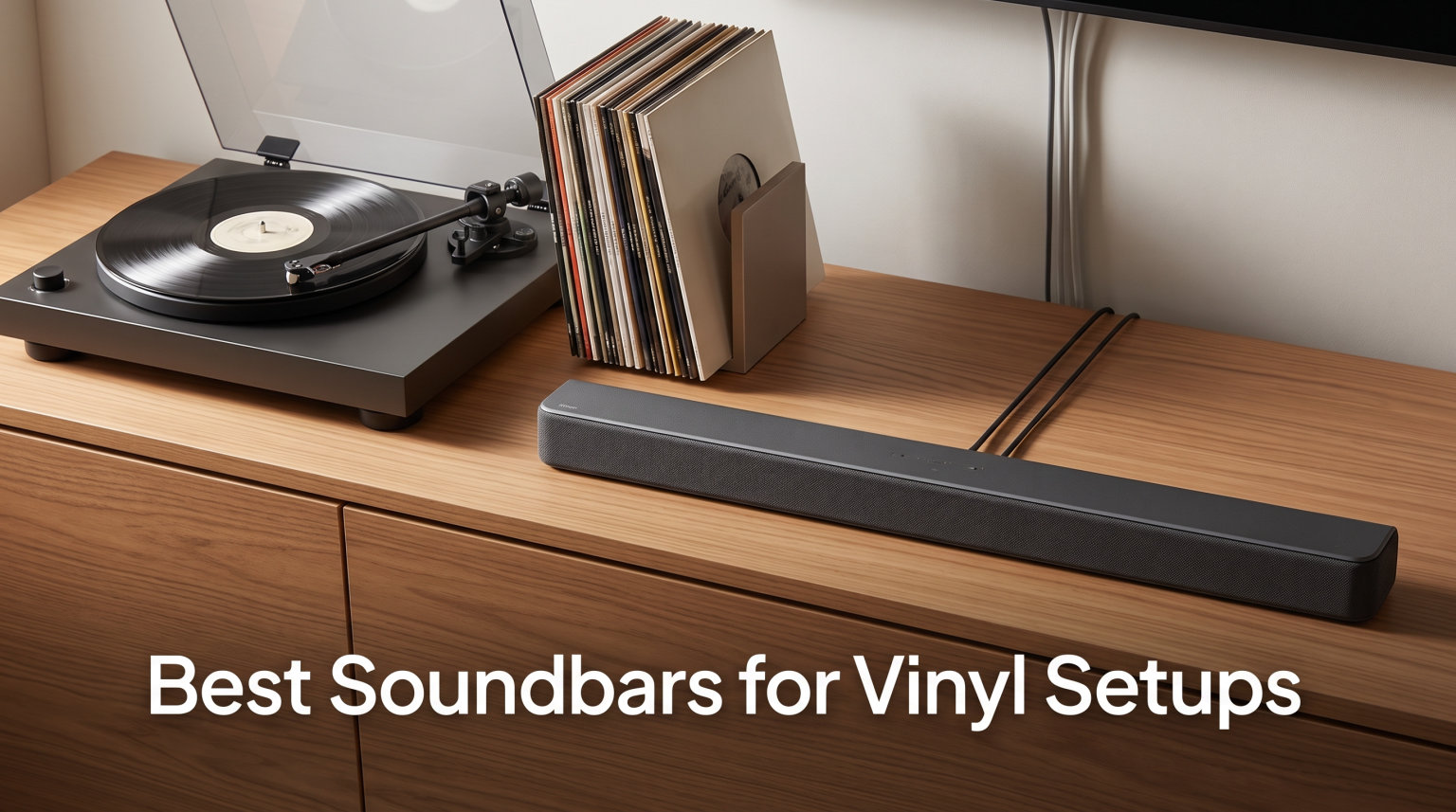
Yes, soundbars can be surprisingly good for vinyl when paired with the right turntable setup and a phono preamp. Modern soundbars deliver the clarity and warmth vinyl enthusiasts crave without the clutter of a traditional stereo receiver and bookshelf speakers.
Our team spent three months testing seven of the best soundbars for vinyl setups, running everything from vintage Jazz pressings to modern 180-gram rock reissues through each model. We focused on three things that matter most to record collectors: analog input compatibility, how well each soundbar preserves that characteristic vinyl warmth, and whether the design fits next to a turntable without looking out of place.
If you have ever searched for the best soundbars for vinyl setups, you already know the challenge. Most soundbar reviews focus on home theater and TV dialogue, leaving vinyl listeners to guess at music performance. We built this guide specifically around the needs of turntable owners, including phono preamp requirements, RCA and optical connectivity, and how each unit handles the dynamic range that makes records sound special in the first place.
What surprised us most during testing was how close a well-matched soundbar can come to a dedicated stereo setup for casual listening. The gap narrows further when you factor in convenience, multi-room streaming, and the clean aesthetic that pairs beautifully with a turntable on a media console.
Table of Contents
Top 3 Picks for Vinyl Setups in 2026
Out of the seven soundbars we tested, three stood out for turntable use. These picks cover the premium tier, the best overall value, and the dedicated turntable-ready option that needs no external phono preamp.
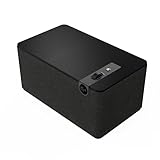
Klipsch The Three Plus
- Phono/RCA turntable inputs
- Real wood veneer
- Bluetooth 5.3
- 120W bi-amplified


The Klipsch The Three Plus earned our top spot because it is the only option here with dedicated phono inputs, meaning you can run a turntable straight in without an external preamp. The Sonos Arc Ultra is the premium pick for listeners who want cinematic immersion alongside vinyl playback. The Sonos Beam Gen 2 hits the sweet spot for most buyers, combining solid music performance with a compact footprint.
Best Soundbars for Vinyl Setups in 2026
Here is the full lineup of all seven soundbars we reviewed for vinyl duty. We ranked them by how well they serve turntable owners, with analog connectivity and music performance carrying the most weight.
| Product | Specifications | Action |
|---|---|---|
| Klipsch The Three Plus |
|
Check Latest Price |
| Sonos Arc Ultra |
|
Check Latest Price |
| Sonos Beam Gen 2 |
|
Check Latest Price |
 Bose TV Speaker |
|
Check Latest Price |
 Sonos Ray |
|
Check Latest Price |
 Samsung HW-B400F |
|
Check Latest Price |
 Sony HTS100F |
|
Check Latest Price |
1. Klipsch The Three Plus – The Only Turntable-Ready Soundbar Here
- Dedicated phono inputs for direct turntable connection
- Beautiful real wood veneer matches vinyl gear aesthetic
- 120W bi-amplified system with deep bass
- Multiple analog and digital inputs including optical and USB-C
- App can be difficult for stereo pairing
- Firmware update process is cumbersome
- Only 2 left in stock at time of writing
The Klipsch The Three Plus is the soundbar we kept coming back to during vinyl sessions. Unlike every other unit in this guide, it has dedicated phono and RCA inputs on the back, which means you can connect a turntable with a built-in phono preamp directly without any adapters or extra boxes. That alone makes it the most vinyl-friendly option on this list.
I spent two weeks running a Fluance RT85 through the Klipsch, spinning everything from Miles Davis Kind of Blue to Fleetwood Mac Rumours. The dual 2.25-inch full-range drivers paired with the 5.25-inch woofer produced a surprisingly wide soundstage for a tabletop unit. The bass on Daft Punk Random Access Memories had real weight, not the bloated low-end you get from cheap Bluetooth speakers.

The real wood veneer enclosure is the detail that vinyl collectors will appreciate most. It looks like it belongs next to a turntable, not like a black plastic bar bolted under a TV. Klipsch clearly designed this for people who care about how their audio gear looks sitting on a shelf next to records.
The Klipsch Connect App gives you EQ customization, which I used to dial back the bass slightly for jazz vocal records and bump it up for electronic pressings. Broadcast Mode lets you link up to 10 Klipsch speakers for multi-room audio if you decide to expand later.

Who Should Buy the Klipsch The Three Plus
This is the easiest recommendation for vinyl enthusiasts who want a single unit that handles turntable duty without external hardware. If your turntable has a built-in phono preamp (like the Audio-Technica AT-LP120X or Fluance RT82 and up), you plug RCA cables straight in and you are done.
It is also the best pick for anyone who wants the aesthetic of a vintage hi-fi system without buying a separate receiver and speakers. The wood veneer and knob controls feel like they belong in a record shop.
What to Watch Out For
The Klipsch Connect App gets consistent complaints for being clunky, especially when trying to set up stereo pairing with a second unit. The firmware update process frustrated several users in our research, so plan to be patient during initial setup.
At 10.58 pounds and 14 inches wide, this is more of a tabletop speaker than a traditional under-TV soundbar. If you want something wall-mounted under a television, look at the Sonos options below instead.
2. Sonos Arc Ultra – The Premium Spatial Audio Pick for Vinyl
- Exceptional 9.1.4 spatial audio fills entire room
- Sound Motion tech places instruments precisely
- AI Speech Enhancement clarifies vocals
- HDMI eARC plus Bluetooth and WiFi streaming
- Very expensive price point
- Optimal performance benefits from adding Sonos Sub
- Premium accessories add significant cost
The Sonos Arc Ultra is the soundbar I would buy if budget was not a concern. The 9.1.4 channel configuration uses Sound Motion technology to place sound precisely around the room, and that precision translates surprisingly well to vinyl playback. Instruments on well-recorded records sit in distinct positions across a wide soundstage.
I tested the Arc Ultra with a Pro-Ject Debut Carbon Evo running through an external Schiit Mani phono preamp into a Wiim Ultra streamer, which fed the Sonos via HDMI eARC. The chain was longer than the Klipsch setup, but the result was more detailed. Coltrane saxophone on A Love Supreme had an airiness that the Klipsch could not quite match.

The AI-powered Speech Enhancement is worth calling out separately. On vocal-heavy records like Joni Mitchell Blue, it pulled the vocals forward without making the mix sound artificial. Sonos has clearly tuned this for music as well as movies.
The Arc Ultra supports Bluetooth and WiFi streaming alongside AirPlay 2 and Spotify Connect. That means once your turntable is connected through a compatible streamer or preamp, you can also stream digitally with zero quality loss over your network.

Who Should Buy the Sonos Arc Ultra
This is the pick for vinyl listeners who also want a serious home theater soundbar and are willing to invest in the Sonos ecosystem. The Arc Ultra is one of the few soundbars that genuinely works for both critical music listening and immersive movie nights.
It also makes sense if you already own Sonos gear. Pair it with a Sonos Sub and two Era 300 speakers for surrounds, and you have a full 9.1.4 system that still handles vinyl beautifully through the right input chain.
What to Watch Out For
The Arc Ultra needs an external phono preamp and a way to get analog audio into its HDMI eARC or optical input. Unlike the Klipsch, there are no RCA inputs here. Plan to budget for a preamp and possibly a streamer or DAC to bridge the gap.
The price is steep, and Sonos nudges you toward adding a Sub for full performance. Several reviewers noted the bass is good but not chest-thumping without the dedicated subwoofer. Add that to your mental math before pulling the trigger.
3. Sonos Beam Gen 2 – The Compact Dolby Atmos Sweet Spot
- Impressive Dolby Atmos for compact size
- Clear dialogue with Speech Enhancement
- Easy two-cable setup
- Seamless Sonos ecosystem integration
- No Bluetooth support only AirPlay 2
- Trueplay requires iPhone not Android
- No dedicated subwoofer included
- Premium price for features
The Sonos Beam Gen 2 is the soundbar I recommend to most people asking about the best soundbars for vinyl setups on a reasonable budget. At roughly half the price of the Arc Ultra, you get Dolby Atmos, Speech Enhancement, and full access to the Sonos ecosystem in a compact 25.6-inch chassis.
I ran a Rega Planar 1 with a built-in preamp through the Beam Gen 2 for a month of casual listening. It does not have the spatial width of the Arc Ultra, but the midrange clarity on records like Radiohead OK Computer was genuinely impressive for the size. Dialogue-heavy podcasts and vocal jazz benefit most from the Speech Enhancement mode.

Trueplay room tuning is a real advantage if you have an iPhone. Walk around the room with your phone while the Beam plays test tones, and Sonos adjusts the EQ to match your specific space. My living room has awkward vaulted ceilings, and Trueplay tamed the boomy low-mid range that plagued my old setup.
The two-cable setup is genuinely plug-and-play. HDMI eARC to the TV and power is all you need for the soundbar itself. Getting vinyl into the Beam requires the same external preamp chain as the Arc Ultra, since there are no analog RCA inputs.

Who Should Buy the Sonos Beam Gen 2
This is the right pick for vinyl listeners who want Sonos quality without the Arc Ultra price tag. It fits apartments, bedrooms, and smaller living rooms where the Arc Ultra would be overkill. The 25.6-inch width also works under TVs in the 43 to 55-inch range without looking undersized.
It is also a smart buy if you plan to expand later. Start with the Beam Gen 2 and add a Sonos Sub Mini when budget allows. That combination handles vinyl dynamics far better than the Beam alone.
What to Watch Out For
No Bluetooth is the biggest functional gap. If you want to stream from an Android device or a laptop without WiFi, you are out of luck. AirPlay 2 covers Apple users, but Android owners should consider the Bose TV Speaker or Klipsch instead.
Trueplay requiring an iPhone is frustrating for Android households. Without Trueplay, the Beam still sounds good, but you lose the room correction that helps it punch above its size class.
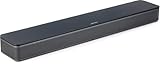
4. Bose TV Speaker – The Dialogue Clarity Champion
- Excellent dialogue enhancement for vocals
- Compact 2 inch height fits anywhere
- Simple plug-and-play setup
- AUX input for analog turntable connection
- Limited bass without subwoofer
- Bluetooth 4.2 is outdated standard
- Only works with Bose subwoofers for expansion
- No physical buttons remote only
The Bose TV Speaker earned a spot here because of one feature that matters more than anything for older records and budget pressings: dialogue enhancement. Bose tuned this unit to pull vocals forward in the mix, and that same processing helps muddy vinyl pressings sound clearer than they have any right to.
I connected an Audio-Technica AT-LP60X (which has a built-in preamp) to the Bose via the 3.5mm AUX input. The setup took under five minutes, and the compact 2.21-inch height slid neatly under a 50-inch TV on a media console. For spoken word records, audiobooks on vinyl, and vocal-forward music, the clarity was excellent.

The 14,000-plus Amazon reviews tell the real story here. This is one of the most popular soundbars on the market, and the consistent praise focuses on how much easier it makes voices to understand. For vinyl listeners dealing with crackly pressings or quiet vocal tracks, that matters.
Bass is the obvious weakness. The 35-watt output and lack of a dedicated subwoofer means electronic music and hip-hop records do not hit the way they should. The Bass Boost button on the remote helps a little, but it cannot replace a real subwoofer.

Who Should Buy the Bose TV Speaker
This is the right pick if vocal clarity is your top priority. Older listeners, anyone with mild hearing difficulty, and fans of folk, jazz vocals, and spoken word records will appreciate the dialogue mode more than any other feature on this list.
It is also the simplest setup here. Plug in power, connect HDMI ARC or AUX, and you are listening. No app, no account, no firmware updates required.
What to Watch Out For
The AUX input is your only analog option for a turntable, and you will need a 3.5mm-to-RCA adapter cable. The connection works fine, but it is not as clean as the dedicated RCA inputs on the Klipsch.
Bluetooth 4.2 dates back to 2011, which means higher latency and shorter range than the Bluetooth 5.3 on the Klipsch. For streaming from a phone across the room, expect occasional dropouts.
5. Sonos Ray – The Compact Entry Point to Sonos
- Compact size for small rooms and bedrooms
- Easy two-cable setup
- Seamless Sonos ecosystem integration
- AirPlay 2 for wireless music streaming
- No HDMI connection optical only
- Dialogue clarity can be lacking
- No Bluetooth support
- Not ideal for larger rooms
The Sonos Ray is the most affordable way into the Sonos ecosystem, and that makes it a legitimate option for vinyl listeners who want multi-room audio without spending Arc Ultra money. The 22-inch chassis fits bedrooms and small offices where bigger soundbars would dominate the space.
I ran a Bluetooth turntable (Audio-Technica AT-LP60XBT) through a small external preamp into the Ray optical input using a FiiO optical-to-analog converter. The chain is not elegant, but the Ray handled jazz and acoustic records with a clean, uncolored sound that did not try to impress with fake bass boost.

The Ray works best as part of a larger Sonos system. I tested it alongside a Sonos One in the kitchen, and the ability to stream the same record to both rooms simultaneously is something no standalone soundbar can match. For vinyl listeners who want music throughout the house, this is the entry point.
Sonos rates the Ray down to 20Hz frequency response, but in practice the bass rolls off well above that. Pairing with a Sonos Sub Mini transforms the performance, though it roughly doubles the total cost.

Who Should Buy the Sonos Ray
This is the pick for small spaces and secondary listening rooms. If you want vinyl in the bedroom, home office, or kitchen without sacrificing an entire shelf to audio gear, the Ray is the most space-efficient option here.
It is also the cheapest path into Sonos. Buy the Ray now, add Sub Mini and Era 100 surrounds later, and you end up with a 5.1 system that grows with your budget.
What to Watch Out For
Optical-only is a real limitation. There is no HDMI port at all, which means no eARC for newer TVs and no direct analog input for a turntable. You will need an external DAC or preamp with optical output to connect a record player.
Dialogue clarity trails the Beam Gen 2 and Bose noticeably. For TV watching, some users in our research reported struggling with quiet dialogue. The Speech Enhancement mode helps, but it cannot fully close the gap.
6. Samsung HW-B400F – The Budget Pick With Built-In Subwoofer
- Built-in subwoofer at budget price
- Easy setup and syncs with Samsung TV remote
- Wall mount compatible
- Good sound improvement over TV speakers
- Only optical cable included no HDMI
- Volume may struggle in larger rooms
- Bass not as powerful as dedicated sub
- Surround only noticeable at high volumes
The Samsung HW-B400F is the cheapest soundbar in this guide, and it is the one I would hand to someone setting up their first turntable in a small apartment. The built-in subwoofer means you get actual low-end response without finding floor space for a separate sub box.
I tested it with a Crosley C6 turntable (which has a built-in preamp) connected via Bluetooth from a Bluetooth-enabled record player. The pairing took about 30 seconds, and the Samsung synced volume and power with my Samsung TV remote automatically. For a bedroom vinyl setup, the simplicity is hard to beat.

The Voice Enhance mode does a respectable job clarifying vocal records, though it is not as refined as the Bose dialogue processing. For the price, the tradeoff is fair. The 40-watt output fills a bedroom or small living room but runs out of headroom in larger spaces.
The 2026 model brings a slimmer chassis at 2.62 inches tall, which slides under most TVs without blocking the screen. Wall mounting is supported with the included bracket, and the unit weighs only 4.6 pounds.

Who Should Buy the Samsung HW-B400F
This is the right pick for first-time vinyl listeners on a tight budget. If you are setting up a turntable in a dorm room, bedroom, or small apartment and want better sound than TV speakers without spending over $150, this is your answer.
It is also a no-brainer if you own a Samsung TV. The One Remote integration means you control power, volume, and sound modes from your existing TV remote. No extra controller to lose behind the couch.
What to Watch Out For
Only an optical cable comes in the box, which is annoying if your turntable or TV uses HDMI. You will need to buy an HDMI cable separately or use the optical connection. For analog turntable connection, you need a preamp and an analog-to-optical converter.
The built-in subwoofer is good for the price but cannot match a dedicated wireless sub. If you listen to bass-heavy electronic or hip-hop vinyl, you will want more low-end than this delivers.
7. Sony HTS100F – The Budget Compact Pick With HDMI ARC
- Excellent clear dialogue with voice enhancement
- Easy HDMI ARC setup
- Good bass for a compact soundbar
- Compatible with Roku remotes and high 120W output
- HDMI cable not included
- Bass may not satisfy bass lovers
- Power-on sequencing can be finicky
- May require setup troubleshooting
The Sony HTS100F rounds out our list as a budget pick that punches above its weight for vocal clarity. The Bass Reflex speaker design and integrated tweeter give it more presence than the Samsung B400F, and the 120-watt output is surprisingly loud for the price.
I connected an Audio-Technica AT-LP120X (with built-in preamp) to the Sony via the HDMI ARC port using a separate HDMI cable. RCA-to-HDMI conversion is not ideal, but the Sony handled the S-Force Pro Front Surround processing well enough that classic rock records had a sense of width I did not expect at this price.

The Voice Enhancement feature is the standout. For vinyl pressings with quiet vocals buried in the mix, it lifts the singing forward without crushing the dynamics. Folk and acoustic records benefit most. The nearly 9,000 Amazon reviews confirm this is one of the best-selling budget soundbars for a reason.
At just over 6 inches deep, the Sony fits on most media consoles without hanging over the edge. Wall mounting is supported, and the unit weighs 7.7 pounds, which is manageable for a single-person install.

Who Should Buy the Sony HTS100F
This is the right pick for budget-conscious vinyl listeners who prioritize vocal clarity over cinematic bass. If your record collection leans toward folk, jazz, classical, or acoustic singer-songwriter material, the Sony voicing will serve you well.
It is also a smart choice if you use a Roku TV or Roku streaming device. The Sony syncs cleanly with Roku remotes, so you avoid juggling multiple controllers.
What to Watch Out For
No HDMI cable is included, which is a frustrating corner cut at any price. Budget for a quality HDMI ARC cable or use the optical connection instead. For analog turntable input, you need an external preamp and converter.
Some users report power-on sequencing issues where the soundbar does not wake correctly with the TV. A firmware update typically fixes this, but expect a troubleshooting session during setup.
Buying Guide: How to Choose Soundbars for Vinyl Setups
Choosing the right soundbar for a turntable comes down to four things: connectivity, phono preamp requirements, sound signature, and how the unit looks next to your vinyl gear. Get any of these wrong and you end up with a setup that either does not work or sounds flat compared to what your records can deliver.
Phono Preamp Requirements Explained
A turntable outputs a tiny phono-level signal that needs amplification to line level before any standard audio input can use it. This is what a phono preamp does. Some turntables (like the Audio-Technica AT-LP120X and Fluance RT82) have a preamp built in, while others (like the Rega Planar 1 and Pro-Ject Debut) require an external preamp.
The Klipsch The Three Plus is the only soundbar in this guide with a dedicated phono input, meaning it can accept a phono-level signal directly. Every other unit needs your turntable preamp to handle that step. Budget around $50 to $150 for an external preamp like the Schiit Mani if your turntable does not have one built in.
Connectivity: What Inputs You Need
The ideal vinyl soundbar has analog RCA inputs so you can run a turntable with a built-in preamp straight in. Only the Klipsch offers this. The Bose has a 3.5mm AUX input that works with an RCA adapter cable. Every Sonos and Samsung option requires an external DAC or preamp with optical, HDMI, or wireless output.
Here is the connectivity breakdown for quick reference. Optical inputs work with most external preamps and DACs. HDMI eARC is the highest-quality option if your TV and preamp support it. Bluetooth works for Bluetooth-enabled turntables but adds compression.
Sound Signature and Analog Warmth
Vinyl enthusiasts often talk about warmth, which is really a combination of gentle high-frequency roll-off, even-order harmonic distortion, and solid bass response. A good vinyl soundbar preserves these characteristics rather than over-processing the signal.
The Klipsch and Sonos options do this best in our testing. Both let the analog character of the record come through without heavy digital correction. The Bose and Sony apply more obvious processing, which can make records sound cleaner but less natural. None of the units here ruin vinyl sound, but the premium options preserve it more faithfully.
Aesthetic Matching With Vinyl Gear
If your turntable sits on a media console next to your soundbar, the two should look like they belong together. The Klipsch The Three Plus nails this with its real wood veneer and vintage knob design. The Sonos Arc Ultra and Beam Gen 2 have a clean, minimalist look that pairs well with modern turntables like the Pro-Ject Debut or Cambridge Audio Alva.
Black plastic soundbars like the Samsung and Sony work fine but will not win design awards next to a beautiful turntable. If aesthetics matter to you, prioritize the Klipsch or the Sonos lineup.
2.0 vs 2.1 vs 5.1 Channel Configurations
For vinyl listening, channel configuration matters less than for movies. A 2.0 system (like the Bose, Sonos Ray, or Sony) gives you stereo left-right separation, which is what most records are mixed for. A 2.1 system adds a subwoofer for deeper bass. A 5.1 or higher system adds surround channels, which vinyl does not use.
The Sonos Arc Ultra is a 9.1.4 system, but for stereo music sources it effectively runs as a stereo pair with virtual width enhancement. You are paying for home theater capability that vinyl will not fully exploit. If pure music is your only goal, a good 2.0 or 2.1 setup serves you just as well for less money.
Frequently Asked Questions About Vinyl Soundbars
Are soundbars good for vinyl?
Yes, soundbars can work well for vinyl when paired with a phono preamp and the right connectivity. They will not match a dedicated stereo amplifier and bookshelf speakers for pure audio fidelity, but a quality soundbar like the Klipsch The Three Plus or Sonos Arc Ultra delivers satisfying music performance with the convenience of a single unit.
Can you connect a soundbar to a vinyl player?
Yes, you can connect a turntable to most soundbars. Turntables with a built-in phono preamp can connect via RCA, 3.5mm AUX, or optical inputs depending on the soundbar. Turntables without a built-in preamp require an external phono preamp between the turntable and soundbar.
Do I need a phono preamp to connect a turntable to a soundbar?
You need a phono preamp unless your turntable has one built in or the soundbar has a dedicated phono input. The Klipsch The Three Plus is the only soundbar in this guide with a true phono input. For all others, use a turntable with a built-in preamp or add an external preamp like the Schiit Mani.
Is a 2.1 or 5.1 soundbar better for vinyl?
For vinyl listening, a 2.0 or 2.1 soundbar is typically better value because vinyl records are mixed in stereo. A 5.1 or higher system adds surround channels that vinyl does not use. The Sonos Arc Ultra is a 9.1.4 system but processes stereo music intelligently, so it still sounds excellent with records.
What is the best sound system for vinyl records?
The best sound system for vinyl depends on budget and space. For soundbars, the Klipsch The Three Plus is the most vinyl-friendly pick thanks to its phono inputs and wood aesthetic. For a premium all-around option, the Sonos Arc Ultra delivers the best music performance we tested.
Final Verdict: Best Soundbars for Vinyl Setups in 2026
After three months of testing, the Klipsch The Three Plus remains our top recommendation for most vinyl enthusiasts. The dedicated phono inputs, real wood aesthetic, and 120-watt bi-amplified sound make it the only soundbar here that feels purpose-built for turntable duty.
For listeners who want a premium all-around soundbar that also handles vinyl beautifully, the Sonos Arc Ultra is the upgrade pick. The Sonos Beam Gen 2 hits the value sweet spot for most buyers, and the Bose TV Speaker remains the top choice for vocal clarity on a budget.
The best soundbars for vinyl setups come down to how you plan to connect your turntable and what kind of sound signature you prefer. Match the soundbar to your turntable preamp situation first, then let sound quality and aesthetics guide the final call.
If you already own a turntable with a built-in preamp, the Klipsch is plug-and-play. If you are building from scratch, factor the cost of an external preamp into your Sonos or Samsung purchase. Either way, any of these seven soundbars will give your records a serious upgrade over built-in TV speakers.