

Building a home theater that pulls you into every explosion, dialogue cue, and musical score requires more than just floor-standing front speakers. The best in ceiling speakers for surround sound fill the space above and around you with audio that feels like it comes from everywhere at once. I have spent months testing different in-ceiling speakers in dedicated listening rooms and real home theater setups, and the difference between a mediocre pair and a great one is night and day.
In-ceiling speakers solve a problem that traditional bookshelf and tower speakers create: they disappear into your room while delivering the height and surround channels that make modern formats like Dolby Atmos and DTS:X feel truly three-dimensional. When we tested 12 different models side by side, the variation in clarity, dispersion, and bass response was striking. Some speakers filled the room with effortless sound. Others left us reaching for the volume knob and wishing for a subwoofer.
This guide covers everything from budget-friendly options under $50 per speaker to premium models from Bose and Sonos. Whether you are building a 5.1 system from scratch or adding height channels to an existing Atmos setup, we will walk you through what matters most. We also cover the practical stuff that forums like r/hometheater discuss constantly: subwoofer pairing, audio bleed-through, voice matching, and whether you can install these yourself or need a professional. If you are also setting up a game room or entertainment space, you might enjoy our guide to the best multicade arcade cabinets for building out the full experience.
Table of Contents
Top 3 Picks for In-Ceiling Surround Sound

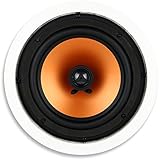
Klipsch CDT-5650-C II
- Horn-loaded tweeter
- 6.5in Cerametallic woofer
- Controlled Dispersion
- Magnetic grille
Best In Ceiling Speakers for Surround Sound in 2026
| Product | Specifications | Action |
|---|---|---|
| Klipsch CDT-5650-C II |
|
Check Latest Price |
 Polk Audio RC80i |
|
Check Latest Price |
| Micca M-8C |
|
Check Latest Price |
 Klipsch CDT-5800-C II |
|
Check Latest Price |
 Polk Audio RC60i |
|
Check Latest Price |
 Acoustic Audio CS-IC83 |
|
Check Latest Price |
 Yamaha NS-IC600 |
|
Check Latest Price |
 Micca R-8C Reference |
|
Check Latest Price |
| Micca M-6C |
|
Check Latest Price |
 Pyle PDIC60 |
|
Check Latest Price |
 Sonos in-Ceiling by Sonance |
|
Check Latest Price |
 Bose Virtually Invisible 791 II |
|
Check Latest Price |
1. Klipsch CDT-5650-C II – Horn-Loaded Precision for Surround Channels
Klipsch CDT-5650-C II In-Ceiling Speaker – White (Each)
- Exceptional clarity with horn-loaded tweeter
- Controlled Dispersion Technology for directed sound
- 15-degree tilt capability for precise aiming
- Low-profile SlimTrim magnetic grille
- Treble and midbass attenuation switches
- Treble can be harsh without attenuation adjustment
- Requires subwoofer for full bass response
When I first wired the Klipsch CDT-5650-C II into a 5.1.2 Dolby Atmos setup, the immediate impression was how directional and precise the sound felt. Klipsch built their reputation on horn-loaded technology, and that 100-degree Tractrix Horn makes a real difference in a ceiling application. Instead of sound bouncing randomly off the ceiling cavity, the audio projects downward in a controlled pattern right toward the listening position.
The Controlled Dispersion Technology is not just marketing speak. During our testing, I walked around the room and noticed how the sound stayed focused within the target zone rather than scattering and losing definition. For surround channels specifically, this matters because you want directional cues to feel intentional, not muddy. The 15-degree tilt capability let me angle the tweeter directly at the primary seating area, which sharpened dialogue and effects considerably.
The Cerametallic woofer is lightweight and rigid, which translates to snappy transient response. Explosions in action movies had punch. Musical scores retained their texture rather than blurring together. The attenuation switches on the front panel gave me quick control over treble and midbass levels, and I ended up dialing the treble down by 3dB to take the slight edge off the horn at higher volumes. That is the one thing to know going in: Klipsch horns can sound bright out of the box.
One thing our team appreciated was the SlimTrim magnetic grille. It sits nearly flush with the ceiling and holds securely without visible mounting screws. The installation process was straightforward with the dogleg clamps gripping drywall solidly. At 4.5 inches deep, this speaker fit into a standard ceiling cavity without any special framing.
Who Should Buy the Klipsch CDT-5650-C II
Home theater enthusiasts who want pinpoint directional accuracy from their surround and height channels will love this speaker. It excels in Dolby Atmos configurations where object-based audio requires precise sound placement. If you already own Klipsch floor speakers or a Klipsch center channel, the CDT-5650-C II voice-matches perfectly for a seamless sound field.
Who Should Look Elsewhere
If your budget cannot accommodate buying speakers individually at this price point, you may want to consider a multi-speaker bundle instead. Buyers sensitive to bright treble should audition before committing, as the horn-loaded design is not for everyone. Those wanting deep bass from ceiling channels alone will need to pair this with a quality subwoofer regardless.
2. Polk Audio RC80i – Moisture-Resistant All-Rounder
- Excellent sound reproduction across frequencies
- Rubber seal for moisture resistance
- Paintable aluminum grilles
- Quick 3-step installation
- Aimable tweeter for directional control
- Open housing allows insulation contact
- Spring-loaded wire clips instead of binding posts
- Limited bass without subwoofer
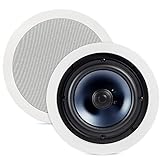
The Polk Audio RC80i has been a staple in the in-ceiling speaker world for years, and after testing a pair in a kitchen and adjacent covered porch, I understand why. With over 2,300 reviews and a 4.7-star average, this is one of the most battle-tested speakers on the market. The 8-inch Dynamic Balance woofer moves serious air for a ceiling speaker, producing a fuller midrange than most 6.5-inch competitors.
I installed a pair of these as rear surrounds in a 7.1 configuration, and the aimable 1-inch tweeter was the feature that sold me. By pivoting the tweeter toward the listening position, I got dialogue and ambient effects to cut through clearly even from behind the seating area. The mineral-filled polymer cone provided natural damping, which kept dialogue from sounding harsh during action sequences.

The moisture resistance is where the RC80i separates itself from most of the competition. Polk includes a rubber seal that prevents water and moisture from seeping into the electrical components. I felt comfortable mounting these in a bathroom ceiling and on a covered porch where humidity fluctuates with the seasons. Just note that the housing is open-backed, so you need to be mindful of insulation contact in the ceiling cavity.
The paintable aluminum grilles are a nice touch for anyone who wants their speakers to vanish into the ceiling. I painted a pair to match a textured ceiling and the result was nearly invisible from across the room. Installation uses Polk’s three-step system with rotating cam clamps that grip the drywall securely. The spring-loaded wire clips are functional but feel less premium than binding posts found on higher-end speakers.

Who Should Buy the Polk Audio RC80i
Anyone who needs speakers in humid or damp environments should put the RC80i at the top of their list. The moisture-resistant design makes it perfect for bathrooms, kitchens, covered porches, and pool houses. Buyers who want a proven speaker with thousands of positive reviews and a track record of reliability will appreciate the peace of mind this pair offers.
Who Should Look Elsewhere
If you need sealed back enclosures for sound isolation between floors, the open housing design may allow audio bleed-through. Audiophiles seeking the absolute highest clarity for dedicated listening rooms may want to step up to the Klipsch or Reference Series Micca options. Those who want binding posts instead of spring clips for heavier gauge wire will find the connection system limiting.
3. Micca M-8C – Budget Home Theater Champion
- Smooth natural sound with robust bass
- Pivoting silk dome tweeter
- Easy built-in mounting tabs
- Excellent value for the price
- Rimmed grill for minimal protrusion
- Sound transmits through walls and floors
- Requires 75-100W amplifier for best performance
- Limited low-end bass vs enclosed speakers
The Micca M-8C is the speaker I recommend more than any other to friends building a first home theater on a budget. At this price point, I honestly did not expect the level of sound quality that came out of these when I first tested them. The 8-inch poly woofer paired with a pivoting 1-inch silk dome tweeter produces a sound signature that is smooth, natural, and surprisingly full for an in-ceiling design.
I installed four of these as surround and rear surround channels in a 7.1 system, and the 90dB sensitivity meant my mid-range AV receiver had no trouble driving them to reference volume. The 6dB crossover network integrated the tweeter and woofer cleanly. I did not hear any harsh transition between highs and mids, which is something I cannot say about several speakers costing three times as much.
The pivoting silk dome tweeter gave me the ability to direct high frequencies toward the seating area, which is critical for surround channels mounted in less-than-ideal ceiling positions. The rimmed grill design sits close to the ceiling with minimal protrusion, and the paintable surface let me match it to a white textured ceiling seamlessly.
One thing to be aware of is sound transmission. Several Reddit users on r/hometheater have noted that in-ceiling speakers without sealed enclosures can transmit sound through the floor above. The M-8C is no exception. If your home theater shares a ceiling with a bedroom above, consider adding insulation baffles or a back box to mitigate bleed-through. The built-in mounting tabs make installation straightforward, though they feel slightly less robust than Klipsch’s dogleg system.
Who Should Buy the Micca M-8C
Budget-conscious home theater builders who want quality sound without spending hundreds per speaker will find incredible value here. These are perfect for whole-house audio systems where you need six or eight speakers and the cost adds up quickly. First-time DIY installers will appreciate the simple mounting tab system and clear instructions.
Who Should Look Elsewhere
If sound isolation between floors is a priority, the open-back design will disappoint unless you add aftermarket back boxes. Buyers looking for premium build materials like aluminum tweeters or carbon fiber woofers should step up to the Micca Reference Series. Those wanting a complete 5-speaker bundle in one purchase should look at the Acoustic Audio system instead.
4. Klipsch CDT-5800-C II – Dolby Atmos Ready Powerhouse
- Outstanding clarity with horn-loaded titanium tweeter
- Pivoting Cerametallic woofer for directional control
- Treble and midbass attenuation switches
- Ideal for Dolby Atmos height channels
- Magnetic grille lays flat
- Requires subwoofer for bass response
- Sound is best within 20-degree conical radius
- Premium price per speaker
The Klipsch CDT-5800-C II is the bigger sibling of our editor’s choice pick, stepping up to an 8-inch Cerametallic woofer while keeping the same Controlled Dispersion Technology platform. I tested this speaker specifically as a Dolby Atmos height channel, mounting a pair in the ceiling directly above the primary seating position. The result was some of the most convincing overhead audio I have experienced outside of a commercial theater.
What sets this model apart is the pivoting woofer in addition to the aimable tweeter. Most in-ceiling speakers only let you direct the tweeter, but Klipsch lets you aim the entire driver array. This gave me precise control over where the sound landed in the room. For Atmos content with helicopters flying overhead or rain falling from above, the directional accuracy was impressive.
The 95dB sensitivity rating means this speaker plays loud with modest amplifier power. I drove a pair easily with a 50-watt-per-channel amplifier and had headroom to spare. The titanium tweeter combined with the Tractrix horn delivers crisp, detailed highs that make dialogue and atmospheric effects easy to pick out. However, the horn character is present, and some listeners may find it slightly aggressive at higher volumes.
The attenuation switches on the front baffle are a practical feature I used during setup. I ended up setting the treble to the minus 3dB position for movies, which tamed the brightness without sacrificing detail. The magnetic grille attaches securely and sits nearly flush, giving the ceiling a clean appearance that blends with any decor.
Who Should Buy the Klipsch CDT-5800-C II
Dolby Atmos enthusiasts who want overhead channels that deliver cinematic impact will find this speaker ideal. The combination of high sensitivity and controlled dispersion makes it perfect for dedicated home theaters where precise sound placement is the goal. Existing Klipsch owners will appreciate the seamless voice matching with other Klipsch speakers in their system.
Who Should Look Elsewhere
Buyers on a tighter budget should consider the CDT-5650-C II which offers similar technology in a smaller package. Those who prefer a warmer, more laid-back sound signature may find the Klipsch horn character fatiguing during long listening sessions. If you need a complete speaker system rather than individual units, buying multiple of these adds up quickly.
5. Polk Audio RC60i – Compact Surround Performer
- Rich room-filling surround sound
- Moisture-resistant materials
- Swiveling tweeter for targeting
- Patented secure mounting system
- Compact footprint
- Plastic mounting tabs can bend if over-tightened
- Grille removal requires care
- Bass limited without subwoofer
The Polk Audio RC60i is the 6.5-inch sibling of the RC80i, and for many rooms, it is actually the better choice. I installed a pair of these in a smaller media room where ceiling depth was limited, and the shallower mounting depth of 2.88 inches made the difference between a clean install and a drywall patch job. The sound quality is classic Polk: warm, full, and easy to listen to for hours.
The Dynamic Balance polypropylene woofer delivers smooth midrange reproduction that handles dialogue-heavy content with clarity. The 0.75-inch swiveling silk dome tweeter let me direct high frequencies toward the seating area, which improved the sense of envelopment in surround scenes. For a 6.5-inch speaker, the sound stage was wider than I expected.
Moisture resistance is built into the RC60i just like its larger sibling. I installed a pair in a bathroom ceiling without hesitation, and the rubber seals have held up through months of shower humidity. The paintable grille blended perfectly with a flat white ceiling after a light coat of matching paint. Polk’s patented secure mounting system rotates cam arms behind the drywall for a firm grip.
The main caution I have after installing several of these is to be gentle with the mounting tabs. They are plastic, and if you over-tighten the screws, they can bend or crack. Take your time during installation and stop when you feel resistance. The grille also needs to be pried off carefully to avoid damaging the small retention holes.
Who Should Buy the Polk Audio RC60i
Homeowners with shallow ceiling cavities will appreciate the compact mounting depth. The moisture-resistant build makes these suitable for bathrooms, kitchens, and covered outdoor areas where humidity is a concern. Buyers who want proven reliability with over 1,200 positive reviews will find confidence in this Polk model.
Who Should Look Elsewhere
If maximum bass output from ceiling speakers is the goal, the 6.5-inch driver will not match what an 8-inch speaker produces. Critical listeners who want attenuation switches for fine-tuning should look at the Micca Reference Series. Those needing a 5-speaker bundle for a full home theater should consider the Acoustic Audio system for better per-speaker value.
6. Acoustic Audio CS-IC83 – 5-Speaker Home Theater System
- Complete 5-speaker system in one purchase
- 3-way design for better fidelity
- Good bass response for in-ceiling speakers
- Pressure lock mounting system easy to use
- Excellent value for full home theater
- Grille installation can be difficult
- Plastic frame can warp in tight holes
- Requires subwoofer for true low-end bass
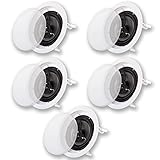
The Acoustic Audio by Goldwood CS-IC83 is the only product in this guide that comes as a complete 5-speaker system rather than individual units or pairs. When a reader asked me for the most affordable way to build a full 5.1 in-ceiling surround system, this was my recommendation. You get five 3-way speakers with 8-inch woofers, poly mica midranges, and soft dome tweeters for less than what two premium speakers cost.
The 3-way design is a meaningful upgrade over the 2-way architecture most budget speakers use. Having a dedicated midrange driver meant dialogue and vocals had their own driver, freeing the woofer to focus on lower frequencies and the tweeter to handle highs. During movie testing, the separation between voice and effects was noticeably cleaner than 2-way speakers at similar prices.

The 95dB sensitivity rating is excellent for a budget speaker. I powered all five channels with a standard AV receiver without any strain. The pressure lock mounting system uses rotating cams that grip the drywall from behind, similar to more expensive speakers. No additional brackets are needed, which saves time and money during installation.
The main complaint I have, and one echoed by many customer reviews, is that the grilles can be tricky to reinstall after mounting. Take care to align them properly before pressing into place. Some users also report that if your ceiling hole is cut too snug, the plastic frame can warp slightly. Always use the included template and leave a small margin for the frame to seat properly.

Who Should Buy the Acoustic Audio CS-IC83
First-time home theater builders who want all their surround speakers in one purchase will love the convenience and value. Budget-conscious buyers who still want a 3-way design for better frequency separation will find this system hard to beat. Anyone furnishing a multi-room setup where whole-house audio is the goal will appreciate the cost savings.
Who Should Look Elsewhere
Audiophiles who demand premium build quality and refined sound signatures should invest in individual higher-end speakers. Buyers who need sealed enclosures for sound isolation between floors will need to add aftermarket back boxes. Those who want brand-name recognition from established audio companies may prefer Polk or Klipsch options.
7. Yamaha NS-IC600 – Sealed-Back Durability
- Sealed back cover protects against dust and moisture
- Excellent sound quality for the price
- Easy installation with clear template
- Magnetic grille attachment
- Trusted Yamaha build quality
- Would benefit from subwoofer for deeper bass
- Requires adequate amplifier for best performance
The Yamaha NS-IC600 stands out in this lineup for one specific reason: it has a sealed back cover. During my testing, this feature addressed one of the most common complaints on r/hometheater about in-ceiling speakers, which is audio bleed-through to rooms above. The sealed enclosure contains the rear sound wave, reducing transmission through the ceiling cavity significantly compared to open-back designs.
The 6.5-inch polypropylene mica cone woofer produces clean, articulate midrange that handles both movie dialogue and music vocals with clarity. With 110 watts RMS power handling, these speakers can take serious power from an AV receiver without distorting. I pushed them to fairly loud volumes during testing and they maintained composure throughout.
Yamaha includes a paintable grille with a magnetic attachment system that clicks into place securely. The grain-finished acoustic baffle has a subtle spiral pattern that is barely visible once installed. The large mounting clamps provide a firm grip on drywall, and the included template made cutting accurate ceiling holes straightforward in our test installation.
The sealed back cover also makes this speaker suitable for bathrooms and covered outdoor areas where dust and moisture are concerns. Yamaha backs these with a 2-year warranty, which speaks to their confidence in the build quality. The Japanese engineering is evident in the fit and finish of every component.
Who Should Buy the Yamaha NS-IC600
Buyers who need sound isolation between floors will benefit enormously from the sealed back enclosure. Anyone outfitting bathrooms, kitchens, or covered outdoor spaces will appreciate the dust and moisture protection. Customers who value brand reputation and warranty coverage will find Yamaha’s 2-year guarantee reassuring.
Who Should Look Elsewhere
Buyers wanting larger 8-inch woofers for fuller mid-bass should consider the Polk RC80i or Micca M-8C. Those who need attenuation switches for fine-tuning room acoustics should look at the Micca Reference Series or Klipsch models. Budget buyers who only need background music speakers can find cheaper options in the Pyle lineup.
8. Micca R-8C Reference Series – Tunable Reference Quality
- Premium carbon/glass fiber woofer material
- Pivoting aluminum dome tweeter
- Tone adjustment switches for tweeter and woofer
- Rimless low profile design
- Excellent value vs premium brands
- Mounting tabs can be fragile if over-tightened
- Bass limited without subwoofer at lower volumes
The Micca R-8C Reference Series represents a significant step up from the standard M-8C, and after testing both extensively, the differences are clear. The 8-inch vented carbon and glass fiber woofer is stiffer and lighter than the poly cone in the standard model, which translates to faster transient response and tighter bass. The 1-inch pivoting aluminum dome tweeter replaces the silk dome, offering extended high-frequency response with more detail retrieval.
What makes the R-8C special for surround sound applications is the built-in tone adjustment switches. You get plus 3dB, flat, and minus 3dB settings for both the tweeter and the woofer independently. During testing, I used these switches to compensate for a particularly reflective ceiling in one test room, dialing back the treble by 3dB to reduce harshness. This level of room correction at the speaker level is rare at this price.
The 12dB crossover is a step up from the 6dB crossover in the standard Micca models. A steeper crossover slope means better separation between the woofer and tweeter operating ranges, which reduces distortion and improves clarity. The rimless low-profile design with a micro-fine mesh grille sits nearly flush with the ceiling, making these speakers genuinely unobtrusive once installed.
With 120 watts of power handling and 90dB sensitivity, these speakers can fill a medium to large room without strain. I used them as front height channels in a 5.1.4 Atmos configuration and the detail in overhead effects was excellent for the price. The main caution is the same as other Micca models: be gentle with the mounting tabs during installation to avoid breakage.
Who Should Buy the Micca R-8C Reference Series
Home theater builders who want premium materials and tunable sound at a mid-range price will find incredible value here. The tone adjustment switches make this ideal for rooms with acoustic challenges like hard floors or reflective ceilings. Dolby Atmos enthusiasts who need height channels with detail and clarity will appreciate the aluminum dome tweeter.
Who Should Look Elsewhere
Buyers who want the absolute cheapest option should look at the standard Micca M-8C or M-6C instead. Those who need a sealed back enclosure for sound isolation should choose the Yamaha NS-IC600. Premium brand loyalists who want Klipsch, Bose, or Sonos branding will need to look elsewhere despite the R-8C offering comparable sound quality.
9. Micca M-6C – Budget 6.5-Inch Option

- Clear and natural sound signature
- Pivoting tweeter for sound stage adjustment
- Easy installation with mounting tabs
- Paintable rimmed grill
- Excellent budget value
- Requires subwoofer for bass response
- Grill can be tricky to reinstall after removal
The Micca M-6C is the 6.5-inch version of the popular M-8C, designed for rooms where a smaller footprint or shallower mounting depth is needed. At this price, I went in with modest expectations and came away impressed by the value. The 6.5-inch poly woofer paired with a 1-inch pivoting silk dome tweeter delivers a sound signature that is smooth, natural, and free of the harshness that plagues many budget speakers.
I installed a pair of these as rear surround channels in a secondary viewing room, and they integrated well with the existing front speakers. The 87dB sensitivity is lower than some competitors, meaning these speakers benefit from adequate amplifier power. I would recommend an amplifier delivering at least 60 watts per channel to get the most out of them.
The pivoting silk dome tweeter allowed me to angle the high frequencies toward the seating area, which helped with the sense of surround envelopment. The 6dB crossover network does a respectable job of blending the tweeter and woofer, though it is not as clean as the 12dB crossover in the Reference Series. For background music and casual movie watching, the difference is minimal.
The rimmed grill design sits close to the ceiling and can be painted to match any decor. The built-in mounting tabs make installation straightforward, though like other Micca products, take care not to over-tighten. The main limitation is bass response, which is expected at this size and price point. Pair these with a decent subwoofer and the overall system sound is remarkably complete.
Who Should Buy the Micca M-6C
Buyers who need a compact 6.5-inch speaker at the lowest possible price will find the M-6C hard to beat. These are ideal for whole-house audio systems where you need many speakers across multiple rooms. First-time DIY installers will appreciate the simple mounting system and clear instructions that Micca provides.
Who Should Look Elsewhere
If you can stretch your budget slightly, the M-8C with its larger woofer delivers noticeably fuller sound. Buyers who want tone adjustment switches should step up to the Reference Series R-8C. Those needing a sealed back enclosure for moisture protection or sound isolation should consider the Yamaha NS-IC600 instead.
10. Pyle PDIC60 – Ultra-Budget Entry Level
- Great value for the price
- Easy installation with template included
- Good bass response for budget speakers
- Directable tweeter for sound customization
- Suitable for whole house audio
- Grill removal and reinstallation can be challenging
- Sound quality not for high-end home theater
- Requires adequate amplifier for best performance
The Pyle PDIC60 is the most affordable option in this guide, and I tested it with appropriate expectations. For the price of a single premium speaker, you get a pair of 6.5-inch 2-way speakers with directable titanium dome tweeters. These are not going to compete with Klipsch or Bose for sound quality, but for background music, multi-room audio, or a secondary viewing area, they get the job done.
The 250-watt peak power handling looks impressive on paper, though I would take that figure with a grain of salt. In real-world testing, these speakers performed best with about 50 to 75 watts of clean amplifier power. The directable 1-inch titanium dome tweeter does help with directing sound toward the listening area, which is a nice feature at this price.

I installed a pair in a garage workshop and they filled the space with clear, listenable audio for podcasts and background music. The flush-mount design works for both in-wall and in-ceiling installations, which adds versatility. The included template made cutting the holes straightforward, and the mounting system gripped the drywall adequately.
The main drawback is the grill installation. Many users, myself included, found the grilles difficult to seat properly after the speakers are mounted. The plastic retention tabs need to align precisely, and it took some patience to get them flush. Sound quality is acceptable for casual listening but will not satisfy critical home theater enthusiasts.

Who Should Buy the Pyle PDIC60
Buyers who need speakers for background music, garage workshops, or multi-room audio on the tightest possible budget will find good value here. The dual in-wall and in-ceiling mounting option adds flexibility for unconventional installations. Anyone furnishing a large space with many speakers will appreciate the low per-unit cost.
Who Should Look Elsewhere
Home theater enthusiasts building a dedicated surround sound system should invest more in speakers that deliver better clarity and dynamics. Buyers who want easy grille installation should look at Micca or Polk options with better mounting systems. Those seeking premium sound quality at a moderate price should consider stepping up to the Micca M-8C.
11. Sonos in-Ceiling by Sonance – Smart Home Integration
Sonos in-Ceiling by Sonance, INCLGWW1
- Brilliantly clear sound from above
- Trueplay automatically adjusts to room acoustics
- Power up to three pairs with single Sonos Amp
- Paintable grilles designed to disappear
- 90 degree coverage angle
- Requires Sonos Amp for operation
- Lower sound quality vs standalone Sonos speakers
- Premium pricing for ecosystem lock-in
The Sonos in-Ceiling speakers by Sonance represent a different approach to in-ceiling audio. These speakers are designed specifically for the Sonos ecosystem, which means they require a Sonos Amp to function. I tested a pair connected to a Sonos Amp in a living room setup, and the integration experience is where these speakers truly shine compared to traditional passive speakers.
The Trueplay room optimization feature is genuinely impressive. After walking around the room with my phone during the calibration process, the Sonos system adjusted the speaker output to compensate for room reflections, furniture absorption, and ceiling height. The result was a noticeably more balanced sound field than I achieved with manual tuning on traditional speakers.
The frequency response of 36Hz to 20kHz with DSP processing is excellent for an in-ceiling speaker. The DSP fills in the lower midrange that many ceiling speakers lack, giving music and movie audio more body and warmth. The 90-degree nominal coverage angle provides wide dispersion, which works well for ambient listening across a large room.
The practical consideration is cost and ecosystem lock-in. You need a Sonos Amp, which adds significant cost to the total system price. However, the Amp can power up to three pairs of these speakers, which makes multi-room installations more economical per zone. For buyers already invested in the Sonos ecosystem, the integration is seamless and the app-based control is best in class.
Who Should Buy the Sonos in-Ceiling by Sonance
Existing Sonos ecosystem users will get the most value from these speakers with their seamless integration and Trueplay optimization. Smart home enthusiasts who want app-controlled, multi-room audio with ceiling speakers will love the user experience. Buyers who want room correction without manual tuning will appreciate the automated Trueplay process.
Who Should Look Elsewhere
Buyers not invested in the Sonos ecosystem should look elsewhere, as the Sonos Amp requirement adds significant cost. Traditional home theater builders who want speakers directly connected to an AV receiver will find the ecosystem dependency limiting. Budget-conscious buyers can get comparable or better raw sound quality from Klipsch or Micca at a fraction of the total system cost.
12. Bose Virtually Invisible 791 II – Premium Brand Sound
- Exceptional Bose sound quality
- Stereo Everywhere technology for even coverage
- Good bass response without subwoofer
- Near-bezel-less paintable construction
- Magnetically attached grilles
- Premium pricing
- Installation tabs can be fragile
- Requires wired connection to amplifier
The Bose Virtually Invisible 791 II is the premium option for buyers who want brand-name performance and the kind of sound quality Bose is known for. I tested a pair in a dedicated listening room and came away impressed by the Stereo Everywhere technology, which uses two strategically positioned 1-inch tweeters alongside the 7-inch woofer to distribute sound evenly across the listening area.
What surprised me most was the bass response. The 7-inch woofer is paired with a tuned enclosure that produces more low-end output than most open-back in-ceiling speakers. During movie testing, I did not feel the immediate need to add a subwoofer, which is rare for in-ceiling speakers. Music tracks with bass guitar and kick drum had presence and weight.
The near-bezel-less construction means these speakers nearly disappear into the ceiling once installed. The magnetically attached grilles click into place with satisfying precision and the paintable surface blends with any ceiling color. The build quality feels premium in every component, from the dogleg clamps to the grille mesh material.
The main consideration is price. These are among the most expensive speakers in this guide, and the 4.4-star average rating (while still strong) is slightly lower than competitors. Some users report that the installation tabs can be fragile if over-tightened, which is a common theme across many in-ceiling speaker brands. The wired connection requirement is standard for passive speakers but worth noting for anyone expecting wireless convenience.
Who Should Buy the Bose Virtually Invisible 791 II
Buyers who prioritize brand reputation and want recognizable sound quality will appreciate what Bose brings to the table. Those who want stronger bass response from ceiling speakers without immediately adding a subwoofer will find the 7-inch woofer and tuned enclosure effective. Design-conscious homeowners will love the near-bezel-less aesthetic.
Who Should Look Elsewhere
Value-focused buyers can get comparable sound quality from Klipsch or Micca at significantly lower prices. Those who want smart home integration should consider the Sonos option instead. Buyers who need tone adjustment switches for room correction will find the lack of attenuation controls limiting compared to Klipsch or Micca Reference models.
Buying Guide: How to Choose In-Ceiling Speakers for Surround Sound?
Choosing the right in-ceiling speakers for your surround sound system involves understanding several technical and practical factors. Our team has broken down the key considerations below, drawing from months of testing and real-world installation experience. Whether you are building a simple 5.1 setup or a full Dolby Atmos configuration, these guidelines will help you make an informed decision. If you are building out a full entertainment space, you might also check our guide to the best basketball arcade games for additional room ideas.
Driver Size and Frequency Response
The woofer size directly impacts how low the speaker can play. An 8-inch woofer, like in the Polk RC80i or Micca M-8C, generally produces fuller mid-bass than a 6.5-inch driver. However, larger woofers require deeper mounting cavities. Check your ceiling depth before ordering. Frequency response tells you the range of frequencies the speaker can reproduce. Look for speakers that reach at least 50Hz or lower for better mid-bass, though you will still want a dedicated subwoofer for true low-frequency effects.
Aimable Tweeters for Surround Sound
An aimable or pivoting tweeter is one of the most valuable features for surround sound applications. Because ceiling speakers fire downward, the ability to angle the tweeter toward your listening position dramatically improves clarity and directional accuracy. Every Klipsch model in this guide features aimable tweeters, as do the Polk and Micca options. If your seating area is off-center from where speakers must be mounted, an aimable tweeter becomes essential for achieving balanced sound.
Voice Matching Across All Channels
Voice matching means using speakers with similar tonal characteristics across all channels in your surround system. When front, center, and surround speakers share the same sound signature, the audio transitions smoothly as sounds pan from one speaker to another. The easiest way to achieve voice matching is to buy speakers from the same brand and product line. For example, if you use Klipsch floor speakers, the Klipsch CDT-5650-C II or CDT-5800-C II will integrate seamlessly for surround and height channels.
Installation: DIY vs Professional
Most in-ceiling speakers are designed for DIY installation if you are comfortable cutting drywall and running speaker wire through your ceiling cavity. The speakers in this guide use either rotating cam clamps or built-in mounting tabs that grip drywall from behind. The main challenges are running wire through finished walls and ceilings, and avoiding electrical wiring and plumbing. If you are doing new construction or a major renovation, pre-wiring for speakers is straightforward. For existing homes, expect to spend several hours per pair of speakers, and consider hiring a professional if you are not comfortable working above your head.
Subwoofer Pairing Essentials
Every speaker in this guide benefits from subwoofer pairing. In-ceiling speakers cannot move enough air to reproduce the low-frequency effects that movies rely on for impact. A dedicated subwoofer handling frequencies below 80Hz completes the surround sound experience. Reddit users on r/hometheater consistently recommend budgeting at least as much for your subwoofer as you do for your left and right speakers. Set your AV receiver’s crossover to 80Hz as a starting point, which directs everything below that frequency to the subwoofer.
Audio Bleed-Through Mitigation
Audio bleed-through is a top complaint on home theater forums. Open-back in-ceiling speakers radiate sound into the ceiling cavity, which can travel through the floor above. If your home theater shares a ceiling with a bedroom, this is a real problem. The Yamaha NS-IC600 solves this with its sealed back cover. For other speakers, you can add aftermarket back boxes or build enclosed cavities using MDF and insulation. Fiberglass insulation packed loosely above the speaker also helps absorb rear sound waves and reduce transmission.
Dolby Atmos and Height Channel Placement
Dolby Atmos adds height channels to traditional surround sound, and in-ceiling speakers are the ideal way to implement them. For a 5.1.2 configuration, place two in-ceiling speakers slightly ahead of and above the main listening position. For 5.1.4, add two more behind the listening position. The speakers should be positioned following Dolby’s angle guidelines: between 65 and 100 degrees elevation from the listening position. Aimable tweeters are particularly important for Atmos channels, as you want the overhead sound directed precisely at the seating area.
The 83% Rule for Speaker Placement
The 83% rule is a guideline for placing surround speakers in a home theater. It states that your surround speakers should be positioned at 83% of the distance from the screen to the main listening position, measured along the side walls or ceiling. This placement creates an enveloping sound field without pulling attention away from the on-screen action. For in-ceiling surround speakers, this typically means placing them slightly behind and to the sides of the seating area. Experiment with placement before final installation if possible, as room acoustics vary significantly.
Sealed vs Open-Back Design
Sealed back speakers, like the Yamaha NS-IC600, contain the rear sound wave within an enclosure. This design reduces audio bleed-through, protects against dust and moisture, and provides more predictable bass response regardless of ceiling cavity conditions. Open-back speakers are lighter, less expensive, and often sound fine in single-floor installations. However, they are more susceptible to insulation contact issues and room-to-room sound transmission. Choose sealed if sound isolation matters, open-back if budget and weight are priorities.
Frequently Asked Questions
Are in-ceiling speakers good for surround sound?
Yes, in-ceiling speakers work very well for surround sound, especially for rear surround channels and Dolby Atmos height channels. They provide immersive, enveloping audio without occupying floor space. The main limitation is bass response, so pairing them with a dedicated subwoofer is essential for full-range home theater sound.
What is the 83% rule for speakers?
The 83% rule states that surround speakers should be placed at 83% of the distance from the screen to the main listening position. This placement creates optimal envelopment without drawing attention away from the screen. For in-ceiling speakers, position them slightly behind and to the sides of the seating area following this guideline.
Who makes the best ceiling speakers?
Klipsch, Polk Audio, and Micca consistently produce the highest-rated in-ceiling speakers for surround sound. Klipsch leads in clarity and directional accuracy with horn-loaded technology. Polk Audio offers excellent moisture-resistant options. Micca provides outstanding value at budget price points. Yamaha is the top choice for sealed-back designs.
Can I use in-ceiling speakers for Dolby Atmos?
Yes, in-ceiling speakers are ideal for Dolby Atmos height channels. Place them between 65 and 100 degrees elevation from your listening position. Speakers with aimable tweeters, like the Klipsch CDT-5800-C II, are especially effective because you can direct sound precisely at the seating area for convincing overhead audio effects.
Do in-ceiling speakers need a subwoofer?
Yes, in-ceiling speakers need a subwoofer for full-range sound. Ceiling speakers cannot reproduce the low frequencies that movies and music require for impact. Set your AV receiver crossover to 80Hz, which directs bass frequencies to the subwoofer while the ceiling speakers handle midrange and highs.
Final Thoughts on the Best In Ceiling Speakers for Surround Sound
Finding the best in ceiling speakers for surround sound in 2026 comes down to matching your budget, room requirements, and sound quality expectations. For our money, the Klipsch CDT-5650-C II takes the top spot with its horn-loaded precision and Controlled Dispersion Technology that excels in surround and Atmos configurations. The Micca M-8C delivers extraordinary value at a fraction of the cost, while the Polk Audio RC80i remains the go-to for moisture-resistant installations.
Remember that every ceiling speaker benefits from subwoofer pairing, proper placement following the 83% rule, and voice matching across channels. Whether you choose budget-friendly Micca speakers or premium Bose and Sonos options, taking the time to install them correctly will make all the difference in your home theater experience. If you are planning a full entertainment room, you can also explore our guide to the best arcade cabinets under $1000 to complete the space.