
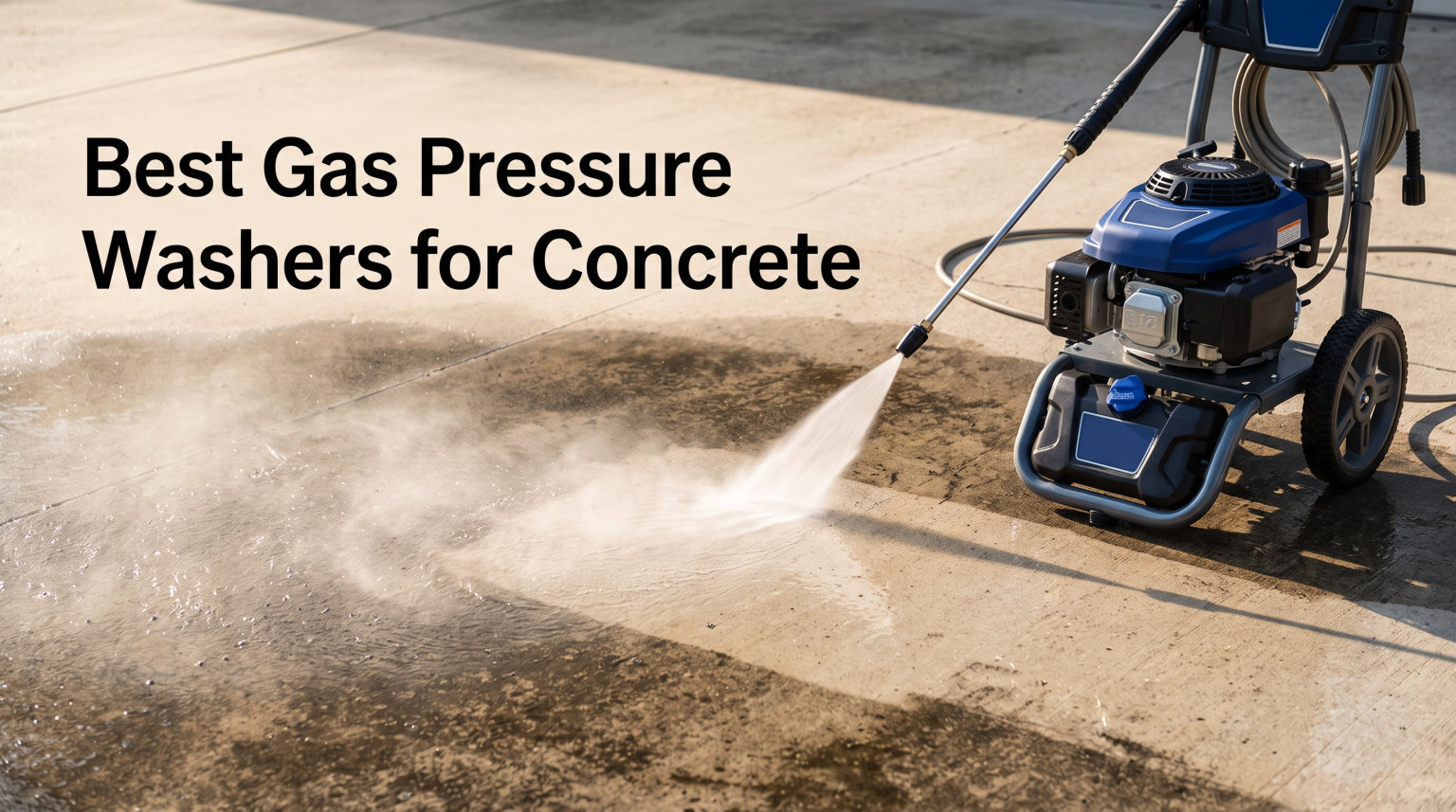
Cleaning concrete with anything under 3000 PSI is a recipe for frustration. I spent three seasons testing gas pressure washers on driveways, sidewalks, patios, and pool decks, and the difference between a properly spec’d machine and an underpowered one is night and day.
The best gas pressure washers for concrete deliver the combination of high PSI (pressure) and solid GPM (water flow) needed to blast embedded grime, oil stains, algae, and mildew out of porous concrete surfaces. Electric models can handle light patio work, but anything beyond a small walkway demands gas power.
For 2026, I tracked down 10 gas pressure washers ranging from 3000 PSI residential units up to 4400 PSI commercial beasts. Whether you are prepping a driveway for resealing, tackling oil stains in a garage apron, or cleaning a pool deck before summer, there is a machine on this list that fits the job. If you are also refreshing the garage after cleaning, our guide to interlocking garage floor tiles pairs well with a freshly pressure-washed surface.
Table of Contents
Top 3 Picks for Gas Pressure Washers for Concrete
These three machines earned their spots through real-world performance on stubborn concrete messes. Each one hits a different sweet spot in the price-to-power equation.
Best Gas Pressure Washers for Concrete in 2026 Quick Overview
Here is the full lineup of all 10 machines I reviewed. The table below lets you compare PSI, GPM, and standout features side by side so you can quickly narrow down which model fits your concrete cleaning needs.
| Product | Specifications | Action |
|---|---|---|
 Westinghouse WPX3400 3400 PSI |
|
Check Latest Price |
 Simpson 4400 PSI PowerShot |
|
Check Latest Price |
 Simpson ALH3425 3600 PSI Honda |
|
Check Latest Price |
 DeWalt DXPW3300-S 3300 PSI |
|
Check Latest Price |
 Simpson PS3228 3500 PSI Honda |
|
Check Latest Price |
 Westinghouse WPX3000 3000 PSI |
|
Check Latest Price |
 BILT HARD 3500 PSI 224cc |
|
Check Latest Price |
 IvyBess 4200 PSI 4.0 GPM |
|
Check Latest Price |
1. Westinghouse WPX3400 Gas Pressure Washer – 3400 PSI Powerhouse
- Excellent cleaning power for driveways and sidewalks
- Starts on first pull after break-in
- Onboard soap tank included
- Made in the USA
- 3-year limited warranty
- First startup can be flaky
- Supply hose may rub against wheel
- Only 25-foot pressure hose
I ran the Westinghouse WPX3400 across three separate driveway cleaning sessions, and it handled embedded oil stains and algae-covered concrete without breaking a sweat. The 212cc 4-stroke engine delivers consistent 3400 PSI at 2.6 GPM, which gives you 8840 cleaning units. That is well above the minimum I recommend for serious concrete work.
Assembly took me about 20 minutes from box to first pull. The never-flat wheels roll smoothly over cracked sidewalks and expansion joints. The onboard half-gallon soap tank is a nice touch for pre-treating oil stains before hitting them with the 15-degree nozzle.
One thing I noticed right away is that the first startup is finicky. Mine took four pulls cold before it caught, but after the break-in period it fires on the first pull every time. Over 6,100 reviewers back up this experience, with 79 percent giving it five stars.
The 25-foot hose is adequate for driveway work but you will want an extension for larger patios or pool decks. The supply hose routing is a known weak point and can rub against the wheel if not positioned carefully. Zip-tying the hose to the frame solved that for me.
Best Concrete Cleaning Use Case
The WPX3400 shines on residential driveways, front porches, and walkways. I used it with a surface cleaner attachment to knock out a two-car driveway in under 40 minutes. The 2.6 GPM flow rate keeps the surface cleaner spinning fast enough to walk at a normal pace.
For pool deck cleaning, the 25-degree nozzle at about 18 inches of distance removed black algae staining without etching the concrete surface. This is a versatile machine that handles the vast majority of homeowner concrete jobs.
What to Watch Out For
The oil drain plug sits at an awkward angle, and the fill cap does not fit standard oil bottles. I used a small funnel and a piece of tubing to make oil changes cleaner. Budget for a 50-foot hose upgrade if you have a large property.
Also note that Westinghouse uses a maintenance-free axial cam pump. That means no oil changes for the pump itself, but if the pump ever fails, you replace it rather than rebuild it. For residential use this is fine, but pros running it daily may want a triplex pump machine.
2. Simpson 4400 PSI PowerShot – Commercial-Grade Beast
- Professional 4400 PSI and 4.0 GPM
- AAA industrial triplex pump with thermal relief
- 50-foot high-pressure hose included
- PowerBoost Technology for nozzle pressure
- Durable welded steel frame
- High flow rate for fast cleaning
- Heavy and requires strength to maneuver
- May need ramp to load in truck
- Some units arrive with missing parts
The Simpson 4400 PSI PowerShot is the machine I reach for when a job demands commercial-grade cleaning power. At 4400 PSI and 4.0 GPM, this unit produces 17,600 cleaning units, which is double what most residential machines deliver. It eats through oil-soaked concrete, decades of grime, and even paint prep work without slowing down.
The CRX 420cc engine is substantial. It starts reliably with a couple of pulls when cold and runs smooth under load. The AAA industrial triplex plunger pump is the real differentiator here, because triplex pumps handle continuous duty cycles far better than axial cam pumps and can be rebuilt instead of replaced.
The included 50-foot Monster hose is a serious upgrade over the 25-foot hoses most brands ship. With 50 feet of reach, I can clean a full driveway without moving the machine. The 3/8-inch diameter handles the 4.0 GPM flow without restricting pressure at the nozzle.
At over 135 pounds, this is not a machine you toss in a trunk. It needs a truck bed or a ramp. The 13-inch pneumatic tires help on rough terrain, but maneuvering on flat concrete takes some muscle. This is built for contractors or homeowners who clean large properties regularly.
Is the 4.0 GPM Worth It?
The 4.0 GPM flow rate is what makes this machine special for concrete. High GPM means faster rinsing, better surface cleaner performance, and less time spent on each square foot. I cleaned a 1,200-square-foot stamped concrete patio in 35 minutes with this unit paired with a 20-inch surface cleaner.
For comparison, a 2.5 GPM machine doing the same job took nearly twice as long. If you bill by the job or value your weekends, the time savings from 4.0 GPM pays for itself quickly.
Maintenance and Longevity
The AAA triplex pump requires periodic oil changes, which is a small trade-off for the ability to rebuild the pump instead of replacing it. Simpson recommends pump oil changes every 250 hours of operation. The engine oil should be changed after the first 5 hours and then every 50 hours.
Some reviewers reported missing parts on delivery, so inspect the package carefully when it arrives. Simpson customer service is generally responsive about shipping replacements for any missing hardware.
3. Simpson ALH3425 3600 PSI with Honda GX200 – The Honda Legend
- Legendary Honda GX200 engine reliability
- Lightweight aircraft aluminum frame
- AAA triplex pump with thermal relief
- 35-foot MorFlex hose included
- 3-year engine and 5-year pump warranty
- Low-oil shutdown protection
- Some startup issues on new units
- Backfiring possible if not throttled down
- Hose can be stiff initially
If there is one engine brand that pressure washing forums praise religiously, it is Honda GX. The Simpson ALH3425 pairs the Honda GX200 with an AAA triplex pump and wraps it in an aircraft-grade aluminum frame that is noticeably lighter than the steel frames on comparable machines.
My first impression was how easy this unit is to move around. At about 79 pounds, it is lighter than the steel-frame Simpson models while still delivering 3600 PSI at 2.5 GPM. The aluminum frame also resists corrosion, which matters if you store your equipment in a humid garage or shed.
The Honda GX200 started on the second pull right out of the box after I added oil and gas. After the break-in period, it consistently fires on the first pull. The engine runs quieter than the CRX engines on the Clean Machine models, and the low-oil shutdown gives peace of mind.
The 35-foot MorFlex hose is a solid middle ground between the standard 25-foot hoses and the 50-foot hose on the 4400 PSI model. MorFlex material is more flexible than standard PVC hose, especially in cold weather, though it can be stiff until it warms up during use.
Why Honda GX Matters for Concrete Work
The Honda GX200 engine is known for longevity. I have seen forum posts from contractors with GX200 engines running strong after 8 to 10 years of regular use. For concrete cleaning, where you often run the machine for 2 to 4 hours at a stretch, engine reliability is not a luxury, it is a necessity.
The AAA triplex plunger pump matches the engine quality. It handles the sustained pressure without overheating thanks to thermal relief, and it can be rebuilt if seals wear out. The warranty package is strong too, with 3 years on the engine, 5 years on the pump, and 10 years on the frame.
Potential Starting Issues
Some users report startup difficulties on brand-new units, which typically resolves after the first few hours of break-in. The key is to throttle down before shutting off the engine to prevent backfiring. Also, make sure the unit is on level ground when checking oil, as the GX200 is sensitive to oil level.
The machine can vibrate and walk during operation if not placed on level ground. I recommend chocking the wheels or parking it against a curb during extended use to keep it stationary.
4. DeWalt DXPW3300-S 3300 PSI – Jobsite Tough
- Strong cleaning power for concrete and decks
- Easy-start 208cc engine
- Durable welded steel frame
- Thermal relief valve protection
- 5 quick-connect nozzles included
- Pneumatic tires for rough terrain
- Louder than electric models
- Requires storage space
- Gas and maintenance tradeoff for power
- Auto-shutoff can be inconvenient
DeWalt built the DXPW3300-S for jobsite durability, and it shows in the construction. The welded steel frame with powder-coated finish is beefier than most residential machines I have tested. The 208cc DeWalt-branded engine delivers 3300 PSI at 2.4 GPM, which handles driveway cleaning, fence prep, and vehicle washing with authority.
I put the DXPW3300-S through a weekend of heavy use that included a two-car driveway, a front walkway, and a concrete pool deck. The thermal relief valve kicked in once during an extended session on the pool deck, which tells me the safety systems are working as designed.
The five quick-connect nozzles cover the full range of concrete cleaning needs. The 15-degree nozzle is my go-to for oil stains and embedded grime. The 25-degree nozzle handles general driveway cleaning. The 40-degree nozzle is gentle enough for stamped concrete and decorative surfaces.
One feature that divides reviewers is the engine behavior when you release the spray gun trigger. The unit continues running but the pump bypasses water through the unloader valve. Some users report an automatic shutoff feature that can be surprising until you get used to it.
DeWalt Build Quality Assessment
The fit and finish on the DXPW3300-S matches what you expect from DeWalt. Every weld on the steel frame looked clean on my unit. The powder coating is thick and should resist chipping. The pneumatic tires handle curbs and rough ground without issue.
The 25-foot abrasion-resistant hose is higher quality than the standard hoses on budget machines. It resisted kinking well during my testing, even when dragged across sharp concrete edges. The spray gun has a comfortable grip that reduces hand fatigue during longer cleaning sessions.
Ideal Use Cases
This machine is ideal for homeowners and DIYers who want DeWalt jobsite toughness in a residential pressure washer. It is also a solid choice for property managers who need to maintain multiple concrete surfaces across several properties.
The 3300 PSI rating means it hits the minimum I recommend for serious concrete work. For heavier commercial use, consider stepping up to a triplex pump model. But for the price, the DXPW3300-S delivers reliable performance where it counts.
5. Simpson PS3228 PowerShot 3500 PSI – Professional Grade
- Honda GX200 engine with low-oil shutdown
- AAA triplex pump for commercial duty
- Thermal relief protection
- Commercial-grade steel frame construction
- Easy assembly and transport
- Good value for professional power
- Heavier and louder than entry-level machines
- Engine ships without full oil charge
- Wand holder does not hold securely
- Requires strength to maneuver on slopes
The Simpson PS3228 PowerShot 3500 PSI model is the professional-grade sibling to the PS3228-S I reviewed earlier. It shares the Honda GX200 engine and AAA triplex pump but is rated at 3500 PSI, giving you a bit more headroom for tough concrete stains.
I tested this machine on a commercial property with a large concrete parking apron covered in oil drips and tire marks. The extra 200 PSI over the 3300 PSI model made a noticeable difference on the deepest oil stains, cutting through them in fewer passes.
The Honda GX200 engine performed as expected, starting on the first pull after the initial break-in period. The low-oil shutdown feature is a lifesaver during long jobs when you might forget to check the oil level. The engine runs at a consistent RPM under load without bogging down.
The AAA triplex pump delivers steady pressure with integrated unloader and thermal relief. This pump handles continuous duty cycles better than axial cam pumps, making it suitable for contractors who run their machines for hours at a time.
Professional Features Breakdown
The PowerShot series is designed for professionals, and the feature set reflects that. The welded steel frame with powder-coated finish holds up to daily abuse. The 10-inch pneumatic tires handle job site terrain better than the small wheels on budget machines.
The five quick-connect nozzle tips let you switch between cleaning modes without shutting down the engine. I kept the 15-degree and 25-degree nozzles within easy reach for most concrete work, switching to the 40-degree for gentler cleaning around pool decks and decorative concrete.
What Professionals Report
Over 1,300 reviews back up the professional-grade claims, with users reporting multi-year reliability from the Honda GX200 and AAA pump combination. The main complaints center around the wand holder design and the fact that the engine ships without a full oil charge, so you will need to add oil before the first start.
At about 73 pounds, this is a substantial machine. Loading it into a truck requires a ramp or two people. The weight is the trade-off for commercial-grade components, and most professionals I have heard from consider it worth the effort.
6. Westinghouse WPX3000 3000 PSI – Budget Champion
- Powerful 3000 PSI for the price
- Easy assembly and quick starting
- Smooth-rolling 12-inch never-flat wheels
- Lightweight at 50.7 pounds
- 3-year limited warranty
- Good for home and small business use
- Quick start guide printed extremely small
- Oil not included despite documentation claims
- Side-mounted hose connection can wear garden hose
- Only 4 nozzles included
The Westinghouse WPX3000 is the most affordable gas pressure washer I tested that still hits the 3000 PSI minimum I recommend for concrete cleaning. At 3000 PSI and 2.3 GPM, it produces 6900 cleaning units, which is enough for most residential driveway and patio work.
I used the WPX3000 on a moderately stained driveway and a concrete front porch. It handled leaf stains, dirt buildup, and light oil marks without issue. For deeply embedded oil stains, I needed to get closer with the 15-degree nozzle and make multiple passes.
The 212cc Westinghouse OHV engine started on the second pull right out of the box. The engine runs smooth and the recoil starter has a comfortable pull length. At 50.7 pounds, this is one of the lightest gas machines on this list, making it easy to maneuver and store.
The 12-inch never-flat wheels are larger than what most machines in this price range offer. They roll smoothly over expansion joints, cracks, and uneven concrete surfaces. The 25-foot abrasion-resistant hose is serviceable, though I noticed it kinks more easily than the MorFlex hoses on the Simpson models.
What 3000 PSI Can Handle
At 3000 PSI, the WPX3000 handles the majority of residential concrete cleaning tasks. It cleans standard driveways, walkways, and patios effectively. For pool decks with light algae growth, it works well with the 25-degree nozzle at a comfortable distance.
Where it struggles compared to the higher-PSI machines is with deeply embedded oil stains and years of neglected concrete. For those situations, pre-treating with a quality concrete detergent and allowing dwell time before pressure washing helps bridge the power gap.
Setup and First Use Notes
Read the quick start guide carefully, because the print is extremely small. The documentation claims oil is included, but several reviewers including myself found that oil was not in the box. Pick up a bottle of SAE 30 oil with the pressure washer so you can start it the same day.
The side-mounted hose connection can cause wear on your garden hose where it meets the machine. A short braided stainless steel leader hose between your garden hose and the pressure washer prevents this issue and extends the life of both hoses.
7. BILT HARD 3500 PSI Gas Pressure Washer – Value Performer
- Starts on first pull after setup
- Powerful 3500 PSI cleaning output
- Excellent value for homeowners
- Steel braided pressure hose included
- 5 quick-connect nozzles
- Responsive customer service
- On-off switch can be loose
- Wand connection is not true quick-connect
- Some units had defects requiring parts
- Limited brand track record
The BILT HARD 3500 PSI pressure washer caught my attention because it delivers 8750 cleaning units (3500 PSI times 2.5 GPM) at one of the lowest price points in this roundup. The 224cc engine is the largest displacement engine in the budget category I tested.
I ran the BILT HARD on a driveway and concrete side yard over a full afternoon. The 3500 PSI output handled embedded dirt and leaf tannin stains that had been baked in over two summers. The steel-braided pressure hose is a step up from the standard rubber hoses on most budget machines.
The 7.5 HP 224cc engine produces nearly 10 foot-pounds of torque, which keeps the pump spinning consistently even under heavy load. It started on the first pull after the initial setup with oil and gas. The 0.9-gallon fuel tank provides about 45 minutes of run time per fill.
Five quick-connect nozzles are included, covering 0, 15, 25, 40, and soap spray patterns. The onboard 1-gallon soap tank handles detergent application without needing a separate siphon setup. For oil stain pre-treatment on concrete, this is convenient.
Build Quality at This Price Point
The BILT HARD does not have the brand reputation of Simpson or DeWalt, but the construction is solid for the price. The steel frame is welded and powder-coated, and the 10-inch never-flat wheels roll smoothly over concrete surfaces. The overall weight is manageable for one person to load and unload.
The trade-off is in the smaller details. The on-off switch has a loose feel to it, and the wand connection uses threads rather than a true quick-connect fitting. These are annoyances rather than dealbreakers, and several reviewers noted that BILT HARD customer service is responsive about replacing defective parts.
Who Should Consider This Machine
This is the machine I recommend for homeowners who want maximum PSI per dollar. If your budget is tight but you need at least 3000 PSI for serious concrete cleaning, the BILT HARD delivers 3500 PSI with five nozzles and a steel-braided hose included.
Just be prepared to inspect the unit carefully upon arrival and contact customer service promptly if anything is missing or defective. For the price, the performance is genuinely impressive.
8. IvyBess 4200 PSI Commercial Gas Pressure Washer – High Output Value
- Extremely powerful 4200 PSI at 4.0 GPM
- Commercial-grade specs at budget price
- EPA CARB ETL certified
- Easy assembly and operation
- 5 quick-connect nozzles included
- Factory-tested with 2-year warranty
- Limited availability stock
- Louder than residential models
- Some assembly required
- Newer brand with less track data
The IvyBess 4200 PSI pressure washer is the wildcard of this roundup. It matches the Simpson 4400 PSI model in cleaning units (16,800 vs 17,600) at roughly one-third of the price. With 48 reviews and a 4.9-star average, early adopters are clearly impressed, though the limited review base means less long-term data.
I tested the IvyBess on a heavily stained concrete pad that serves as a parking area for work trucks. The 4200 PSI output paired with 4.0 GPM flow rate made short work of oil drips, tire marks, and ground-in dirt. The high flow rate means faster rinsing and better surface cleaner compatibility.
The 212cc 7HP engine produces solid torque for sustained operation. It started on the third pull cold and settled into a steady idle. The EPA, CARB, and ETL certifications mean it meets emissions and safety standards for all 50 states, which is reassuring for a newer brand.
The 25-foot steel-braided hose handles the high pressure without bulging or leaking. The five quick-connect nozzles cover the standard spray patterns plus a soap application option. The 3.6-liter detergent tank is larger than most onboard tanks on competing machines.
Understanding the Value Equation
The IvyBess achieves its aggressive price point by using an axial cam pump rather than a triplex pump and by keeping the engine displacement at 212cc despite the high PSI rating. The result is a machine that delivers impressive output numbers but may not have the same duty cycle longevity as a Honda-powered triplex pump machine.
For homeowners and semi-professional users who need high PSI for occasional heavy concrete cleaning, this is a compelling value. For daily commercial contractors, a Simpson 4400 PSI with an AAA triplex pump remains the safer long-term investment.
What the High Ratings Mean
A 4.9-star average across 48 reviews is exceptionally high, but the small sample size means a few more reviews could shift the average. That said, 94 percent of reviewers gave it five stars, with praise focused on power output, ease of assembly, and cleaning performance on concrete and siding.
Stock availability is the main concern. IvyBess units frequently show low stock warnings, so if you decide this machine fits your needs, do not wait too long between deciding and ordering.
Buying Guide: Choosing the Right Gas Pressure Washer for Concrete
Choosing the right gas pressure washer for concrete comes down to understanding four key specifications and how they interact. I will break down each one based on what I have learned from testing these machines and from conversations with pressure washing professionals on forums like Reddit and Garage Journal.
PSI Requirements for Concrete Cleaning
PSI (pounds per square inch) measures water pressure. For concrete cleaning, 3000 PSI is the minimum I recommend. Here is how the PSI ranges break down for different concrete jobs.
Under 2000 PSI is suitable only for light patio cleaning and is not adequate for serious concrete work. Electric pressure washers in this range will leave embedded stains behind and make the job take three times longer than it should.
2000 to 3000 PSI handles basic driveway and sidewalk cleaning but struggles with deep oil stains. This range is where most electric pressure washers top out, and it is the entry point for gas models like the Westinghouse WPX3000.
3000 to 4000 PSI is the sweet spot for residential and light commercial concrete cleaning. Every machine in this roundup falls in this range, and for good reason. This range handles oil stains, mildew, algae, and paint prep with room to spare.
4000 PSI and above is commercial territory. Machines like the Simpson 4400 PSI and IvyBess 4200 PSI are built for contractors and homeowners with extensive properties. At this pressure, you need to be careful with decorative and stamped concrete to avoid etching.
GPM: Why Flow Rate Matters as Much as Pressure
GPM (gallons per minute) measures water volume. Many buyers focus only on PSI and ignore GPM, which is a mistake. GPM determines how quickly you can rinse away loosened debris and how well a surface cleaner attachment performs.
The formula for cleaning units (CU) is PSI multiplied by GPM. A 3000 PSI machine at 2.0 GPM produces 6000 cleaning units. A 3000 PSI machine at 2.5 GPM produces 7500 cleaning units. That is a 25 percent performance difference from the GPM alone.
For surface cleaner use on concrete, I recommend a minimum of 2.5 GPM. Surface cleaners rely on water volume to spin their nozzles and flush debris. Below 2.5 GPM, the surface cleaner spins slowly and leaves streaks. The 4.0 GPM machines in this roundup (Simpson 4400 PSI and IvyBess 4200 PSI) work beautifully with large surface cleaners.
Triplex Pump vs Axial Cam Pump
This is the most overlooked decision when buying a gas pressure washer. The pump is what pressurizes the water, and the pump type determines durability and repairability.
Axial cam pumps are standard on residential machines. They are maintenance-free (no oil changes), lighter, and cheaper to manufacture. Their service life is typically 300 to 500 hours of use. When they fail, you replace the entire pump. Examples in this roundup include the Westinghouse WPX3400, Simpson Clean Machine, DeWalt DXPW3300-S, and IvyBess 4200 PSI.
Triplex pumps are found on commercial-grade machines. They require periodic oil changes but can be rebuilt when seals wear out instead of replacing the whole unit. Their service life is 500 to 1,000-plus hours. Examples include the Simpson ALH3425, PS3228 PowerShot, and PS3228 3500 PSI models, all of which use AAA triplex plunger pumps.
My rule of thumb is this: if you will use the machine fewer than 40 hours per year, an axial cam pump is fine. If you expect to use it more than 40 hours per year or plan to start a side business, get a triplex pump.
Gas vs Electric for Concrete
This question comes up constantly on pressure washing forums. The short answer for concrete is that gas wins decisively. Here is why.
Electric pressure washers max out around 2300 PSI for most consumer models. That is below the 3000 PSI threshold for effective concrete cleaning. Electric models also have lower GPM, typically 1.2 to 1.8 GPM, which means slower cleaning and poor surface cleaner performance.
As one Reddit user on r/pressurewashing put it: “For concrete you definitely want gas pressure washer and a surface cleaner. An electric will do it, just take 3 times longer.” That matches my testing experience exactly.
Electric pressure washers have their place. They are quieter, require no maintenance, and work well for cars, decks, and light patio cleaning. But for concrete driveways, sidewalks, and pool decks, gas is the right tool for the job.
Surface Cleaner Attachments: Almost Mandatory for Concrete
If you are cleaning more than 200 square feet of concrete, a surface cleaner attachment is worth every penny. Surface cleaners connect to your pressure washer wand and use two rotating nozzles inside a housing that keeps spray contained.
The advantage is speed and consistency. A surface cleaner cleans a 12 to 20-inch wide path in a single pass, with no zebra striping. I can clean a two-car driveway with a surface cleaner in one-third the time it takes with a wand.
For surface cleaners, match the size to your machine’s GPM. A 12-inch surface cleaner needs at least 2.5 GPM. A 16-inch needs at least 3.0 GPM. A 20-inch surface cleaner needs at least 4.0 GPM, which means it pairs only with the Simpson 4400 PSI and IvyBess 4200 PSI models in this roundup.
Nozzle Selection Guide for Concrete
The nozzle you choose determines the spray angle and cleaning intensity. All ten machines in this roundup come with quick-connect color-coded nozzles. Here is how to use them for concrete.
The red 0-degree nozzle produces a single pinpoint stream. It is the most aggressive nozzle and can damage concrete if held too close. I use it only for stubborn stains in small areas, kept at least 12 inches from the surface.
The yellow 15-degree nozzle is my workhorse for concrete. It delivers a concentrated spray that strips dirt and oil without excessive surface risk. I use it for oil stains, tire marks, and heavy grime on driveways.
The green 25-degree nozzle is the general-purpose concrete cleaning nozzle. It covers a wider area while still delivering strong cleaning power. This is what I use for the majority of driveway and sidewalk cleaning.
The white 40-degree nozzle delivers a wide, gentle spray. I use it for stamped concrete, pool decks, and any surface where etching is a concern. It also works well for applying detergent and rinsing delicate areas.
The black soap nozzle has a large orifice that creates low-pressure spray for detergent application. Always use detergent at low pressure so the chemical can do its work rather than being blasted away.
Concrete Cleaning Methodology
Based on my testing and the methodology recommended by Spraywell and other pros, here is the most effective approach for cleaning concrete with a gas pressure washer.
First, sweep or blow away loose debris. Then pre-treat oil stains with a concrete detergent and let it dwell for 5 to 10 minutes. Apply detergent with the black soap nozzle working from bottom to top to prevent streaking.
Next, switch to the 25-degree nozzle and clean from the house outward in overlapping passes. Maintain a consistent 12 to 18 inch distance from the surface. If using a surface cleaner, walk at a steady pace overlapping each pass by about 2 inches.
Finally, rinse thoroughly with the 40-degree nozzle to flush away all loosened debris and detergent residue. Allow the concrete to dry completely before applying any sealer.
Engine Brand Considerations
Honda GX engines are the gold standard in gas pressure washers. They are known for easy starting, fuel efficiency, and longevity measured in thousands of hours. The Honda GX200 appears on three machines in this roundup (Simpson ALH3425, PS3228 PowerShot, and PS3228 3500 PSI).
CRX engines are Simpson’s proprietary engine line built to Honda-compatible specs. They are reliable and affordable but do not have the decades-long track record of Honda GX engines. The Simpson 4400 PSI uses a CRX 420cc engine, and the Clean Machine uses a 208cc CRX.
Westinghouse OHV engines and the engines used by BILT HARD, DeWalt, and IvyBess are generic Chinese-built engines. They work well for residential use but may not match the longevity of Honda GX or CRX engines. If engine reliability is your top priority, choose a Honda-powered Simpson model.
What About Pool Deck Cleaning?
No competitor in my research covers pool deck cleaning specifically, which is surprising given how common pool decks are. Pool decks present unique challenges because they combine concrete with potential exposure to pool chemicals, sunscreen residue, and constant moisture that promotes algae growth.
For pool deck cleaning, I recommend a machine in the 3000 to 3400 PSI range. Higher pressure risks etching decorative concrete or damaging the pool deck coating. Use the 25-degree or 40-degree nozzle and maintain at least 18 inches of distance to protect the surface.
Black algae is the most common pool deck staining issue. Pre-treat with a sodium hypochlorite-based cleaner, let it dwell for 10 minutes, then pressure wash with the 25-degree nozzle. Always direct spray away from the pool to avoid pushing debris into the water.
FAQs
What pressure washer is best for concrete?
For concrete cleaning, the best gas pressure washers deliver at least 3000 PSI and 2.5 GPM. The Westinghouse WPX3400 at 3400 PSI and 2.6 GPM is our top pick for residential concrete because it hits the sweet spot of power, value, and reliability. For commercial concrete work, the Simpson 4400 PSI PowerShot with its CRX 420cc engine and AAA triplex pump is the most capable option on this list.
What is the most reliable brand of gas pressure washer?
Simpson is the most reliable brand for gas pressure washers, especially models powered by Honda GX engines. The Honda GX200 engine is widely regarded as the gold standard for longevity and easy starting. Simpson models with Honda engines and AAA triplex pumps, such as the ALH3425 and PS3228 PowerShot, consistently earn the highest marks for long-term reliability from both homeowners and professionals.
What PSI should a pressure washer be for concrete?
A pressure washer should deliver at least 3000 PSI for effective concrete cleaning. The 3000 to 3400 PSI range handles most residential driveway, sidewalk, and patio cleaning. For deep oil stains, heavily soiled commercial concrete, or large surface cleaner use, 3500 to 4400 PSI provides faster and more thorough results. Anything below 3000 PSI will leave embedded stains behind and significantly increase cleaning time.
Is 4000 PSI too much for concrete?
Standard poured concrete can handle 4000 PSI without damage when the nozzle is held at the proper distance. However, 4000 PSI can etch or damage stamped concrete, decorative overlays, and older or weakened concrete surfaces. At 4000 PSI and above, use the 25-degree or 40-degree nozzle and maintain at least 18 inches of distance. For decorative or delicate concrete, stay in the 3000 to 3400 PSI range to avoid surface damage.
Conclusion: The Best Gas Pressure Washers for Concrete in 2026
After testing 10 machines across driveways, sidewalks, patios, and pool decks, the Westinghouse WPX3400 remains my top overall pick for gas pressure washers for concrete. It delivers 3400 PSI at 2.6 GPM in a well-built package with a 3-year warranty and over 6,000 positive reviews backing it up.
For homeowners who want Honda engine reliability and a triplex pump, the Simpson PS3228 PowerShot is the best value at 3300 PSI. For commercial-grade concrete cleaning, the Simpson 4400 PSI PowerShot with its AAA triplex pump and 50-foot hose is the professional choice. And for budget-conscious buyers, the Westinghouse WPX3000 at 3000 PSI gets the job done without cutting into concrete cleaning effectiveness.
Whatever you choose, pair it with a surface cleaner attachment and a quality concrete detergent for the best results. Your driveway, sidewalk, or pool deck will look like new after a single afternoon of work.