
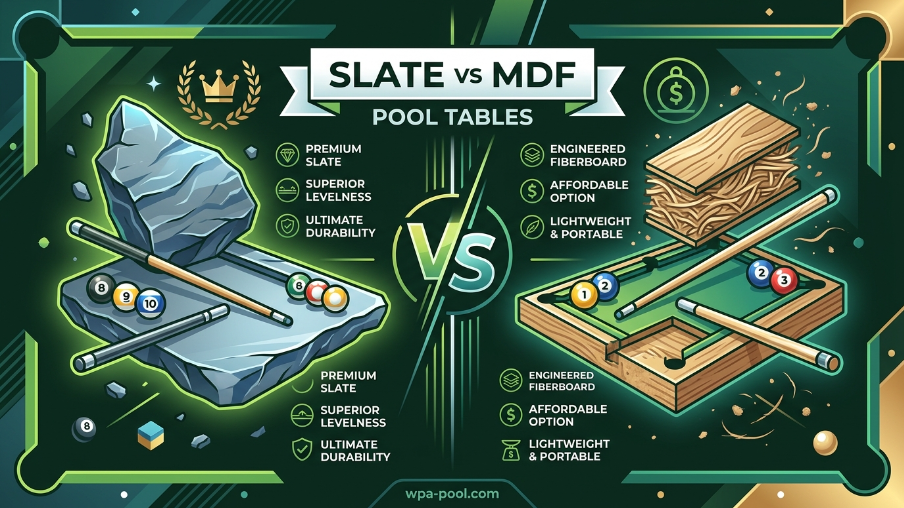
Choosing between slate vs MDF pool tables is the single most important decision you will make when buying a table for your home. The bed material determines everything from how the balls roll to how long your investment lasts. I have talked to dozens of players who bought the wrong type and regretted it within months.
Slate pool tables use natural stone that provides tournament-quality play and can last 50+ years. MDF pool tables use engineered wood composite that costs far less but comes with significant trade-offs in performance and durability. Your choice depends entirely on your budget, playing goals, and where you plan to put the table.
In this guide, I will break down the real differences between these materials based on actual player experiences and technical specifications. You will learn which type suits serious players, which works for casual family fun, and how to avoid the common mistakes that waste money.
Table of Contents
What is MDF (Medium-Density Fiberboard)?
MDF stands for Medium-Density Fiberboard, an engineered wood product made by compressing wood fibers with resin under heat and pressure. Manufacturers use it for pool table beds because it is cheap, consistent in thickness, and easy to machine.
Pool table MDF beds typically range from 15mm to 25mm thick. The material provides a flat surface when new, but it lacks the density and stability of natural stone. You will find MDF beds almost exclusively on tables priced under $1,500, often marketed as “portable” or “folding” options for home use.
The manufacturing process creates a uniform material without grain patterns, which sounds good in theory. However, MDF absorbs moisture from the air, swells when humid, and can sag under its own weight over time. These properties make it fundamentally different from slate in ways that directly affect your playing experience.
What is Slate?
Slate is natural metamorphic rock that forms under intense heat and pressure deep underground. For pool tables, manufacturers use slate mined from quarries in Brazil, China, Italy, and Wales. The material has been the standard for professional play for over a century.
Slate beds are mechanically honed to create perfectly flat playing surfaces. A typical slate bed measures 19mm to 25mm thick and weighs 400 to 600 pounds for a full-size table. Professional tables use either single-piece slate or three-piece sectional slate that installers seam together during assembly.
The density of slate makes it virtually immune to humidity changes and temperature fluctuations. Once properly leveled, a slate table stays flat for decades. Professional players rely on slate because it provides the only surface that delivers truly consistent ball roll and predictable cushion response.
Slate vs MDF Pool Tables: Key Differences
Playing Surface and Ball Roll
Slate provides a true, consistent roll that serious players demand. The stone surface does not flex or compress, so balls travel in perfectly straight lines at predictable speeds. When you strike a ball on slate, it goes exactly where physics says it should.
MDF surfaces create subtle irregularities that affect ball movement. The material can develop slight waves or soft spots over time. Players often describe balls “wandering” or rolling inconsistently on MDF tables, especially as the bed ages and sags.
Cushion response differs significantly between the materials too. Slate beds transfer energy efficiently to the rubber cushions, giving you that crisp bounce you see in professional tournaments. MDF absorbs some impact energy, resulting in softer, less predictable rebounds.
Durability and Longevity
A quality slate pool table lasts 50 years or more with proper care. Many families pass slate tables down through generations. The stone does not warp, sag, or degrade under normal conditions. If the cloth wears out, you simply replace it and keep playing on the same perfect surface.
MDF tables typically show significant wear within 2 to 5 years. The bed material sags in the center where the weight concentrates, creating a subtle valley that ruins ball roll. According to forum discussions from real owners, MDF tables warp faster in humid environments, sometimes within just 12 months.
As one experienced player noted in a billiards forum: “MDF quickly starts to sag, no matter what. Slate is way, way less sensitive to temperature and humidity changes.” This matches what I have heard from dozens of players who upgraded from MDF to slate.
Weight and Portability
Slate tables weigh between 700 and 1,000 pounds for a standard 8-foot model. The bed alone accounts for 400 to 600 pounds. This extreme weight creates challenges for installation and moving, but it also means the table stays rock-solid during play.
MDF tables typically weigh 200 to 400 pounds total. Many models feature folding legs and detachable parts for easier transport. This lighter weight makes MDF practical for apartments, upper floors, or situations where you might need to move the table occasionally.
The weight difference affects floor loading too. A slate table may require structural reinforcement on upper floors, while MDF tables work in most residential spaces without special preparation.
Installation Requirements
Slate tables require professional installation. The slate bed comes in pieces that must be leveled to within thousandths of an inch using specialized shims and tools. DIY installation almost always results in an uneven playing surface that ruins the table’s performance.
Professional installation for slate typically costs $300 to $600 depending on your location and table size. Installers spend hours ensuring the slate is perfectly flat before stretching the cloth. This expense adds to the upfront cost but is absolutely necessary.
MDF tables often ship with DIY-friendly assembly. The lighter bed pieces bolt together without precision leveling. You can set up most MDF tables in a few hours with basic tools. However, the easier installation comes at the cost of playing quality.
Maintenance Needs
Both table types need regular cloth brushing and occasional cleaning. The real maintenance difference comes with longevity and repairability. Slate tables may need cloth replacement every 5 to 10 years depending on use, but the bed itself requires no maintenance.
MDF tables present a problem when they wear out. You cannot repair a warped or sagging MDF bed. Once the surface deteriorates, you must replace the entire table. As one forum user bluntly stated: “Slate tables are designed to be repaired; MDF designed to be thrown away.”
Cost Comparison
MDF pool tables typically cost $500 to $1,500 depending on size and features. Entry-level 7-foot models start around $500, while larger tables with better cushions might reach $1,200. This low upfront cost makes MDF attractive for budget-conscious buyers.
Slate tables start around $1,800 for basic models and can exceed $5,000 for premium options. Professional-grade tournament tables may cost $10,000 or more. You must also budget $300 to $600 for professional installation.
The long-term cost analysis favors slate for serious players. A $2,500 slate table used for 30 years costs about $83 per year. A $1,000 MDF table replaced every 5 years costs $200 per year over the same period. Slate represents better value if you plan to play regularly for years.
MDF vs Slate Pool Table Comparison
| Feature | MDF Pool Tables | Slate Pool Tables |
|---|---|---|
| Bed Material | Engineered wood composite | Natural stone |
| Typical Weight | 200-400 lbs | 700-1,000 lbs |
| Price Range | $500-$1,500 | $1,800-$10,000+ |
| Ball Roll Quality | Inconsistent | True and consistent |
| Expected Lifespan | 2-5 years | 50+ years |
| Humidity Resistance | Poor – warps easily | Excellent |
| Installation | DIY possible | Professional required |
| Repairability | Not repairable | Fully repairable |
| Best For | Casual/family play | Serious players |
MDF Pool Table Pros
- Affordable: Entry-level pricing makes pool accessible to more families
- Lightweight: Easier to move and install without professional help
- Upper-floor friendly: Works in apartments and rooms that cannot support heavy loads
- DIY assembly: Most tables can be set up in a few hours with basic tools
- Good enough for casual play: Kids and occasional players may not notice the quality difference
MDF Pool Table Cons
- Warping and sagging: Surface deteriorates within 2-5 years, often faster in humid climates
- Poor ball roll: Balls do not travel straight or at consistent speeds
- Not repairable: Once the bed fails, the table becomes unusable
- Limited skill development: Playing on MDF does not prepare you for slate tables
- Lower resale value: Hard to sell used MDF tables due to known durability issues
Slate Pool Table Pros
- Tournament-quality play: True ball roll and consistent cushion response
- Lifetime durability: Lasts 50+ years with basic maintenance
- Repairable: Cloth, cushions, and pockets can be replaced; the bed lasts forever
- Skill development: Playing on slate prepares you for any competitive environment
- Humidity resistant: Unaffected by normal temperature and moisture changes
- Resale value: Quality slate tables hold value and remain desirable used
Slate Pool Table Cons
- High upfront cost: $1,800 minimum plus installation expenses
- Extremely heavy: 700-1,000 pounds makes moving difficult
- Professional installation required: DIY setup will ruin the playing surface
- Floor load concerns: May need structural reinforcement on upper floors
- Permanent placement: Moving a slate table requires disassembly and re-leveling
Which Should You Choose?
Choose MDF If:
- Your budget is under $1,000
- You want casual family entertainment, not serious practice
- You live in an apartment or upper floor with weight restrictions
- You might need to move the table within a few years
- You are unsure how much you will actually play
Choose Slate If:
- You plan to play regularly and want to improve your skills
- You view this as a long-term investment
- You have a dedicated game room or basement space
- You want tournament-quality play at home
- You can afford $2,000+ plus professional installation
Environment-Specific Recommendations
Basement installations favor slate. The concrete slab handles the weight easily, humidity tends to be stable, and you likely want a permanent setup. A slate table in a basement essentially becomes a permanent fixture that adds value to your home.
Apartments and upper floors often require MDF due to weight restrictions. However, check your floor load capacity first. Some modern construction can handle slate if the table sits near a load-bearing wall. If you choose MDF for an apartment, plan for replacement rather than permanence.
Garages and unfinished spaces present challenges for both types. Temperature swings and humidity wreck MDF quickly. Slate handles the conditions better but still needs climate control to protect the cloth and wood components. If you must put a table in a garage, invest in climate control or choose a very cheap MDF table you do not mind replacing.
Before finalizing your choice, review regulation pool table dimensions to ensure your space can accommodate the size you want, regardless of bed material.
Skill Transfer: Will Your MDF Experience Help on Slate?
This question comes up constantly in pool forums, and the honest answer is both yes and no. Basic mechanics like stance, bridge, and stroke translate between any table. However, shot prediction and speed control require significant adjustment when switching from MDF to slate.
On MDF, you learn to compensate for irregular ball roll and soft cushions. Your brain unconsciously adjusts for the table’s quirks. When you switch to slate, those compensations become errors. Balls travel farther and straighter than your MDF-trained instincts expect.
As one competitive player explained in a Reddit discussion: “MDF skills will not directly transfer. You will need to relearn speed control and bank angles.” Another player put it more bluntly: “I would rather play on a 4-foot slate than a 9-foot MDF.”
If your goal is competitive play or league participation, skip the MDF phase entirely. Starting on slate develops correct instincts from day one. The money saved buying MDF first becomes wasted when you must unlearn bad habits and adjust to real playing conditions.
Frequently Asked Questions
Is MDF board better than slate for pool?
No, slate is superior for pool in every performance metric. Slate provides true ball roll, consistent cushion response, and lasts decades. MDF is only better for budget-conscious buyers who need a lightweight table for casual play and accept the trade-offs in quality and durability.
Is an MDF pool table worth it?
An MDF pool table is worth it if you have a budget under $1,000, need a lightweight table for an upper floor, or want casual family entertainment without serious practice goals. However, serious players should invest in slate because MDF warps within 2-5 years and provides inferior ball roll that hinders skill development.
Are pub pool tables slate or MDF?
Commercial pub and bar pool tables almost always use slate. The heavy use in commercial environments demands the durability and consistent play that only slate provides. MDF tables cannot withstand constant daily play and would require frequent replacement, making them uneconomical for business use.
What is the best material for a pool table?
Slate is the best material for a pool table playing surface. Natural stone slate provides the only surface that delivers tournament-quality ball roll, consistent cushion response, and decades of durability. All professional tournaments and serious players use slate exclusively.
How long do MDF pool tables last?
MDF pool tables typically last 2 to 5 years before showing significant wear. In humid environments, warping and sagging may appear within 12 to 24 months. Once the MDF bed deteriorates, the table cannot be repaired and must be replaced entirely.
Can you move a slate pool table upstairs?
Moving a slate pool table upstairs is possible but requires professional movers. The slate bed must be disassembled into sections, carefully transported, then re-leveled at the new location. Never attempt to move an assembled slate table upstairs, as the weight creates serious injury and damage risks.
Final Thoughts on Slate vs MDF Pool Tables
The choice between slate vs MDF pool tables ultimately comes down to your priorities. If you want the best playing experience, long-term value, and a table that could last your lifetime, slate is the only option worth considering. The upfront investment pays off through decades of true, consistent play.
If budget constraints or living situation make slate impossible, MDF provides a serviceable entry point into the game. Just go in with realistic expectations. Plan for replacement within a few years, do not expect professional-quality play, and understand that skills developed on MDF will need adjustment when you eventually upgrade to slate.
Before making your final decision, measure your space carefully and review the regulation pool table dimensions to ensure your chosen table fits properly. The right bed material combined with the right size creates the foundation for years of enjoyment.