
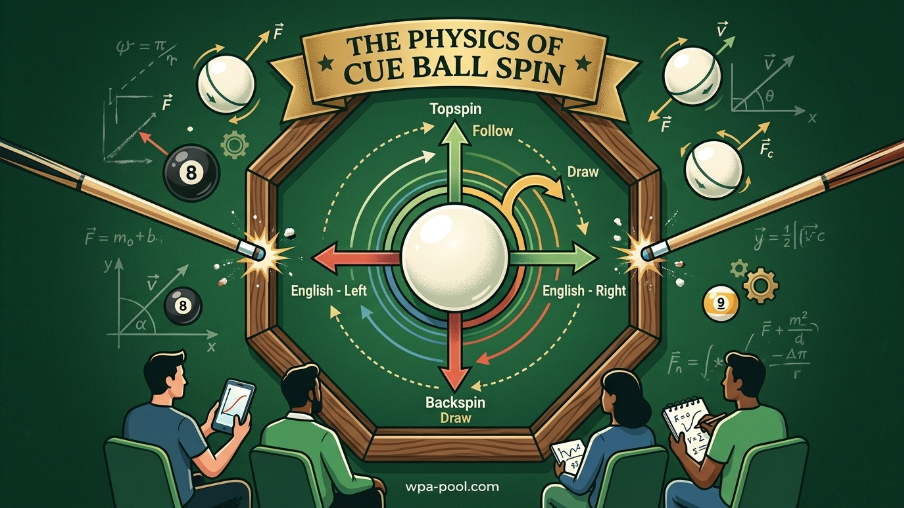
When you strike a cue ball off-center, something fascinating happens. The ball doesn’t just move forward. It begins to rotate, and that rotation fundamentally changes everything about its journey across the table. This is the physics of cue ball spin at work – a concept that separates beginners from skilled players.
In pool, we call this applied rotation “English” (or sometimes “side” in snooker). Understanding how spin works transforms your game from guesswork into calculated precision. After 15 years of playing and studying these mechanics, I can tell you that spin control is the single most important skill for positional play.
This guide breaks down exactly what happens when you apply spin, why the cue ball behaves the way it does, and how to use these physics principles to your advantage. Whether you are struggling with draw shots or trying to understand why your cue ball curves unexpectedly, the answers lie in the physics.
Table of Contents
What Is Cue Ball Spin (English)?
English is the rotational force imparted to the cue ball when you strike it anywhere other than its vertical center axis. When you hit the cue ball dead center, it slides across the cloth without rotation. Strike above, below, or to either side of center, and you create angular velocity – the ball begins to spin.
The term “English” comes from the British players who popularized sidespin techniques in the 2026s. Today, it refers to any intentionally applied spin: topspin (follow), backspin (draw), left English, or right English. Each type produces distinct effects on the cue ball’s trajectory, its interaction with object balls, and how it responds off cushions.
The physics is straightforward at the moment of contact. Your cue tip strikes the ball at a specific point. The friction between the leather tip and the phenolic resin ball surface creates torque – a twisting force that generates spin. The farther from center you strike, the more spin you impart, up to the physical limits of miscuing.
Types of Cue Ball Spin
Pool players work with three fundamental spin types. Each creates different rotational axes and produces unique effects on ball behavior. Mastering when to use each type is essential for advanced position play.
Topspin (Follow)
Topspin occurs when you strike the cue ball above its horizontal centerline. The ball rotates forward in the direction of travel, creating what players call a “follow” shot. This forward rotation fundamentally changes how the ball interacts with the table surface.
When a cue ball with topspin makes contact with an object ball, it continues moving forward after the collision. The forward rotation causes the cue ball to “follow” the object ball’s path rather than stopping or reversing. This is invaluable for gaining position when you need to move the cue ball forward after contact.
The physics behind topspin involves friction between the spinning ball and the cloth. As the ball rolls, the contact point with the cloth moves backward relative to the ball’s center. This creates a forward frictional force that actually helps maintain the ball’s momentum. A ball with natural roll – where the rotational speed matches the forward speed – experiences minimal sliding friction and rolls efficiently.
Backspin (Draw)
Backspin, or “draw,” happens when you strike below the cue ball’s center. The ball rotates backward against its direction of travel. This reverse spin creates dramatically different behavior both during travel and after object ball contact.
A cue ball with backspin initially slides across the cloth while spinning backward. The friction between the spinning surface and the cloth actually accelerates the backward spin while slowing the forward motion. Eventually, if the ball travels far enough, friction will convert all the backspin into forward roll. But before that happens, striking an object ball causes the cue ball to reverse direction – it “draws” back toward you.
From a physics perspective, backspin requires more energy to maintain over distance. The cloth friction works against the spin direction, causing the angular velocity to decay faster than with topspin. This explains why draw shots over long distances require harder strokes – you need to impart enough initial spin to survive the journey while still having reverse rotation at impact.
Humidity and cloth condition significantly affect backspin retention. On humid days or with worn cloth, the increased friction causes spin to dissipate faster. Experienced players adjust their stroke power accordingly, hitting harder to ensure the spin reaches the target.
Sidespin (English)
Sidespin occurs when you strike to the left or right of the cue ball’s vertical centerline. The ball rotates around a horizontal axis perpendicular to its direction of travel. Left English spins the ball counter-clockwise (from above); right English spins it clockwise.
Sidespin produces some of the most complex effects in pool. It influences the cue ball’s path during travel (swerve), changes how it deflects from cues (squirt), alters object ball trajectories (throw), and dramatically affects cushion bounces. Mastering sidespin separates intermediate players from advanced ones.
Inside English means striking on the side of the cue ball facing the cut direction – toward the object ball on cut shots. Outside English means striking on the opposite side, away from the cut direction. Running English refers to sidespin that matches the direction the ball will travel after hitting a cushion. Check English is the opposite – spin that fights against the natural cushion rebound direction.
Inside English increases the cut angle and can cause the object ball to throw in the direction of the spin. Outside English reduces the effective cut angle and can decrease throw or even reverse it. Understanding these interactions allows players to make thin cuts that seem impossible with a center-ball hit.
The Physics of Cue Ball Spin: How Spin is Generated
The physics of cue ball spin begins at the moment of contact between cue tip and ball. This brief interaction – lasting only about 2 milliseconds – determines everything that follows. Understanding this contact mechanics explains why spin behaves the way it does.
When your cue tip strikes the cue ball off-center, it creates both linear momentum (forward motion) and angular momentum (rotation). The relationship between these two forces determines the ball’s initial sliding versus rolling behavior. A center hit produces pure linear momentum with zero angular momentum – the ball slides without rotation.
An off-center hit generates torque because the impact force acts at a distance from the ball’s center of mass. This torque creates angular velocity – the rate at which the ball spins. The farther from center you strike, the greater the torque and the more spin you generate. Strike too far from center, and the tip slides off the ball surface, producing a miscue.
The friction coefficient between your cue tip and the ball surface matters enormously. A well-chalked tip with good leather condition creates higher friction, allowing cleaner transfer of spin. A poorly maintained tip or insufficient chalk leads to miscues even with moderate offsets.
Stroke speed also affects spin generation. Faster strokes impart more spin because the cue ball compresses deeper into the tip, increasing the contact area and friction duration. However, there are diminishing returns – extremely hard strokes don’t proportionally increase spin because the contact time remains limited by the ball’s elasticity.
Friction and Cloth Interaction
Once the cue ball leaves your tip, the table cloth becomes the dominant physics factor. The wool-nylon blend of pool cloth creates friction that fundamentally determines how spin affects ball behavior. This friction has two components: sliding friction and rolling friction.
Sliding friction occurs when the ball skids across the cloth surface without rolling. A freshly struck cue ball with heavy backspin slides while spinning backward – the contact point moves forward relative to the cloth, creating forward friction that slows the ball while increasing spin. A ball with topspin slides initially until friction converts the sliding motion into pure rolling.
The friction coefficient of pool cloth typically ranges from 0.15 to 0.25 depending on nap length, humidity, and wear. New, nappy cloth has higher friction. Worn, slick cloth has lower friction. This coefficient determines how quickly sliding converts to rolling and how fast spin dissipates.
Angular velocity decays over distance because friction continuously works against the spin. Backspin decays faster than topspin because the friction at the contact point acts in the same direction as the ball’s travel for backspin, increasing the relative motion. For topspin, the friction opposes travel, partially canceling relative motion and preserving spin longer.
The cloth “grabs” the ball surface, creating a torque that either accelerates or decelerates the spin depending on the spin direction and ball motion. This grabbing effect is why you can see a cue ball suddenly “take” to spin after sliding – the friction finally establishes rolling contact and the ball transitions from sliding to rolling motion.
The Magnus Effect in Pool
The Magnus effect explains how spinning objects experience forces perpendicular to their direction of travel. In pool, this effect is subtle but real – a spinning cue ball experiences slight lateral forces from air resistance differences across its surface.
For sidespin, the Magnus effect contributes to swerve – the curved path a cue ball takes when traveling with English. The spinning surface creates different airflow speeds on opposite sides of the ball. The side spinning into the air creates higher pressure; the side spinning with the air creates lower pressure. This pressure differential pushes the ball sideways.
However, in pool the Magnus effect is secondary to cloth-induced forces. The friction between ball and cloth creates much stronger lateral forces than air pressure differences. The Magnus effect becomes more noticeable at higher ball speeds and on very slick cloth where cloth friction is reduced.
How to Apply Spin: Cue Tip Positioning and Technique
Applying spin consistently requires understanding where to strike the cue ball and how your stroke mechanics affect the outcome. After analyzing thousands of shots, I have found that most spin problems stem from inconsistent tip placement rather than stroke power.
Center vs Offset Hits
The cue ball is 2.25 inches in diameter. Its geometric center sits at the midpoint of this sphere. To apply spin, you must strike away from this center point in specific directions.
For topspin (follow), strike above center – typically 1 to 1.5 cue tip widths above the equator. The farther above center, the more topspin you generate. However, striking too high causes the cue to slide over the ball rather than gripping it – this produces a miscue.
For backspin (draw), strike below center – again about 1 to 1.5 tip widths below the equator. Maximum practical draw is limited by the same miscue risk. You cannot strike through the table, so there is a physical limit to how much backspin you can apply.
For sidespin (English), strike to the left or right of the vertical centerline. Left English means striking the left side; right English means striking the right side. The horizontal offset follows the same pattern – about 1 to 1.5 tip widths for moderate English, approaching the miscue limit for maximum sidespin.
Combinations are common and powerful. You can strike high-and-left for follow with left English, or low-and-right for draw with right English. These combination spins produce compound effects on ball behavior and are essential for advanced position play.
Cue Elevation and Its Effects
Cue elevation – how much you raise the butt of your cue above the playing surface – dramatically affects spin physics. Most players learn to keep the cue as level as possible, but understanding elevation effects opens advanced techniques.
When you elevate the cue butt and strike down on the cue ball, you create a force vector with a vertical component. This downward force increases the normal force between ball and cloth, temporarily increasing friction at the contact point. The result is called “masse” – a pronounced curve in the cue ball’s path.
Even subtle elevation affects trajectory. When applying sidespin with an elevated cue, the downward component of your stroke combines with the sidespin to create immediate curve. The ball begins curving toward the spin direction immediately after contact, rather than traveling straight initially.
Practical limits exist. Elevating more than 15-20 degrees makes accurate contact difficult and increases miscue risk. Professional players use elevation deliberately for masse shots or to enhance swerve, but for standard spin shots, keeping the cue within 5 degrees of horizontal provides the most consistent results.
Stroke Speed and Spin Amount
Faster strokes generate more spin, but the relationship is not linear. Understanding this helps you match stroke speed to your spin requirements.
At slow speeds, the cue ball compresses less into the cue tip. The brief contact time limits how much spin transfers. At medium speeds, compression increases and friction acts longer, producing more spin per unit of offset. At high speeds, while contact force increases, the contact duration stays relatively constant due to the ball’s elasticity.
This means you get diminishing returns on very hard strokes. A stroke twice as fast does not produce twice the spin. However, harder strokes do impart more linear momentum, so the ball travels farther while maintaining the spin. This is crucial for long draw shots – you need enough forward speed to reach the object ball while maintaining backspin throughout the journey.
Spin retention over distance follows predictable physics. Backspin on a 6-foot draw shot requires significantly more initial spin than backspin on a 1-foot draw shot. The cloth friction continuously works against the spin. For every foot of travel, you lose a percentage of your angular velocity.
Advanced Spin Effects: Squirt, Swerve, Throw, and More
Once you understand basic spin types, you encounter compound effects that make pool physics truly fascinating. These advanced phenomena explain why cue balls sometimes behave unexpectedly and how professionals execute seemingly impossible shots.
Squirt (Cue Ball Deflection)
Squirt, also called deflection, is the immediate sideways movement of the cue ball when struck with English. When you apply sidespin, the cue ball does not travel in the direction your cue points. It squirts away from the spin direction.
The physics is straightforward. When you strike off-center, the cue tip pushes the ball sideways during contact. For right English, the tip pushes the ball to the left during the brief contact period. The ball leaves the cue traveling at an angle away from the spin side.
Squirt angle depends on several factors. More offset creates more squirt. Softer tips squirt less than hard tips because they deform more during contact, reducing the sideways push. Lighter cues generally produce less squirt than heavy cues because the cue itself deflects more during impact.
Low-deflection shafts are designed specifically to minimize squirt. These shafts use lightweight front ends and special construction techniques that allow the shaft to flex away from the ball during contact, reducing sideways push. Professional players often prefer low-deflection cues for precise spin shots.
Swerve: The Curved Path
Swerve is the gradual curve a cue ball takes when traveling with sidespin. Unlike squirt, which happens instantly at contact, swerve develops over time as the ball travels. The curve bends toward the spin direction – opposite to the initial squirt.
Swerve occurs because the spinning ball interacts with the cloth. A ball with right English rotates clockwise (viewed from above). At the contact point with the cloth, the ball surface moves leftward relative to the cloth. The friction at this point pushes the ball rightward, creating a curve in that direction.
Several factors affect swerve amount. Cloth condition matters significantly – nappy cloth creates more friction and more swerve than slick cloth. Ball speed matters too – slower balls experience more swerve because they spend more time on the cloth while spinning. Cue elevation increases swerve because the downward stroke component increases cloth friction immediately after contact.
On a typical sidespin shot over 4-6 feet, swerve can curve the cue ball 2-6 inches from a straight path. This explains why players sometimes miss shots they aimed perfectly – they did not account for the curve.
Squerve: Squirt + Swerve Combined
Squerve describes the combined effect of squirt and swerve acting together. The cue ball first squirts one way, then curves back the other way. The net result depends on which effect dominates.
On soft shots with maximum English, swerve often dominates. The ball curves significantly toward the spin direction, potentially ending up on the opposite side of the aim line from where squirt initially sent it. On hard shots with moderate English, squirt may dominate, leaving the ball on the squirt side of the aim line.
There exists a “squirt-canceling speed” for each amount of English – a specific stroke speed where squirt and swerve exactly cancel. At this speed, the cue ball travels straight despite the sidespin. Finding this speed through practice allows you to play with English while aiming as if hitting center ball.
Throw Effect on Object Balls
Throw is the sideways displacement of an object ball caused by friction during contact with a spinning cue ball. When the cue ball transfers some of its spin to the object ball at impact, that spin pushes the object ball off its expected path.
Cut-induced throw occurs on all cut shots, even without English. The cue ball slides across the object ball surface during contact, creating friction that throws the object ball toward the cue ball’s path. Thin cuts produce more throw than thick cuts because the contact duration is longer.
Spin-induced throw adds to this effect. Outside English – striking the side away from the cut – can reduce or even eliminate throw by making the cue ball’s surface move with the object ball at contact. Inside English – striking toward the cut – increases throw significantly.
Throw amounts vary from nearly zero to over 5 degrees depending on cut angle and spin. On a thin cut with heavy inside English, the object ball can throw so much that it banks off a nearby cushion unexpectedly. Understanding throw allows you to make shots that geometry says are impossible – by throwing the object ball into the pocket.
Cushion Interactions
English dramatically changes how the cue ball responds off cushions. A spinning ball hitting a rubber rail behaves very differently from a sliding or rolling ball.
Running English means the cue ball hits the cushion with spin that helps it “run” along the rail after contact. For a ball hitting the left rail, left English is running English. The spin causes the ball to bounce off at a shallower angle and retain more speed along the rail direction.
Check English is the opposite – spin that fights against the natural rebound. For a ball hitting the left rail, right English is check English. The spin causes the ball to bounce off at a steeper angle, slowing its progress along the rail. Check English is invaluable for controlling speed on multi-rail position routes.
The 30-degree rule states that a rolling cue ball deflects approximately 30 degrees from its approach angle when hitting a cushion. With English, this angle changes significantly. Running English might reduce the angle to 20 degrees; check English might increase it to 45 degrees. Professional players use these variations to create precise position routes that would be impossible with center-ball hits.
Practical Tips and Rules of Thumb
After years of experimenting with spin techniques and observing what works consistently, here are practical guidelines that will accelerate your spin mastery.
Keep your cue as level as possible for consistent spin. Elevation introduces swerve variables that make prediction difficult. A level cue minimizes unintended curve and makes your spin effects more repeatable.
Match stroke speed to distance. Longer shots need harder strokes to maintain spin all the way to the object ball. Backspin over 6 feet requires significantly more power than backspin over 1 foot. Practice finding the minimum speed needed for each distance.
Account for humidity and cloth condition. On humid days, expect spin to dissipate faster. On new, nappy cloth, expect more swerve and faster spin decay. Adjust your stroke power and aim compensation accordingly. I typically add 10-15% power on humid days for draw shots.
Use minimal spin when possible. Excessive English introduces complications – squirt, swerve, throw – that make prediction harder. The best players use just enough spin to achieve their position goal, not maximum spin on every shot. Control beats flashiness.
Practice the squirt-canceling speed for your common English amounts. Find the stroke speed where squirt and swerve balance for your typical left and right English. This becomes your default speed for those spins, allowing you to aim naturally while still getting spin effects.
Understand that inside English increases throw while outside English can reduce it. When you need to cut a ball thin but the angle seems impossible, try outside English to reduce throw and effectively widen the pocket. When you need to throw a ball into a pocket that geometry denies, use inside English.
Learn to read the cloth. Fast, slick cloth produces less swerve but also less spin retention. Slow, nappy cloth produces more swerve but better spin maintenance over distance. Spend a few minutes testing spin behavior before serious play on unfamiliar tables.
Frequently Asked Questions
How does spin on cue ball work?
Spin on the cue ball works through friction between the cue tip and ball at contact. When you strike off-center, the friction creates torque that generates angular velocity – rotation. This spin interacts with the cloth during travel, affecting the ball’s path (swerve), its deflection at impact (squirt), and how it affects object balls (throw). The physics involves converting linear motion into rotational force, then managing how that rotation interacts with surfaces throughout the shot.
What is the spinning ball effect in physics?
The spinning ball effect refers to how a rotating sphere experiences forces perpendicular to its direction of travel. In pool, this creates the Magnus effect – a spinning cue ball experiences slight lateral forces from air pressure differences. More significantly, cloth friction creates pronounced curve (swerve) when sidespin is applied. The spinning surface grips the cloth differently depending on rotation direction, creating lateral forces that bend the trajectory.
What is the 30 rule in pool?
The 30-degree rule states that a rolling cue ball deflects approximately 30 degrees from its approach angle when hitting a cushion. This rule helps players predict cue ball paths on bank shots and position play. With English, this angle changes – running English reduces the angle to about 20 degrees while check English increases it to around 45 degrees. The rule assumes the cue ball is rolling naturally without significant spin at rail contact.
Does English affect the object ball?
Yes, English significantly affects the object ball through a phenomenon called throw. When a spinning cue ball contacts an object ball, friction between the balls transfers some spin and pushes the object ball sideways from its expected path. Inside English increases throw, potentially moving the object ball several degrees off its geometric trajectory. Outside English can reduce or even reverse throw. This effect allows players to make shots that pure geometry would suggest are impossible.
How do I keep backspin over long distances?
To maintain backspin over long distances, you need to strike with more initial spin by hitting farther below center and using a harder stroke. The cloth friction continuously works against backspin, so longer shots require more power to ensure reverse rotation survives the journey. On a 6-foot draw shot, you typically need medium-hard speed. Also consider cloth condition – humid or nappy cloth increases friction and accelerates spin decay, requiring even more power.
Conclusion
The physics of cue ball spin transforms pool from a game of chance into a game of calculated precision. Understanding topspin, backspin, and sidespin gives you control over the cue ball’s journey. Mastering squirt, swerve, and throw lets you predict and manipulate ball behavior in ways that seem magical to untrained observers.
But knowledge alone is not enough. The physics only works when your execution is consistent. Practice striking the cue ball at precise points. Develop feel for how different stroke speeds affect spin retention. Learn to read cloth conditions and adjust accordingly. The best players make spin physics look effortless because they have internalized these principles through thousands of repetitions.
Start with the fundamentals – center-ball hits, then gentle follow and draw. Add sidespin gradually as your tip placement consistency improves. Study how the cue ball reacts on your home table. The physics never changes, but your understanding and execution will deepen with every session. Control the spin, and you control the table.