
Picture this: You walk into the bar with two friends, ready for some pool. But 8-ball needs two players, 9-ball works best one-on-one, and you have three people itching to play. That is where cutthroat pool saves the day.
I have played cutthroat pool hundreds of times over the past decade at local halls and friendly gatherings. It is hands-down the best solution when you have an odd number of players who all want in on the action. Learning how to play cutthroat pool takes about 10 minutes, but mastering the strategy keeps you coming back for years.
In this guide, I will walk you through everything you need to know. You will learn the basic rules, equipment requirements, ball group assignments, and proven strategies that help you win. Whether you are a complete beginner or looking to refine your game, this article has you covered.
Table of Contents
What is Cutthroat Pool
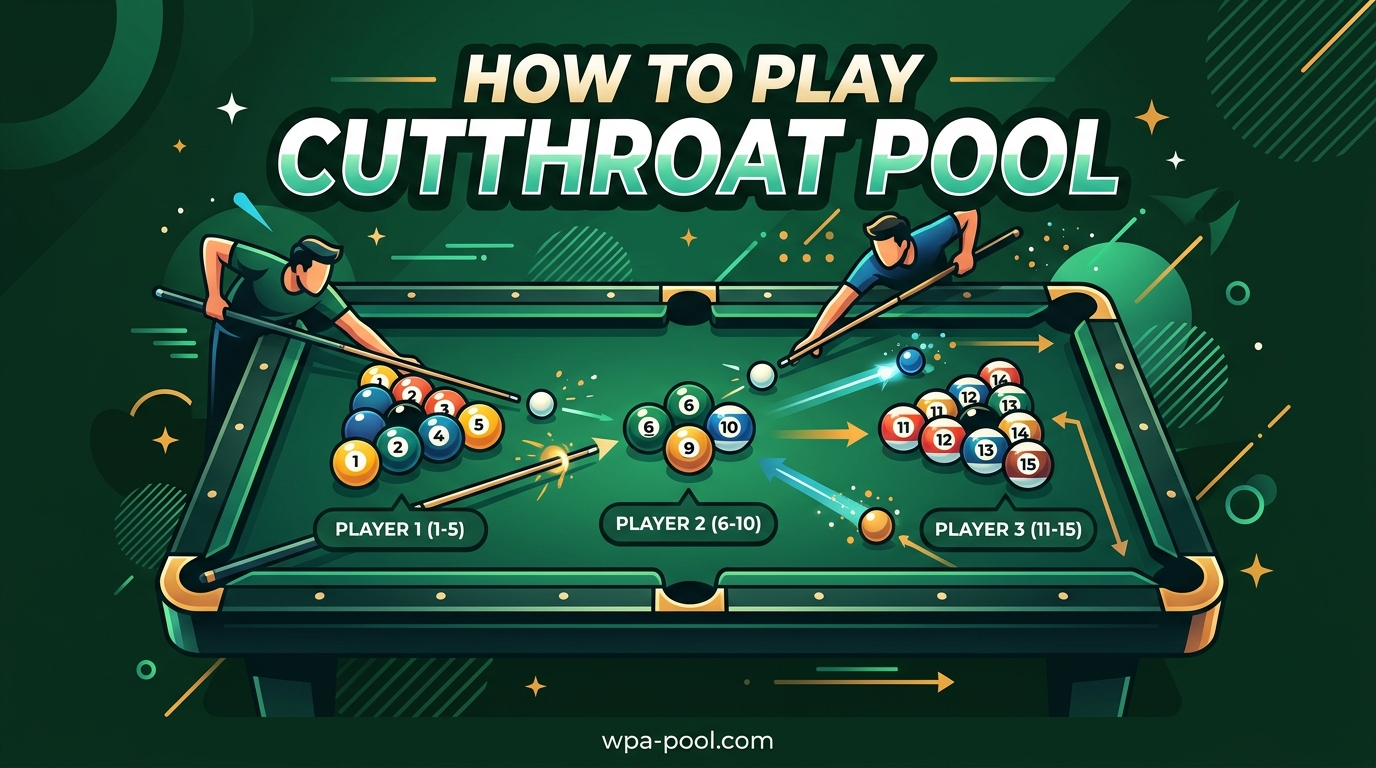
Cutthroat pool is a three-player pocket billiards game, also known as elimination pool or three-man-screw. Each player protects five balls while trying to pocket the other ten balls belonging to their opponents.
The game uses all fifteen object balls (numbered 1 through 15) plus the cue ball. Players divide into three groups: low balls (1-5), middle balls (6-10), and high balls (11-15). Your mission is simple. Pocket your opponents’ balls while keeping yours on the table. When you are the only player with balls remaining, you win.
Unlike 8-ball or 9-ball where you chase specific balls, cutthroat creates a unique dynamic. You play offense and defense simultaneously. Every shot requires thinking about which opponent to target and how to protect your own balls from the next shooter.
Equipment You Need
You do not need special equipment to play cutthroat pool. Any standard setup works perfectly.
The essentials include a regulation pool table (7-foot bar size, 8-foot standard, or 9-foot professional), fifteen object balls numbered 1-15, one cue ball, a triangle rack, and at least one cue stick per player. Chalk helps prevent miscues.
The game plays identically on any table size. I prefer 8-foot tables for cutthroat because they offer a good balance between making shots achievable and requiring genuine skill. Bar tables work fine for casual play, though the tighter pockets definitely increase the difficulty.
Ball Group Assignments
Before breaking, players need to know which balls belong to whom. There are three standard methods for assigning groups in cutthroat pool.
The Three Groups
The balls divide evenly into three sets. Low balls cover numbers 1 through 5. Middle balls include 6 through 10. High balls encompass 11 through 15. Each player owns one complete group of five balls.
Some players use the stripe/solid concept borrowed from 8-ball for easier visual tracking. Balls 1-5 are essentially solids, 6-10 are the middle group, and 11-15 work like stripes. Whatever system you choose, make sure everyone agrees before the first shot.
Method 1: Pre-Game Assignment
The simplest approach assigns groups before play begins. Player A takes 1-5, Player B gets 6-10, Player C claims 11-15. Everyone knows their targets from the start. This method works best for beginners because it eliminates confusion.
Method 2: Break-Based Claiming
After the break, groups assign based on what drops. If the breaker pockets a 3-ball, they own the low group (1-5). The player to their left typically gets the next group with a ball pocketed, and so on. If no balls drop on the break, use Method 1 instead.
Method 3: Random Selection
Some groups prefer complete randomness. Write numbers 1-3 on paper slips. Each player draws to determine group order: 1 gets lows, 2 gets middles, 3 gets highs. This adds a fun element of chance and prevents arguments about who gets which group.
How to Rack Cutthroat Pool
Setting up the rack for cutthroat follows standard pool conventions with one small twist.
Place the triangle rack at the foot of the table with the apex ball positioned on the foot spot. The 8-ball traditionally occupies the center position inside the rack. All other balls fill randomly around it. Unlike 8-ball, you do not need to alternate solids and stripes or place specific balls in corners.
Tighten the rack by pushing the balls forward together, then lift the triangle straight up without disturbing the formation. A tight rack ensures a fair break and prevents gaps that could affect ball movement.
The Break Shot
The break sets the entire game in motion. Here is how to execute a legal break in cutthroat pool.
Who Breaks First
Typically, players lag for the break or simply rotate each game. In casual play, the player who won the previous game often breaks next. For your first game, flip a coin or play rock-paper-scissors to decide.
Legal Break Requirements
A legal break requires the cue ball to strike the rack with sufficient force to drive at least four balls to the cushions or pocket at least one ball. The cue ball must not scratch into a pocket. If the break is illegal, the next player can accept the table as-is or request a re-rack and break themselves.
After the Break
Cutthroat uses an “open break” rule. The table remains open after the break, meaning no groups are officially assigned yet if you are using break-based claiming. The breaker continues shooting if they pocketed a ball legally. If not, play passes to the next player.
How to Play Cutthroat Pool: Basic Rules
Once groups are assigned and the break is complete, the real game begins. Here is the step-by-step process for how to play cutthroat pool.
Step 1: Identify Your Target Balls
Know exactly which five balls belong to each opponent. You want to pocket their balls while avoiding your own. I always take a mental snapshot at the start, noting where my balls sit on the table.
Step 2: Execute a Legal Shot
For a shot to be legal, the cue ball must first contact an opponent’s ball. You cannot hit your own ball first. After making contact, either the cue ball or any object ball must touch a cushion, or you must pocket a ball.
This rule creates interesting strategy. Sometimes your ball blocks the path to an opponent’s ball. You must find creative ways to reach their balls without hitting yours first, often using banks or combination shots.
Step 3: Continue Shooting After Pocketing
If you legally pocket an opponent’s ball, you keep shooting. There is no limit to how many balls you can run in a single turn. Professional players often clear three or four opponent balls in one inning, completely shifting the game’s balance.
Step 4: Pass the Turn
If you miss entirely, fail to hit an opponent’s ball first, or commit a foul, your turn ends. Play rotates to the next player in sequence (typically clockwise around the table).
Step 5: Elimination and Reinstatement
When all five of your balls get pocketed, you are eliminated from shooting. However, you can return to the game if an opponent commits a foul. One common house rule reinstates eliminated players when any foul occurs, giving them one ball back on the table. Official BCA rules vary, so confirm before playing.
Call-Shot vs Slop Rules
Cutthroat pool has two distinct rule styles: call-shot and slop. Understanding the difference prevents arguments mid-game.
| Rule Style | Description | Best For |
|---|---|---|
| Call-Shot (BCA Rules) | You must call the ball and pocket before shooting. Banks, combinations, and caroms must be declared. | Competitive play, tournaments, serious players |
| Slop (Casual Rules) | Any pocketed opponent ball counts, regardless of intent. No calling required. | Bar games, beginners, social situations |
I recommend call-shot rules for players with intermediate skill or higher. It rewards planning and shot-making ability. Slop works better for beginners or when you just want a relaxed social game without debates about what someone intended.
The official BCA cutthroat rules follow call-shot standards. If you are playing in a league or competitive setting, learn and use these rules. For casual Friday night games with friends, slop keeps things moving and fun.
Fouls and Penalties
Fouls in cutthroat pool carry specific penalties that can change the entire game. Here are the most common violations.
Hitting Your Own Ball First
The most frequent foul occurs when the cue ball contacts your own ball before touching an opponent’s ball. This is illegal because the game requires targeting opponents, not protecting yourself through blocking.
Scratching the Cue Ball
Pocketing the cue ball sends it “in the kitchen” (behind the head string). The next player gets ball-in-hand and can place the cue ball anywhere behind the head string for their shot. Some house rules give full ball-in-hand anywhere on the table.
No Ball Touches a Cushion
After the cue ball hits an object ball, something must touch a cushion. Either the cue ball, the contacted object ball, or any other ball must hit a rail. If nothing does, it is a foul.
Cue Ball Off the Table
Jumping the cue ball off the table surface counts as a foul. The opponent gets ball-in-hand. This often happens on aggressive break shots or when attempting difficult masse shots.
Scratching on Your Last Ball
Here is where forum discussions get heated. If you have only one ball left and scratch while pocketing it, most house rules treat this as a loss. Official BCA rules may differ. Always clarify this situation before the game starts to prevent arguments.
Ball-In-Hand After Fouls
After any foul, the incoming player gets ball-in-hand. Under strict rules, this means placing the cue ball anywhere behind the head string. Most casual games allow placement anywhere on the table, which speeds up play.
Winning the Game
Victory in cutthroat pool comes down to simple math. You win when you are the only player with one or more balls remaining on the table.
This can happen multiple ways. You might pocket the final opponent ball yourself. Another player might eliminate the third competitor, leaving just you two. Or opponents might foul each other into elimination while you sit safely with balls on the table.
The winning condition creates fascinating endgame scenarios. Sometimes you want to let another player eliminate the third opponent rather than doing it yourself. Other times you must aggressively run out before someone targets your last ball.
Cutthroat Pool Strategy Tips
After playing hundreds of cutthroat games at WPA Pool events and local halls, I have developed strategies that consistently improve winning percentages. Here is what works.
Protect Your Balls Early
Position your balls behind blockers or cluster them together. When balls touch each other, they are harder to pocket cleanly. I always look for ways to break up opponents’ groups while consolidating my own.
Target the Strongest Player
In cutthroat, you want the best player eliminated first. If you have a choice between pocketing a ball from the novice or the shark, take the shark’s ball every time. Leaving strong players alive late in the game usually means losing.
Leave Tough Angles for Opponents
When you cannot run out, focus on leaving the cue ball in difficult positions. Hide it behind your own balls or force long, thin cuts. Defensive positioning wins as many cutthroat games as offensive skill.
Watch the Ball Count
Constantly track how many balls each player has left. When someone drops to one or two balls, they become desperate. Use this knowledge to predict their targets and protect accordingly.
Master the Soft Break
Unlike 9-ball where you hammer the rack, cutthroat benefits from controlled breaks. A soft break keeps balls clustered, making it easier to protect your group while picking off opponents. I break at about 70% power, focusing on control over dispersion.
Know When to Play Defense
Not every shot needs to pocket a ball. Sometimes a safety that leaves the cue ball tucked behind your 4-ball is the winning play. Recognize when the risk of missing outweighs the reward of potting.
Cutthroat Pool Variations
The standard three-player game adapts well to different player counts and situations.
Four-Player Cutthroat
With four players, divide the fifteen balls into four groups. Three players get four balls each, and one player gets three balls. Alternatively, play in teams of two, where partners share ball groups and alternate shots.
Five-Player Cutthroat
Five players means three balls per person. This variation moves quickly since everyone has less to protect. Games typically end in just a few rotations around the table.
Team Cutthroat
Team variations work great for larger groups. Two teams of three players each can play with each team protecting a shared set of balls. Players on a team alternate turns, and the team with balls remaining wins.
Partnership Cutthroat
In this version, two players team up against the third. The solo player gets seven balls while the partnership shares eight balls (four each). This creates an interesting underdog dynamic where skill can overcome numbers.
Frequently Asked Questions
Is cutthroat pool good for beginners?
Yes, cutthroat pool is excellent for beginners. The rules are simpler than 8-ball or 9-ball, and beginners can win through defensive play and luck even against experienced players. The social nature of the game makes it less intimidating than head-to-head competition.
How to win a cutthroat pool?
To win cutthroat pool, be the last player with balls remaining on the table. Strategy involves pocketing opponents’ balls while protecting your own through defensive positioning and cluster creation. Target the strongest player first and use ball-in-hand opportunities wisely.
Can you hit your own ball first in cutthroat pool?
No, hitting your own ball first is a foul in cutthroat pool. The cue ball must contact an opponent’s ball before touching any other ball. This rule prevents players from simply hiding behind their own balls and forces offensive play.
How does cutthroat work?
Cutthroat pool works by dividing three players into groups of five balls each (1-5, 6-10, 11-15). Players take turns shooting at opponents’ balls while protecting their own. When you legally pocket an opponent’s ball, you continue shooting. The last player with balls on the table wins.
What happens if you scratch on your last ball?
Scratching on your last ball typically results in a loss under most house rules. Since your final ball left the table (either pocketed by the scratch or legally), you have no balls remaining. Some variations allow reinstatement if an opponent later commits a foul, but clarify this rule before starting.
How many players can play cutthroat pool?
Cutthroat pool traditionally plays with three players, but variations accommodate 4-5 players by adjusting ball distribution. Four-player games usually give three players four balls and one player three balls. Five-player games divide fifteen balls into three-ball groups for each player.
Conclusion
Learning how to play cutthroat pool opens up a world of fun when you have three players and only one table. The game combines strategic depth with social interaction in a way that 8-ball and 9-ball simply cannot match.
You now understand the basic rules, ball assignments, fouls, and winning conditions. You have learned the difference between call-shot and slop play, explored multiple group-claiming methods, and discovered proven strategies for protecting your balls while eliminating opponents.
Grab two friends, head to your local pool hall, and give cutthroat a try. Start with slop rules if you are new, then graduate to call-shot as your skills improve. Before long, you will find yourself choosing cutthroat over traditional games even when you have just two players available.
The next time someone asks how to play cutthroat pool, you will have the answer. Rack them up and enjoy the game.