
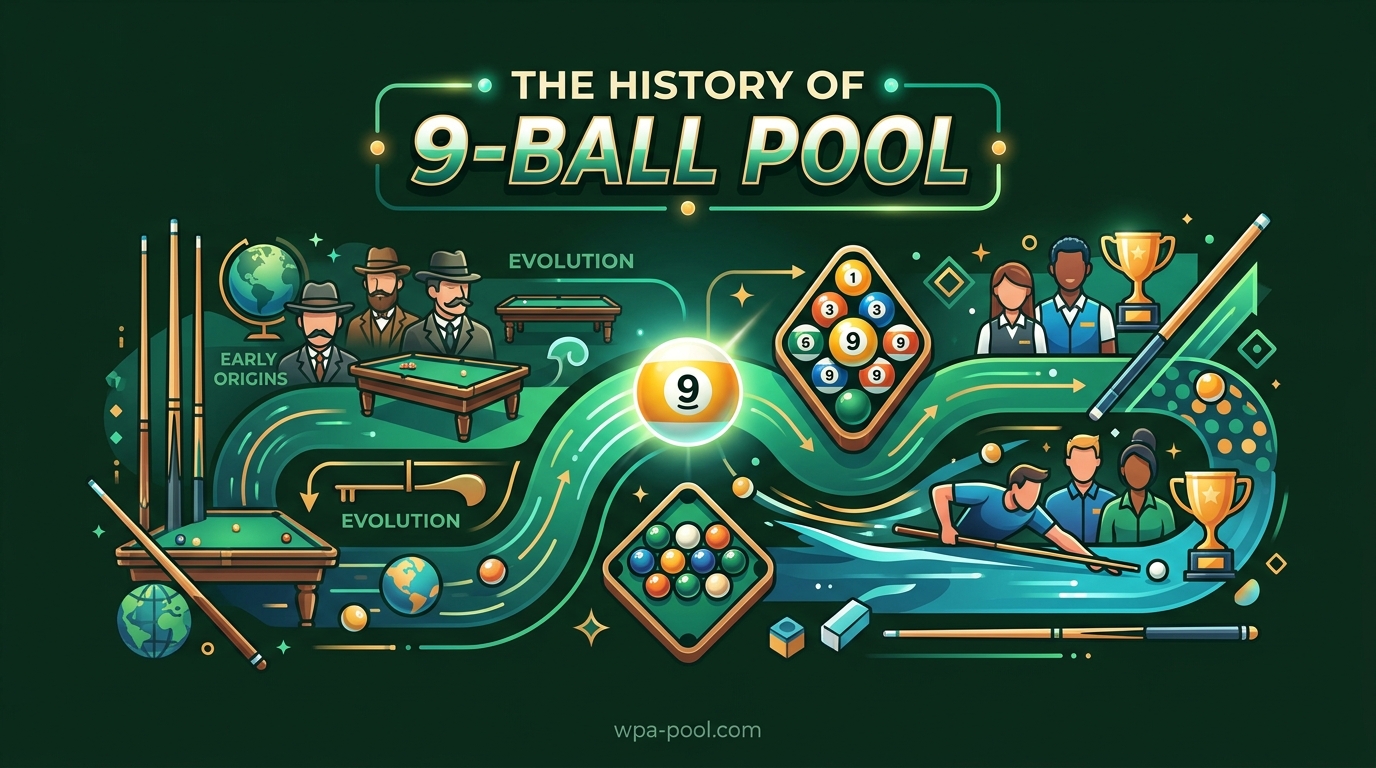
9-ball is one of the most widely played cue sports in the world. Fast-paced, strategic, and thrilling to watch, it has evolved from a casual barroom gambling game into a professional discipline with global championships and devoted fans.
When I started researching the history of 9-ball pool, I discovered a fascinating story. The game emerged in the United States during the 1920s, though its exact inventor remains unknown. What began as a regional American pastime eventually conquered pool halls worldwide and produced some of the most legendary players in billiards history.
In this article, I will walk you through the complete history of nine-ball. You will learn where it came from, how it dominated American bar culture, who the greatest players were, and why Asian competitors now rule the modern professional scene.
Table of Contents
Where Did 9-Ball Pool Come From? Origins in 1920s America
9-ball traces its origins to the United States in the 1920s. The game developed from existing rotation pool games, particularly fifteen-ball pool, which required players to pocket balls in numerical order.
Historians agree on the timeframe but not on the inventor. Unlike some sports with clear creation stories, 9-ball emerged organically from American pool hall culture. The reduced ball count made games faster, which appealed to gamblers who wanted quick action.
Some sources suggest the game developed in the Midwest or Southern United States, though concrete documentation remains scarce. The World Pool-Billiard Association later formalized rules, but the original creators never received official credit.
The basic concept was simple: nine object balls numbered 1 through 9, arranged in a diamond-shaped rack. Players struck a cue ball to hit the lowest-numbered ball on the table first, continuing until someone pocketed the 9-ball to win. This straightforward structure made it easy to learn but difficult to master.
The Bar and Pool Hall Era: Gambling and Hustling Culture
Through the mid-20th century, 9-ball remained primarily a gambling game in bars and pool halls across America. The fast pace allowed players to complete matches quickly, making it ideal for betting.
Pool halls became social hubs where players gathered to test their skills and wager money. The game’s structure encouraged what players call “hustling” — pretending to be a weaker player to lure opponents into bigger bets. A skilled hustler could appear to struggle through early racks before revealing true talent and taking an opponent’s cash.
The “money ball” concept added tension to every game. Since pocketing the 9-ball legally won immediately, even a trailing player had a chance until the final shot. This made 9-ball more exciting for spectators and gamblers than slower games like straight pool.
During this era, equipment was simple. Players used standard cue sticks and billiard tables with pockets at each corner and the middle of each long side. The diamond rack became the standard formation for arranging balls at the start of each game.
Willie Mosconi, perhaps the most famous pool player of the mid-20th century, reportedly disliked nine-ball. He preferred straight pool, which emphasized precision and control. His attitude reflected the divide between traditional billiards enthusiasts and the emerging gambling-focused 9-ball culture.
The Rise of Professional 9-Ball: Television and Tours
Professional 9-ball really took off in the 1980s. The Professional Billiard Tour brought structure, prize money, and television coverage to a game that had previously existed mainly in smoky barrooms.
Television changed everything. Networks discovered that 9-ball’s fast pace and clear winners made it perfect for broadcasting. Unlike slower pool disciplines that dragged on for hours, a 9-ball match could conclude in under an hour, fitting neatly into programming schedules.
The 1980s and 1990s produced the first true 9-ball superstars. Earl Strickland emerged as the dominant American player, known for his intense focus and competitive drive. Luther Lassiter, though primarily remembered for straight pool excellence, also competed in early 9-ball championships.
Tournament structures formalized during this period. The U.S. Open 9-Ball Championship, established in 1976, became the most prestigious American event. International competition grew as well, with players from the Philippines, Taiwan, and Europe challenging American dominance.
The World Pool-Billiard Association (WPA) provided global governance, standardizing rules and organizing world championships. This professionalization transformed 9-ball from a bar game into a legitimate sport with organized rankings, official referees, and substantial prize purses.
Who Is the Best 9-Ball Player of All Time? Legendary Players Who Defined the Game
Ask any billiards fan about the greatest 9-ball player, and you will spark passionate debate. Several names dominate any serious discussion.
Luther Lassiter dominated American pool in the 1960s. Though best known for straight pool, his cue ball control and competitive mindset influenced generations of 9-ball players. He won six world championships and set records that stood for decades.
Earl Strickland defined American 9-ball from the 1980s through the early 2000s. In 1996, he achieved what many consider the greatest single performance in 9-ball history: 11 consecutive break-and-runs in tournament play. This means he won 11 straight games without his opponent even getting a shot at the table. Strickland won five U.S. Open titles and became known for both his genius and his volatile temper.
Efren Reyes is widely considered the greatest all-around pool player ever. The Filipino legend earned nicknames like “The Magician” for his seemingly impossible shot-making. Reyes won countless championships across multiple disciplines, including the WPA World 9-Ball Championship. Forum discussions consistently rank him as the GOAT (Greatest of All Time).
Shane Van Boening represents modern American excellence. The South Dakota native has won five U.S. Open 9-Ball Championships and numerous international titles. His powerful break shot and tactical precision have made him the dominant American player of the 2010s and 2020s.
Jeanette Lee, known as “The Black Widow,” brought women’s 9-ball to mainstream attention. Though she never won a world championship, her charisma and competitive success helped elevate the women’s game during the 1990s and early 2000s.
Championships and International Rivalry: The Mosconi Cup and Beyond
Professional 9-ball features several major championships that define careers and create international rivalries.
The WPA World 9-Ball Championship represents the pinnacle of the sport. First held in 1990, this tournament brings together the world’s best players for a week of intense competition. Winners join an elite list that includes Reyes, Strickland, and recent champions from Asia and Europe.
The U.S. Open 9-Ball Championship stands as America’s most prestigious event. Held annually since 1976, it has crowned legends like Strickland, Johnny Archer, and Shane Van Boening. The tournament’s history mirrors the sport’s evolution from American dominance to international competition.
The Mosconi Cup creates the sport’s fiercest rivalry. This annual team event pits Europe against the United States in a Ryder Cup-style competition. Named after Willie Mosconi, the tournament began in 1994 and has grown into billiards’ most watched event. Europe has dominated recent competitions, reflecting the shift in global 9-ball power.
Regional tours and championships proliferated through the 1990s and 2000s. The Philippines developed a particularly strong 9-ball culture, producing multiple world champions and establishing itself as a powerhouse nation.
The Modern Era: Asian Dominance and Rule Evolution
The modern professional scene looks dramatically different from 9-ball’s American barroom origins. Asian players have dominated championship play since the early 2000s.
Filipino players led the initial wave. Beyond Efren Reyes, champions like Francisco Bustamante and Dennis Orcollo established the Philippines as a 9-ball superpower. Taiwanese players followed, with Ko Pin-yi and Chang Jung-lin winning major titles. Recently, Chinese players have emerged as serious contenders.
European competition strengthened significantly. Players like Niels Feijen, Nick van den Berg, and Joshua Filler have won world championships and helped Europe dominate the Mosconi Cup. Germany’s Fedor Gorst captured the WPA World Championship in 2019 and remains a top contender.
Rule changes have shaped modern play. The shot clock, requiring players to shoot within a time limit, eliminated slow play and made matches more exciting for television. Push-out rules evolved to balance offensive and defensive strategies. Breaking regulations changed repeatedly as players developed increasingly powerful break shots.
Television coverage expanded with dedicated billiards networks and streaming platforms. Fans can now watch professional tournaments from anywhere in the world, following their favorite players through multiple events each year.
Women’s 9-Ball and the Fight for Recognition
Women have played 9-ball since its earliest days, though their contributions received less attention than men’s achievements.
Jeanette Lee’s success in the 1990s brought women’s 9-ball mainstream visibility. Her aggressive playing style and magnetic personality attracted sponsors and media coverage. Allison Fisher, a British player who dominated women’s pool in the 1990s and 2000s, won numerous world championships across multiple disciplines.
The Women’s Professional Billiard Association (WPBA) organized dedicated tours and championships. Players like Karen Corr, Kelly Fisher, and more recently Jasmin Ouschan have built successful professional careers.
Despite progress, gender disparities persist. Prize money for women’s events typically trails men’s tournaments, and media coverage remains uneven. However, women’s 9-ball continues growing, with young players from Asia and Europe joining the professional ranks.
9-Ball in Popular Culture: From The Hustler to Modern Media
9-ball has appeared in films, television, and literature, often symbolizing skill, gambling, and the romanticized pool hall lifestyle.
“The Hustler” (1961) and its sequel “The Color of Money” (1986) shaped public perception of pool, though they focused more on straight pool and hustling culture than pure 9-ball competition. Paul Newman’s portrayal of Fast Eddie Felson introduced mainstream audiences to the intense world of competitive billiards.
Television coverage transformed 9-ball into a legitimate sport. ESPN broadcast major tournaments through the 1990s and 2000s, bringing players like Earl Strickland and Efren Reyes into American living rooms. Modern streaming platforms now offer continuous coverage of professional events.
Video games have introduced 9-ball to younger audiences. Titles like “Virtual Pool” and “Pool Nation” feature 9-ball modes that teach rules and strategy to players who may never visit a physical pool hall.
Frequently Asked Questions
Where did the 9-ball pool come from?
9-ball pool originated in the United States during the 1920s. It evolved from existing rotation pool games, particularly fifteen-ball pool, which required players to pocket balls in numerical order. While historians agree on the timeframe, the exact inventor remains unknown. The game emerged organically from American pool hall culture, particularly in the Midwest and Southern United States.
Who is the best 9-ball player of all time?
Efren Reyes of the Philippines is widely considered the greatest 9-ball player of all time. Nicknamed “The Magician,” Reyes won multiple world championships across several decades. Earl Strickland dominates the conversation for American players with five U.S. Open titles and a record 11 consecutive break-and-runs. Shane Van Boening represents modern American excellence with five U.S. Open championships since 2007.
What did Einstein say about billiards?
Albert Einstein reportedly said that billiards demonstrated the laws of physics in action. While the exact quote varies in different sources, he allegedly described the game as “physics applied to pleasure” or made similar observations about how the balls’ movements illustrated mathematical and physical principles. However, historians debate the authenticity of specific billiards-related quotes attributed to Einstein.
What is the hardest cue sport?
Many professionals consider three-cushion billiards the hardest cue sport. It requires players to hit their cue ball into three cushions before contacting the opponent’s balls, demanding extraordinary precision and spatial calculation. Snooker also ranks highly due to its large table, small pockets, and complex tactical requirements. While 9-ball requires skill, its straightforward rules make it more accessible than these technical disciplines.
Conclusion: The History of 9-Ball Pool Continues
The history of 9-ball pool reflects a remarkable journey from American barrooms to global professional sport. What began as a regional gambling game in the 1920s evolved into a worldwide phenomenon with millions of players and fans.
Each era produced legendary figures who defined excellence. Luther Lassiter established American dominance. Earl Strickland brought television-era intensity. Efren Reyes demonstrated that greatness transcends borders. Today’s stars like Fedor Gorst and Joshua Filler continue pushing the sport forward.
As I researched this article, I gained new appreciation for how a simple game — nine balls, one cue, a rectangular table — could capture global imagination. Whether you are a casual player shooting in a local bar or a fan watching the Mosconi Cup, you are participating in a tradition nearly a century old.
9-ball’s future looks bright. Asian dominance continues growing. Women’s professional play expands. Technology brings tournaments to new audiences worldwide. The game that emerged from American pool halls in the 1920s shows no signs of fading.